A 1998 Nevada Study Anchored Springfield Realtors' 2013 Casino Estimate. Later Studies Found Losses and Gains.

Independently fact-checked against primary sources (last audited November 10, 2026). · 5 primary sources cited on this page. How we verify our legal content
On Tuesday, July 2, 2013, the Realtor Association of Pioneer Valley released a study with a price tag on it. A casino in western Massachusetts, it said, would cost homeowners in the host community $1,650 to $3,300 each in lost value. Springfield was due to vote on MGM's casino in 14 days.
"For most people, it is their single biggest asset," said Brian P. Sears, the association's president and an owner of a Springfield real estate firm. "We don't have an opinion one way or the other. The data is the data." He said he wanted the report in voters' hands before the July 16 vote.
MGM answered the same day. "MGM Springfield is an urban gaming-resort proposal designed to do quite the opposite of what this study suggests," spokeswoman Carole Brennan wrote. Its design, she said, "includes residential housing and is expected to spur additional residential in the area." Two weeks later, 57.66 percent of Springfield voters said yes.
Sears put a question to voters: what does a gambling hall do to the house down the street? The same question has since been asked about another newly legal business, the marijuana dispensary. Economists have measured both. Mostly they compared homes near a new site with homes farther away, and once they used a lottery.
For casinos, one end of the range comes from a study that used home-loan amounts near 48 new urban casinos as a stand-in for house prices. Those amounts ran 6 to 8 percent below trend, meaning below where they had been heading. The other end is house prices 19 percent higher across Atlantic County, New Jersey, in the first five years of its casinos. Near dispensaries, the estimates run from a 3 to 4 percent drop in sale prices to gains of about 8 percent.
Several of the researchers name the same difficulty. Casinos and dispensaries do not open on blocks chosen at random: zoning, landlords and the companies themselves pick the sites. Those sites are often in poorer parts of town, or, for Denver's early dispensaries, industrial ones. In only one study in this review did chance decide which proposed stores got licenses.
Thirteen years after the vote, Springfield is in court with MGM over what the company promised in 2013. What does the evidence say a homeowner near one of these businesses should expect?
Higher in some places, lower in others
So what has happened near the casinos and stores that did open? Put side by side, the estimates fall on both sides of zero, for casinos and for dispensaries alike. The chart groups each study's headline figure by what the researchers compared.
A hollow marker means no statistically significant effect, or no negative impact found. The table below gives the place, design and outcome behind each figure.
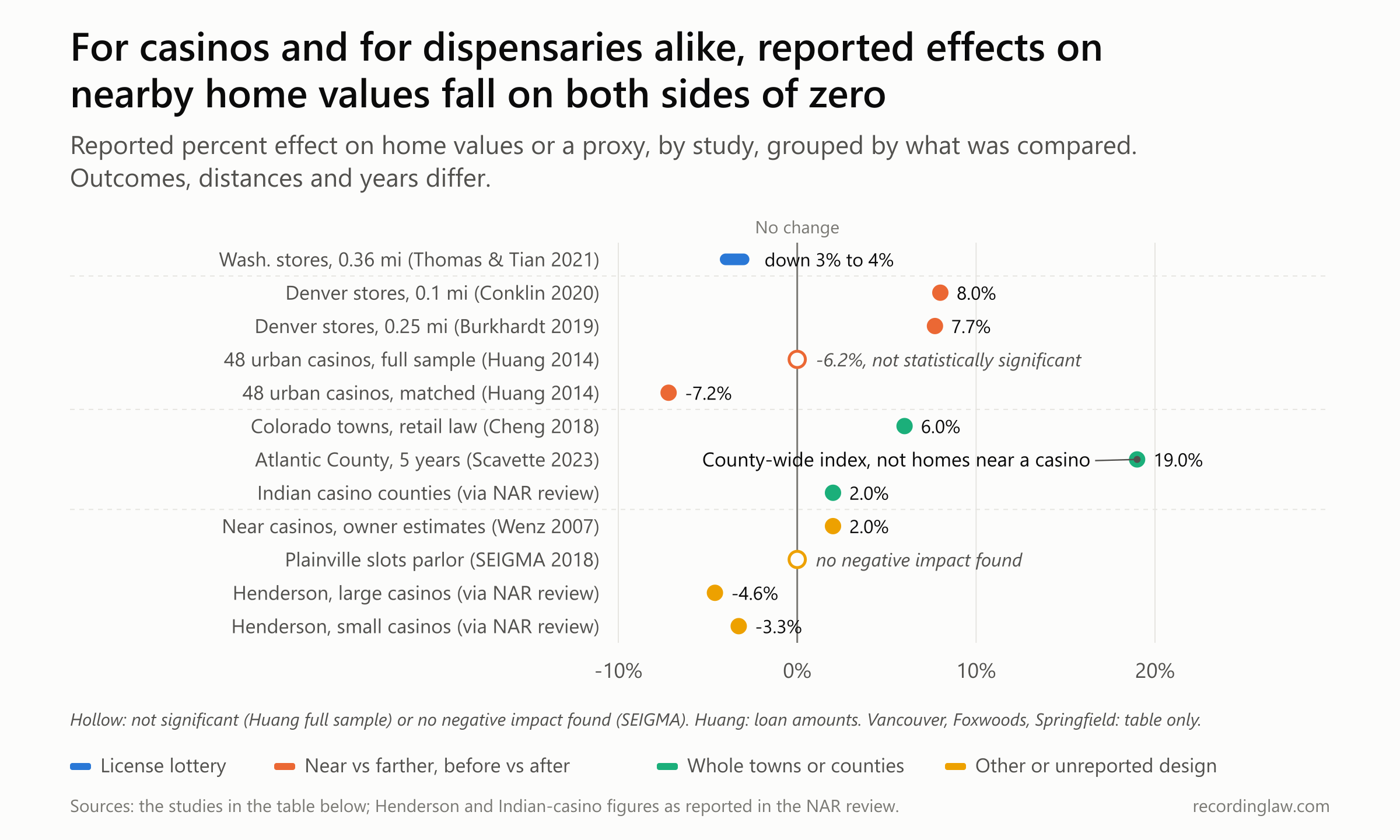
Reported effects of casinos and dispensaries on nearby home values or proxies, by study. Hollow markers: no statistically significant effect, or no negative impact found. The Washington bar is Thomas and Tian's 3 to 4% range; Burkhardt shown at 0.25 mile per quotations of the paper body. Outcomes, designs and windows differ. Sources: Thomas and Tian 2021; Conklin, Diop and Li 2020; Burkhardt and Flyr 2019; Huang, Humphreys and Zhou 2014; Cheng, Mayer and Mayer 2018; Scavette 2023; Wenz 2007; SEIGMA 2018; Baxandall and Sacerdote and Clauretie et al. 1998 via NAR review.
| Study | Place and business | Design | Outcome | Reported effect |
|---|---|---|---|---|
| Thomas and Tian (2021) | Washington, new store, within 0.36 mile | License lottery | Sale prices | -3 to -4% (range charted) |
| Conklin, Diop and Li (2020) | Denver, dispensary, within 0.1 mile | Difference-in-differences | Sale prices | about +8% |
| Burkhardt and Flyr (2019) | Denver, new dispensary, within 0.25 mile | Event study | Sale prices | +7.7% |
| Huang, Humphreys and Zhou (2014) | 48 U.S. urban casinos, 3 years | Difference-in-differences | Loan amount applied for vs trend | -6.17% (not statistically significant) |
| Huang, Humphreys and Zhou (2014) | Matched comparison sample, 3 years | Difference-in-differences | Loan amount applied for vs trend | -7.19% |
| Tyndall (2021) | Vancouver, 84 dispensaries, within 100 meters | Repeat sales | Sale prices | No gain; some evidence of a decline (not charted) |
| Cheng, Mayer and Mayer (2018) | Colorado towns allowing retail sales | Difference-in-differences | Housing values | +6% |
| Scavette (2023) | Atlantic County, casinos, 5 years | Synthetic difference-in-differences | County house prices | +19% |
| Baxandall and Sacerdote, via NAR | Counties with Indian casinos | County comparison | Median home prices | about +2% (no difference among urban counties) |
| Wenz (2007) | U.S., near casinos | Hedonic | Owner-estimated values | about +2% |
| SEIGMA (2018) | Plainville, Mass., slots parlor | Regression with trend and home controls | Sale prices | No negative impact found |
| Foxwoods study, via NAR | Properties adjacent to Foxwoods, Conn. | Growth-rate comparison with the Hartford LMA | Annual sales price growth | +0.57% a year vs -1.16% for the Hartford LMA (not charted) |
| SEIGMA (2019) | Springfield, Mass., licensing to opening | Trend comparison and interviews | Inflation-adjusted prices | Single-family and condo flat or slightly up; multi-family up sharply (not charted) |
| Clauretie et al. (1998), via NAR | Henderson, Nev., large casinos, within 1 mile | Price-distance regression (per NAR summary) | Home values | -4.6% |
| Clauretie et al. (1998), via NAR | Henderson, Nev., small casinos (under 100 slots) | Price-distance regression (per NAR summary) | Home values | -3.27% |
The rows are not one measurement. They track loan sizes, sale prices, owners' own estimates and county indexes. They cover distances from a tenth of a mile to a whole county, in different years.
The figure behind Springfield's estimate is the Henderson row, minus 4.6 percent. Its path to Springfield's voters began with a 2011 state law.
Two weeks in Springfield
Massachusetts had made the casino possible two years earlier. Gov. Deval Patrick signed the Expanded Gaming Act on Nov. 22, 2011. That made Massachusetts "the 40th state in the country to legalize casinos and slot parlors," Boston.com reported. "Now the work will turn to getting it right in the implementation," Patrick said.
The promises that day were about work, not houses. "I think it's going to be a tremendous opportunity for jobs throughout the Commonwealth of Massachusetts," said state Rep. Angelo Puppolo, a Springfield Democrat. We found no statement from the law's sponsors at signing about home values in either direction.
By the summer of 2013, MGM had pledged 3,000 permanent jobs and 2,000 construction jobs in Springfield. The Realtors' study put a number on the other side of the ledger. Economists at the National Association of Realtors prepared it at the Pioneer Valley association's request.
A casino would "sap 1.1 to 2.3 percent of home values in the host community," The Republican summarized. The study itself called the impact on home values "unambiguously negative." Springfield, West Springfield and Palmer were the three towns then competing for the license. Across all three, the study estimated that assessed home values would "most likely be negatively impacted by $64 to $128 million."
The Republican explained the reason "in plain words": "nuisance value: traffic noise and the general bother created by living near an attraction expected to draw thousands of people." Inman, a real estate trade publication, described "Realtors who are opposed to a casino."
On July 16, 13,973 Springfield voters said yes and 10,260 said no. Turnout was 24.74 percent. "Today is the dawn of a new era," said MGM's chief executive, James Murren.
Mayor Domenic Sarno said there was "no better deal" than the casino agreement the city had negotiated with MGM. Michael Kogut, chairman of Citizens Against Casino Gaming, claimed "a moral victory" because MGM had not reached 60 percent.
Home values were not the debate that decided it. A MassLive and CBS 3 poll found that supporters' "No. 1 reason cited for support was overwhelmingly the prospect of new jobs." The reporter's summary of the opponents' case on vote night listed small businesses, problem gambling and traffic. But the Realtors' estimate had been published, and it rested on one number.
Where the 4.6% came from
The Realtors' review surveyed earlier studies and reported a range. "A casino can have a negative impact on home prices of between -2 and -10 percent decline in value," it said, "with the most credible being a negative decline of 4.6 percent." That figure anchored the Springfield estimate.
Its footnote leads to a three-page article: Clauretie, Carroll and Daneshvary, "Rolling the Dice: Would Casinos Harm Illinois Home Values?", Illinois Real Estate Letter, Winter 1998, pages 7 to 9. The authors had studied homes near casinos in Henderson, Nevada. Within a mile of a large casino, according to the review's summary, "the value of each home fell by 4.6%." Near small casinos with fewer than 100 slot machines, the summary says, values fell by 3.27 percent.
Those casinos were not destination resorts. "The patrons of the suburban casinos are generally area residents rather than tourists," the review noted.
The original article is not online. It is known here only through the review's footnote. The copy of the review that we read is hosted by Stop Predatory Gambling, an anti-gambling advocacy group.
The same review also summarized studies pointing the other way. Near Foxwoods in Connecticut, it reported, the yearly growth in sales prices "averaged 0.57% annually, compared to a negative 1.16% annual growth rate for the Hartford LMA during the same time period." LMA stands for labor market area, the region around Hartford.
So prices near Foxwoods grew by an average of a little over half a percent a year, while those in the Hartford region fell by an average of more than 1 percent a year. A county-level study of Indian casinos found median home prices about 2 percent higher in casino counties than in others.
The Realtors' study came up again in Everett. When Wynn proposed a casino there, Banker and Tradesman told readers in 2016 that, according to the Realtors' study, "some Everett-area homeowners can expect to see their home values decline."
Asked about it, Albert Saiz, director of the MIT Center for Real Estate, gave a distance-based answer. "Studies typically find there is a bit of a negative impact on residential properties in the immediate area," he said. "Further away, there isn't a lot of impact, and 3, 4, 5 miles away they might see a bit of a positive impact."
What happened to home loans near 48 casinos
A year after the Springfield vote, a national study found a decline near new casinos, though not in sale prices. Haifang Huang, Brad Humphreys and Li Zhou followed 48 urban casinos that opened in the United States between 1995 and 2009. Instead of sale prices, they used a stand-in: the average amount sought in home-purchase mortgage applications. They took that average for each census tract, a small neighborhood area drawn by the Census Bureau.
Their method was difference-in-differences. In plain words, they looked at how loan sizes changed near a casino after it opened. Then they set that against how loan sizes changed in tracts farther away over the same years.
Three years after opening, loans near the casinos ran "6-7 percentage points from trend" below where they had been heading. The number of applications and the profile of applicants barely changed.
Two details in the paper change how that number reads. The tracts near the casinos started out poorer: a median home value of $86,900 within two miles, against $116,000 farther out, in the 2000 Census. And before the casinos opened, those tracts had been catching up, "at the rate of about 2% a year." The estimated loss is measured against that rising line: it is the gap between where loans near the casinos ended up and where they had been heading.
The authors raised another possible explanation themselves. The 2000s mortgage boom and bust "disproportionately affected poorer neighborhoods," they wrote, "where new urban casinos in this sample tend to locate."
They also built a matched comparison group of similar tracts and got a similar result. In another version, they let poorer tracts follow their own trend, before and after 2007. With that change, the estimated shortfall shrank only a little, from 7 to 8 percent to 6 to 7 percent. They concluded that "casino openings are a negative factor for the housing values of nearby communities."
Huang and Humphreys thanked the Alberta Gambling Research Institute for funding. The paper is a working paper. They also thanked Michael Wenz "for providing data on casino openings early in our sample."
Wenz's own 2007 study used a hedonic model, which estimates a home's value from its features and location. Its data came from the Census, in which owners estimate their homes' worth. It found the opposite sign: a net benefit of "approximately 2% of household value, or about $2,000-$3,000 per household" for households near a casino. He found the benefit shrank as population density rose.
A third design looked at one place over a long time. Adam Scavette of the Federal Reserve Bank of Richmond studied Atlantic County, New Jersey. He built its comparison from a weighted mix of other counties, a design called synthetic difference-in-differences.
He estimated house prices 19 percent higher five years after casino gambling arrived, a result "only significant for the five-year time horizon." Scavette's "significant" is short for statistically significant, meaning by the study's own test, chance alone would rarely produce a result this far from no difference if there were truly none; it does not measure size or importance.
Scavette added a warning about what that gain meant. He cited earlier work about Atlantic City. In the 1980s, he wrote, the use of eminent domain and condemnation further reduced the city's housing stock, and the author of that work suggests this pushed middle-class residents into the county's suburbs. "Therefore," he wrote, "the increase in housing prices do not necessarily reflect welfare gains for city or county residents."
The state checks its own casinos
The state's checks began in Plainville. The Plainridge Park slots parlor opened there in June 2015, on the site of a harness racing track. Massachusetts had built a review of casinos like it into the law.
Section 71 of the Expanded Gaming Act told the Gaming Commission to "develop an annual research agenda in order to understand the social and economic effects of expanding gaming in the commonwealth." The commission hired a University of Massachusetts Amherst team called SEIGMA, and real estate became one of its subjects.
In 2013, consultants hired by Plainville had listed "lower property values immediately surrounding the would-be slots parlor" among possible effects. Rachel Volberg, a problem-gambling researcher, was working with them.
Volberg later led SEIGMA. Its 2018 report found "no evidence that the opening of PPC has had a negative impact on area home and condo sales prices in either Plainville or surrounding communities." PPC is the report's shorthand for Plainridge Park Casino.
A slight rise in single-family prices matched regional and statewide trends. The team also found "weak evidence of a small casino-related bump" in condo prices in surrounding towns. Mark Melnik of the UMass Donahue Institute said the casino's location on the edge of town, on an existing gaming site, was "likely to limit the extent" of any effect.
Then the state checked Springfield. The commission voted to award MGM the license in June 2014. SEIGMA's 2019 report covered the years from the 2014 license to the casino's opening. It found that single-family and condo prices in Springfield, adjusted for inflation, "increased slightly or remained relatively flat between the casino's licensing and opening."
One part of the market did move. "In contrast, multi-family home prices increased dramatically during that time," the report said. Multi-family homes are buildings with more than one unit. Interviews suggested investors were buying.
Liz Bewsee, an organizer with Arise for Social Justice, told the researchers that "landlords were looking for ways to get tenants out of properties in the South End and in Metro Center because they expected to get more money once the casino opened." Catherine Ratté, a principal planner at the Pioneer Valley Planning Commission, told them there was "a lot of concern on City Council about displacement." The 2013 warning had been that values would fall. The worry SEIGMA recorded in 2019 was that landlords expected them to rise.
SEIGMA did not claim to have isolated the casino. "It is difficult to disentangle which real estate trends are attributable to the casino versus other economic trends," it wrote.
Everett: higher prices, no comparison group
Everett, where Wynn proposed its casino, had voted first. On June 22, 2013, its residents voted on Wynn's host community agreement, the casino's contract with the city. They backed it "by a better than 6-1 margin," the city clerk reported. Boston Mayor Marty Walsh later dropped his opposition in exchange for an extra $6 million a year in payments over 15 years.
In 2016, Mayor Carlo DeMaria was asked about falling home values near the site. "I've noticed both residential and commercial values in Everett are going up," he said. "That's possibly due to the casino and the jobs it's going to bring, but also possibly other factors." He added: "This isn't like Atlantic City where you have no other venues; this is Boston."
The Everett casino, Encore Boston Harbor, opened in 2019. From 2018 through 2024, Everett's median single-family sale price rose 38.5 percent, the Boston Globe reported from Warren Group data, and 30 percent counting condos. Those figures have no comparison group, and Everett sits inside the Boston market its mayor had pointed to.
To Everett's planning director, Matt Lattanzi, the effect showed up in the tax bill. "The [property tax] rate hasn't changed much, but when your property value doubles, so does the bill," he told the Globe in 2025. "Without Encore, our taxes would've skyrocketed. With Encore, they've stayed about the same." The Globe called the apartment boom around the casino "a $2.6 billion housing chicken-or-egg question."
Where Denver's pot shops opened
Colorado's retail marijuana law took effect on Jan. 1, 2014. The same argument followed the stores. In spring 2014, Centennial, Colo., moved to ban marijuana storefronts. Mayor Cathy Noon said residents and businesses had told the council the storefronts clashed with the image they wanted for the city, and they feared the cash-only shops "would attract crime and lower property values," VMSD reported.
Where the shops could go was already shaped by law. Jeremy Nemeth of the University of Colorado Denver helped craft the state's land-use rules for the industry. Local zoning frequently forces pot shops into already-depressed parts of town, he told the Associated Press in 2014.
"Some might talk about these shops as a blight on our neighborhood, and others might say, 'Really? They're worse than the empty doughnut shop and the vacuum repair shop?'" he said. He added that it was "too soon to say."
Westword reported in 2022 that before Denver had location rules, dispensary and grow owners struggled to find landlords. Many of them, it reported, "found homes in industrial areas on the fringes of the city." The first studies measured what happened to home prices around the stores.
By 2016 the complaint in Denver was concentration. "I don't think it's a myth," Councilman Paul Lopez said of neighborhoods with large numbers of marijuana businesses. "It's happening. It's real. It's not right. And we have to correct it." The council voted 7 to 5 in April 2016 to freeze the count at 421 businesses, including 147 stores and 63 shared locations.
The economists found prices rising near the stores. Jesse Burkhardt and Matthew Flyr of Colorado State University tracked Denver sales around each new dispensary's opening. They used an event study, which follows prices period by period before and after each opening. They found a gain of about 7.7 percent.
The paper's published abstract places that gain within a half mile. Two quotations from the full paper put the 7.7 percent within a quarter mile, and about 5 percent from a quarter to a half mile.
Conklin, Moussa Diop and Li compared houses within 0.1 mile of a medical dispensary that converted to retail sales in 2014 with houses slightly farther away. Those closest gained about 8 percent. "This suggests that in addition to the sales and business taxes generated from the retail marijuana industry, municipalities may experience an increase in property taxes," Diop said.
A third study looked across Colorado towns rather than blocks. Cheng, Mayer and Mayer estimated that legalization "leads to an average 6% increase in housing values." NORML, a marijuana-law reform advocacy group, publicized the Burkhardt and Flyr paper under the headline "Home Prices Spike Following Opening Of Marijuana Retailers," quoting its conclusion: "Our findings suggest that legalization and dispensary openings create localized net benefits."
Those gains were measured inside a market that was rising fast on its own. The chart below shows how fast.
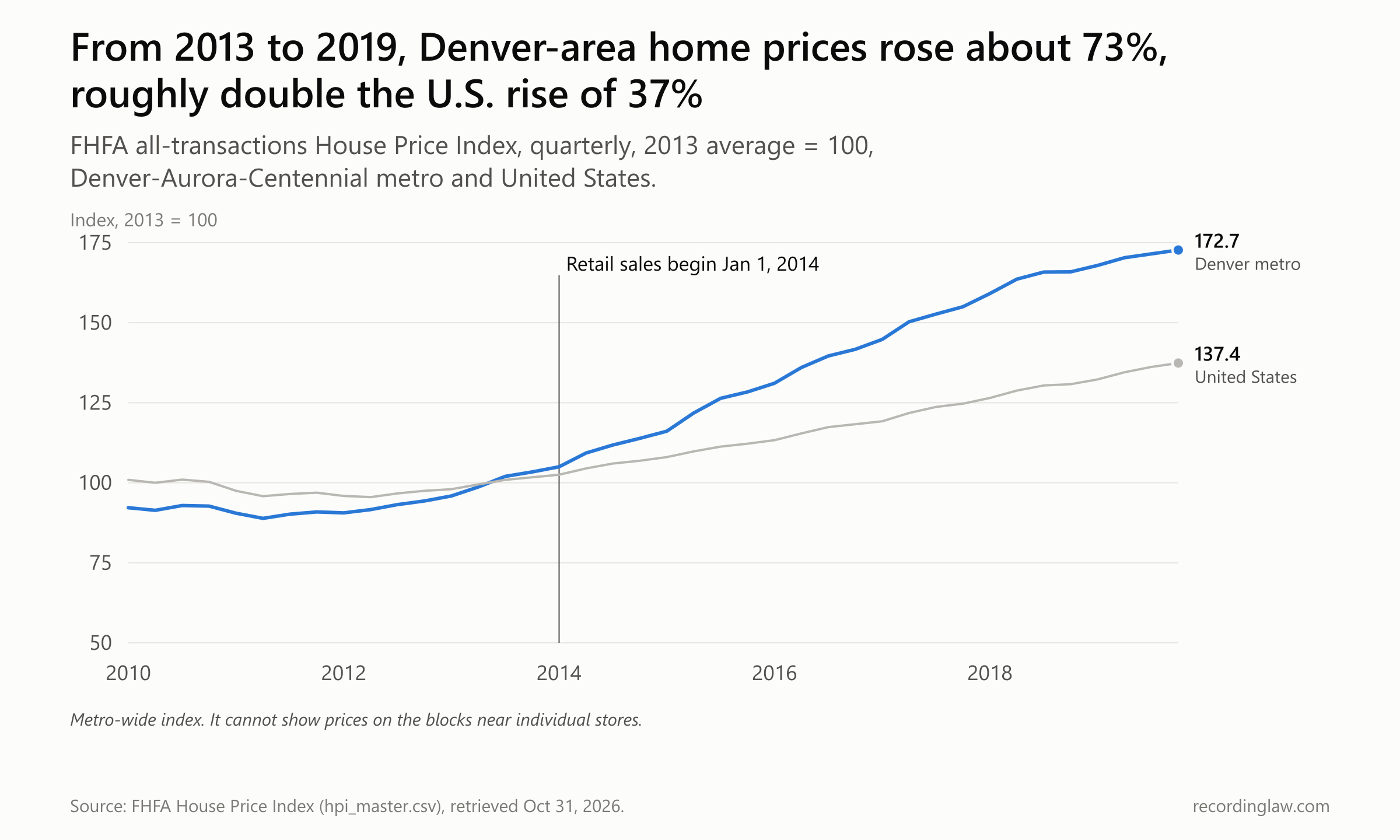
FHFA all-transactions House Price Index, Denver-Aurora-Centennial metro and United States, quarterly, 2013 average = 100. Metro-wide, not near dispensaries. Source: FHFA.
| Quarter | Denver metro | United States |
|---|---|---|
| 2010 Q1 | 92.2 | 100.9 |
| 2013 Q1 | 95.9 | 98.0 |
| 2014 Q1 | 105.0 | 102.5 |
| 2016 Q1 | 131.1 | 113.3 |
| 2019 Q4 | 172.7 | 137.4 |
From its 2013 average to the end of 2019, the Denver metro's house price index rose about 73 percent, double the national rise of 37 percent. The Denver studies compare homes near stores with homes a little farther away in the same city. That comparison is meant to take the citywide rise out of the result. What it cannot take out is the choice of block, since zoning, landlords and the companies themselves pick the sites.
When a lottery picked the licenses
Only one study in this review could use licenses decided by chance. In 2014, Washington state awarded its marijuana store licenses by lottery. Applicants named their own store addresses, and the draw decided which of them got licenses.
"A total of 1,173 applications were submitted for a total of 334 available licences," wrote Lin Tian of INSEAD. Results came out in May 2014.
"For social scientists, lotteries themselves mean a jackpot," Tian wrote, because "the only difference between two groups is luck of the draw." With Danna Thomas of the University of South Carolina, she used the random draw to estimate what new stores did to nearby sale prices.
They found prices fell, the opposite of the Denver results. "Home prices within a 0.36 mile area around a new dispensary fall by 3–4% on average, relative to control areas," they wrote. For the average home sale, Tian wrote, that meant "a price drop of between US$10,100 and US$13,500," and the decrease "particularly affected younger, more diverse neighbourhoods."
Justin Tyndall studied Vancouver, using 84 dispensaries and 62,000 repeat sales. He found "no evidence that dispensaries increase local home values" and "some evidence of a negative price effect" within 100 meters. Those shops were largely operating outside the law at the time, according to a 2022 Colorado State dissertation's reading of the paper.
NORML's fact sheet on dispensaries lists the positive findings, including a 2024 analysis by the brokerage Tomo that said a nearby dispensary means "an additional $4,400 increase in your property value each year." The Washington and Vancouver studies are not in its home-value section.
The one dispensary study that compared lottery winners with losers found prices fell near new stores. In Denver, stores opened wherever zoning and willing landlords allowed, and the studies there found prices rose. The Vancouver study found no gain. The studies also differ in place, years and distance, so they cannot say whether the design alone explains the gap.
Each casino study's sites came with a history. The 48 casinos in the study by Huang and his colleagues opened in tracts that started poorer and were already catching up. Atlantic County's gain came while its city's housing supply shrank.
Plainridge was built at the edge of town, on the site of an existing gaming facility. None of these casino designs could let chance decide where a casino went.
What Springfield is fighting about now
The housing that MGM spokeswoman Carole Brennan pointed to in 2013 became a written obligation. MGM was required to develop at least 54 market-rate apartments within a half mile of the casino. By February 2020, WAMC reported, "the commission has granted MGM numerous extensions to fulfill its housing obligation."
In early September 2026, Springfield sued MGM Resorts International and Blue Tarp Redevelopment. Sarno said he had directed the city solicitor to commence legal action. "The people of Springfield deserve nothing less," he said.
MGM wants to sell the $970 million casino to Clairvest, a Canadian private equity firm. In arbitration, a closed-door process outside public court, MGM claims that the city owes it $500 million in damages for holding the sale up.
On Oct. 14, 2026, the city argued at a Hampden Superior Court hearing that the dispute should stay in public court rather than closed-door arbitration. The failures it cites, as MassLive reported them, include too few table games and slot machines, not having the promised 3,000 jobs and not developing MGM's building at 101 State St.
Judge Jeffrey Trapani denied the city's request to halt the arbitration, finding Springfield unlikely to succeed in blocking it, as reported by Western Mass Politics & Insight on Oct. 22, 2026. The city's lawsuit over the host community agreement "remains intact and will proceed in the normal course," City Solicitor Stephen Buoniconti said, adding that "all appellate rights will be reviewed." That was the reported status as of November 10, 2026.
The same question is now headed to New York and Denver. New York's Gaming Commission licensed three casinos for the New York City area on Dec. 15, 2025. Two are in Queens: the Hard Rock Metropolitan Park project at Citi Field, and an expansion of the existing Resorts World gaming site in South Ozone Park. The third is Bally's in the Bronx.
Denver's exclusivity period reserves new marijuana store licenses for social equity applicants. It ends on July 1, 2027, which could open new store licenses to all applicants.
In July 2013, Brian Sears wanted the Realtors' number in voters' hands. Carole Brennan answered that MGM's design was "expected to spur additional residential in the area." The Court Square building MGM helped finance opened in April 2024 with 74 apartments, WAMC reported. Sarno said about 60 would be market rate.
SEIGMA's Mark Melnik had said the team would "continue to track these issues." We found no later residential report for Springfield.
How we measured
Sources. This story reviews published research and contemporaneous reporting; we did no original analysis of sales or assessment records. Study figures come from each paper's abstract, text or tables as opened on Oct. 31, 2026, or from the authors' own releases where noted. Quotes come from the news, government and university pages listed in the citations.
The methods in plain words. A difference-in-differences design compares how prices changed near a site before and after it opened with how they changed in a comparison area over the same period. An event study is a version that tracks that gap period by period around the opening.
A synthetic difference-in-differences design builds the comparison from a weighted mix of other places chosen to match the treated place before the change. A hedonic model estimates a home's value from its features and location and asks how much nearness to a casino adds or subtracts. A license lottery lets chance decide which applicants open, so neighborhoods near winners and losers can be compared. None of the designs except the lottery controls for how sites are chosen.
Huang, Humphreys and Zhou (2014). This is University of Alberta working paper 2014-04. It covers 48 urban casinos opened 1995 to 2009. Its outcome is the average loan amount on home-purchase mortgage applications from federal mortgage-disclosure data, used as a stand-in for house prices.
The abstract reports a loss of 6 to 7 percentage points from trend over three years. The basic model gives 8.2% (full sample) and 7.8% (matched sample). The chart uses the authors' specification with poverty-specific trends, the version that lets poorer tracts follow their own trend, which gives 6.17% and 7.19%.
In that specification the paper says the full-sample trend estimate loses statistical significance while the matched one keeps it. So the chart shows the full-sample estimate as a hollow marker at zero, labelled with its -6.17% figure. The paper was funded in part by the Alberta Gambling Research Institute.
Burkhardt and Flyr (2019). Contemporary Economic Policy 37(3). The full text is behind a paywall. The published abstract attributes approximately 7.7% to homes "within a half-mile radius." NORML's 2018 quotation of the paper and a 2022 Colorado State dissertation quoting page 2 both put 7.7% within 0.25 mile and about 5% (4.7%) at 0.25 to 0.5 mile.
NORML's quotation also reports an effect "around ten percent" for homes with no earlier dispensary nearby. The chart uses the 0.25-mile figure from those quotations of the paper's body.
Conklin, Diop and Li (2020). Real Estate Economics 48(1). The abstract says "approximately 8%"; the University of Wisconsin release says 8.4% and "almost $27,000 for an average house in the area." We chart 8%.
Clauretie, Carroll and Daneshvary (1998) and Wenz (2007). We could not open the Clauretie article. Its figures (-4.6% large casinos, -3.27% small) come from the National Association of Realtors review, prepared in conjunction with the Realtor Association of Pioneer Valley and hosted online by Stop Predatory Gambling. We found no funding statement for that review. Wenz's figures come from his abstract; the full paper is paywalled.
Scavette (2023). Federal Reserve Bank of Richmond working paper 23-07 (May 2023). A later published version exists that we did not open and may differ.
SEIGMA. Funded by the Massachusetts Gaming Commission. The Springfield report covers the period between licensing in 2014 and opening, not years after opening. SEIGMA dates the license announcement to February 2014, while the commission voted to award it in June 2014.
Its findings are trend comparisons and interviews, not a causal design. The Plainridge report used regression controls for trends and home characteristics.
Everett. The 38.5% and 30% figures are Warren Group data reported by the Boston Globe, with no comparison group.
Denver price index. FHFA all-transactions House Price Index for the Denver-Aurora-Centennial metro area and the United States, not seasonally adjusted, rebased so the 2013 quarterly average equals 100. Denver's 172.7 in 2019 Q4 is 73% above that base and the U.S. 137.4 is 37% above it.
The charted study estimates run from -7.19% (Huang, matched sample) to +19% (Scavette). Thomas and Tian report a 3 to 4% decline; the chart shows that range as a bar, with no point estimate. The latest quarter in the file checked on Oct. 31, 2026 was 2026 Q2; we stop the chart at 2019 Q4, the period the Denver studies cover. The index is metro-wide and cannot show effects near individual stores.
The estimates chart. Rows are grouped by what each study compared: a license lottery; homes near a site against homes farther away, before and after it opened; whole towns or counties; and other designs or designs the source did not report. A hollow marker at zero means the study reported no statistically significant effect (Huang's full sample) or no negative impact (SEIGMA's Plainridge report).
Three studies cited in the story give no figure comparable to the others and appear in the table only. Tyndall's Vancouver study reports a direction without a percentage in the abstract we read. The Foxwoods study reports annual growth rates rather than a level effect. SEIGMA's Springfield report describes trends without a causal design.
The Indian-casino county figure (Baxandall and Sacerdote) and the Foxwoods growth rates are as summarized in the NAR review. Everett's 38.5% rise is a market figure with no comparison group, not a study estimate, and is not charted.
What comes next. As of November 10, 2026, Judge Trapani had denied Springfield's request to stay the arbitration (as reported by Western Mass Politics & Insight in October 2026), the city's host-community-agreement lawsuit was continuing in court, and the city said it would review its appellate rights. Denver's equity-only window for new marijuana store licenses closes July 1, 2027.
What the data cannot show. The studies measure different outcomes (loan sizes, sale prices, owner estimates, county indexes) over different windows, so their numbers are not strictly comparable and we do not average them. None of them can say what a particular new casino or store will do to a particular home.
This article reports published research and historical housing data and is not financial or investment advice.
Frequently Asked Questions
Do casinos lower nearby home values?
Studies disagree. A study of 48 U.S. urban casinos opened from 1995 to 2009 found that home-loan amounts nearby ran 6 to 7 percentage points below trend three years after opening. A 1998 study of Henderson, Nevada, found losses of 4.6% within a mile of large casinos. A 2007 Census-based study found values about 2% higher near casinos, and a Richmond Fed study found Atlantic County house prices 19% higher five years after casinos arrived. Urban casinos in one national sample tended to open in poorer areas, which makes the effect hard to isolate.
Do marijuana dispensaries raise or lower property values?
Three Colorado studies found gains of about 6 to 8% near new stores or in towns that allowed retail sales. A Washington study used the state's random license lottery, and it found prices within 0.36 mile of a new store fell 3 to 4%. A Vancouver study found no gain and some evidence of a decline within 100 meters.
What did the Realtors predict for the Springfield casino?
A July 2013 study by National Association of Realtors economists for the Realtor Association of Pioneer Valley said a casino would cost host-community homeowners $1,650 to $3,300 each. It also estimated a $64 million to $128 million hit to assessed home values in Springfield, West Springfield and Palmer combined. The figure it called most credible, a 4.6% loss, came from a 1998 newsletter article about Henderson, Nevada.
What happened to home prices in Springfield after MGM got its license?
A 2019 study funded by the Massachusetts Gaming Commission found inflation-adjusted single-family and condo prices in Springfield rose slightly or stayed flat between the 2014 license and the casino's opening. Multi-family prices rose sharply. Housing advocates described landlords trying to move tenants out. The study said it was difficult to separate the casino's effect from other trends.
Why do studies of casinos and dispensaries get opposite results?
They measure different things over different periods, and most cannot control for where the business was allowed to open. Urban casinos in one national sample tended to open in poorer neighborhoods. Zoning often pushed dispensaries into already-depressed parts of town, places that may already be changing. The one study in this review that used a license lottery, in Washington, found prices fell near new dispensaries, but it also differs from the Denver studies in place, years and distance.
Is Springfield suing MGM?
Yes. Springfield sued MGM Resorts and Blue Tarp Redevelopment in September 2026 over the 2013 host community agreement. At a Hampden Superior Court hearing on Oct. 14, 2026, the city argued that the dispute should stay in court rather than arbitration. MGM, which is trying to sell the casino to Clairvest, claims $500 million in damages in arbitration. In October 2026 a judge declined to halt the arbitration. As of November 10, 2026, the city's lawsuit was continuing in court.
Updates
Corrected: the story said earlier research found that Atlantic City's shrinking housing stock in the 1980s pushed middle-class residents into the suburbs. The Richmond Fed paper says that author suggests it; we restored the hedge.
Restructured as a feature: chart titles state the finding, side details moved to How we measured. Every figure and quote was re-checked against its source.
Independently fact-checked against the cited primary sources
Independently fact-checked against the cited primary sources
Sources and References
- The Republican / MassLive, Realtors study says casino would hurt home values in host community (July 2, 2013), copy hosted by Stop Predatory Gambling(stoppredatorygambling.org)
- National Association of Realtors Research, Economic Impact of Casinos on Home Prices: Literature Survey and Issue Analysis (2013), copy hosted by Stop Predatory Gambling(stoppredatorygambling.org)
- The Republican / MassLive, Springfield casino referendum results (July 16, 2013), hosted by the City of Springfield(springfield-ma.gov).gov
- Inman, Realtors oppose western Massachusetts casino (July 3, 2013)(inman.com)
- Boston.com, Patrick signs casino bill into law (Nov. 22, 2011)(boston.com)
- WAMC, Governor Patrick signs historic legislation legalizing casino gambling (Nov. 2011)(wamc.org)
- Massachusetts General Laws, chapter 23K, section 71 (gaming research agenda)(malegislature.gov).gov
- Banker & Tradesman, Will casino be a Wynn for residents? (Feb. 7, 2016)(bankerandtradesman.com)
- Associated Press via CDC Gaming, Voters in Mass. city approve Wynn casino deal (June 2013)(cdcgaming.com)
- Huang, Humphreys and Zhou, Urban Casinos and Local Housing Markets: Evidence from the US, University of Alberta working paper 2014-04(sites.ualberta.ca)
- Wenz, The Impact of Casino Gambling on Housing Markets: A Hedonic Approach, Journal of Gambling Business and Economics (2007), abstract(ideas.repec.org)
- Scavette, The Economic Impact of a Casino Monopoly: Evidence from Atlantic City, Federal Reserve Bank of Richmond working paper 23-07 (May 2023)(fraser.stlouisfed.org)
- UMass SEIGMA, Real estate report finds Plainridge Park Casino has minimal impacts on Plainville real estate(umass.edu)
- Renski and Peake (SEIGMA), Real Estate Impacts of the Plainridge Park Casino on Plainville and Surrounding Communities (2018)(umass.edu)
- Massachusetts Gaming Commission, release on the Plainridge Park real estate report (2018)(massgaming.com)
- Boston Globe, Plainville slots parlor consultants report (March 2013), hosted by the City of Springfield(springfield-ma.gov).gov
- SEIGMA, Real Estate Impacts of MGM Springfield, executive summary (2019)(massgaming.com)
- SEIGMA, Real Estate Impacts of MGM Springfield in Springfield and Surrounding Communities, full report (2019)(massgaming.com)
- Massachusetts Gaming Commission, release on MGM Springfield real estate impacts (Sept. 2019)(massgaming.com)
- Boston Globe, Everett housing development after Encore (Oct. 29, 2025)(bostonglobe.com)
- VMSD, citing The Denver Post, Colorado city nixes marijuana storefronts (April 2014)(vmsd.com)
- Associated Press via Claims Journal, marijuana shops and neighbors (Nov. 13, 2014)(amp.claimsjournal.com)
- Westword, Denver marijuana report (May 2022)(westword.com)
- Colorado Public Radio, Plan to cap marijuana dispensaries moves forward in Denver council (April 5, 2016)(cpr.org)
- Westword, Denver City Council approves caps on pot businesses (April 2016)(westword.com)
- Burkhardt and Flyr, The Effect of Marijuana Dispensary Openings on Housing Prices, Contemporary Economic Policy 37(3), 2019, abstract(onlinelibrary.wiley.com)
- Burkhardt and Flyr (2019), IDEAS/RePEc record(ideas.repec.org)
- NORML (marijuana-law reform advocacy group), Home Prices Spike Following Opening Of Marijuana Retailers (Dec. 13, 2018)(norml.org)
- Colorado State University dissertation (2022) quoting Burkhardt and Flyr (2019), p. 2(mountainscholar.org)
- Conklin, Diop and Li, Contact High, Real Estate Economics 48(1), 2020, abstract(ideas.repec.org)
- Wisconsin School of Business, release on Conklin, Diop and Li (2017)(business.wisc.edu)
- Cheng, Mayer and Mayer, Economic Inquiry 56(3), 2018, abstract(ideas.repec.org)
- Thomas and Tian, Hits from the Bong, Regional Science and Urban Economics 87, 2021, abstract(ideas.repec.org)
- Lin Tian, INSEAD Knowledge, There goes the neighbourhood (May 27, 2021)(knowledge.insead.edu)
- Tyndall, Getting High and Low Prices, Real Estate Economics 49(4), 2021, abstract(ideas.repec.org)
- NORML fact sheet, Societal impacts of cannabis dispensaries and retailers(norml.org)
- Federal Housing Finance Agency, House Price Index datasets (all-transactions index)(fhfa.gov).gov
- WAMC, Massachusetts casino regulators praise progress report on MGM residential requirement (Feb. 13, 2020)(wamc.org)
- MassLive via CDC Gaming, MGM responds to Springfield lawsuit over host community agreement (Sept. 2026)(cdcgaming.com)
- MassLive via CDC Gaming, In court, Springfield asserts right to say no to MGM casino sale (Oct. 2026)(cdcgaming.com)
- CDC Gaming, New York Gaming Commission licenses three New York City casino bids (Dec. 2025)(cdcgaming.com)
- City and County of Denver, marijuana social equity program FAQ(denvergov.org).gov
- WBUR, MGM named first official casino operator (June 13, 2014)(wbur.org)
- WAMC, Ribbon cut on 31 Elm Street apartments in Springfield in historic Court Square (April 23, 2024)(wamc.org)
- Western Mass News, Springfield sues MGM Resorts over Host Community Agreement (Sept. 3, 2026)(westernmassnews.com)
- Western Mass Politics & Insight, Judge Refuses Springfield's Plea for Stay of Arbitration over MGM Sale (Oct. 22, 2026, updated Oct. 23, 2026)(wmasspi.com)