State Sports-Betting Tax Passed $1 Billion a Quarter in Late 2025. Five Studies Split on Whether the Money Came Out of the Lottery.

Independently fact-checked against primary sources (last audited November 10, 2026). · 10 primary sources cited on this page. How we verify our legal content
Super Bowl LIII, played on February 3, 2019, went badly for Rhode Island's budget. "The state's sportsbooks lost $2.35 million," the Associated Press reported that April, "because, come on, really, who's going to bet against Tom Brady in New England?"
That, in turn, cut into the state's tax revenue, the AP noted. Rhode Island takes 51% of what its sportsbooks keep after paying winning bets. The state had expected that share to bring in more than $1 million a month. From the sportsbooks' launch in late November through February, the AP found, the state's share averaged about $50,000 a month.
The pitch had been simple. Sports wagering "provides the state with a revenue stream that supports critical priorities, such as investing in roads and schools, without increasing the tax burden," Senate President Dominick Ruggerio, a Democrat, said in a statement at the time.
Seven years later, in the second quarter of 2026, states collected $1.09 billion in sports-betting tax, by the U.S. Census Bureau's count. The bureau started counting that tax in the third quarter of 2021, when states collected $188 million. So the 2026 quarter brought in nearly six times as much.
Several states, as later sections show, took in more than they had forecast. The argument now is about what the money came out of. In one study's illustration, a $100 lottery purchase sends the state more than $30. A $100 sports bet sends it $1.59, on average across the same study's sample of states.
Suppose a player stops buying lottery tickets and bets the same money on sports. The state's sports-betting tax goes up, and its lottery revenue goes down by more. Research teams have tried to measure how often that happens, and they did not all count the same thing. Their answers run from a net loss of state revenue to a rise in lottery sales.
So every state budget that counts on the money faces two questions. How much did betting bring in? And how much of it is lottery money moved to a game that keeps far less of each dollar for the public?
From $50,000 a month to a billion a quarter
How big did the national total get? The Census Bureau began reporting a sports-betting line in its quarterly state tax survey, the Quarterly Summary of State and Local Tax Revenue (QTAX), with the third quarter of 2021.
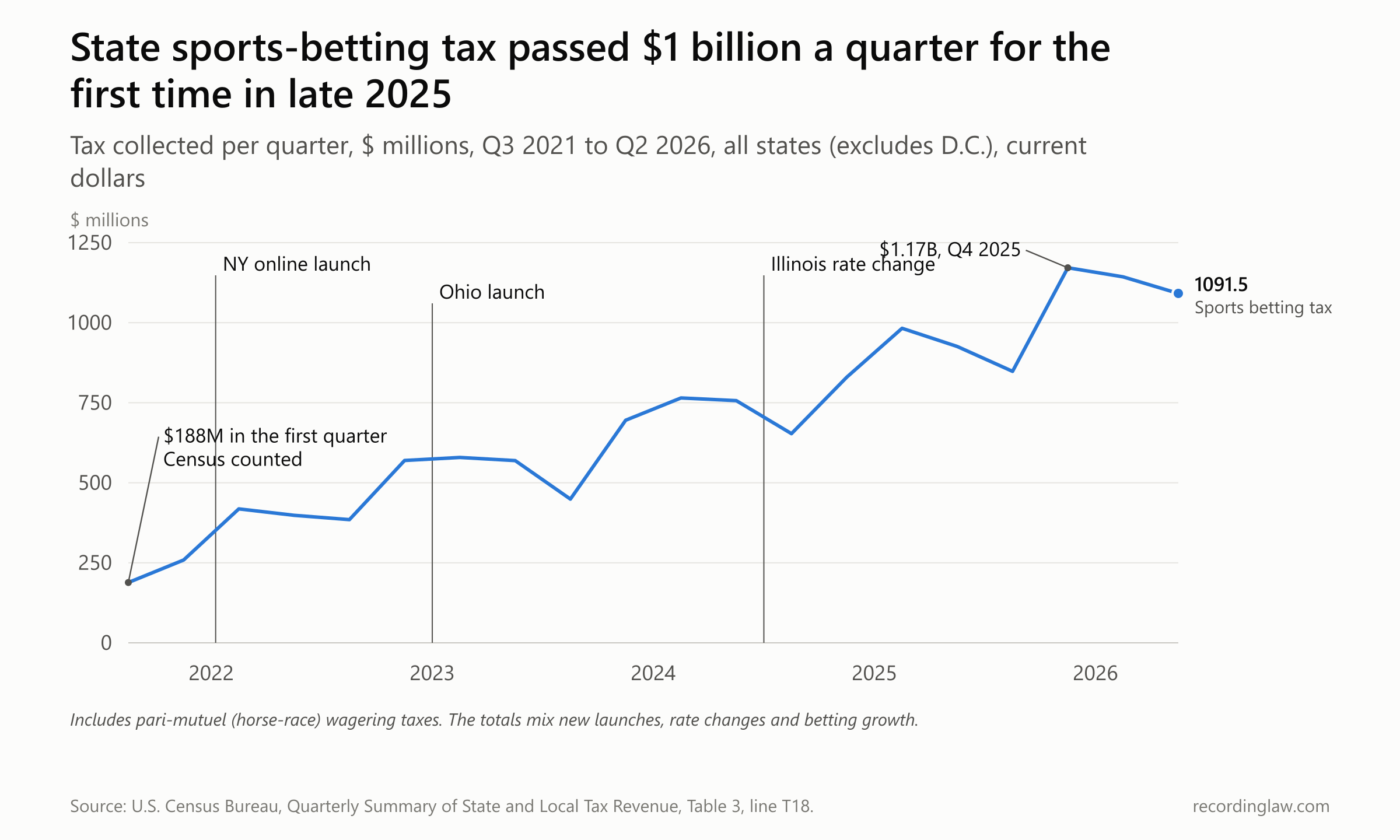
State sports-betting tax collections by quarter, Q3 2021 to Q2 2026, all states excluding D.C., including pari-mutuels. Source: U.S. Census Bureau, Quarterly Summary of State and Local Tax Revenue, Table 3.
| Quarter | Sports-betting tax, all states ($ millions) |
|---|---|
| Q3 2021 | 188.4 |
| Q2 2022 | 398.4 |
| Q2 2023 | 569.3 |
| Q2 2024 | 756.6 |
| Q2 2025 | 925.8 |
| Q4 2025 | 1,171.6 |
| Q1 2026 | 1,143.2 |
| Q2 2026 | 1,091.5 |
The line climbed in steps, with a dip each summer. It first passed $1 billion in the last quarter of 2025. Census notes that sports-betting revenue is typically higher in the winter.
The markers show when New York launched mobile betting, when Ohio launched a year later, and when Illinois changed its rate in July 2024. Other states launched and raised rates over the same years. The national total does not separate those changes from growth in betting itself.
The first states to legalize had started far smaller, and in most of them the early money came in below forecast.
What states were told to expect
The biggest number came first, from the industry. In June 2017, before the Supreme Court cleared the way for states to legalize, the American Gaming Association, the casino and sportsbook trade group, summarized a study it had commissioned from Oxford Economics. Legal sports betting, it said, would "deliver powerful economic benefits, possibly generating $8 billion in local taxes, creating hundreds of thousands of jobs, and adding $22.4 billion to the gross domestic product." The estimate assumed betting in all 40 casino states and combined state, local and federal taxes.
The states that moved first in 2018 wrote smaller numbers into their budgets. New Jersey Treasurer Elizabeth Muoio, a Democrat, expected about $13 million in tax revenue for fiscal 2019, less than 1 percent of the state's $37.4 billion budget, the Pew Charitable Trusts' Stateline reported. West Virginia lawmakers expected $5.5 million in the first year, rising to $13 million to $18 million a year. Rhode Island officials estimated $23.5 million in the first fiscal year.
Mississippi Gov. Phil Bryant, a Republican, said the money could help with the state's infrastructure deficit. Democratic lawmakers there, Pew reported, "suggested that the likely revenue won't be enough to close the state budget gap."
The credit rating agencies were cooler still. Standard & Poor's said in July 2018 that sports betting "may boost state gaming tax revenue, but those gains are unlikely to be sustained." Moody's Investors Service, Pew reported, "found that even under the most optimistic scenarios, the revenue boost from sports betting would be minor."
Tax analysts said much the same thing. "States can collect millions of dollars in tax revenue from legal sports betting, but that tax revenue will always be relatively small and volatile," a 2019 report by Richard C. Auxier of the Tax Policy Center, run by the Urban Institute and Brookings, said. "As such, politicians should not overpromise what the revenue will do for state budgets, and legislators absolutely should not make critical spending programs dependent on that revenue."
Ulrik Boesen of the free-market-leaning Tax Foundation wrote that "high excise taxes applied to small tax bases are volatile, making it difficult to sufficiently fund designated priorities from year to year."
The first scorecard came in below the forecasts. In April 2019, the AP found that tax revenue had "fallen far short of projections in four of the six states where gambling on sporting events started last year." West Virginia was taking in a quarter of its projected monthly revenue. Mississippi and Pennsylvania were taking in about half of theirs.
Opponents read that in different ways. West Virginia state Sen. Michael J. Romano, a Democrat, had opposed legalization partly because he thought the 10% tax was too low, and the shortfall did not surprise him, the AP reported. Mississippi state Sen. Hob Bryan, a Democrat who had opposed legalization for fear it would promote point shaving and other corruption, said it was too early to tell whether revenue would improve or the original projections were way off.
Supporters read it differently. Republican state Sen. Craig Blair, a co-author of West Virginia's law, said the revenue reflected growing pains, and the AP noted that New Jersey, where bettors could place wagers from a mobile device, had met its projections. The answer came from the next wave of states, and especially from the biggest one.
When the money outran the forecasts
New York's governor had been against the whole idea. In his January 2020 budget address, Andrew Cuomo said: "There's no gimmicks. There's no new casino revenue. … This is not the time to come up with creative although irresponsible revenue sources to solve a problem which doesn't really exist."
A year later he had changed course, and his budget predicted that mobile betting would bring in $500 million in taxes a year, City & State New York later reported. Assemblymember J. Gary Pretlow, a co-author of the mobile plan, said later that he had studied New Jersey and knew much of its success came from New Yorkers crossing the state line. "I saw it as an opportunity to keep more tax revenue and make New York the largest betting market in the U.S.," he said.
Mobile betting went live in New York on January 8, 2022. It was taxed at 51% of gross gaming revenue, which is the amount sportsbooks keep after paying winning bets.
In the first 30 days, the governor's office reported, bettors wagered more than $1.98 billion and the state collected more than $70.6 million in tax. "Over the past month, we've seen how mobile sports wagering can be an economic engine for New York, driving significant funding to our schools, youth sports, and so much more," Gov. Kathy Hochul said.
That January, the state's financial plan projected $249 million for the fiscal year ending in March, including $200 million in license fees already collected. Total collections came to $361 million, the governor's office reported in July.
By the first anniversary, bettors had wagered about $16.6 billion and the state had collected about $709 million in tax, most of it earmarked for education. "What amazed me, what I marveled at, was the fact that we did these numbers – these record-setting, No. 1 in the nation kind of numbers – within the first year and with only nine operators," said state Sen. Joseph Addabbo Jr., the Democrat who chaired the Senate gaming committee.
Ohio told a similar story at a smaller scale. Before signing Ohio's law in December 2021, Gov. Mike DeWine, a Republican, said Ohioans were already betting on apps and offshore. "So it's time to bring in Ohio, to regulate it and get a little more money for schools," he said.
The legislature's budget office assumed a 10% tax would raise about $7 million in the first half of 2023. It also noted that "actual revenue ... could exceed projected revenue, if the market expands rapidly." Ohio's market went live on January 1, 2023, and the Census Bureau counted $39 million in the first quarter (a line that also includes horse-race betting taxes). The two figures are not on the same basis: the budget office's estimate was for six months of sports-betting tax, and the Census figure covers three months.
By 2025 one industry newsletter was arguing that the old story had flipped. "Has sports betting tax revenue underperformed predictions? As of 2025, there's little evidence to support that claim. In fact, one could argue that tax revenue projections were sandbagged," wrote Dustin Gouker in The Closing Line, a gambling-industry newsletter whose issue carried a FanDuel-sponsored message.
Early expectations, he argued, often confused the handle, the industry's word for the total amount bet, with the revenue the sportsbooks keep after paying winners. Most states tax that smaller revenue figure, though Illinois added a per-bet fee in 2025.
Big as the national total got, it is a small part of what states collect. In the second quarter of 2026, sports betting made up about 0.22% of all state tax revenue, or roughly $1 of every $460. In 2019 the AP had found that the tax would be "just a fraction of 1% of most states' budgets" even if states hit their estimates.
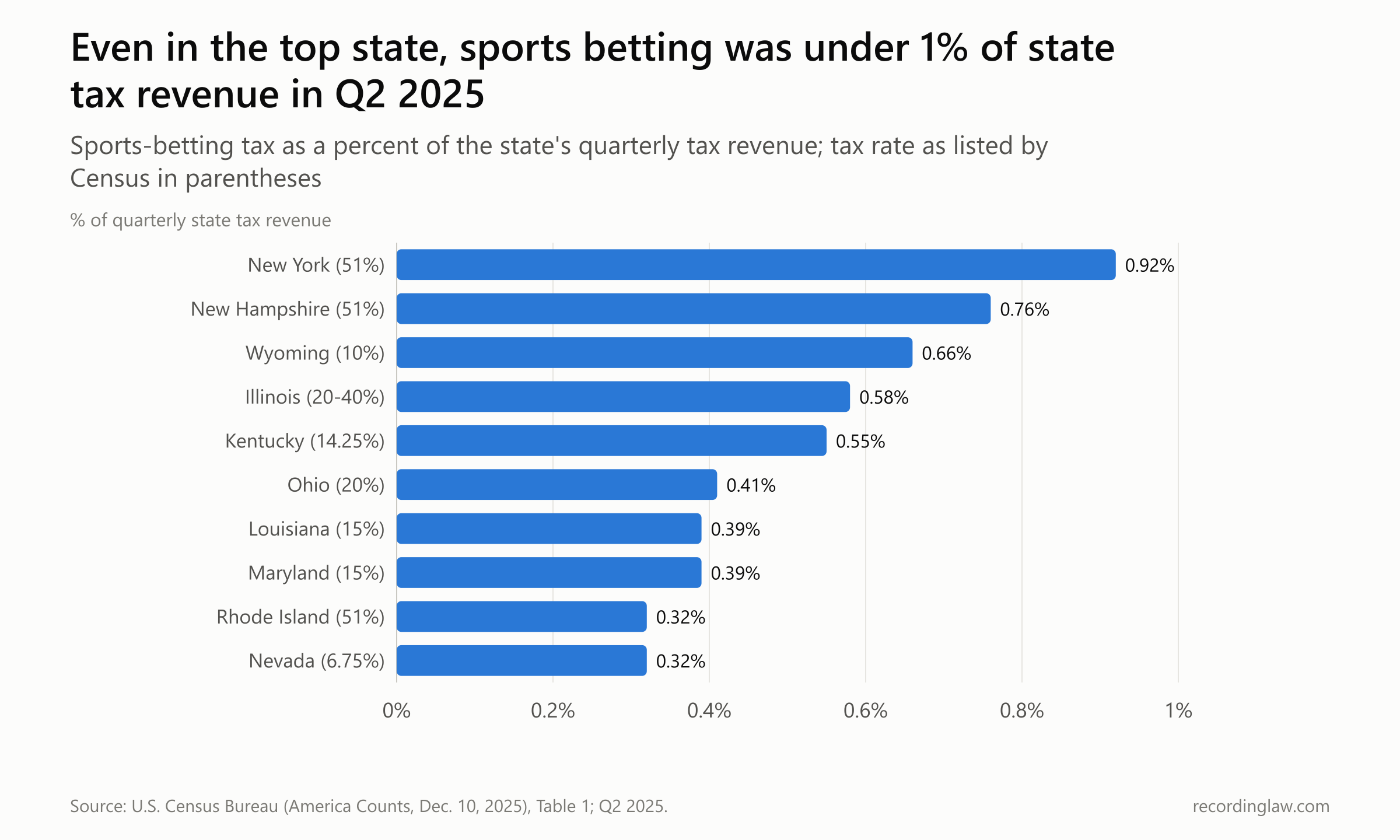
Sports-betting tax as a share of quarterly state tax revenue, top 10 states, Q2 2025, with each state's rate as listed by Census. Source: U.S. Census Bureau, America Counts (December 2025), Table 1. Q2 2026 column computed from Census QTAX Table 3.
| State | Tax rate (Census, 2025) | Share of state tax, Q2 2025 | Share of state tax, Q2 2026 |
|---|---|---|---|
| New York | 51% | 0.92% | 0.90% |
| New Hampshire | 51% | 0.76% | 0.82% |
| Wyoming | 10% | 0.66% | 0.75% |
| Illinois | 20% to 40% | 0.58% | 0.65% |
| Kentucky | 14.25% | 0.55% | 0.67% |
| Ohio | 20% | 0.41% | 0.58% |
| Louisiana | 15% | 0.39% | 0.65% |
| Maryland | 15% | 0.39% | 0.42% |
| Rhode Island | 51% | 0.32% | 0.32% |
| Nevada | 6.75% | 0.32% | 0.31% |
Even in New York, the state with the highest share, sports betting was under 1% of state tax revenue in either year. Every one of the forecasts above, high or low, estimated what the new tax would collect. None tried to count what betting might take away from the lottery, a source of money states already had.
The lottery's warning
Massachusetts made that point out loud before its betting launched. In September 2022, state Treasurer Deborah Goldberg, a Democrat who chairs the Lottery Commission, set the two numbers side by side for the state's Gaming Commission.
"Lawmakers project that sports wagering will generate $60 million in state revenue annually. Only $16.5 million, which is 27.5 percent, will be earmarked for unrestricted local aid. By contrast, the Lottery produced approximately $1.1 billion this past year for our cities and towns," she said. "Simply put, the Lottery plays a very vital role in generating unrestricted local aid for our communities and it is imperative that we work to ensure it continues to do so."
The $60 million she quoted was about one-eighteenth of the $1.1 billion the lottery sent to cities and towns. Three years earlier she had declared that "if sports betting is available online, the Lottery must be available online also."
In March 2024, for the second year in a row, the state lottery's director, Mark William Bracken, used a commissioners' meeting to sound the alarm, iGaming Business reported. He pointed to a 6.8% drop in lottery sales from February 2023 to February 2024. He also pointed to a year-to-date net profit $28.4 million below the year before.
A lottery dollar and a betting dollar do not send the same amount to the state. The chart below follows $100 of each.
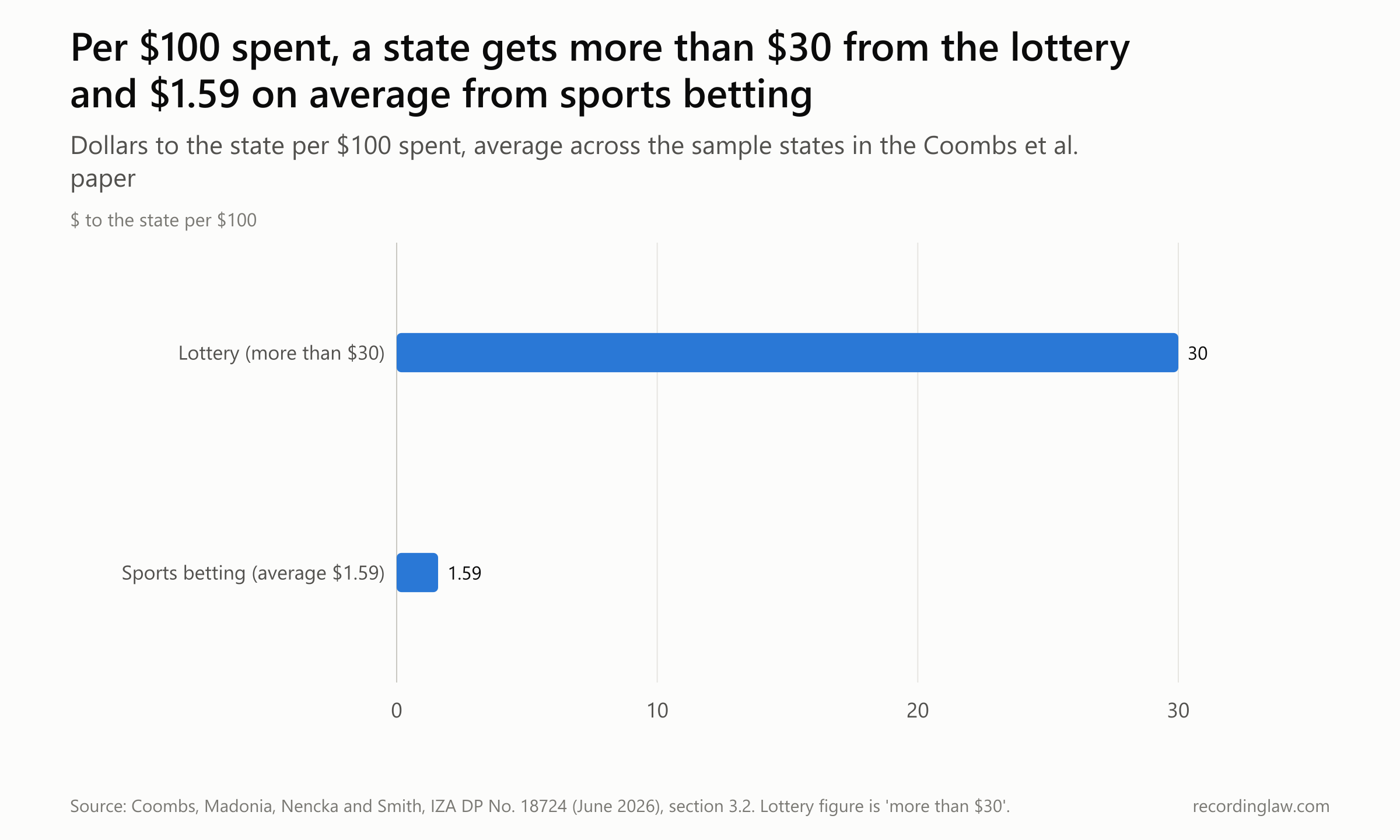
State take per $100 spent on the lottery versus wagered on sports. Source: Coombs, Madonia, Nencka and Smith, IZA Discussion Paper No. 18724 (June 2026). The lottery figure is "more than $30"; the sports figure is the average in the paper's sample.
| Per $100 | Lottery | Sports betting |
|---|---|---|
| Returned to players | About $65 in prizes | Over $91 in winnings |
| Kept before the state's share | About $35 (about $4.50 of it for administration) | Under $9 (the operator's take) |
| To the state | About $30 | $0.50 to $4.50 ($1.59 average) |
In a lottery, the state is what the authors of a June 2026 IZA discussion paper call the residual claimant. It keeps what is left after prizes and costs, about $30 of every $100.
A sportsbook returns over $91 of every $100 to bettors. The state taxes only what the operator keeps after that, at rates from 6.75% to 51%.
So a bettor who moves $100 from scratch tickets to a betting app does not move $30 of state revenue with it. In the IZA sample, about $1.59 follows on average. Economists call that kind of switch substitution. In the gambling business it is often called cannibalization.
The University of Washington's business school put the same gap another way: states capture 25 cents of every lottery dollar and "less than 1 cent from sports betting." Those are the school's own figures and are not on the same basis as the IZA paper's $30 and $1.59.
The national lottery numbers, though, did not shrink. State lottery ticket sales roughly doubled, from $52.8 billion in fiscal 2008 to $104.7 billion in fiscal 2024, the Census Bureau reports. Net lottery revenue rose from $20.6 billion to $34.5 billion over the same years, by the same count. Census figures net lottery revenue as ticket sales minus prizes, and it still includes the lotteries' administrative costs.
These lottery figures are in dollars not adjusted for inflation. For the four quarters ending June 2026, states' sports-betting tax, pari-mutuels included, came to about $4.25 billion. That is a different period from the lottery figures, which end in fiscal 2024.
What did change is the share of sales left after prizes. Net lottery revenue was 39% of ticket sales in fiscal 2008. It fell to 35% in 2018, the year states began legalizing sports betting, and it was 33% in 2024.
Most of that slide came before 2018, so by itself it says nothing about sports betting. To see what betting did, researchers had to compare states that launched it with states that had not yet.
Did the betting money come out of the lottery?
We read five recent studies that made that comparison. They did not count the same thing. Some measured lottery sales and one measured the state's net lottery revenue, over samples that run from one state to 42. The IZA authors, whose paper is one of the five, offer their own explanation for the spread: "These conflicting results may reflect differences in geographic scope, time horizon, or the specific gambling products examined."
Two of the five report declines in lottery money, two found no loss, and one found the answer depended on how betting launched. Those five are not the only studies. The IZA paper cites others that we did not count among the five, including a 2024 study by Matheson and co-authors that found a modest decline in New York lottery sales after legalization.
The study that made headlines came from the University of Washington. In January 2026 its Foster School of Business described research by Uttara Ananthakrishnan and two co-authors that tracked lottery sales after states launched online sports betting, including a comparison of convenience stores on either side of the Washington-Oregon border. "Oregon stores experienced a decline in lottery sales, while Washington stores did not," the article said.
Across the states studied, the school reported, lottery sales fell about 5% in the 16 months after online betting arrived, or $164 million. "Just 43% of sportsbook tax revenue represents truly new money. The other 57% would have been generated through lottery sales had demand not shifted," it said. Ananthakrishnan, pointing to the toll on people most vulnerable to problem gambling, drew her own conclusion: "It's just not worth it for states to legalize sports gambling if the only reason is money."
The team's abstract tells it differently. An abstract is the authors' own summary, and this one is posted with the paper on SSRN. It lists three authors, Poet Larsen, Sriniketh Vijayaraghavan and Ananthakrishnan, was last revised on April 24, 2026, and does not give the 43% split. It reports that lottery sales fell 5.4% to 6.2% in the 16 months after launch, in county data from 17 states plus D.C. and store data from all 50 states.
It also reports that "our set of 17 states plus DC incurred a cumulative loss of −$112 million (95% CI = [−12M, −213M]) in state revenue following OSG implementation." OSG is the paper's short form for online sports gambling. The bracket is a 95% confidence interval, the range of values that fit the study's data reasonably well, by a method that would catch the true value in about 95 of 100 repeat studies. Here it runs from losses of $12 million to $213 million.
The early adopters, New Jersey and Pennsylvania, "experience significant revenue losses, while most other states break even." Neither the abstract nor the Foster article shows how the 43% figure was calculated.
A second team went to the state ledgers. Kyle Coombs, Greg Madonia, Peter Nencka and Austin Smith compared 42 states from 2012 to 2023. They used a design called difference-in-differences. It compares the change in net lottery revenue in states that legalized with the change over the same years in states that had not.
Their June 2026 IZA discussion paper, which the institute labels preliminary, finds "a persistent 10–13% decline in lottery revenue." When they added the sports-betting tax to the lottery revenue, the combined total fell 5% to 8% on average, "though statistical significance is not robust across specifications." That means the drop was statistically significant at the 10% level in one version of the paper's analysis and not in the others.
The authors wrote that they could not rule out no change at all, but that they could rule out a gain of more than 3.4%. In their year-by-year estimates, combined revenue stayed about flat for the first three years. They summed it up this way: "sports gambling appears to have neutral to negative consequences for state public revenue in the medium term."
The later years rest on fewer states. The estimate for the fifth year after betting began comes from New Jersey alone.
Two other teams found no such loss. A West Virginia University working paper by Joseph Nedved, Brad Humphreys and three co-authors, one of them at the free-market-leaning Tax Foundation, used monthly lottery sales from 18 states. It reports in its abstract "no economically or statistically significant effect of sports betting on state lottery revenues."
A study of Indiana's non-jackpot lottery games, presented by Rodney Paul of Syracuse University at a gambling conference in May 2026, reports in its abstract "no evidence of lottery cannibalization" and a rise in core lottery sales after retail sportsbooks opened. The abstract describes those non-jackpot games as scratch tickets and fixed-payout draw games.
A fifth team found it depended on how betting launched. At NYU's Stern School of Business, Anthony Adam Sy and Masakazu Ishihara split launches by type, according to the school's December 2025 summary. The summary describes retail sports betting as placing bets in person.
Where states launched only online betting, monthly lottery sales rose 17.3%. Where they launched only retail betting, sales fell 16.4%. Where both came at once, there was no significant change.
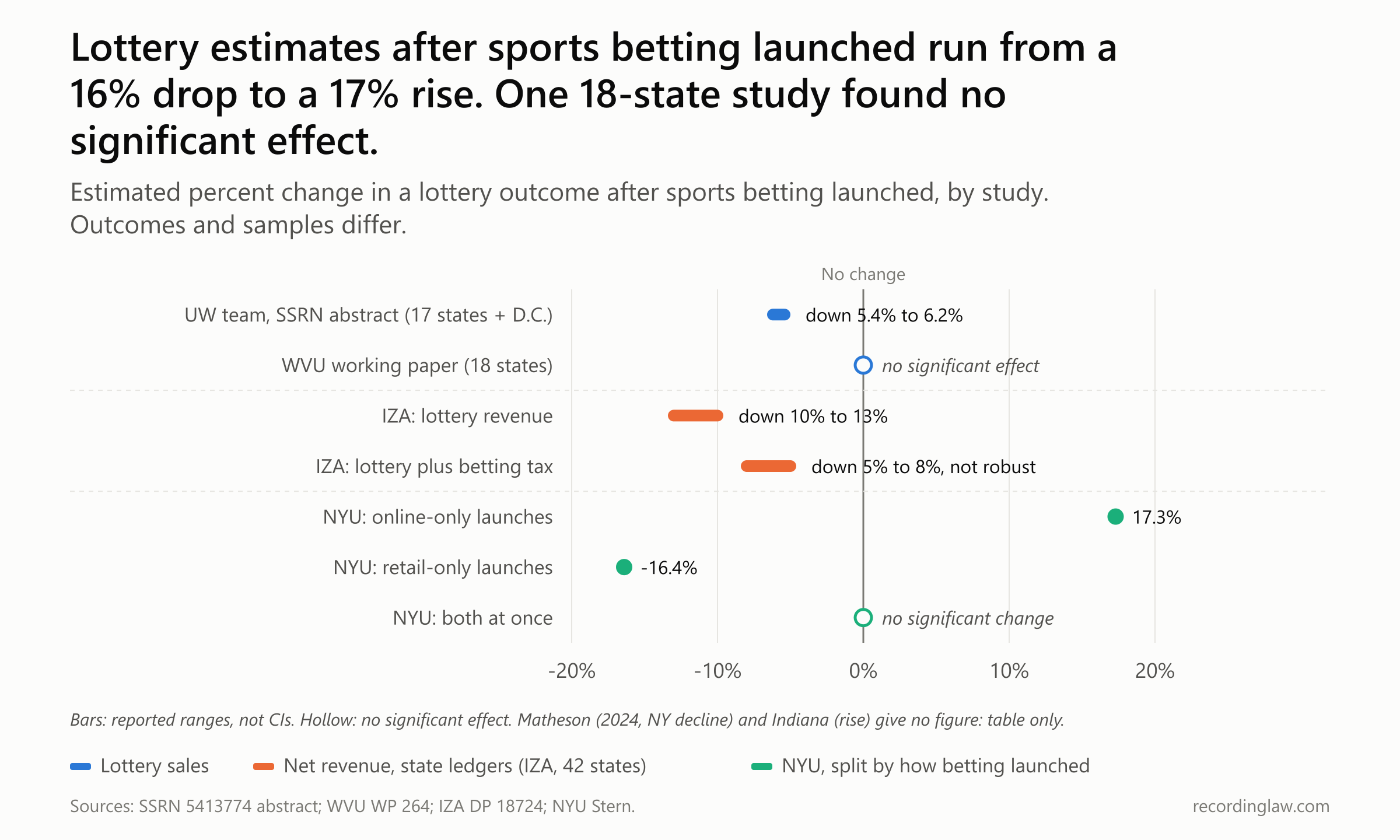
Estimated change in a lottery outcome after sports betting launched. The outcomes differ: lottery sales (UW, WVU, NYU) and net lottery revenue (IZA). Bars show the ranges the studies report; hollow circles mark results that are not statistically significant. Matheson and co-authors (2024), as cited in the IZA paper, report a modest decline and the Indiana study a rise, but neither gives a comparable percentage, so both appear in the table, not the chart. Sources: SSRN 5413774 abstract; WVU Economics Working Paper 264; IZA DP 18724; NYU Stern research highlights; UNLV gaming conference abstract.
| Study | What it measured | Estimate |
|---|---|---|
| Larsen, Vijayaraghavan and Ananthakrishnan (SSRN abstract, revised April 2026) | Lottery sales, county data from 17 states plus D.C. and store data from all 50 states, 16 months after online launch | Down 5.4% to 6.2%; net state revenue loss of $112 million |
| Coombs, Madonia, Nencka and Smith (IZA, June 2026) | Net lottery revenue, 42 states, 2012 to 2023 | Down 10% to 13%; lottery plus betting tax down 5% to 8%, not robust |
| Sy and Ishihara (NYU Stern summary, December 2025) | Convenience-store lottery sales, by launch type | Online only up 17.3%; retail only down 16.4%; both, no significant change |
| Nedved and co-authors (WVU working paper, 2026) | Monthly lottery sales, 18 states | No significant effect |
| Indiana study (conference abstract, May 2026) | Indiana non-jackpot lottery sales | No cannibalization; increase tied to retail launch |
| Matheson and co-authors (2024), as cited in the IZA paper | New York lottery sales | Modest decline; no figure given |
None names a funder in the text this page draws on (the full IZA paper; abstracts or summaries for the rest). Most are working papers that may change, as the University of Washington paper already has.
Raising the rate
While economists argued about the lottery, legislatures turned the dial they control. New York's 51% rate had looked like an outlier. "But after nearly $2 billion in collected tax revenue from sports wagering in the Empire State just since online sports formally began there in January 2022, other states are moving quickly to increase their tax rates and garner money they believe has been left on the table," Front Office Sports reported in May 2024.
Illinois moved from a flat 15% to a graduated rate of 20% to 40% on July 1, 2024. The Sports Betting Alliance, a coalition of operators including DraftKings, FanDuel, Fanatics and BetMGM, said the change would create "worse products, worse promotions, and inevitably, worse odds for Illinois customers" and "provide a massive leg up to dangerous, unregulated, and illegal offshore sportsbooks." DraftKings CEO Jason Robins told analysts: "In the end, the cost has to get absorbed by the consumer if the government raises taxes."
Ohio had already doubled its rate to 20%. In February 2025 DeWine proposed doubling it again, to 40%. "We have seen the sports gaming companies do massive advertising trying to reach people all over the state of Ohio and try to entice them into gaming," he said. "To me, it just makes sense that these sports gaming companies need to give something back."
House Finance Chair Brian Stewart, a Republican, said it was "very unlikely we include tax increases in this budget," and lawmakers removed it.
Other states went ahead. Maryland raised its online rate from 15% to 20% in May 2025.
"This wasn't just about balancing a budget," Gov. Wes Moore, a Democrat, said. "It was about weathering two storms: A fiscal crisis and a new White House that attacks our economy."
Louisiana went from 15% to 21.5%, though the original proposal was 50%. "We knew that was never going to happen. You would lose operators because the cost of doing business just isn't worth it," said Christopher Hebert, chairman of the Louisiana Gaming Control Board.
Some lawmakers in high-tax states began warning their peers. "Lawmakers need to understand, what you think you're going to get from raising taxes, you're not going to get," Illinois state Rep. Jehan Gordon-Booth, a Democrat, told a December 2025 panel of the National Council of Legislators from Gaming States. Brandt Iden, vice president of government affairs at Fanatics Betting and Gaming and a former Michigan state representative, told iGaming Business he would "not be surprised when I see a number of pieces that raise online sports betting taxes early next year."
North Carolina was one of them. Its online rate rose from 18% to 23% on July 1, 2026. House Speaker Destin Hall, a Republican, said the goal was to "line up with other states" and that lawmakers were "somewhat hesitant to tweak too much a program that's worked pretty well for the state."
FanDuel told customers that legal betting was "generating real revenue for collegiate athletic departments across the state" and that "a tax hike would threaten that funding and hit fans." Yogonet, citing WRAL, reported that the state collected about $133 million in the 2025-26 fiscal year. At 23%, it reported, the same year would have produced about $170 million.
By late 2025 the governor who signed Ohio's law had turned against it. In November the AP reported that DeWine now "absolutely" regrets signing it. "But just the power of these companies and the deep, deep, deep pockets they have to advertise and do everything they can to get someone to place that bet is really different once you have legalization of them," he said.
The next competitor
By 2026 the sportsbook tax line had a newer competitor than the lottery. Prediction markets sell contracts that pay out on the outcome of an event, including a game.
In February 2026 the American Gaming Association reported that state-regulated sportsbooks generated $3.71 billion in taxes in 2025. That is the trade group's own count for calendar 2025, not the Census figure, which covers different months and includes pari-mutuel wagering. The group also estimated that prediction markets offering sports event contracts "have diverted more than $500 million in potential sports betting tax revenue to date." The release did not say how the estimate was made.
The lotteries see the same rival. A July 2026 position paper from the North American Association of State and Provincial Lotteries warned that failing to set "appropriate regulatory parameters" for prediction markets would "undermine public benefit funding efforts."
The next national figure is the Census Bureau's tax data for July to September 2026, the first quarter of North Carolina's 23% rate. The bureau released the April-to-June data on September 10, 2026. The third-quarter tables had not been posted when we checked on November 10, 2026, and we found no published release date.
Rhode Island, where this story began, got its own warning. "If you're the first to market, you're going to benefit for a while until the other states decide if they're going to match you," Patrick Kelly, an accountancy professor at Providence College, told Rhode Island Current in 2024. "With increased competition, Rhode Island will be challenged to maintain this important revenue source," he added. "And the problem is once you get matched, more of the revenue is going to come out of the pockets of your residents."
The state that once expected more than $1 million a month from its sportsbooks collected sports-betting tax equal to 0.32% of its state tax revenue in the second quarter of 2026, the same share as in Census's count for a year earlier.
How we measured
Sports-betting tax. Quarterly figures are line T18, "Sports betting (including pari-mutuels)," in Table 3 of the Census Bureau's Quarterly Summary of State and Local Tax Revenue (QTAX), U.S. total, which excludes D.C. Each quarter is taken from that quarter's own release file, and earlier quarters may be revised in later files. The line begins in the third quarter of 2021, so it misses launches from 2018 to mid-2021, and it includes pari-mutuel wagering taxes that we cannot separate out.
Census's own December 2025 story uses a version that includes D.C., so its figures differ slightly (for example, $190 million in Q3 2021 and $917 million in Q2 2025 in its 382% headline, against $188.4 million and $925.8 million, as revised, in our files). Dollars are current, not adjusted for inflation. The same Census story dates the Illinois rate change to January 1, 2025; the statute, 230 ILCS 45/25-90(d), sets July 1, 2024, which we use.
Arithmetic. $1,091.5 million divided by $188.4 million is 5.8 ("nearly six times"). Q2 2026 sports-betting tax of $1,091.5 million divided by total state taxes of $501,508.9 million is 0.218%, or $1 in about $460. The four quarters from Q3 2025 to Q2 2026 sum to $4,254.4 million. Massachusetts: $60 million against $1.1 billion is about one-eighteenth. New York fiscal 2022: $249 million projected and $361 million collected both include $200 million in license fees; without them, the comparison is $49 million against $161 million.
State shares. The Q2 2025 shares and tax rates come from Census's Table 1 in its December 2025 story. The Q2 2026 shares are our division of each state's line T18 by its total taxes in the Q2 2026 Table 3 file; the same file's revised Q2 2025 values differ slightly from Table 1 (New York 0.91% against 0.92%). Rates are as Census listed them; Louisiana and Maryland raised theirs during 2025.
Lottery. Ticket sales, prizes and net revenue for fiscal 2008 and 2024, and net revenue as a share of sales by year, come from the Census Bureau's April 2026 story on its Annual Survey of State Government Finances; the shares were read from a published table. In those figures, net revenue equals ticket sales minus prizes. Fiscal 2024 is the latest year available. Alabama, Alaska, Hawaii, Nevada and Utah have no lottery. We did not obtain an annual lottery dollar series, so we do not chart lottery and sports-betting dollars on the same axis, and the lottery and sports-betting totals in the text cover different periods.
Per-$100 figures. From the IZA paper's flow-of-funds illustration (section 3.2), which uses its sample of states. The University of Washington's "25 cents" and "less than 1 cent" are that school's separate summary and are not on the same basis.
The studies. The University of Washington team's 43% and 57% figures appear in the Foster School article of January 21, 2026, which describes 18 states plus D.C. and names the paper "Cross-Channel Demand for Addictive Goods: Evidence from Online Sports Gambling and State Lotteries." The SSRN abstract revised April 24, 2026, under the title "Gambling Spillovers: Evidence from Online Sports Gambling and State Lotteries," describes 17 states plus D.C. and a $112 million cumulative loss (95% confidence interval: losses of $12 million to $213 million). This page draws on the article and the abstract; neither describes the method behind the 43% figure.
The IZA paper (June 2026) uses 504 state-years across 42 states, Census lottery data through fiscal 2023, and excludes Nevada, Delaware and states without lotteries. Its lottery-only estimates are statistically significant; its combined lottery-plus-betting estimates are significant at the 10% level in one specification and not in others.
NYU Stern's figures come from the school's summary. The Indiana and West Virginia University studies were read from their abstracts. Matheson and co-authors (2024) appear only as the IZA paper describes them, with no percentage.
Estimates chart. Bars are the ranges each source states (5.4% to 6.2%; 10% to 13%; 5% to 8%), not confidence intervals; the IZA paper reports standard errors, which we do not convert. Hollow circles at zero mark studies that report no significant effect; they are not estimates of zero. Matheson and co-authors (a decline) and the Indiana study (a rise) report a direction with no comparable percentage, so they are in the table and not on the chart. The $112 million loss in the University of Washington abstract is in dollars and is not on the chart.
The studies measure different outcomes (net lottery revenue, lottery sales, convenience-store sales) over different samples and periods, so their percentages are not directly comparable. None can account for every other change in gambling over the same years.
What comes next. Census's QTAX tables for July to September 2026, the first quarter of North Carolina's 23% rate, had not been posted on November 10, 2026; the second-quarter tables came out September 10, 2026. The lottery side runs further behind: Census's newest lottery data are for fiscal 2024. The University of Washington and IZA papers, the two that put a price on the swap, are working papers, and the Washington paper has already been revised since its university first publicized it.
What the data cannot show. Rising tax collections reflect new states launching, rate increases and growth in betting at once; this page does not separate them.
Lottery sales rose nationally over the same years that sports betting spread, and the share of sales left after prizes was falling before 2018. Trade-press sources (Covers, Legal Sports Report, iGaming Business, Yogonet, Gambling Insider) are betting-industry publications and are used here for dated facts and attributed quotes. Industry figures from the American Gaming Association are its own estimates.
Frequently Asked Questions
How much do states collect in sports betting taxes?
In the second quarter of 2026, states collected $1,091.5 million in tax on sports betting, according to the Census Bureau's quarterly tax survey. That figure includes pari-mutuels, such as bets on horse races. Collections were $1,171.6 million in the fourth quarter of 2025 and $4,254.4 million over the four quarters ending June 2026. The American Gaming Association, the industry trade group, reported that state-regulated sportsbooks generated $3.71 billion in taxes in calendar 2025. That is the trade group's own count, not the Census figure.
Does sports betting reduce state lottery sales?
Studies disagree. A June 2026 IZA discussion paper covering 42 states estimates a persistent 10% to 13% decline in net lottery revenue. The abstract of a University of Washington team's revised paper reports lottery sales down 5.4% to 6.2% in 16 months after online launches. A West Virginia University working paper on 18 states finds no significant effect, and an Indiana study finds no cannibalization. An NYU Stern study finds lottery sales rose 17.3% after online-only launches and fell 16.4% after retail-only launches.
Is only 43% of sportsbook tax revenue new money?
That figure comes from a University of Washington Foster School article published in January 2026, which said the other 57% would have come from lottery sales. The abstract of the research team's paper, as revised on April 24, 2026, does not state that split. It reports a cumulative state revenue loss of $112 million across 17 states and D.C., with New Jersey and Pennsylvania losing and most other states breaking even. Neither the abstract nor the article shows how the 43% was calculated.
How much does a state keep from $100 spent on the lottery versus sports betting?
According to the IZA paper by Coombs, Madonia, Nencka and Smith, about $65 of every $100 spent on the lottery goes to prizes, about $4.50 to administration and about $30 to the state. On sports betting, over $91 of every $100 goes back to bettors, and states collect $0.50 to $4.50 per $100 wagered, $1.59 on average in the paper's sample.
What share of state tax revenue comes from sports betting?
About 0.22% nationally in the second quarter of 2026. New York had the highest share in the Census Bureau's top-10 list, 0.92% in the second quarter of 2025 by the Census Bureau's count and 0.90% in the second quarter of 2026 by our calculation from Census data.
What are state sports betting tax rates?
The Census Bureau lists rates from 6.75% (Iowa, Nevada) to 51% (New Hampshire, New York, Rhode Island). Several states raised rates recently: Illinois to a graduated 20% to 40% on July 1, 2024, Maryland's online rate from 15% to 20% in 2025, Louisiana from 15% to 21.5% in 2025, and North Carolina's online rate from 18% to 23% on July 1, 2026.
Updates
Reworded for readability. No figures, quotes, sources or findings changed.
Restructured as a feature: chart titles state the finding, side details moved to How we measured. Every figure and quote was re-checked against its source.
Independently fact-checked against the cited primary sources
Independently fact-checked against the cited primary sources
Sources and References
- U.S. Census Bureau, Quarterly Summary of State and Local Tax Revenue (QTAX), Table 3 quarterly files, Q3 2021 to Q2 2026(census.gov).gov
- U.S. Census Bureau, QTAX Table 3, second quarter 2026 (released September 10, 2026)(www2.census.gov).gov
- U.S. Census Bureau, QTAX program page (release status)(census.gov).gov
- U.S. Census Bureau, America Counts: state sports-betting tax revenue (December 2025)(census.gov).gov
- U.S. Census Bureau, America Counts: state lottery ticket sales (April 2026)(census.gov).gov
- Coombs, Madonia, Nencka and Smith, Gambling with State Budgets: Legalized Sports Betting and Lost Lottery Revenue, IZA DP No. 18724 (June 2026)(docs.iza.org)
- Larsen, Vijayaraghavan and Ananthakrishnan, Gambling Spillovers: Evidence from Online Sports Gambling and State Lotteries, SSRN 5413774 (revised April 24, 2026)(papers.ssrn.com)
- University of Washington Foster School of Business, news article on online sports gambling and state lotteries (January 21, 2026)(foster.uw.edu)
- NYU Stern Research Highlights, Apps vs. scratch-offs: does sports betting cannibalize lottery sales? (December 2025)(stern.nyu.edu)
- Nedved, Nason, Hoffer, Ferreira Neto and Humphreys, Sports Betting, Lotteries, and State Revenues in the Post-PASPA Era, WVU Economics Working Paper 264 (2026)(researchrepository.wvu.edu)
- Do Sportsbooks Cannibalize Lottery Play? Evidence from Non-Jackpot Lottery Sales in Indiana, International Conference on Gambling and Risk Taking abstract (May 2026)(oasis.library.unlv.edu)
- Associated Press analysis, Most states falling short on early projections for sports betting (April 2019), via Indianapolis Business Journal(ibj.com)
- Pew Charitable Trusts, States jump at chance to boost revenue with sports betting (2019)(pewtrusts.org)
- American Gaming Association, Economic impact of legalized sports betting (Oxford Economics study, June 2017)(americangaming.org)
- American Gaming Association, 2025 commercial gaming revenue release (February 26, 2026)(americangaming.org)
- The Fiscal Times, States bet big on sports gambling (May 2019), quoting a Tax Policy Center report(thefiscaltimes.com)
- Tax Foundation, Ulrik Boesen on Colorado Proposition DD (October 2019)(taxfoundation.org)
- Legal Sports Report, Cuomo budget address (January 2020)(legalsportsreport.com)
- City & State New York, New York cashing in on mobile sports betting (March 2023)(cityandstateny.com)
- Office of the Governor of New York, first 30 days of mobile sports wagering (February 14, 2022)(governor.ny.gov).gov
- Office of the Governor of New York, fiscal 2022 mobile sports wagering tax revenue (July 8, 2022)(governor.ny.gov).gov
- Office of the Governor of New York, first year of mobile sports wagering (January 2023)(governor.ny.gov).gov
- WHIO-TV, How revenue from legalized sports betting will impact Ohio (December 2021)(whio.com)
- Ohio Legislative Service Commission, fiscal note for H.B. 29 as enacted (February 2022)(legislature.ohio.gov).gov
- The Closing Line (Dustin Gouker), sports betting tax revenue versus projections (July 2025)(closingline.substack.com)
- CommonWealth Beacon (State House News Service), Lottery facing headwinds (September 2022)(commonwealthbeacon.org)
- iGaming Business, sports betting and lottery sales (June 2024)(igamingbusiness.com)
- Front Office Sports, More states hiking sports betting taxes (May 2024)(frontofficesports.com)
- 13abc (WTVG), DeWine proposes doubling sports betting tax to 40% (February 2025)(13abc.com)
- Legal Sports Report, Ohio lawmakers drop sports betting tax hike (April 2025)(legalsportsreport.com)
- Covers, Maryland governor signs mobile sports betting tax increase (May 2025)(covers.com)
- iGaming Business, National Council of Legislators from Gaming States panel on sports betting taxes (December 2025)(igamingbusiness.com)
- Yogonet, North Carolina lifts online sportsbook tax from 18% to 23% (June 2026)(yogonet.com)
- Associated Press, DeWine signed a law legalizing sports betting, now opposes it (November 2025), via Spectrum News 1(spectrumnews1.com)
- North American Association of State and Provincial Lotteries, prediction markets position paper (July 2026)(cibelae.net)
- Rhode Island Current, Rhode Island sports betting revenue and competition (October 2024)(rhodeislandcurrent.com)
- Illinois General Assembly, 230 ILCS 45/25-90, Sports Wagering Act tax provisions(ilga.gov).gov