Since 2024, Atlantic City's Casinos Have Won More Online Than on Their Slot Machines

Independently fact-checked against primary sources (last audited November 9, 2026). · 16 primary sources cited on this page. How we verify our legal content
On May 26, 1978, Resorts International opened Atlantic City's first casino inside the old Chalfonte-Haddon Hall on the Boardwalk, a hotel it had bought for $2.5 million. Fire marshals allowed 5,500 people onto the small casino floor. It took less than 10 minutes after the doors opened to reach that limit, the Philadelphia Daily News recounted on the 30th anniversary.
Gov. Brendan Byrne cut the ribbon. "My father always told me not to bet on anything but Notre Dame and the New York Yankees," he said. "For those of you not willing to follow my father's advice, this casino is now open." Police estimated that 350,000 people came into the city over the 72-hour Memorial Day weekend.
New Jersey's plan for the city depended on crowds like that one, and on Atlantic City being the only place nearby where they could gamble. In 1976 the state's voters had approved casinos on one condition, which the campaign's slogan put as "Casinos Yes, Atlantic City Only." As the state's Casino Control Commission tells it, the question went to them as "a unique tool of urban redevelopment."
Neighboring states then built casinos of their own. Several of their leaders said openly that they wanted back the money their residents were spending in other states' casinos, New Jersey's among them.
In the casino business, the money gamblers lose to the house is called win. It is counted before taxes, and it is not profit. In 2025, Atlantic City's nine casinos won $2.9 billion from slot machines and table games, according to the Center for Gaming Research at the University of Nevada, Las Vegas (UNLV). This story calls those two together the casino floors.
The floors' 2025 win is 55% of what they won in 2006, the peak year, and after adjusting for inflation it is about a third. The same casinos' total win in 2025, which also counts online games and sports betting, was $6.9 billion, a record before inflation. Adjusted for inflation, it was about 17% below 2006.
Most of that total, 58%, came from two kinds of gambling that New Jersey did not allow until 2013 and 2018. The first is internet gaming, meaning casino games played for money online, which began in 2013. The second is sports betting, which began in 2018.
What happened to Atlantic City once it stopped being the only place to gamble, and what is holding up its numbers now? The answer runs through five ballot questions, four casino closings in one year, a state takeover of the city and a legal deadline in November 2028.
Until 2013, slots and tables made up nearly all of the casinos' win. After that, the total and the floors split apart.
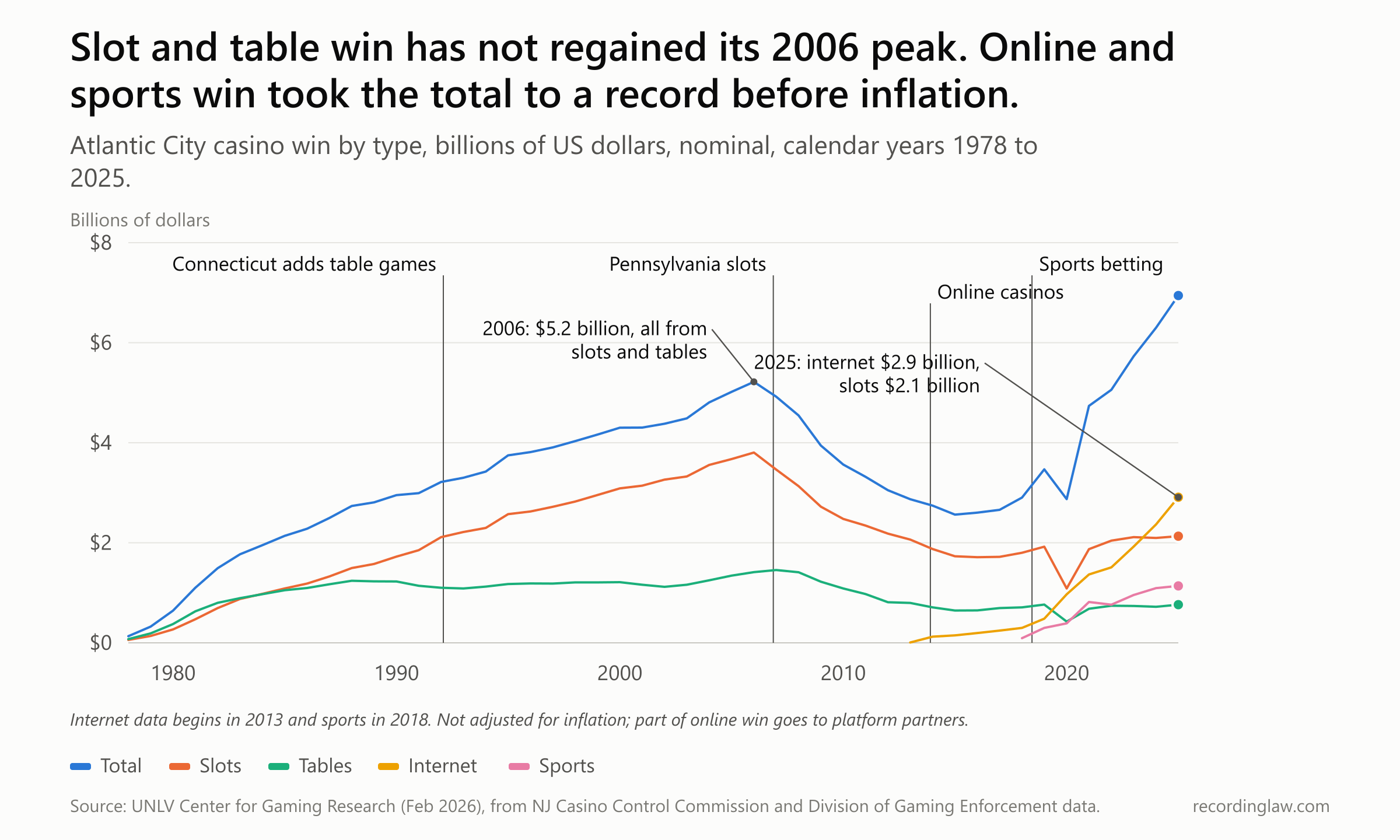
Atlantic City casino win by type, nominal dollars, calendar years. Internet data begins in 2013 and sports in 2018. Source: UNLV Center for Gaming Research, from New Jersey Casino Control Commission and Division of Gaming Enforcement data.
| Year | Slots | Tables | Internet | Sports | Total |
|---|---|---|---|---|---|
| 1985 | $1,087.7 million | $1,050.9 million | none | none | $2,138.7 million |
| 2006 | $3,803.6 million | $1,414.0 million | none | none | $5,217.6 million |
| 2015 | $1,731.5 million | $647.1 million | $148.9 million | none | $2,563.1 million |
| 2020 | $1,088.1 million | $424.4 million | $970.3 million | $390.1 million | $2,873.0 million |
| 2024 | $2,096.1 million | $721.4 million | $2,368.4 million | $1,094.6 million | $6,299.3 million |
| 2025 | $2,131.6 million | $762.5 million | $2,911.2 million | $1,138.1 million | $6,943.4 million |
The chart counts dollars as they were, not adjusted for inflation. It cannot say why the floors fell.
From 1978 through 1992, Atlantic City held what a Federal Reserve economist later called a regional monopoly on casinos east of the Mississippi River. That monopoly grew out of a vote that failed.
Casinos yes, Atlantic City only
The one-city condition came out of a defeat. In November 1974, voters rejected a constitutional amendment, 1,202,638 to 790,777. It would have allowed casinos throughout the state, subject to local approval. Only Hudson and Atlantic counties voted yes.
The New York Times headlined its story "Outlook for Atlantic City is Bleak, Gambling Setback Casts a Pall over Atlantic City," according to a history of the period published by Rutgers University's Center on the American Governor. Two years later the question came back, narrowed to one city.
The 1976 campaign sold the narrowing as protection. Its supporters used "an effective, not-in-your-backyard slogan," the Las Vegas Sun wrote in a 1996 retrospective, "Casinos Yes, Atlantic City Only," and "they sold the promise of jobs, urban revitalization and help for senior citizens."
A month before the vote, Assemblyman Howard Kupperman told the Pleasantville Republican Club, "You don't have to be in favor of gambling to vote for it." He added: "You have to be in favor of seeing Atlantic City reborn again."
Seniors and voters with disabilities were told, according to the state's Casino Revenue Fund Advisory Commission, that "up to 15% of the Gross Casino receipts would be placed in a Special Fund for programs that would benefit seniors and persons with disabilities only." The law enacted in 1977 set the share at 8%.
The money was one-sided. Pro-casino committees spent $1,330,615, and opponents spent $21,250, according to the state's Election Law Enforcement Commission. That is about $63 on the pro-casino side for every dollar on the other side. Resorts International, then a Miami firm, gave $201,630, the largest single contribution in support.
The opponents' warnings were about crime and gamblers' losses. Organized under the slogan "Casinos: No Dice," they "predicted casinos would turn the city into a cesspool of con men, Mafia dons and loan sharks while bankrupting the hapless patrons," the Sun reported.
"It's not gambling I'm against," said Alan Kligerman, the Atlantic City businessman credited with the slogan. "It's the element that would be drawn here by it. They say they can keep out organized crime. Bull. Lie down with dogs and you're going to catch fleas."
In 1974, U.S. Attorney Jonathan Goldstein, whose office had won convictions of two former Atlantic City mayors, had argued that organized crime would be the main beneficiary of legal casinos. None of the campaign warnings in the record we reviewed concerned what would happen if other states legalized casinos too.
On November 2, 1976, Public Question 1 passed, 1,535,249 to 1,180,799, with 56% of the vote. On June 2, 1977, after a boardwalk parade, Byrne signed the Casino Control Act in front of Atlantic City's Convention Hall. "Keep your filthy hands off Atlantic City," he told organized crime. "Keep the hell out of our state!"
The Act set out its goal as "the restoration of Atlantic City as the Playground of the World and the major hospitality center of the Eastern United States." The 1977 Act let only major hotel and convention facilities hold casino licenses, so that casinos would not become what the Casino Control Commission's summary calls "the industry unto themselves that they have become in other jurisdictions." Less than a year later, Resorts opened its doors on the Boardwalk.
What did fourteen years alone buy?
For the 14 years its monopoly lasted, Atlantic City's casino floors grew fast. Resorts had the city's casino trade to itself for 13 months, until Caesars Boardwalk Regency opened on June 26, 1979.
Casino win went from $325 million in 1979, the first full year, to $2.1 billion in 1985. UNLV puts the average growth from 1978 to 1985 at 55% a year.
The jobs came with it. This is the one part of the story that has been measured with a causal design. Adam Scavette, then an economist at the Federal Reserve Bank of Richmond, compared Atlantic County with New Jersey's 20 other counties using a method called synthetic difference-in-differences. It builds a stand-in for Atlantic County from a weighted blend of the other counties, then compares the two paths before and after the casinos arrived.
He found that casino development raised Atlantic County's payroll employment by 26% within five years, by 38% within ten and by 45% within fifteen. It raised wages by about 9% to 10%. Over the first five years, he found that personal income rose 5% and house prices 19%. He found significant rises in those two only at that five-year horizon, not at ten or fifteen years.
He found no statistically significant effect on population, meaning his estimate for population could not be told apart from zero. The working paper's conflict-of-interest statement says, "No specific funding has been received for this study."
The county and the city did not move together. During the 1980s, Scavette wrote, Atlantic City "lost 6 percent of its population, while retaining its high poverty and unemployment rates," while Atlantic County grew its population by 16%.
A 2022 Richmond Fed survey of the research, also by Scavette, put it this way: "many researchers conclude that the industry did not have a significant lasting positive impact on the city's economy, nor did it spur widespread urban development beyond the casinos themselves." It added: "To this day, the city notoriously has difficulty keeping a single grocery store open."
The 1977 Act had required each casino to reinvest 2% of its gross gaming revenue, the legal term for win. But "by the beginning of 1984, no casino licensee had yet made any of its required reinvestments," according to the Casino Reinvestment Development Authority. The state created that authority in 1984 to channel the reinvestment into the city.
Steven Perskie, the assemblyman who pushed the referendum, wrote the casino law and later chaired the Casino Control Commission, was asked about the city in 1996. "I'm not telling you I'm proud of the pace. The pace has been an embarrassment," he said.
By then the monopoly had been over for four years. In February 1992, the Mashantucket Pequot Tribal Nation added table games, and soon slot machines, to its bingo hall in Ledyard, Connecticut, a development that, the Rutgers history says, "received little notice at the time but which in later years would pose threats to the viability of the Atlantic City domination of East Coast casino gaming." Mohegan Sun opened nearby on October 12, 1996.
Scavette's peer-reviewed version of the study, in Regional Science and Urban Economics (2023), found "evidence that the city's 1992 monopoly expiration negatively impacted the growth of local wages and personal income through 2000." That finding is about how fast the county's wages and income grew, not about casino win. During the monopoly era, Atlantic County's employment had grown 122%, against 28% for the state. In the next ten years, it grew 14%, against the state's 17%.
The neighbors said what they were after
Losing the monopoly did not shrink Atlantic City's casino floors right away. Slots and tables won $3.2 billion in 1992 and more every year after, reaching $5.2 billion in 2006.
In Pennsylvania, a leading senator named New Jersey. On July 2, 2004, the Pennsylvania Senate passed a slots bill 30-20.
Afterward Sen. Vincent J. Fumo, a Philadelphia Democrat and one of the bill's chief architects, said the billions Pennsylvanians gambled in other states, such as New Jersey, would come home. "This is a competitive decision we're faced with, keeping our money inside our borders," he said.
Gov. Ed Rendell signed it three days later at Philadelphia Park, a thoroughbred track in Bensalem. The law authorized 61,000 slot machines at 14 sites, with most of the state's share going to cut property taxes. "It isn't a panacea, but it certainly isn't the demon it's been made out to be," Rendell said. "It's a good, significant step on the road to property-tax relief."
The Philadelphia Inquirer later reported that Rendell and the bill's supporters said the casinos would raise about $1.6 billion a year for the state.
The opponents spoke in the same debate. "We must addict tens of thousands of Pennsylvanians who have to lose to make this work," said Senate President Pro Tempore Robert C. Jubelirer, a Blair County Republican. "I'm not sure that's such good economic policy."
Other opponents predicted "a proliferation of crime, gambling addiction and other social ills" and complained the bill "was crafted in secret by a handful of party leaders."
Pennsylvania's first slots parlor, Mohegan Sun at Pocono Downs, opened on November 14, 2006. Statewide slot revenue in that first month was $8.8 million, according to the Pennsylvania Gaming Control Board.
That same year Atlantic City's floors had their best year on record.
The floors fall for ten straight years
In 2007, the first full year of Pennsylvania slots, Atlantic City's 11 casinos took in $4.9 billion, down from the 2006 peak. Pennsylvania's six slots parlors took in $1 billion. "The impact of Pennsylvania slots on Atlantic City has been dramatic," the Inquirer wrote in February 2008.
Other things changed in Atlantic City at the same time. In July 2006, a state budget crisis had closed the casinos for three days, because state regulators were not allowed to work. In mid-April 2007, smoking restrictions took effect on casino floors. Then the recession arrived.
Because those events overlap with Pennsylvania's opening, the revenue figures cannot say how much of the decline came from competition.
People in the industry disagreed about what came next. In September 2007, Mark Juliano, chief executive of Trump Entertainment Resorts, said of Pennsylvania slots, "The biggest impact has been felt already, and I think it will continue to dissipate." Andrew Zarnett of Deutsche Bank said that month, "Pennsylvania's impact is clearly unquestioned, and that impact will continue to worsen as Pennsylvania grows its slots capacity over the next two years."
Atlantic City's slots and tables fell every year from 2007 through 2016, ten straight years. Pennsylvania competed while taxing much more heavily. In early 2008 its tax took 55% of gross slots revenue, against New Jersey's 9.25% on gross gaming revenue.
"Pennsylvania knew that it had to compete with Atlantic City in the sense that the gaming facilities and the amount of [payouts] couldn't be any less than what is offered in Atlantic City, even though we are paying over six times the amount in tax," Bob Green, chairman of Greenwood Gaming and Entertainment, which owns Parx, said in 2013.
Maryland came next. On November 4, 2008, its voters approved up to 15,000 slot machines at five sites, 58.7% to 41.3%. "We believe it will jump-start the Maryland economy," said Tom Saquella, president of the Maryland Retailers Association. State officials projected at least $600 million a year for the state.
Comptroller Peter Franchot, the most vocal opponent, said the other side had "made promises they would never, ever be able to keep." Maryland's first casino, Hollywood Casino Perryville, opened on September 30, 2010.
In July 2009, Connecticut's two tribal casinos put up billboards aimed at Atlantic City gamblers, the Rutgers history records, headlined "Way Beyond the Boredwalk" and "Escape the Jersey Snore."
Did the region's casino business shrink, or did it spread out to new places?
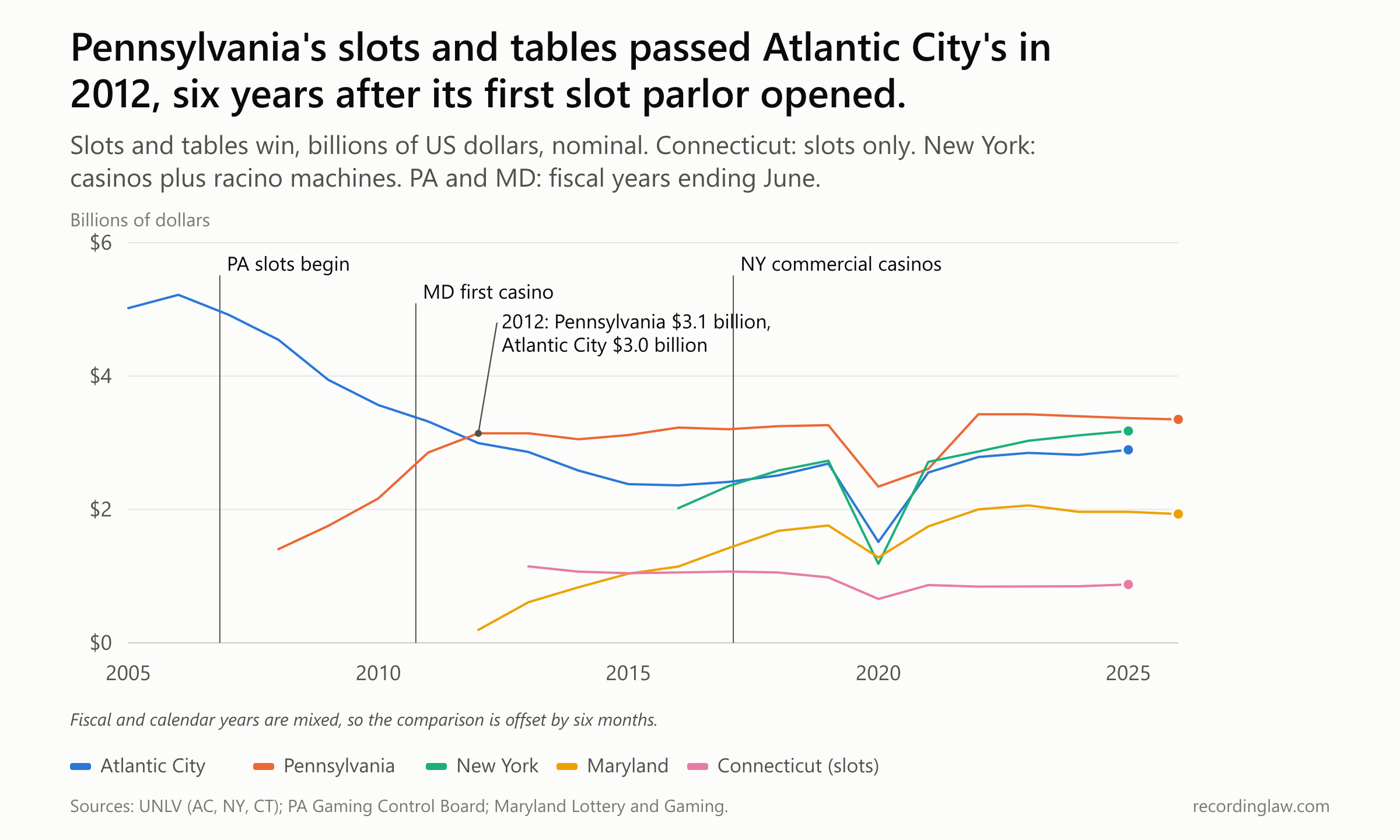
Slots and tables win, nominal dollars. Pennsylvania and Maryland are fiscal years ending in June; Connecticut is slots only; New York combines commercial casinos and racetrack video gaming machines. Sources: UNLV Center for Gaming Research, Pennsylvania Gaming Control Board, Maryland Lottery and Gaming.
Atlantic City's floors fell while Pennsylvania and Maryland built casino markets from scratch and New York added commercial casinos. The four neighbors' latest figures, some for fiscal years and some for calendar years, add up to about $9.3 billion. That is more than three times Atlantic City's $2.9 billion.
| Market (basis) | 2012 | 2025 or fiscal 2026 |
|---|---|---|
| Atlantic City, slots and tables (calendar year) | $2,994.7 million | $2,894.1 million (2025) |
| Pennsylvania, slots and tables (fiscal year ending June) | $3,140.6 million | $3,349.9 million (FY2026) |
| Maryland, casino revenue (fiscal year ending June) | $194.5 million | $1,931.5 million (FY2026) |
| New York, commercial casinos plus video gaming (calendar year) | not collected | $3,176.5 million (2025) |
| Connecticut, Foxwoods and Mohegan Sun slots only (calendar year) | not collected | $875.5 million (2025) |
The crossing came in 2012. Pennsylvania took in $3.16 billion from slots and table games that year against Atlantic City's $3.05 billion, the Inquirer reported in January 2013, six years after Pennsylvania's first parlor opened. The Inquirer's figures are for calendar 2012, and the table above uses Pennsylvania's fiscal year, which shows the same crossing. Rendell said the tens of thousands of casino and racetrack jobs, along with the school property-tax cuts for seniors, were "vindication for me."
Michael Pollock, managing director of Spectrum Gaming Group, a consultancy in Linwood, New Jersey, described the difference as geography. "Pennsylvania policymakers made a conscious decision to put gaming where the population is, and New Jersey policymakers made a conscious decision to put gaming away from the population centers," he said. "Atlantic City is not designed for convenience."
How far did the floors fall once inflation is counted?
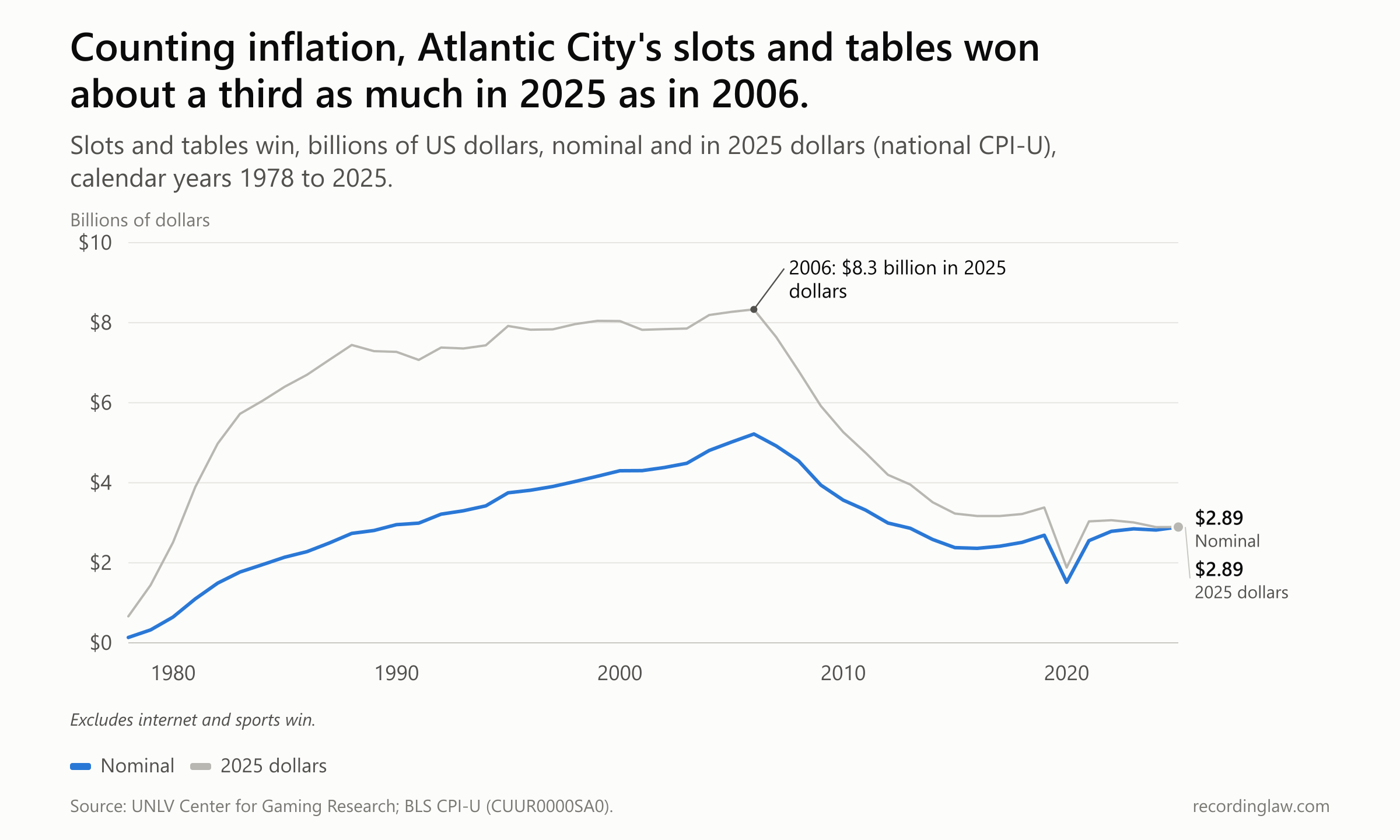
Atlantic City slots and tables win, in nominal dollars and adjusted to 2025 dollars with the national consumer price index (CPI-U). Sources: UNLV Center for Gaming Research; U.S. Bureau of Labor Statistics.
Adjusted for inflation to 2025 dollars, the floors won about $8.3 billion in 2006. They won $2.9 billion in 2025, which is about 35% as much.
| Year | Nominal | In 2025 dollars |
|---|---|---|
| 1988 | $2,734.8 million | $7,442.4 million |
| 2006 (peak) | $5,217.6 million | $8,332.2 million |
| 2015 | $2,378.5 million | $3,230.8 million |
| 2020 | $1,512.5 million | $1,881.5 million |
| 2025 | $2,894.1 million | $2,894.1 million |
Four casinos closed in one year
By 2010, New Jersey's own governor was talking about the city's years as a monopoly. That July, Gov. Chris Christie endorsed a commission's recommendations for the city.
"Atlantic City is dying," he said, according to the Rutgers history, which quotes the Inquirer. "For 30 years, Atlantic City has had a monopoly on gambling. As a result," he said, "Atlantic City has not done everything to change to exploit its natural advantages."
The commission's consultant, McKinsey & Company, attributed some of the lost visitors and revenue to the city's failure to develop more attractions outside gambling.
That August, Atlantic City's first casino changed hands for a fraction of its earlier price. Resorts International sold for $35 million, the Rutgers history says, after being bought in 2001 for $140 million and an additional $110 million spent on a new tower.
The casino industry, for its part, opposed two ways of expanding gambling in New Jersey: casinos outside the city and internet gaming. Mark Juliano, by then president of the Casino Association of New Jersey, warned in 2010 that slots or table games elsewhere in the state "would not only take substantial gaming revenue from our casino resorts" but would also make it harder to attract the private capital needed to revitalize the city.
Christie had vetoed an earlier internet gaming bill. In that veto, he had asked for a state review after 10 years and a tax on online winnings of 15% instead of 10%. In February 2013 the Legislature passed internet gaming, and Christie signed it hours later.
Sen. Raymond Lesniak, one of the strongest proponents of online gambling, made a prediction. "Internet gaming will give an immediate boost to the outlook for Atlantic City's future, preventing the closing of at least one casino, and saving thousands of jobs," he said.
New York voted that November. Its Proposal One allowed up to seven casinos.
It was approved 57% to 43% in the Associated Press's partial count, at 60% of precincts. Gov. Andrew Cuomo said the vote "will keep hundreds of millions of dollars spent each year in neighboring states right here in New York."
Blair Horner of the New York Public Interest Research Group, a good-government advocacy group, said of the ballot wording, "It has more spin than a roulette wheel." The AP noted that the wording did not mention "the decline of some casinos from New Jersey's Atlantic City to those run by Indian tribes."
In 2014, four of Atlantic City's 12 casinos closed. The Atlantic Club went in January and the Showboat at the end of August. Revel, which cost $2.4 billion to build and opened in April 2012, closed on September 2 after its owners twice sought bankruptcy protection. Trump Plaza followed on September 16.
WHYY put the job loss from all of that year's closings at 8,000. NPR and WNYC reported more than 6,500 layoffs in the late-summer weeks alone. How many casino jobs were left?
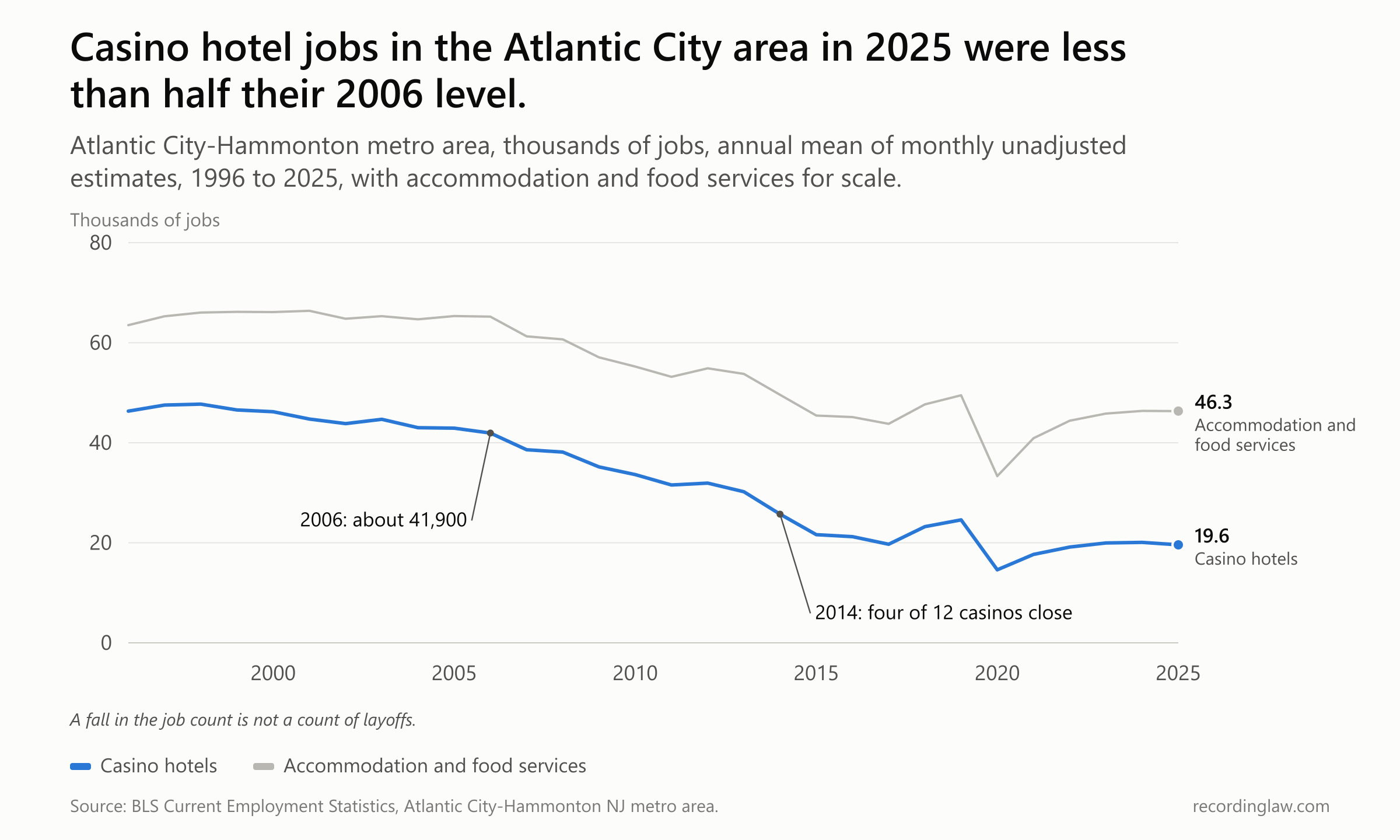
Casino hotel employment and the wider accommodation and food services sector, Atlantic City-Hammonton metro area (Atlantic County), annual average of monthly estimates, not seasonally adjusted. Source: U.S. Bureau of Labor Statistics, Current Employment Statistics.
Casino hotel jobs in the Atlantic City-Hammonton metro area, which is Atlantic County, averaged about 41,900 in 2006, 30,200 in 2013 and 21,600 in 2015.
| Year | Casino hotel jobs | Accommodation and food services jobs | All nonfarm jobs |
|---|---|---|---|
| 1998 | 47,730 | 66,040 | 181,900 |
| 2006 | 41,940 | 65,210 | 196,860 |
| 2013 | 30,200 | 53,750 | 176,080 |
| 2015 | 21,610 | 45,430 | 170,440 |
| 2019 | 24,580 | 49,500 | 176,090 |
| 2025 | 19,590 | 46,330 | 175,660 |
The state steps in, and voters keep the monopoly
The AP tied the city's budget troubles to the casinos' decline. Many of the remaining casinos won property tax appeals, "convincing a tax court that they are worth less in a diminished market than they were when times were better," the AP reported in January 2016.
"Atlantic City's finances are now the greatest threat to the city's well-being," Christie said that month. Senate President Stephen Sweeney said the city was "spending $3 and taking $1 in, and that doesn't work."
On October 10, 2016, the Trump Taj Mahal closed just before 6 a.m., after a strike, and about 3,000 workers lost their jobs.
The owner, Carl Icahn, and the union disagreed in public about why. "There is no way that Carl Icahn made the decision based upon finances," said Bob McDevitt, president of UNITE HERE Local 54. "This was an attack on workers who stood up to him." Icahn has said the union "is one of the main contributors to the problems in Atlantic City."
The next month the state took control of the city's finances. It used the Municipal Stabilization and Recovery Act, the takeover law lawmakers had passed that spring.
On November 8, 2016, New Jersey voters rejected casinos in North Jersey, 2,400,081 to 707,064. Forty years after "Casinos Yes, Atlantic City Only," 77% of voters kept it that way.
Internet gaming passes the slot machines
The money that later took Atlantic City's casinos to a record total before inflation came from outside their floors, first through internet gaming and later through sports betting. Online casinos went live in New Jersey on November 26, 2013. Internet win was $123 million in 2014, the first full year, and $970 million in 2020.
Sports betting took longer. In 1992 Congress passed the Professional and Amateur Sports Protection Act (PASPA), which made it unlawful for a state to authorize betting on sports. One provision would have let New Jersey set up sports betting in Atlantic City within a year.
New Jersey "did not take advantage of this special option, but by 2011, with Atlantic City facing stiff competition, the State had a change of heart," the Supreme Court wrote on May 14, 2018, when it struck PASPA down in Murphy v. National Collegiate Athletic Association. The ruling went New Jersey's way after years in court over sports betting.
Gov. Phil Murphy signed the state's sports betting law on June 11. "Our casinos in Atlantic City and our racetracks throughout our state can attract new business and new fans, boosting their own long-term financial prospects," he said.
The AP reported that the law was seen as "a modest help to Atlantic City's seven casinos, which have recently regained their footing after five others closed down since 2014."
Three days later, Murphy placed $20 on Germany to win the World Cup and $20 on the New Jersey Devils to win the next Stanley Cup at Monmouth Park racetrack, which was set to take the state's first legal sports bets from 10:30 a.m. The Borgata, about 70 miles south and set to start 30 minutes later, was the first Atlantic City casino to offer sports betting.
Then the pandemic closed every casino on March 16, 2020. Slots and tables won $1.5 billion that year, the lowest since 1982. Internet win kept rising.
Which part of Atlantic City's casino business carries its totals now? Since 2023, internet and sports win added together have been larger than slots and tables added together. In 2024, internet win alone passed slot machine win. In 2025 internet games won $2.9 billion, slot machines $2.1 billion and sports betting $1.1 billion, the split in the first chart above.
Internet gaming is one of the two expansions the casino industry opposed in 2010, and not all of its win stays with the casinos. The 2013 law let Atlantic City casinos tether their brick-and-mortar licenses to online gaming, which means a casino can lend its license to online casino platforms and partner with several of them. The Borgata, for one, had lent its license to 11 online partners, Casino.org reported in 2023.
The state counts those partners' online revenue in the casino's monthly internet figures, and casino representatives have said the monthly revenue reports are "quite misleading, as a considerable portion of the online money goes to the internet operator," rather than the casino, the site reported. None of the sources for this story says how large that share is.
The record total before inflation did not bring the jobs back. In 2025, the casinos' total win was 33% higher than in 2006 before inflation, and about 17% lower after it. Casino hotel employment that year averaged about 19,600, less than half its 2006 level of about 41,900. The metro area's total nonfarm jobs, about 175,700, were roughly where they were in 1996.
Scavette's 2022 survey offered a view of what new gambling can do now: "as the means to gamble proliferate and gambling-restricted states dwindle, commercial casino expansion is less likely to induce economic growth."
What comes due in 2028
Internet gaming, now the largest single source of Atlantic City's win, runs on a legal clock.
The 2013 law that Christie signed authorized online casino games for 10 years. In June 2023, Murphy signed a law extending that to 15 years after the November 26, 2013, start. The authorization now expires in late November 2028, "unless reauthorized by law." Internet win was 42% of Atlantic City's total in 2025.
So far it is still growing. In 2026 through September, the state's figures show in-person casino win of $2.24 billion. That was up 1.4% from the same months a year earlier.
Over those months, internet gaming won $2.40 billion, up 13.2%. Sports wagering revenue fell 6.3%.
Those internet figures now carry a higher tax. In June 2025 the Legislature raised the rate on online gaming and online sports wagering to 19.75% as part of the fiscal 2026 budget.
The competition is still moving closer. Casino.org reported that in December 2025, New York approved three casino licenses in New York City: Resorts World and Hard Rock Metropolitan Park in Queens, and Bally's in the Bronx. It also reported that some New Jersey lawmakers say North Jersey needs its own casino to compete.
The deadline to put a North Jersey casino question on the November 2026 ballot passed on August 3 with no action. A resolution to allow casinos at the Meadowlands and Monmouth Park racetracks was filed.
The state also still runs the city. On January 20, 2026, Murphy signed a six-year extension of state oversight of Atlantic City, which now runs to December 1, 2031.
In 1978, Byrne opened a casino floor that filled in under ten minutes. In 2025, the part of Atlantic City's casino business that needs no one on that floor won $2.9 billion, more than its slot machines.
How we measured
Sources for the numbers. Atlantic City win by type comes from UNLV Center for Gaming Research's "Atlantic City Gaming Revenue" annual table for 1978 to 2025 (February 2026 file), compiled from New Jersey Casino Control Commission and Division of Gaming Enforcement (DGE) documents and published in thousands of dollars. The 2025 total ($6,943.4 million) is the figure for the casinos. The DGE's statewide total of $6.98 billion also counts racetracks and their partners. 2026 year-to-date figures come from the DGE's September 2026 press release, the latest on October 31, 2026.
Pennsylvania figures are our sums of 12 monthly statewide totals from Pennsylvania Gaming Control Board workbooks. For fiscal 2017 to fiscal 2026, our sums match the board's own press-release table. Maryland figures come from Maryland Lottery and Gaming annual summaries. New York and Connecticut figures come from UNLV's monthly state sheets.
Employment comes from the BLS Current Employment Statistics series for the Atlantic City-Hammonton metro area. Inflation adjustment uses the BLS national CPI-U annual average.
What "win" means. Casino win is what gamblers lose to the house before taxes; it is not profit. Gross gaming revenue, the term in New Jersey's law and the state's reports, is the same measure. "Slots and tables" or "the floors" in this story means the UNLV slot and table columns added together.
UNLV's total also includes small amounts not broken out by type in 2012 ($56.7 million), 2014 to 2016 ($36.3 million, $35.7 million and $44.3 million) and 2024 ($18.8 million), so slots plus tables understates total in-person win by 1% to 2% in those years. In 2006 and 2008, slots plus tables equal the total exactly.
Series breaks. Internet win begins in 2013 (online play started November 26, 2013, so 2013 has about five weeks; $8.4 million) and sports betting in 2018 (from June 14). Totals before and after those years are not like for like, which is why the story compares slots and tables. 1978 is a partial year (Resorts opened May 26), so we use 1979 as the first full year.
Pennsylvania slots begin in November 2006 and table games in July 2010, so fiscal years 2008 to 2010 are slots only. Pennsylvania and Maryland are July-to-June fiscal years, plotted at the year they end. Atlantic City, New York and Connecticut are calendar years, so the comparison is offset by six months.
Maryland fiscal 2012 to 2016 are rounded figures as printed, and fiscal 2020 is derived from the fiscal 2021 summary's stated change ($1,745.7 million minus $465.8 million). Connecticut is slots only because the source carries no table revenue.
New York combines commercial casinos with racetrack video gaming machines, a slot-heavy proxy for the state's market. COVID-19 closures distort 2020 in every series.
Derived figures. 55% is 2025 slots and tables ($2,894.1 million) divided by 2006 ($5,217.6 million). "About a third" and 35% use 2006 converted to 2025 dollars: $5,217.6 million x 321.943 / 201.6 = $8,332.2 million, and $2,894.1 million / $8,332.2 million = 34.7%.
58% is internet plus sports ($2,911.2 million + $1,138.1 million) divided by the 2025 total ($6,943.4 million). 42% is internet alone divided by the same total. "About $63 for every dollar" is $1,330,615 / $21,250 = 62.6.
56% is 1,535,249 of 2,716,048 votes cast on the 1976 question (56.5%); the Casino Control Commission rounds it to 56%. 77% is 2,400,081 of 3,107,145 votes on the 2016 question.
"Ten straight years" counts the annual declines from 2007 through 2016 ($2,361.8 million in 2016, below 2015's $2,378.5 million); 2017 rose. "Lowest since 1982" is 2020's $1,512.5 million against $1,493.2 million in 1982.
"33% higher" is the 2025 total ($6,943.4 million) over the 2006 total ($5,217.6 million), nominal; 2006 had no internet or sports win. "About 17% lower" after inflation converts that 2006 total to 2025 dollars with the same CPI-U factors ($5,217.6 million x 321.943 / 201.6 = $8,332.2 million), and $6,943.4 million / $8,332.2 million = 83.3%. "Record" means the highest nominal total in the UNLV table; in 2025 dollars, every year from 1987 through 2007 was higher than 2025.
"Less than half" is 2025 casino hotel jobs (19,590) over 2006 (41,940), 46.7%. "More than three times" compares the latest Pennsylvania, New York, Maryland and Connecticut figures in the table (together about $9.3 billion) with Atlantic City's $2.9 billion, on mixed fiscal and calendar bases.
Jobs. Annual job figures are our averages of 12 monthly, not seasonally adjusted BLS estimates, which BLS rounds to hundreds. A cross-check against a second BLS count, the Quarterly Census of Employment and Wages, for Atlantic County casino hotels gives 25,709 (2014), 24,408 (2019) and 17,581 (2021), against our 25,720, 24,580 and 17,680. The 8,000 figure is WHYY's count for all of 2014; NPR and WNYC's 6,500 covers the late-summer closings only. The fall in casino hotel jobs between 2013 and 2015 in the BLS series is not a count of layoffs.
The study. Scavette's working paper (Richmond Fed Working Paper 23-07, May 2023) and the peer-reviewed article (Regional Science and Urban Economics, vol. 103, 2023) use synthetic difference-in-differences, comparing Atlantic County with New Jersey's other 20 counties over 1970 to 1992, with horizons ending in 1982, 1987 and 1992 and a post-monopoly test through 2000. The working paper's results section gives a 9% personal income effect at five years; its conclusion and the journal abstract give 5%, which we use.
The study measures the county, not the city, and does not cover the years after 2000, so it says nothing directly about the decline after 2006. Scavette is now at the Federal Reserve Bank of Philadelphia. We read only a library summary, not the text, of George Sternlieb and James W. Hughes's 1983 book, The Atlantic City Gamble, on the casinos' first five years, and the 2010 McKinsey work only as the Rutgers history describes it.
Quoted sources. Opening-day details come from the Philadelphia Daily News's 2008 anniversary piece and the 1976 campaign details from a 1996 wire retrospective in the Las Vegas Sun; contemporaneous 1976 and 1978 newspaper copy was not available to us. Vote totals for 1974 and 1976 come from the state Election Law Enforcement Commission's 1977 report. Christie's 2010 remarks and the Casino Association's 2010 testimony are quoted as the Rutgers history quotes them.
New York's 57% to 43% is the AP count at 60% of precincts. The Pennsylvania overtaking in 2012 uses the Inquirer's calendar-year figures; our fiscal-year series shows the same crossing ($3,140.6 million against $2,994.7 million).
Dates ahead. "Late November 2028" is 15 years after the November 26, 2013, operative date under P.L.2023, c.71; we have not confirmed the exact expiry day with the state. December 1, 2031, is the end date NJ.com reported for the January 2026 law; it matches the state Department of Community Affairs' earlier December 1, 2025, end date plus the six-year extension. By our reading of this year's calendar, a North Jersey casino question for November 2027 would need action by a similar deadline next summer; no source we found states that date, so the 2027 timing is our inference.
What comes next. The state's monthly figures in this story run through its September 2026 report, released October 19, 2026; the state publishes a report each month. UNLV published its 2025 annual table in February 2026. The internet gaming authorization expires in late November 2028 unless reauthorized, and state oversight of Atlantic City runs to December 1, 2031.
What the data cannot show. There is no control group for the years after 2006. The figures show what Atlantic City's casinos won while neighboring states opened casinos, while smoking rules changed, through a recession and a pandemic; they cannot separate those effects or say how many gamblers moved from Atlantic City to other states. We did not adjust any market's win for population, so the comparisons are of market size, not of how much each resident gambled. Online and sports win attributed to Atlantic City casinos includes amounts shared with online platform partners.
Frequently Asked Questions
When did Atlantic City get casinos?
New Jersey voters approved casinos in Atlantic City only on November 2, 1976, by 1,535,249 to 1,180,799, two years after rejecting a statewide version. Gov. Brendan Byrne signed the Casino Control Act on June 2, 1977, and the first casino, Resorts International, opened on May 26, 1978.
How much do Atlantic City casinos make?
In 2025 Atlantic City's casinos won $6.94 billion, according to UNLV's annual table. That was $2.13 billion from slots, $0.76 billion from table games, $2.91 billion from internet gaming and $1.14 billion from sports betting. Win is what gamblers lose to the house before taxes. It is not profit, and part of the online money goes to platform partners.
How much has Atlantic City casino revenue fallen since its peak?
Slots and tables won $5.22 billion in 2006 and $2.89 billion in 2025. That is about 55% of the peak before inflation and about 35% after it. Counting internet gaming and sports betting, total win in 2025 was a record $6.94 billion before inflation, and about 17% below 2006 after adjusting for inflation.
Why did Atlantic City casinos close in 2014?
Four of the city's 12 casinos closed in 2014: the Atlantic Club, Showboat, Revel and Trump Plaza. Coverage at the time, such as WHYY's, pointed to growing competition from gambling halls in Pennsylvania, New York and Maryland. NPR noted that Revel took on heavy debt as the recession began. Smoking rules and the recession fall in the same years, so the revenue data cannot separate the causes.
When did Pennsylvania casinos pass Atlantic City?
In 2012. The Philadelphia Inquirer reported Pennsylvania took in $3.16 billion from slots and table games that year against Atlantic City's $3.05 billion, six years after Pennsylvania's first slots parlor opened in November 2006.
When does New Jersey online casino gambling expire?
Under P.L.2023, c.71, signed June 30, 2023, the authorization for online casino games expires 15 years after the November 26, 2013, start date. That is late November 2028, unless the Legislature reauthorizes it.
Is the state still in charge of Atlantic City?
Yes. New Jersey took oversight of the city's finances in November 2016 under the Municipal Stabilization and Recovery Act. On January 20, 2026, Gov. Phil Murphy signed a six-year extension, to December 1, 2031.
Will New Jersey allow casinos in North Jersey?
Voters rejected North Jersey casinos in 2016, 2,400,081 to 707,064. No question reached the 2026 ballot. The August 3, 2026, deadline passed without legislative action, though a resolution to allow casinos at the Meadowlands and Monmouth Park racetracks was filed.
Updates
Corrected: the story said the AP called New Jersey's 2018 sports betting law "a modest help" to Atlantic City's casinos. The AP reported that the law was seen that way; it did not offer that view as its own.
Restructured as a feature: chart titles state the finding, side details moved to How we measured. Every figure and quote was re-checked against its source.
Independently fact-checked against the cited primary sources
Independently fact-checked against the cited primary sources
Sources and References
- UNLV Center for Gaming Research, Atlantic City Gaming Revenue: annual statistics, 1978-2025 (February 2026)(library.unlv.edu)
- New Jersey Division of Gaming Enforcement, December 2025 press release and statistical summary(nj.gov).gov
- New Jersey Division of Gaming Enforcement, September 2026 press release and statistical summary(nj.gov).gov
- Pennsylvania Gaming Control Board, revenue reports (monthly slot and table game workbooks)(gamingcontrolboard.pa.gov).gov
- Maryland Lottery and Gaming, FY2026 summary(mdgaming.com).gov
- Maryland Lottery and Gaming, casino revenue annual reports(mdgaming.com).gov
- UNLV Center for Gaming Research, New York monthly gaming revenue(library.unlv.edu)
- UNLV Center for Gaming Research, Connecticut monthly slot revenue(library.unlv.edu)
- UNLV Center for Gaming Research, Maryland monthly gaming revenue(library.unlv.edu)
- U.S. Bureau of Labor Statistics, Current Employment Statistics: casino hotels, Atlantic City-Hammonton NJ (and related series SMU34121007072000001, SMU34121000000000001)(data.bls.gov).gov
- U.S. Bureau of Labor Statistics, Quarterly Census of Employment and Wages, Atlantic County(data.bls.gov).gov
- U.S. Bureau of Labor Statistics, CPI-U all items, U.S. city average (CUUR0000SA0), annual averages(data.bls.gov).gov
- New Jersey Election Law Enforcement Commission, Casino Gambling Referendum (Atlantic City): Special Report of Contributions and Expenditures (August 1977)(elec.nj.gov).gov
- New Jersey Casino Control Commission, Gaming in New Jersey(nj.gov).gov
- New Jersey Casino Revenue Fund Advisory Commission, Overview(nj.gov).gov
- Casino Reinvestment Development Authority, About(njcrda.com).gov
- Donald Linky, Atlantic City, New Jersey Governors and Casino Gaming, Center on the American Governor, Rutgers University(governors.rutgers.edu)
- Las Vegas Sun, Twenty years ago, New Jersey voters rolled the dice (October 19, 1996)(lasvegassun.com)
- Philadelphia Daily News, 30 facts about gambling's start in Atlantic City (May 23, 2008)(inquirer.com)
- Atlantic City Free Public Library, Heston Archives: History of Casino Gambling in Atlantic City(acfpl.org)
- Adam Scavette, The Economic Impact of a Casino Monopoly: Evidence from Atlantic City, Federal Reserve Bank of Richmond Working Paper 23-07 (May 2023)(fraser.stlouisfed.org)
- Adam Scavette, Regional Science and Urban Economics, vol. 103 (2023), abstract(ideas.repec.org)
- Adam Scavette, Casinos and Regional Economies: Has the Game Changed?, Richmond Fed Economic Brief 22-28 (July 2022)(richmondfed.org)
- CT Mirror, Mohegan Sun reopening (May 14, 2020)(ctmirror.org)
- AP via Las Vegas Sun, Pennsylvania Senate approves gambling bill (July 2, 2004)(lasvegassun.com)
- David G. Schwartz, Keystone slots (July 5, 2004), quoting wire copy of the signing(dgschwartz.com)
- Philadelphia Inquirer, After a year, slots look like a big winner for Pa. (November 14, 2007)(inquirer.com)
- Philadelphia Inquirer, Summer slump (September 11, 2007)(inquirer.com)
- Philadelphia Inquirer, All 11 A.C. casinos post revenue drop (February 12, 2008)(inquirer.com)
- Philadelphia Inquirer, Pennsylvania kicks A.C. off No. 2 gambling spot (January 16, 2013)(inquirer.com)
- Capital News Service, Slots divide state (October 29, 2008)(cnsmaryland.org)
- Capital News Service, Slots are passed but not ready to play (November 5, 2008)(cnsmaryland.org)
- Maryland State Board of Elections, 2008 general election, Question 2 results(elections.maryland.gov).gov
- AP via CBS New York, Internet gambling bill wins approval (February 26, 2013)(cbsnews.com)
- AP via CBS New York, NY voters approve casino measure (November 5, 2013)(cbsnews.com)
- AP via CDC Gaming Reports, NY ballot wording (September 12, 2013)(cdcgaming.com)
- NPR, After two years, huge Atlantic City casino shuts down (September 2, 2014)(npr.org)
- WHYY, Atlantic City shutters third casino this year as Revel closes its doors (September 2014)(whyy.org)
- WNYC, Atlantic City loses thousands of jobs as casinos close (2014)(wnyc.org)
- AP via CBS New York, Atlantic City takeover (January 27, 2016)(cbsnews.com)
- WHYY, Trump Taj Mahal closes in Atlantic City (October 10, 2016)(whyy.org)
- AP via CDC Gaming Reports, Icahn on union costs(cdcgaming.com)
- New Jersey Department of Community Affairs, Fiscal Oversight of Atlantic City(nj.gov).gov
- Eric Conklin, NJ.com via Yahoo News, Murphy's last-minute extension delays Atlantic City's financial independence again (January 2026)(yahoo.com)
- New Jersey Division of Elections, 2016 official general election results, Public Question 1(nj.gov).gov
- Murphy v. National Collegiate Athletic Association, No. 16-476 (U.S. May 14, 2018), opinion of the Court(law.cornell.edu)
- AP via WHYY, New Jersey governor signs bill allowing sports betting (June 11, 2018)(whyy.org)
- AP via WHYY, Gov. Murphy places first wager (June 14, 2018)(whyy.org)
- AP via Las Vegas Sun, New Jersey set to begin taking legal sports bets (June 14, 2018)(lasvegassun.com)
- Casino.org, New Jersey iGaming extended by five years (July 3, 2023)(casino.org)
- New Jersey P.L.2023, c.71 (approved June 30, 2023)(pub.njleg.gov).gov
- Stockton University, Levenson Institute LIGHT, Summer 2025(stockton.edu)
- CDC Gaming Reports, NYC casinos timeline (December 16, 2025)(cdcgaming.com)
- Casino.org, No dice for North Jersey (August 6, 2026)(casino.org)