In Fiscal 2026, Illinois Sports Bettors Placed 17% Fewer Bets and Wagered 3% More

Independently fact-checked against primary sources (last audited November 9, 2026). · 13 primary sources cited on this page. How we verify our legal content
On May 31, 2025, Illinois lawmakers voted to tax every online sports bet. Ten days later, on June 10, FanDuel announced what the tax would mean for its customers. FanDuel is an online sportsbook, a company licensed to take sports bets in Illinois.
It "will introduce a new $0.50 transaction fee on each bet placed on its platform in Illinois," the company said. Two days later DraftKings, another sportsbook, followed. It would "implement a 50-cent transaction fee on all mobile and online bets placed in Illinois through DraftKings Sportsbook, effective September 1, 2025." The governor signed the bill on June 16, six days after FanDuel's announcement.
The state's tax was 25 cents a bet. Each sportsbook paid that rate on its first 20 million bets of the fiscal year, which in Illinois runs from July through June, and 50 cents on every bet after that. Both companies set their fee at the higher rate, 50 cents, and charged it on every bet. So their customers paid 50 cents even on bets the state taxed at 25 cents.
Illinois had chosen to tax the number of bets rather than the money bet. The Governor's Office projected the per-wager tax would raise $36 million. In its first fiscal year, July 2025 through June 2026, it raised $127 million.
Over the same twelve months, Illinoisans placed about 67 million fewer sports bets than in the year before, which is 17% fewer. But the dollars they wagered, a total the industry calls handle, rose 3%.
So who ended up paying a tax on the count of bets, and how did the forecasts and the warnings hold up? Sixteen months into the tax, a repeal bill has sat in a House committee since March. FanDuel paused its fee in April 2026 and brought it back in October, about six months later. And lawmakers return to Springfield for the veto session on November 17.
How did a tax on every bet get written?
The bill began as something else. House Bill 2755 was filed in February 2025 to designate "July 25 of each year as Emmett Till Day." By the last day of the spring session it had been rewritten by Senate amendment into the revenue package for the state's fiscal 2026 budget.
On May 31, 2025, the Senate passed it 31-25. The House agreed to the Senate's version the same day, 71-43, with every no vote coming from Republicans, NBC Chicago and DePaul University's Center for Journalism Integrity and Excellence reported.
One limit on the package came from the governor. Gov. JB Pritzker had said he would veto any budget containing "broad-based" tax increases, Capitol News Illinois reported. House Majority Leader Robyn Gabel, D-Evanston, described the package's $709 million in new revenue as "smart new sources of revenue."
Sen. Bill Cunningham, the South Side Democrat who handles much of the state's gaming legislation, told the Chicago Sun-Times that sin taxes were "the most politically digestible" options for legislators in a tough budget year.
Pritzker signed the budget on June 16, 2025, saying it "doubles down on our strong fiscal discipline and responsible governance without raising taxes for working families." The per-bet tax took effect July 1. The question nobody in Springfield had settled was who would pay it.
Who was supposed to pay?
The law put the tax on the sportsbook operators. "It could be the cost gets passed on to the bettor in some way," Covers wrote two days after the vote.
The sportsbooks had already made their case to customers. "Yes, you heard that right, every time you want to place a legal bet online, Illinois wants to charge YOU a fee," the Sports Betting Alliance, the trade group whose members are DraftKings, FanDuel, BetMGM, Fanatics and bet365, told Illinois residents. An online petition drive produced some 76,000 messages of opposition in a few hours, the Sun-Times reported. The same report said the tax met little pushback inside the Democratic supermajorities.
The alliance called it a "discriminatory, punitive and constitutionally suspect tax increase." Its prediction was specific. "These illegal operators are the big winners from Saturday's vote," it said.
FanDuel's parent, Flutter Entertainment, made the same forecast. Its release called the state's new tax the "Illinois Transaction Fee." Its chief executive, Peter Jackson, said that tax "will disproportionately impact lower wagering recreational customers" and would "likely motivate some" customers in Illinois "to bet with unregulated operators."
The tax's defenders answered. "They backed down last year, so this could be another episode of 'The Boy Who Cried Wolf,'" Cunningham said. "They can charge whatever fee they want."
Rep. Kam Buckner, a Chicago Democrat and budget negotiator, answered FanDuel directly. "These companies are making real money here," he said. "I understand FanDuel's concerns, but I hope they'll reconsider passing this flat fee on to every customer."
FanDuel did not reconsider. Both companies' fees began on September 1, and both came with a promise. "Should the state reverse its decision at any point in the future, FanDuel will immediately remove the $0.50 transaction fee," Flutter said. DraftKings said it would do the same if the law were repealed.
Fewer bets, more dollars
September 2025 was the first full month of football and of the 50-cent fees. That month, Illinoisans placed about 30.6 million sports bets. That was roughly 5 million fewer than a year earlier, a 15% drop.
In the same month, handle was up 9% from a year earlier. Did that gap last, or was it one month?
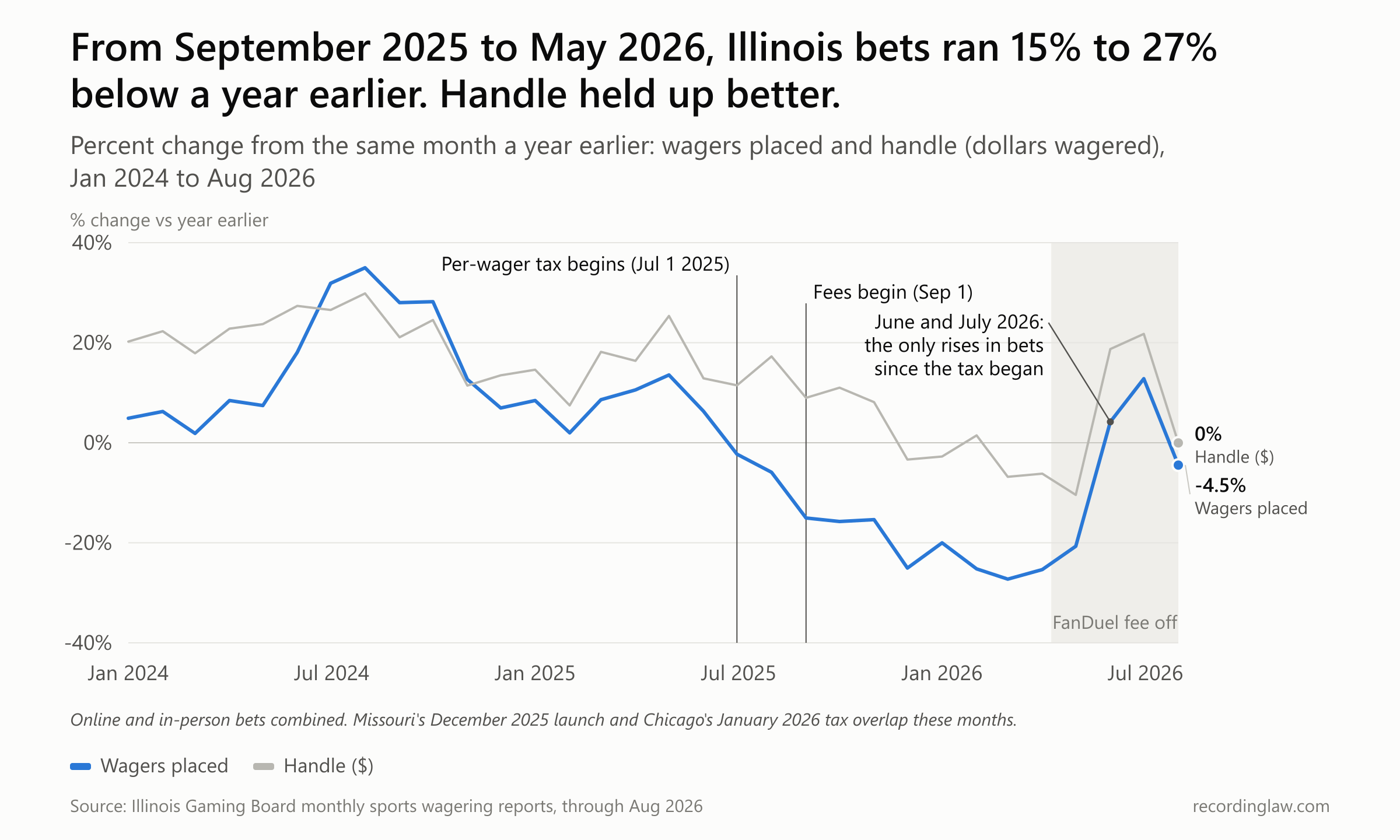
Source: Illinois Gaming Board monthly sports wagering reports, online and in-person combined, through August 2026.
| Month | Wagers placed | Wagers vs a year earlier | Handle vs a year earlier |
|---|---|---|---|
| Sep 2025 | 30,642,511 | -15.05% | +8.99% |
| Nov 2025 | 33,939,445 | -15.36% | +8.11% |
| Dec 2025 | 28,794,125 | -25.06% | -3.37% |
| Feb 2026 | 20,853,835 | -25.21% | +1.48% |
| Mar 2026 | 25,745,827 | -27.26% | -6.81% |
| May 2026 | 23,766,981 | -20.68% | -10.42% |
| Jun 2026 | 24,787,933 | +4.18% | +18.74% |
| Jul 2026 | 21,626,375 | +12.81% | +21.75% |
| Aug 2026 | 20,562,991 | -4.47% | -0.03% |
Every month from September 2025 through May 2026, Illinoisans placed fewer bets than in the same month a year earlier. In every one of those months, handle held up better against the year before than the count of bets did. For the fiscal year that ended in June 2026, the count fell 17% while the dollars wagered rose 3%, to $15.5 billion.
A year earlier, in fiscal 2025, before the per-bet tax began, both had grown. Bets rose 15% and handle rose 18%. A different tax changed that year: Illinois raised its tax on sportsbooks' revenue.
September was also, as Covers noted, "the first full month of surcharges and betting minimums implemented by sports betting operators." Fanatics charged 25 cents a bet, and other sportsbooks raised their minimum bet sizes, Casino.org reported. The Sports Betting Alliance, the sportsbooks' trade group, put the falling count at the center of its response.
From December 2025, handle also began falling against the year before. Two other things changed around then. December was the first month of mobile sports betting in Missouri, next door, and sportsbooks there took 25.6 million bets that month. On January 1, 2026, Chicago's new city tax on online sportsbooks began.
In July 2026 the alliance described "the combined pressure of the state surrounded by legalized jurisdictions and Illinois' high taxes." The Gaming Board's data cannot separate those pressures from the per-wager tax. If the count fell and the dollars mostly held, the average bet had to get bigger.
How big is an Illinois bet now?
The average bet is handle divided by the number of bets. In the tax's first year, the average Illinois sports bet grew by about $10, from $39.13 to $48.76. The year before, it had risen about $1.
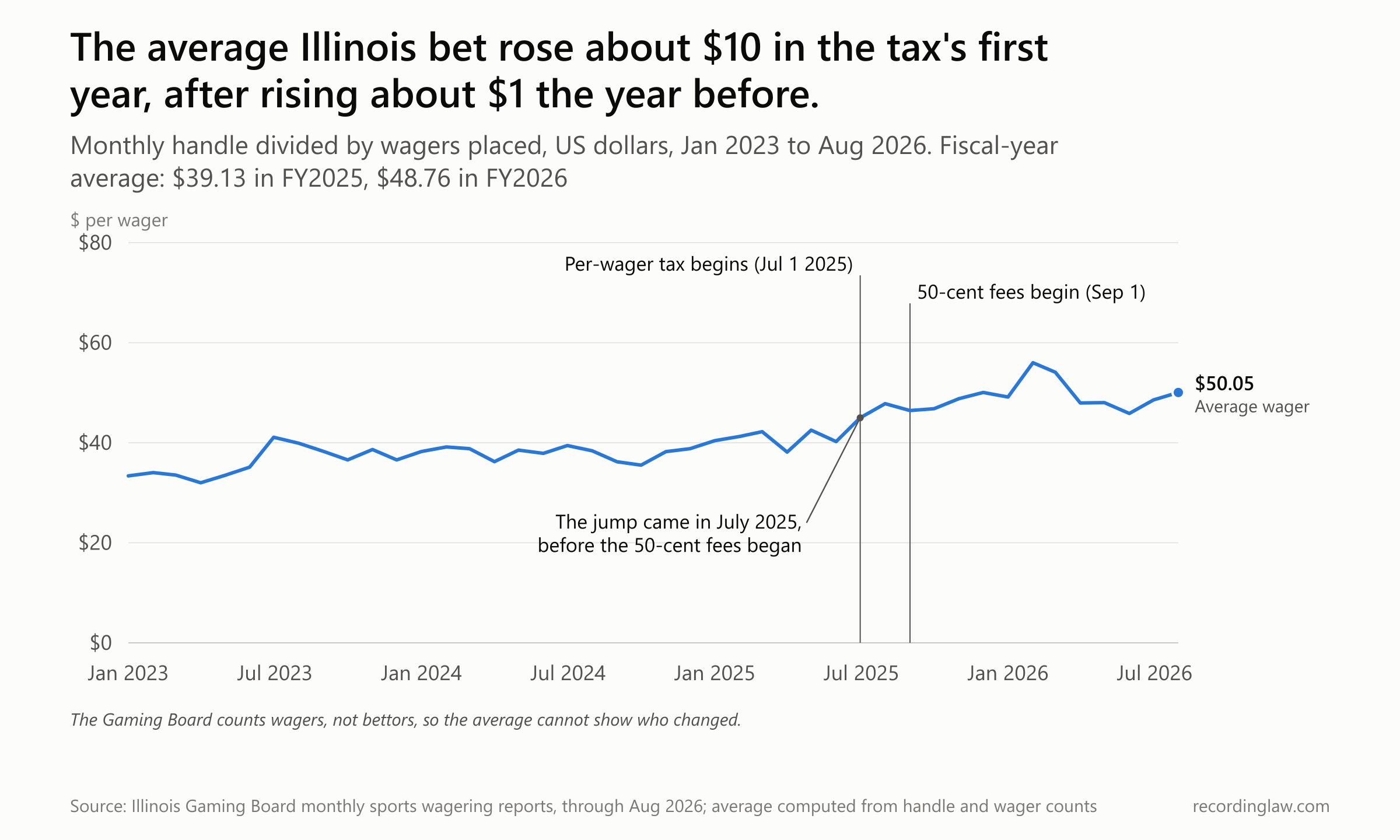
Source: Illinois Gaming Board monthly sports wagering reports; average computed from handle and wager counts.
| Period | Average bet |
|---|---|
| FY2024 (Jul 2023-Jun 2024) | $38.11 |
| FY2025 (Jul 2024-Jun 2025) | $39.13 |
| FY2026 (Jul 2025-Jun 2026) | $48.76 |
| Jun 2025 | $40.23 |
| Feb 2026 | $55.99 |
| Aug 2026 | $50.05 |
The jump came in July 2025, the month the tax took effect and two months before DraftKings and FanDuel began charging their fees. The monthly totals do not show what moved it. From August 2025 on, the monthly average has stayed above $45.
A flat fee is a bigger share of a small bet than of a large one. On a $1 bet, a 50-cent fee is half the size of the bet itself. On the average Illinois bet in August 2026, about $50, a 50-cent fee is about 1%.
"At +100 odds, a bettor normally needs to win 50% of wagers to break even," Covers calculated. "The 50-cent fee pushes that requirement to 66.7% on a $1 bet, but the impact quickly shrinks as the wager gets larger."
Before the tax began, two predictions about who would stop betting pointed in opposite directions. Adam Hoffer of the Tax Foundation, a market-oriented tax research group, said it would be "practically impossible" for sportsbooks to keep taking $1 bets. "It's going to distort the market, which is not something you generally want tax policy to do," he told Front Office Sports.
Joe Stauff, a senior equity analyst at Susquehanna, made a different prediction. He said the tax "could drive more of the VIP business out of the market into black markets."
Before the tax took effect, Hoffer also described two possible effects. Discouraging small-money wagers might reduce rates of problem gambling, he said. But some bettors, he said, would raise the amount they put on each bet because of the tax.
One industry research firm, Eilers & Krejcik Gaming, read the rise as bettors putting more on each bet. It compared Illinois since July 2025 with the national market in a report Casino.org described in December 2025. Casino.org reported its finding that adjusted gross receipts, the money the books keep after paying out winning bets, "still grew in line with the national gross gaming revenue (GGR) average (+8%), indicating that Illinois customers do not appear to have downwardly adjusted their wagering activity to account for the fees but are simply betting more per wager." The same firm said Illinois "has essentially incentivized a higher stake per bet, which has potential negative RG ramifications," using the industry's shorthand for responsible gambling.
The alliance circulated a similar warning from Keith Whyte, a responsible-gambling expert: "these taxes raise the price of participation, pushing customers to place higher bets that could be out of their comfort zone."
An average cannot say who changed. It would rise if the same people bet more each time. It would also rise if the smallest bets simply stopped being placed while larger bettors carried on as before. The Gaming Board counts wagers, not bettors.
For the state, a bigger bet is still one bet, taxed once. How much did a tax on 67 million fewer bets collect?
A $36 million forecast and a $127 million year
The state's own forecast was the lowest of the estimates. "It's projected to raise $36 million," Capitol News Illinois reported when the budget was signed. The Civic Federation, a Chicago fiscal research group, attributed that estimate to the Governor's Office. It added that "industry projections suggest it could raise up to $160 million based on betting volume," without naming who made them.
Analysts estimated the cost to the two biggest books. Jordan Bender, an analyst at Citizens, noted that only DraftKings and FanDuel had topped 20 million Illinois wagers in the past year, "implying the tax was created to hurt those two companies more than the mid-scale companies."
He put the gross hit to DraftKings' and FanDuel's annual earnings by 2026 at $79 million and $86 million. A 2025 Truist Securities report estimated the two would have paid an extra $68 million and $77 million had the tax been in effect for a full year.
The tax brought in $126.7 million in its first fiscal year. That is about three and a half times the state's $36 million estimate, and about $350,000 a day.
How much it collects on each bet depends on the 20 million line. Each sportsbook pays 25 cents a bet until it passes 20 million bets in the fiscal year, and 50 cents after that. So the tax per bet changes over the year, as the biggest books pass their 20 millionth wager.
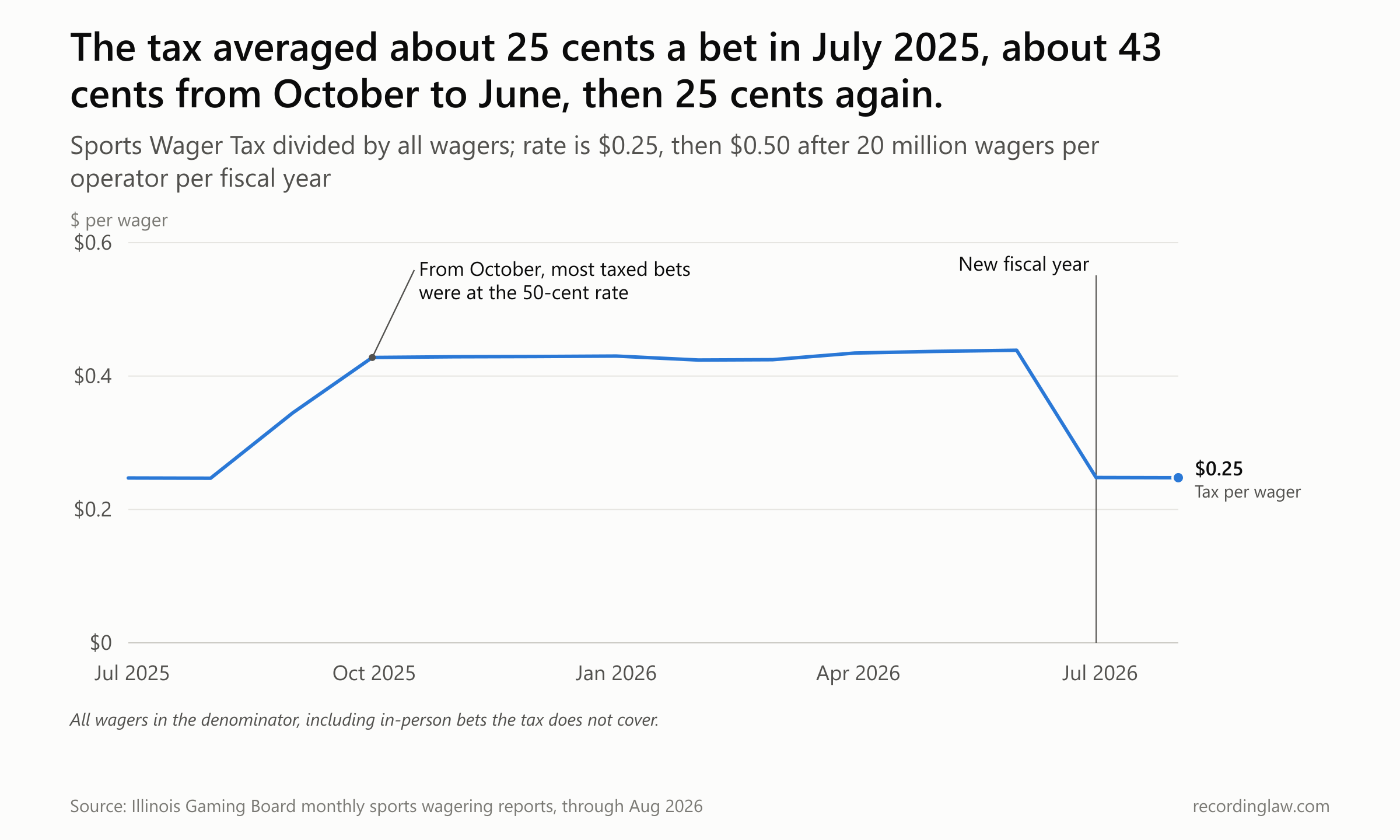
Source: Illinois Gaming Board monthly sports wagering reports. All wagers in the denominator, including in-person bets the tax does not cover.
| Month | Per-wager tax paid | Tax per wager placed |
|---|---|---|
| Jul 2025 | $4,737,108 | $0.2471 |
| Sep 2025 | $10,561,853 | $0.3447 |
| Oct 2025 | $14,663,626 | $0.4278 |
| Jun 2026 | $10,875,810 | $0.4388 |
| Jul 2026 | $5,360,725 | $0.2479 |
| Aug 2026 | $5,091,403 | $0.2476 |
The tax averaged about 25 cents a bet in July and August 2025. It climbed to about 43 cents by October and held there through June. Then it dropped back to 25 cents when the new fiscal year began in July 2026.
An average of 43 cents falls between the 25-cent and 50-cent rates, closer to 50 cents than to 25. It means most taxed bets from October onward were taxed at 50 cents.
The per-bet tax came on top of a tax on sportsbooks' adjusted gross receipts, which Illinois had raised a year earlier. That tax was a flat 15% until June 2024. Since July 2024 it has been charged at graduated rates, from 20% to 40% of each operator's annual receipts, with the rate rising as the receipts grow.
DraftKings' chief executive, Jason Robins, said Illinois had chosen "to more than triple our tax rate over the past two years." How large is the per-bet tax next to the one on revenue?
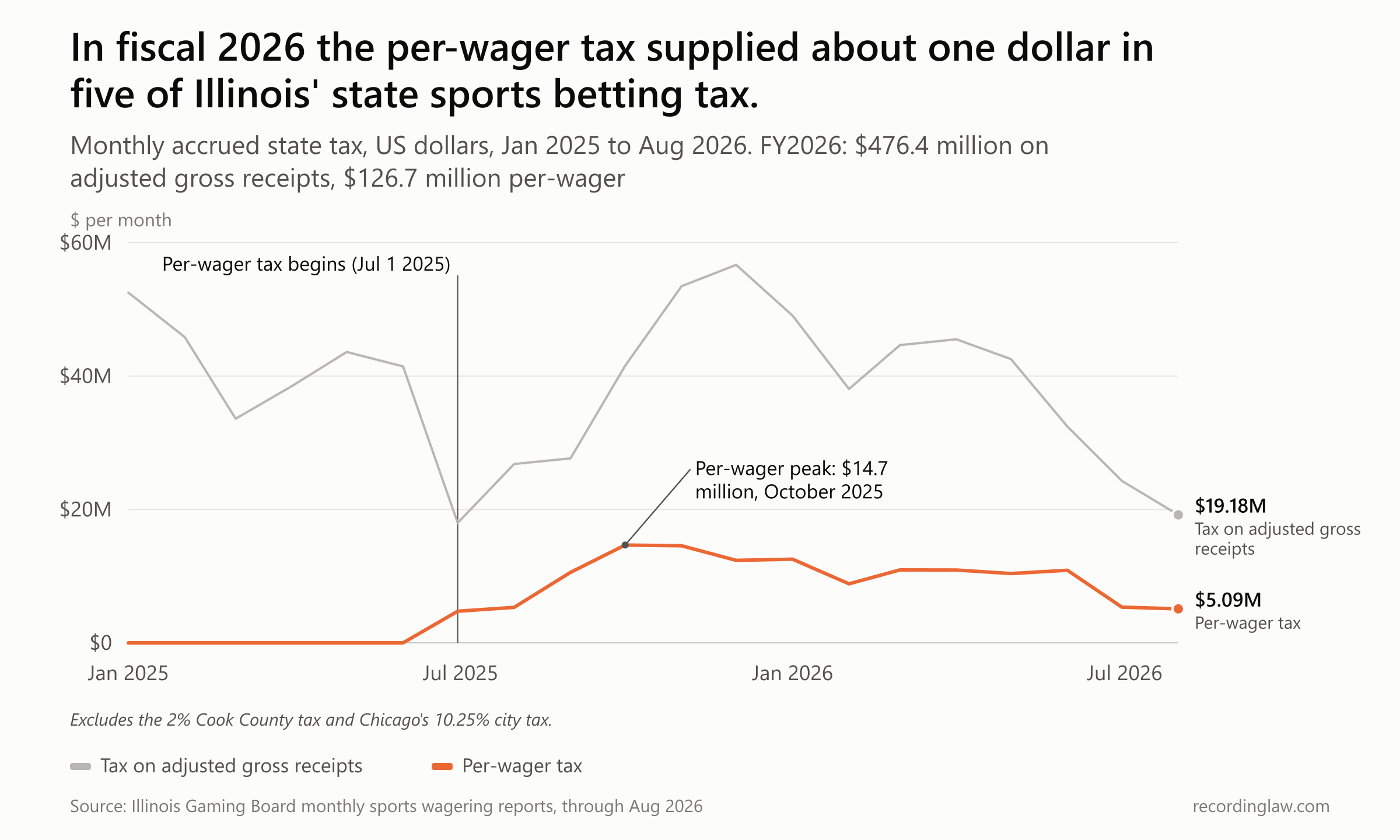
Source: Illinois Gaming Board monthly sports wagering reports (Tax Summary, accrual basis). Excludes the 2% Cook County tax and Chicago's city tax.
| Fiscal year | State tax on adjusted gross receipts | Per-wager tax | Total |
|---|---|---|---|
| FY2025 | $428,475,959 | $0 | $428,475,959 |
| FY2026 | $476,380,780 | $126,690,413 | $603,071,193 |
In fiscal 2026, the state's total from the two taxes came to about $603 million, against about $428 million in fiscal 2025. The per-wager tax supplied $126.7 million of it, about one dollar in five. The tax on sportsbooks' revenue rose 11% over the year before.
The Sports Betting Alliance had warned that revenue would fall. In November 2025 the alliance's Illinois spokesperson, Maura Possley, called the data on falling bet counts "a warning sign" that over-taxing legal betting "will have profound negative ramifications for the sustainability of the legal market and future tax revenues for state coffers." In January its president, Joe Maloney, said: "Once the consumers flee this market, there's no additional tax revenue to go to these important priorities."
Through June 2026, the first full year, the state's receipts from both taxes were higher than the year before. Two months of the new fiscal year are too few to test a longer-run claim.
The other prediction, that bettors would go to illegal books, is one the state's data cannot test. Offshore sportsbooks report nothing to the Gaming Board. None of the studies we found measures how much Illinois betting moved there. Sen. Bill Cunningham had drawn the same line in June 2025, before the tax took effect: "We do have to be careful that we don't overtax this and drive activity underground. I feel like we're getting close to that point, but I don't think we've hit it yet."
In Springfield, the next fight was over the law itself.
A repeal bill without a vote
On February 5, 2026, Rep. Daniel Didech filed House Bill 5143 to end the per-wager tax on July 1, 2026. Didech is a Democrat, in the governor's party, and chairs the House Gaming Committee. On March 27 the bill was sent back to the Rules Committee, where it has stayed without a committee vote.
A second bill filed by Didech, HB 4171, would bar home-rule cities from taxing sports wagering, which would reach Chicago. It cleared the Gaming Committee 15-0 on February 18. On April 17 it went back to Rules.
Chicago had added its own tax by then. The City Council passed its budget on December 19, 2025. Mayor Brandon Johnson allowed it to become law without his signature.
The budget extended the city's sports wagering tax to online books, at 10.25% of their receipts, from January 1, 2026. The city collected about $3.7 million in January, according to its Department of Finance.
In April a News-Gazette columnist, Jim Dey, predicted where the repeal would end up. "The industry considers the tax to be an 'albatross' on its back, and friendly legislators are seeking to repeal it," he wrote. "But that legislation will go nowhere as long as the state remains in dire financial straits."
Michigan looked at the same design. Gov. Gretchen Whitmer proposed the identical 25-cent and 50-cent structure in her budget in February 2026. "The same tax was enacted in Illinois last year," her budget briefing papers said. Michigan's House and Senate passed budget bills in April that left it out, Covers reported.
When Illinois lawmakers next changed the sports wagering law, they added a tax rather than removing one. Public Act 104-468, effective June 16, 2026, imposed a 1.75% transaction tax on each "exchange wager," including prediction-market contracts tied to sporting events.
The rate rises to 3.5% after a licensee's first five million exchange wagers in a fiscal year. The law left the per-wager tax as it was. Kalshi, a prediction-market operator, sued the state in federal court in June to stop the law, Capitol News Illinois reported.
With the law unchanged, the next move came from one company.
FanDuel's pause
On April 9, 2026, FanDuel announced it was waiving its 50-cent fee on Illinois bets through June 19, InGame reported. An email sent to Illinois bettors did not explain why. The state had not reversed anything. DraftKings kept its fee.
The waiver ran well past June 19. FanDuel gave its users "nearly four more months of betting without the per-bet fee" before reinstating it in the first week of October, Covers reported. Bettors posted about the returned fee on October 6, according to Covers. Deadspin dated its return October 7.
In April and May, the first two months of the pause, the count of bets was still down from a year earlier. It was down 25% in April and 21% in May. Then the count turned upward.
June 2026 had 4% more bets than June 2025, and July 2026 had 13% more than July 2025. Those were the only months since the tax began in which the count rose from a year earlier. In August the count was down 4.5% again.
Three things overlapped in those weeks, and the data cannot separate them. FanDuel's fee was off. The men's World Cup was played in North America from June 11 to July 19, 2026, the schedule FIFA announced. And on July 1 each operator's count of bets for the tax started over, which dropped every operator's tax back to 25 cents a bet.
The fee that returned in October is narrower. FanDuel now exempts parlays of at least $10, straight bets of at least $25 and bets made with bonus credit, according to Covers. Bets under those amounts still carry it.
Sixteen months on
HB 5143 is still in the House Rules Committee. The date it set for ending the tax, July 1, 2026, has already passed. The General Assembly's veto session meets November 17-19 and December 1-3, 2026.
As of November 8, 2026, the Gaming Board had published figures through August 2026. September's come next, and they cover a month when FanDuel's fee was still paused.
October is the first month since March in which both DraftKings and FanDuel charged their fees for most of the month. At last year's pace, October's figures would come out in mid-December, after the session's last day. Lawmakers will most likely leave Springfield before the state publishes a month that shows whether the count falls with the fee again.
In June 2025, FanDuel said it would remove the fee "immediately" if the state reversed its decision. The state has not. The fee is back on FanDuel's Illinois straight bets under $25. That cutoff is about half the size of the average Illinois bet in August 2026, which was $50.05.
An average does not show how many bets fall under $25. The Gaming Board's data also do not show how much of the tax's cost bettors paid.
How we measured
Sources for the numbers. Monthly wagers placed, handle, adjusted gross receipts and taxes come from the Illinois Gaming Board's Sports Reports application, summed across all licensees for January 2023 through August 2026. Wagers and handle come from the cash-basis detail report. Taxes come from the accrual-basis tax summary, so the two can differ in timing in a given month.
Wager counts are Tier 1 plus Tier 2 wagers, the two categories the statute adds together to count bets for the tax. In the statute, a Tier 1 wager is one decided solely by the final score or outcome and placed before the event begins, and a Tier 2 wager is any other. Together they are every individual bet placed with a sportsbook.
Wager counts cover all sport sections, including an unlabeled section that appears in recent files (about 0.6% of handle in May 2026). The latest month available when the data was pulled on October 31, 2026, was August 2026. On November 6, 2026, the Gaming Board's application still returned no figures for September or October 2026.
The law. Lawmakers had first considered taxing sportsbooks for each betting account, the Sun-Times reported, "but opted against it because many of those accounts go dormant after curious one-time bettors lose interest." They taxed each bet instead. The tax falls on each licensed sportsbook, covers only bets placed online or through a mobile app, and each book's count of bets starts over every July 1.
Online and in-person. The per-wager tax applies only to bets placed online or through a mobile app. The wager counts and handle include in-person bets, about 1% of wagers and about 2% of handle in fiscal 2026 (3.4 million of 317.8 million wagers). So the "tax per wager placed" figure slightly understates the tax per online bet.
Fiscal years. Illinois fiscal years run July to June and are labelled by the year they end: FY2026 is July 2025 to June 2026. FY2025 had 384,932,121 wagers and $15,061,590,754 in handle; FY2026 had 317,799,509 wagers and $15,494,356,254 in handle. The difference is 67,132,612 wagers (17.4%) and a 2.9% rise in handle. FY2024 to FY2025: wagers up 14.6%, handle up 17.6%.
Derived figures. Average bet is handle divided by wagers. "About 1%" is $0.50 divided by the August 2026 average bet of $50.05. "About half the average Illinois bet" is FanDuel's $25 straight-bet threshold divided by the August 2026 average of $50.05 (0.50). "About three and a half times" is $126,690,413 divided by $36 million (3.52). "About $350,000 a day" is $126,690,413 divided by 365. "One dollar in five" is the per-wager tax divided by the per-wager tax plus the state tax on adjusted gross receipts in FY2026 ($126.7 million of $603.1 million, 21%).
The 11% rise is FY2026 state tax on adjusted gross receipts ($476.4 million) against FY2025 ($428.5 million). Both years were under the graduated 20% to 40% rates, which apply to each operator's annual receipts, so the state's monthly tax from them rises within each fiscal year. "Most bets taxed at 50 cents" follows from the rate: an average of $0.43 between $0.25 and $0.50 requires at least 72% of taxed wagers at the higher rate, because $0.25 plus 72% of the 25-cent difference is $0.43. The September 2025 drop of about 5 million bets is 36,071,879 in September 2024 minus 30,642,511 in September 2025.
Taxes left out. The figures above are state taxes. The state also collects 2% of adjusted gross receipts from bets placed in Cook County ($15.4 million in FY2026). Chicago's 10.25% city tax is not in Gaming Board reports; the city collected $3,732,882 in January 2026 and $3,326,357 in February 2026, according to its Department of Finance, via a public-records request published by InGame. The city's budget had estimated $26 million a year, based on Chicago generating 40% of Cook County's sports betting revenue, a share that "surpassed 60% in February," InGame reported.
The Chicago lawsuit. The alliance sued, arguing that "the State has sole authority to license and tax online sports wagering." On December 31, 2025, it withdrew its request for a temporary restraining order, saying its complaint "will continue to proceed on the merits in court," Gambling Insider reported. The city tax took effect on January 1, and a hearing on the suit was set for March 3, 2026.
Where other figures differ. Covers reported May 2026 handle down 10.2% and state tax of $52.5 million. Our Gaming Board sums give a 10.4% handle decline and $42.5 million in state tax on adjusted gross receipts plus $10.4 million in per-wager tax. We use the Gaming Board figures.
The $36 million projection is attributed to the Governor's Office by the Civic Federation and described as "projected" by Capitol News Illinois; we did not open the state budget document itself. The "up to $160 million" industry projection has no named author. We did not see the Eilers & Krejcik report itself; it is quoted as reported by Casino.org.
The World Cup dates come from FIFA's February 2024 schedule announcement. Missouri's first month is from the Missouri Gaming Commission's fiscal 2026 summary, which shows December 2025 as the first month of mobile wagering. Analyst estimates of operator costs are reported as published; this article is not investment advice.
What comes next. The fall veto session meets November 17-19 and December 1-3, 2026, with HB 5143 still in the House Rules Committee. The Gaming Board's September 2026 figures cover the last full month of FanDuel's pause; last year the Board released September's figures in mid-November, so this year's could arrive around the week the session opens.
Release timing. "Mid-November" for last year's September release rests on a Covers report of November 17, 2025, quoting the alliance on Gaming Board data "released today." "Mid-December" for October 2026 applies the same gap, about seven weeks after the month ends. The Board does not publish a release calendar, and the statute's deadline of the last day of the following month applies to tax payments, not to publication.
What the data cannot show. There is no comparison group. A neighbouring-state comparison is not included. Most neighbouring states publish handle but not wager counts, so a comparison of bet counts is not possible.
Missouri's launch in December 2025, Chicago's city tax from January 2026, operator betting minimums, Fanatics' 25-cent fee and promotions, and the World Cup all overlap the months after the tax began. The figures show what Illinois betting did after July 2025, not how much of it the tax or the fees caused. Illegal and offshore betting are not measured anywhere in the data.
Frequently Asked Questions
What is the Illinois per-wager sports betting tax?
Since July 1, 2025, Illinois has charged each sports wagering licensee 25 cents for each of its first 20 million wagers in a fiscal year and 50 cents for each wager after that. It applies to bets placed online or through a mobile app, and the count restarts every July 1. It was enacted in Public Act 104-6 (House Bill 2755), signed June 16, 2025.
Do bettors pay the Illinois per-wager tax?
The tax is owed by the sportsbooks. DraftKings and FanDuel passed it on as a 50-cent fee per bet starting September 1, 2025. FanDuel waived its fee from April 9, 2026. It reinstated the fee in early October 2026 (reports date its return October 6 or 7), with exemptions for parlays of at least $10, straight bets of at least $25 and bonus bets. Gaming Board data do not show how much of the total cost bettors paid.
How much money has the Illinois per-wager tax raised?
It raised $126.7 million in fiscal 2026 (July 2025 to June 2026), according to Illinois Gaming Board reports. The Governor's Office had estimated $36 million. After each operator's count of bets started over on July 1, 2026, it raised $5.4 million in July and $5.1 million in August.
Did Illinois sports betting drop after the per-wager tax?
The number of bets fell and the dollars wagered did not. Illinois bettors placed 317.8 million wagers in fiscal 2026, 17.4% fewer than in fiscal 2025. Handle, the dollars wagered, rose 2.9% to $15.5 billion. The average bet rose from $39.13 to $48.76. Missouri's launch, a Chicago city tax and the World Cup overlap the same period, so the data cannot show how much the tax caused.
Does the Illinois per-wager tax apply to in-person bets?
No. The statute covers wagers placed over the internet or through a mobile application. In-person bets are about 1% of Illinois wagers and about 2% of the dollars wagered.
What other taxes do Illinois sportsbooks pay?
The state taxes each operator's annual adjusted gross receipts, the money it keeps after paying out winning bets, at graduated rates from 20% to 40%. Those rates have applied since July 1, 2024 (the tax was a flat 15% before). Bets placed in Cook County carry an additional 2% tax on receipts, and Chicago has taxed online sportsbooks at 10.25% of receipts since January 1, 2026. Public Act 104-468, effective June 16, 2026, imposes a 1.75% transaction tax on exchange wagers, including sports prediction-market contracts. The rate rises to 3.5% after a licensee's first five million exchange wagers in a fiscal year. Kalshi, a prediction-market operator, has challenged that law in federal court.
Is Illinois repealing the per-wager tax?
Not so far. House Bill 5143, filed February 5, 2026, by House Gaming Committee chair Daniel Didech, would have ended the tax on July 1, 2026. It was re-referred to the House Rules Committee on March 27, 2026, and has not had a committee vote. Public Act 104-468, effective June 16, 2026, left the per-wager tax unchanged. The fall veto session meets November 17-19 and December 1-3, 2026.
Updates
Corrected: the article said Sen. Bill Cunningham warned against driving betting underground before the May 31, 2025 vote. He said it in June 2025, after the vote and before the tax took effect.
Restructured as a feature: chart titles state the finding, side details moved to How we measured. Every figure and quote was re-checked against its source.
Independently fact-checked against the cited primary sources
Independently fact-checked against the cited primary sources
Sources and References
- Illinois Gaming Board, Sports Wagering monthly reports (detail and tax summary), January 2023 to August 2026(igbapps.illinois.gov).gov
- Illinois Gaming Board, sports wagering reports page(igb.illinois.gov).gov
- Sports Wagering Act, 230 ILCS 45/25-90 (tax rates, per-wager tax, Cook County tax)(ilga.gov).gov
- Public Act 104-0006 (HB 2755), Article 5, Section 5-30(ilga.gov).gov
- Illinois General Assembly, HB 2755 bill status (104th General Assembly)(ilga.gov).gov
- Illinois General Assembly, HB 5143 bill status(ilga.gov).gov
- Illinois General Assembly, HB 4171 bill status(ilga.gov).gov
- Public Act 104-0468 (exchange wager transaction tax)(ilga.gov).gov
- Capitol News Illinois, Prediction market Kalshi sues Illinois over its push to regulate sports bets (June 26, 2026)(capitolnewsillinois.com)
- Illinois Senate, 2026 veto session calendar(ilga.gov).gov
- Illinois House of Representatives, 2026 veto session calendar(ilga.gov).gov
- Commission on Government Forecasting and Accountability, Wagering in Illinois: 2025 Update(cgfa.ilga.gov).gov
- Capitol News Illinois, Pritzker signs $55.1B state budget reliant on $700M of new taxes (June 16, 2025)(capitolnewsillinois.com)
- Civic Federation, State of Illinois FY2026 enacted budget(civicfed.org)
- Office of the Governor, Gov. Pritzker signs seventh consecutive balanced budget (June 16, 2025)(gov-pritzker-newsroom.prezly.com)
- Chicago Sun-Times via Illinois Public Media, FanDuel eyes 50-cent fee on every Illinois sports bet (June 11, 2025)(ipmnewsroom.org)
- Flutter Entertainment, response to Illinois transaction fee (June 10, 2025)(nasdaq.com)
- DraftKings press release, SEC Form 8-K Exhibit 99.1 (June 12, 2025)(sec.gov).gov
- Covers, Illinois passes per-bet sports betting tax (June 2025)(covers.com)
- Front Office Sports, Illinois passes new sports betting tax (June 2, 2025)(frontofficesports.com)
- InGame, analyst comments on the Illinois per-wager tax (June 2025)(ingame.com)
- NBC Chicago and DePaul Center for Journalism Integrity and Excellence (November 18, 2025)(nbcchicago.com)
- Covers, Sports Betting Alliance says drop in Illinois bets stems from per-wager tax (November 17, 2025)(covers.com)
- Covers, Sports Betting Alliance on the Illinois market (January 12, 2026)(covers.com)
- WAND TV via 25 News Now, Sports Betting Alliance president Joe Maloney (January 2026)(25newsnow.com)
- Casino.org, Eilers & Krejcik Gaming on Illinois bets and revenue (December 2025)(casino.org)
- Casino.org, FanDuel temporarily halts Illinois per-bet fee (April 13, 2026)(casino.org)
- CDC Gaming / InGame, FanDuel waives surcharge on Illinois online bets (April 10, 2026)(cdcgaming.com)
- Covers, FanDuel Illinois per-bet fee is back (October 7, 2026)(covers.com)
- Deadspin, FanDuel reinstates 50-cent betting fee for Illinois customers (October 2026)(deadspin.com)
- Covers, Illinois sports betting handle down 10% in May (July 14, 2026)(covers.com)
- Missouri Gaming Commission, sports wagering monthly financials, FY2026(mgc.dps.mo.gov).gov
- EY Tax News, Chicago FY26 budget bill increases various taxes(taxnews.ey.com)
- City of Chicago Department of Finance, FOIA response on January 2026 sports wagering tax receipts (published by InGame)(ingame.com)
- City of Chicago Department of Finance, FOIA response on February 2026 sports wagering tax receipts (published by InGame)(ingame.com)
- InGame, Chicago February 2026 sports betting tax(ingame.com)
- FOX 32 Chicago, sportsbooks sue Chicago over sports betting tax(fox32chicago.com)
- Gambling Insider, Sportsbooks remain operational in Chicago, SBA drops restraining order request (January 1, 2026)(gamblinginsider.com)
- Jim Dey, The News-Gazette column via CPA Practice Advisor (April 21, 2026)(cpapracticeadvisor.com)
- Covers, Michigan governor proposes per-wager sports betting tax (February 2026)(covers.com)
- Covers, Michigan Legislature budget bills exclude per-bet tax (May 2026)(covers.com)
- FIFA, World Cup 26 schedule announcement (February 4, 2024)(inside.fifa.com)