Under the 2026 Gambling-Loss Cap, a Bettor Who Wins and Loses $200,000 Owes Tax on $20,000

Independently fact-checked against primary sources (last audited November 10, 2026). · 26 primary sources cited on this page. How we verify our legal content
A sentence in the One Big Beautiful Bill Act had already cleared the Senate by the time bettors found it. "The provision first generated buzz online after the Senate passed the legislation on Tuesday," NBC News reported on July 3, 2025. The Tuesday it mentions was July 1. July 3 was the day the House gave the bill final approval, 218 to 214, and President Trump signed it the next day.
Phil Galfond, a professional poker player, posted his reading of it on X. "A pro who earns $200k/year might have $3m in winnings and $2.8m in losses," he wrote. "This means earning $200k and being taxed as if they earned $480k."
The arithmetic behind his $480,000 is one sentence of the new law. From the 2026 tax year on, a gambler's deduction for losses "shall be equal to 90 percent of the amount of such losses," and it still cannot exceed the year's winnings.
Before, losses could cancel winnings dollar for dollar. For Galfond's professional, 90 percent of $2.8 million in losses is $2.52 million. That leaves $480,000 of the $3 million in winnings to tax, against $200,000 of actual profit.
That 90 percent limit is the gambling-loss cap of this story's title. It has applied since January 1, 2026, the start of the 2026 tax year.
Take a bettor who wins $200,000, loses $200,000 and deducts the losses this year. The deduction is 90 percent of $200,000, which is $180,000. That leaves $20,000 of wagering income on the tax return, in a year that ended even.
In September 2026, the House Ways and Means Committee, which writes the chamber's tax bills, voted 38 to 5 for a bill that would undo the cap back to the start of 2026. As of November 10, 2026, it had not had a floor vote, a vote of the full House.
Bets placed in 2026 are reported on returns for the 2026 tax year, and those returns are filed in the 2027 filing season. Whether Congress reverses the cap before bettors file under it is the open question. Until it is answered, the cap is the law for every 2026 bet.
What a break-even year looks like on the return
Until Congress answers that question, two things decide what the 90 percent means for a given bettor: how much they win and lose, and whether they deduct their losses at all. A casual bettor can deduct them only by itemizing, which means listing deductions such as gambling losses one by one on the return instead of taking the flat standard deduction.
Under the new rule, a tenth of a bettor's losses stays on the return as income, as long as winnings are large enough to absorb it. Wagering expenses, the kind professionals deduct, are expenses, otherwise deductible, incurred in carrying on a wagering transaction. They count as losses under the statute, so they are cut to 90 percent too.
So what is left to tax when a year's bets come out even, or a little behind? The chart below, our calculation, runs one bettor with $200,000 of winning bets through both rules at different results for the year.
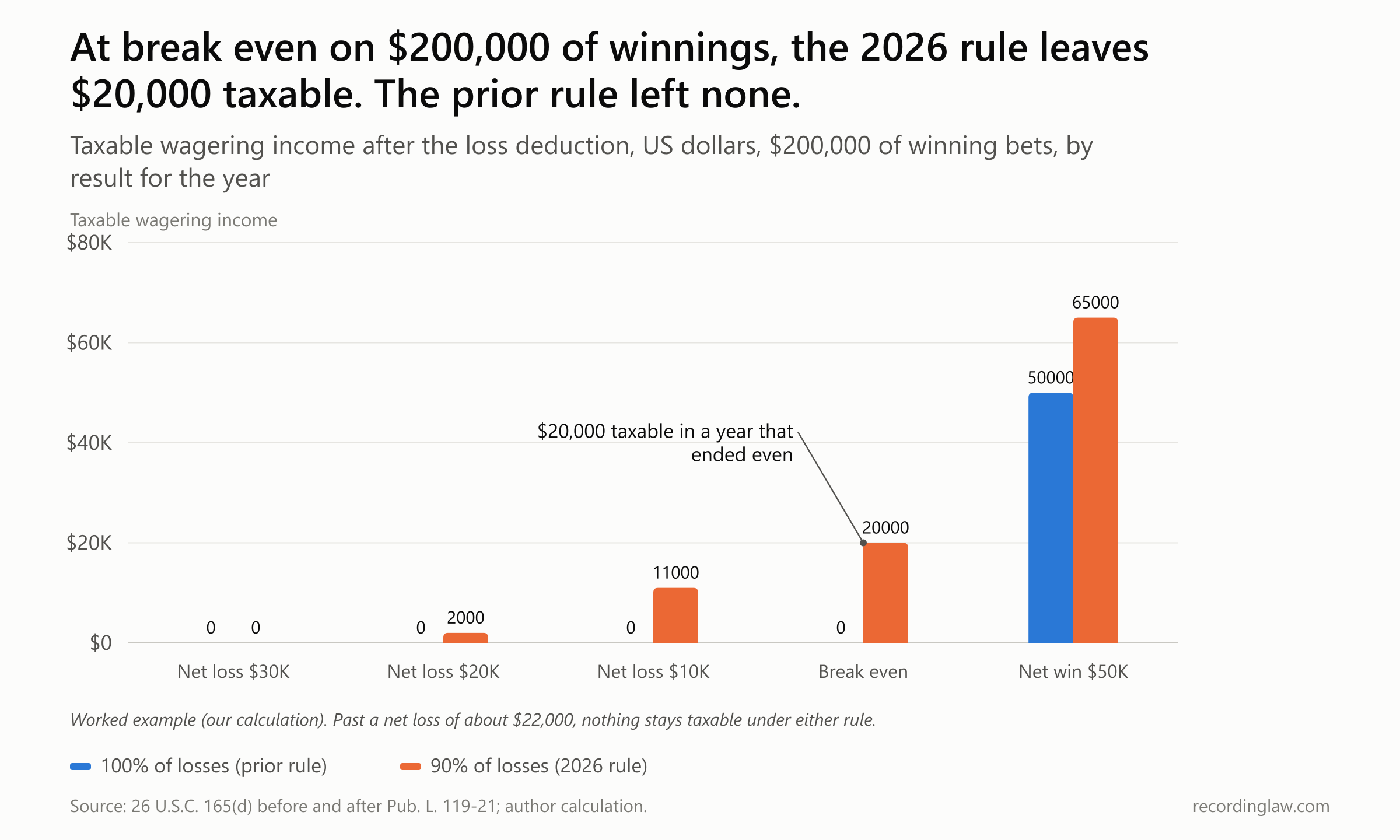
Taxable wagering income after the loss deduction, $200,000 of winnings. Source: 26 U.S.C. 165(d) before and after Pub. L. 119-21; our calculation.
| Result for the year | Losses | Taxable, prior 100% rule | Taxable, 2026 90% rule |
|---|---|---|---|
| Net loss $30,000 | $230,000 | $0 | $0 |
| Net loss $20,000 | $220,000 | $0 | $2,000 |
| Net loss $10,000 | $210,000 | $0 | $11,000 |
| Break even | $200,000 | $0 | $20,000 |
| Net win $50,000 | $150,000 | $50,000 | $65,000 |
Take the row for a $20,000 net loss. The bettor won $200,000 and lost $220,000. Ninety percent of $220,000 is $198,000, so $2,000 of the winnings stays taxable in a year that ended $20,000 behind.
On $200,000 of winnings, some wagering income stays taxable at any net loss up to about $22,000. The point is $200,000 of winnings divided by 0.9, which is losses of about $222,222, or a net loss of about $22,222. Past that point, 90 percent of the losses is enough to cover all of the winnings.
How much tax the extra $20,000 adds depends on the bettor's other income. Federal income tax rates rise in brackets, so added income is taxed at the rate of the bracket it lands in, and a bettor with more other income starts in a higher one.
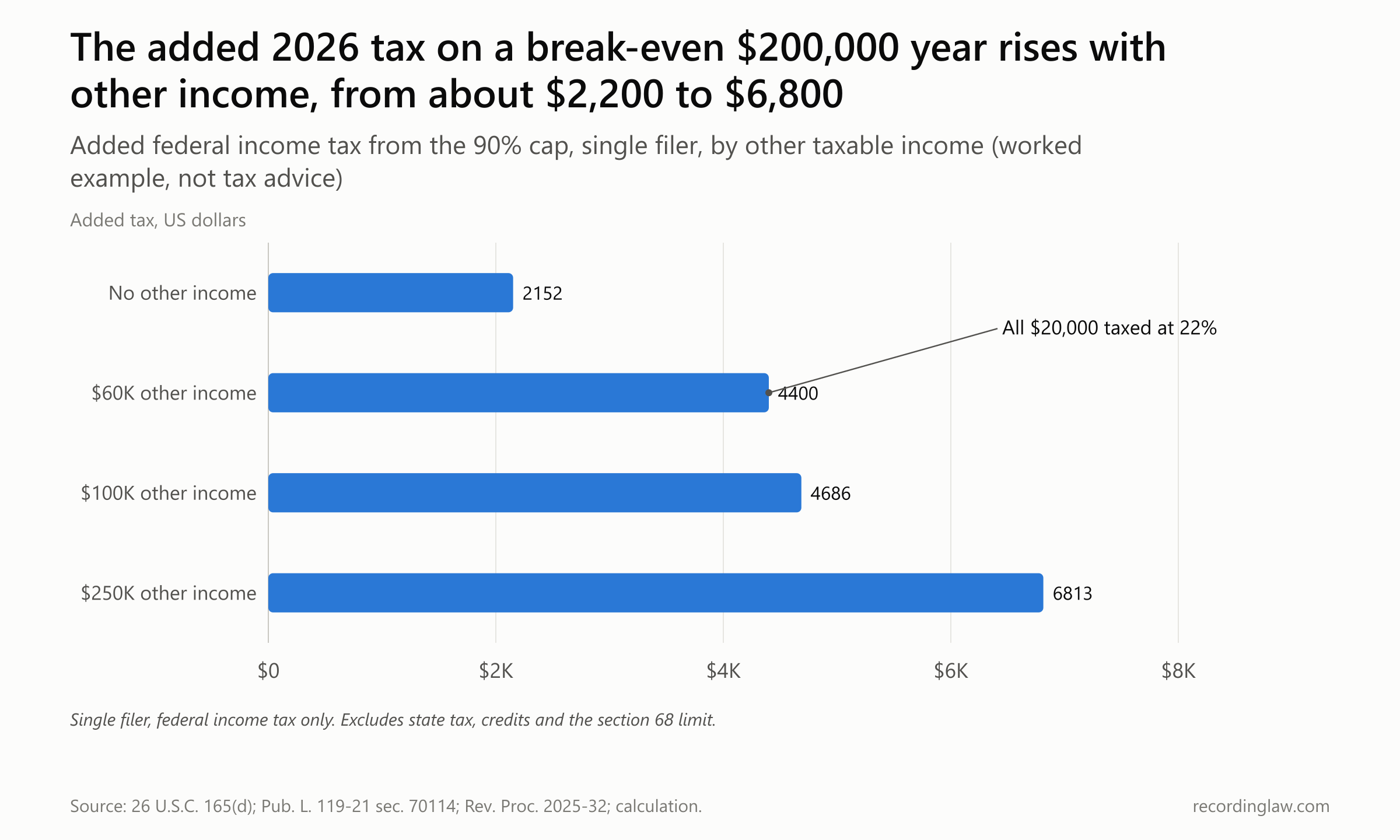
Added 2026 federal income tax for a single filer who wins and loses $200,000, by other income. Source: 26 U.S.C. 165(d); Rev. Proc. 2025-32; our calculation.
| Other taxable income | Taxable income, prior rule | Taxable income, 2026 rule | Added federal income tax |
|---|---|---|---|
| $0 | $0 | $20,000 | $2,152 |
| $60,000 | $60,000 | $80,000 | $4,400 |
| $100,000 | $100,000 | $120,000 | $4,686 |
| $250,000 | $250,000 | $270,000 | $6,813.25 |
In our calculation, the added bill runs from about $2,200 for a bettor with no other income to about $6,800 for one with $250,000. At $60,000 of other income, all of the extra $20,000 falls in the 22 percent bracket, and 22 percent of $20,000 is $4,400. At $100,000 of other income, $14,300 of the extra $20,000 lands in the 24 percent bracket, so the added tax is higher, at $4,686.
Other published examples use a single assumed rate. The accounting firm Withum put the same $200,000 case at $4,800: "Assuming this individual had an effective tax rate of 24%, they would owe $4,800 in taxes for the year." The Tax Foundation wrote that a player's "tax liability when she broke even on $1,000,000 of wagers would increase from $0 to $37,000," assuming a 37 percent rate. That $37,000 is 37 percent of $100,000, which is a tenth of $1,000,000.
Galfond's professional, with $480,000 taxable against $200,000 of actual profit, is the same arithmetic at a larger scale. All of these examples, ours included, show how the statute reads. They are not tax advice.
The sentence that produces these numbers was added in the Senate, less than three weeks before the bill became law.
Where the 90 percent came from
The House did not write the cap. The version of the bill it passed 215 to 214 on May 22, 2025, kept a rule from the 2017 tax law, the Tax Cuts and Jobs Act, that counted a gambler's wagering expenses as losses. That rule, which is separate from the 90 percent cap, was otherwise due to expire after 2025, and the House version made it permanent. It changed nothing about how much of those losses could be deducted.
The 90 percent first appeared in the text Senate Finance Committee Chair Mike Crapo, an Idaho Republican, released on June 16. The Senate passed its version 51 to 50 on July 1, and the House agreed to it on July 3. On July 4 the bill became law, numbered Public Law 119-21, and the provision became its section 70114.
Crapo's office has given the only on-record explanation of why the number is 90. "To comply with the rules of reconciliation, every provision from the Tax Cuts and Jobs Act needed to be modified to create a budgetary effect. In order to retain the gambling loss provision, it was changed to 90 percent," a spokesperson told NBC News. Republicans called it, in the Associated Press's summary, "a necessary procedural change tied to the reconciliation process, which allowed them to pass the sweeping bill without Democratic support."
Under the Senate's Byrd rule, a provision of a reconciliation bill that does not change federal revenue or spending can be struck on any senator's objection, unless 60 senators vote to waive the rule. The Tax Foundation, a nonprofit tax research group that favors full deductibility, wrote that lowering the deduction to 90 percent "satisfied the Byrd Rule."
The budgetary effect is about $1.1 billion in added revenue over fiscal 2025 to 2034, as scored in 2025 by the Joint Committee on Taxation, which estimates for Congress what tax bills will raise or cost. Almost none of it arrives in fiscal 2026. Returns for the 2026 tax year are filed in 2027. After fiscal 2026, the estimate runs from $120 million to $159 million a year.
The spokesperson also said that "there were no concerns raised with lowering the threshold" after the text came out on June 16. Weeks earlier, in a May 6 letter, the American Gaming Association, the casino industry's trade group, had listed "maintaining the current deduction for wagering losses as one of three industry-specific tax priorities," NBC reported.
Several Republicans who voted for the bill said afterward that they had not known the provision was there. "If you're asking me how it got in there, no I don't know," Sen. Chuck Grassley of Iowa, a Finance Committee member, told the Deseret News. "Nobody really takes responsibility for introducing it," said Sen. Ted Cruz of Texas.
Rep. Mike Kelly, a Pennsylvania Republican on Ways and Means, told NOTUS he had not known about it before voting either, and described the trade-offs as routine. "It's all math, you see. If you subtract stuff, you're going to be able to find it somewhere else. At the end of the day, we still need to be able to have enough money."
Who the cap reaches, and who it never did
Every bettor in the worked examples above deducts losses. A casual bettor does it by itemizing. A professional like Galfond's does it as a business, on Schedule C, the business schedule of the tax return.
A casual bettor who takes the standard deduction gets no deduction for gambling losses at all, under either rule. For a casual bettor, gambling losses are an itemized deduction, and in 2026 a single filer itemizes only when those deductions top the $16,100 standard deduction.
Professional gamblers are the exception. IRS Publication 525 tells anyone "in the trade or business of gambling" to use Schedule C. So a professional's losses are not an itemized deduction, and the 90 percent cap applies to them either way.
In our calculation, take a single filer with $60,000 of other income who wins and loses $10,000 over the year. Ninety percent of the losses is $9,000, well under the $16,100 standard deduction, so the filer takes the standard deduction under both rules. Taxable income is $53,900 under both the old rule and the new one, and without the bets it would be $43,900. The difference is the full $10,000, so that bettor was already taxed on all $10,000 of winnings before the cap, and still is.
The Associated Press summed up the split in July 2025. "The change will only significantly impact those who gamble larger amounts and who take the extra steps to itemize and deduct their losses. But for those individuals, the impact could be steep."
The IRS's own counts show how small the itemizing group is compared with everyone who reports a win. In tax year 2023, three years before the cap, about 2.3 million returns reported gambling winnings, totaling $61.3 billion. About 593,000 itemized returns deducted gambling losses, $42.7 billion in all, or roughly one return in four among those with winnings. Professionals, who report on Schedule C, are outside both counts.
No count exists of how many bettors pay more under the cap. The 2023 figures come from a year under the old rule, and the first returns under the new one have not been filed. Our worked examples show what the rule does to one return, not how many returns look like them.
Two law professors read the same split as an argument against the deduction itself. "Taxpayers must report their gambling winnings, but high rollers ( who generally itemize their deductions for tax purposes ) get to deduct the majority of their gambling losses, whereas low rollers (who generally take the standard deduction in lieu of itemizing their deductions) do not," Mirit Eyal of the University of Alabama School of Law and Jay A. Soled of Rutgers Business School wrote in March 2026.
They would go past 90 percent, to zero. "Because gambling is a form of entertainment, the Tax Code should eliminate gambling loss deductions in their entirety," they wrote, citing a Tax Policy Center estimate that doing so "could generate $3 billion annually."
Victor Matheson, an economist at the College of the Holy Cross, described what the cap means for a high-volume bettor. "Anyone who is a large-scale bettor who breaks even or makes a little money by making lots and lots and lots of bets and just winning slightly more than they lose, that bettor is going to be destroyed by this," he told AZFamily in July 2025.
Section 68 of the tax code trims itemized deductions for the highest earners. For itemizing bettors in the top bracket, the 90 percent deduction may be trimmed a second time, by the rewritten section 68 limit on itemized deductions, as the accounting firm Forvis Mazars noted in February 2026.
That leaves the larger question. Whether any of these bettors will bet differently is what the two sides have argued about since July 2025.
What each side said the cap would do
On the record, the case for the cap is mostly a budget case, and Crapo's office described it as a procedural necessity. When Rep. Dina Titus, a Nevada Democrat, tried in January 2026 to attach a repeal to a spending bill, House Republican leaders "opposed allowing the amendment to advance, citing concerns over lost federal revenue," GamingAmerica, a trade outlet, reported. It said Sen. James Lankford of Oklahoma had raised budget concerns too. We could not find either position in the officials' own statements.
Senate Majority Leader John Thune of South Dakota, asked by NBC in July 2025 whether colleagues' measures to undo the Medicaid cuts and the gambling change would succeed, said, "No." He added: "There are members out there who are saying, 'We'd like to do this or that differently.' That's always the case."
Rep. Blake Moore of Utah, a Ways and Means Republican, "has raised concerns about the negative risks of gambling," the accounting firm EY wrote in its summary of the September 2026 markup. A markup is the committee session where members amend and vote on bills. The FULL HOUSE Act is a bill that would restore the full deduction for gambling losses. At the markup, EY wrote, he "took issue with inclusion of the FULL HOUSE Act and said the bill can't be the last action taken on the provision."
That is EY's paraphrase, and we could not find a transcript of his own words. EY listed all five votes against the bill as Democrats. We could not find an anti-gambling group or economist on record defending the 90 percent figure itself.
The warnings came from players, both parties and the industry. "This new amendment to the One Big Beautiful Bill Act would end professional gambling in the US and hurt casual gamblers, too," Galfond wrote. Maria Konnikova, a poker player and author, told Front Office Sports, "If the purpose of this bill is to kill poker and stop people from playing, mission accomplished."
Sen. Catherine Cortez Masto, a Nevada Democrat, told the Senate on July 10, 2025, "This makes no sense, and it will do irreparable harm to our country's gaming industry if it takes effect, especially in Nevada." Titus wrote to the Ways and Means leaders that the cap "will inevitably drive players toward offshore and unregulated markets where consumer protections are non-existent." Rep. Steven Horsford, a third Nevada Democrat, said it "would drive major tournaments abroad, push gaming underground, and hurt tourism across my state."
Republicans made the same objections. "This provision punishes responsible record-keepers and disproportionately harms professional gamblers, retirees, and middle-income Americans who itemize," said Rep. Jeff Van Drew of New Jersey, whose district includes Atlantic City.
"The income tax is designed to tax actual income," said Cruz. "Americans should not be taxed on money they didn't actually take home," said Rep. Max Miller of Ohio.
The industry framed it as a tax on money never earned. The American Gaming Association told Ways and Means in July 2025 that the cap "creates an unfair precedent by taxing phantom income and uniquely penalizing a legal, heavily regulated activity," in a letter that also thanked the committee for the rest of the tax package.
The IRS, meanwhile, has written rules to carry out the cap. Proposed regulations published in the Federal Register on April 17, 2026, apply it to spouses filing jointly as a pair: 90 percent of their combined losses, up to their combined winnings. Reporting on the IRS's public hearing on the rules on July 17, Tax Notes wrote that the cap "is grossly unfair to honest gamblers and should be repealed, according to stakeholders."
The Tax Foundation made a revenue prediction of its own: "If only a fraction of professional gamers take their bets outside of legal US markets, the effect will be a net loss to tax collections and an increase in illegal activity." That is a forecast. No study has measured how bettors responded, because no 2026 return has been filed.
The only number in the record so far is an industry claim. In a July 17, 2026 letter to Treasury Secretary Bessent, reported by PlayUSA, the National Thoroughbred Racing Association tied the cap to racing results, saying "US pari-mutuel handle through June is down $45 million , or 4.7%, from the same period in 2025," handle being the total amount wagered. The same report notes that wagering on US thoroughbred racing fell every year from 2022 through 2025, before the cap applied, so the decline has more than one possible cause. With no data yet to settle the argument, the argument moved to Congress's calendar.
How a repeal reached a committee vote
The first repeal bill came three days after the signing. On July 7, 2025, Titus introduced the FAIR BET Act, H.R. 4304, which strikes "90 percent" and inserts "100 percent." As of November 10, 2026, it had 25 cosponsors, 14 Democrats and 11 Republicans. Rep. Andy Barr, a Kentucky Republican, filed another, the WAGER Act, H.R. 4630, on July 23.
On July 9, Cortez Masto introduced the Senate's FULL HOUSE Act, S. 2230, with Sen. Jacky Rosen of Nevada and Cruz. On July 10, during the World Series of Poker in Las Vegas, she asked the Senate to pass it by unanimous consent, a shortcut that works only if no senator objects. Sen. Todd Young, an Indiana Republican, said he supported the fix. But he objected unless it also restored a tax exemption for religious universities' endowments, one that would have covered Notre Dame, in his state.
"I think it's only fair that we fix this one as well," he said. Sen. Ron Wyden of Oregon, the Finance Committee's top Democrat, refused that change.
"I'm disappointed, but I am not done," Cortez Masto said. Even a Senate win would have stalled: revenue bills must start in the House, and a Senate-passed bill "likely would have fallen victim to a House 'blue slip,'" CQ-Roll Call reported in a story republished by CPA Practice Advisor.
The House's tax-writing chair said within weeks that the provision was not the House's. "It was definitely not something that we did in the House. I don't understand why the Senate decided to do something like that," Ways and Means Chair Jason Smith, a Missouri Republican, told NBC in July 2025.
In December he told The Nevada Independent, "I believe there is a bipartisan path forward to restoring full deductibility of gambling losses." That same month, President Trump, who signed the cap, was asked about the opposite idea: "No tax on gambling winnings? I don't know. I'm gonna have to think about that."
In January 2026, Miller and Horsford, both on Ways and Means, introduced a House version of the Senate's FULL HOUSE Act, H.R. 6985. That was the same month the House Rules Committee, which decides which amendments reach the floor, turned down Titus's amendment to the spending bill, one of nearly 70 amendments it considered.
On February 12, Titus filed a discharge petition to force a floor vote on her bill. As of November 10, 2026, it had two of the 218 signatures it needs: hers and that of Rep. Troy Nehls, a Texas Republican who voted for the 2025 law.
The first committee vote came on September 16, 2026, in committee room HVC-210. Ways and Means voted 38 to 5 to send H.R. 10357, the Digital Asset Tax Certainty Act, a crypto tax bill, to the full House. "At the very end of the Digital Asset Tax Certainty Act is the text of the FULL HOUSE Act," EY wrote, a provision to "restore the long-standing rule allowing a 100% deduction of losses against winnings." PwC reported that all committee Republicans and 12 Democrats voted for it.
The committee's posted substitute text says the repeal "shall apply to taxable years beginning after December 31, 2025," which would reach back to January 1, 2026, if enacted. The Joint Committee staff scored it at $2.0 billion in lost revenue over fiscal 2027 to 2036, assuming enactment by the end of 2026.
That total is nearly twice the cap's 2025 score of $1.1 billion. But the two scores cover different ten-year windows: fiscal 2025 to 2034 for the cap, and fiscal 2027 to 2036 for the repeal. The repeal's window drops the cap's first two fiscal years, when it was scored to raise little or nothing, and adds two later years.
Coverage of the vote, and Titus herself, described the timing in ways the statute does not. FOX5 Las Vegas reported the committee's vote as blocking a change "that would slash the deduction cap to 90% starting Jan. 1, 2027," and Titus said the repeal "would stop the reduction to 90 percent from taking effect." The cap has applied since January 1, 2026. The first returns under it are filed in 2027.
A year earlier, the National Association of Tax Professionals had written that "there's a very real chance the 90% cap could be repealed before it ever takes effect." It took effect without a repeal. In mid-September, Casino.org reported, prediction-market traders were "implying a 48% chance of repeal by April 1, 2027."
Before the first returns are filed
The House left for its midterm election recess in September. TheLines reported then that the recess "probably won't end until the scheduled time of Nov. 9." As of November 10, 2026, the last date we checked the congressional record, H.R. 10357 still had no floor date.
Titus has set her own deadline. After the committee vote she said "we must now encourage the House to approve this measure before Jan. 1, 2027." A House vote would not finish the job. Any repeal needs both chambers and the president's signature, and as of November 10, 2026, the Senate bill, S. 2230, had sat in the Finance Committee since July 9, 2025.
The bettor in our example does not wait on any of it. Their 2026 bets are being placed under the 90 percent rule, and the return reporting them is due in the 2027 filing season. If Congress passes the repeal as written, that return deducts all $200,000 of losses. If not, it carries $20,000 of wagering income from a year that ended even.
The sentence Galfond posted about on X has now applied to more than ten months of bets. Without a repeal, the professional he described, $200,000 ahead for the year, files a 2026 return taxed as if they had earned $480,000.
How we measured
The rule. The deduction is the lesser of 90 percent of wagering losses or wagering gains, the statute's term for winnings (26 U.S.C. 165(d), as amended by Pub. L. 119-21, section 70114, effective for taxable years beginning after December 31, 2025). "Losses" include any deduction otherwise allowable that is incurred in carrying on a wagering transaction (section 165(d)(2)). Under the prior rule the deduction was the lesser of losses or gains.
The worked examples are our calculation. The model is a single filer in tax year 2026, counting federal income tax only, and it models a casual bettor who itemizes. A professional filing Schedule C would also owe self-employment tax, which is outside the model. Brackets and the $16,100 standard deduction come from IRS Rev. Proc. 2025-32 (Table 3).
Taxable income = other income + winnings, minus the larger of the standard deduction or the wagering-loss deduction. We assume no other itemized deductions. The model leaves out state income tax, the net investment income tax, the alternative minimum tax, credits, phase-outs, self-employment tax, gambling-session netting and the section 68 limitation discussed below. Every scenario stays below the 37 percent bracket.
- No other income, $200,000 won and lost: prior rule, deduction $200,000, taxable income $0, tax $0. 2026 rule, deduction $180,000 (90% x $200,000), taxable income $20,000, tax $1,240 + 12% x ($20,000 - $12,400) = $2,152.
- $60,000 other income: prior taxable income $60,000, tax $5,800 + 22% x $9,600 = $7,912. 2026 taxable income $80,000, tax $5,800 + 22% x $29,600 = $12,312. Added: $4,400.
- $100,000 other income: prior taxable income $100,000, tax $5,800 + 22% x $49,600 = $16,712. 2026 taxable income $120,000, tax $17,966 + 24% x $14,300 = $21,398. Added: $4,686.
- $250,000 other income: prior taxable income $250,000, tax $41,024 + 32% x $48,225 = $56,456. 2026 taxable income $270,000, tax $58,448 + 35% x $13,775 = $63,269.25. Added: $6,813.25 (the extra $20,000 crosses the 35 percent bracket at $256,225).
- $60,000 other income, $10,000 won and lost: 90% of losses is $9,000, below the $16,100 standard deduction, so the filer takes the standard deduction under both rules. Taxable income $60,000 + $10,000 - $16,100 = $53,900; without the bets, $60,000 - $16,100 = $43,900. Added tax from the cap: $0. The same holds at every other-income level we tested ($0, $60,000, $100,000, $250,000).
Net-loss threshold. With winnings G and losses L, wagering income stays taxable while 0.9 x L is less than G, that is, while L is less than G / 0.9, or about 1.111 x G. On $200,000 of winnings that is losses under about $222,222, a net loss under about $22,222. At $220,000 of losses: $200,000 - $198,000 = $2,000 taxable. At $210,000: $200,000 - $189,000 = $11,000. At a $50,000 net win ($150,000 of losses): $50,000 taxable under the prior rule, $200,000 - $135,000 = $65,000 under the 2026 rule.
Other people's examples. Withum's $4,800 is $20,000 at an assumed 24 percent effective rate. The Tax Foundation's $37,000 assumes a 37 percent rate on a break-even year of $1 million in wagers. Galfond's $480,000 is $3,000,000 - 0.9 x $2,800,000. None of these, and none of ours, is an estimate of what any group of bettors pays.
Two points that could change the numbers on a real return. The first is gambling sessions. KPMG wrote in 2025 that IRS guidance letting gamblers net wins and losses within a single gambling session may mean that "It is only when the Gambling Session terminates with a net loss realized for the session that such net loss becomes subject to the 90 percent annual limitation." The firm also cautioned that "There is limited guidance and definitional uncertainty remains." The IRS's proposed regulations on the cap, published in April 2026, do not address gambling sessions.
The second point concerns only the top bracket, and only losses taken as an itemized deduction. Section 68 of the tax code trims itemized deductions for the highest earners. The 2025 law rewrote it to reduce itemized deductions for taxpayers in the 37 percent bracket by "2 ⁄ 37 of the lesser of" two amounts, and it says the section "shall be applied after the application of any other limitation on the allowance of any itemized deduction."
The version of section 68 suspended from 2018 through 2025 expressly excluded "losses described in section 165(d)," the gambling-loss provision. The current text lists no such exception.
Read as written, a top-bracket bettor's itemized 90 percent deduction would be trimmed a second time. The accounting firm Forvis Mazars wrote in February 2026 that for taxpayers in the top bracket, "their wagering deduction may be even further limited." The IRS's proposed regulations on the cap do not address it, and our worked examples stay below the 37 percent bracket.
Revenue estimates. The cap's score is the Joint Committee on Taxation's JCX-34-25 (July 1, 2025, Senate-passed bill, current-policy baseline): no revenue in fiscal 2025, a negligible amount in fiscal 2026, then $120 million to $159 million a year, $1,096 million over fiscal 2025 to 2034. Against a present-law baseline (JCX-35-25), the same provision scores $1,144 million. The repeal's score is JCX-52-26 (September 15, 2026, H.R. 10357 chairman's substitute, enactment assumed December 31, 2026): $160 million to $245 million a year, $1,997 million over fiscal 2027 to 2036. The windows differ, so the two totals are not a like-for-like comparison: $1,997 million / $1,096 million = 1.82.
Who itemizes. IRS Statistics of Income, tax year 2023: Table 1.4 (all returns) shows 2,304,901 returns reporting gambling earnings of $61.3 billion; Table 2.1 (itemized returns) shows 592,864 returns claiming a gambling-loss deduction of $42.7 billion, and 629,854 itemized returns reporting $50.1 billion of gambling earnings. 592,864 / 2,304,901 = 25.7 percent. Both counts come from the lines casual bettors use (other income and Schedule A); professional gamblers, who report on Schedule C, are not in them. These are sample-based estimates from a year under the old rule, when wagering expenses also counted as losses. No figure exists yet for tax year 2026.
What the record cannot show. How many bettors pay more, how much in total, and whether anyone changed how or where they bet. The first returns under the cap are filed in 2027. The racing-handle figure is the National Thoroughbred Racing Association's, reported secondhand by PlayUSA. The bill status is as of Congress.gov and the House Clerk's discharge-petition page on November 10, 2026 (Congress.gov data read through its public API). H.R. 10357's contents are described here from EY and PwC summaries, the committee's posted substitute text and the Joint Committee estimate.
Frequently Asked Questions
Can you deduct gambling losses in 2026?
Yes, if you itemize, which means listing deductions one by one instead of taking the standard deduction, or if you gamble as a business. Starting with tax year 2026, the federal deduction for wagering losses equals 90% of losses and cannot exceed wagering winnings (26 U.S.C. 165(d), as amended by Pub. L. 119-21). Before 2026, losses could be deducted in full up to winnings. Casual bettors who take the standard deduction get no deduction for gambling losses under either rule. Professional gamblers deduct losses and expenses on Schedule C, and the 90% limit applies to them too (IRS Publication 525).
Does the 90% gambling loss limit start in 2026 or 2027?
It applies to taxable years beginning after December 31, 2025, which is tax year 2026. Returns for 2026 are filed in 2027, which is why some coverage describes it as a 2027 change.
How much more tax does a break-even gambler owe under the 90% rule?
In our worked example, a single filer wins and loses $200,000 in 2026. Under the 90% rule, that leaves $20,000 of added taxable income. The filer owes $2,152 more in federal income tax with no other income, $4,400 more with $60,000 of other income, $4,686 more with $100,000 and $6,813.25 more with $250,000. The figures exclude state tax and other provisions and are illustrations, not tax advice.
Can you owe tax on gambling winnings if you lost money for the year?
Under the 90% rule, yes, if you deduct your losses (by itemizing, or on Schedule C as a professional) and your losses are less than your winnings divided by 0.9. With $200,000 of winnings, a net loss up to about $22,222 still leaves some wagering income taxable. At a $20,000 net loss, $2,000 remains taxable.
Does the gambling loss cap affect casual bettors?
Only if they itemize. For a casual bettor, gambling losses are an itemized deduction, and in 2026 a single filer itemizes only when total itemized deductions exceed the $16,100 standard deduction. In tax year 2023, about 2.3 million returns reported gambling winnings and about 593,000 itemized returns deducted gambling losses. Professional gamblers, who deduct losses on Schedule C, are covered by the cap whether or not they itemize.
Why did Congress limit gambling loss deductions to 90%?
A spokesperson for Senate Finance Committee Chair Mike Crapo told NBC News that every provision carried over from the 2017 tax law had to be modified to create a budgetary effect under reconciliation rules, and the gambling loss provision was changed to 90 percent to keep it. The Joint Committee on Taxation scored the change at $1.096 billion over fiscal 2025 to 2034.
Is Congress going to repeal the 90% gambling loss limit?
On September 16, 2026, the House Ways and Means Committee approved H.R. 10357, the Digital Asset Tax Certainty Act, 38 to 5. It includes the FULL HOUSE Act, which would restore the 100% deduction for taxable years beginning after December 31, 2025. As of November 10, 2026, it had no House floor date. The Senate repeal bill, S. 2230, had been in the Finance Committee since July 2025 as of November 10, 2026, and any repeal needs both chambers and the president's signature.
What are the FAIR BET Act and the FULL HOUSE Act?
Both would restore the full deduction for gambling losses. The FAIR BET Act, H.R. 4304, introduced by Rep. Dina Titus on July 7, 2025, replaces 90 percent with 100 percent and had 25 cosponsors as of November 10, 2026. The FULL HOUSE Act was introduced in the Senate as S. 2230 by Sen. Catherine Cortez Masto and in the House as H.R. 6985 by Reps. Max Miller and Steven Horsford; its text is Title VII of H.R. 10357. Rep. Andy Barr's WAGER Act, H.R. 4630, would also restore the full deduction.
Updates
Reworded for readability. No figures, quotes, sources or findings changed.
Restructured as a feature: chart titles state the finding, side details moved to How we measured. Every figure and quote was re-checked against its source.
Independently fact-checked against the cited primary sources
Independently fact-checked against the cited primary sources
Sources and References
- Public Law 119-21 (One Big Beautiful Bill Act), section 70114, limitation on wagering losses(govinfo.gov).gov
- 26 U.S.C. 165 (losses), current text and amendment notes(law.cornell.edu)
- IRS Rev. Proc. 2025-32, 2026 tax brackets and standard deduction(irs.gov).gov
- H.R. 1 as passed by the House, May 2025, section 110014(govinfo.gov).gov
- H.R. 1 Senate amendment, July 2025(govinfo.gov).gov
- Congress.gov, H.R. 1 all actions(congress.gov).gov
- Joint Committee on Taxation, JCX-34-25, estimated budget effects of the Senate-passed reconciliation bill (current-policy baseline)(jct.gov).gov
- Joint Committee on Taxation, JCX-35-25 (present-law baseline)(jct.gov).gov
- Joint Committee on Taxation, JCX-52-26, estimated revenue effects of the H.R. 10357 chairman's substitute(jct.gov).gov
- 26 U.S.C. 68 (2023 edition), former overall limitation on itemized deductions(govinfo.gov).gov
- 26 U.S.C. 68, current text(law.cornell.edu)
- IRS Statistics of Income, Table 1.4, tax year 2023(irs.gov).gov
- IRS Statistics of Income, Table 2.1 (itemized returns), tax year 2023(irs.gov).gov
- H.R. 4304, FAIR BET Act, as introduced(govinfo.gov).gov
- Congress.gov, H.R. 4304 cosponsors(congress.gov).gov
- S. 2230, FULL HOUSE Act, as introduced(govinfo.gov).gov
- Office of the Clerk, U.S. House, Discharge Petition No. 119-16(clerk.house.gov).gov
- House Ways and Means Committee, markup of H.R. 10357, September 16, 2026(waysandmeans.house.gov).gov
- Amendment in the nature of a substitute to H.R. 10357(waysandmeans.house.gov).gov
- Congress.gov, H.R. 10357 all actions(congress.gov).gov
- Rep. Max Miller, Reps. Miller and Horsford introduce FULL HOUSE Act(maxmiller.house.gov).gov
- Rep. Dina Titus, letter to Ways and Means Chairman Smith and Ranking Member Neal(titus.house.gov).gov
- EY Tax News, Ways and Means approves digital assets tax bill(taxnews.ey.com)
- PwC, Ways and Means Committee advances digital asset tax legislation(pwc.com)
- NBC News, bettors worried about the gambling-loss change (July 3, 2025)(nbcnews.com)
- NBC News, Republicans and the gambling tax change (July 2025)(nbcnews.com)
- Associated Press via CT Mirror, tax change for gamblers (July 14, 2025)(ctmirror.org)
- Deseret News, gambling tax fix blocked (July 10, 2025)(deseret.com)
- Front Office Sports, Crapo and the gambling provision(frontofficesports.com)
- NOTUS, House members on the gambling provision (July 2025)(notus.org)
- CQ-Roll Call, republished by CPA Practice Advisor, gambling tax repeal bill blocked in Senate (July 11, 2025)(cpapracticeadvisor.com)
- CPA Practice Advisor, bill to reverse gambling tax change advances in House (September 24, 2026)(cpapracticeadvisor.com)
- The Nevada Independent, bipartisan bill on gaming tax (December 2025)(thenevadaindependent.com)
- Yahoo Finance, Trump on taxing gambling winnings (December 2025)(finance.yahoo.com)
- GamingAmerica, House GOP blocks effort to restore full deduction (February 2026)(gamingamerica.com)
- Yogonet, House Rules Committee declines amendment (January 26, 2026)(yogonet.com)
- FOX5 Las Vegas, committee vote coverage (September 16, 2026)(fox5vegas.com)
- TheLines, restoration of gambling loss deduction clears House committee(thelines.com)
- Casino.org, prediction-market odds on repeal (September 15, 2026)(casino.org)
- National Association of Tax Professionals, will the gambling deduction change be reversed? (September 11, 2025)(natptax.com)
- American Gaming Association, comments to the House Ways and Means Committee (July 2025)(americangaming.org)
- Tax Foundation, gambling losses and the One Big Beautiful Bill (August 22, 2025)(taxfoundation.org)
- Withum, sports betting and the 90% loss limitation(withum.com)
- KPMG, Gambling losses under the One Big Beautiful Bill Act, Part 2 (2025)(kpmg.com)
- Mirit Eyal and Jay A. Soled, That's entertainment: gambling and the tax code (Rutgers Business School, March 2026)(business.rutgers.edu)
- AZFamily, new tax law caps gambling loss deductions (July 8, 2025)(azfamily.com)
- PlayUSA, NTRA letter on the gambling-loss deduction (July 2026)(playusa.com)
- Congress.gov, S. 2230 all actions(congress.gov).gov
- Congress.gov, H.R. 6985, FULL HOUSE Act (House)(congress.gov).gov
- H.R. 4630, WAGER Act of 2025, as introduced (July 23, 2025)(govinfo.gov).gov
- IRS Publication 525, Taxable and Nontaxable Income (gambling winnings and losses)(irs.gov).gov
- Forvis Mazars, OB3 redefines breakeven wagering (February 26, 2026)(forvismazars.us)
- Federal Register, IRS proposed regulations REG-113229-25, extension and modification of limitation on wagering losses (April 17, 2026)(federalregister.gov).gov
- Federal Register, notice of public hearing on REG-113229-25, July 17, 2026 (published July 2, 2026)(federalregister.gov).gov
- TaxProf Blog, summarizing Tax Notes, gambling loss limitations condemned at IRS hearing (July 21, 2026)(taxprofblog.aals.org)
- 2 U.S.C. 644, extraneous matter in reconciliation legislation (Byrd rule)(law.cornell.edu)