One Model Put Medical Marijuana States' Opioid Death Rates 25% Below Expected Through 2010 and 23% Above Through 2017

Independently fact-checked against primary sources (last audited November 9, 2026). · 20 primary sources cited on this page. How we verify our legal content
See Recording Law first on Google. Add us as a preferred source to see more of our legal news when you search.
Add on GoogleOn August 25, 2014, JAMA Internal Medicine published a study that compared all 50 states from 1999 to 2010. It counted overdose deaths involving opioid analgesics, which a University of Pennsylvania release described as drugs such as OxyContin, Percocet and Vicodin, prescribed for moderate to severe pain. States with medical marijuana laws, it found, had death rates from those overdoses 24.8% lower than the study's statistical model expected for them.
The lead author later described that expectation as based on earlier trends and on what was happening in the rest of the country. For 2010 alone, the authors estimated, the 24.8% gap came to 1,729 fewer deaths than expected.
Less than four years later, on July 12, 2018, the New York State Department of Health filed emergency regulations. They made "any condition for which an opioid could be prescribed" a qualifying condition for medical marijuana, a condition for which a registered practitioner may certify a patient to use it.
A department release the month before had cited a figure of the same size as the 2014 study's. States with medical cannabis programs, it said, "have been found to have lower rates of opioid overdose deaths than other states, perhaps by as much as 25 percent."
Eleven months after the New York rule, on June 10, 2019, a Stanford-led team published a reanalysis in the Proceedings of the National Academy of Sciences. It used the 2014 study's methods on the same years, 1999 to 2010, and got nearly the same answer. Then it added seven more years of data, through 2017. With those years in, the result flipped from lower than expected to higher: states with the laws now had opioid overdose death rates 22.7% higher than the model expected.
Neither percentage counts deaths that happened or were prevented, and the 1,729 is a model estimate too, not a count. Each percentage measures how far death rates in states with the laws, which this story calls law states, sat from the model's prediction. From 1999 to 2010, law states had higher raw death rates from these overdoses than other states in every year, and the rates rose in both groups.
Both studies use the same design, a comparison of state death rates year by year. It compares states, not people, so it cannot show whether people who used medical cannabis were more or less likely to die of an overdose. The researchers behind each study cautioned against drawing that kind of conclusion from it.
Each study's span of years is its window. By the CDC's account, a third wave of opioid deaths began between the ends of the two windows, marked by rising deaths involving illegally made fentanyl.
That leaves two questions. How did one estimate from that design end up in state policy? And what happened to it when the same model ran through the fentanyl years?
Two runs of one model
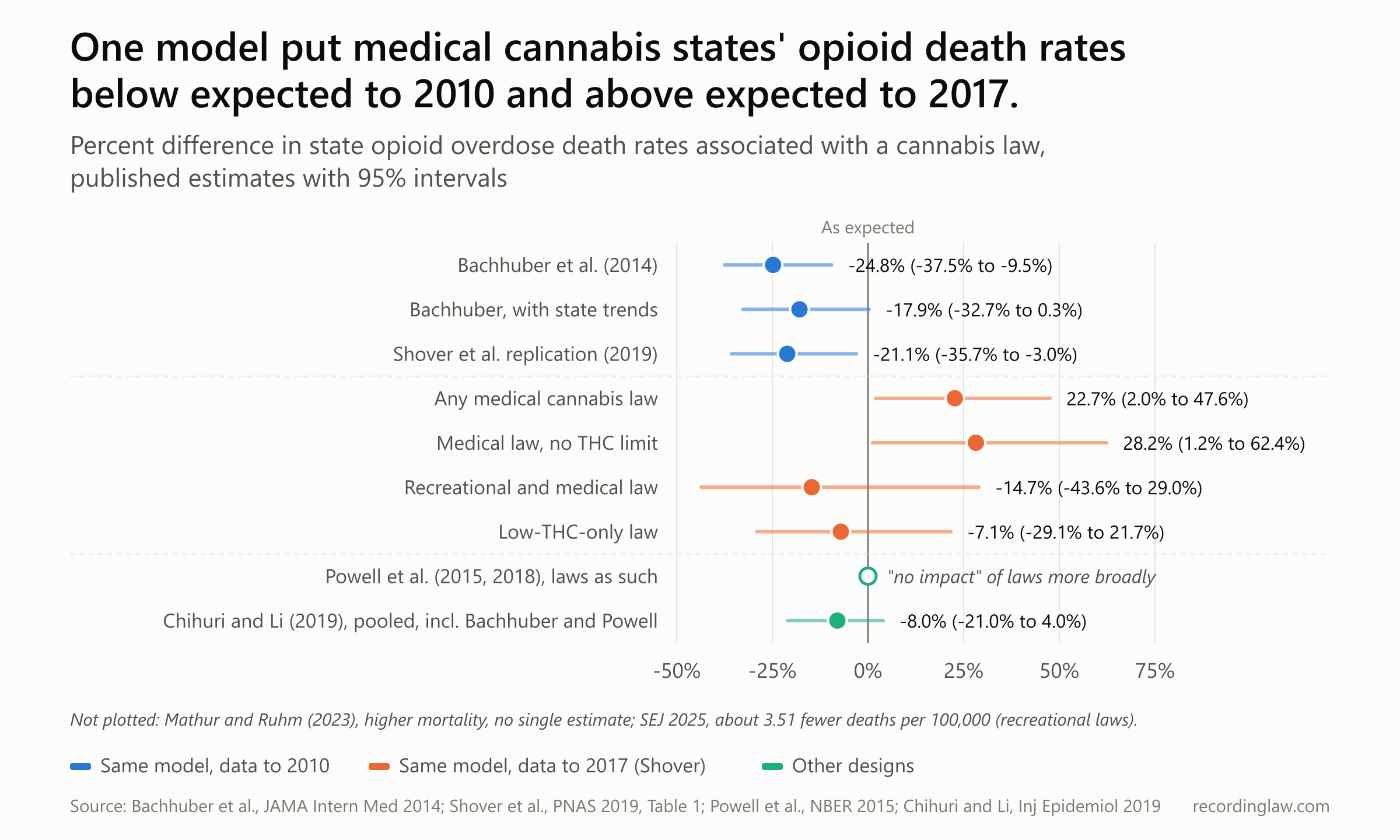
How far apart did the two answers land, and how sure was each? The chart below puts the estimates in this story that measure the same thing on one scale: how many percent higher or lower a state's opioid overdose death rate was, compared with what a model expected, in years when it had a cannabis law. The top four rows are the two studies' estimates for medical cannabis laws as a whole.
The next three come from the 2019 study, split by type of law, and the last two from other studies. Two of those three split medical laws by how much THC, a psychoactive compound in cannabis, they allow.
Source: Bachhuber et al., JAMA Internal Medicine, 2014; Shover et al., PNAS, 2019, Table 1; Powell, Pacula and Jacobson, NBER, 2015; Chihuri and Li, Injury Epidemiology, 2019. Published model estimates, not counts of deaths.
Each dot is a model's estimate. Each line is that estimate's 95% confidence interval, which is the range of values the data were consistent with. The two studies' estimates for medical cannabis laws sit on opposite sides of zero, and each estimate's interval is wide.
| Model | Years | Estimate | 95% confidence interval |
|---|---|---|---|
| Bachhuber et al., published | 1999-2010 | -24.8% | -37.5% to -9.5% |
| Bachhuber et al., with state-specific trends | 1999-2010 | -17.9% | -32.7% to +0.3% |
| Shover et al., replication | 1999-2010 | -21.1% | -35.7% to -3.0% |
| Shover et al., extension | 1999-2017 | +22.7% | +2.0% to +47.6% |
| Expanded model: medical law, no THC limit | 1999-2017 | +28.2% | +1.2% to +62.4% |
| Expanded model: recreational and medical law | 1999-2017 | -14.7% | -43.6% to +29.0% |
| Expanded model: low-THC-only law | 1999-2017 | -7.1% | -29.1% to +21.7% |
| Powell, Pacula and Jacobson, laws as such | see How we measured | no impact found | no single estimate in the summary quoted |
| Chihuri and Li, four mortality studies pooled | see How we measured | -8% | -21% to +4% |
The top row is the one that reached state policy. The fourth is what the same model gave when the data ran seven years longer.
What the 2014 study compared
The 2014 study compared states, not people. It had four authors: Marcus Bachhuber of the Philadelphia VA Medical Center and the University of Pennsylvania, Brendan Saloner and Colleen Barry of Johns Hopkins, and Chinazo Cunningham of the Albert Einstein College of Medicine. Its funders included the National Institute on Drug Abuse (NIDA), the Robert Wood Johnson Foundation and the Philadelphia VA.
That design is called an ecological study. It compares groups rather than individuals, and here each group was one state in one year.
The team used CDC death certificate data for every state from 1999 to 2010. A death certificate records each drug involved in a death with a code. The team counted overdose deaths of any intent, suicides included, in which an opioid analgesic was coded.
One of the codes it counted, T40.4, covers synthetic opioids other than methadone. That is the CDC category that includes illicitly manufactured fentanyl, so deaths involving fentanyl could already be in the 2014 count.
The model asked whether a state's death rate was different after its medical cannabis law took effect. It adjusted for each state's fixed characteristics and for national changes in each year. It also took into account three state opioid policies and the unemployment rate.
Thirteen states had laws in that window. California, Oregon and Washington had them before 1999, and ten more, from Alaska to Vermont, enacted them between 1999 and 2010.
Around the 24.8% estimate, the 95% confidence interval ran from 9.5% lower to 37.5% lower. The gap between law states and what the model expected widened with time since the law took effect. It was about 20% in the first year and about 33% in the fifth and sixth years.
| Years since law took effect | Estimated difference in death rate | 95% confidence interval |
|---|---|---|
| 1 | -19.9% | -30.6% to -7.7% |
| 2 | -25.2% | -40.6% to -5.9% |
| 3 | -23.6% | -41.1% to -1.0% |
| 4 | -20.2% | -33.6% to -4.0% |
| 5 | -33.7% | -50.9% to -10.4% |
| 6 | -33.3% | -44.7% to -19.6% |
Source: Bachhuber et al., JAMA Internal Medicine, 2014. Published model estimates, 1999 to 2010.
"Throughout the study period, states with medical cannabis laws had a higher opioid analgesic overdose mortality rate and the rates rose for both groups," the paper said. It added that between 2009 and 2010 the rate in states with medical cannabis laws appeared to plateau. Bachhuber, the lead author, made the same point to Philadelphia public radio station WHYY that week: "It's important to note that this wasn't a 25 percent decrease, it was a 25 percent lower rate than we would have expected, based on the previous trends, and on what was happening in the rest of the country."
The paper carried its own limits. In one test, the authors gave each state its own straight-line trend over time. The paper says this adjusts for hard-to-measure factors, such as attitudes or cultural changes, that changed at a steady rate but differently from state to state. It calls these confounders, and it says such state characteristics may explain differences both in which states had medical cannabis laws and in their overdose death rates.
An estimate is called statistically significant when its whole confidence interval sits on one side of zero. With the trend test, the estimate shrank to 17.9%, and its interval stretched just past zero. That made it only borderline statistically significant.
The authors wrote that "proposed mechanisms for this association are speculative and rely on indirect evidence," and that the strengthening over time "could represent heterogeneity between states that passed laws earlier in the study period vs those that passed the laws later." In other words, states that passed laws early might differ from those that passed them later.
Their policy sentence was conditional. "If the relationship between medical cannabis laws and opioid analgesic overdose mortality is substantiated in further work, enactment of laws to allow for use of medical cannabis may be advocated as part of a comprehensive package of policies to reduce the population risk of opioid analgesics," they wrote. University press releases announcing the study went out the day the paper did.
How the 25 percent left the paper
Within a day the 25 percent was in news coverage, and within four years it was in state policy. Johns Hopkins's release framed the finding as a possibility. "While more research is needed, these findings suggest that it is possible that the wider availability of medical marijuana for people in pain might help to reduce the growing number of overdose deaths attributed to prescription pain pills," it said. Barry, the senior author, offered one explanation in the same release: "individuals with chronic pain and their medical providers may be opting to treat pain entirely or in part with medical marijuana, in states where this is legal."
Some coverage went further than the paper. A Reuters Health story, as published by Fox News, said that "in the 23 U.S. states where medical marijuana has been legalized, deaths from opioid overdoses have decreased by almost 25 percent." The study covered 13 law states and measured a rate below expectation, not a decrease. An ABC News health blog wrote that the effect's growth over time suggested "the laws themselves may cause the difference," a causal reading the authors did not make.
Others took it as confirmation. Quartz wrote that the study's conclusions "suggest the pot advocates have it right." Marie Hayes of the University of Maine, who co-wrote the journal's invited commentary, told Live Science: "This is the first time that we have population-level data that suggests that marijuana has medical benefits."
Dr. Igor Grant, who directs the University of California, San Diego's Center for Medicinal Cannabis Research, told ABC News that one possible explanation for the link was the "opioid-sparing effect." In ABC's paraphrase, he said legalizing medical marijuana comes with serious considerations, but studies like this one suggest there may be unanticipated benefits as well. "Not to say cannabis is trivial and couldn't have a bad public health impact," Grant said. "But, we shouldn't jump to conclusions."
The authors moved between caution and possibility. In a release from NORML, the marijuana-legalization advocacy group, Barry was quoted from USA Today saying the findings "suggest the potential for many lives to be saved." Bachhuber told Managed Healthcare Executive in September 2014 that "managed care plans could start thinking about including it in their formularies in states where it is legal."
On February 25, 2015, Barry testified in Harrisburg on Senate Bill 3, Pennsylvania's medical cannabis bill. "While medical marijuana laws have been controversial, our study indicates an important unintended benefit of state medical marijuana laws," she wrote in testimony to the Senate State Government Committee.
By July 2017 the figure was on a billboard in South Boston. "States that legalized marijuana had 25% fewer opioid-related deaths," it read, according to CommonWealth Beacon, which reported that the ad was paid for by Weedmaps, a California company that runs a website guide to medical marijuana dispensaries. Clear Channel Outdoor took it down after a complaint.
In June 2018, New York's health commissioner, Dr. Howard Zucker, announced plans to add opioid use as a qualifying condition. "As research indicates that marijuana can reduce the use of opioids, adding opioid use as a qualifying condition for medical marijuana has the potential to help save countless lives across the state," he said. State Sen. George Amedore, a Republican who co-chaired the Senate's opioid task force, backed the change in the same release. Assembly Health Committee Chair Richard Gottfried, a Democrat, said in the same release: "Evidence from across the country shows that access to medical marijuana for pain treatment reduces the use of much more dangerous opioids."
When the emergency rule followed in July, New York's program had 62,256 certified patients. Marijuana Business Daily, a cannabis trade publication, wrote that the move was "expected to spur sales significantly."
Illinois followed on August 28, 2018, when Gov. Bruce Rauner, a Republican, signed the Alternatives to Opioids Act of 2018. "Medical cannabis creates an opportunity to treat pain in a less intrusive, less destructive way than opioids," Rauner said. "This creates an option to save lives."
The sponsor, Sen. Don Harmon, an Oak Park Democrat, answered critics who worried patients could become addicted to marijuana. "There's talk of medical cannabis being addicting; I don't know if that's true," he said. "I do know that opioids are addicting and we're seeing the ravishing costs of that right now."
Dr. Nirav Shah of the Illinois Department of Public Health said: "It's difficult to predict what the numbers will look like, but we're prepared and encouraging folks to use (medical marijuana)."
In North Dakota, a lead sponsor of the medical marijuana measure voters approved in 2016 later told the Minot Daily News, in the paper's paraphrase, that the study's findings were among the advocacy points cited in pushing for passage. By 2019, the reanalysis authors counted more than 350 scientific articles citing the 2014 paper and wrote that it "was hailed by many activists and industry representatives as proof that expanding medical cannabis would reverse the opioid epidemic."
The warnings, 2014 to 2018
Doubts were on the record the day the study appeared. "I'd be very, very careful saying that medical marijuana laws decrease risk of opiate [narcotic] overdose," Dr. Bradley Flansbaum, a hospitalist at Lenox Hill Hospital in New York, told HealthDay. "There are so many things going on in states, whether it be cultural or through laws, it's hard to say what's the effect of the medical marijuana law versus everything else that's happening," he said. "You don't know what causes what."
Saloner, a co-author, said in the Hopkins release that "more research is critical to understand how medical marijuana laws might be influencing both overdose deaths and the health trajectories of individuals suffering from chronic pain." Barry's own testimony in Pennsylvania spelled out the confounding problem in the same pages as the benefit. "It is important to note that isolating the effects of laws on health is challenging. For one thing, we would expect that states that have already passed medical marijuana laws are likely to be different in important ways from states that have not passed such laws with regard to, for example, social attitudes about drug use and overall health trends that might affect rates of opioid painkiller deaths," she wrote.
In April 2015, three researchers at the VA in Palo Alto and Stanford, John Finney, Keith Humphreys and Alex Harris, wrote to JAMA Internal Medicine. "We would suggest that the primary drawback of the ecologic analyses is that they provide no information whether individual pain patients who use marijuana have a lower or higher opioid analgesic mortality risk," their letter began. Four years later, Humphreys would be the senior author of the reanalysis.
Opponents of legalization disputed the finding outright. Kevin Sabet, head of Smart Approaches to Marijuana, a group that opposes commercial legalization, was quoted by the cannabis magazine High Times in 2017: "Simply put, it is erroneous to make the claim that people who use medical marijuana are at lower risk of overdose."
The same article quoted Attorney General Jeff Sessions on the idea that marijuana is a cure for opiate abuse: "Give me a break." Later in the same remarks he said: "I doubt that's true. Maybe science will prove I'm wrong."
In a September 2018 slide deck filed with a Kentucky legislative committee, Sabet wrote that in the 2014 study "The raw data showed that medical marijuana states had higher rates of opioid deaths until the authors introduced four possible reasons." That first point matches the paper's own description of the raw rates. Nine months after that deck, the reanalysis was published.
What happened when the window reached 2017?
In 2019, a team that included one of the 2015 letter writers ran the 2014 model again. It was led by Chelsea Shover, then a postdoctoral researcher at Stanford, with Corey Davis, Sanford Gordon and Humphreys. Shover was supported by a NIDA training grant and the Wu Tsai Neurosciences Institute, and Humphreys by a VA Senior Career Research Scientist Award, the Wu Tsai Neurosciences Institute and the Esther Ting Memorial Professorship at Stanford. The authors declared no conflict of interest.
The design was the 2014 one, with the same state and year adjustments and the same four controls for opioid policies and unemployment. First they reran 1999 to 2010.
"Whereas Bachhuber et al. estimated a 24.8% reduction in deaths per 100,000 population associated with a medical cannabis law's introduction, we estimated a statistically indistinguishable 21.1% decrease," they wrote. In other words, the two estimates were too close to tell apart. The authors said the slight differences from the 2014 estimates were likely due to missing values for 30 state-years, meaning 30 combinations of a state and a year.
Then they extended the window to 2017. "Using the full 1999–2017 dataset, we found that the sign reversed for medical cannabis laws, such that states passing a medical cannabis law experienced a 22.7% increase, 95% CI (2.0, 47.6) in overdose deaths." The confidence interval, from 2% to 48% higher, was wide but excluded zero.
How much did the answer depend on where the window stopped? The team ran the model again for each end year from 2002 to 2017: once with the data stopping in 2002, then a year later, and so on. "For end dates between 2008 and 2012, the association was negative as reported in Bachhuber et al.," they wrote. "Subsequently, the association became statistically indistinguishable from zero before turning positive in 2017."
On the chart near the top of this story, that is the jump from the third row to the fourth, from 21.1% below expected to 22.7% above.
The team also split the laws by type, the next three rows of that chart. Low-THC laws allowed only medical cannabis with low levels of THC. Comprehensive medical laws were medical laws with no THC limit, in states without a recreational law.
If broader access to cannabis lowered opioid deaths, states with recreational laws should show the strongest drop and low-THC states the weakest. Instead, comprehensive medical laws were associated with 28.2% higher mortality. The estimates for recreational and low-THC-only laws were not statistically significant, meaning their confidence intervals included zero. The authors wrote that their results did not support the expected pattern.
Jacob Sullum of the libertarian magazine Reason, who had reported the 2014 study's 25 percent figure, wrote of the type-by-type pattern: "Nevertheless, this is not the pattern you would expect to see if increased legal access to marijuana had a measurable impact on deaths involving opioids, either negative or positive."
A further test weakened both results. When each state was given its own straight-line trend, the same test the 2014 paper ran, "the sign of the effect of medical cannabis law switched from negative to positive once the data were extended to 2017; however, the magnitude was diminished and in neither specification was the estimate statistically significant." That is, with trend lines neither run was statistically significant. With or without them, the estimate went from negative to positive as the window grew, and the only change between the two runs was the seven added years.
What changed in the years that were added?
Between 2010 and 2017, two things changed at once. The laws multiplied: according to the reanalysis, 32 states enacted medical cannabis laws, 17 of them limited to low-THC products, and eight enacted recreational laws. And the deaths changed in kind.
The CDC dates a third wave of the opioid epidemic to 2013, "with substantial increases in overdose deaths involving synthetic opioids, particularly those involving illegally made fentanyl and fentanyl analogs." In the reanalysis, 2013 is also the first end year at which the medical cannabis estimate became statistically indistinguishable from zero. The CDC does not connect the two.
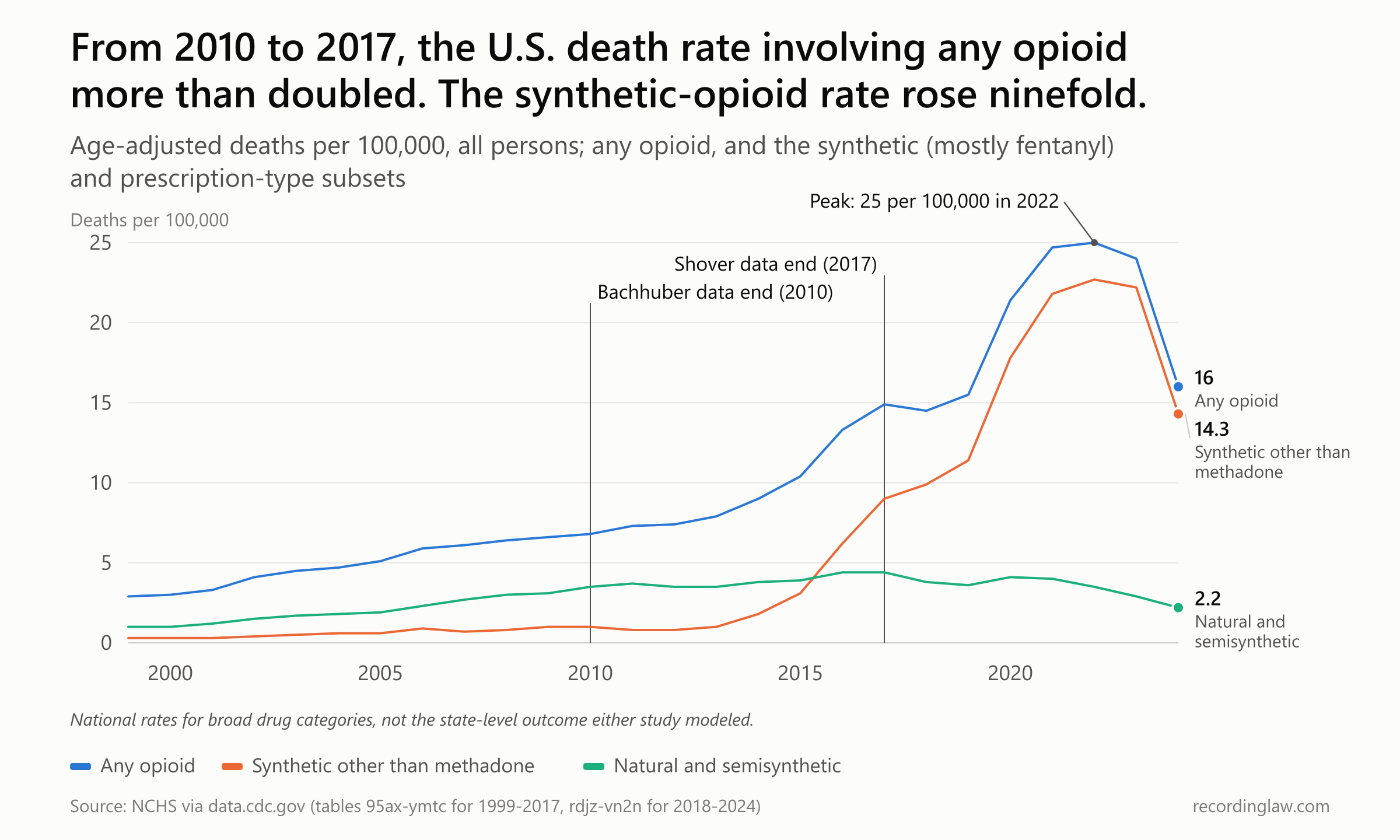
What did national opioid deaths do across the two study windows? The chart below uses national figures. Its top line is broader than the 2014 count: it counts deaths involving any opioid, including deaths involving only heroin, opium or unspecified narcotics, which the 2014 count left out. Its synthetic-opioid line (T40.4, mostly fentanyl) is a category the 2014 count did include.
Source: National Center for Health Statistics via data.cdc.gov (tables 95ax-ymtc for 1999-2017 and rdjz-vn2n for 2018-2024). National rates, not the state-level outcome either study modeled.
The national rate for deaths involving any opioid more than doubled between the end of the first window and the end of the second, from 6.8 per 100,000 in 2010 to 14.9 in 2017. The rate for synthetic opioids other than methadone, mostly fentanyl, rose ninefold, from 1 to 9.
| Year | Any opioid | Synthetic other than methadone | Natural and semisynthetic | Heroin |
|---|---|---|---|---|
| 1999 | 2.9 | 0.3 | 1.0 | 0.7 |
| 2010 | 6.8 | 1.0 | 3.5 | 1.0 |
| 2013 | 7.9 | 1.0 | 3.5 | 2.7 |
| 2017 | 14.9 | 9.0 | 4.4 | 4.9 |
| 2022 | 25.0 | 22.7 | 3.5 | 1.8 |
| 2024 | 16.0 | 14.3 | 2.2 | 0.8 |
Age-adjusted deaths per 100,000. A death can involve more than one type of opioid, so the columns do not add up to the first.
The reanalysis authors did not treat either number as an effect of the laws. Medical cannabis, they said, is used by about 2.5% of the U.S. population, and they called it "unlikely" that it "has exerted large conflicting effects on opioid overdose mortality." Their point was that a drug used by so few people was an implausible cause of lower death rates in one window and higher ones in the next.
"A more plausible interpretation is that this association is spurious," they wrote, meaning it came from something the model did not measure. They named candidates: "state incarceration rates and practices, naloxone availability, and the extent of insurance and services." Naloxone is an antidote to opioid overdoses.
Shover put it this way to STAT: "This isn't to say that cannabis was saving lives 10 years ago and it's killing people today." She went on: "We're saying these two things are probably not causally related." Humphreys, in Stanford's release, said the earlier finding of lower death rates "wasn't about the cannabis," adding: "It was something else about those states."
The main objection from the supporter side was about measurement. Sullum noted in Reason that the reanalysis coded laws by when they were enacted, not when sales began: Arizona counted as having a comprehensive law from 2011, though its first dispensary "did not open until December 2012," and Hawaii from 2001, though "legal sales did not begin there until 16 years later."
What each side did with the reversal
Chinazo Cunningham, one of the 2014 study's four authors, "didn't dispute the new findings," Olga Khazan reported in The Atlantic in 2019. Khazan, who had covered the 2014 study, wrote that it had "launched hopes that medical marijuana could help fight the opioid epidemic." "Certainly cannabis is not a silver bullet. It's not going to fix the opioid epidemic," Cunningham told her.
Cunningham also said there was still hope that cannabis could play a role in pain management, Khazan reported, pointing to clinical research showing it can reduce pain and to other studies associating ready availability of marijuana with fewer opioid-overdose deaths. In Stanford's release, Humphreys and Shover said they believe medical marijuana provides benefits and that research into its effectiveness should continue.
The federal research agency that paid for both studies rewrote its public summary. By July 2019, NIDA's research report on marijuana as medicine described the 2014 study and "a 2019 analysis, also funded by NIDA," and concluded: "These data, therefore, do not support the interpretation that access to cannabis reduces opioid overdose."
Some framing went past the authors' own conclusion, which was that the claim that medical cannabis laws reduce overdose deaths "should be met with skepticism." NBC News called the findings a possible "blow to those in the cannabis industry, and even doctors." Stanford Medicine's own Insights blog went further: "Now, thanks to new Stanford research, we know it was a pipe dream."
Addiction researchers interviewed by STAT warned against treating medical marijuana as an answer to overdose deaths. Wayne Hall of the University of Queensland said: "The risk is distracting attention away from much more effective interventions that should be implemented to reduce overdose deaths."
"Is cannabis less of a mortality risk than opioids? Absolutely. Hands down," Yasmin Hurd of Mount Sinai's Addiction Institute, who also studies CBD (cannabidiol, a nonpsychoactive component of cannabis) for opioid craving, told STAT. "But there's really no research that says cannabis use per se decreases opioid overdose." Shover told AlterNet her concern was patients being encouraged or driven to try medical cannabis "instead of therapy for opioid use disorder that we do have evidence for."
Then the critics turned to marketing: in 2020, Shover and colleagues reviewed the websites of 167 dispensary brands in seven states. They called states where opioid use disorder (OUD) was a qualifying condition policy-exposed. "In policy-exposed states, 39% (95% CI, 23%-55%) more dispensaries claimed cannabis could treat OUD compared with unexposed states," they reported. In the same paper they quoted Weedmaps billboards and wrote: "never in the history of medicine has a drug been approved to treat a serious condition based on ecological correlations in uncontrolled research."
Theodore Caputi, a researcher who disclosed a past consulting contract with Smart Approaches to Marijuana, wrote in the American Journal of Public Health in 2020 that "marijuana companies may mislead consumers into conflating" rigorous FDA trial evidence with "a correlational or ecological study." A 2022 study of six companies' websites by Caputi counted "908 research-related health claims."
Has later research settled it?
Later research has not settled it. Its authors point to what the answer depended on: whether a state had dispensaries open, which years the data covered, and, in the words of a 2023 study described below, "the choice of specifications." One such choice is whether a model gives each state its own trend line.
The dispensary question came first. A RAND team, David Powell, Rosalie Liccardo Pacula and Mireille Jacobson, funded by NIDA, used two methods that compare states that changed their laws with similar states that did not (difference-in-differences and synthetic control). They found reductions tied to dispensaries rather than to laws as such.
"We find no impact of medical marijuana laws more broadly," they wrote in a 2015 working paper. In the 2018 published version: "As states have become more stringent in their regulation of dispensaries, the protective value generally has fallen."
Two Columbia University researchers, Stanford Chihuri and Guohua Li, in a 2019 review funded by the CDC's injury center, pooled four mortality studies, which means they combined the studies' results into one estimate. The four included the 2014 paper and the RAND study. The pooled estimate was an 8% reduction that was not statistically significant, the bottom row of the chart near the top. "Evidence about the effect of marijuana legalization on opioid overdose mortality is inconsistent and inconclusive," they concluded, and any effect "appears to be rather small and limited to states with operational marijuana dispensaries."
They also named the years. In their wording, MMLs are medical marijuana laws. They wrote that "studies assessing the impact of MMLs on opioid overdose mortality using data for 2014 and after, such as the report by Shover et al. (2019), can be seriously confounded by the overriding role of fentanyl and analogs."
In 2023, Neil Mathur and Christopher Ruhm of the University of Virginia replicated and extended the earlier designs. They reported that prior results were "frequently fragile to the choice of specifications and time periods," and that "legal medical marijuana, particularly when available through retail dispensaries, is associated with higher opioid mortality."
For Chihuri and Li, fentanyl was a confounder. Mathur and Ruhm instead named fentanyl as a likely mechanism for the higher mortality they estimate: "the emergence of illicit fentanyl, which has increased the riskiness of even small positive effects of cannabis legalization on the consumption of opioids." By a positive effect on consumption they mean more opioid use, and in their reading fentanyl made even a small rise riskier.
Their study was funded by Arnold Ventures. Ruhm has served as a plaintiff's consultant and Mathur has provided support to defendants in opioid litigation, roles the authors say were unrelated to the study.
Other studies, about recreational laws and dispensary openings, continued to point the other way. In October 2025, NORML deputy director Paul Armentano said a new analysis of opioid deaths in early- and later-adopting legalization states, the Southern Economic Journal paper below, "provides greater clarity" on the issue.
A 2025 Southern Economic Journal paper by researchers at West Virginia University, Angelo State, New Mexico State and the American Institute for Economic Research found recreational laws associated with about 3.51 fewer opioid deaths per 100,000, according to NORML's summary. Its authors reported no specific funding for the work and no conflicts of interest.
A 2026 Preventive Medicine Reports study by University of Kentucky researchers, also summarized by NORML, looked at non-fatal opioid poisoning diagnoses among adults with employer insurance. It linked medical cannabis dispensary openings to a 15.47% reduction in those diagnoses, and recreational laws to an 11.92% reduction. It was supported by the National Institutes of Health's National Center for Advancing Translational Sciences, and its authors declared no competing interests.
Studies that looked at individuals instead of states asked a different question. Caputi and Humphreys, using a 2015 national survey, found medical marijuana users about twice as likely to report non-medical use of prescription pain relievers after adjusting for other differences (an adjusted risk ratio of 1.95). Bachhuber and colleagues answered that "Studies comparing people who take medical cannabis with people who do not take it cannot draw conclusions about the effect of medical cannabis on drug use," and called for randomized trials.
Cunningham named the obstacle to those trials in 2019: "And with the federal government's policies, that's nearly impossible to do." In September 2025, Pacula and Powell from the RAND dispensary study and Davis, a co-author of the 2019 reanalysis, shared a byline on a 15-author Health Affairs article warning that opioid-policy evaluations "may muddy the waters, particularly when they generate inconsistent findings."
Where it stands in November 2026
The death count has moved again. The national opioid death rate peaked at 25 per 100,000 in 2022 and was 16 in 2024, the latest final year.
The CDC also publishes provisional counts, which are revised as records arrive. In CDC's October 14, 2026, release, provisional counts for the 12 months ending May 2026 showed 40,641 opioid overdose deaths, about half the 80,719 for calendar 2023. The CDC cautions that falling provisional numbers "could be due to incomplete data, true decreases in the number of deaths, or a combination of the two."
Federal policy has moved too, on a different evidence base. On April 22, 2026, Acting Attorney General Todd Blanche signed a final rule, which was published and took effect on April 28. It moved FDA-approved drug products containing marijuana, and marijuana covered by a state medical marijuana license, out of Schedule I, the strictest category of the federal Controlled Substances Act, and into the less restrictive Schedule III.
The American Society of Addiction Medicine told members that such marijuana is "also now Schedule III." The society added that "there currently is no American medical society guideline endorsing marijuana (i.e., non‑FDA‑approved) as a treatment."
The April order said its choice most closely aligned with the findings of a 2023 evaluation by the Department of Health and Human Services (HHS). That evaluation does not cite either study. On whether cannabis spares opioids, it said the data showed "any effect was uncertain" or "there was likelihood of an effect, but a causal inference could not be determined."
The April rule did not cover all marijuana. In a separate DEA hearing on moving all remaining marijuana to Schedule III, the judge's October 22 order set no date for his recommended decision.
The CDC updates its provisional overdose counts monthly, and each release revises the months before it. The 2014 model stopped at 2010 and the 2019 rerun stopped at 2017. The same comparison of state death rates can be run on every year since, through the fentanyl peak and the decline that followed, and its answer has already depended once on where the window ends.
The 2014 finding is still in circulation. NORML's fact sheet on marijuana and opioids, as read on October 31, 2026, quotes the study's conclusion that medical cannabis laws "were associated with a lower rate of overdose mortality that generally strengthened over time." It does not mention the 2019 reanalysis.
How we measured
The two studies. Bachhuber et al. (JAMA Internal Medicine, 2014) and Shover et al. (PNAS, 2019) were read in full text from PubMed Central (PMC4392651, PMC6600903); the journal sites block scripted access. Both are state-year panels, which means every state appears once for every year. Both use state and year fixed effects, which are the adjustments for each state's fixed characteristics and for national changes in each year. Both also use four time-varying controls (the unemployment rate and three state opioid-policy laws).
Death certificates record each drug involved with an ICD-10 code, the international system for coding causes of death. Bachhuber's outcome is opioid analgesic overdose deaths of any intent in which one of the ICD-10 codes T40.2 to T40.4 was also listed, from CDC death certificates via CDC WONDER, 1999 to 2010. The paper calls these opioid analgesic overdose deaths and notes that its definition captured deaths involving illicit drugs such as heroin when an opioid analgesic was coded too.
T40.4, synthetic opioids other than methadone, includes illicitly manufactured fentanyl, per CDC's MMWR definitions. The 2010 estimate of 1,729 fewer deaths than expected has a 95% interval of 549 to 3,151.
Shover et al. describe their outcome as opioid analgesic overdose deaths extracted from CDC WONDER using the 2014 study's methods. They do not list ICD-10 codes, and their Table 1 labels it the age-adjusted opioid overdose death rate per 100,000. Their panel runs to 2017.
What the percentages mean. Every percentage in the coefficient table is a model estimate of how much higher or lower a state's death rate was in years with a law than the model predicted. It is not a change in the number of deaths. Bachhuber's state-specific-trend estimate was -17.9% (95% CI -32.7% to 0.3%; P = .054).
Shover's Figure 1 plots the estimate for each end year from 2002 to 2017. Its per-year values are not given in the text, so we do not reproduce them, and we report only the paper's description (negative for end years 2008 to 2012, indistinguishable from zero after, positive in 2017). The paper's discussion says the association "became equivocal in 2013".
The estimates chart. It plots every published estimate in this story of the same quantity, the percent difference in a state's opioid overdose death rate associated with a cannabis law, with the 95% intervals the papers give. The Chihuri and Li row is their random-effects pooling of four mortality studies (Bachhuber et al. 2014, Phillips and Gazmararian 2017, Powell et al. 2018 and Smart 2016), which the review reports as "a statistically non-significant 8% reduction in opioid overdose mortality (95% confidence interval: − 0.21 to 0.04; p = 0.201)"; we show that interval as -21% to +4%. Because the pooled figure includes the 2014 study and the RAND study, it is not independent of them.
The RAND row is a hollow marker at zero because the summary we quote reports "no impact of medical marijuana laws more broadly" and gives no single estimate for laws as such; its dispensary finding is a decrease with no figure in that summary. Mathur and Ruhm (2023) report higher mortality without one summary estimate in their abstract, and Shover's state-trend extension is described only as positive and not significant, so neither is plotted. The 2025 Southern Economic Journal estimate (deaths per 100,000, recreational laws) and the 2026 Preventive Medicine Reports estimates (non-fatal poisoning diagnoses) measure different outcomes or units and are not on the same scale.
National rates. Age-adjusted opioid overdose death rates for all persons come from two NCHS tables on data.cdc.gov: 95ax-ymtc (Health, United States 2019) for 1999 to 2017 and rdjz-vn2n (NCHS Data Query System, rows updated August 3, 2026) for 2018 to 2024. The 2018 value was revised between the tables (any opioid 14.6 in the older, 14.5 in the newer), so 2018 onward uses the newer table.
These are national rates for broad drug categories and are context only. They are not the state-level opioid analgesic outcome either study modeled, and they cannot reproduce either study's result.
Provisional counts. The 12-month counts (80,719 for 2023, 55,007 for 2024, 45,013 for 2025, 40,641 for the 12 months ending May 2026) are reported, not predicted, values from CDC's Vital Statistics Rapid Release for the indicator "Opioids (T40.0-T40.4,T40.6)," rows updated October 14, 2026. Provisional counts are revised as records arrive.
The HHS review's survey evidence. The 2023 HHS evaluation cited a survey on whether cannabis spares opioids, in which 34.1% of respondents did not answer. The review quoted its result: "60.5% of those who reported use of cannabis exclusively for medical reasons in the past year reported having used cannabis for pain relief, instead of using opioids or prescription pain medication in the past 12 months."
What comes next. A separate DEA hearing on moving all remaining marijuana to Schedule III was stayed, or paused, on September 29, 2026. The pause let the administrative law judge consider adding a new Government Accountability Office report to the record.
On October 22, Chief Administrative Law Judge Derek C. Julius admitted the report, refused to reopen the hearing and allowed optional briefs on it, with replies due November 5, and ordered the stay to end when that briefing closed. His order set no date for his recommended decision.
Our arithmetic. "More than doubled" is 14.9 / 6.8 = 2.2. "Ninefold" is 9.0 / 1.0. "About half" is 40,641 / 80,719 = 0.50. "About twice as likely" is the adjusted risk ratio of 1.95. "Seven more years" is 2011 through 2017. "Eleven months" runs from New York's July 12, 2018, rule to the June 10, 2019, publication.
What the data cannot show. We did not build a state-by-state chart comparing early and late adopters: CDC WONDER requires an interactive session, suppresses counts under 10, and such a chart would be our own analysis rather than a published one. Neither study, nor this article, can say whether any individual who used medical cannabis was more or less likely to die of an overdose.
The 2025 Southern Economic Journal and 2026 Preventive Medicine Reports papers were not read in full; we checked each paper's abstract and its funding and competing-interest statements at the publisher or PubMed Central. Quotes attributed to Kevin Sabet in 2017 and to Jeff Sessions come from High Times, not original transcripts. The billboard's wording is reported two ways: CommonWealth Beacon gives "States that legalized marijuana," and Shover et al. (2020) quote Weedmaps billboards as "States that legalized medical marijuana."
Frequently Asked Questions
Do medical marijuana laws reduce opioid overdose deaths?
The research disagrees, and the main studies cannot settle it. A 2014 study of all 50 states found law states had opioid analgesic overdose death rates 24.8% lower than expected from 1999 to 2010. A 2019 reanalysis using the same methods found the association reversed to 22.7% higher through 2017, and its authors called the association likely spurious. A 2019 review of studies called the evidence inconsistent and inconclusive. On whether cannabis spares opioids, a 2023 HHS review called any effect uncertain.
What did the 2014 JAMA Internal Medicine study on medical marijuana and opioids find?
Bachhuber, Saloner, Cunningham and Barry compared states with and without medical cannabis laws from 1999 to 2010. States with laws had a 24.8% lower average yearly opioid analgesic overdose death rate than the model expected (95% CI 9.5% to 37.5% lower), or an estimated 1,729 fewer deaths than expected in 2010. Raw death rates were higher in law states throughout, and the authors said the mechanism was unclear.
Was the 25 percent a drop in deaths?
No. It was a gap between observed death rates and what the model expected. Opioid analgesic overdose death rates rose in both groups of states from 1999 to 2010, and law states had higher raw rates throughout. The lead author told WHYY in 2014 that it was not a 25 percent decrease but a 25 percent lower rate than expected.
Why did the 2019 reanalysis get the opposite result?
Shover, Davis, Gordon and Humphreys reran the 2014 model and got -21.1% for 1999 to 2010. Extending the data to 2017 changed the estimate to +22.7%. They found it negative for end years 2008 to 2012, indistinguishable from zero after that and positive by 2017. They concluded the association was likely spurious in both periods, meaning it likely came from something the model did not measure. Other researchers, including Chihuri and Li (2019) and Mathur and Ruhm (2023), point to the rise of illicit fentanyl in the mid-2010s, either as a confounder that could account for the later results or as a likely mechanism that made even a small rise in opioid use linked to cannabis legalization riskier.
What is an ecological study and why does it matter here?
An ecological study compares groups, here states in each year, rather than individuals. It can show that states with a law had different death rates, but not whether people who used medical cannabis were more or less likely to die of an overdose. Both the 2014 and 2019 authors, and a 2015 letter to the journal, made this point.
Who funded the 2014 and 2019 studies?
The 2014 study was funded by sources including the National Institute on Drug Abuse, the Robert Wood Johnson Foundation and the Philadelphia VA. For the 2019 reanalysis, Shover was supported by a National Institute on Drug Abuse training grant and the Wu Tsai Neurosciences Institute, and Humphreys by a VA Senior Career Research Scientist Award, the Wu Tsai Neurosciences Institute and the Esther Ting Memorial Professorship at Stanford. Its authors declared no conflict of interest.
Did New York and Illinois use medical marijuana as an opioid alternative?
Yes. On July 12, 2018, New York filed emergency regulations making any condition for which an opioid could be prescribed a qualifying condition for medical marijuana. A June 2018 state release said law states had lower opioid overdose death rates, perhaps by as much as 25 percent. On August 28, 2018, Illinois Gov. Bruce Rauner signed the Alternatives to Opioids Act of 2018.
Is medical marijuana in Schedule III now?
In April 2026 the Justice Department issued a final rule, effective April 28, placing FDA-approved drug products containing marijuana, and marijuana covered by a state medical marijuana license, in Schedule III, a less restrictive category than Schedule I. A separate DEA hearing on moving all remaining marijuana to Schedule III was stayed on September 29, 2026, over a Government Accountability Office report. On October 22 the judge admitted the report and allowed briefs, with replies due November 5, and set no date for his recommended decision. On whether cannabis spares opioids, the 2023 HHS evaluation called any effect uncertain.
Are opioid overdose deaths falling?
The national age-adjusted opioid overdose death rate fell from 25 per 100,000 in 2022 to 16 in 2024. CDC provisional counts in the October 2026 release showed 40,641 opioid overdose deaths in the 12 months ending May 2026, compared with 80,719 in 2023. The CDC notes that provisional declines can partly reflect incomplete data.
Updates
Corrected: The article now includes the 2014 study's own qualifier that, while opioid analgesic overdose death rates rose in both groups of states, the rate in states with medical cannabis laws appeared to plateau between 2009 and 2010.
Restructured as a feature: chart titles state the finding, side details moved to How we measured. Every figure and quote was re-checked against its source.
Independently fact-checked against the cited primary sources
Independently fact-checked against the cited primary sources
Sources and References
- Bachhuber MA, Saloner B, Cunningham CO, Barry CL. Medical Cannabis Laws and Opioid Analgesic Overdose Mortality in the United States, 1999-2010. JAMA Internal Medicine 174(10):1668-1673 (2014), PubMed Central full text(pmc.ncbi.nlm.nih.gov).gov
- Shover CL, Davis CS, Gordon SC, Humphreys K. Association between medical cannabis laws and opioid overdose mortality has reversed over time. PNAS 116(26):12624-12626 (2019), PubMed Central full text(pmc.ncbi.nlm.nih.gov).gov
- NCHS, drug overdose death rates by drug type, Health, United States 2019 table (data.cdc.gov 95ax-ymtc)(data.cdc.gov).gov
- NCHS Data Query System, drug overdose death rates (data.cdc.gov rdjz-vn2n), 2018-2024(data.cdc.gov).gov
- CDC/NCHS Vital Statistics Rapid Release, Provisional Drug Overdose Death Counts (data.cdc.gov xkb8-kh2a)(data.cdc.gov).gov
- CDC/NCHS, Provisional Drug Overdose Death Counts technical notes(cdc.gov).gov
- CDC, Understanding the Opioid Overdose Epidemic(cdc.gov).gov
- Johns Hopkins Bloomberg School of Public Health press release, Aug. 25, 2014(publichealth.jhu.edu)
- WHYY, interview with Marcus Bachhuber, Aug. 28, 2014(whyy.org)
- Managed Healthcare Executive, Sept. 3, 2014(managedhealthcareexecutive.com)
- NORML news release (legalization advocacy group), Aug. 28, 2014(norml.org)
- HealthDay News, Aug. 25, 2014(healthday.com)
- Reuters Health story as published by Fox News, Aug. 2014(foxnews.com)
- ABC News health blog, Aug. 25, 2014(abcnews.go.com)
- Quartz, Aug. 26, 2014(qz.com)
- Live Science via NBC News, Aug. 25, 2014(nbcnews.com)
- Reason (Jacob Sullum), Aug. 25, 2014(reason.com)
- Colleen L. Barry, written testimony to the Pennsylvania Senate State Government Committee on Senate Bill 3, Feb. 25, 2015(pasenategop.com)
- Finney JW, Humphreys K, Harris AH, letter, JAMA Internal Medicine 175(4):655-656 (2015)(jamanetwork.com)
- High Times (Russ Belville), June 27, 2017(hightimes.com)
- CommonWealth Beacon, July 13, 2017(commonwealthbeacon.org)
- New York State Department of Health press release, June 18, 2018(health.ny.gov).gov
- New York State Department of Health press release, July 12, 2018(health.ny.gov).gov
- Marijuana Business Daily, July 12, 2018(mjbizdaily.com)
- NPR Illinois via Tri States Public Radio, Aug. 28, 2018(tspr.org)
- Minot Daily News, June 2019(minotdailynews.com)
- Kevin Sabet (Smart Approaches to Marijuana), slide deck filed in Kentucky legislature committee documents, Sept. 14, 2018(apps.legislature.ky.gov).gov
- Stanford Medicine news release, June 10, 2019(med.stanford.edu)
- Stanford Medicine Insights blog, June 10, 2019(med.stanford.edu)
- STAT, June 10, 2019(statnews.com)
- NBC News, June 10, 2019(nbcnews.com)
- Olga Khazan, The Atlantic, republished by Route Fifty, June 10, 2019(routefifty.com)
- Reason (Jacob Sullum), June 11, 2019(reason.com)
- AlterNet, July 11, 2019(alternet.org)
- NIDA Research Report, Is marijuana safe and effective as medicine? (version updated July 2019, archived Aug. 24, 2019)(web.archive.org)
- Powell D, Pacula RL, Jacobson M. Do Medical Marijuana Laws Reduce Addictions and Deaths Related to Pain Killers? NBER Working Paper 21345 (2015)(nber.org)
- USC Schaeffer Center, abstract of Powell, Pacula and Jacobson, Journal of Health Economics (2018)(schaeffer.usc.edu)
- Chihuri S, Li G. State marijuana laws and opioid overdose mortality. Injury Epidemiology (2019)(link.springer.com)
- PubMed abstracts: Mathur and Ruhm, Journal of Health Economics (2023); Caputi and Humphreys, Journal of Addiction Medicine (2018); Shover et al., JAMA Network Open (2020); Caputi, Journal of Studies on Alcohol and Drugs (2022); Pacula et al., Health Affairs (2025)(pubmed.ncbi.nlm.nih.gov).gov
- Shover CL et al., JAMA Network Open 3(7):e2010001 (2020), PubMed Central full text(pmc.ncbi.nlm.nih.gov).gov
- Caputi TL. The Medical Marijuana Industry and the Use of Research as Marketing. American Journal of Public Health 110(2):174-175 (2020)(pmc.ncbi.nlm.nih.gov).gov
- Bachhuber MA, Arnsten JH, Cunningham CO, Sohler N, commentary, Journal of Addiction Medicine 12(4):259-261 (2018)(pmc.ncbi.nlm.nih.gov).gov
- NORML fact sheet, Relationship Between Marijuana and Opioids (read Oct. 31, 2026)(norml.org)
- NORML blog, Oct. 14, 2025(norml.org)
- NORML blog, May 29, 2026(norml.org)
- HHS, Basis for the Recommendation to Reschedule Marijuana into Schedule III (Aug. 29, 2023)(hhs.gov).gov
- American Society of Addiction Medicine, member FAQ on federal marijuana rescheduling, May 11, 2026(asam.org)
- Vicente LLP, on the DEA rescheduling hearing stay (2026)(vicentellp.com)
- Federal Register, FR Doc. 2026-08176 (91 FR 22714), final rule rescheduling FDA-approved products containing marijuana and state-licensed medical marijuana to Schedule III, signed April 22, 2026, effective April 28, 2026(federalregister.gov).gov
- DEA, Chief Administrative Law Judge Derek C. Julius, Order Granting Motion to Admit GAO Report and Motion to File Supplemental Briefs; Order Denying Motion to Reopen Hearing, Hearing Docket No. 26-96, Oct. 22, 2026(dea.gov).gov
- Scholl L et al., Drug and Opioid-Involved Overdose Deaths, United States 2013-2017, CDC MMWR 67(5152) (2018), ICD-10 category definitions(cdc.gov).gov
- Mathur NK, Ruhm CJ. Marijuana Legalization and Opioid Deaths. NBER Working Paper 29802; published Journal of Health Economics (2023), funding and disclosures(nber.org)
- Denkyirah EK, March RJ, Rayamajhee V, Yonk RM. Because I Got High? Recreational Marijuana Legalization's Impact on Opioid Overdose Deaths. Southern Economic Journal (published online Oct. 9, 2025)(onlinelibrary.wiley.com)
- The association between state cannabis legalization and non-fatal opioid poisonings among adults with employer-sponsored insurance in the United States. Preventive Medicine Reports (June 2026), PubMed Central full text(pmc.ncbi.nlm.nih.gov).gov
- Pacula RL et al. Improving Policy Evaluations Of The Opioid Crisis. Health Affairs (2025), PubMed Central author manuscript(pmc.ncbi.nlm.nih.gov).gov