Crime Near New York's Two Overdose Prevention Centers Showed No Significant Change in a 2023 Study. A 2024 Study Found Property Crime Up 167% Near One.

Independently fact-checked against primary sources (last audited November 10, 2026). · 18 primary sources cited on this page. How we verify our legal content
On November 30, 2021, two syringe programs in upper Manhattan began letting people use drugs inside, with trained staff watching. One is on East 126th Street between Park and Lexington Avenues in East Harlem, directly across the street from a children's center that houses a daycare. The other is on West 180th Street off Amsterdam Avenue in Washington Heights.
The city called them overdose prevention centers, or OPCs, and its announcement that day made a claim anyone with a police database could test against New York. "Other places with OPCs have not seen an increase in crime, even over many years," it said. City agencies would run joint operations on street conditions, it added, "and we will include an increased focus on the areas surrounding the OPCs as they open."
Federal law pointed the other way. Ten months earlier, in a case over a planned site in Philadelphia, a federal appeals court had ruled 2-1 that such a site would violate 21 U.S.C. 856, a federal drug statute. "Though the opioid crisis may call for innovative solutions, local innovations may not break federal law," Circuit Judge Bibas wrote for the majority.
In 2026 the two centers were still running. Their operator, OnPoint NYC, counts 244,623 uses of its rooms and 2,004 overdose interventions as of early January 2026, by its own tally.
Over the same years, felony complaints (the felonies reported to the NYPD) within 300 meters of the two sites averaged about 20% more per month than before the opening, by our count of police data. Citywide, the increase was about 28%.
A study of crime around the centers, published in JAMA Network Open in November 2023, compared the blocks around the two centers with the blocks around 17 other syringe programs through 2022. It found no significant change in violent or property crime. It also found arrests for drug possession near the centers down 83% relative to those programs. Its authors wrote that the drop may reflect City Hall not wanting arrests to scare people away.
A second study, which looked at each center on its own, found property crime up 167% near the Washington Heights site. Near East Harlem it found no change.
Did the blocks around the centers get more dangerous? The studies disagree, and each answer turns partly on how many arrests police were making near the sites at the time. That question runs through what came after: a federal prosecutor's threat in 2023, a three-month surge in drug arrests near the sites that same year, and a 2026 request to the Justice Department to shut them.
Three studies, three answers
The three studies that measured the blocks around the centers each used a different comparison and a different stretch of time. In the table, the range in brackets after each 2023 estimate is a 95% confidence interval, the range of values that fit the study's data reasonably well, by a method that would catch the true value in about 95 of 100 repeat studies. What did they find?
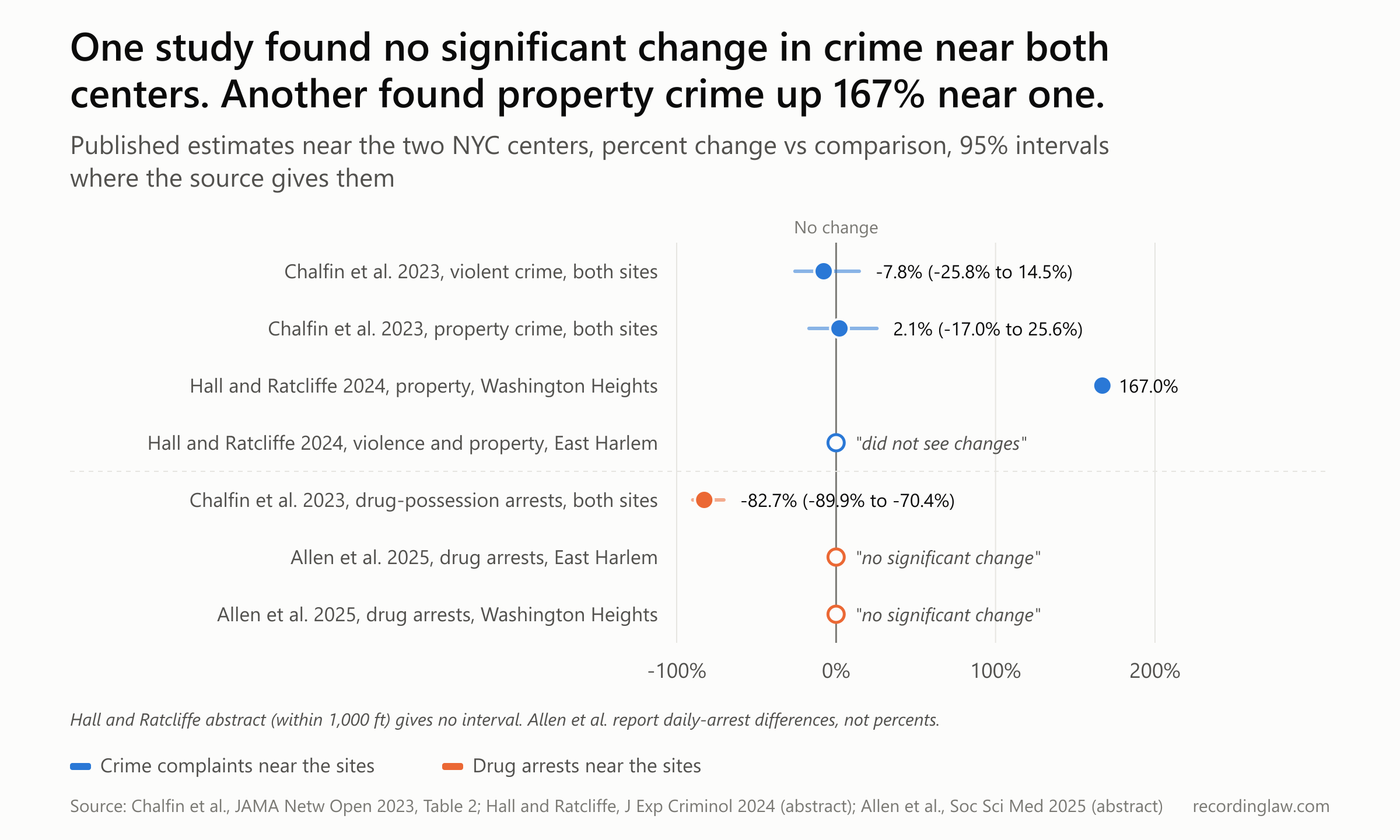
Published estimates near the two centers, with 95% intervals where the source gives them. Sources: Chalfin et al., JAMA Network Open (2023), Table 2; Hall and Ratcliffe, Journal of Experimental Criminology (2024), abstract; Allen et al., Social Science & Medicine (2025), abstract.
| Study | Comparison and window | Outcome near the sites | Estimate |
|---|---|---|---|
| Chalfin et al. (2023) | 17 other syringe programs, through Dec 2022 | Violent crime complaints | -7.8% (-25.8% to 14.5%), not significant |
| Chalfin et al. (2023) | 17 other syringe programs, through Dec 2022 | Property crime complaints | 2.1% (-17.0% to 25.6%), not significant |
| Chalfin et al. (2023) | 17 other syringe programs, through Dec 2022 | Drug-possession arrests | -82.7% (-89.9% to -70.4%), significant |
| Hall and Ratcliffe (2024) | Synthetic control, each site separately | Property crime within 1,000 ft, Washington Heights | 167% increase, significant |
| Hall and Ratcliffe (2024) | Synthetic control, each site separately | Violence and property crime, East Harlem | "did not see changes" |
| Allen et al. (2025) | Synthetic control, Jan 2014 to Sep 2023 | Drug-related arrests, each site | "no significant change" |
The authors name what separates their results. The 2023 team wrote that its crime result may describe the centers plus a change in policing. Hall and Ratcliffe wrote that the effect differed by site, "possibly moderated by local factors." Both explanations go back to opening day, and to what each side said would happen.
What each side said would happen
The case for the centers, as the city made it, rested on lives and on the street. "Overdose Prevention Centers are a safe and effective way to address the opioid crisis," Mayor Bill de Blasio said at the launch. "I'm proud to show cities in this country that after decades of failure, a smarter approach is possible."
His health commissioner, Dr. Dave A. Chokshi, promised the sites would "save lives and bring people in from the streets, improving life for everyone involved." The release cited a Health Department feasibility study that found the centers "would save up to 130 lives a year." Axios reported the same day that the 2018 study behind that figure had modeled four centers. The city opened two.
Supporters also made a public-safety argument. State Sen. Gustavo Rivera, who chaired the Senate Health Committee, said the centers "will also help address the valid concerns that certain New Yorkers have regarding the increased presence of substance use on our streets." Richard Aborn, president of the Citizens Crime Commission of New York City, called them "a compassionate and proven way to help people get critical services and supports, and promote health and safety in the community."
The warnings came first from the neighborhood that got the East Harlem site. Manhattan Community Board 11, which had passed a moratorium resolution that March, said the Health Department had not been straight with it. "The agency was dishonest with this board and with our staff when asked directly whether this facility would indeed be sited in this district," said its chair, Nilsa Orman.
The Greater Harlem Coalition, which says it represents 120 Harlem organizations, predicted more dealing. "This concentration has drawn drug dealers to the district, creating a range of quality-of-life issues," it said. "Adding a supervised injection site in Harlem, and not other districts, will only exacerbate the problem." Assemblywoman Inez Dickens said Harlem "has been forced to accept more than our share of such clinics over decades," and the Rev. Al Sharpton's National Action Network organized a protest over the siting.
Rep. Nicole Malliotakis, a New York Republican, wrote to the attorney general on opening day. "These centers not only encourage drug use but they will further deteriorate our quality of life," she said. The Justice Department had already stated its view after the Philadelphia ruling. Acting Attorney General Jeffrey A. Rosen said in January 2021 that "injection sites are not the solution," and that the ruling "confirmed that these sites are illegal."
So each side had made a claim about the blocks around the centers. The first numbers, though, came from inside the rooms.
What happened inside
In the first two months, 613 people used the centers, according to a paper in JAMA Network Open. Together they used them 5,975 times. Staff responded 125 times to lower the risk of an overdose.
In those two months, emergency medical services came 5 times and took people to hospitals 3 times. The paper reports that "no fatal overdoses occurred in OPCs or among individuals transported to hospitals."
That paper was written partly by the people running the program. Its co-authors included OnPoint's executive director, Sam Rivera, and Chokshi, the commissioner who launched the sites. Two other co-authors worked for OnPoint. The authors noted that the findings "are limited by the short study period and lack of a comparison group."
Over the following years OnPoint published its own tallies, one per operating year. How often did staff have to step in?
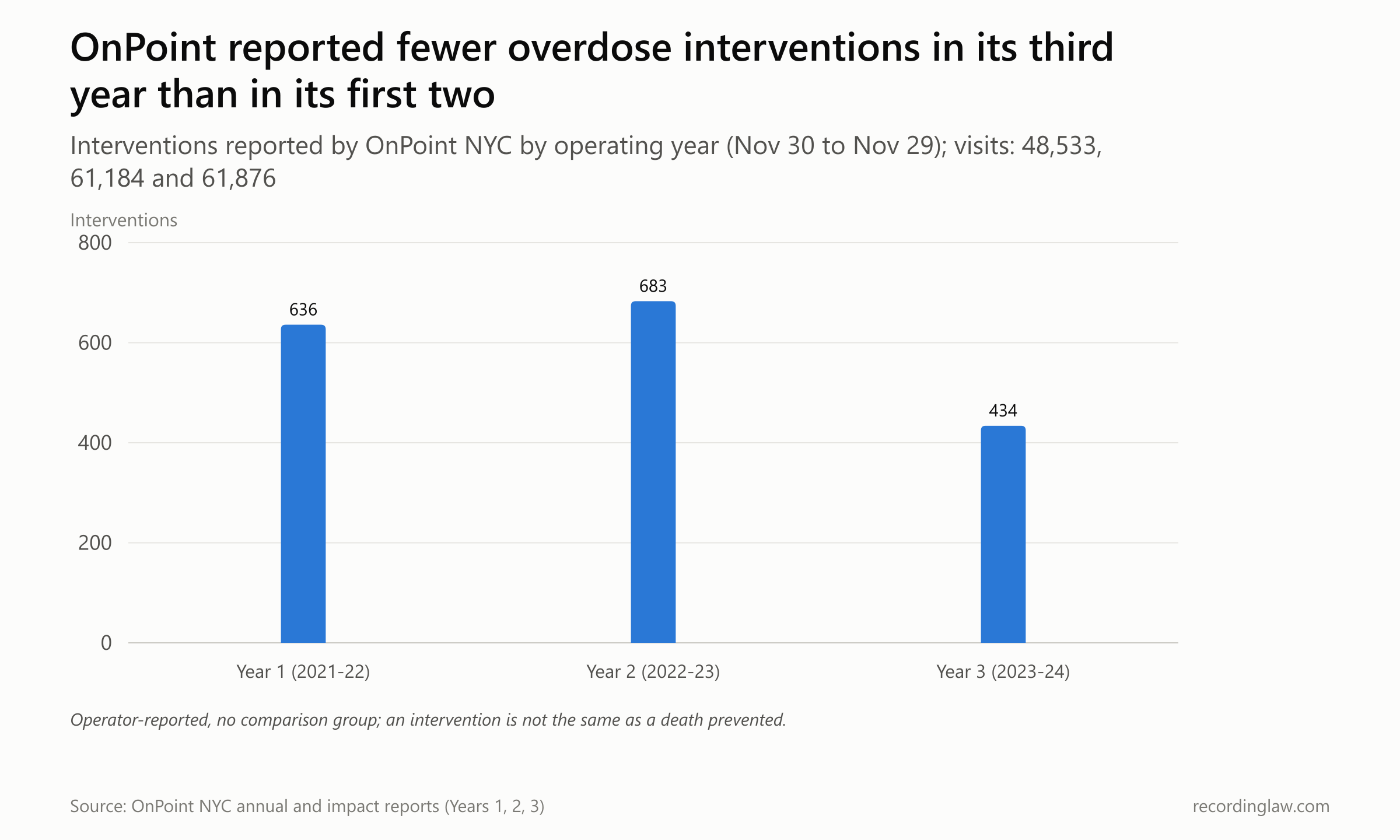
Overdose interventions reported by OnPoint NYC by operating year (Nov 30 to Nov 29). Source: OnPoint NYC annual and impact reports.
Visits rose in the second year and held there in the third. Interventions, though, fell in the third year.
| Operating year | Visits | Overdose interventions | Interventions per 100 visits |
|---|---|---|---|
| Year 1 (Nov 2021 to Nov 2022) | 48,533 | 636 | 1.3 |
| Year 2 (Nov 2022 to Nov 2023) | 61,184 | 683 | 1.1 |
| Year 3 (Nov 2023 to Nov 2024) | 61,876 | 434 | 0.7 |
An intervention is not the same as a death prevented. In those first two months, the 125 responses included 19 doses of naloxone, the overdose-reversal drug, and 35 of oxygen. They also included 45 responses to stimulant overdoses, with "hydration, cooling, and de-escalation as needed." When OnPoint announced in May 2026 that it had passed 2,000 interventions, the city's health commissioner under Mayor Zohran Mamdani, Dr. Alister Martin, said its staff had "saved more than 2,000 lives."
STAT reported in December 2025 that no OnPoint client had died while at the facility.
Inside, then, the record is the operator's count, with no comparison group. Outside, answering the opponents' question meant comparing the blocks around the centers with similar blocks that had none.
The blocks after a year
By the first anniversary, patrol cars regularly sat outside the East Harlem center, THE CITY reported in December 2022. An NYPD spokesperson wrote that the 25th Precinct's commanding officer "is aware of community complaints involving drug and narcotic use in the confines of the precinct and is working to address them." Narcotics arrests in the precinct that week were 23, against 7 in the same week a year earlier.
The Health Department's answer to the siting complaints was that nothing new had been built. The services "are an additional service offered at existing syringe service programs, and are not considered to be new facilities," it said.
Because the rooms were added to existing syringe programs, the city's 17 other syringe programs, which offered no supervised use, could serve as a comparison. Aaron Chalfin, Brandon del Pozo and David Mitre-Becerril used them in the November 2023 study. It was funded by the National Institute on Drug Abuse (NIDA) and the National Institute of General Medical Sciences.
They measured police complaints, arrests, summonses and 911 and 311 calls around all 19 programs, before and after November 2021, through December 2022. The method, called difference-in-differences, asks whether the blocks around the two centers changed more than the blocks around the other 17 did over the same months.
Did crime near the centers change more than it did near the other syringe programs?
On crime, the estimates were small. They were also not statistically significant, meaning by the study's own test chance alone could easily produce a result like this even with no real difference; that does not show there was none. On enforcement, the estimates were large.
Difference-in-differences estimates, immediate vicinity of the 2 centers vs 17 syringe service programs, December 2021 to December 2022. Source: Chalfin et al., JAMA Network Open (2023), Table 2.
| Measure (immediate vicinity) | Estimated change | 95% range | Significant? |
|---|---|---|---|
| Violent crime complaints | -7.8% | -25.8% to 14.5% | No |
| Property crime complaints | 2.1% | -17.0% to 25.6% | No |
| 911 crime calls | -28.5% | -62.3% to 35.6% | No |
| 911 medical calls | -45.9% | -75.2% to 18.1% | No |
| Nuisance calls | 2.5% | -30.1% to 50.3% | No |
| Weapons arrests | -56.5% | -79.4% to -8.1% | Yes |
| Drug arrests | -82.7% | -89.9% to -70.4% | Yes |
| Criminal court summonses | -87.9% | -91.9% to -81.9% | Yes |
In the study's raw counts, before any comparison, felonies near the centers did rise, by 21%. They rose 18% near the comparison programs too, in a period when crime was going up across the city.
Within the crime figures, aggravated assaults showed a rise of 30.4% compared with the other syringe programs, and simple assaults a fall of 19.7% on the same comparison. The authors wrote that the larger margins of error on these figures ruled out confident conclusions about either.
"No one is going to say that things are great around these sites and nothing could be improved," del Pozo, a former NYPD officer, told Gothamist. "The marginal effect we found on crime and disorder is nil." The largest numbers in the study's table, though, were not about crime. They were about the police.
The arrests that fell away
Near the centers, the study estimated, arrests for drug possession fell 82.7% compared with the other syringe programs, and 74.5% in the wider neighborhoods. Criminal court summonses fell 87.9% near the centers. The launch release had said the city's joint operations on street conditions would include "an increased focus on the areas surrounding the OPCs." It did not say whether that meant more arrests or fewer.
The authors addressed it directly. In a city where the police report to the mayor, they wrote, the decreases "were consistent with the mayor's pronounced support for the OPCs." The decreases "may therefore reflect the municipality's desire to not deter clients from visiting OPCs if they fear arrests for narcotics possession."
That means the study's crime result covers two changes at once, the centers opening and police near them making far fewer arrests. "In effect, the results may indicate a bundled intervention that merits further research: the addition of overdose prevention services and coordination with police," they wrote. Their estimates, they added, "may therefore not isolate the marginal association of overdose prevention services with crime and disorder in the narrowest sense, they suggest NYC was able to successfully operate OPCs without compromising public safety."
The paper names two more limits. Residents worried about the centers may have reported more after they opened. And "even if OPCs did not bring additional crime to a community, residents may nevertheless experience higher levels of fear or discomfort in their presence," which the study did not measure.
Xavier Santiago, who chaired Community Board 11 when the study came out, raised a third. He told Gothamist that some residents had lost faith in 311 and no longer called, and that some complained directly to the local precinct instead.
The study's data ended in December 2022. Eight months later, the federal prosecutor for Manhattan threatened to act against the centers.
A federal prosecutor's warning
Early in the Biden administration, the Justice Department had sounded open to the centers. PIX11 reported in February 2022 that the Justice Department wanted to put in place "reasonable guardrails" for centers like OnPoint's.
Then, on August 8, 2023, the U.S. attorney for Manhattan, Damian Williams, told The New York Times: "My office is prepared to exercise all options – including enforcement – if this situation does not change in short order." He also said, as CBS New York reported, "Until New York policymakers take action to authorize the supervised consumption sites, they are operating in violation of federal, state and local law."
Harm reduction advocates rallied at Foley Square the next day. "Intervention by the US Attorney to shut down overdose prevention centers will cost people their lives," said Charles King, chief executive of Housing Works, a harm reduction and HIV services nonprofit. Mayor Adams's press secretary, Kayla Mamelak, said City Hall, "like the U.S. Attorney," was "awaiting state or federal policy to definitively set out a regulatory framework for these lifesaving supports."
Gov. Kathy Hochul had already declined a state board's advice to put opioid settlement money into the centers, saying it would violate the law. No federal enforcement action followed.
Did arrests near the centers stay low?
The arrests in the 2023 study were NYPD arrests, made by the city's police. Our count of NYPD records runs past the study's end date, to mid-2026. Did NYPD drug arrests near the centers stay as low as the study found in 2022?
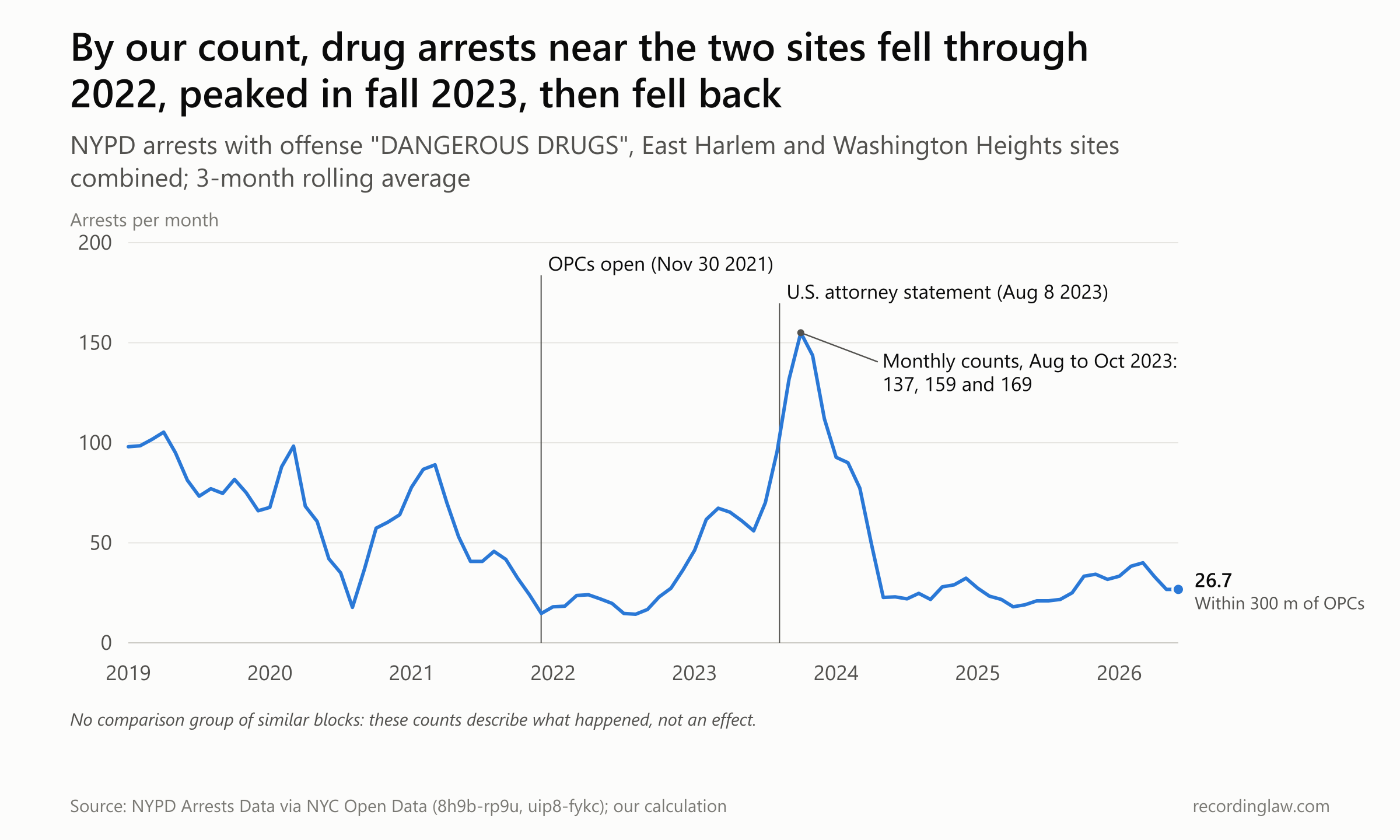
NYPD arrests with offense "DANGEROUS DRUGS" within 300 m of either site, monthly, 3-month rolling average. Source: NYPD Arrests Data via NYC Open Data; our calculation.
They did not stay low through 2023. By our count, drug arrests within 300 meters of the two sites reached 137 in August 2023, 159 in September and 169 in October, the highest months in our 2019 to 2026 series. Nearly all of the rise was within 300 meters of the East Harlem site. Within 300 meters of the Washington Heights site, the count stayed in single digits from July to October.
The climb began in July, the month before the prosecutor's August 8 statement, with 99 arrests. It stayed highest from August through October. We found no public account of what drove the July-to-October rise. A count like ours also cannot show whether the rise is connected to the statement.
In late October 2023, after the peak months, Fox 5 New York reported a new NYPD and city agency initiative, Operation Four Corners, on the strip of Lexington Avenue leading into 125th Street, near the East Harlem site. Police had made several dozen arrests in its first few days, Fox 5 reported.
By spring 2024 the count had fallen back, and in 2025 it was close to its 2022 level. Citywide, drug arrests went the other way.
| Year | Drug arrests within 300 m of the sites | Drug arrests citywide |
|---|---|---|
| 2019 | 971 | 21,071 |
| 2020 | 723 | 11,289 |
| 2021 | 558 | 10,450 |
| 2022 | 289 | 10,651 |
| 2023 | 1,101 | 15,701 |
| 2024 | 463 | 18,519 |
| 2025 | 298 | 22,379 |
| Jan-Jun 2026 | 200 | 11,103 |
In 2025, drug arrests near the centers were about 70% below their 2019 level. Citywide, drug arrests were about 6% above the citywide 2019 level.
Another research team reached a different result on arrests. Bennett Allen, Magdalena Cerdá and colleagues, publishing in Social Science & Medicine in 2025, built a synthetic comparison neighborhood for each center from city arrest data running from January 2014 to September 2023.
A synthetic control is a weighted blend of other areas whose numbers tracked the center's neighborhood before it opened, used to estimate what would have happened without it. "Our findings indicate no significant change in drug-related arrests following the OPC openings," they wrote. Their comparison group, geography and time window all differ from the 2023 study's. Their window also runs to September 2023, so it includes part of the 2023 rise in drug arrests that our count shows.
So the two studies disagree about whether drug arrests near the centers fell at all. On crime itself, a third study split the two centers apart.
Washington Heights and East Harlem part ways
John J. Hall, a retired NYPD officer, and Jerry H. Ratcliffe published a paper online in July 2024 in the Journal of Experimental Criminology. They studied each center separately with a synthetic control method, using police crime data at several distances from each site. SCS stands for supervised consumption site, another name for the centers.
"We found a significant 167% increase in property crimes within 1000 feet of the Washington Heights SCS after it opened as an SCS," they wrote. "We did not see changes in violence or property crimes near the East Harlem site." They added: "These findings suggest a differential impact of SCSs on neighborhood crime, possibly moderated by local factors."
CBS News reported in August 2026 that a Target store had recently opened near the Washington Heights site. CBS also reported that the authors "reasoned that placing the safe injection facility so near a location with easily shoplifted products created an environment ripe for theft." Their full paper sits behind a paywall, so we have that reasoning only through CBS's account.
CBS's own look at precinct data found the two neighborhoods moving apart. Felony complaints in Washington Heights' 34th Precinct "have risen steadily" since 2021, faster than citywide, CBS found. But CBS also wrote that "the increase in felony crime complaints cannot be tied directly to OnPoint." In East Harlem's 25th Precinct, felony complaints peaked in 2023, and by 2025 they were 10% above pre-pandemic levels.
Our own count of NYPD complaint records does not split the two neighborhoods. It covers both sites together, through June 2026. Did felony complaints near the centers rise faster than the city's?
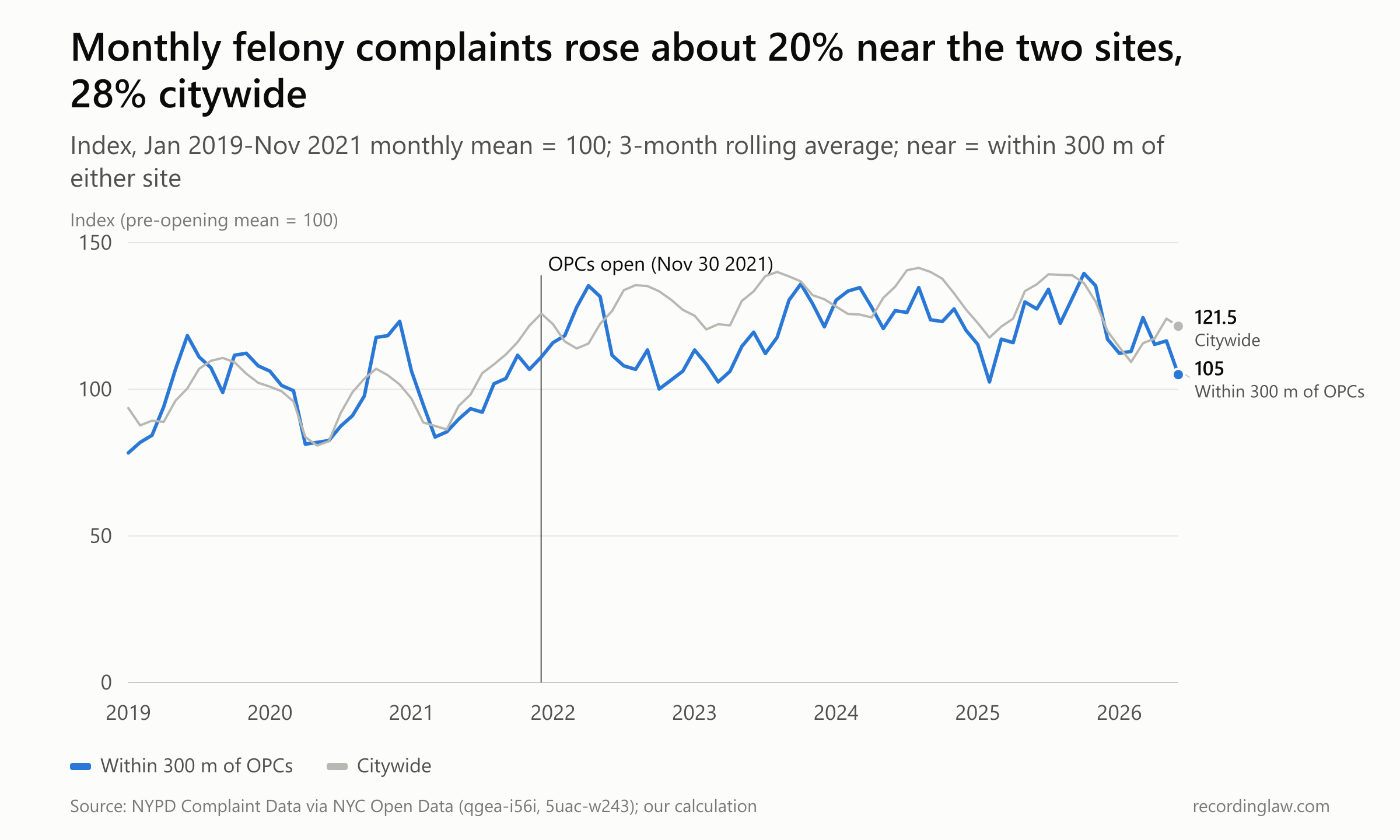
Felony complaints within 300 m of the two sites vs citywide, indexed to the Jan 2019 to Nov 2021 monthly mean, 3-month rolling average. Source: NYPD Complaint Data via NYC Open Data; our calculation.
Both lines rose after 2021, and the citywide line rose further. Our count has no comparison group of similar blocks, so it describes the trend, not an effect.
| Felony complaints per month | Jan 2019 to Nov 2021 | Dec 2021 to Jun 2026 | Change |
|---|---|---|---|
| Within 300 m of the two sites | 54.94 | 65.87 | 19.9% |
| Citywide | 11,796.77 | 15,126.75 | 28.2% |
Complaints tied to the East Harlem center's own address rose more steeply. According to an NYPD spokesperson quoted by the New York Post, drug-related 311 complaints to the East Harlem center's address rose from 57 in 2020 to 272 in 2024. The 2023 study had found no significant change in 311 drug-use calls across the wider vicinity through 2022.
In February 2025, the East Harlem Neighborhood Group and One City Rising asked the new attorney general, Pam Bondi, to step in. "Every day in the area outside the facility and in the blocks surrounding the facility drug dealing occurs regularly in broad daylight," their letter said. "We need federal intervention to shut it down." Malliotakis wrote to Bondi the same month: "They don't work, these heroin injection centers, in fact they attract crime to the neighborhood but also drug dealing."
Crime was the opponents' warning. The supporters' promise had been lives.
Did overdose deaths fall?
Overdose deaths in New York City kept climbing after the centers opened, then dropped. The Health Department counted 2,696 deaths in 2021, 3,070 in 2022 and 3,056 in 2023. In 2024 the provisional count was 2,192.
| Year | Overdose deaths, NYC |
|---|---|
| 2019 | 1,497 |
| 2020 | 2,103 |
| 2021 | 2,696 |
| 2022 | 3,070 |
| 2023 (provisional) | 3,056 |
| 2024 (provisional) | 2,192 |
The department described the 2024 decline of 28% as "mirroring substantial reductions in overdose deaths nationwide." In the two neighborhoods with centers, the resident death rate also fell between 2023 and 2024.
In East Harlem it went from 86.2 to 67.9 per 100,000. In Washington Heights-Inwood it went from 45.6 to 30.6 per 100,000. Those rates count where people who died lived, not where they used.
One official tied the decline to the centers. At OnPoint's fourth-anniversary event, as the operator published it, acting health commissioner Dr. Michelle Morse said "In 2024, overdose deaths … dropped by 28% compared to 2021," and then noted that deaths among Black and Latino New Yorkers had fallen for the first time since 2018. She added, "This is because of OnPoint NYC and the health department's extensive work."
Her figure does not match the department's own report, its Epi Data Brief. The department's own brief puts the 28% drop between 2023 and 2024. Against 2021, the decline was about 19%.
As of early November 2026, no study had measured whether the two centers changed the city's death count. The National Institute on Drug Abuse says that in more than 20 years of centers abroad, "no one has died of a drug overdose while at an overdose prevention center," but "it is unclear whether such facilities reduce overdose death rates overall."
Opponents make an argument about cost as well. "There's a fixed pool of resources available for helping people who are dealing with substance use disorder," Charles Fain Lehman, a senior fellow at the conservative Manhattan Institute, told CBS News in August 2026. "If you're spending the dollars on an intervention that doesn't work, like supervised consumption sites … you're not spending dollars on [addiction medication] and evidence-based treatment."
Who pays, and under what law?
As of early November 2026, no state law authorized the centers. Gustavo Rivera, the state senator, was still pressing a bill in December 2025 "that would authorize supervised consumption sites to operate statewide," STAT reported. According to STAT, he also criticized Hochul for keeping opioid settlement money away from OnPoint.
OnPoint's budget splits along that line, between what the city will pay for and what it will not. CBS News reported OnPoint's funding at about $19 million a year from city, state and private sources. Crain's put its budget at $17 million.
City contracts pay for the drop-in center, outreach and medical care. But city rules bar those funds from paying for supervised drug use. "Philanthropy entirely funds its overdose prevention operation," Crain's reported.
In July 2025, the White House issued Executive Order 14321. It directed the attorney general to review whether recipients of federal housing and homelessness aid that run "safe consumption sites" are violating federal law, "including 21 U.S.C. 856, and bring civil or criminal actions in appropriate cases." OnPoint lost a federal grant from the Substance Abuse and Mental Health Services Administration. Accounts of its size differ: Crain's said roughly half a million dollars, while CBS said OnPoint once had more than $2 million in SAMHSA grants.
As of December 2025, OnPoint "has not been contacted by federal law enforcement," according to its executive director, STAT reported. Mamdani, as a candidate in October 2025, backed keeping the two sites open but did not endorse more.
In February 2026 came what Crain's called New York's coldest weekend. That weekend, after an estimated three people died of suspected overdoses out in the cold, his administration extended OnPoint's city contract so its doors stayed open overnight. Crain's reported almost 850 visitors over the weekend and about 150 overnight stays each night.
Malliotakis has a bill, H.R. 172, introduced in January 2025, that her office says would codify key provisions of the order. "We don't know who will be president in a few years, so we need that codified in statute," she said in August 2026. As of early November 2026, the bill had not moved past its referral to the House Oversight and Government Reform Committee.
One state took the opposite route and put its center in statute.
Rhode Island wrote it into law
In Providence, the nonprofit Project Weber/RENEW cut the ribbon in December 2024 on what WBUR called "the country's first state-sanctioned facility for people to use illegal drugs under medical supervision." It opened to clients in January 2025 at 45 Willard Avenue.
The state's sponsor made the same promise New York had. Sen. Joshua Miller said in 2023 that the experience of centers elsewhere showed "they reduce overdose deaths, they make communities safer and they put treatment at the fingertips of those who need it the second they are ready for it." When the House debated another extension in April 2025, opponents in both parties called the centers "sanctioned opium dens" and said they would drive up violence and crime nearby. The extension passed 52-17 after a 90-minute debate.
The early record there is thin. A Providence spokesperson said the city had received no police, fire or emergency calls to the center's address in its first months, and data for surrounding addresses were not available. The operator reported 731 people, more than 7,925 visits and 173 interventions in its first year, paid for with opioid settlement money and no federal dollars.
The Rhode Island law also has an end date. Its center must close "on or before March 1, 2028, unless an act of the general assembly expressly authorizes the continuation of the operation of the harm reduction center." Vermont passed a law in 2024, Act 178, to fund a center in Burlington. As of October 2026 it had not opened, WCAX reported.
What is still open
In August 2026, Malliotakis wrote again, this time to Attorney General Todd Blanche. "It's signaling to drug dealers where their clients are located and attracting a criminal element in and around the facility," she told Fox News Digital. A Justice Department spokesperson said the department "can confirm receipt of the letter and is ensuring the appropriate personnel within the Department are reviewing it carefully." As of early November 2026, no action had been announced.
The research is not finished either. CBS reported in August 2026 that the NIH was funding a multi-year evaluation of the two OnPoint centers and the Providence site, and that the study was still ongoing. The authors of the 2023 study had written that more research was needed before concluding that the centers "will not be associated with localized increases in crime and disorder over a longer span of time."
The next fixed date is in Providence. Unless the Rhode Island General Assembly acts, the only state-authorized center operating in the country must close by March 1, 2028.
The rooms on East 126th Street and West 180th Street have stayed open since November 30, 2021. That is nearly five years, far longer than the 13 months the 2023 study could see. On opening day, the city said other places with centers had not seen an increase in crime "even over many years." Whether that holds for these blocks is the question the 2023 study's authors left open.
How we measured
Our NYPD counts. We queried NYC Open Data's NYPD Complaint Data Historic (qgea-i56i, through December 2025) and Current Year to Date (5uac-w243, January to June 2026) files for felony complaints by date of occurrence. We also queried the NYPD Arrests Historic (8h9b-rp9u) and Year to Date (uip8-fykc) files for arrests with offense description "DANGEROUS DRUGS" (sale and possession). All four files were retrieved October 31, 2026.
"Near the sites" means within a 300-meter circle of 106 E. 126th St. or 500 W. 180th St., geocoded with OpenStreetMap, summed over both sites. This is not the 2023 study's geography, which used hexagons of about 22 acres, so our counts do not match its tables. We stitched the historic and year-to-date files at January 2026 without checking for definitional differences, and recent months can still receive late reports.
Arithmetic. Felony complaints near the sites averaged 54.94 a month from January 2019 to November 2021 (35 months) and 65.87 from December 2021 to June 2026 (55 months), a 19.9% rise. Citywide felony complaints averaged 11,796.77 and 15,126.75 a month over the same two periods, a 28.2% rise. Drug arrests near the sites were 971 in 2019 and 298 in 2025 (298 / 971 = 30.7%, about 70% below). Citywide drug arrests were 21,071 in 2019 and 22,379 in 2025 (6.2% above).
August to October 2023 near-site drug arrests were 137, 159 and 169. Interventions per 100 visits are OnPoint's interventions divided by its visits for each operating year. The fall in deaths from 2021 to 2024 is (2,696 - 2,192) / 2,696 = 18.7%.
What our counts cannot show. They have no comparison group of similar blocks, so they describe what happened near the sites alongside the city, not what the centers caused. The 2020 pandemic falls inside the "before" period, and NYPD enforcement changed citywide in 2022.
The studies. Chalfin, del Pozo and Mitre-Becerril (JAMA Network Open, 2023) used difference-in-differences Poisson models comparing the 2 centers with 17 other syringe service programs, January 2019 to December 2022, about 13 months after opening; funded by NIDA and NIGMS, with no conflicts reported. Hall and Ratcliffe (Journal of Experimental Criminology, online 2024) used count-based synthetic controls on police crime data at several distances from each site; we read the abstract only, and its funder is not shown there. Allen et al. (Social Science & Medicine, 2025) used synthetic controls on drug-arrest data from January 2014 to September 2023; we read the abstract only. It reports mean absolute differences in daily drug-related arrests (0.63 in East Harlem, p = 0.19; 0.14 in Washington Heights, p = 0.22), not percentages, so the estimates chart plots both sites at zero with the authors' wording. Hall and Ratcliffe's 167% appears there without an interval because the abstract gives none. Chalfin et al. also report 311 calls moving in two directions near the centers: calls about abandoned vehicles rose 591.4%, while calls about homelessness fell 69.5%.
Other measures. Two studies measured outcomes other than crime and arrests, so they are not on the estimates chart. Allen and colleagues, in a February 2026 JAMA Network Open paper funded by NIDA and the CDC, found no significant change in foot traffic or consumer spending around either center from June 2021 to June 2022; they used augmented synthetic controls on SafeGraph data. A study summarized by CDUHR, a research center at NYU, found "limited evidence" of an effect on pedestrian stops, with a possible decrease in the first two years at East Harlem. That study's authors and journal were not shown on the page we read. Harocopos et al. (JAMA Network Open, 2022) is descriptive, with no comparison group, and its co-authors include OnPoint's executive director and the commissioner who launched the centers.
Operator and health data. Visits and interventions are self-reported by OnPoint NYC for operating years running November 30 to November 29; it calls Year 1 visits "utilizations." As of early November 2026, OnPoint had not published a Year 4 report, only cumulative totals that differ within the same post: its fourth-anniversary post gives 2,004 interventions and 244,623 uses in one paragraph, while a speaker quoted in the same post gives 1,983 and 239,200. Overdose deaths come from Health Department Epi Data Brief No. 150 (October 2025); 2023 and 2024 are provisional, and neighborhood rates are by the decedent's residence. Rhode Island figures are the operator's.
Frequently Asked Questions
What is an overdose prevention center?
It is a supervised space where people can use drugs while trained staff watch and respond to overdoses. New York City's two centers, run by the nonprofit OnPoint NYC, are part of existing syringe service programs in East Harlem (East 126th Street) and Washington Heights (West 180th Street). They opened on November 30, 2021, as the first publicly recognized centers in the US.
Are overdose prevention centers legal in New York?
As of early November 2026, no New York state law authorized them. A federal appeals court, the Third Circuit, ruled in 2021 that a planned Philadelphia site would violate 21 U.S.C. 856. Manhattan's U.S. attorney said in 2023 that the New York sites were operating in violation of federal, state and local law. As of early November 2026, no prosecution had followed. In August 2026 the Justice Department said it was reviewing a congressional request to shut them.
Did crime go up near New York's overdose prevention centers?
Studies differ. A 2023 JAMA Network Open study comparing the sites with 17 other syringe programs found no significant change in violent or property crime through 2022. A 2024 study found property crime up 167% within 1,000 feet of the Washington Heights site and no change near East Harlem. Our count of NYPD data shows felony complaints within 300 meters of the sites averaging about 20% more per month after opening than before. By the same count, citywide felony complaints averaged about 28% more per month.
Did drug arrests fall near the centers?
The 2023 study estimated drug-possession arrests near the centers fell 82.7% relative to comparison sites through 2022. Its authors said this may reflect City Hall's support for the centers. A 2025 study using data through September 2023 found no significant change. Our count shows near-site drug arrests rising sharply in August to October 2023, then falling to about 70% below their 2019 level in 2025.
How many overdoses have the New York centers reversed?
OnPoint NYC reported 636 overdose interventions in its first operating year, 683 in the second and 434 in the third, and 2,004 cumulative interventions by early January 2026. These figures are reported by the operator. An intervention, such as giving oxygen or naloxone, is not the same as a death prevented.
Did overdose deaths fall in New York City?
Yes, in 2024. The Health Department counted 3,056 overdose deaths in 2023 and 2,192 in 2024 (both provisional). That was a 28% drop, which the department said mirrored national declines. As of early November 2026, no study had measured how much, if any, of that drop came from the two centers.
Who funds OnPoint NYC's supervised drug use rooms?
Private philanthropy. City contracts fund OnPoint's drop-in center, outreach and medical services, but city rules bar using those funds for supervised drug use. OnPoint lost a federal SAMHSA grant after a July 2025 executive order.
Are there overdose prevention centers in other states?
Rhode Island has the only state-authorized center in operation. Project Weber/RENEW opened its Providence center in January 2025. The state law requires it to close by March 1, 2028, unless the General Assembly authorizes it to continue. Vermont enacted a law in 2024 (Act 178) to fund a center in Burlington; as of October 2026 it had not opened.
Updates
Reworded for readability. No figures, quotes, sources or findings changed.
Restructured as a feature: chart titles state the finding, side details moved to How we measured. Every figure and quote was re-checked against its source.
Independently fact-checked against the cited primary sources
Independently fact-checked against the cited primary sources
Sources and References
- NYC Office of the Mayor, release 793-21, Nation's First Overdose Prevention Center Services to Open in New York City, Nov 30 2021 (Wayback Machine capture)(web.archive.org).gov
- United States v. Safehouse, No. 20-1422 (3d Cir. Jan 12 2021), precedential opinion(www2.ca3.uscourts.gov).gov
- U.S. Department of Justice, press release on the Third Circuit Safehouse ruling, Jan 13 2021(justice.gov).gov
- Executive Order 14321, Ending Crime and Disorder on America's Streets, July 24 2025, Federal Register(govinfo.gov).gov
- Chalfin, del Pozo and Mitre-Becerril, Overdose Prevention Centers, Crime, and Disorder in New York City, JAMA Network Open (2023)(pmc.ncbi.nlm.nih.gov).gov
- Harocopos et al., First 2 Months of Operation at First Publicly Recognized Overdose Prevention Centers in US, JAMA Network Open (2022)(pmc.ncbi.nlm.nih.gov).gov
- Allen et al., Overdose Prevention Centers and Neighborhood Commercial Activity in New York City, JAMA Network Open (2026)(pmc.ncbi.nlm.nih.gov).gov
- Hall and Ratcliffe, Assessing the impact of safe consumption sites on neighborhood crime in New York City: a synthetic control approach, Journal of Experimental Criminology (2024), abstract(link.springer.com)
- Allen et al., Considerations for the epidemiological evaluation of hyperlocal interventions: the New York City overdose prevention centers, Social Science & Medicine (2025), abstract(midasnetwork.us)
- CDUHR (NYU), Changes in community-level pedestrian stops following overdose prevention center implementation in New York City, abstract(cduhr.org)
- National Institute on Drug Abuse, Overdose Prevention Centers(nida.nih.gov).gov
- NYC Health Department, Epi Data Brief No. 150, Unintentional Drug Poisoning (Overdose) Deaths in New York City in 2024 (Oct 2025)(home4.nyc.gov).gov
- NYC Open Data, NYPD Complaint Data Historic(data.cityofnewyork.us).gov
- NYC Open Data, NYPD Complaint Data Current Year to Date(data.cityofnewyork.us).gov
- NYC Open Data, NYPD Arrests Data Historic(data.cityofnewyork.us).gov
- NYC Open Data, NYPD Arrests Data Year to Date(data.cityofnewyork.us).gov
- OnPoint NYC, Year One annual report (operator)(onpointnyc.org)
- OnPoint NYC, Year Two impact report (operator)(onpointnyc.org)
- OnPoint NYC, Year Three impact report (operator)(onpointnyc.org)
- OnPoint NYC, Four Years of Saving Lives (operator, Jan 8 2026)(onpointnyc.org)
- OnPoint NYC, release on 2,000 overdose interventions (operator, May 2026)(onpointnyc.org)
- Crain's New York Business, Overdose Prevention Centers Sheltered Hundreds During New York's Coldest Weekend, Feb 11 2026 (reprint hosted by OnPoint NYC)(onpointnyc.org)
- New York Amsterdam News, New supervised injection sites cause controversy in uptown neighborhoods, Dec 9 2021(amsterdamnews.com)
- 1010 WINS, Rev. Al Sharpton's group to protest de Blasio's safe injection sites, Dec 8 2021(audacy.com)
- Rep. Nicole Malliotakis, press release, Nov 30 2021(malliotakis.house.gov).gov
- Axios, Nov 30 2021(axios.com)
- PIX11, Overdose prevention centers want input as DOJ weighs future, Feb 8 2022(digital-release.pix11.com)
- THE CITY, Harlem locals at odds on first anniversary of America's first safe injection site, Dec 13 2022(thecity.nyc)
- Gothamist, Overdose prevention centers did not increase crime in NYC neighborhoods, study finds, Nov 2023(gothamist.com)
- City & State New York, After Damian Williams' striking comments on supervised injection sites, Aug 2023(cityandstateny.com)
- CBS New York, Federal prosecutor threatens to shut down New York City overdose prevention centers, Aug 9 2023(cbsnews.com)
- Housing Works, press release, Aug 9 2023 (advocacy organization)(housingworks.org)
- New York Post via AOL, NYC residents beg Trump admin to close controversial safe injection site, Feb 23 2025(aol.com)
- WABC-TV (ABC7 New York), Feb 2025(abc7ny.com)
- STAT, on OnPoint NYC's fourth anniversary, Dec 18 2025(statnews.com)
- CBS News, on OnPoint NYC and its neighborhoods, Aug 7 2026(cbsnews.com)
- Fox News Digital, House Republican urges AG Blanche to shut down NYC injection sites, Aug 13 2026(foxnews.com)
- WBUR / The Public's Radio, Providence supervised consumption center opens, Dec 11 2024(wbur.org)
- Rhode Island General Assembly, press release on 2023-S 0026(rilegislature.gov).gov
- Rhode Island Current, Four years after R.I. lawmakers OK safe injection site program, they're still debating its merits, Apr 2 2025(rhodeislandcurrent.com)
- R.I. Gen. Laws 23-12.10-1, harm reduction center pilot program(webserver.rilegislature.gov).gov
- Project Weber/RENEW, A Year of Saving Lives (operator, Jan 2026)(weberrenew.org)
- Vermont Department of Health, Act 178 (2024) progress report on the Burlington overdose prevention center, May 2025(legislature.vermont.gov).gov
- WCAX, Hurdles remain for Burlington's overdose-prevention center, Oct 7 2026(wcax.com)
- FOX 5 NY, NYPD operation aims to improve East Harlem quality of life (Operation Four Corners), Oct 26 2023(fox5ny.com)
- Congress.gov, H.R. 172 (119th Congress), Defund Heroin Injection Centers Act of 2025; latest action Jan 3 2025, referred to the House Committee on Oversight and Government Reform (checked Nov 10 2026)(congress.gov).gov