Ten States Now Control Kratom as a Drug, Five of Them Since August 2025

Independently fact-checked against primary sources (last audited November 10, 2026). · 35 primary sources cited on this page. How we verify our legal content
See Recording Law first on Google. Add us as a preferred source to see more of our legal news when you search.
Add on GoogleConnecticut gave its kratom sellers a deadline. "Prior to March 25, 2026, return all products to your wholesaler or destroy the products," the state Department of Consumer Protection told retailers in March 2026. After that, Attorney General William Tong said, it would be "illegal to possess, manufacture, sell or distribute these drugs." A month earlier the department had announced where that put Connecticut: "Connecticut is the seventh state to designate Kratom and its derivatives, including 7-OH, as Schedule 1 controlled substances."
Louisiana had already been given that rank. "Louisiana now becomes the 7 th state in the country to ban kratom-derived products," Red River Radio, the Shreveport public radio station, reported in August 2025. Then in June 2026 the National Conference of State Legislatures (NCSL) wrote that "In April, Kansas joined Alabama, Arkansas, Indiana, Louisiana, Vermont and Wisconsin," which made Kansas the seventh on its list.
That is three sources naming three different seventh states, in less than a year. Nobody keeps one list.
As of November 7, 2026, ten states had brought the kratom plant or mitragynine, the main alkaloid (active plant compound) in its leaves, under their drug laws: Alabama, Arkansas, Connecticut, Indiana, Kansas, Louisiana, Massachusetts, Tennessee, Vermont and Wisconsin. Eight did it through Schedule I, the category for drugs with no accepted medical use. Vermont uses a regulated-drug rule, and Tennessee made possessing or selling kratom a crime on its own.
Five of the ten acted in the 13 months from August 2025. Over the same years, more states wrote rules to keep kratom on sale, with labels and age limits. NCSL counted "at least 31 states and Washington, D.C." that regulate it in some manner.
The federal government has not scheduled the leaf. Its target is a different product sold under the same name: concentrated 7-hydroxymitragynine, or 7-OH, another of the plant's alkaloids. Federal health officials proposed a line between the two in July 2025, and they replaced it in October 2026. The Drug Enforcement Administration (DEA) says its order can come no earlier than November 13, 2026.
Why have the states and Washington drawn the kratom line in such different places, and what does the evidence each side cites actually show? Our state-by-state kratom guide has each state's current rule.
Six weeks in 2016
The federal government tried to settle the kratom question once before, in 2016, by scheduling the plant's two main alkaloids itself. On August 31 of that year, the DEA published notice that it would place mitragynine and 7-OH in Schedule I on an emergency basis. That meant a temporary order, issued without the usual round of public comment. The DEA administrator, the notice said, had found the move "necessary to avoid an imminent hazard to the public safety."
The notice pointed to supply. "The amount of kratom currently seized or awaiting an admissibility decision by law enforcement, between 2014 and 2016, is enough to produce over 12 million doses of kratom," DEA wrote. The order could take effect as early as September 30.
It never did. On September 13, kratom supporters rallied in front of the White House "chanting 'Don't take away kratom,'" the Phoenix New Times reported, and a petition to reverse the decision passed 132,000 signatures. A letter led by Reps. Matt Salmon, an Arizona Republican, and Mark Pocan, a Wisconsin Democrat, "garnered the signatures of 51 U.S. House members from both parties."
On October 13, the DEA published a notice that it "is withdrawing the August 31, 2016 notice of intent" and asked for public comment instead. The comment docket collected 23,220 comments. Susan Ash, founder of the American Kratom Association (AKA), called the withdrawal "historic" and "unprecedented," the Phoenix New Times reported. In the paper's words, she also warned "kratom users that the fight to keep kratom off the Schedule I list has only just begun."
The FDA recommended scheduling again in 2017, and the Department of Health and Human Services (HHS) rejected that recommendation in 2018. Adm. Brett Giroir, the HHS official who turned it down, later wrote on Twitter that "FDA's recommendation was rejected [because] of embarrassingly poor evidence & data, and a failure to consider overall public health," as Reason reported in 2021.
Salmon, who led the 2016 House letter, now chairs the AKA's board. With Washington out of the decision, it passed to the states.
A few bans, many more sales rules
Left to decide for themselves, a handful of states controlled kratom's compounds as drugs, while a growing number wrote rules to keep it on sale. The Legislative Analysis and Public Policy Association (LAPPA), which tracks state kratom laws, dated each state's first law. Which approach spread once Washington stepped back?
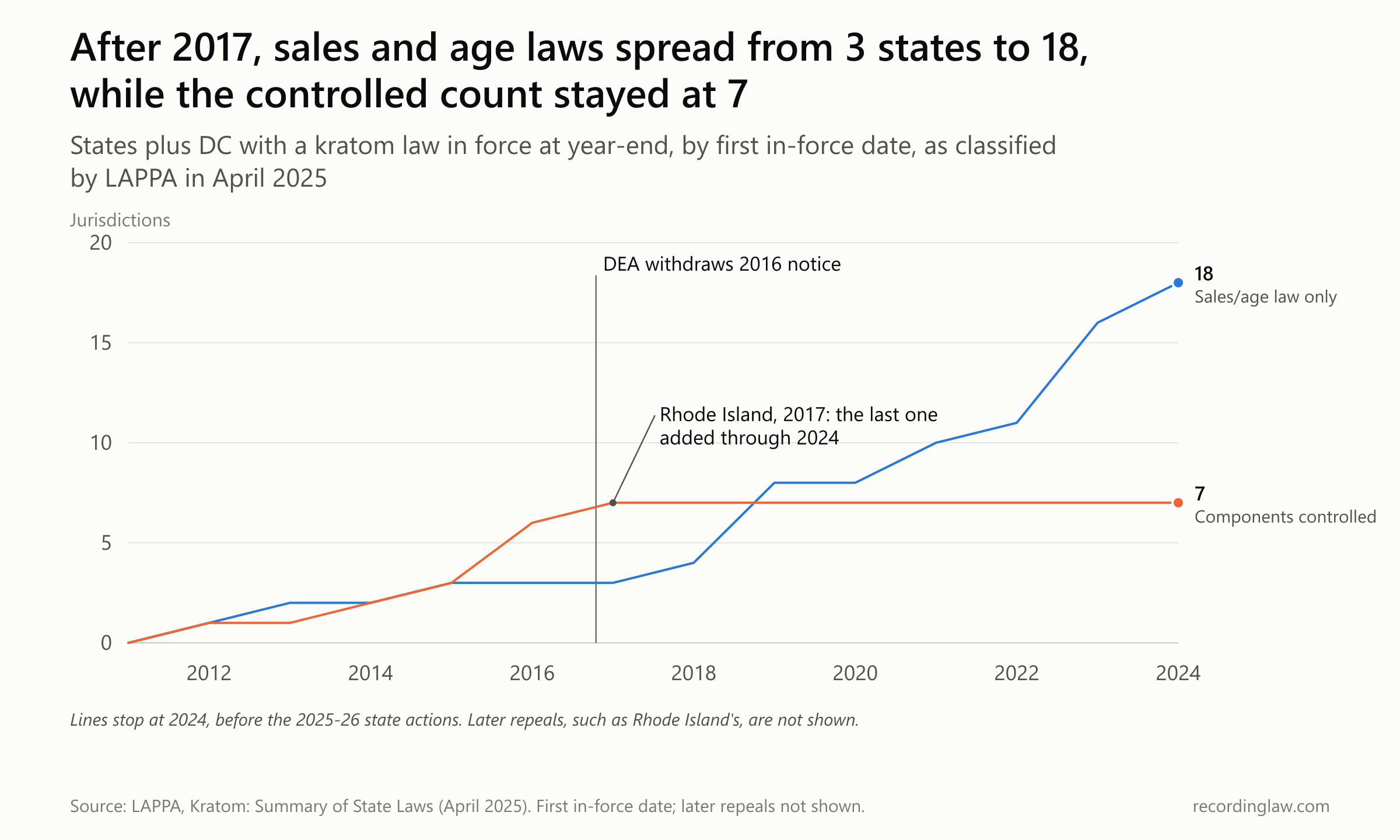
Source: LAPPA, Kratom: Summary of State Laws (April 2025). First in-force date per jurisdiction; later repeals not shown.
The controlled line shows the early movers. Indiana controlled kratom's components from July 2012, Wisconsin from 2014 and Arkansas from 2015. Alabama, Vermont and the District of Columbia followed in 2016, before the DEA's notice, and Rhode Island followed in 2017, after it. After 2017, no new jurisdiction joined the controlled list in LAPPA's tally through 2024, while states with a sales or age law rose from 3 to 18.
| Year-end | Components controlled (states + DC) | Sales/age law only (states) | Any kratom law |
|---|---|---|---|
| 2012 | 1 | 1 | 2 |
| 2015 | 3 | 3 | 6 |
| 2016 | 6 | 3 | 9 |
| 2017 | 7 | 3 | 10 |
| 2019 | 7 | 8 | 15 |
| 2021 | 7 | 10 | 17 |
| 2023 | 7 | 16 | 23 |
| 2024 | 7 | 18 | 25 |
Many of the sales laws follow a model bill, the Kratom Consumer Protection Act, which the AKA wrote and promotes. The DEA counted 19 states that had enacted it. By June 2026, NCSL found 22 states with age limits on kratom, seven at 18 and 15 at 21. In the same count, NCSL found 19 states with labeling rules.
Some states wrote a number into the law. Oklahoma bars sales of products "in which 7-OH exceeds 1% of total kratom alkaloids," and Colorado's 2025 law set an age of 21 and "limits 7‑OH to 2% of total alkaloids," NCSL reported.
One state went from a ban to rules. Rhode Island "took a similar approach after reversing an earlier kratom ban," NCSL wrote, and now regulates sales while prohibiting 7-OH products. "We must embrace every tool available to reduce harm and to save lives," said Senate President Pro Tempore Hanna Gallo, whom NCSL described as "calling regulation preferable to blanket prohibition." The chart above still keeps Rhode Island on the controlled line, because it counts each jurisdiction from its first in-force date and does not show later repeals.
Those sales laws were written around a leaf. By 2025 the product on many shelves was something else.
A different product under the same name
The new product was built from a trace ingredient. 7-OH occurs naturally in kratom, but only as a "minor constituent that comprises less than 2% of the total alkaloid content," an FDA review found. "Given the trace amounts of 7-OH that are naturally present in kratom, direct extraction of 7-OH from plant material would simply be unfeasible economically," the review said. Its conclusion on where concentrated products come from: "The enhanced amount of 7-OH in these products is likely synthetically derived through oxidate chemical conversion of mitragynine isolates or kratom extracts."
The new products were still sold as kratom. A team from Yale, Ohio State, the University of Florida and Johns Hopkins reviewed 304 products containing 7-OH or a related compound, mitragynine pseudoindoxyl (MGPI), on vendor websites from September 2024 to February 2025. Combination products "were almost uniformly marketed as 'kratom' while 92.0 % of 7-OH-only products were advertised as such," they wrote. The mean cost per recommended dose, they found, was $3.97.
The study was funded by the National Institute on Drug Abuse. Two authors were paid consultants to the International Plant and Herbal Alliance, and three had served as expert witnesses in kratom cases.
In June 2025, the FDA sent warning letters to seven companies "for illegally distributing products containing 7-OH." On July 28, HHS sent the DEA a scientific evaluation and scheduling recommendation. The next day, FDA Commissioner Marty Makary announced it.
"Vape stores are popping up in every neighborhood in America, and many are selling addictive products like concentrated 7-OH. After the last wave of the opioid epidemic, we cannot get caught flat-footed again," Makary said. "7-OH is an opioid that can be more potent than morphine."
HHS Secretary Robert F. Kennedy Jr. called it "a critical step in the fight against opioid addiction." The release was specific about what it left alone: "The FDA is specifically targeting 7-OH, a concentrated byproduct of the kratom plant; it is not focused on natural kratom leaf products."
The proposed line was a percentage. The DEA later adapted it from the HHS recommendation. In the DEA's version, botanical kratom would be scheduled only if it "contains more than 0.050 percentage of 7-hydroxymitragynine on a dry weight basis."
What the poison centers recorded
The case for acting rested partly on calls to poison centers. Those calls were rising years before any federal 7-OH proposal. They went from 26 in 2010 to 263 in 2015, the CDC reported in 2016.
Did the newer products change the trend? The CDC's newer series answers with rates among people 12 and older. In its report, a single-substance report is one with kratom as the only reported substance, and a multiple-substance report has kratom and other substances reported for the same exposure. The combined rate is kratom reports per million poison-center reports involving a drug of any kind, and the single-substance and multiple-substance rates are each per million drug exposure reports of the same type.
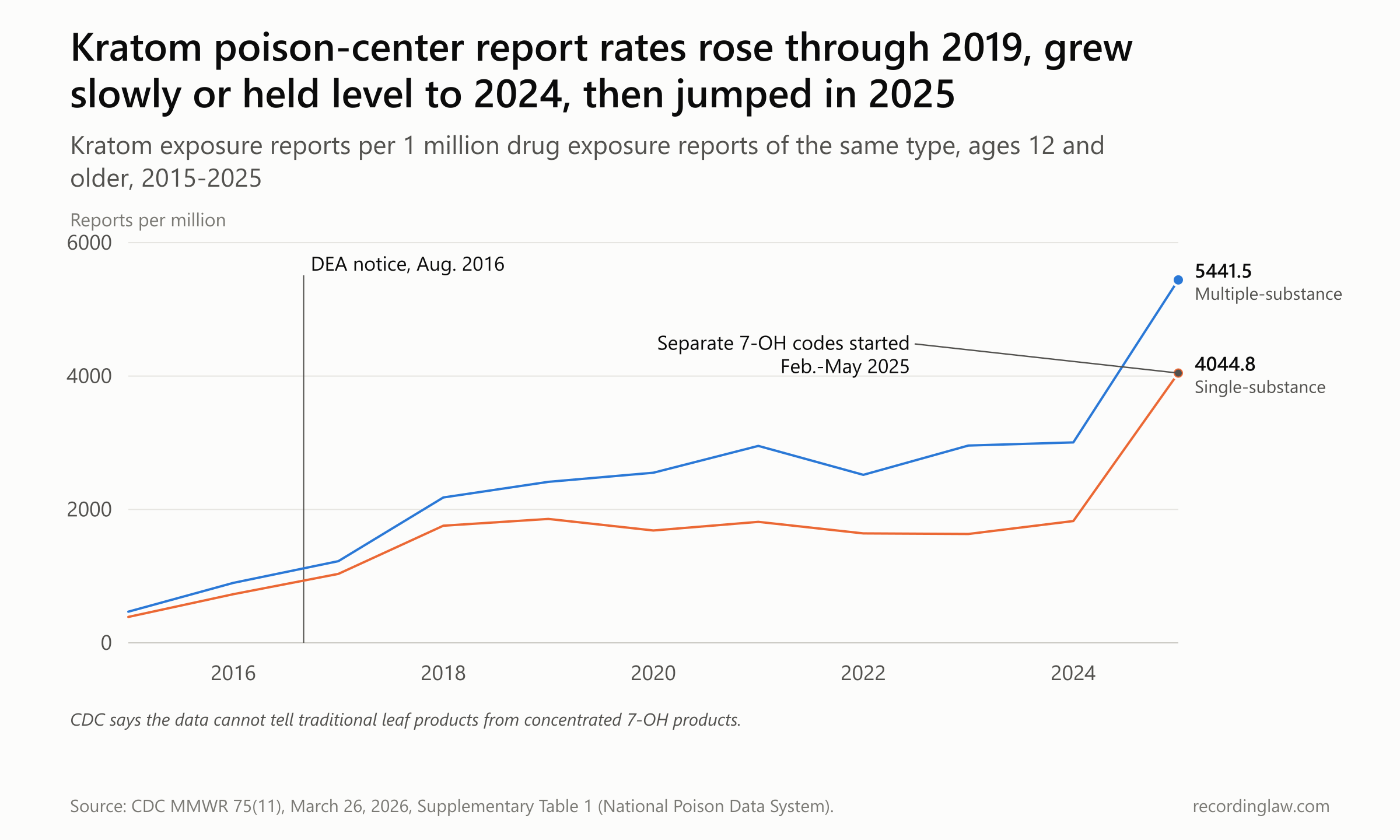
Source: CDC MMWR 75(11), March 26, 2026, Supplementary Table 1 (National Poison Data System).
Kratom's share of poison-center drug reports rose through 2019. From 2019 to 2024, the single-substance rate held roughly level, while the multiple-substance rate rose about a quarter. Then, in 2025, the combined rate more than doubled.
| Year | Single-substance reports per million | Multiple-substance reports per million |
|---|---|---|
| 2015 | 387.6 | 467.3 |
| 2016 | 729.3 | 900.0 |
| 2017 | 1,034.5 | 1,224.9 |
| 2018 | 1,756.1 | 2,179.4 |
| 2019 | 1,857.5 | 2,413.8 |
| 2020 | 1,684.2 | 2,549.7 |
| 2021 | 1,814.8 | 2,952.6 |
| 2022 | 1,640.7 | 2,519.4 |
| 2023 | 1,632.2 | 2,957.2 |
| 2024 | 1,826.4 | 3,005.8 |
| 2025 | 4,044.8 | 5,441.5 |
In raw counts, the CDC found 258 kratom exposure reports among people 12 and older in 2015 and 3,434 in 2025, about 13 times as many. The 263 calls for 2015 cited above come from the 2016 report, which covered all ages with a different method, so the two series are not joined. Counting single- and multiple-substance reports together, the rate went from 2,171 per million drug reports in 2024 to 4,445 in 2025. Hospitalizations for kratom-only exposures rose from 43 in 2015 to 538 in 2025.
The CDC noted that the 2025 increase "coincides with the emergence of high-potency, semisynthetic formulations, including 7-hydroxymitragynine." But it could not say which product drove the jump, because its data "do not include information about whether the kratom use involved traditional leaf products or semisynthetic or concentrated formulations, such as 7-hydroxymitragynine," the report said. Poison centers only began coding 7-OH separately between February and May 2025.
Once they did, the 7-OH count grew. America's Poison Centers, the association that runs the national database, reported that "In 2025, there were 593 reports of exposures to 7-OH compared to 901 from January 1, 2026 to June 30, 2026." The DEA summarized 165 exposure cases involving 7-OH from January through July 2025. Among the single-substance cases, it said, 35% resulted in serious health problems.
Deaths are harder to read. The CDC counted 233 kratom-associated deaths in poison-center reports from 2015 to 2025. Of those, 184, or 79%, involved more than one substance, and opioids were reported in 62% of the fatalities.
An earlier CDC review of 27,338 overdose deaths in 27 states, from July 2016 to December 2017, found 152 who tested positive for kratom. Medical examiners judged kratom a cause in 91, and in seven it was the only substance found.
The DEA's toxicology program identified 7-OH in 85 cases since 2019, 55 of them fatal. The samples often contained other drugs such as fentanyl.
The national drug-use survey that the CDC cites runs only to 2023. In that survey, annual kratom use was stable from 2019 to 2023, while the number of people who had ever used it rose from 4 million to 5 million.
What users told researchers
Opponents of scheduling point to what people who use kratom have told researchers, nearly all of it gathered before the 2025 rise. A University of Florida survey of 8,049 users in October 2016 recruited people partly through "online resources from the American Kratom Association" and found that 68% used kratom to treat pain and 66% used it to treat emotional or mental conditions.
A team at Johns Hopkins, funded by the National Institute on Drug Abuse, surveyed 2,798 users in 2017. Some 41% said they used kratom to stop or reduce opioid use.
In the same survey, 2% met the criteria for a moderate or severe kratom use disorder (KUD), the clinical diagnosis for problem use. The authors call it a substance use disorder, or SUD. "Although regular use was typical, kratom-related SUD and serious adverse effects were uncommon," the authors wrote.
Later, smaller studies found more signs of dependence. Of 129 lifetime users re-surveyed in 2021, "29.5% met current (past-year) KUD threshold," mostly through withdrawal and tolerance. A 2024 smartphone study of 357 people using kratom at least three days a week found that most "reported using kratom in a seemingly nonproblematic way," and that when use looked problematic, avoiding withdrawal was usually the driver.
Both studies were funded by the National Institutes of Health. In the 2024 study, one author reported fees from the International Plant and Herbal Alliance and another reported representing parties in kratom legal disputes.
| Study | Sample | What it measured | Finding |
|---|---|---|---|
| University of Florida, October 2016 | 8,049 users | Reasons for use | 68% pain, 66% emotional or mental conditions |
| Johns Hopkins, 2017 | 2,798 users | Moderate or severe KUD | 2% |
| Re-survey, 2021 | 129 lifetime users | Current (past-year) KUD threshold | 29.5% |
| Smartphone study, 2024 | 357 people using 3+ days a week | Day-to-day use | Most use "seemingly nonproblematic"; no comparable percentage |
All of these were self-reported online samples. A 2022 review went further than any survey. Its authors, at PinneyAssociates, disclosed "advising the American Kratom Association and its affiliate." Scheduling kratom, they wrote, "can be predicted to have serious adverse public health consequences, including potentially thousands of drug overdose deaths."
Physicians and consumer advocates read the record differently. The American College of Medical Toxicology said in August 2026 that it "supports measures to prevent the unrestricted, nonprescription sale of opioid agonists." Public Citizen, a consumer advocacy group, called on the DEA to regulate mitragynine as well as 7-OH. That split, between the leaf and the concentrate, ran straight through the industry itself.
The industry splits
The group that fought the 2016 scheduling attempt now backs federal scheduling of some products. "American Kratom Association Supports Scheduling Action by the DEA of All Synthetics Posing as Natural Kratom Products," reads a headline on its homepage. The AKA asked Kansas legislators to schedule only products above 2% of total alkaloids.
Leaf companies lobbied for the 7-OH crackdown too, The New York Times reported in June 2026. The same investigation, which described Markwayne Mullin as Homeland Security Secretary, found that "Mullin, until recently a Republican senator from Oklahoma, played a key role in a sprawling influence campaign spearheaded by the kratom industry that courted Health Secretary Robert F. Kennedy Jr. and Vice President JD Vance, among others." A White House spokesperson, Kush Desai, told the paper that "The only guiding factor behind the Trump administration's healthcare policymaking is gold standard science."
One state felt it directly. Ohio Gov. Mike DeWine had planned to ban all kratom products. After a call from Kennedy in the fall of 2025, the Times reported, "DeWine soon dropped the push to ban kratom and moved forward with an emergency prohibition against 7-OH."
The AKA describes its funding as coming "from individual donors and organizations interested in supporting the mission of AKA." The Times reported in October 2026 that the AKA is funded by companies tied to a large kratom distributor.
On the other side of the split are makers of the concentrated products. On August 26, 2026, a DEA temporary order placed MGPI (mitragynine pseudoindoxyl, a compound related to 7-OH) and two related compounds, MGM-15 and MGM-16, in Schedule I. The order is set to run until August 26, 2028. "These are potent opioids being manufactured and sold in consumer products, often under labels that obscure their true risks," Attorney General Todd Blanche said.
That week CBD American Shaman, a Kansas City company whose owner, Vince Sanders, said it produced most of the MGPI products sold nationwide, destroyed $10 million worth of product, the Missouri Independent reported. "Unfortunately, of all the things, pseudoindoxyl is probably the very best pain medicine ever to hit Earth," Sanders said. Courthouse News described "industry insiders" as "simultaneously scrambling and celebrating."
In Washington, the target stayed on concentrated products. In five state capitols, officials drew the line around the leaf as well.
Five states go further
Louisiana moved first. Act 41 took effect on August 1, 2025. It put mitragynine and 7-OH in Schedule I, and it added the plant to the state's list of prohibited plants. Its author, Sen. Jay Morris, a West Monroe Republican, compared kratom with prescription painkillers: "Opioids are beneficial to people too. They are amazing pain relievers. But they are only used, unless somebody's doing it illegally, with doctors' orders and under [a] strict regulatory scheme."
Connecticut's legislature directed the scheduling and left the details to the Department of Consumer Protection. At a hearing held on October 15, 2025, at the AKA's request, 64 people testified and the department received 405 written comments, most of them opposed. "Many commenters explained that kratom and/or 7-OH alleviated pain or assisted them in becoming sober from other substances and intoxicants," the department summarized. It answered that it "does not have authority to leave the Substances unscheduled."
Commissioner Bryan Cafferelli said the substances "pose a significant public health risk, particularly to children, as they have been widely available for purchase by people of all ages, with no regulation, testing, or other public health protections." Rep. Christie Carpino, a co-chair of the committee that approved the rule, said: "Kratom is dangerous to our kids. It doesn't belong in places where they can easily access or obtain it."
Kansas heard the AKA's warning directly. "Any effort to schedule 7-OH without recognizing that trace amounts of 7-OH are naturally present in all kratom leaf products will have an unavoidable and disastrous consequence: it will function as a de facto ban on all natural kratom," Mac Haddow, the group's senior fellow on public policy, testified in February 2026. "That is not regulation. That is prohibition by chemical technicality." The Global Kratom Coalition asked for a concentration limit, "as the bill would move all kratom products into Schedule I."
The legislature passed HB 2365 with no concentration limit. Gov. Laura Kelly signed it in April 2026. "Until such a time as quality scientific reviews determine positive impacts and minimal health risks, it is wise to safeguard the health of Kansans," she said.
The signed bill listed 7-OH alone, though the legislature's conference summary said it would add mitragynine too. A second bill, SB 430, added mitragynine, the main alkaloid in kratom's leaves.
Tennessee went furthest. HB 1649 passed the House 78-9 and the Senate 23-2. It was signed on May 7, 2026, and it took effect July 1.
It replaced the state's age-21 sales rule with a ban. Possession became a Class A misdemeanor, and making or selling kratom became a Class C felony. Its sponsor, Rep. Esther Helton-Haynes, a Republican, said kratom is "often marketed as a natural supplement" and that "natural does not equal safe."
The Tennessee law also requires medical examiners to test suspected overdose deaths for kratom. Its fiscal note projects that the state's general fund will lose about $1.3 million in revenue a year.
Massachusetts acted by emergency order. Gov. Maura Healey announced on August 13, 2026, that "Dangerous kratom products are being sold in stores across Massachusetts with little oversight, and people – including children – often have no way of knowing what they're buying or how potent it is." From August 28, a one-year regulation put the plant, mitragynine, 7-OH and the newer compounds in Schedule I.
Official sources disagree on what the order means for individuals. The governor's August 13 release framed it as "restricting the sale of kratom," and when the order took effect on August 28 the governor's office said Schedule I substances "are illegal to possess, distribute or manufacture." A legal advisory from the Municipal Police Training Committee, posted on mass.gov, said "the regulation has no impact on criminal enforcement of substance abuse laws," because kratom is not in any of the state's criminal drug classes, A through E.
Why the counts don't match
Each official tally counts different states because each measures a different thing on a different date. NCSL's June 2026 list named eight states. It left out Connecticut, which had scheduled kratom in March, and it came before Massachusetts acted in August.
The DEA counted something different. In its July 2026 notice, using February 2026 data, it listed nine states that "have prohibited 7-hydroxymitragynine consumption," including Florida, Kentucky and Ohio but not Connecticut or Tennessee.
The ten in this story are states that control the plant or mitragynine, and they did not all do it the same way. Six of them (Alabama, Arkansas, Indiana, Kansas, Vermont and Wisconsin) list the compounds rather than the plant. Louisiana, Connecticut, Massachusetts and Tennessee name the plant itself.
Vermont uses a regulated-drug rule rather than Schedule I, and Tennessee wrote a separate kratom crime instead of a schedule. Massachusetts' order is temporary, and state sources disagree on whether it carries criminal penalties.
The regulation side is just as hard to pin down. LAPPA counted 24 states and DC regulating kratom "in some manner" in April 2025, and NCSL counted at least 31 and DC fourteen months later. During 2024 and 2025, 29 states introduced kratom bills, LAPPA found. Those counts use different definitions, so the gap between them is not a trend line.
The federal line moves again
Meanwhile, Washington's own number was about to change. The threshold HHS proposed in July 2025 lasted about 14 months. On July 6, 2026, the DEA published notice that it intended to schedule 7-OH above the July 2025 threshold, with an order no earlier than August 5. HHS extended its comment period on the threshold to September 10, and no order followed.
Instead, HHS sent a new letter on October 8. The DEA's October 14 notice set a different test: products with "greater than 1 mg per gram (for solid powders, encapsulated material, or other solid forms) or greater than 1 mg per milliliter (for liquid preparations)," or with a mitragynine-to-7-OH mass ratio under 100. The same notice would move MGPI, which the August order had scheduled at any level, to the same threshold. A companion notice that day said a new order would keep MGM-15 and MGM-16 in Schedule I without change.
"Again, this action should not be used to infer that DEA views 7-hydroxymitragynine or mitragynine pseudoindoxyl below this threshold as safe for consumption," the agency wrote. It also said that "DEA still views kratom and its two major psychoactive ingredients, mitragynine and 7-hydroxymtragynine, as drugs of concern."
The New York Times reported the change under the headline "Trump Administration Backs Down on an Opioid Ban After Kratom Industry Lobbying." The allowable amounts "are 25 to 500 times the levels currently found on the market," the senior author of a study the administration cited told the paper. "They're not doing this because the science supports it," said Dr. Andrew Kolodny of Brandeis University's Opioid Policy Research Collaborative, who reviewed the HHS justification. "They're doing this because the industry and the lobbyists are basically writing the policy."
The administration rejected that reading. "Neither litigation nor political contributions influenced HHS' recommendation," HHS spokesperson Emily Hilliard told the Times. White House spokesperson Allison Schuster said: "These actions were subject to rigorous scientific review, and any assertion that they may be based in anything other than scientific evidence is completely false."
The AKA's Haddow said "The New York Times owes its readers a correction that explains what the DEA actually proposed." Earlier in October he had argued the federal approach should be the model: "Federal drug policy should target the substances and product formulations that actually create the risk." Public Citizen's Peter Whoriskey, writing before the October change, argued the opposite: "The continued sale of kratom products over the counter, as if they were just cans of soda, can only lead to more addiction and death."
Some paperwork is still missing. The DEA's October notice says a separate document in the same issue withdraws the July 2026 notice; no such document had appeared in the Federal Register as of November 10, 2026. The AKA, which sued over the MGPI order, says its lawsuit was resolved, without giving terms.
The dates still ahead
The next move is the DEA's. "The temporary scheduling order will be published in the Federal Register on or after November 13, 2026," its October notice says. As of November 10, 2026, none had been published. If the order follows the notice, products above the new threshold would become Schedule I drugs nationwide, while leaf below it would stay federally unscheduled.
The state map has its own dates. Massachusetts' emergency regulation runs to August 28, 2027 unless the state ends it sooner. If it lapses without a permanent rule, the list drops to nine.
The August order on MGPI, MGM-15 and MGM-16 runs to August 26, 2028, unless the new orders the DEA announced in October replace it first. For MGPI, that would mean products below the threshold leave Schedule I. In Ohio, which NCSL reported permanently banned synthetic kratom compounds such as 7-OH through pharmacy rulemaking, the Times reported in June 2026 that the governor's office said it was moving ahead with a broader crackdown. A separate bill in the Ohio House on kratom sales, HB 587, had not passed the House as of November 7, 2026.
Connecticut's retailers had until March 25, 2026 to send their kratom back or destroy it. Three sources each called a different state the seventh to act. By November 7, 2026, Connecticut was one of ten, on no single official list. In the states that only regulate sales, the question left is whether legislatures stop at the line Washington has proposed for concentrated 7-OH, or draw it around the leaf, as five states did between August 2025 and August 2026.
How we measured
State law counts. The year-by-year lines come from LAPPA's Kratom: Summary of State Laws (April 2025; research current as of March 2025). Each jurisdiction is counted from its first in-force date and classified as LAPPA classified it in April 2025: controlled (kratom components in Schedule I or, for Vermont, a regulated-drug rule) or sales/age law only. Later repeals and later moves from regulation to a ban are not shown. Rhode Island stays in the controlled line though NCSL reports it reversed its ban, and Louisiana and Tennessee stay in the sales line from their first laws. The lines stop at 2024.
The ten states. Our count of ten (Alabama, Arkansas, Connecticut, Indiana, Kansas, Louisiana, Massachusetts, Tennessee, Vermont, Wisconsin) is states that bring the kratom plant or mitragynine under their drug laws as of November 7, 2026 (eight through Schedule I, Vermont through its regulated-drug rule, Tennessee through a standalone criminal offense), matching recordinglaw.com's kratom hub (last verified October 12, 2026), checked against primary sources for the five newest. "Five of the ten in 13 months" counts Louisiana (August 1, 2025) through Massachusetts (August 28, 2026). NCSL's June 30, 2026 list of eight, the DEA's count of nine states prohibiting 7-OH (February 2026 data), LAPPA's 24 states and DC (April 2025) and NCSL's 31 states and DC each use a different definition and date and are not a series.
Dates. Connecticut's Department of Consumer Protection gave March 25, 2026 as the effective date; the state's regulation record gives April 2, 2026, which we could not open when we checked, so the story says March 2026. Kansas: HB 2365 was signed April 10, 2026 and SB 430, which added mitragynine, on April 27, 2026, according to the Legislature's bill histories; both took effect on publication in the statute book. Tennessee HB 1649 is Public Chapter 950; votes and dates are from the General Assembly's bill page. Massachusetts: 105 CMR 726.000, effective August 28, 2026 for one year.
Poison-center data. The 2015 to 2025 series is from CDC's MMWR of March 26, 2026, which uses the National Poison Data System for people 12 and older; rates are kratom reports per 1 million drug exposure reports of the same type (single-substance or multiple-substance), from its Supplementary Table 1. "About 13 times" is 3,434 divided by 258; "more than doubled" is 4,445 divided by 2,171 (2.05) for all reports and 4,044.8 divided by 1,826.4 (2.2) for single-substance reports. The 2010 to 2015 call counts (26 to 263) come from a 2016 MMWR covering all ages with a different method and are not joined to the newer series. The America's Poison Centers 7-OH counts (593 in 2025, 901 in January to June 2026) are a separate series. The association's total for 2025 (3,803 reports involving kratom or derivatives, all ages) differs from CDC's 3,434 for ages 12 and older. 7-OH-specific codes started between February and May 2025, so there is no earlier 7-OH history.
What the data cannot show. Poison-center reports are calls, not a count of all users or all harm, and they cannot separate leaf from concentrated products. Deaths "associated" with kratom in those reports mostly involved other substances. Kratom sales data are private, so there is no way here to measure whether a state ban changed how much kratom its residents bought, or whether buyers crossed state lines. The user surveys cited are online, self-selected samples, and they measure different things with different definitions, so the page lists them in a table rather than on one chart; none of them, and no study in our record, measures what a state ban or sales law did to use or harm. The AKA's estimate of 11 to 15 million regular users, which LAPPA repeats, and the federal survey's 5 million lifetime users measure different things and come from different sources.
Other sources. Federal actions are from the Federal Register (2016-20803, 2016-24659, 2026-13580, 2026-17409, 2026-17429, 2026-20942, 2026-20943) and the FDA's July 29, 2025 release and 7-OH review. New York Times reporting was read through its syndication on GV Wire. In Haddow's Kansas testimony, the PDF's text extraction renders "effort" as "eRort"; we print the intended word.
Frequently Asked Questions
What happened to the DEA's 2016 plan to schedule kratom?
The DEA announced on August 31, 2016 that it would place mitragynine and 7-OH in Schedule I on an emergency basis. On October 13, 2016, it published a notice withdrawing that plan and asking for public comment, and the docket collected 23,220 comments. Besides the House letter signed by 51 members, Reps. Hank Johnson and Mark Pocan told Attorney General Loretta Lynch that 'Access to improved data and further studies will now be impossible to gather should Kratom be scheduled as Schedule I substance.' Sens. Cory Booker, Kirsten Gillibrand and Ron Wyden wrote that 'We should not, in haste and without adequate opportunity for comment and analysis, place substances in categories that may be inconsistent with their medical value and potential for abuse,' according to Reason.
Is kratom legal under federal law?
The kratom leaf is not federally scheduled. In August 2026 the DEA placed three related compounds, mitragynine pseudoindoxyl, MGM-15 and MGM-16, in Schedule I in an order set to run until August 26, 2028. Two DEA notices of October 14, 2026 would change that. One says a temporary order covering 7-OH and mitragynine pseudoindoxyl above a new threshold will be published on or after November 13, 2026, and that order would replace the no-threshold listing of mitragynine pseudoindoxyl. The other says a new order would keep MGM-15 and MGM-16 in Schedule I without change.
Which states ban kratom?
As of November 7, 2026, ten states control the kratom plant or its main alkaloid, mitragynine: Alabama, Arkansas, Connecticut, Indiana, Kansas, Louisiana, Massachusetts, Tennessee, Vermont and Wisconsin. Six of them list mitragynine and related compounds rather than the plant. Vermont uses a regulated-drug rule, and Tennessee made possession and sale separate crimes. Massachusetts' rule is a one-year emergency regulation that runs to August 28, 2027.
How many states regulate kratom sales?
NCSL counted at least 31 states and Washington, D.C. regulating kratom or its components in some manner as of June 30, 2026. It found 22 states with age limits (seven at 18 and 15 at 21) and 19 with labeling rules. The DEA counted 19 states that enacted the Kratom Consumer Protection Act model.
What is 7-OH and how is it different from kratom leaf?
7-hydroxymitragynine (7-OH) is an alkaloid present in natural kratom at less than 2% of total alkaloid content, according to an FDA review. The FDA says concentrated 7-OH products are likely made by chemically converting mitragynine, and federal regulators target those concentrated products rather than leaf.
What threshold has the DEA proposed for 7-OH?
The October 14, 2026 notice covers products with more than 1 mg of 7-OH per gram (solids) or per milliliter (liquids), or with a mitragynine-to-7-OH mass ratio under 100. It replaced a July 2025 HHS threshold of more than 0.050% 7-OH on a dry weight basis. DEA says the threshold does not mean lower levels are safe.
Are kratom poison center reports increasing?
Yes. The CDC counted 258 kratom exposure reports among people 12 and older in 2015 and 3,434 in 2025. Measured per million drug exposure reports, the single-substance rate was roughly flat from 2019 to 2024, and the multiple-substance rate rose modestly. The combined rate more than doubled in 2025. The CDC says the data cannot separate traditional leaf products from concentrated 7-OH products.
When was kratom banned in Tennessee?
Tennessee HB 1649 (Public Chapter 950) was signed on May 7, 2026 and took effect July 1, 2026. It replaced an age-21 sales rule with a ban: possession is a Class A misdemeanor and manufacturing or selling kratom is a Class C felony.
Updates
Reworded for readability. No figures, quotes, sources or findings changed.
Restructured as a feature: chart titles state the finding, side details moved to How we measured. Every figure and quote was re-checked against its source.
Independently fact-checked against the cited primary sources
Independently fact-checked against the cited primary sources
Sources and References
- Legislative Analysis and Public Policy Association (LAPPA), Kratom: Summary of State Laws (April 2025)(legislativeanalysis.org)
- National Conference of State Legislatures, Lawmakers Weigh Guardrails, Bans on Kratom and 7-OH (June 30, 2026)(www.ncsl.org)
- CDC, MMWR 75(11): kratom exposures reported to U.S. poison centers, 2015-2025 (March 26, 2026)(www.cdc.gov).gov
- CDC, MMWR 75(11) Supplementary Table 1 (rates per million exposure reports)(stacks.cdc.gov).gov
- CDC, MMWR 65(29): kratom exposures reported to poison centers, 2010-2015(www.cdc.gov).gov
- CDC, MMWR 68(14): kratom-involved overdose deaths, SUDORS, July 2016 to December 2017(www.cdc.gov).gov
- DEA, notice of intent to temporarily schedule mitragynine and 7-hydroxymitragynine, FR Doc 2016-20803 (Aug. 31, 2016)(www.federalregister.gov).gov
- DEA, withdrawal of notice of intent and solicitation of comments, FR Doc 2016-24659 (Oct. 13, 2016)(www.federalregister.gov).gov
- Regulations.gov, comment count for docket DEA-2016-0015(api.regulations.gov).gov
- DEA, notice of intent: 7-hydroxymitragynine above a specified threshold, FR Doc 2026-13580 (July 6, 2026)(www.federalregister.gov).gov
- Extension of comment period on the 7-OH threshold, FR Doc 2026-17409 (Aug. 26, 2026)(www.federalregister.gov).gov
- DEA, temporary placement of mitragynine pseudoindoxyl, MGM-15 and MGM-16 in Schedule I, FR Doc 2026-17429 (Aug. 26, 2026)(www.federalregister.gov).gov
- DEA, notice of intent: 7-hydroxymitragynine and mitragynine pseudoindoxyl above a new threshold, FR Doc 2026-20943 (Oct. 14, 2026)(www.federalregister.gov).gov
- FDA, FDA Takes Steps to Restrict 7-OH Opioid Products Threatening American Consumers (July 29, 2025)(www.fda.gov).gov
- FDA, review of 7-hydroxymitragynine (7-OH) chemistry, pharmacology and surveillance data (2025)(www.fda.gov).gov
- America's Poison Centers, 7-OH health advisory (July 2026)(poisoncenters.org)
- Rep. Hank Johnson, release on the DEA decision to withdraw the kratom ban (2016)(hankjohnson.house.gov).gov
- Phoenix New Times, Rep. Matt Salmon asks DEA to delay listing kratom (September 2016)(www.phoenixnewtimes.com)
- Phoenix New Times, Kratom ban dead for now: DEA withdraws Schedule I notice (Oct. 13, 2016)(www.phoenixnewtimes.com)
- Reason, senators' letter to the DEA on kratom (Sept. 30, 2016)(reason.com)
- Reason, former federal health officials on the 2018 HHS kratom decision (May 24, 2021)(reason.com)
- American Kratom Association, About(www.americankratom.org)
- American Kratom Association, homepage(www.americankratom.org)
- American Kratom Association, statement on DEA and DOJ scheduling of 7-OH and MGPI (Oct. 9, 2026)(www.americankratom.org)
- American Kratom Association, statement on the New York Times (Oct. 30, 2026)(www.americankratom.org)
- Grundmann (2017), survey of 8,049 kratom users, PubMed abstract(pubmed.ncbi.nlm.nih.gov).gov
- Garcia-Romeu et al. (2020), survey of 2,798 kratom users, PubMed abstract(pubmed.ncbi.nlm.nih.gov).gov
- Smith et al. (2022), kratom use disorder among lifetime users, PubMed abstract(pubmed.ncbi.nlm.nih.gov).gov
- Smith et al. (2024), ecological momentary assessment of kratom use, PubMed abstract(pubmed.ncbi.nlm.nih.gov).gov
- Henningfield, Wang and Huestis (2022), abuse-potential review of kratom, PubMed abstract(pubmed.ncbi.nlm.nih.gov).gov
- Hill et al. (2025), marketing of 7-OH and MGPI products, PubMed abstract(pubmed.ncbi.nlm.nih.gov).gov
- American College of Medical Toxicology, position statement on 7-hydroxymitragynine (August 2026)(www.acmt.net)
- Public Citizen, statement on federal kratom action (2026)(www.citizen.org)
- Red River Radio, Louisiana becomes 7th state to ban kratom (Aug. 4, 2025)(www.redriverradio.org)
- Louisiana Board of Pharmacy, Bulletin 25-02: new laws from the 2025 regular session(www.pharmacy.la.gov).gov
- Connecticut DCP, regulation record and summary of public comments, 2026-003(www.cga.ct.gov).gov
- Connecticut DCP, release on controlled substance schedule updates (Feb. 24, 2026)(portal.ct.gov).gov
- Connecticut DCP, recent controlled substance regulation changes (March 23, 2026)(portal.ct.gov).gov
- American Kratom Association testimony to a Kansas Senate committee (February 2026)(www.kslegislature.gov).gov
- Kansas Legislative Research Department, conference committee report brief, HB 2365 (March 24, 2026)(www.kslegislature.gov).gov
- Kansas SB 430, enrolled(www.kslegislature.gov).gov
- Office of the Governor of Kansas, release on HB 2365 (April 2026)(www.governor.ks.gov).gov
- Tennessee General Assembly, HB 1649 bill history, summary and fiscal note(wapp.capitol.tn.gov).gov
- Office of Gov. Maura Healey, release on kratom emergency order (Aug. 13, 2026)(www.mass.gov).gov
- Massachusetts DPH, 105 CMR 726.000 emergency regulation(www.mass.gov).gov
- Municipal Police Training Committee, Legal Advisory: Kratom (2026), mass.gov(www.mass.gov).gov
- Missouri Independent, Missouri kratom company destroys $10M in products after DEA crackdown (Aug. 28, 2026)(missouriindependent.com)
- Courthouse News Service, Feds schedule kratom derivatives as opioids (Aug. 26, 2026)(www.courthousenews.com)
- The New York Times via GV Wire, How an addictive gas station drug found allies in Trump's cabinet (June 17, 2026)(gvwire.com)
- The New York Times via GV Wire, Trump Administration Backs Down on an Opioid Ban After Kratom Industry Lobbying (Oct. 28, 2026)(gvwire.com)
- recordinglaw.com, Kratom Laws by State (2026)(www.recordinglaw.com)
- DEA, notice of intent: temporary placement of MGM-15 and MGM-16 in Schedule I, FR Doc 2026-20942 (Oct. 14, 2026)(www.federalregister.gov).gov
- Office of Gov. Maura Healey, reminder that the kratom order goes into effect (Aug. 28, 2026)(www.mass.gov).gov
- Ohio General Assembly, House Bill 587 (136th General Assembly), regards sales of kratom products(www.legislature.ohio.gov).gov