Oregon Voters Were Told Fees and Taxes Would Cover the Psilocybin Program. Its 2025-27 Budget Is Projected $3.8 Million Short.

Independently fact-checked against primary sources (last audited November 10, 2026). · 16 primary sources cited on this page. How we verify our legal content
On September 22, 2026, the Oregon Health Authority said it would not adopt the fee increases it had proposed for the state's psilocybin businesses three months earlier. The plan would have doubled the annual license fee for a service center, the licensed site where adults 21 and older take psilocybin under supervision, from $10,000 to $20,000.
Keeping fees where they were leaves the program short of money. With no fee increases, a health authority document reported by the Oregon Capital Chronicle projected a $3.8 million shortfall in the current two-year budget, for 2025-27.
Voters had been told the program would pay its own way. Measure 109 was the 2020 ballot measure that created the program. The state's estimate of its cost, printed for voters, said that once the program was established, its costs of $3.1 million a year "will be covered by the fees and tax funds for the administration and enforcement of the Act." About 1.27 million Oregonians voted yes.
The measure also promised something harder to price, a plan to make psilocybin services "a safe, accessible and affordable therapeutic option" for adults in Oregon. In 2025, the first year centers had to report who they served, they served 5,935 clients. Of the clients who answered a question about where they live, 48% named another US state and 34% named Oregon. So who ended up using Oregon's legal psilocybin, and who is paying for the program?
Who came in the first full year?
In the summer of 2022, the man who had managed the measure's campaign set a test for the program. He was Sam Chapman, who now ran the Healing Advocacy Fund, a nonprofit that promotes the program. At a Benton County commissioners meeting, he said that if the clientele turned out to be "just a bunch of wealthy white people from outside the state of Oregon, this program will have been a failure." Official numbers to check it against would not exist until 2025.
Until then, the only answers were owners' estimates. The co-owner of Omnia Group Ashland told the Capital Chronicle in November 2023 that about 80% of his clients had come from out of state. The co-founder of The Journey Service Center in Portland put his figure at 95%.
The Journey's website called its location 10 minutes from the airport "ideal for the psychedelic tourist." Pre-election coverage in 2020 had already said the program "could generate tourism in the state."
The first full year of reports counted 5,935 clients in 2025, about 16 a day, and gave Chapman's test its first official numbers. The state can show those 5,935 clients, but not the ones who came before. The health authority has published no client count for 2023 or 2024, and it describes the total since launch only as "thousands of clients." Where did the 2025 clients come from?
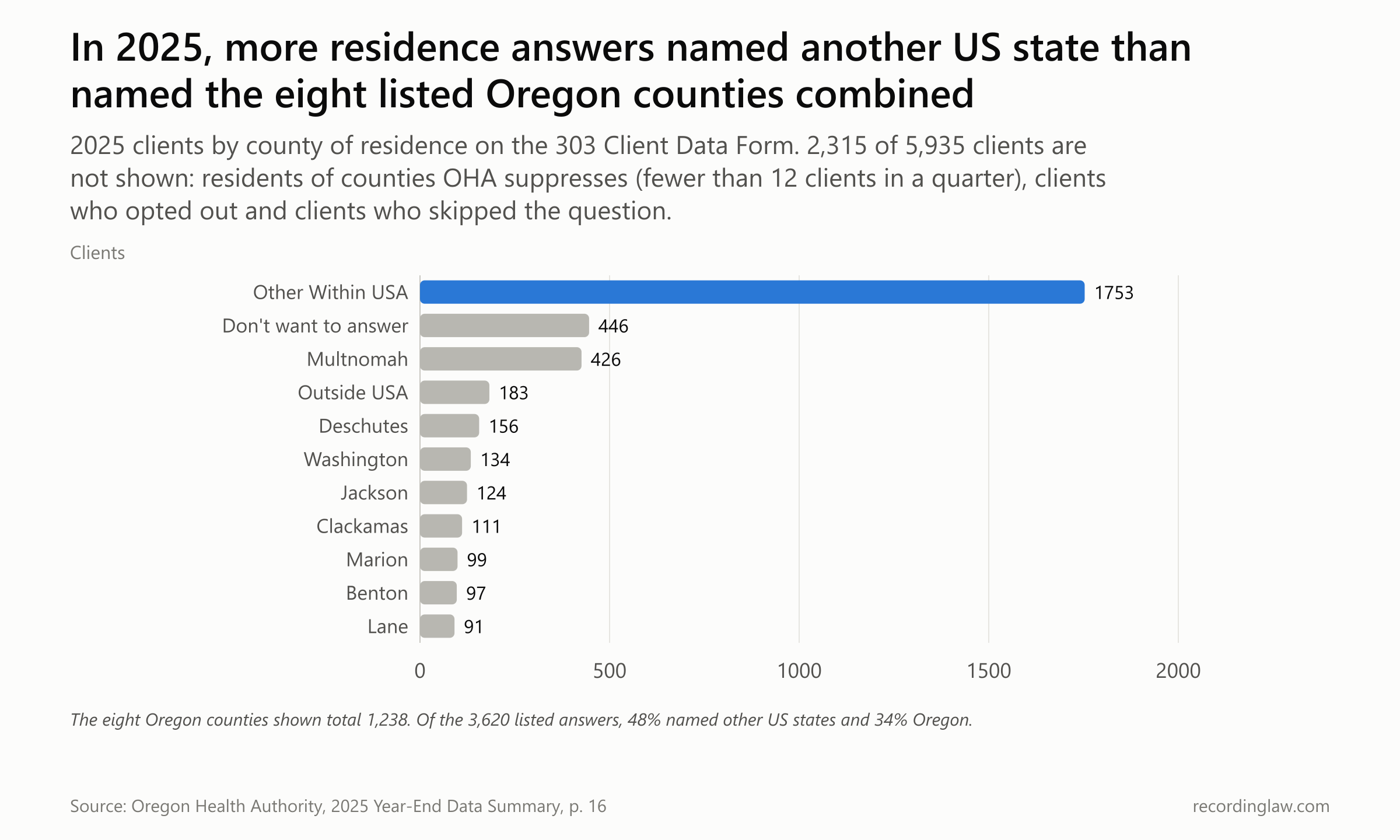
2025 clients by county of residence as reported on the 303 Client Data Form. Counties with fewer than 12 clients in a quarter are suppressed. Source: OHA 2025 Year-End Data Summary.
| Residence (2025) | Clients |
|---|---|
| Another US state or territory | 1,753 |
| Did not want to answer | 446 |
| Multnomah County | 426 |
| Outside the US | 183 |
| Deschutes County | 156 |
| Washington County | 134 |
| Jackson County | 124 |
| Clackamas County | 111 |
| Marion County | 99 |
| Benton County | 97 |
| Lane County | 91 |
| Total listed | 3,620 |
The county rows in the table are Oregon counties, and together they make up the 34% of answers that named Oregon. Another 48% named another US state, and the health authority reports 5% from outside the country. Added together, 53% of the answers named a home outside Oregon, and 12% declined to say.
The 3,620 published answers are not every client. The health authority suppresses, or hides, counties with fewer than 12 clients in a quarter, some clients opted out of having their data reported, and some skipped the question. Together they leave 2,315 of the 5,935 clients out. The hidden counties leave out an unknown number of Oregonians, up to 11 per county per quarter.
Chapman's test also named race and wealth. Of the answers to the race question, 76% were European or White.
The income band clients chose most often was $95,376 to $182,100 a year, picked by 864 clients. The next was $44,726 to $95,375, picked by 749, while 960 declined to answer. The largest age groups were people in their late 30s and 40s, and no client was under 21.
Clients could pick several reasons for coming. The most common was general health and wellness (1,816), then a change in perspective (1,642) and expanded consciousness (1,602), ahead of anxiety (1,413), depression (1,304) and post-traumatic stress disorder, or PTSD (775).
A team at Johns Hopkins read the same year of data in a commentary for the International Journal of Drug Policy. "Access also remains limited, with most clients being of high-income and from outside Oregon," the authors wrote, adding that the program "has expanded supervised psilocybin use beyond strictly medical uses." The health authority answered that the law voters passed in 2020 comes with its own "broad eligibility criteria" that are "not expanded by the agency."
What voters were told in 2020
Measure 109 was put to voters as mental health care. "An estimated one in every five adults in Oregon is coping with a mental health condition," the law's own findings said, and studies by "nationally and internationally recognized medical institutions indicate that psilocybin has shown efficacy, tolerability, and safety" for conditions including depression, anxiety and addiction.
Its authors, Beaverton therapists Tom and Sheri Eckert, described something closer to a clinic than a store. "It doesn't parallel cannabis," Tom Eckert told OPB in 2019. "There'll be no dispensaries. Nobody is buying this and taking it home with them."
On election night, OPB told its readers what the measure would create: psilocybin would "only be available through an extensive, three-session therapy system located in a state-licensed clinic." Weeks earlier, Sheri Eckert had summed up the design: "We followed the science, we kept safety at the forefront and we emphasized equitable access."
State Sen. Elizabeth Steiner Hayward, a Portland Democrat and family physician, vouched for it. "I think the science on this is rock solid, it's been studied for over 40 years by some of the preeminent institutions in the country," she told The Lund Report. "This is going to be very, very thorough and deliberate."
Most of the campaign's money came from one donor. Two committees campaigning for a yes vote reported $5.3 million in contributions, according to Ballotpedia, and the largest donor was New Approach PAC, which gave more than $3.5 million and backs marijuana legalization initiatives.
The soap maker Dr. Bronner's committed $2 million. Its chief executive, David Bronner, called psychedelic-assisted therapy "life-saving medicine that the world needs now."
No committee registered to oppose the measure. The opposition came instead from psychiatrists and a former federal drug policy adviser. "As medical experts in psychiatric care, we are concerned about determining medical treatment by ballot initiative," wrote Dr. Saul Levin, chief executive of the American Psychiatric Association. "Science does not yet indicate that psilocybin is a safe medical treatment for mental health conditions."
Dr. Nicole Cirino, president of the Oregon Psychiatric Physicians Association, said the measure would "set up Oregonians as really the guinea pigs to be receiving psilocybin treatment for psychological conditions". Jonathan Betlinski, a Portland psychiatrist who chaired the association's program committee, put it in six words: "The excitement outpaces the available evidence."
Kevin Sabet, a former drug policy adviser to Presidents Clinton, Bush and Obama, co-founded Smart Approaches to Marijuana, a group that works to reduce marijuana use. He objected to the method itself. "Medical research should not be the purview of a popular vote," he said. "This isn't elementary school choosing a class president."
Voters approved the measure 1,270,057 to 1,008,199, or about 56% to 44%. The law gave the state two years to write rules before anyone could legally take a dose. Before those two years were up, voters were asked again, town by town.
Why did so many towns vote again?
In the summer of 2022, during a heat wave, the Philomath City Council spent hours debating psilocybin. Philomath voters had approved Measure 109 by more than 500 votes, a 17% margin. The council voted 4-3 to ask those voters again anyway, this time about a two-year moratorium, or pause, the Oregon Capital Chronicle reported.
Local governments could ask their voters for a ban or a two-year moratorium, and several officials cited the state's record with marijuana. "I have no confidence that they'll get this thing right," said Roger Nyquist, chair of the Linn County Board of Commissioners. "We ought to get the marijuana program stable and rational before we move on to other stuff."
"I just know how bad the state stumbled with the rollout of the marijuana stuff, being involved with that first hand," said Adam Garvin, a McMinnville city councilor. Jackson County Commissioner Colleen Roberts said officials were "a little head shy about time, place and manner because of what happened with marijuana."
In November 2022, authorities in 27 counties and 114 cities and towns put bans or two-year moratoriums on the ballot. Those were the places that asked. By The Astorian's count of the results later that month, voters in 23 of Oregon's 36 counties and 111 of its 241 cities chose to opt out or pause.
Most of the state's population centers stayed in. Seventeen of Oregon's 20 most populous cities allowed services, the Capital Chronicle reported. "Up to 2.9 million Oregonians will have access to the breakthrough treatment in their local city or county," Chapman said.
By then the rules no longer matched the clinic OPB had described on election night. Facilitators, the licensed staff who supervise clients during a session, needed 120 hours of training, The Astorian reported, and "They do not have to be medical personnel, and they are not considered therapists."
Who was going to count the clients?
Licensing opened on January 2, 2023. EPIC Healing Eugene became the first licensed service center that May, and the first center opened to clients that summer, according to the health authority. For the next two years, Chapman's test had only owners' estimates to go on.
Steiner Hayward, by then serving as State Sen. Elizabeth Steiner, sponsored a bill to replace the estimates with data. SB 303 required service centers to report data about their clients to the state. "Without race and ethnicity data, without sexual orientation data, we will not know whether this is being only for rich white people," she said in April 2023.
The regulator argued against it. "The client information required by SB 303 is extensive and could be seen as invasive for many clients, especially for clients who belong to communities that have been subject to disproportionate enforcement of criminal laws or unethical research practices," wrote Andre Ourso of the health authority. He added that carrying it out "would require an increase in licensing fees, which would have a detrimental impact to licensees."
Mike Arnold, founder of the psilocybin company Silo Wellness, warned about security. "When you are having a system that is collecting data, and that system breaks down, what can bad actors do with that information?" he asked. The bill passed, and reporting began on January 1, 2025.
In the meantime, centers opened and some closed. The Journey, the Portland center whose co-founder had put his out-of-state figure at 95%, shut down in March 2024, six months after opening and after serving more than 100 people, and told FOX 12 the reason was a lack of clients. Heidi Pendergast, Oregon director of the Healing Advocacy Fund, the nonprofit that promotes the program, said she did not think it was "necessarily a 'canary in a coal mine' situation," and forecast "over 5,000 clients through the end of this year who have accessed services since the program has opened."
What does a session cost?
The price was a problem the program's supporters acknowledged early. In May 2024, Pendergast, of the Healing Advocacy Fund, said an individual session could cost $1,200 and a group session $750. "Those numbers have come down significantly since the program first launched in May, and we anticipate they will continue to decrease as more service centers come online," she told Jefferson Public Radio. "But this is cost-prohibitive, and we acknowledge that."
The next documented figure came from a mystery-shopper study. From July to September 2025, researchers at Washington University in St. Louis and the University of Missouri made scripted calls to the 22 centers still open, posing as adults with depression, and reached 15.
The median quoted cost for a full session, covering preparation, dosing and integration, was $1,900. That figure is the median, the middle value when all are lined up in order. The quotes ran from $850 to $3,000.
The two figures measure different things, a single session in one and the full package in the other, so they do not show whether prices rose. No center the callers reached accepted insurance. All offered some discount or sliding scale, and all said out-of-state clients could come.
The study was funded by the National Institutes of Health and university awards. One co-author reported grants from COMPASS Pathways and Usona, outside this work.
In an Oregon Health & Science University (OHSU) study of clients, about a third said the cost was a financial strain, and 81% said the experience was worth the money. In that group, 29% reported household income above $200,000.
Clients also pay a 15% tax on the psilocybin products used in their session. The health authority's sales figure, $748,926 in 2025, counts psilocybin products only, not the facilitator's time or the session.
How safe is the program, and how would anyone know?
The state's main safety measure is a count of emergency-services contacts. In 2025, centers reported 13 of them for 5,935 clients, or 0.2%. There have been no product safety recalls in the regulated program, the agency says. The recalled products that the federal Centers for Disease Control and the health authority warned about in 2024 were unregulated ones, from outside the program.
Centers also report reactions by type. How often did they report one?
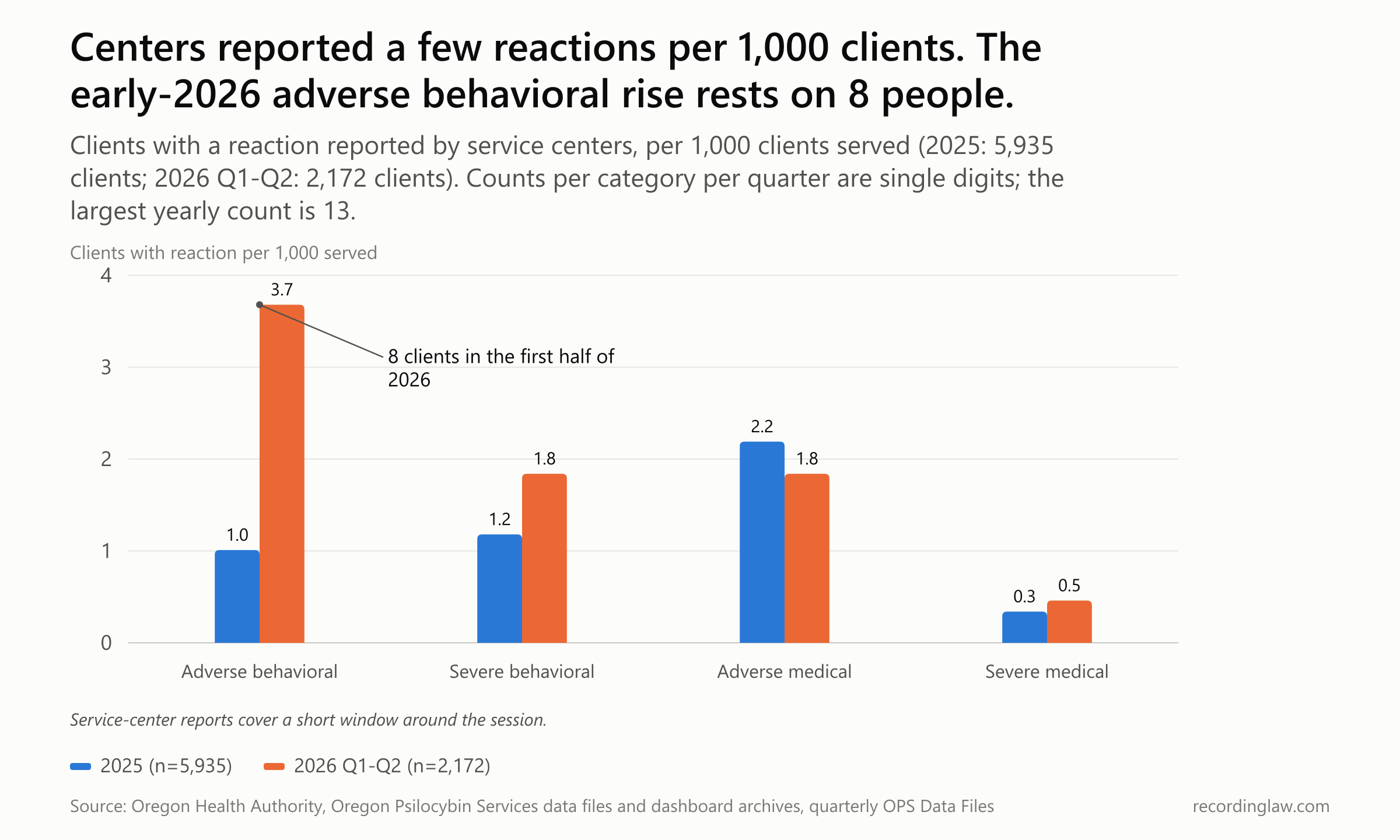
Clients with a reaction reported per 1,000 clients served, 2025 versus 2026 Q1-Q2. Source: OHA OPS Data Files.
| Reaction type | 2025 clients | 2025 per 1,000 | 2026 H1 clients | 2026 H1 per 1,000 |
|---|---|---|---|---|
| Adverse behavioral | 6 | 1.01 | 8 | 3.68 |
| Severe behavioral | 7 | 1.18 | 4 | 1.84 |
| Adverse medical | 13 | 2.19 | 4 | 1.84 |
| Severe medical | 2 | 0.34 | 1 | 0.46 |
Each category held a few clients a year, at most 13. The jump in adverse behavioral reports in early 2026 rests on 8 clients. With counts that small, a change of one or two people moves the rates a long way.
Supporters point to the record as evidence that the rules work. "We are seeing that the safety guardrails work," Pendergast told Willamette Week in June 2025, "and now it is time for us to reevaluate the rules for business viability."
The first independent study tested how complete the state's numbers are. Researchers at Oregon Health & Science University followed 346 clients from 24 of 26 licensed centers for three months, without a comparison group. Four had serious behavioral reactions that needed medical attention, all of them first-time psychedelic users. Facilitators reported only one of the four, and the authors wrote that the state's day-of-service reporting "may underestimate true adverse reaction rates."
The same study found fewer participants reporting moderate-to-severe symptoms of depression, anxiety and PTSD at three months than before their session. Its authors wrote that the uncontrolled design, with no comparison group, "precludes causal inference." That means it cannot show that psilocybin caused the changes it measured. The authors also wrote that the sample was about 5% of clients, and that whether the results apply to people with lower incomes "remains to be determined."
The study's funders included the National Institutes of Health and the federal Substance Abuse and Mental Health Services Administration. One co-author disclosed ties to the Portland Institute for Psychedelic Science and the psychedelic company Atai.
Outside researchers split on how to read it. "To see that the whole thing did not blow up in this regulated business environment is definitely good news for psilocybin," said Balázs Szigeti of the University of California, San Francisco. Albert Garcia-Romeu of Johns Hopkins said, "This is a very small group of people and a rarified sample," and "we really can't generalize based on this study that it's going to be this safe and look this way for everyone."
David Yaden of Johns Hopkins, a co-author of the commentary in the International Journal of Drug Policy, said the program's "risk profile" was better than he expected but that concerns may not be fully reported. Todd Korthuis, who led the OHSU study, said, "I am cautiously optimistic that expanding services through state regulated programs will be a good thing, but we won't know that for sure until we have long term data on people accessing these services."
The rules are enforced, including against one of the measure's authors. In 2025 the health authority received 51 complaints and issued 22 final orders. Of those orders, 18 were civil penalties and 4 were revocations.
In July 2025 the health authority fined Tom Eckert $3,000. The agency said that during a group session at his company InnerTrek's Portland center in May 2024, he and another facilitator left the room for more than five minutes, breaking the requirement to monitor clients continuously. Under the design voters approved, the agency that enforces those rules is meant to be paid for by license fees from the businesses it regulates and a tax on the products their clients use.
Who pays for the program?
Fee revenue has not covered the program's costs. By the end of August 2023, eight months into licensing, the health authority had collected $318,419 in fees, Willamette Week reported. Lawmakers put $3.1 million from the taxpayer-supported General Fund into the 2023-25 budget.
"The promise was that taxpayers wouldn't be on the hook for this," Mason Marks, a Florida State University law professor who had served on the state's psilocybin advisory board, told Willamette Week. "I don't think this is ever going to be funded by fees."
How many centers stayed open?
Centers were closing. The health authority had approved 34 service centers by June 2025, and 25 remained open, Willamette Week reported. By July 2026 the state had issued licenses to 39 service centers, about half of which had expired or been surrendered, according to state figures cited by the Capital Chronicle. Both are point-in-time counts from news reports, not a series.
Fewer centers were open. Did the clients keep coming?
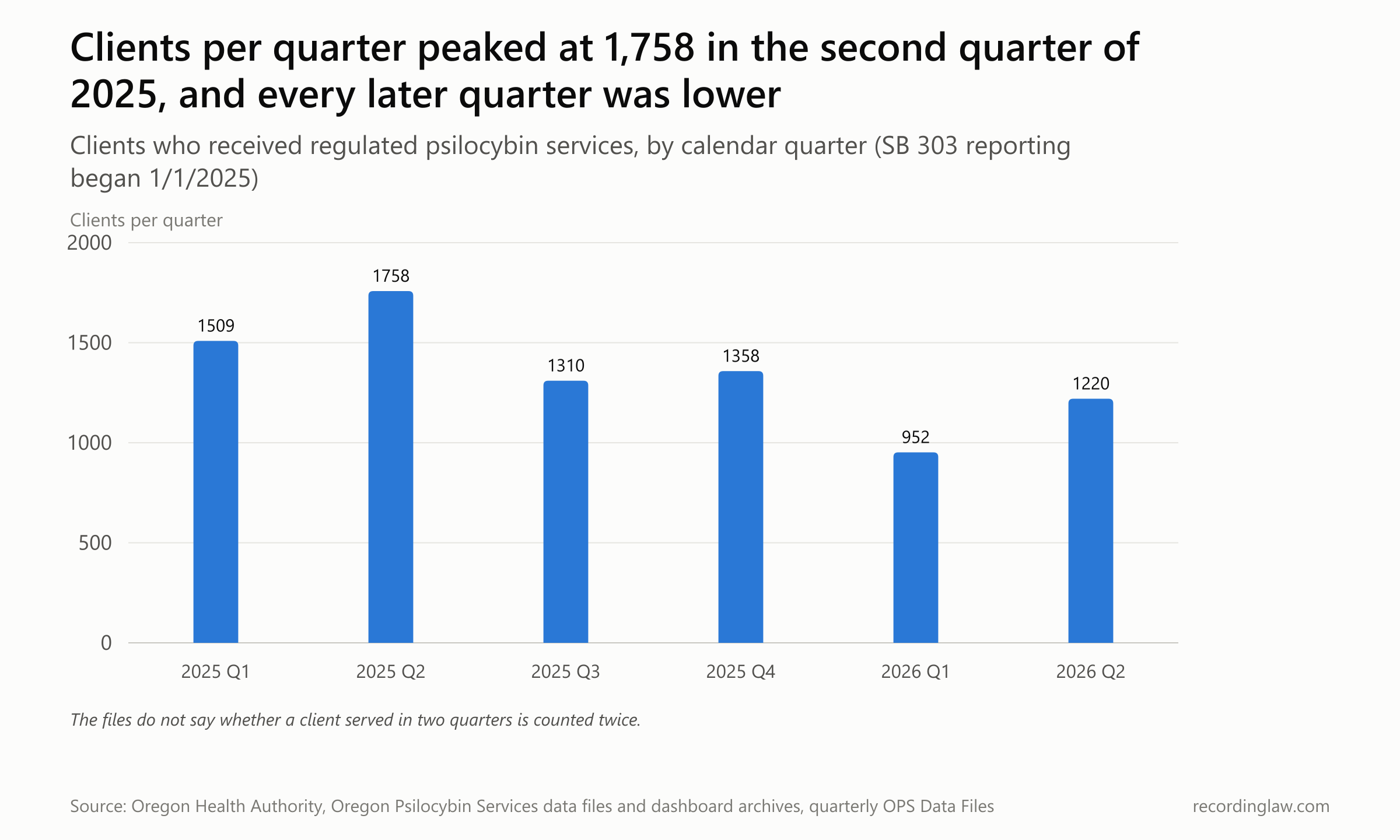
Clients served per quarter by Oregon psilocybin service centers, 2025 Q1 to 2026 Q2. Source: Oregon Health Authority OPS Data Files.
| Quarter | Clients served |
|---|---|
| 2025 Q1 | 1,509 |
| 2025 Q2 | 1,758 |
| 2025 Q3 | 1,310 |
| 2025 Q4 | 1,358 |
| 2026 Q1 | 952 |
| 2026 Q2 | 1,220 |
The count peaked at 1,758 in the second quarter of 2025, and every later quarter was lower. Centers reported 2,172 clients in the first half of 2026, about a third fewer than the 3,267 in the first half of 2025.
Andrew Jacobs, a New York Times reporter who covered the closures, described the arithmetic on OPB in January 2026. License fees run "about $10,000 just to, annually, just to open a center," he said, and "Insurance rates are about three times higher than it is for other medical and health related businesses." The high cost of sessions, he said, "has meant fewer clients than expected."
The centers still open kept selling about 4,200 to 5,200 products a quarter in the last three quarters of 2025. How much regulated psilocybin has been sold in all?
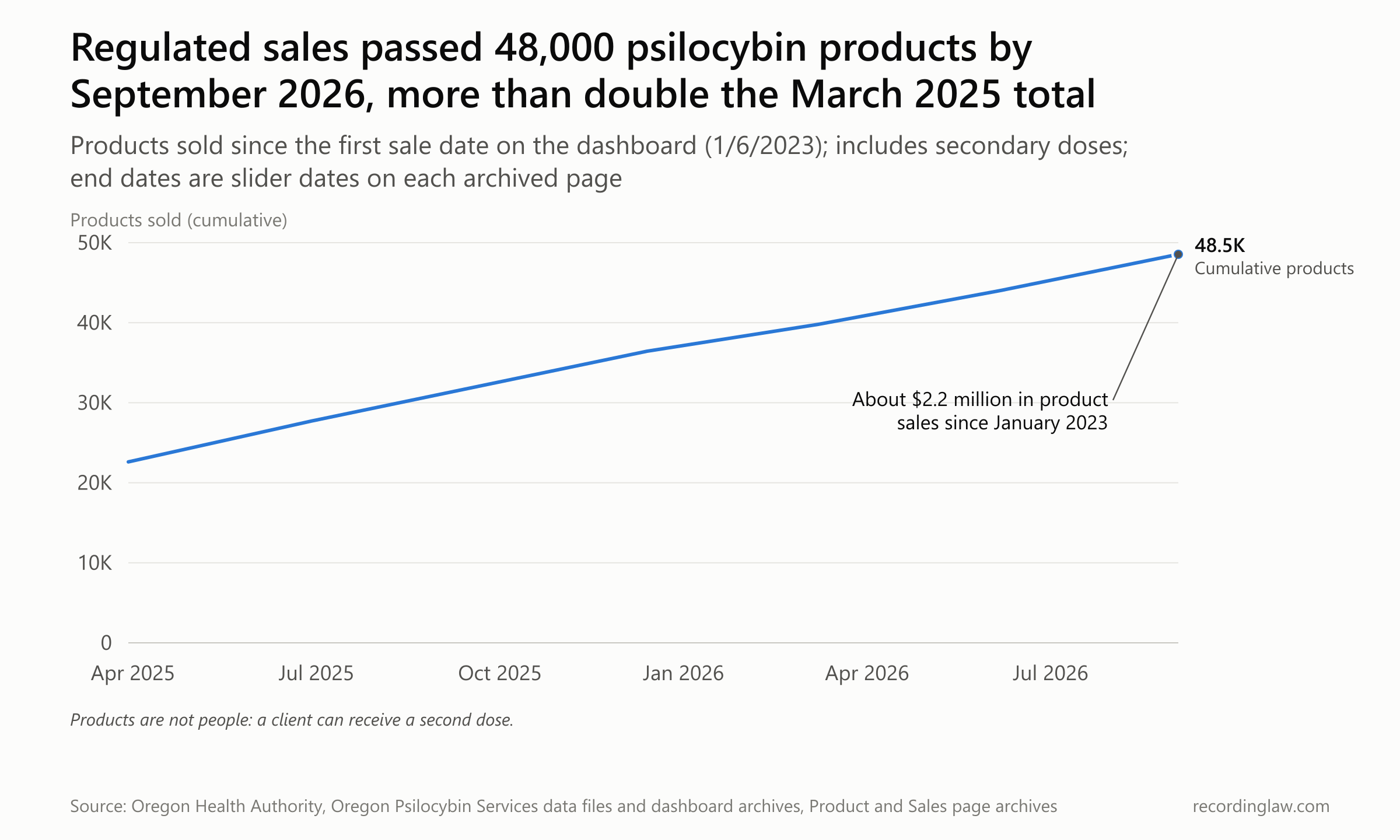
Cumulative regulated psilocybin products sold since January 6, 2023, at six dates between March 2025 and September 2026. Source: OHA OPS Data Dashboard archives.
| Sold through | Cumulative products |
|---|---|
| March 31, 2025 | 22,609 |
| June 30, 2025 | 27,710 |
| December 14, 2025 | 36,449 |
| March 9, 2026 | 39,790 |
| June 7, 2026 | 44,000 |
| September 4, 2026 | 48,544 |
The running total more than doubled between March 2025 and September 2026, reaching 48,544 products and about $2.2 million in product sales since January 2023. Products are not people. A client can receive a second dose, so the health authority says the number of clients is lower than the number of products.
The state's only licensed testing lab was also losing money. Daniel Huson, who heads that lab, Rose City Laboratories, said in July 2026 that it made $26,000 from compliance testing the previous year. He said that did not cover its costs, including its $10,000 license fee.
The closures reached Tom Eckert's own company. On June 30, 2026, Willamette Week reported that InnerTrek was letting the lease on its Portland service center expire and would stop facilitating sessions in Oregon, focusing instead on training facilitators.
Why were the fee increases dropped?
In late June, the health authority proposed its fee increases. Spokesperson Erica Heartquist said in an email that the program is funded through fees, not taxpayer money, and that because revenue had not kept up with costs, "the only option is increasing fees." Ryan Reid, co-founder of the Bend service center Bendable Therapy, answered: "I don't think the industry can survive this."
The agency dropped the plan in September after hearing from its advisory board, rule committees and public comment. "This was an industry fighting for its survival, and it really came together," said the co-founder of the Ashland center Satya Therapeutics.
The same agency document showed that raising fees would not have closed the gap either. If the number of licenses held steady under the higher fees, it projected a $2.9 million shortfall. In its worst case, with businesses dropping their licenses instead of paying more, it projected a $4.2 million shortfall.
In October 2026 the health authority wrote that higher fees "may be counterproductive." It also wrote that without "a significant increase in licensees and statutory changes," the program's ability to keep meeting its legal requirements would depend on "other revenue streams, such as General Fund, or additional solutions, such as creation of new revenue streams." Documents released in September show it is considering an increase to the 15% product tax, and suggest it does not expect lawmakers to add General Fund money in the upcoming budget cycle.
What 2027 brings
The next answer to who uses the program comes in the health authority's next quarterly file. As of November 10, 2026, it had posted data through June. Its 2025 year-end file was published about a quarter after the year closed. If it keeps that pace, the July-to-September 2026 file would be expected around January 2027.
January also brings two rule changes. From January 1, 2027, under a 2026 law, HB 4040, people trained in Colorado's approved programs may apply for Oregon facilitator licenses. The health authority has also restarted the non-fee part of its rulemaking, with a planned effective date of January 15, 2027. HB 4040 also adds a data point on low doses to the quarterly reports centers file.
Colorado began accepting license applications on December 31, 2024, and approved its first healing center license in April 2025. In voluntary early data, it reported 109 participants served from August to December 2025. By October 30, 2026, it had approved 12 standard and 35 micro healing centers, and its health department expects to contribute data to its next annual report by 2027.
The research will take longer. The OHSU team has 6-, 9- and 12-month results still to report. A separate five-year, $3.3 million federal grant funds a larger study with a comparison group. A synthetic form of psilocybin tested in large studies for hard-to-treat depression could be approved as early as 2027, NPR reported in August.
The September 22 notice left the main question open. The estimate voters saw in 2020 said fees and taxes would carry a $3.1 million-a-year program. Whether clients pay more through the product tax, licensees through fees, or taxpayers through the General Fund has not been decided.
How we measured
Client counts. Clients served come from the ClientsServed column of the six Oregon Health Authority quarterly OPS Data Files (2025 Q1 to 2026 Q2). The four 2025 quarters sum to 5,935, matching the agency's 2025 Year-End Data Summary.
The files do not say whether a client served in two quarters is counted twice. SB 303 reporting began January 1, 2025. There are no official client counts for 2023 or 2024. The 2026 files add a count of clients who opted out of having their data reported (139 in the first quarter and 291 in the second).
"About 16 a day" is 5,935 divided by 365. The first-half comparison is 2,172 (952 + 1,220) against 3,267 (1,509 + 1,758), 33.5% lower.
Residence, race, income and reasons. Residence comes from page 16 of the Year-End Data Summary. Its "Other Within USA" row is clients from other US states, per the agency's 2025 Year in Review ("Other state/territory within the USA").
The listed rows sum to 3,620 of 5,935 clients: the rest live in suppressed counties, opted out of reporting or skipped the question. The 48%, 34%, 5% and 12% shares are OHA's, computed on those 3,620 answers (1,753, 1,238, 183 and 446). Together, other states and other countries are 1,936 answers, 53%. OHA hides a county in any quarter with fewer than 12 responses (28 counties in all four quarters of 2025, and Jackson County in two), so the published counts leave out an unknown number of Oregonians, up to 11 per county per quarter.
Race shares are of responses, not clients. Reasons for use were "select all that apply," so no share of clients can be computed from them. These are self-reported answers on a form, and the clients who opted out are not in them.
Opt-out counts. No state agency publishes a statewide tally of local opt-outs. The 27 counties and 114 cities are jurisdictions that referred measures to voters in November 2022 (Oregon Capital Chronicle).
The passed count, 23 of 36 counties and 111 of 241 cities, is The Astorian's tally of November 29, 2022; earlier counts that month differ (the East Oregonian counted 137 opt-outs passed, 17 of them temporary). Some measures have since expired or been revisited; we did not tally them.
Prices and sales. The $1,900 median is from Adams and colleagues' mystery-shopper study (Health Affairs Scholar, published online August 2026): two waves of scripted calls from July to September 2025 to 22 open centers, 15 reached, 27 calls, plus website review and five staff interviews. It is a quoted price, not a record of what clients paid. Pendergast's $1,200 and $750 are her 2024 figures as reported by Jefferson Public Radio. OHA's 2025 product sales ($748,926.10) and the cumulative $2,173,290.79 (an average of $61.69 per sale) are dollar sales of psilocybin products in the regulated model, not session prices.
Products. Cumulative products were read from screenshots in the OHA dashboard archives. Only March 31 and June 30, 2025, are quarter ends; the other dates are the days each archive was captured. Products include secondary doses.
The 2025 total is 18,877 in the Year-End Data Summary and 18,868 in the Year in Review; OHA does not explain the gap. The OHA budget overview says more than 50,000 products had been sold by October 1, 2026. The average dose per session in the quarterly files was 24.1 to 24.9 mg of psilocybin from early 2025 through March 2026 and 28.14 mg in the April-June 2026 quarter.
Safety data. Emergency contacts and reaction counts are service-center reports under SB 303, which cover a short window around the session. Reaction rates are counts divided by clients served (5,935 for 2025; 2,172 for the first half of 2026). Raw counts are single digits per category per quarter. The OHSU study (Korthuis and colleagues, JAMA Network Open, August 2026) followed 346 clients recruited from November 2024 to March 2026, with no control group; it cannot show that psilocybin caused the changes it measured.
The Johns Hopkins piece (Cheung, Propes and Yaden, International Journal of Drug Policy, 2026) is a commentary on OHA's 2025 data; we read its abstract and news coverage of it. Yaden discloses consulting for Soneira and lecture fees from the Integrative Psychiatry Institute.
Centers and money. Service-center counts come from point-in-time news reports of state figures (Willamette Week, June 2025; the Capital Chronicle, July 2026); we did not build a quarterly series. The General Fund figure and the 2023 fee total are as reported by Willamette Week.
The shortfall projections come from an agency document as reported by the Capital Chronicle and OPB. Campaign finance figures are from Ballotpedia's summary. Vote totals are from the Oregon Blue Book.
Colorado. Colorado's 109 participants are voluntary early data from its Department of Revenue's annual report (published February 2, 2026), covering August to December 2025. They are not comparable with Oregon's mandatory counts.
What the data cannot show. None of these sources measures whether psilocybin services improved mental health across the program, and there is no comparison group of Oregonians without access. The residence figures describe who answered the form, not all clients. Nothing here is medical advice. The current rules are summarised in our guides to Oregon psilocybin laws and psilocybin laws by state.
Frequently Asked Questions
Is psilocybin legal in Oregon?
Adults 21 and older can take psilocybin at a licensed service center under the supervision of a licensed facilitator, under Measure 109, which voters approved in November 2020. Psilocybin remains illegal under federal law. Cities and counties can opt out. In November 2022, voters in 23 of 36 counties and 111 of 241 cities chose to opt out or pause, according to The Astorian.
How many people have used Oregon's psilocybin program?
Service centers reported 5,935 clients in 2025, the first year of mandatory reporting, and 2,172 in the first half of 2026. The Oregon Health Authority has no official count for 2023 and 2024 and describes the total since launch as thousands of clients.
How much does a psilocybin session cost in Oregon?
A mystery-shopper study of Oregon centers from July to September 2025 found a median quoted cost of $1,900 for a full session including preparation, dosing and integration, with quotes from $850 to $3,000. No center the callers reached accepted insurance, and clients also pay a 15% tax on the products used.
Do you have to live in Oregon to use psilocybin services?
No. In the 2025 state data, 48% of answers to the residence question named another US state or territory and 34% named Oregon. Every center reached in the 2025 mystery-shopper study said out-of-state clients could use its services.
How many emergencies have there been in Oregon's psilocybin program?
Service centers reported 13 emergency-services contacts for 5,935 clients in 2025, or 0.2%. An Oregon Health & Science University study found that facilitators reported only one of four serious reactions among the 346 clients it followed, and its authors wrote that the state's reporting may underestimate reaction rates.
Who pays for Oregon's psilocybin program?
The program is meant to be funded by license fees and a 15% product tax. Lawmakers added $3.1 million from the taxpayer-supported General Fund for 2023-25. An agency document projected a $3.8 million shortfall for 2025-27, and the health authority dropped a proposal to double license fees on September 22, 2026.
How many psilocybin service centers are open in Oregon?
The state had issued licenses to 39 service centers by July 2026, about half of which had expired or been surrendered, according to state figures reported by the Oregon Capital Chronicle. The health authority's dashboard listed 22 service center licenses as approved in its 2026 second-quarter archive.
Updates
Reworded for readability. No figures, quotes, sources or findings changed.
Restructured as a feature: chart titles state the finding, side details moved to How we measured. Every figure and quote was re-checked against its source.
Independently fact-checked against the cited primary sources
Independently fact-checked against the cited primary sources
Sources and References
- Oregon Health Authority, Oregon Psilocybin Services, 2025 Year-End Data Summary(oregon.gov).gov
- Oregon Health Authority, Oregon Psilocybin Services, 2025: Year in Review(oregon.gov).gov
- Oregon Health Authority, OPS quarterly data file, 2026 Q2 (quarterly files 2025 Q1 to 2026 Q2)(oregon.gov).gov
- Oregon Health Authority, Oregon Psilocybin Services Data Dashboard(oregon.gov).gov
- Oregon Health Authority, OPS Data Dashboard archive, 2026 Q2(oregon.gov).gov
- Oregon Health Authority, Oregon Psilocybin Services Data Archive(oregon.gov).gov
- Oregon Health Authority, Medical Cannabis and Psilocybin, Psilocybin Budget Information (October 2026)(oregon.gov).gov
- Oregon Health Authority, statement on not moving forward with proposed psilocybin fee increases (September 22, 2026)(oregon.gov).gov
- Oregon Psilocybin Services, 2026 Spring Newsletter (HB 4040)(content.govdelivery.com)
- Oregon Psilocybin Services, newsletter and 2026 Legislative Session Update (data release timing)(content.govdelivery.com)
- Oregon Secretary of State, Measure 109 (2020) text, Initiative Petition 34(sos.oregon.gov).gov
- Oregon Blue Book, initiative, referendum and recall history (Measure 109 vote)(sos.oregon.gov).gov
- Multnomah County, full text of ballot titles for November 3, 2020, including the Measure 109 estimate of financial impact(multco.us).gov
- Ballotpedia, Oregon Measure 109 (2020): campaign finance(ballotpedia.org)
- OPB, Psilocybin Measure Approved For Oregon's November Ballot (July 8, 2020)(opb.org)
- OPB, Push To Regulate Psychedelic Mushroom Inches Closer To Oregon's 2020 Ballot (August 8, 2019)(opb.org)
- OPB, Oregon voters legalize therapeutic psilocybin (November 4, 2020)(opb.org)
- Herald and News, Measure 109 would use magic mushrooms to treat mental illness (October 18, 2020)(heraldandnews.com)
- The Lund Report, Critics: Psilocybin Measure Would Turn Oregonians Into Guinea Pigs (September 16, 2020)(thelundreport.org)
- Jefferson Public Radio (OPB), Measure 109: Accessing The Therapeutic Promise Of Psilocybin Mushrooms (September 30, 2020)(ijpr.org)
- Oregon Capital Chronicle, Many Oregonians will have to vote again on psilocybin (August 8, 2022)(oregoncapitalchronicle.com)
- KVAL, Magic mushrooms banned in 25 Oregon counties, over 100 cities (November 14, 2022)(kval.com)
- Oregon Capital Chronicle, Thousands of Oregonians vote against psilocybin centers (November 14, 2022)(oregoncapitalchronicle.com)
- East Oregonian, Election 2022: 137 Oregon towns and counties vote to opt out of psilocybin services (November 11, 2022)(eastoregonian.com)
- The Astorian, Many counties and cities step back from psilocybin program (November 29, 2022)(dailyastorian.com)
- Oregon Capital Chronicle via Source New Mexico, Oregon's legal psilocybin clinics draw hundreds, mostly from out of state (November 28, 2023)(sourcenm.com)
- The Lund Report, Bill seeks personal data collection on people who use legal psilocybin in Oregon (February 28, 2023)(thelundreport.org)
- KATU, Oregon lawmakers consider bill to collect data on psilocybin therapy patient demographics (April 17, 2023)(int.katu.com)
- Willamette Week, Oregon's Legal Psilocybin Program Gets Taxpayer Funds Despite Promise to Pay Its Own Way (August 30, 2023)(wweek.com)
- KPTV (FOX 12), After psilocybin service center closes in NE Portland (April 4, 2024)(kptv.com)
- Jefferson Public Radio, One year of psilocybin in Oregon: availability increases while costs remain high (May 28, 2024)(ijpr.org)
- Willamette Week, Oregon's Psychedelic Service Centers Are Closing Amid High Costs and Tough Regulation (June 3, 2025)(wweek.com)
- Willamette Week, Founding Father of Oregon Psilocybin Fined for Breaking Rules He Helped Establish (August 4, 2025)(wweek.com)
- OPB Think Out Loud, A third of Oregon's licensed psilocybin service centers have closed (January 22, 2026)(opb.org)
- Willamette Week, In Change of Tack, Major Portland Psilocybin Service Center Closes (June 30, 2026)(wweek.com)
- Jefferson Public Radio (Oregon Capital Chronicle), Oregon regulators propose steep psilocybin fee hikes (July 6, 2026)(ijpr.org)
- Oregon Capital Chronicle via Washington State Standard, Growing scope of Oregon psilocybin program raises safety concerns, study says (July 1, 2026)(washingtonstatestandard.com)
- OPB (Oregon Capital Chronicle), Oregon regulators nix higher fees for psilocybin after industry backlash (September 23, 2026)(opb.org)
- Korthuis, Cook et al., Safety and Mental Health Outcomes of Oregon State-Regulated Psilocybin Services, JAMA Network Open (2026)(pmc.ncbi.nlm.nih.gov).gov
- Adams et al., A mystery shopper study of Oregon psilocybin service centers, Health Affairs Scholar (published online August 27, 2026)(pmc.ncbi.nlm.nih.gov).gov
- Cheung, Propes and Yaden, Balancing safety and access in Oregon's psilocybin services, International Journal of Drug Policy (2026), abstract(pubmed.ncbi.nlm.nih.gov).gov
- NPR via KUNC, A real-world study of Oregon's nonmedical psilocybin program shows promise (August 19, 2026)(kunc.org)
- The Debrief, As States Legalize Psilocybin, NIH Moves to Study the Real-World Impact (February 19, 2026)(thedebrief.org)
- Colorado Department of Revenue, Natural Medicine Division (approved licenses)(nmd.colorado.gov).gov
- Colorado Department of Revenue, Natural Medicine Division, About Us(dnm.colorado.gov).gov
- Colorado Department of Revenue, Annual Natural Medicine Implementation Report (published February 2, 2026)(drive.google.com)
- Smart Approaches to Marijuana, About SAM(learnaboutsam.org)