Burundi E-Scooter Laws: Trottinette Motorisee Named by Law (2026)
This article is general information about e-scooter laws in Burundi and is not legal advice. Confirm current requirements with a Burundian lawyer or the relevant transport authority before riding. Information last verified on 23 July 2026.
Are e-scooters legal in Burundi?
Burundi's road traffic law is the Code de la Circulation Routiere, enacted as Loi n.1/26 du 23 novembre 2012 and published in the Bulletin Officiel du Burundi. Its definitions section states that a "cyclomoteur" is "tout vehicule a deux ou trois roues, qui est pourvu d'un moteur thermique, electrique ou autre de propulsion d'une cylindree tout au plus egale a 50 cm3 et dont la limite de vitesse par construction n'excede pas 50 km... a l'heure" (any two or three-wheeled vehicle equipped with a thermal, electric, or other propulsion motor of at most 50cm3 displacement and a construction speed limit not exceeding 50 km/h). Naming "electrique" directly answers the question that trips up many similar Francophone codes in the region, which typically gate the lenient moped category to combustion engines only. Burundi does not do that. An electric motor has no cylindree at all, so the operative test becomes the 50 km/h construction speed limit, a threshold a consumer e-scooter clears with room to spare.
The code goes a step further than most in the region by naming the device itself. Article 43 lists categories of special vehicles exempted from registration, and item 5 reads, in the government's own text, "la trottinette motorisee" (motorized scooter). This is a direct, unambiguous textual hit, showing Burundi's legislature was specifically aware of motorized scooters in 2012 and chose to regulate them by name, rather than a modern device being swept in by analogy to an old law never written with it in mind. The practical effect is narrow but real: unlike a standard cyclomoteur, which must carry a registration plate under Article 49, a trottinette motorisee does not need to be registered or plated at all.
That registration exemption is the detail that makes Burundi's framework workable rather than a trap. Registration is usually the requirement a personal electric scooter cannot practically meet, since it has no chassis number, no manufacturer type-approval process suited to the device, and no natural path through a registration office built for cars and motorcycles. By waiving that one obligation specifically for a "trottinette motorisee," the code removes the single biggest practical barrier, leaving a framework a rider could realistically be expected to comply with.
What counts as an e-scooter here
The governing threshold is the cyclomoteur definition: two or three wheels, a motor (thermal, electric, or other), no more than 50cm3 displacement where the motor has one, and a construction speed limit no higher than 50 km/h. A private electric kick-scooter, which has no displacement figure to measure and is typically built well under this speed cap, fits comfortably inside the definition. Article 43(5) additionally names "trottinette motorisee" as its own line item for the registration exemption, without giving it a separate speed or power threshold of its own, so the cyclomoteur definition is the reference point available in the text.
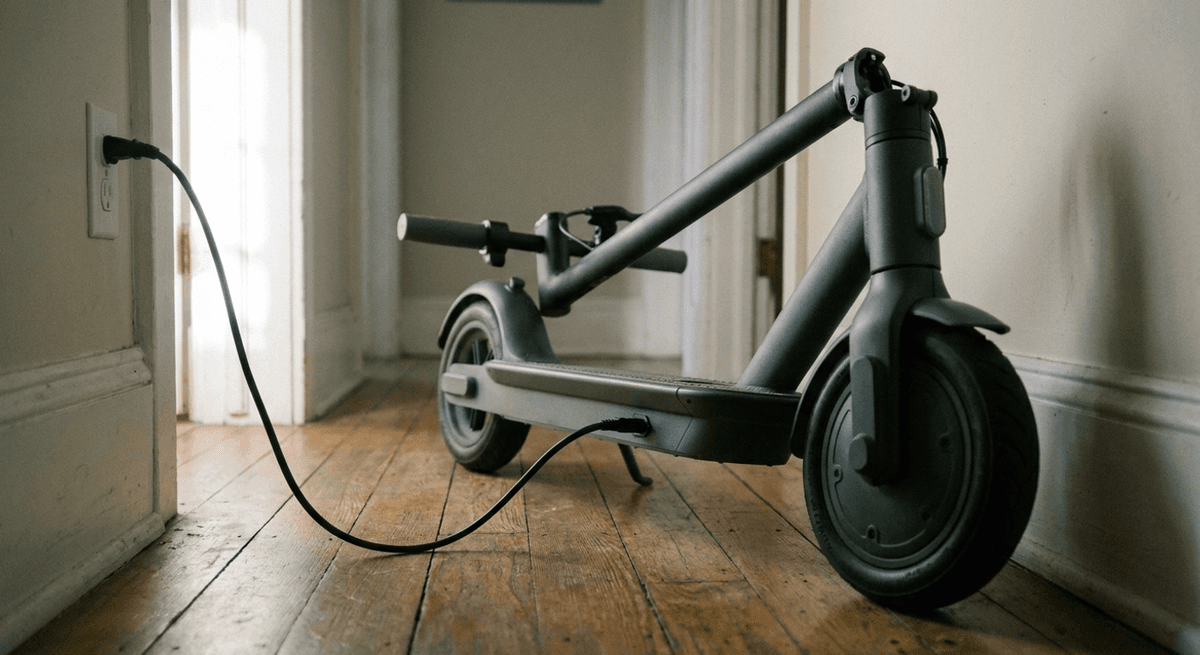
A separate, narrower clause, Article 131, requires "toute bicyclette et toute trottinette" to be fitted with at least a rear-wheel brake. This equipment rule groups scooters generally with bicycles for braking purposes and does not by itself establish vehicle classification.
Where you can ride
The located text does not spell out a separate lane or road-positioning rule specifically for a trottinette motorisee. As a device falling within the cyclomoteur framework, it would generally be expected to use the road network rather than the pavement, consistent with how cyclomoteurs are treated elsewhere in the code, but a dedicated lane rule for this specific device was not confirmed in this research.
Rider rules
Burundi's minimum age for a Category A driving licence, which covers cyclomoteurs, is 17, per Article 181: "17 ans pour le permis de la categorie A relatif aux cyclomoteurs et aux vehicules motorises pour handicapes." Since Article 43 exempts a trottinette motorisee from registration specifically, and does not separately address licensing, the most defensible reading is that the Category A licence requirement still applies to a trottinette motorisee rider, but this is an inference from what the article does not say rather than a directly quoted exemption or requirement.
No helmet requirement was located for cyclomoteur or trottinette riders. Every "casque" (helmet) clause found in a full-text read of the code names "motocyclette" (motorcycle) specifically, not cyclomoteur or trottinette. This should be read as "no helmet requirement was located," not as confirmation that none exists in a separate regulation.
Penalties
No trottinette-specific fine was located in the code. One unverified secondary summary described the Code's general traffic-infraction fine structure as running roughly between 20,000 and 100,000 Burundian francs (FBu), but this figure was not independently confirmed against a specific article number in this research and is not scooter-specific, so it should be treated as a general reference point rather than a confirmed trottinette penalty.
Enforcement in practice
No trottinette-specific enforcement incident, news report, or official guidance was located for Bujumbura or elsewhere in Burundi in this research, and no rental or shared e-scooter scheme was confirmed either way. That silence is a data gap, and enforcement patterns, whatever they turn out to be, do not change the legal classification described above and are not permission to disregard the licensing question.
Legal history and what may change
No amendment or implementing decree updating this 2012 framework specifically for e-scooters was located in this research. Whether one has been issued since 2012 was not resolved either way, so the 2012 Code de la Circulation Routiere is the only version this article relies on.
For how other countries in the region and around the world classify e-scooters, see the world e-scooter law hub.
Frequently Asked Questions
Are electric scooters legal in Burundi?
Burundi's Code de la Circulation Routiere defines cyclomoteur to include electric motors, and Article 43 names "trottinette motorisee" by exact term and exempts it from vehicle registration. That combination gives Burundi a workable framework, though the licensing question for a trottinette specifically is an inference rather than a directly stated rule.
Does Burundi's traffic law mention motorized scooters by name?
Yes. Article 43(5) of the 2012 Code de la Circulation Routiere lists "la trottinette motorisee" among the special vehicles exempted from registration, using that exact term.
Do I need to register an e-scooter in Burundi?
No. Article 43 of the Code de la Circulation Routiere expressly exempts a trottinette motorisee from the registration requirement that applies to a standard cyclomoteur.
Do I need a driving licence to ride an e-scooter in Burundi?
The code does not say so directly. Since only registration is expressly waived for a trottinette motorisee, the most defensible reading is that the Category A cyclomoteur licence requirement, minimum age 17, still applies, but this is an inference, not a quoted rule.
Is there a minimum age for riding an e-scooter in Burundi?
Burundi's Category A driving licence, which covers cyclomoteurs, has a minimum age of 17 under Article 181. Whether that age applies to a trottinette motorisee specifically follows from the same licensing inference described above, since the statute does not separately address it.
Do I need a helmet to ride an e-scooter in Burundi?
No helmet requirement for cyclomoteur or trottinette riders was located in the code. Every helmet clause found names motocyclette (motorcycle) specifically, so this should be treated as no requirement located rather than a confirmed absence of one.
Sources and References
- Loi n.1/26 du 23 novembre 2012 portant Code de la Circulation Routiere, Section 2 (definitions), cyclomoteur (motor thermique, electrique ou autre, 50cm3, 50 km/h)(amategeko.gov.bi).gov
- Loi n.1/26 du 23 novembre 2012, Art. 43 (registration exemptions, item 5, "la trottinette motorisee") and Art. 49 (standard cyclomoteur plate requirement)(amategeko.gov.bi).gov
- Loi n.1/26 du 23 novembre 2012, Art. 181 (minimum age 17 for Category A licence, covering cyclomoteurs) and Art. 131 (rear-brake requirement for bicycles and trottinettes)(amategeko.gov.bi).gov
- Loi n.1/26 du 23 novembre 2012, Arts. 121, 464 and 469 (helmet requirements, scoped to motocyclette only)(amategeko.gov.bi).gov