
Indiana
Is Jaywalking Illegal in Indiana? Crossing Rules and Fines (2026)
Independently fact-checked against primary sources (last audited October 10, 2026). · 5 primary sources cited on this page. How we verify our legal content

Indiana does not ban every crossing outside a crosswalk. Under IC 9-21-17-7, a pedestrian crossing at a point other than a marked crosswalk or an unmarked crosswalk at an intersection must yield the right-of-way to all vehicles. Separate sections bar crossing between adjacent signalized intersections except in a marked crosswalk (IC 9-21-17-9) and bar diagonal crossing of an intersection unless official traffic control devices authorize it (IC 9-21-17-10). Every violation of the pedestrian chapter is a Class C infraction (IC 9-21-17-24), for which a court may enter a judgment of up to $500, subject to the exceptions in IC 34-28-5-4(f). For other states, see our guide to jaywalking laws by state.
Information last verified on 2026-10-10. This article has not been reviewed by a licensed lawyer.
Jurisdiction scope: This article covers Indiana state law: the pedestrian chapter of the Indiana Code (IC 9-21-17-1 to 9-21-17-24), the traffic-light rules in IC 9-21-3-7, the driver duties and freeway rule in IC 9-21-8, the crosswalk definition in IC 9-13-2-40, and the infraction rules in IC 34-28-5, as published in the Indiana Code 2026 edition. It does not cover city or town ordinances, injury claims after a crash, or the law of other states.
Is jaywalking illegal in Indiana?
It depends on where and how you cross. Indiana's pedestrian chapter pairs a general duty to yield with a few outright bans.
| Situation | Indiana rule |
|---|---|
| Crossing outside a marked crosswalk or an unmarked crosswalk at an intersection | Allowed, but the pedestrian must yield to all vehicles (9-21-17-7) |
| Crossing where a pedestrian tunnel or overhead crossing is provided | Pedestrian must yield to all vehicles (9-21-17-8) |
| Crossing between adjacent intersections with traffic control signals in operation | Only in a marked crosswalk (9-21-17-9) |
| Crossing an intersection diagonally | Barred unless official traffic control devices authorize it (9-21-17-10) |
| Starting to cross on a steady or flashing don't walk signal | Barred, with a countdown-signal exception for flashing don't walk (9-21-17-2) |
| Starting to cross on a steady yellow light, with no pedestrian signal saying otherwise | Barred (9-21-3-7(b)(2)(B)) |
| Entering the roadway on a steady red light, with no pedestrian signal saying otherwise | Barred (9-21-3-7(b)(3)(C)) |
| Suddenly leaving a curb into the path of a vehicle too close to stop | Barred (9-21-17-5) |
| Walking on the roadway where a usable sidewalk is provided | Barred (9-21-17-12 to 9-21-17-15) |
| Crossing outside a crosswalk in a business district or on a designated highway | May be barred by local ordinance (9-21-17-4(1)) |
| Walking on a freeway or interstate where posted signs prohibit pedestrians | Barred (9-21-8-20) |
| Passing a closed or moving railroad or bridge gate or barrier | Barred (9-21-17-22, 9-21-17-23) |
| Not yielding to an approaching emergency vehicle using its signals | Barred (9-21-17-20) |
| Standing in the roadway to solicit a ride, except in an emergency | Barred (9-21-17-16) |
Crossing outside a crosswalk in Indiana
Indiana spreads the crossing rules over four short sections:
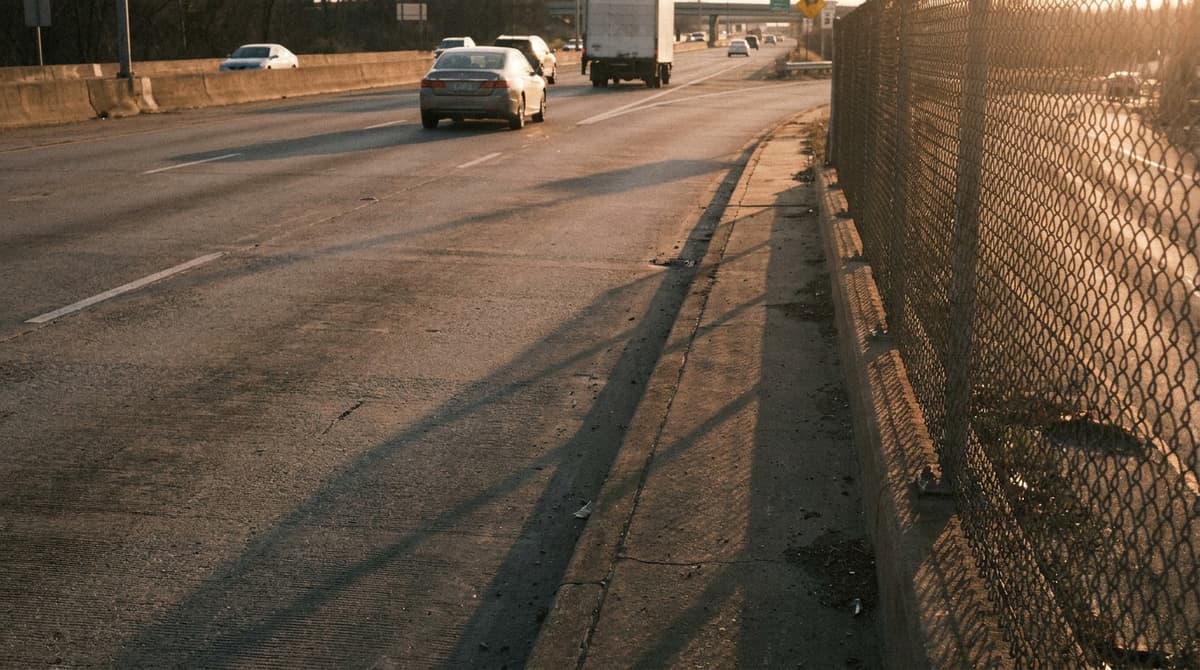
- Yield outside crosswalks. IC 9-21-17-7: "A pedestrian crossing a roadway at a point other than within a marked crosswalk or within an unmarked crosswalk at an intersection shall yield the right-of-way to all vehicles upon the roadway."
- Tunnels and overpasses. IC 9-21-17-8: "A pedestrian crossing a roadway at a point where a pedestrian tunnel or overhead pedestrian crossing has been provided shall yield the right-of-way to all vehicles upon the roadway."
- Signalized blocks. IC 9-21-17-9: "Between adjacent intersections at which traffic control signals are in operation, pedestrians may not cross at any place except in a marked crosswalk."
- Diagonal crossings. IC 9-21-17-10: "A pedestrian may not cross a roadway intersection diagonally unless authorized by official traffic control devices. When authorized to cross diagonally, pedestrians shall cross only in accordance with the official traffic control devices pertaining to diagonal crossing movements."
Sections 7 and 8 are yield duties: a mid-block crossing on an ordinary street is lawful if the pedestrian lets traffic pass first. Section 9 is a prohibition limited to blocks with working signals at both adjacent intersections. What counts as an unmarked crosswalk depends on the definition in IC 9-13-2-40: ""Crosswalk" means any of the following: (1) That part of a roadway at an intersection included within the connections of the lateral lines of the sidewalks on opposite sides of the highway measured from the curbs, or in the absence of curbs, from the edges of the traversable roadway. (2) A part of a roadway distinctly indicated for pedestrian crossing by lines or other markings on the surface." At an intersection with no sidewalks and no markings, that definition describes no crosswalk, so a pedestrian crossing there falls under the yield duty in section 7.
Walk and don't walk signals in Indiana
IC 9-21-17-3 requires a pedestrian to "obey the instructions of an official traffic control device specifically applicable to the pedestrian, unless otherwise directed by a police officer." The meaning of each pedestrian signal is set out in IC 9-21-17-2:
"(2) Steady "don't walk" means a pedestrian may not start to cross the roadway in the direction of the signal. A pedestrian who has partially completed crossing on the "walk" signal shall proceed to a sidewalk or safety island while the "don't walk" signal is showing. (3) Flashing "don't walk" means a pedestrian may not start to cross the roadway in the direction of the signal. A pedestrian who has already started to cross on the "walk" signal shall proceed to a sidewalk or safety island. If a countdown pedestrian signal indication is also shown, a pedestrian may cross if the pedestrian is able to proceed to the sidewalk or safety island by the time the steady "don't walk" signal is shown, and a person who drives a vehicle shall yield the right-of-way to the pedestrian."
Two points stand out. Both signals bar starting to cross, not being in the street, so a pedestrian caught partway across keeps going. And where a countdown timer accompanies a flashing don't walk, Indiana lets a pedestrian start across if there is time to reach the sidewalk or safety island before the steady don't walk appears, and drivers must yield to that pedestrian.
Traffic lights without a pedestrian signal
IC 9-21-3-7 makes the ordinary traffic light apply to pedestrians too, unless a pedestrian control signal directs otherwise:
- Green. "Unless otherwise directed by a pedestrian control signal, pedestrians facing a green signal, except when the sole green signal is a turn arrow, may proceed across the roadway within a marked or unmarked crosswalk."
- Steady yellow. A pedestrian "is advised that there is insufficient time to cross the roadway before a red indication is shown, and a pedestrian may not start to cross the roadway at that time."
- Steady red. "Unless otherwise directed by a pedestrian control signal pedestrians facing a steady circular red or red arrow signal may not enter the roadway."
Walking along the road
IC 9-21-17-12 to 9-21-17-15 cover walking along a roadway. "If a sidewalk is provided and the sidewalk's use is practicable, a pedestrian may not walk along and upon an adjacent roadway." If a sidewalk is not available, a pedestrian "shall walk only on a shoulder, as far as practicable from the edge of the roadway." If neither a sidewalk nor a shoulder is available, a pedestrian "shall walk as near as practicable to an outside edge of the roadway. If the roadway is two-way, the pedestrian shall walk only on the left side of the roadway." And "Except as otherwise provided in this chapter, a pedestrian upon a roadway shall yield the right-of-way to all vehicles upon the roadway."
What drivers owe pedestrians in Indiana
The pedestrian's duty to yield outside a crosswalk sits alongside a driver's duty inside one. IC 9-21-8-36 provides:
"Except as provided in IC 9-21-17-8 and IC 9-21-3-7(b)(4)(C), when traffic control signals are not in place or not in operation, a person who drives a vehicle shall yield the right-of-way, slowing down or stopping if necessary to yield, to a pedestrian crossing the roadway within a crosswalk when the pedestrian is upon the half of the roadway upon which the vehicle is traveling or when the pedestrian is approaching closely from the opposite half of the roadway."
Drivers must also yield to a pedestrian crossing on a countdown signal under IC 9-21-17-2(3), quoted above. Other driver duties apply at working signals and elsewhere:
- Walk signal. On a flashing or steady walk, "a person who drives a vehicle shall yield the right-of-way to the pedestrian" (IC 9-21-17-2(1)).
- Green light. Vehicular traffic "shall yield the right-of-way to pedestrians lawfully within an adjacent crosswalk" (IC 9-21-3-7(b)(1)(D)).
- Turning on red. A driver making a permitted turn on red "shall yield the right-of-way to pedestrians lawfully within an adjacent crosswalk" (IC 9-21-3-7(b)(3)(B)).
- Stopped vehicles. When a vehicle is stopped at a crosswalk to let a pedestrian cross, a driver approaching from the rear "may not overtake and pass the stopped vehicle" (IC 9-21-17-6).
- Due care. Every driver must "Exercise due care to avoid colliding with a pedestrian" and "Exercise proper caution upon observing a child or an obviously confused, incapacitated, or intoxicated person" (IC 9-21-8-37).
- Blind pedestrians. A driver "shall yield the right-of-way to a blind pedestrian carrying a clearly visible white cane or accompanied by a guide dog" (IC 9-21-17-21).
- Sidewalks. A driver crossing a sidewalk "shall yield the right-of-way to a pedestrian and all other traffic on the sidewalk" (IC 9-21-17-19(b)). Pedestrians have a matching limit in IC 9-21-17-5: "A pedestrian may not suddenly leave a curb or other place of safety and walk or run into the path of a vehicle that is so close as to constitute an immediate hazard."
Jaywalking fine and penalty in Indiana
IC 9-21-17-24 provides: "A person who violates this chapter commits a Class C infraction." That covers the pedestrian-chapter rules above, including the walk and don't walk signals in IC 9-21-17-2. The traffic-light rules for pedestrians sit in IC 9-21-3-7, outside that chapter. Under IC 9-21-3-11, a violation of IC 9-21-3-7 is a Class C infraction, but a violation "in a manner that results in bodily injury to a person" is a Class A infraction, and IC 34-28-5-4(a) allows a judgment of up to $10,000 for a Class A infraction. Walking on a posted freeway (IC 9-21-8-20) is a Class C infraction under IC 9-21-8-49, or a Class A infraction if it results in bodily injury to a person.
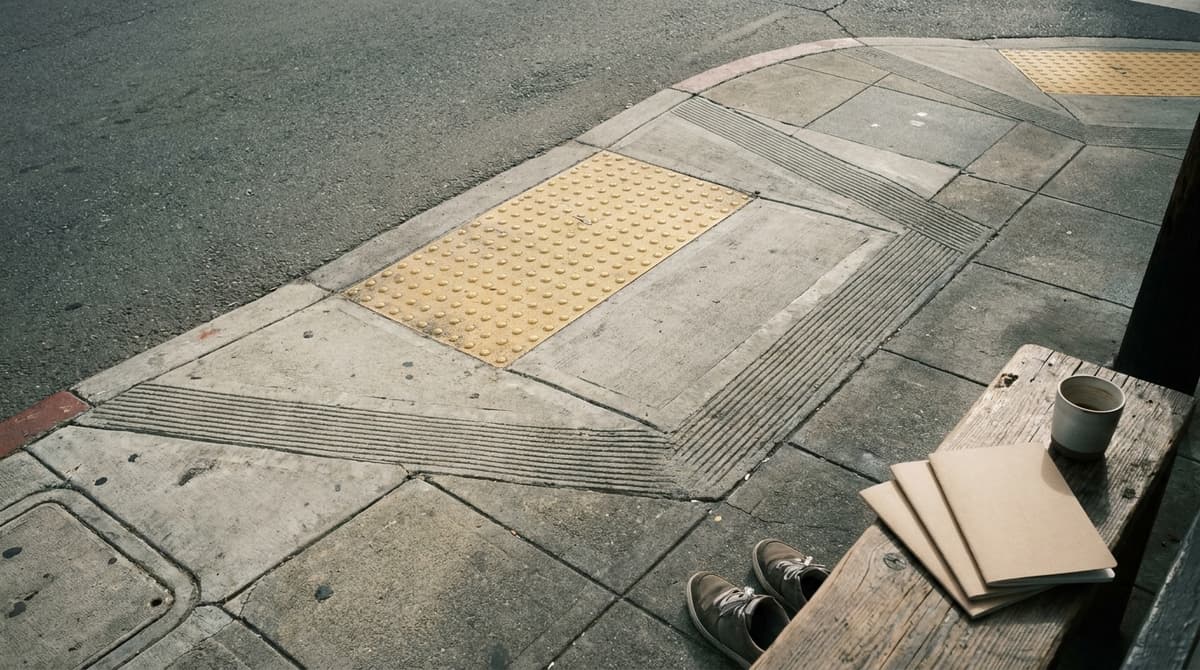
For the amount, IC 34-28-5-4(c) provides: "Except as provided in subsection (f), a judgment of up to five hundred dollars ($500) may be entered for a violation constituting a Class C infraction." The $500 figure is a ceiling, not a fixed fine.
Subsection (f) caps what a person pays for a moving violation that is a Class C infraction: court costs plus a judgment of no more than $35.50 for an admission or plea of nolo contendere mailed or delivered before the appearance date or on that date, and, after a contested trial, $35.50, $250.50 or $500 depending on whether a court in the county found the person to have committed no, one, or two or more moving violations in the previous five years. The chapter does not define "moving violation", and the Code's related definition of a "moving traffic offense" (IC 9-13-2-110) refers to "the operation or use of a motor vehicle while the motor vehicle is in motion", so do not assume the caps apply to a pedestrian ticket. In Marion County, a court must impose a judgment of at least $35 for an infraction judgment for a traffic violation (IC 34-28-5-4(h)). The citation or the court handling it shows the amount owed.
An infraction case is civil in form: the plaintiff "must prove the commission of an infraction or ordinance violation by a preponderance of the evidence" (IC 34-28-5-1(d)), and a prosecuting attorney or municipal attorney may establish a deferral program for these actions (IC 34-28-5-1(f)). An officer who believes in good faith that a person committed an infraction may detain the person long enough to inform the person of the allegation, obtain the person's name, address and date of birth or driver's license, and have the person sign a notice to appear (IC 34-28-5-3(a)). Knowingly or intentionally refusing to provide that information to an officer who stopped the person for an infraction is a Class C misdemeanor (IC 34-28-5-3.5).
Local rules and recent changes
State law lets cities and towns go further in some places. Under IC 9-21-17-4(1), "A local authority: (1) may, by ordinance, prohibit pedestrians from crossing a roadway in a business district or a designated highway except in a crosswalk, which may be established by the ordinance;" Local ordinances are outside the scope of this article; check the code of the city or town where you cross.
The pedestrian chapter has changed little. Its sections were added by P.L.2-1991, and the only later amendment shown anywhere in the chapter is P.L.8-2010, to the signal section, 9-21-17-2.
If a pedestrian is hit by a car
Whether a pedestrian yielded under 9-21-17-7, or a driver yielded under 9-21-8-36, can come up after a collision. For how fault, insurance and deadlines work in a crash claim, see Indiana car accident laws. Electric scooter riders follow different rules, covered in Indiana e-scooter laws.
Related pages
This article provides general legal information about Indiana law, not legal advice. For advice about a specific situation, contact a lawyer licensed in Indiana or the court handling your citation.
Last updated: 2026-10-10.
Frequently Asked Questions
Is jaywalking illegal in Indiana?
Crossing outside a crosswalk is allowed if you yield to all vehicles (IC 9-21-17-7). It is barred between adjacent signalized intersections except in a marked crosswalk (IC 9-21-17-9), diagonal crossing is barred unless authorized (IC 9-21-17-10), and a local ordinance may bar it in a business district or on a designated highway (IC 9-21-17-4).
What is the fine for jaywalking in Indiana?
A violation of the pedestrian chapter is a Class C infraction (IC 9-21-17-24). Under IC 34-28-5-4(c), a judgment of up to $500 may be entered, except as provided in subsection (f), which sets lower limits for moving violations. Disobeying an ordinary traffic light is a Class C infraction under IC 9-21-3-11, or a Class A infraction, with a judgment of up to $10,000, if it results in bodily injury to a person.
Is jaywalking a crime in Indiana?
Indiana classifies a violation of the pedestrian chapter as a Class C infraction (IC 9-21-17-24), not a misdemeanor or felony. But knowingly refusing to give your name, address and date of birth, or your driver's license if you have it, to an officer who stopped you for an infraction is a Class C misdemeanor (IC 34-28-5-3.5).
Can I start crossing when the countdown is running in Indiana?
Under IC 9-21-17-2(3), when a countdown display accompanies a flashing don't walk, a pedestrian may cross if able to reach the sidewalk or safety island by the time the steady don't walk signal is shown, and drivers must yield to that pedestrian.
Can I cross in the middle of the block in Indiana?
Yes, if you yield to all vehicles (IC 9-21-17-7), unless the block lies between adjacent intersections with operating traffic control signals, where you may cross only in a marked crosswalk (IC 9-21-17-9).
Which side of the road should I walk on in Indiana?
Use the sidewalk where one is provided and practicable; if there is no sidewalk, walk only on a shoulder, as far as practicable from the edge of the roadway. Where there is neither a sidewalk nor a shoulder, walk as near as practicable to the outside edge and, on a two-way roadway, only on the left side (IC 9-21-17-12 to 9-21-17-15).
Do drivers have to stop for pedestrians in Indiana?
When traffic control signals are not in place or not in operation, a driver must yield, slowing down or stopping if necessary, to a pedestrian crossing within a crosswalk on the driver's half of the roadway or approaching closely from the other half (IC 9-21-8-36). On a walk signal, on a green light, and when turning on red, a driver must yield to pedestrians lawfully in the crosswalk (IC 9-21-17-2(1), 9-21-3-7), and every driver must exercise due care to avoid colliding with a pedestrian (IC 9-21-8-37).
Updates
Independently fact-checked against the cited primary sources
The Law Behind This Article
This article rests on the statutory provisions below, held in our own legal record and retrieved from the official source. Tap a section to read the operative text.
Indiana Code, TITLE 9. MOTOR VEHICLES
§ 9-21-17-7Crossing roadway at point not marked as a crosswalk; yield of right-of-way to trafficIn force
Sec. 7. A pedestrian crossing a roadway at a point other than within a marked crosswalk or within an unmarked crosswalk at an intersection shall yield the right-of-way to all vehicles upon the roadway. [Pre-1991 Recodification Citation: 9-4-1-88(a).]
Official text (excerpt) · last checked 2026-07-29 · Read the full text in our law library · Verify at iga.in.gov
§ 9-21-8-36Traffic control signals not in operationIn force
Sec. 36. Except as provided in IC 9-21-17-8 and IC 9-21-3-7(b)(4)(C), when traffic control signals are not in place or not in operation, a person who drives a vehicle shall yield the right-of-way, slowing down or stopping if necessary to yield, to a pedestrian crossing the roadway within a crosswalk when the pedestrian is upon the half of the roadway upon which the vehicle is traveling or when the pedestrian is approaching closely from the opposite half of the roadway. [Pre-1991 Recodification Citation: 9-4-1-87(a); (c).]
Official text (excerpt) · last checked 2026-07-29 · Read the full text in our law library · Verify at iga.in.gov
Search our full record of US law — 2.1 million sections, every state + federal →
Sources and References
- IC 9-21-17, Pedestrians (Indiana Code 2026, sections 9-21-17-1 to 9-21-17-24)(iga.in.gov).gov
- IC 34-28-5, Infractions and ordinance violations (sections 34-28-5-1, 34-28-5-3, 34-28-5-3.5 and 34-28-5-4)(iga.in.gov).gov
- IC 9-21-8, Traffic regulations (sections 9-21-8-20, 9-21-8-36, 9-21-8-37 and 9-21-8-49)(iga.in.gov).gov
- IC 9-21-3-7 and 9-21-3-11, Traffic control signals and penalties (Indiana Code 2026)(iga.in.gov).gov
- IC 9-13-2-40, Definition of crosswalk, and IC 9-13-2-110 (Indiana Code 2026)(iga.in.gov).gov