
Michigan
Michigan Fireworks Laws (2026): Certificate Rules and Local Hours
Independently fact-checked against primary sources (last audited September 18, 2026). · 16 primary sources cited on this page. How we verify our legal content
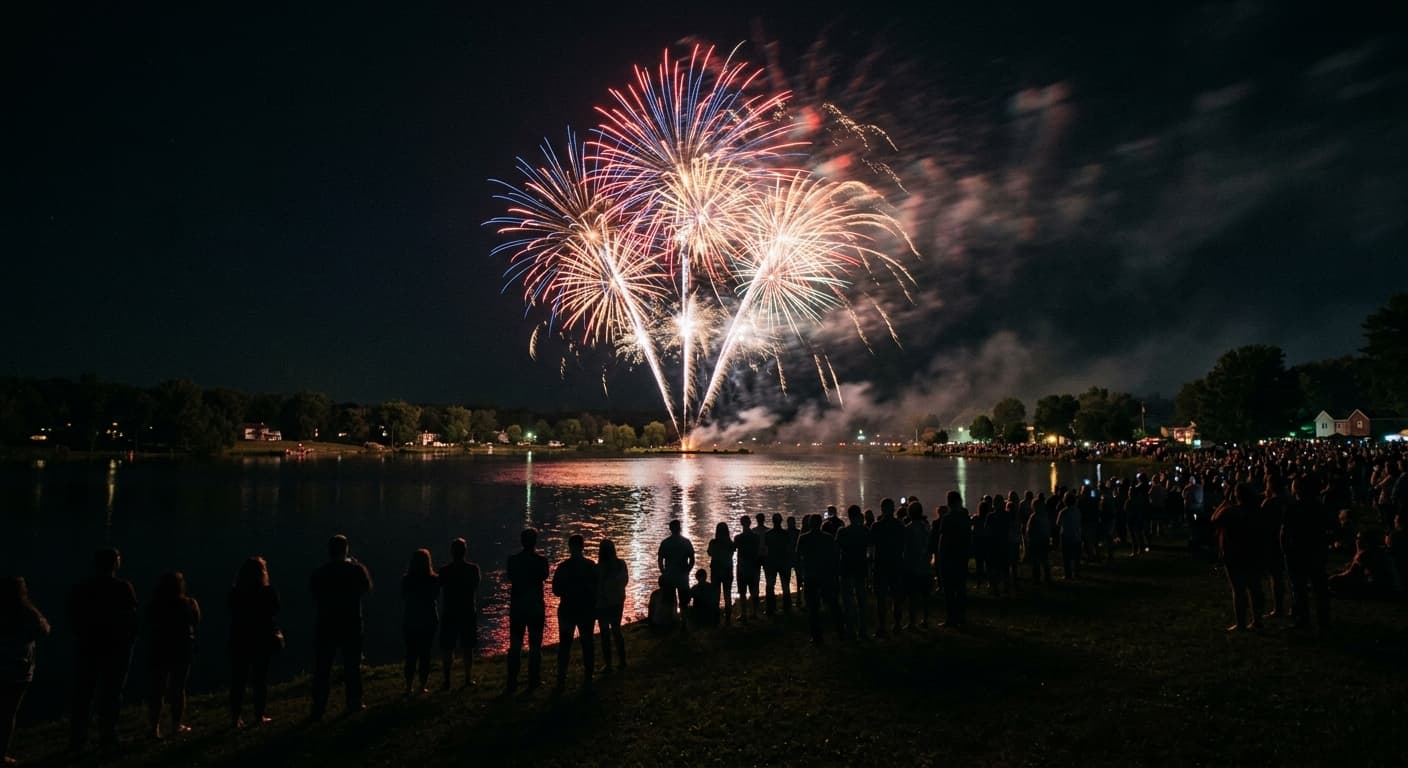
Michigan allows consumer fireworks statewide through retailers holding an annual state certificate, and low-impact fireworks through that same certificate or a separate state registry, with no calendar sale-date window, under the Michigan Fireworks Safety Act, MCL 28.451 to 28.470. Local governments cannot regulate the sale of those fireworks at all, but they can set the hours when residents may set them off, subject to statutory safe-harbor dates the state protects.
Jurisdiction scope: This article addresses Michigan's state fireworks law under the Michigan Fireworks Safety Act, MCL 28.451 to 28.470: the consumer and low-impact fireworks certificate system, the novelties exemption, the local-preemption structure for sale versus discharge hours, purchaser age verification, and the penalty structure. It does not address Michigan's separate burn-permit or wildfire-restriction rules, or county and township ordinances that regulate hours within the bounds this article describes.
What Michigan Allows: A Certificate System, Not a Ban List
Michigan does not regulate fireworks through a list of banned devices. Instead, the Fireworks Safety Act gates retail sale through a state certificate:
"A person shall not sell consumer fireworks unless the person annually obtains and maintains a consumer fireworks certificate from the department under this section."
MCL 28.454
Consumer fireworks, the federal 1.4G/UN0336 category, and low-impact fireworks are separate statutory categories under MCL 28.452(f) and (n); the definitions section says in terms that "consumer fireworks does not include low-impact fireworks." Both are broadly legal for retail sale and personal use statewide, but they reach the market through two different state gates: a consumer fireworks seller holds the annual certificate described above, while a low-impact-only seller instead registers on the state's low-impact fireworks retail registry, discussed below, unless it already holds a certificate. The certificate and the registry are both issued and enforced at the state level, which sets up the local-preemption rule described below. Construction, approval, and transportation limits that distinguish consumer fireworks, low-impact fireworks, and other tiers come from APA Standard 87-1 (2001 edition), which MCL 28.452(b) incorporates by reference rather than restating in the statute itself.
Novelties Are Outside the Act Entirely
Separate from the certificate system, MCL 28.453 removes "novelties" from the act's scope completely:
"This act does not apply to novelties. Nothing in this act allows a local unit of government to enact or enforce an ordinance, code, or regulation pertaining to, or in any manner regulating, the sale, storage, display for sale, transportation, use, or distribution of novelties."
MCL 28.453
That means novelty items are not subject to the consumer fireworks certificate, the local-hours rules below, or any local ordinance at all, because the act's definitions never reach them. The statute does not restate a device-by-device novelty list here; check the act's definitions section, MCL 28.452, for a specific product.
No Statewide Sale-Date Window
Many states restrict fireworks sale to a calendar window, commonly a stretch around Independence Day and a second one around the New Year. Michigan's statute does not do that. Sections 28.454, 28.455, 28.457, and 28.467, which cover the certificate, retail-location conditions, local ordinances, and citation procedure, set no statewide sale-date restriction. Sale is gated by the retailer's certificate status year-round, not by the calendar. Do not assume a June or July sale window applies here the way it does in many neighboring states.
Local Option: Hours, Not Sale
Michigan's local-preemption structure splits sharply between sale and use. Under MCL 28.457(1), a local unit of government cannot enact or enforce any ordinance regulating the sale, display, storage, transportation, or distribution of fireworks covered by the act. That authority belongs to the state alone.
What a local unit can do is regulate ignition, discharge, and use hours. MCL 28.457(2) lets a city or township set an ordinance "prescribing the hours of the day or night" residents may set off consumer fireworks, but limits what that ordinance can restrict:
"If a local unit of government enacts an ordinance under this subsection, the ordinance shall not regulate the ignition, discharge, or use of consumer fireworks on the following days after 11 a.m.: (a) December 31 until 1 a.m. on January 1. (b) The Saturday and Sunday immediately preceding Memorial Day until 11:45 p.m. on each of those days. (c) June 29 to July 4 until 11:45 p.m. on each of those days. (d) July 5, if that date is a Friday or Saturday, until 11:45 p.m. (e) The Saturday and Sunday immediately preceding Labor Day until 11:45 p.m. on each of those days."
MCL 28.457(2)
A local ordinance that restricts hours outside those windows can only impose a $1,000 civil fine per violation, no other fine or sanction, with $500 of each fine remitted to the local enforcement agency, under MCL 28.457(3). Since August 1, 2019, larger local units, those with a population of 100,000 or more, or located in a county of 750,000 or more, can also regulate temporary sale structures like tents and stands, though such an ordinance cannot prohibit temporary storage, transport, or distribution by a certificate holder at a permanent retail building, under MCL 28.457(4).
Age to Purchase
Michigan's purchase age is 18. MCL 28.452(o) defines a "minor" as an individual who is less than 18 years of age, and the act bars selling consumer fireworks to a minor while also requiring identity verification at the point of sale. MCL 28.462(2) provides:
"A person shall not sell consumer fireworks to a minor. A person that violates this subsection shall be ordered to pay a civil fine of not more than $1,000.00, or, for a second or subsequent violation of this subsection, a civil fine of not more than $2,500.00. For a second or subsequent violation, the department shall suspend the person's consumer fireworks certificate for 90 days beginning on the date a civil fine is ordered."
MCL 28.462(2)
The statute requires a seller to verify a buyer's age using one of several forms of identification: an operator's or chauffeur's license, an official state personal ID card, an enhanced driver's license, a military ID card, a passport, or other bona fide photo identification.
Permits and the Certificate Regime
Retail sale of consumer fireworks requires the annual certificate discussed above, and the state can deny or refuse to renew it. MCL 28.468b bars certificate eligibility over disqualifying criminal history findings, covering arson, theft, and fraud-type offenses, checked through the state's ICHAT system. MCL 28.468c adds escalating ineligibility for repeat unlicensed-sale violations: five years after a second violation of the certificate requirement in MCL 28.454(1), and longer after a third. Retail locations must also meet NFPA 101 and NFPA 1124 fire-code requirements, including a sprinkler system unless exempted, under MCL 28.455. A low-impact-fireworks-only retailer instead registers on a department-maintained public registry under MCL 28.456, paying $50 per retail location (capped at $1,000 total) at least 10 days before selling in each calendar year; a retailer that already holds a valid consumer fireworks certificate is not required to register separately. Display fireworks, articles pyrotechnic, and agricultural and wildlife fireworks use requires a separate permit from the local legislative body under MCL 28.466.
Penalties
Michigan splits fireworks penalties into two tracks. General violations of the act fall under a tiered criminal penalty ladder in MCL 28.468:
"Unless otherwise provided in this act, if a person violates this act, the person is guilty of a crime as follows: (a) ... a misdemeanor punishable by imprisonment for not more than 30 days or a fine of not more than $1,000.00, or both. (b) If the violation causes damage to the property of another person, a misdemeanor punishable by imprisonment for not more than 90 days or a fine of not more than $5,000.00, or both. (c) If the violation causes serious impairment of a body function of another person, a felony punishable by imprisonment for not more than 5 years or a fine of not more than $5,000.00, or both. (d) If the violation causes the death of another person, a felony punishable by imprisonment for not more than 15 years or a fine of not more than $10,000.00, or both."
MCL 28.468(1)
A person convicted under this section must also reimburse the local government for the cost of storing any fireworks it seized, under MCL 28.468(2).
Several specific violations are civil infractions instead, each with its own fine under MCL 28.462: discharging consumer fireworks on public, school, or church property, or on someone else's property, without permission draws a civil fine of up to $500, unless another provision of MCL 28.462 applies; using fireworks while under the influence of alcohol or a controlled substance draws up to $1,000; violating the act's smoking prohibition near fireworks draws a mandatory $1,000; and using fireworks to harass, scare, or injure livestock is also a civil infraction. A local-ordinance hours violation, discussed above, carries its own flat $1,000 civil fine under MCL 28.457(3).
Federal Law
Federal law sets the floor: 16 CFR 1500.17 and Part 1507 define which consumer devices may be sold at all; 27 CFR 555.141(a)(7) exempts the importation, distribution and storage of consumer fireworks from ATF licensing (manufacture is not exempt); 18 U.S.C. 836 makes it a federal offense, punishable by up to one year, to transport fireworks into any state whose law specifically prohibits or regulates their use, in violation of that law, except in the course of continuous interstate transportation, with exceptions for common carriers, water carriers and federal agencies; and USPS Publication 52 § 341.22 bars fireworks from the mail entirely.
Michigan's own rule is broadly permissive for certificate-sold consumer fireworks, so 18 U.S.C. 836 rarely restricts bringing them into the state. It works the other way at the border: Michigan fireworks legally bought here can become a federal transportation offense if carried into a state whose law prohibits or regulates their use, outside the statute's carrier and interstate-transportation exceptions.
For the broader regional picture, see the fireworks laws by state comparison, including Ohio's fireworks laws and Indiana's fireworks laws, two bordering states with their own certificate and permit structures, and Minnesota's fireworks laws across Michigan's Upper Peninsula border.
If you are also researching Michigan's roadside rules, see Michigan's open container laws.
Disclaimer: This article provides general legal information about fireworks laws in Michigan as of September 2026. It is not legal advice. Fireworks statutes, local ordinances, sale and use hours, and penalties change frequently and are often further restricted by county or township ordinance beyond what state law requires; verify the current rule for your specific city or township before buying, selling, or using fireworks, and consult a lawyer licensed in Michigan for advice about a specific situation.
Statutes cited reflect their in-force version as of 2026-09-17. Last updated: 2026-09-17.
Frequently Asked Questions
Are fireworks legal in Michigan?
Yes. Consumer fireworks are legal statewide when sold by a retailer holding an annual consumer fireworks certificate under MCL 28.454; low-impact fireworks are legal statewide when sold by a retailer that holds that certificate or instead registers on the state's low-impact fireworks retail registry under MCL 28.456. Novelties are a separate, entirely exempt category under MCL 28.453.
When can you buy fireworks in Michigan?
Michigan sets no statewide calendar sale-date window. Retail sale is gated by the seller's certificate status year-round rather than tied to a fixed date range, which differs from many neighboring states.
Can a Michigan city ban fireworks even though state law allows them?
No, not the sale. A local government cannot regulate the sale, storage, display, transport, or distribution of consumer or low-impact fireworks under MCL 28.457(1). A city or township can set the hours when fireworks may be discharged, but its ordinance cannot restrict use during the statutory safe-harbor dates in MCL 28.457(2), such as June 29 through July 4.
Is there an age minimum to buy fireworks in Michigan?
Yes, 18. MCL 28.452(o) defines a minor as anyone under 18, and MCL 28.462(2) bars selling consumer fireworks to a minor, requiring a seller to verify a buyer's identity with a driver's license, state ID, passport, military ID, or similar photo ID. A seller who sells to a minor faces a $1,000 fine for a first violation and $2,500 plus a 90-day certificate suspension for a later one.
What happens if you set off fireworks on someone else's property without permission in Michigan?
It is a civil infraction under MCL 28.462(1), punishable by a fine of up to $500, unless another provision of the section applies.
What is the penalty for violating Michigan's fireworks law?
General violations carry a tiered criminal penalty under MCL 28.468: up to 30 days and a $1,000 fine as a baseline misdemeanor, rising to a 15-year, $10,000 felony if a violation causes death. Specific conduct, like intoxicated use or an hours-ordinance violation, is instead a civil infraction with its own separate fine.
Updates
Independently fact-checked against the cited primary sources
Sources and References
- MCL 28.454 - Consumer fireworks certificate requirement(legislature.mi.gov).gov
- MCL 28.453 - Novelties entirely outside the act, including local regulation(legislature.mi.gov).gov
- MCL 28.452 - Definitions, including APA Standard 87-1 incorporation(legislature.mi.gov).gov
- MCL 28.457 - Local ordinances: sale/storage preemption and protected discharge-hour safe harbor(legislature.mi.gov).gov
- MCL 28.462 - Prohibited conduct, civil infractions, sale to a minor and age verification(legislature.mi.gov).gov
- MCL 28.455 - Retail location conditions, including sprinkler requirement(legislature.mi.gov).gov
- MCL 28.456 - Low-impact fireworks retailer registry(legislature.mi.gov).gov
- MCL 28.466 - Local legislative body permit for display fireworks and articles pyrotechnic(legislature.mi.gov).gov
- MCL 28.468 - Criminal penalty ladder for violations of the act(legislature.mi.gov).gov
- MCL 28.468b - Certificate ineligibility for disqualifying criminal history(legislature.mi.gov).gov
- MCL 28.468c - Multi-year certificate ban for repeat unlicensed-sale violations(legislature.mi.gov).gov
- 16 CFR 1500.17 - Banned hazardous substances including certain fireworks(ecfr.gov).gov
- 16 CFR 1507.1 - CPSC consumer fireworks construction/safety scope(ecfr.gov).gov
- 27 CFR 555.141(a)(7) - ATF licensing exemption for consumer fireworks import/distribution/storage(ecfr.gov).gov
- 18 U.S.C. § 836 - Transportation of fireworks into a state whose law prohibits or regulates their use(uscode.house.gov).gov
- USPS Publication 52 § 341.22 - Fireworks nonmailable(pe.usps.com).gov