Arkansas Audio Recording Laws: One-Party Consent Rules and Penalties (2026)
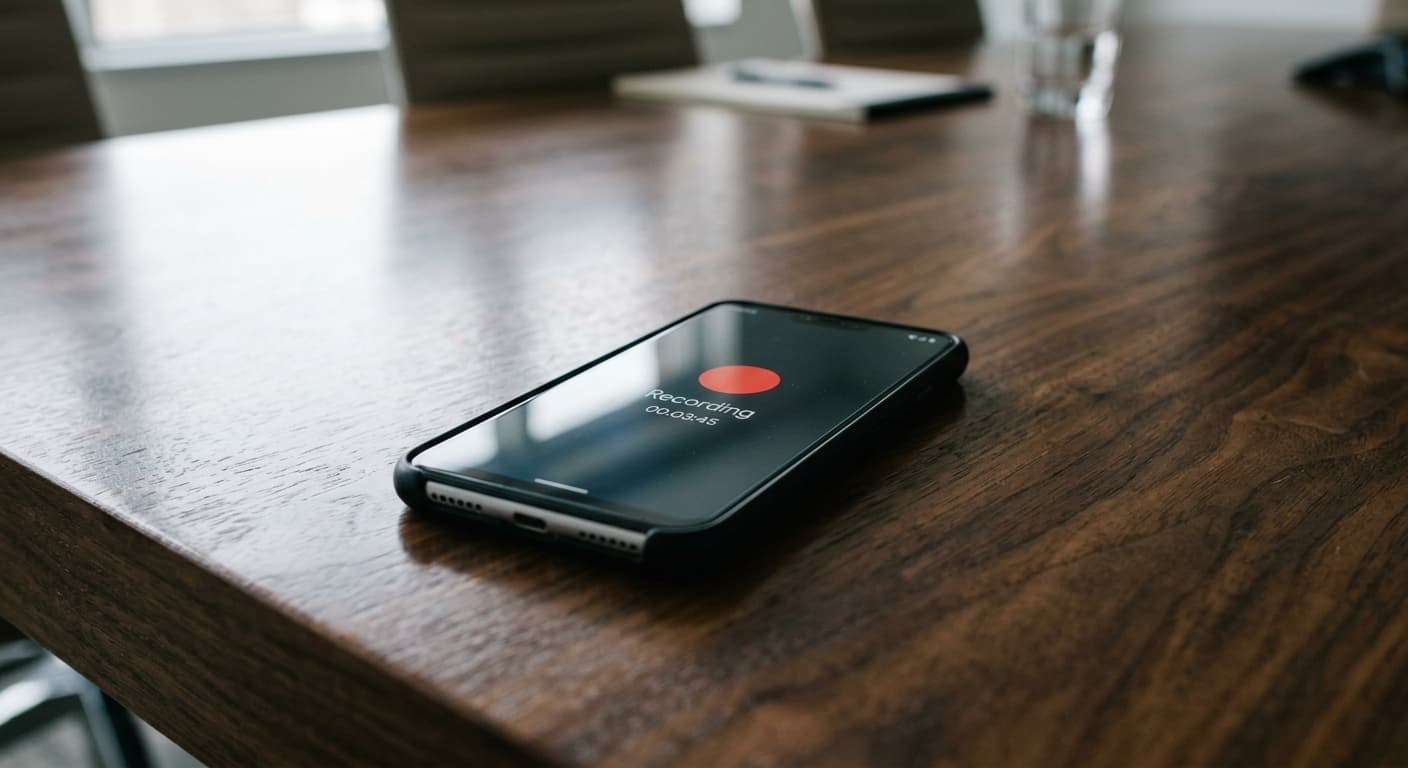
Arkansas is a one-party consent state for audio recording. Under Ark. Code 5-60-120, you can legally record any conversation you participate in without telling the other parties. This means that as long as you are part of the conversation, you satisfy the consent requirement simply by choosing to record.
This page provides a detailed breakdown of Arkansas audio recording laws, including what the statute covers, the penalties for illegal recording, how recordings are treated as evidence, and the specific exceptions written into the law.
What Is Ark. Code 5-60-120?
Ark. Code 5-60-120 is the primary statute governing the interception and recording of communications in Arkansas. It is located in Title 5, Subtitle 6, Chapter 60 of the Arkansas Code and addresses wire, landline, oral, telephonic, and wireless communications.
The statute makes it unlawful to intercept, record, or possess a recording of any communication without the consent of at least one party. The critical word is "intercept," which the law defines as the aural acquisition of the contents of a communication through the use of any electronic, mechanical, or other device.
The One-Party Consent Standard
Under one-party consent, only one participant in a conversation needs to know about and agree to the recording. That participant can be the person doing the recording. You do not need to announce that you are recording, ask for permission, or provide any form of notice to other parties.
This standard applies equally to all forms of audio communication covered by the statute, including face-to-face conversations, telephone calls, and digital voice communications.
How Arkansas Compares to Other States
Arkansas is one of roughly 38 states that follow some form of one-party consent for audio recording. This stands in contrast to all-party consent states such as California, Florida, and Pennsylvania, where every participant in a conversation must agree before recording can begin.
Among its neighbors, Arkansas shares the one-party consent approach with Missouri, Oklahoma, Tennessee, and Texas. Mississippi and Louisiana also follow one-party consent rules.
What Communications Does the Law Cover?
Ark. Code 5-60-120 applies broadly to multiple types of audio communications. The statute specifically names the following categories.

Wire Communications
Wire communications include any transmission of voice content carried over a physical wire, cable, or similar connection. This covers traditional landline telephone calls and any communication that travels through a wired infrastructure at some point during transmission.
Oral Communications
Oral communications refer to spoken words exchanged in person. The key factor is whether the speaker has a reasonable expectation of privacy. A conversation in a private office or home is considered an oral communication. A shouted exchange on a public sidewalk, where anyone passing by could hear, may not qualify because there is no reasonable expectation of privacy.
Telephonic and Wireless Communications
The statute also covers telephonic and wireless communications, which include cell phone calls, satellite phone calls, and other voice transmissions carried over wireless networks. This category has grown increasingly important as wireless communication has become the dominant form of telephone use.
Digital and VoIP Communications
While the original statute was drafted before modern VoIP platforms existed, Arkansas courts and legal practitioners apply the statute to digital voice communications. Calls made through Zoom, Microsoft Teams, Google Meet, FaceTime, and similar platforms fall under the same one-party consent framework. If you are a participant in the call, you can record it.
Exceptions Written Into the Statute
Ark. Code 5-60-120 contains several explicit exceptions that allow certain types of interception without meeting the standard consent requirement.
Law Enforcement Exception
Officers acting under color of law may intercept communications as part of their official duties. This includes wiretaps authorized by court order and recordings made during lawful investigations. The law enforcement exception is narrow and requires that the officer be performing duties related to their official capacity.
Amateur Radio and Police Scanner Exception
The statute exempts FCC-licensed amateur radio operators who intercept communications as part of their licensed activity. It also exempts individuals who use police scanners to monitor publicly broadcast communications for personal use. These exceptions recognize that certain radio frequencies are inherently public and that intercepting them does not violate privacy expectations.
Consent of One Party
The broadest and most commonly invoked exception is the consent of one party. If you are a participant in the conversation, your own consent satisfies the legal requirement. This is what makes Arkansas a one-party consent state rather than requiring all parties to agree.
Criminal Penalties for Illegal Audio Recording
Violating Ark. Code 5-60-120 by recording a conversation without the consent of any party is a criminal offense in Arkansas. The penalties are defined by the state's sentencing guidelines.
Class A Misdemeanor
Illegal interception or recording of communications is classified as a Class A misdemeanor under Arkansas law. Sentencing guidelines for Class A misdemeanors are set by Ark. Code 5-4-401 for jail time and Ark. Code 5-4-201 for fines.
| Penalty | Maximum |
|---|---|
| Jail time | Up to 1 year |
| Fine | Up to $2,500 |
A conviction for a Class A misdemeanor becomes part of your permanent criminal record and can affect employment, housing, and professional licensing.
Federal Penalties
In addition to Arkansas state law, the federal Wiretap Act (18 U.S.C. 2511) also prohibits the unauthorized interception of communications. Federal violations can result in up to five years in federal prison. Both state and federal law may apply to the same conduct, meaning a single act of illegal recording could lead to prosecution under both systems.
Civil Liability for Illegal Recording
Beyond criminal penalties, a person who is illegally recorded in Arkansas may pursue civil remedies against the person who made the recording.
State Civil Claims
Victims of illegal recording can bring civil lawsuits under several legal theories in Arkansas courts:
- Invasion of privacy: Arkansas recognizes the tort of intrusion upon seclusion, which applies when someone intentionally intrudes on the private affairs of another in a manner that would be highly offensive to a reasonable person.
- Intentional infliction of emotional distress: If the illegal recording causes severe emotional distress, the victim may recover damages.
- Negligence claims: In some circumstances, negligent handling of recording equipment or recorded material may give rise to liability.
Federal Civil Remedies
The federal Wiretap Act provides a private right of action under 18 U.S.C. 2520. A person whose communications are illegally intercepted can sue for:
- Actual damages, but not less than statutory damages of $10,000
- Punitive damages in appropriate cases
- Reasonable attorney fees and litigation costs
These federal civil remedies exist independently of any criminal prosecution and independently of any state civil claims.
Recording in Public vs. Private Spaces
The distinction between public and private spaces is critical to understanding when audio recording is legal in Arkansas.
Public Spaces
Arkansas law recognizes that people have no reasonable expectation of privacy in public spaces. You can generally record audio in places like:
- Public streets, sidewalks, and parks
- Government buildings open to the public
- Public transportation
- Retail stores and restaurants (common areas)
- Outdoor events and gatherings
In these settings, you typically do not need anyone's consent to record audio because there is no reasonable expectation that conversations will remain private.
Private Spaces
In private spaces such as homes, offices, medical facilities, and other areas where people reasonably expect privacy, the one-party consent rule applies in full. You must be a participant in the conversation to record it legally. If you are not part of the conversation, you need the consent of at least one participant.
Placing a hidden recording device in a private space to capture conversations you are not part of is illegal under Ark. Code 5-60-120, regardless of whether you own the property.
Recording Technology and Arkansas Law
Arkansas audio recording law applies regardless of the technology used. The statute covers any "electronic, mechanical, or other device" used to intercept communications.

Smartphones and Voice Recorders
Using a smartphone's built-in recording app or a dedicated digital voice recorder to capture a conversation you participate in is legal under one-party consent. The form of the recording device does not change the legal analysis.
Wearable Recording Devices
Wearable devices such as AI voice recorders (like Plaud), smart watches with recording capability, and clip-on microphones are all covered by the same one-party consent framework. If you are participating in the conversation, you can use any of these devices to record it.
Smart Speakers and Always-On Devices
Devices like Amazon Echo, Google Home, and Apple HomePod raise unique questions under recording law. These devices are designed to listen continuously for a wake word. When they capture audio beyond the wake word, including fragments of nearby conversations, the legal implications under Ark. Code 5-60-120 remain an evolving area. Users should be aware that the presence of these devices in a room could create questions about consent and interception.
Using Audio Recordings as Evidence in Arkansas
One of the most common reasons people record conversations is to preserve evidence for legal proceedings. Arkansas courts generally accept legally obtained recordings as evidence, but several requirements must be met.
Authentication
The party offering the recording must establish that it is authentic and has not been altered. This typically requires testimony from the person who made the recording or from an expert who can verify the recording's integrity. Digital recordings should be preserved in their original format whenever possible.
Relevance
The recording must be relevant to a matter at issue in the case. A court will exclude a recording that has no bearing on the claims or defenses being litigated, regardless of how it was obtained.
Hearsay Considerations
Statements captured in a recording may be subject to hearsay objections. However, several exceptions commonly apply. A statement by a party opponent is not hearsay under Arkansas Rule of Evidence 801(d)(2). Excited utterances, present sense impressions, and other recognized exceptions may also allow recorded statements into evidence.
Illegally Obtained Recordings
Recordings made in violation of Ark. Code 5-60-120 are generally inadmissible in Arkansas courts. The person who made the illegal recording may also face criminal charges and civil liability. In criminal cases, the exclusionary rule typically bars evidence obtained through illegal interception. In civil cases, courts have discretion to exclude illegally obtained recordings.
Interstate and Cross-Border Recording
When you are in Arkansas and recording a conversation with someone in another state, the legal analysis becomes more complex.
The Stricter-Law Principle
As a general practice, when parties to a recorded conversation are in different states, the stricter consent law typically applies. If you are in Arkansas (one-party consent) and the other party is in California (all-party consent), California law may govern the recording.
States Requiring All-Party Consent
If you regularly record calls with people in the following states, you should obtain consent from all parties:
- California
- Connecticut
- Florida
- Illinois
- Maryland
- Massachusetts
- Montana
- New Hampshire
- Pennsylvania
- Washington
Best Practice for Interstate Calls
The safest approach for recording interstate calls is to inform all parties and obtain consent. This eliminates the risk of violating a stricter state's recording law and ensures the recording is admissible in any jurisdiction.
Specific Audio Recording Scenarios
Recording at Home
You can record conversations in your own home when you are present and participating. You cannot plant a recording device and leave the room to capture conversations between other people who are in your home. Even though you own the property, the consent requirement applies to the conversation, not the location.
Recording Phone Calls
All phone calls, including landline, cell phone, and VoIP calls, are covered by one-party consent. You can record any call you are on without telling the other party. For detailed information, see our page on Arkansas phone call recording laws.
Recording Meetings
You can record any meeting you attend in person, whether it is a business meeting, a neighborhood association gathering, or a parent-teacher conference. Your presence as a participant satisfies the one-party consent requirement.
Recording for Journalism
Journalists in Arkansas benefit from the same one-party consent rules as everyone else. A reporter who participates in a conversation can record it without informing the other party. The Reporters Committee for Freedom of the Press provides additional guidance on recording rights specific to journalists in Arkansas.
Federal Wiretap Law and How It Interacts with Arkansas Law
The federal Wiretap Act (18 U.S.C. 2511) establishes a nationwide baseline for recording law. Federal law follows a one-party consent model, which aligns with Arkansas state law.
Because federal law sets a floor rather than a ceiling, states can impose stricter requirements but cannot be more permissive than the federal standard. Since Arkansas and the federal government both follow one-party consent, there is no conflict between the two systems for recordings made entirely within Arkansas.
However, if a recording involves parties in multiple states, both the relevant state laws and federal law may apply. Federal prosecution is relatively rare for simple recording violations but can occur in cases involving organized interception schemes or recordings made in connection with other federal crimes.
2025 Legislative Update
In 2025, the Arkansas General Assembly enacted Act 600 (formerly HB1641), which amended the state's harassment statute (Ark. Code 5-71-208) to criminalize the non-consensual use of electronic tracking devices. While Act 600 addresses location tracking rather than audio recording, it signals continued legislative attention to electronic surveillance and privacy in Arkansas.
No amendments to Ark. Code 5-60-120 itself were enacted during the 2025 session. The core one-party consent framework for audio recording remains unchanged.
More Arkansas Laws
- Arkansas Recording Laws
- Arkansas Recording Laws
- Arkansas Dog Bite Laws
- Arkansas Child Support Laws
- Arkansas Statute of Limitations
- Arkansas Recording Laws
- Arkansas Recording Laws
- Arkansas Recording Laws
Explore More Arkansas Recording Law Topics
Audio Recording | Video Recording | Voyeurism Laws | Workplace Recording | Recording Police | Phone Call Recording | Security Cameras | Recording in Public | Landlord-Tenant | Dashcam Laws | School Recording | Medical Recording
Sources and References
- Ark. Code 5-60-120 - Interception and Recording(law.justia.com)
- Ark. Code 5-4-401 - Sentencing for Misdemeanors and Felonies(law.justia.com)
- Ark. Code 5-4-201 - Fines and Limitations on Amount(law.justia.com)
- 18 U.S.C. 2511 - Federal Wiretap Act(law.cornell.edu)
- 18 U.S.C. 2520 - Civil Remedies for Wiretap Violations(law.cornell.edu)
- Act 600 of 2025 - Tracking Device Harassment Amendment(arkleg.state.ar.us).gov
- Arkansas Freedom of Information Act - Attorney General(arkansasag.gov).gov
- Arkansas Reporters Recording Guide - RCFP(rcfp.org)
- Arkansas General Assembly - Legislative Session Information(arkleg.state.ar.us).gov