An Iowa Senator Warned in 1989 That Casino Boats Would Spread to Land. Iowa Allowed Land Casinos in 2007.

Independently fact-checked against primary sources (last audited November 10, 2026). · 14 primary sources cited on this page. How we verify our legal content
On April 1, 1991, the Casino Belle tied up in Dubuque with a cart full of coins for its slot machines. The cart tipped over on the ramp, and "people were picking all of that up, and gaming regulators were helping us and they were filling up slot machines as fast as they could," Dan Kehl, whose father ran the boat, told the Telegraph Herald 25 years later. "Right behind them came the customers, and off we went."
Off they went was the point. Customers had to be 21, and "$5 was the most you could bet at one time and $200 was the most you could lose per cruise," the paper wrote. "And you couldn't gamble until the boat was cruising." A lunch cruise cost $29.95 and lasted five hours.
Iowa had written those rules on purpose. "While the legislation was promoted as economic development, the regulatory nature of the legislation was designed to maintain the wholesome image of Iowa," the local history Encyclopedia Dubuque records. Only 30% of a boat could be casino, and the boats had to sail.
The rules did not last. Fifteen months after opening day, two of Iowa's five boats had stopped operating, and their owner was taking them to Mississippi. Mississippi let casinos stay tied up at the dock, a practice known as dockside gambling, and it had no betting limits. In 1994 Iowa took its limits off on a 51-49 House vote.
By 2004, none of the five Mississippi River states with riverboat casinos still required them to cruise. Iowa was the last to drop the rule. In 2005, after a hurricane wrecked Mississippi's coast casinos and threw some of their barges ashore, that state let them rebuild on land. One Iowa senator had predicted two of these turns on the day Iowa's riverboat bill passed the Senate in 1989.
Each time a rule came off, someone on the record said what would happen, and state revenue records show what the money did next. What those records cannot always say is which rule moved the money, because several rules usually came off at once. The boats are still coming ashore. Penn Entertainment plans land casinos to replace boats in Council Bluffs and New Orleans.
Why put a casino on a boat?
The bill had already lost twice in 1988. In the first week of March 1989, the Iowa Senate voted it down again, 22-28. On March 7, it passed 26-23. Eastern Iowa lawmakers said the victory marked a bright day for the economically depressed counties along the Mississippi River, UPI reported.
Supporters "invoked images of gamblers on old-time riverboats plying up and down the Mississippi River," the wire service wrote. Sen. Wally Horn, D-Cedar Rapids, who managed the bill, said it would create hundreds of new jobs, bring in millions of dollars from out of state and prompt new hotels and restaurants. "This will be a first-class operation that will be enhanced by gambling," Horn said.
Sen. William Dieleman, D-Pella, made two predictions that day. He warned, in UPI's words, that "the casinos would spread to land eventually and promoters would be lobbying to raise the betting limits." He added: "The state has more gambling now that it can handle. What we're saying is, 'let's bring it in and hope we can control it.'"
Gov. Terry Branstad signed the bill on April 27, 1989, as more than 50 backers watched. "This bill will provide an economic shot in the arm for many river communities that wish to further promote tourism," he said, and he declared that "the integrity of the state will be protected." Rep. Tom Fey, one of its authors, said: "I couldn't be happier."
An amendment from Sen. George Kinley, D-Des Moines, held the boats back until April 1, 1991. When they launched, Iowa had what economist Mark Nichols later called "a strict regulatory structure, consisting of mandated sailing, wagering and loss limits, and casino space restrictions." That structure would hold for three years. What did the state collect while it held, and after it was gone?
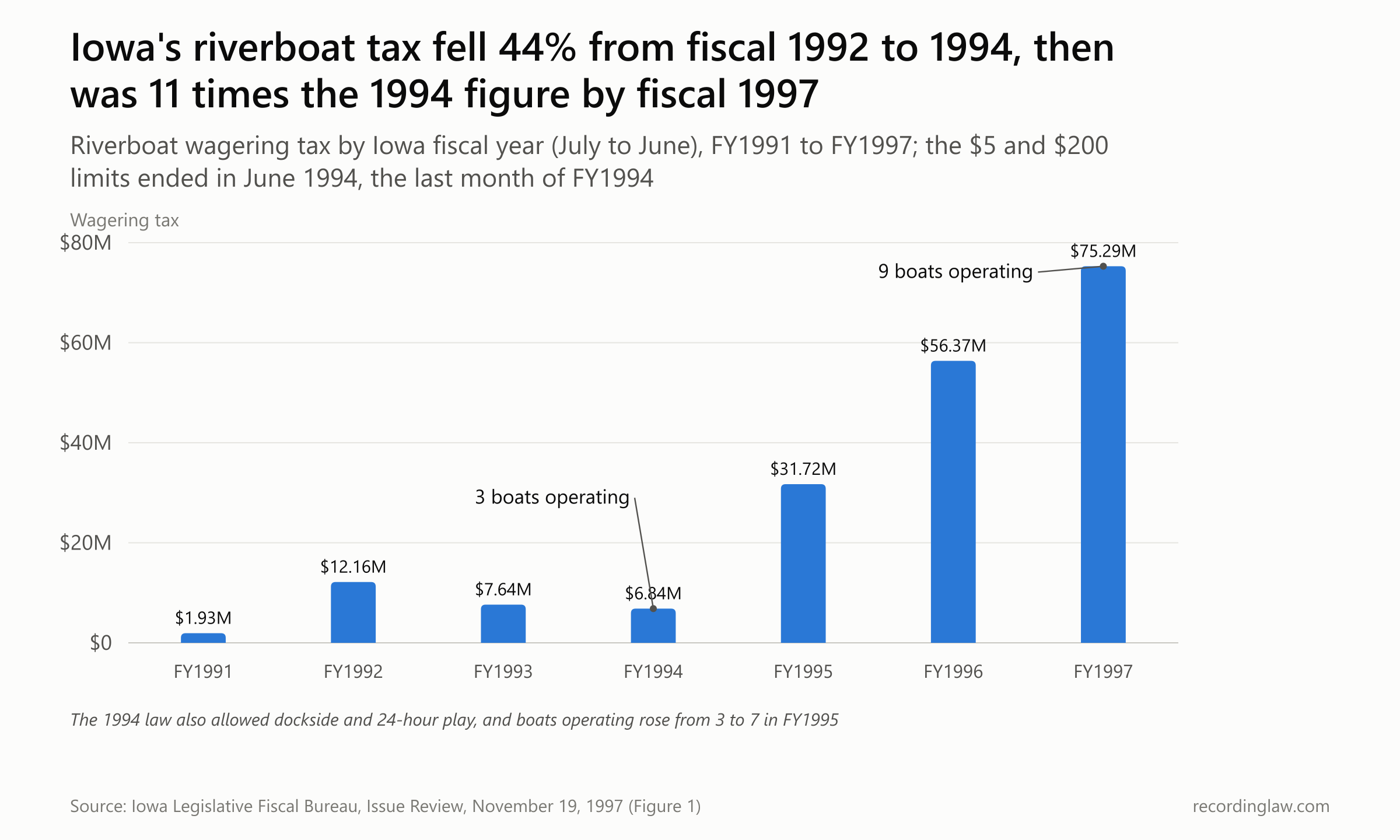
Iowa riverboat wagering tax by fiscal year, fiscal 1991 to fiscal 1997. Source: Iowa Legislative Fiscal Bureau, Issue Review, November 19, 1997.
| Fiscal year | Riverboat wagering tax | Boats operating (LFB) |
|---|---|---|
| FY1991 | $1,928,361 | not stated |
| FY1992 | $12,160,807 | not stated |
| FY1993 | $7,637,891 | not stated |
| FY1994 | $6,841,758 | 3 |
| FY1995 | $31,723,085 | 7 |
| FY1996 | $56,373,341 | 9 for part of the year |
| FY1997 | $75,288,897 | 9 |
The tax figures cannot say which rule mattered, because the fleet changed size as the rules changed. The tax fell before it rose. Most of what undid Iowa's strict structure happened in other states, as the next section shows.
The boats that went south
Iowa's limits had competition before its first boat sailed. Illinois signed its own Riverboat Gambling Act on February 7, 1990. Its boats also had to leave the dock before anyone could gamble, but they had no loss limit. The first Illinois boat, the Alton Belle, launched on September 10, 1991, with 296 slot machines and 22 gambling tables.
Mississippi legalized casinos in 1990 and also kept them on the water, but it let them stay at the dock. A 2018 column, citing the historians Nash and Taggart, traces that choice to the river itself. In the column's account, the river casinos were allowed to stay at the dock because the channel meanders across the state line, and a boat leaving Natchez could drift into Louisiana water, where gambling was illegal. By January 1993, a Maritime Reporter table of river-state rules showed Iowa as the only state with both a bet cap and a loss cap.
Iowa's own boats were taking in less. Their combined take, called adjusted gross revenue or AGR, is the money players lost after winnings were paid. It peaked at about $11.3 million in the August 1991 reporting month, one of the Iowa Racing and Gaming Commission's four- or five-week reporting periods, when five boats were operating. The commission records that in July 1992 the license holders for the boat serving Bettendorf and the boat serving Burlington, Fort Madison and Keokuk ceased operations, which left three boats.
Their operator, Steamboat Development, had publicized plans to "take its two Mississippi River gambling boats south to Mississippi to escape Iowa's betting restrictions and to try to stem multimillion-dollar losses," according to a 2019 account in the Northern Kentucky Tribune. On August 1, 1992, Mississippi's first dockside casino, the Isle of Capri, opened in Biloxi. Mississippi casinos took in $121.8 million from August to December that year.
In Dubuque, Bob Kehl announced on August 24, 1992, that he had sold the Casino Belle, citing Iowa's gambling restrictions among his reasons. The price was $17 million, $5 million more than he had paid. Chuck Patton, the commission's riverboat gambling director, explained the demand: operators in states with no limits had found that a top-quality boat took two years to build, so it was easier to buy one.
The state's fiscal analysts were already asking the next question. A July 1992 Legislative Fiscal Bureau review listed, as one option, to "Try to draw additional casino boats to Iowa and/or legalized unlimited wagering." Its third question for lawmakers is printed cut off mid-sentence: "Would unlimited wagering stabilize the riverboat gambling industry or would".
Operators answered that question. "I hope that the gaming legislation in other states inspires Iowa to change," Ken Bonnet, whose company ran boats in Clinton and Dubuque, told Maritime Reporter in January 1993. "The $5 bet limitation in particular is a problem."
For 1993, Adam Zaretsky, an economist at the Federal Reserve Bank of St. Louis, counted about $790 million in adjusted gross revenue for Mississippi's boats and about $606 million for Illinois's 10 boats. Mississippi had 17 boats by the end of that year. Zaretsky attributed Mississippi's lead to dockside play and the absence of a loss limit.
Iowa's riverboat wagering tax, the state's cut of the boats' revenue, fell over the same stretch, from $12.2 million in fiscal 1992 to $6.8 million in fiscal 1994. (Iowa's fiscal year runs July to June.)
A 51-49 vote
House File 2179 passed the Iowa House 51-49 on March 17, 1994, and the Senate 27-23 on March 30. Branstad signed it on March 31. It removed the $5 bet limit and the $200 loss limit, lifted the restrictions on cruise schedules and operating hours, allowed gambling at the dock and authorized slot machines at four racetracks.
It also raised Iowa's legal gambling age from 18 to 21, including for the lottery. The boats had already required players to be 21. And it bundled all of those changes into one revenue estimate, the bill's fiscal note, which is the official forecast of what a bill will cost or raise.
"The revenue estimated in the fiscal note for HF 2179 was $17.0 million for FY 1995," the fiscal bureau wrote. "This was based on $15.0 million from slot machine revenues at the 4 racetracks and $2.0 million from unlimited wagering at the riverboats."
A year earlier, a bill to lift the limits had failed in the Iowa House by one vote. Rep. Bill Witt of Cedar Falls, in his first session, voted against it.
In 1998, Witt told a federal commission that he had asked the industry to show it was taxed enough to cover the social costs. "Nobody ever came up with those figures for me, at least not from that side of the issue. So I voted no."
Before any limit came off, the law needed one more vote in each county with a boat. Referendums ran on May 10 and May 17, 1994. Dubuque County approved gambling without limits with about 80% of the vote, and the campaign for it reported spending nearly $129,000. Black Hawk County rejected gambling at its racetrack.
The law was signed on March 31, and the counties voted in May. The boats, the commission records, "began unlimited gambling in June of 1994." Witt described what came next: "It was wide open. The companies could go after their market with bare knuckles."
What the boats took in after June 1994
Did the money change once the limits came off? The commission's monthly reports, which list each boat separately, give the clearest view.
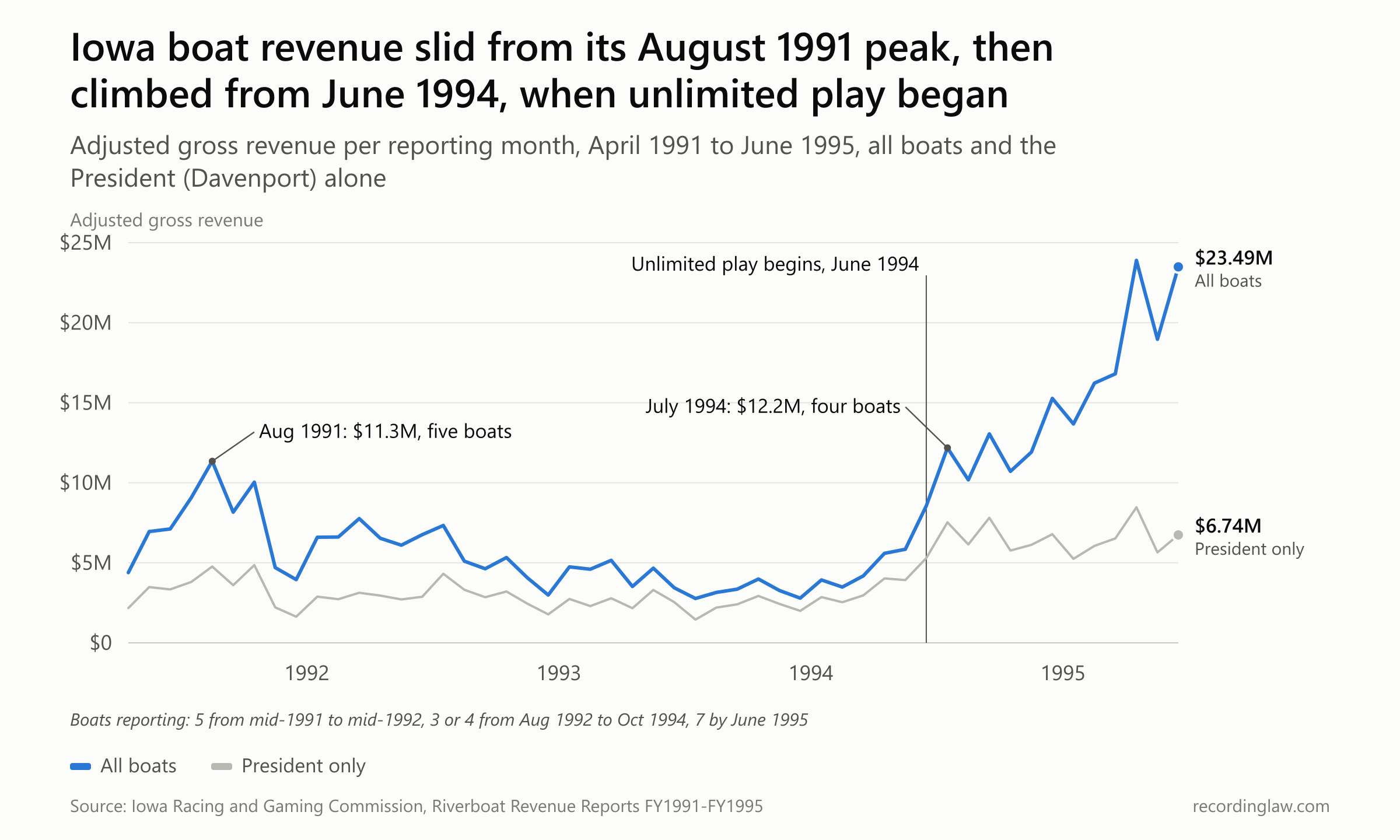
Iowa riverboat adjusted gross revenue per reporting month, all boats and the President alone, April 1991 to June 1995. The law was signed March 31, 1994, the counties voted in May 1994 and unlimited play began in June 1994, where the marker sits. Source: Iowa Racing and Gaming Commission.
| Reporting month | All boats | Boats reporting | President (Davenport) |
|---|---|---|---|
| August 1991 | $11,346,828 | 5 | $4,764,053 |
| December 1992 | $2,989,507 | 3 | $1,775,758 |
| March 1994 | $4,181,274 | 3 | $2,969,604 |
| July 1994 | $12,182,258 | 4 | $7,530,096 |
| June 1995 | $23,487,798 | 7 | $6,741,239 |
The combined total nearly tripled between the March 1994 and July 1994 reporting months, from about $4.2 million to $12.2 million. Part of that is a fourth boat, and part is summer.
The President in Davenport is the only boat that appears in every month of these reports. Over the same four months, it went from about $3.0 million to $7.5 million. In July 1992, two summers earlier, it had taken in $4.3 million, against $7.5 million in July 1994.
Across whole years, the President took in about $35.0 million in fiscal 1994 and $73.6 million in fiscal 1995, which is 110% more, or a little more than twice as much. Counting every boat open each month, the average boat's monthly take also roughly doubled from fiscal 1994 to fiscal 1995, from $1.34 million to $2.78 million.
Average monthly adjusted gross revenue per Iowa riverboat reporting, fiscal 1992 to fiscal 1995. Ratio calculated from Iowa Racing and Gaming Commission reports.
| Fiscal year | Average monthly AGR per boat |
|---|---|
| FY1992 | $1,460,457 |
| FY1993 | $1,323,226 |
| FY1994 | $1,339,982 |
| FY1995 | $2,781,580 |
The state's tax take shows the same turn at a larger scale, because the fleet grew. Riverboat wagering tax went from $6.8 million in fiscal 1994 to $31.7 million in fiscal 1995, a rise of about $24.9 million. The fiscal note had counted on $2.0 million from unlimited riverboat wagering.
Those figures reflect more than the end of the limits. Seven boats operated in fiscal 1995, against three the year before. The same law also let them stay open 24 hours and take bets at the dock. Even the President's doubling mixes the end of the limits with longer hours and dockside play, so no figure here isolates the limits alone.
The fiscal bureau, looking back in 1997, credited "changes made during the 1994 Legislative Session, including the elimination of the maximum $5 bet and $200 loss limits," along with the end of cruise-schedule and hours restrictions. By fiscal 1997, with nine boats, riverboat wagering tax was $75.3 million, 11 times the fiscal 1994 figure. Bettendorf, which lost its boat in 1992, got a new one, Lady Luck, on April 21, 1995, after about three years without.
A peer-reviewed study of the change, by Mark Nichols, the economist quoted earlier, at the University of Nevada, Reno, used casino win (the industry's term for what players lost) and admissions data from Iowa and Illinois. He found that "deregulation significantly increased casino win, win per admission, and total admissions in Iowa," and that in the Quad Cities market, which straddles the two states, it produced "significant cross-border substitution." His published abstract dates the change to May 1994 and notes that the restrictions came off "after Illinois introduced riverboat gambling without space, betting, or loss limits."
Where did the extra money come from?
The studies that tried to answer that measured different things. Nichols worked from casino win and admissions. Two surveys, years apart, counted Iowa adults with gambling problems.
Nichols had a third finding: "there is evidence that deregulation has partly resulted in existing gamblers losing more money as opposed to increasing the number of gamblers." The abstract, the only part of the study that is freely available, does not state a funder.
The state had already paid for a way to check. In early 1995, Rachel Volberg of Gemini Research surveyed 1,500 Iowa adults, in a study funded by the Iowa Department of Human Services. It repeated a survey done in 1989, and it compared its results with that earlier survey.
"Our hypothesis, that increases in the availability of gambling in Iowa would lead to increases in the prevalence of gambling-related problems, is fully supported by the results of this study," she wrote. The forms most closely associated with the increase were machines, including casino slots, and instant lottery tickets.
A University of Iowa team led by Donald Black surveyed 356 eastern Iowa adults in 2006 to 2008, using the same screening test as the 1995 survey, the South Oaks Gambling Screen. All of them had gambled at some point, while the 1989 and 1995 samples were drawn from Iowa adults in general.
Its paper was funded in part by the National Institute on Drug Abuse and the National Center for Responsible Gaming, an industry-funded research body. It put disordered gambling at 1.7% in 1989, 5.4% in 1995 and 3.6% in 2006-08.
The 2006-08 rate, from that sample of people who had all gambled, was significantly above the 1989 rate. It was not significantly different from the 1995 rate. Here "not significantly different" is short for not statistically significant, meaning by the study's own test chance alone could easily produce a result like this even with no real difference; that does not show there was none.
Those surveys sample different people at different times. They cannot separate the boats from the lottery, the racetrack slots and the rest of what was legal. The national group Stop Predatory Gambling, which opposes state-sponsored gambling, reads the period this way: "In Iowa, as elsewhere, gambling limits quickly disappeared in a race to the bottom with neighboring states wanting in on the action."
Horn, who had managed the bill in 1989, remembered the warnings differently in 2016. "Everybody just thought everything would go to hell, the people that were against gambling," he told the Globe Gazette. The Iowa Gaming Association, the casinos' trade group, said the industry had generated more than $22.6 billion in tax revenue. Its president, Wes Ehrecke, said: "I think we've exceeded all those expectations in an extraordinary way."
Iowa's boats could now take bets without limits, but the law still let the commission require them to leave the dock now and then. In other states, the boats were stopping altogether.
The boats that stopped sailing
Mississippi's boats had never had to move. "Many boats, in fact, do not even have engines or wheelhouses," Zaretsky, the economist at the Federal Reserve Bank of St. Louis, wrote in July 1994. In Missouri, a 1999 Southeast Missourian report found that gamblers could board only in the first 45 minutes of each two-hour "cruise," and that the boats, "many of them 'boats in moats,'" never left the dock.
Illinois let its boats stay docked from June 25, 1999. Over the next full fiscal year, adjusted gross receipts (Illinois's name for adjusted gross revenue) rose 36% and admissions rose 43%, the legislature's forecasting commission reported. But the definition of an admission changed at the same time.
Louisiana followed on April 1, 2001. "We're having a locked-at-the-dock party Saturday night," said Carol Collins of the Isle of Capri in Lake Charles. "It will definitely put us on a more-even playing field with the Indian casino."
Not everyone expected the money. Jim Brandt of the Public Affairs Research Council of Louisiana, a private watchdog, said the state was counting too much on projected gains. "We don't consider gambling revenue to be a stable source of revenue," he said.
Under Louisiana's old rule, a boat had to cruise two hours for every two hours open at the dock. Bernard Goldstein, chairman of Isle of Capri Casinos, recalled the result: "you'd see a big rush down the dock from the departing boat to get on the other one."
In 2004, his Louisiana boats still carried a licensed captain and ran man-overboard drills, more than a year after they last left the dock. He expected legislatures to loosen those remaining maritime rules eventually. "You can say it's silly, but I call it evolvement," he said.
Indiana went dockside in August 2002. Sen. Earline Rogers, D-Gary, had argued that the boats "have meant a lot to the state in terms of revenue and jobs." Rep. Dennis Kruse, R-Auburn, answered: "I think we have had our fill of gambling, and we need to stop this." Researchers at Indiana University later found that about 52% of admissions under the cruise rule had been the same players boarding again, so the admission tax brought in an estimated 38% less.
Iowa was the last state to drop the rule. Iowa's casino boats held licenses as excursion boats, and a 2004 law let a moored barge, one tied up at the dock, count as an excursion boat.
That summer, msnbc.com reported that only one of the 30 boats on the Mississippi River still cruised on a regular basis, the Mississippi Belle II in Clinton. "As far as I know everyone else has gone dockside," said Ken Bonnet, whose company ran it.
Why had the boats stopped? Goldstein, whose company had taken two boats out of Iowa in 1992, said customers decided. "But the bettors didn't like cruising. When they wanted to get on, they wanted to get on, and when they wanted to get off, they wanted to get off."
Tom Gray of the National Coalition Against Legalized Gambling, an anti-gambling group, saw the same history differently. "This thing (gambling) slithered out of the water and onto the land faster than anyone could ever track," he said.
"The only way they could sell this was quaint riverboats and entertainment," Gray said. "The Midwest states never would have bought hard-core Las Vegas-style casinos." Kevin Horrigan, a St. Louis Post-Dispatch editorial columnist, added a claim of his own: "Three-quarters of the money comes from local people, and most of that is cannibalized from other businesses, according to studies I've seen."
The gaming analyst Sebastian Sinclair of Christiansen Capital Advisors said operators surely hoped to reach land but could not count on it. "That's your hope, but if you're a smart businessman you never go into it assuming that you'll have an opportunity to expand your operations," he said.
Once the boats had stopped sailing, did the money keep growing? UNLV's Center for Gaming Research compiles each state's casino revenue by year, and its by-state table runs from 2001 to 2014.
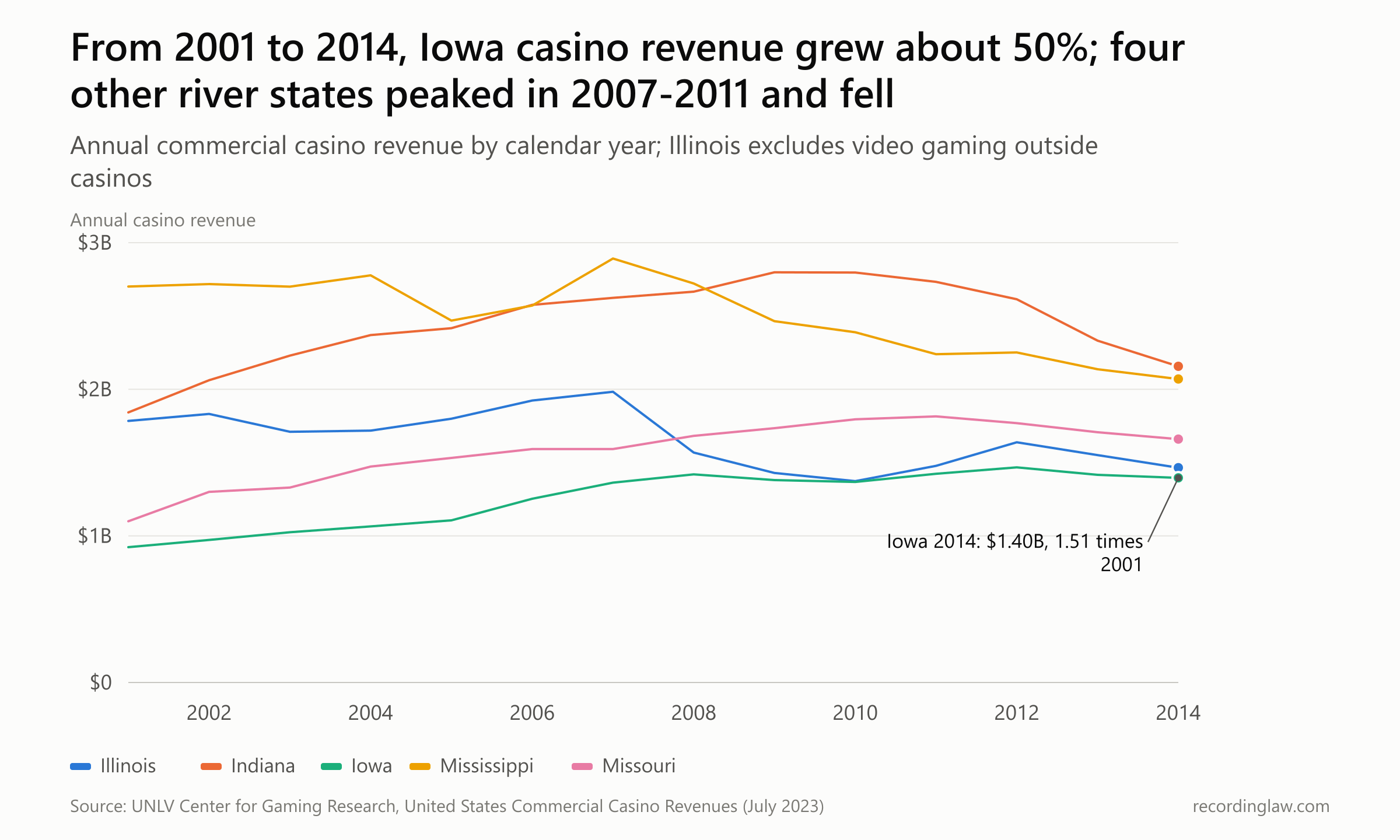
Annual commercial casino revenue, five river states, 2001 to 2014. Illinois excludes video gaming outside casinos. Source: UNLV Center for Gaming Research.
| State | 2001 | 2007 | 2014 |
|---|---|---|---|
| Illinois | $1,783,958,000 | $1,983,387,000 | $1,465,353,000 |
| Indiana | $1,841,842,000 | $2,623,939,000 | $2,156,766,000 |
| Iowa | $922,867,000 | $1,363,055,000 | $1,396,008,000 |
| Mississippi | $2,700,438,000 | $2,891,546,000 | $2,070,157,000 |
| Missouri | $1,100,000,000 | $1,592,000,000 | $1,660,097,000 |
Iowa's casinos took in about $923 million in 2001 and $1.4 billion in 2014, and their line flattened after 2008. The other four states each peaked between 2007 and 2011 and were lower by 2014, and this table does not show why. On the chart, Mississippi's line dips in 2005, and that dip has a plain cause on the coast.
Eight hundred feet
Hurricane Katrina came ashore on August 29, 2005. All 13 hotel-casinos on the Mississippi coast were damaged or destroyed. The storm surge, the Associated Press reported, "tore the walls off many gambling houses and tossed some of the massive barges on land."
About 14,000 people had worked for the coast casinos, and the casinos had generated an estimated $500,000 a day in state and local taxes. Then, for three months, the coast counties reported no casino revenue at all.
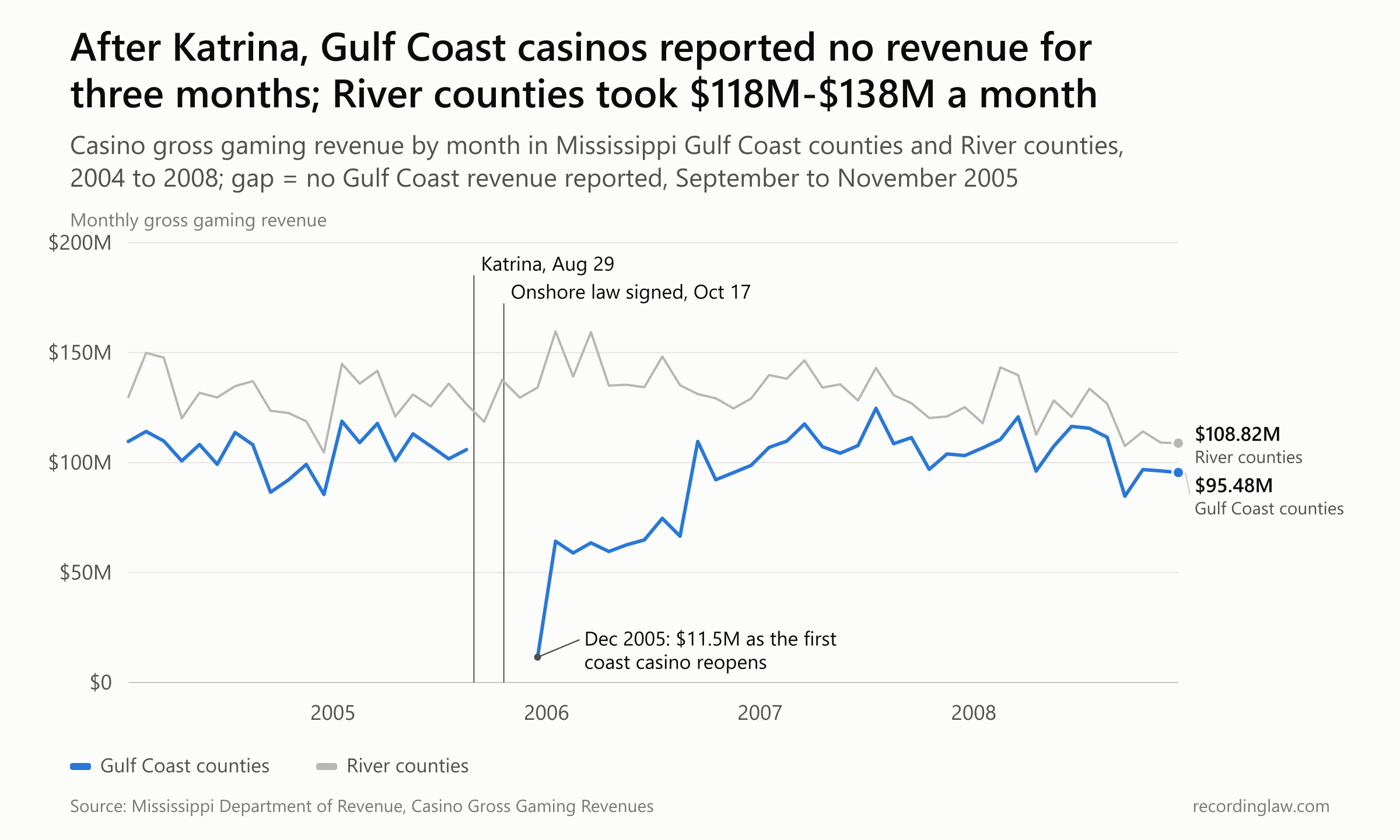
Mississippi casino gross gaming revenue by month, Gulf Coast and River counties, 2004 to 2008. Source: Mississippi Department of Revenue.
| Month | Gulf Coast counties | River counties |
|---|---|---|
| August 2005 | $105,900,778.98 | $126,553,826.80 |
| September 2005 | none reported | $118,549,040.08 |
| October 2005 | none reported | $137,601,346.58 |
| November 2005 | none reported | $129,515,698.61 |
| December 2005 | $11,494,128.88 | $134,156,504.88 |
| January 2006 | $64,217,676.26 | $159,636,516.62 |
| September 2006 | $109,595,693.69 | $131,126,780.34 |
Over those same three months, September to November 2005, the river-county casinos took in between $118 million and $138 million a month. The question for the legislature was whether the coast casinos could come back on land.
Gov. Haley Barbour had campaigned in 2003 on preventing the spread of gambling. On September 26 he backed a move ashore. "We have learned the hard way that making them float on water is not a good idea," he said, adding that his plan "will not have any material effect" on where the state already allowed casinos.
The industry made its case in practical terms. Jan Jones of Harrah's said casino companies could build larger "integrated resorts" with convention space if they could go on shore. "For us, the issue of shore-based gaming is really important to give us the ability to reinvest and get our people back to work," said Eric Schippers of Penn National Gaming.
Rep. Bobby Moak, D-Bogue Chitto, the House Gaming Committee chairman, cited about 50,000 jobs tied to gaming, 14,000 to 15,000 of them direct. He also asked what the word "inland" meant: "I don't want to be Clintonesque here, but I think you really have to define what is 'inland.'"
Religious groups including the Mississippi Baptist Convention and the American Family Association lobbied against any change. "It can open the door for land-based casinos across the state without a vote of the people," said the Rev. Michael Weeks, one of about 50 Baptist pastors at the Capitol. Barbour said there was "zero chance" courts would read the law to allow casinos in new counties. Gladys Gill of Concerned Women for America said she opposed letting the casinos leave the water.
Sen. Cindy Hyde-Smith, now a U.S. senator, pointed out that lawmakers had already let casinos build on pilings, a law that took effect on July 1. "They seemed very content with that before the storm," she said, and repeated that the state "can't smoke, drink or gamble" its way out of a crisis.
The House cut the distance in the bill from 1,500 feet to 800 feet and passed it on September 30. The Senate passed it 29-21 on October 3, after which coast business people and civic leaders "exchanged hugs and high-fives in a Capitol hallway." House Bill 45 let coast casinos sit "no more than eight hundred (800) feet from the mean high-water line," or, in Harrison County, up to U.S. 90, whichever was greater. It did not let the river casinos move onto dry land.
Barbour signed it on October 17, 2005, 49 days after the storm. "This bill is about more than gaming," he said. "By signing this bill, the state is taking the necessary precautions to provide safety for the casinos and, in turn, is providing jobs for thousands of displaced Mississippi workers."
Back on the coast, on land
The Imperial Palace reopened first, on December 22, 2005. Coast revenue was about $64 million in January 2006 and about $110 million in September 2006, back in the range of the months before the storm.
Over whole years, the coast took in $1.23 billion in 2004, $886 million in 2005 and $911 million in 2006. In 2007 it took in $1.30 billion, 6.1% more than in 2004. Before the first dockside casinos opened in 1992, supporters in Harrison County had promised "jobs, jobs, jobs," and "the thought was a half dozen casinos would likely operate in the county," WLOX later recalled.
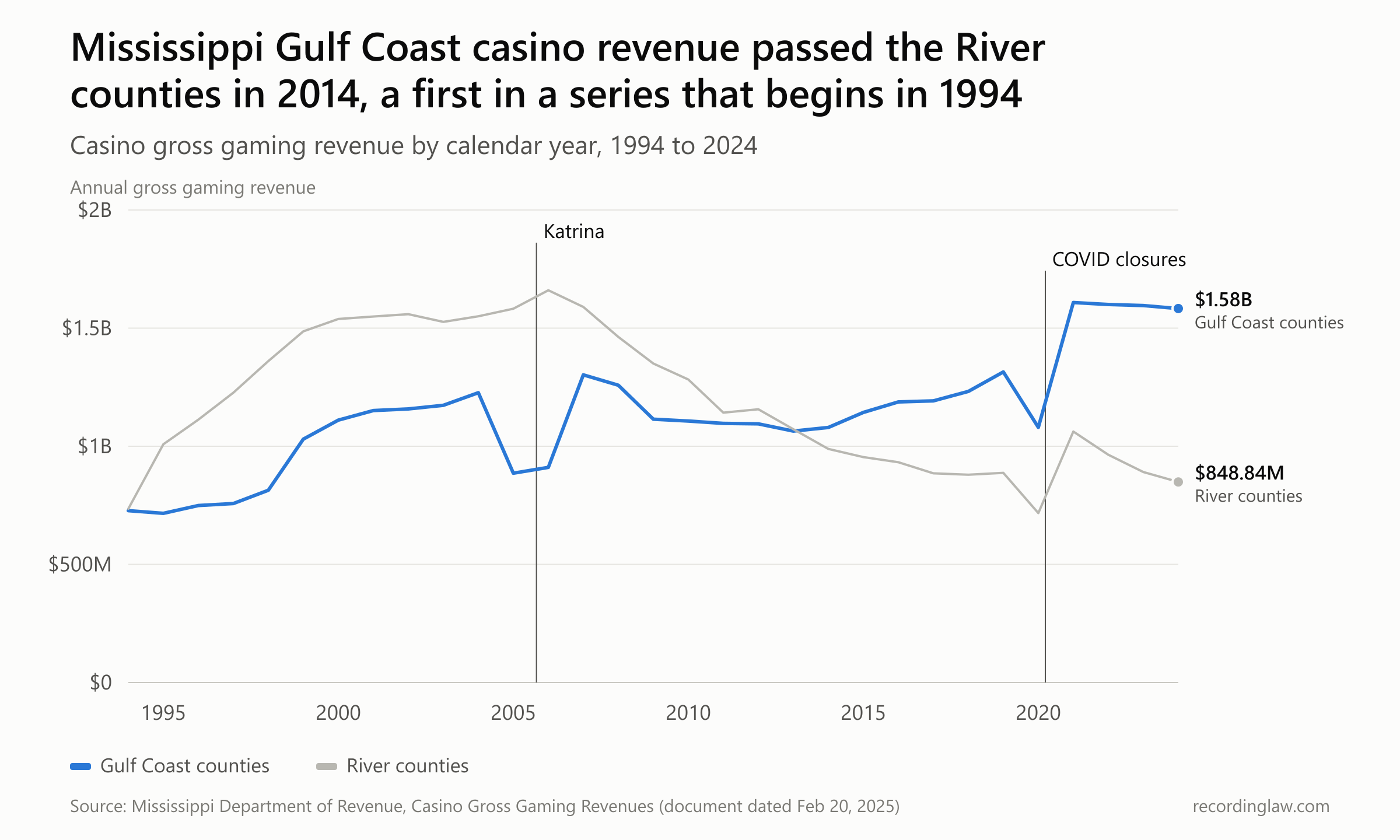
Mississippi casino gross gaming revenue by calendar year, Gulf Coast vs River counties, 1994 to 2024. Source: Mississippi Department of Revenue (document dated February 20, 2025).
| Year | Gulf Coast counties | River counties |
|---|---|---|
| 1994 | $727,326,701 | $735,467,945 |
| 2004 | $1,226,874,812 | $1,550,095,500 |
| 2005 | $886,158,035 | $1,582,318,836 |
| 2006 | $910,696,342 | $1,660,187,243 |
| 2007 | $1,302,102,369 | $1,589,444,058 |
| 2013 | $1,064,324,063 | $1,072,299,767 |
| 2014 | $1,079,420,121 | $988,462,006 |
| 2020 | $1,080,188,146 | $717,267,380 |
| 2024 | $1,582,952,962 | $848,841,028 |
The longer record shows the two lines crossing. The river counties, where casinos stayed on the water, out-earned the coast every year from 1994 to 2013, peaking at $1.66 billion in 2006.
In 2014 the coast took in $1.08 billion and the river counties $988 million. The coast has stayed ahead in every year since, including the 2020 pandemic closures. In 2024 the coast took in $1.58 billion and the river counties $849 million.
The Department of Revenue's yearly figures record where the money went. They do not say why. The coast casinos were rebuilt after a storm that also displaced thousands of their workers, and the river counties' decline after 2006 has causes this data does not identify.
The Mississippi Gaming Commission counts by its own regions, and its Coastal region is not the same as the Department of Revenue's Gulf Coast counties. It counted $1.59 billion in coastal casino revenue in 2025 and $1.22 billion from January through September 2026.
The last boats in the water
Illinois let its casinos leave the water only in 2019. When Rivers Casino Des Plaines opened in 2011, it was "simply built over a 144,000-gallon man-made pool to qualify as a riverboat," the Chicago Tribune reported. The 2019 expansion law let all of the state's casinos be built on or moved to dry land. On June 10, 2026, Hollywood Casino Aurora ended more than 30 years of riverboat gambling and two weeks later opened a $360 million casino on land.
Louisiana's 2018 law let its riverboats move onto land within 1,200 feet of their berths. "We're talking about $500 million, $600 million, to build a first-class facility. They're not going to be allowed to move slot machines into some warehouse space," said its sponsor, Sen. Ronnie Johns, R-Lake Charles. Until then, the Advocate reported, even resorts built over watery sloughs kept circulating paddle wheels, "usually stowed in some out-of-the-way closet," because the law required them.
Missouri still requires casinos to sit within 1,000 feet of the Mississippi or Missouri river. Since 2021, the state's gaming commission can approve a casino that is an ordinary building, as long as a container holding at least 2,000 gallons of water sits beneath it.
The next moves already have dates. Penn Entertainment, which counts its recent casinos in Aurora and Joliet among its moves from the water to land, expects to open Hollywood Casino Council Bluffs in Iowa in 2028.
In New Orleans, it plans to move Boomtown off its boat into a land casino of about 140,000 square feet, opening in 2029. The Louisiana Gaming Control Board approved the move on August 20, 2026. More of the boats are coming ashore, one license at a time.
In 1989, Dieleman predicted that promoters would lobby to raise the betting limits and that the casinos would spread to land. Iowa's limits came off in 1994, and racetrack slot machines opened on land in 1995. In 2007, 18 years after his warning and 16 years after a cart of coins tipped over on the Dubuque ramp, Iowa passed a law allowing land-based casinos.
How we measured
Iowa riverboat revenue. Monthly adjusted gross revenue (AGR: money wagered minus winnings paid) comes from the Iowa Racing and Gaming Commission's riverboat revenue reports for fiscal 1991 to fiscal 1995, one column per boat. The commission's "months" are four- or five-week reporting periods (April 1994, for example, ran March 28 to May 1), so monthly figures are not calendar months. We counted the boats reporting in each period from the report columns. A boat in a first or last partial period counts as one.
The President control series. The President in Davenport is the one boat present in every period, so its change is not a boat-count effect. Its fiscal 1994 total ($35,020,023) is our sum of 12 reporting periods (June 28, 1993 to June 26, 1994). Its fiscal 1995 total ($73,601,159) is from the commission's summary page (July 1, 1994 to June 30, 1995). The ratio is 2.10, or 110% more. It still mixes the end of the limits with 24-hour and dockside play from the same law.
Per-boat average. For each fiscal year we divided the sum of monthly total AGR by the sum of boats reporting each month. Fiscal 1995 understates the true per-boat figure, because four boats opened mid-year, and a boat that opened partway through a reporting period still counts as a full boat for that period. The ratio from fiscal 1994 ($1,339,982) to fiscal 1995 ($2,781,580) is 2.08.
Wagering tax. Iowa riverboat wagering tax by fiscal year is from the Legislative Fiscal Bureau's November 19, 1997 Issue Review (Figure 1). This is tax, not AGR. The fiscal 1995 increase is $31,723,085 minus $6,841,758, or $24,881,327. The fiscal 1997 figure is 11.0 times fiscal 1994. The bureau's fiscal 1995 figure differs slightly from the commission's ($31,276,350), and we did not reconcile them. The fiscal-note estimate ($2.0 million for unlimited riverboat wagering in fiscal 1995) is from the bureau's June 15, 1994 review.
Dates of the 1994 law. The Iowa Legislature's bill file shows House passage on March 17, 1994 (51-49), Senate passage on March 30 (27-23) and the governor's approval on March 31, effective on enactment. The limits still needed county referendums (May 10 and May 17, 1994), and the commission dates unlimited play to June 1994. Nichols dates the change to May 1994.
What we left out of Iowa. The 1993 Mississippi River flood (the President was moved before the July 9 crest) depressed summer 1993 revenue, and those months fall inside fiscal 1994. Leaving out the June, July and August reporting periods of both fiscal years, the President's take still rose 2.24 times ($26,073,449 to $58,428,106) and the per-boat average 2.08 times ($1,301,420 to $2,702,134). We could not assemble all-boat AGR for fiscal 1996 and 1997, and we did not find why the boat count changed in early 1993.
Five-state comparison. Annual commercial casino revenue for 2001 to 2014 is from the UNLV Center for Gaming Research's United States Commercial Casino Revenues (July 2023 edition), the latest by-state annual table it lists; it stops at 2014. Illinois excludes video gaming outside casinos. Missouri 2001 to 2012 come from the American Gaming Association per the report's note. Iowa's 2001-to-2014 change is $1,396,008,000 divided by $922,867,000, about 1.51.
Mississippi. Monthly and annual gross gaming revenue for Gulf Coast counties and Mississippi River counties are from the Mississippi Department of Revenue's casino gross gaming revenue history (dated February 20, 2025, through December 2024). The source shows a dash for Gulf Coast September to November 2005, which we report as none reported. The 2007-vs-2004 change is $1,302,102,369 divided by $1,226,874,812, or 6.1% more. The 2025 and 2026 coastal figures come from the Mississippi Gaming Commission, whose Coastal region is not the same as the Department of Revenue's Gulf Coast counties, so we do not join them to the series.
Dates of the 2005 law. The Mississippi Legislature's bill status page for House Bill 45 (2005 Fifth Extraordinary Session) shows House passage September 30, Senate passage October 3 and the governor's approval October 17. The 29-21 Senate vote is from the Associated Press. We did not confirm the House vote count.
Studies. Nichols (1998, Journal of Gambling Studies) is a regression on Iowa and Illinois win and admissions data. We read the abstract only, and its funder is not stated there. Volberg (1995) and Black and colleagues (2012) are telephone or survey prevalence studies using the South Oaks Gambling Screen. They compare separate samples and cannot attribute changes to any one form of gambling. Black's 356 respondents all reported having gambled at some point, unlike the general-population 1989 and 1995 samples. The Illinois figures for fiscal 2000 come from the legislature's forecasting commission, a descriptive year-over-year comparison in which the definition of an admission changed.
What the data cannot show. No series here isolates the effect of the bet and loss limits from the other changes made in the same laws (more boats, longer hours, dockside play, racetrack slots), from competition in neighbouring states, or from the storm. Figures are in dollars not adjusted for inflation.
Frequently Asked Questions
When did Iowa legalize riverboat gambling?
The Iowa Senate passed the riverboat bill (SF 124) 26-23 on March 7, 1989, and Gov. Terry Branstad signed it on April 27, 1989. An amendment delayed the boats until April 1, 1991, when the first casino boats began operating.
What were Iowa's original riverboat gambling limits?
The boats had a $5 maximum bet and a $200 loss limit per excursion. They had to sail before gambling could start, and only 30% of a boat could be used for the casino.
When did Iowa remove the $5 bet limit and the $200 loss limit?
House File 2179 was signed on March 31, 1994, after a 51-49 House vote and a 27-23 Senate vote. Each county with a boat then had to approve unlimited gambling in a referendum, held in May 1994, and the Iowa Racing and Gaming Commission says unlimited gambling began in June 1994.
Did removing the limits increase Iowa casino revenue?
Revenue rose sharply after June 1994. But the same law also allowed 24-hour and dockside play, and the number of boats grew from three to seven in fiscal 1995. The one boat open throughout, the President in Davenport, took in 110% more in fiscal 1995 than in fiscal 1994. A 1998 study by Mark Nichols found that deregulation significantly increased Iowa casino win and admissions, partly because existing gamblers lost more.
Do Iowa casinos still have to be on boats?
No. A 2004 law let a moored barge count as an excursion boat, and a 2007 law (SF 263) allowed land-based casinos. Penn Entertainment expects to open Hollywood Casino Council Bluffs, one of its moves from the water to land, in 2028.
Why did Mississippi let casinos move onshore?
Hurricane Katrina damaged or destroyed all 13 hotel-casinos on the Mississippi coast on August 29, 2005. Gov. Haley Barbour backed letting them rebuild on land, saying the state had learned the hard way that making them float was not a good idea. The legislature passed House Bill 45 in a special session, and Barbour signed it on October 17, 2005.
How far inland can Mississippi coast casinos be built?
Under House Bill 45 (2005), they can be built no more than 800 feet from the mean high-water line, or in Harrison County up to U.S. 90 if that is farther. The 2005 law applied to the coast only and did not let the Mississippi River casinos move onto dry land.
Are Illinois casinos still on riverboats?
Illinois let its riverboats stay docked from June 25, 1999, and a 2019 law allowed all of its casinos to move to dry land. Hollywood Casino Aurora ended riverboat gambling on June 10, 2026, and opened a $360 million land casino later that month.
Updates
Corrected: the 38% figure for Indiana is an estimated fall in what the state's admission tax collected after its casino boats stopped cruising, not a 38% shrinkage of the tax base.
Restructured as a feature: chart titles state the finding, side details moved to How we measured. Every figure and quote was re-checked against its source.
Independently fact-checked against the cited primary sources
Independently fact-checked against the cited primary sources
Sources and References
- Iowa Racing and Gaming Commission, archived riverboat gaming revenue reports, FY1991 to FY1995(irgc.iowa.gov).gov
- Iowa Racing and Gaming Commission, Commission History(irgc.iowa.gov).gov
- Iowa Legislative Fiscal Bureau, Issue Review on gambling revenue, November 19, 1997(legis.iowa.gov).gov
- Iowa Legislative Fiscal Bureau, Issue Review, "Expanded Gambling", June 15, 1994(legis.iowa.gov).gov
- Iowa Legislative Fiscal Bureau, Issue Review, "Riverboat Gambling", July 14, 1992(legis.iowa.gov).gov
- Iowa Legislative Services Agency, Fiscal Research Brief, "Update on Iowa's Gaming Industry and Associated Revenues", November 24, 2025(legis.iowa.gov).gov
- Iowa Legislature, House File 2179 (75th General Assembly) bill file and enrolled act(legis.iowa.gov).gov
- UPI, "Riverboat gambling bill passes Iowa Senate", March 7, 1989(upi.com)
- Deseret News (wire), "Iowa legalizes gambling on casino boats", April 28, 1989(deseret.com)
- Encyclopedia Dubuque, "Riverboat Gambling"(encyclopediadubuque.org)
- Telegraph Herald, "Dubuque marks 25 years since riverboat gambling", March 27, 2016(telegraphherald.com)
- Northern Kentucky Tribune, Diamond Lady recollection, January 2019(nkytribune.com)
- Maritime Reporter and Engineering News, riverboat gaming feature and legislation table, January 1993(magazines.marinelink.com)
- Mark W. Nichols, "Deregulation and Cross-Border Substitution in Iowa's Riverboat Gambling Industry", Journal of Gambling Studies 14 (1998)(link.springer.com)
- National Gambling Impact Study Commission, Chicago meeting, May 20, 1998, testimony of Rep. William Witt(govinfo.library.unt.edu).gov
- Rachel A. Volberg, "Gambling and Problem Gambling in Iowa: A Replication Survey", report to the Iowa Department of Human Services, July 28, 1995(prism.ucalgary.ca)
- Black, Shaw, McCormick, Allen and colleagues, Iowa gambling prevalence survey, Annals of Clinical Psychiatry (2012)(dhhl.hawaii.gov)
- University of Iowa news release on the 2006-08 Iowa gambling survey and its funders(now.uiowa.edu)
- Stop Predatory Gambling, "Gambling Limits Do Not Last", March 18, 2011(stoppredatorygambling.org)
- Globe Gazette, "Riverboat gambling came to Iowa amid farm crisis, heated debate", March 27, 2016(globegazette.com)
- Northern Public Radio, "This week in Illinois history: riverboat gambling comes to Illinois"(northernpublicradio.org)
- Illinois Commission on Government Forecasting and Accountability, Wagering in Illinois, September 2000(cgfa.ilga.gov).gov
- Adam M. Zaretsky, Federal Reserve Bank of St. Louis, The Regional Economist, July 1994(files.stlouisfed.org)
- Southeast Missourian, "Five years with gambling", May 30, 1999(semissourian.com)
- Jeremy Alford column, "How Mississippi beat Louisiana to legalized gaming", July 16, 2018(heraldguide.com)
- WLOX, "Mississippi's first dockside casinos opened 29 years ago this week", August 2, 2021(wlox.com)
- WLOX, "Dockside gambling approved 20 years ago", March 10, 2012(wlox.com)
- Associated Press via Las Vegas Sun, Louisiana riverboats go dockside, April 2, 2001(lasvegassun.com)
- Associated Press via Las Vegas Sun, Indiana dockside bill, March 29, 2001(lasvegassun.com)
- Associated Press via Las Vegas Sun, "Dockside bill clears Ind. House", February 27, 2002(lasvegassun.com)
- Indiana Business Research Center, "The Two-Sided Coin: Casino Gaming and Casino Tax Revenue in Indiana", Indiana Business Review, Spring 2009(ibrc.indiana.edu)
- msnbc.com, "Riverboat casinos going nowhere fast", August 9, 2004(nbcnews.com)
- Associated Press via Las Vegas Sun, Barbour proposal on onshore casinos, September 27, 2005(lasvegassun.com)
- Associated Press via Las Vegas Sun, "Onshore casinos clear first hurdle", September 30, 2005(lasvegassun.com)
- The Daily Leader (Brookhaven), "Casino move still on table for senators", October 3, 2005(dailyleader.com)
- Associated Press via NBC News, Mississippi Senate passes onshore casino bill, October 2005(nbcnews.com)
- Associated Press via Sun Journal, "Lawmakers OK casinos' move to land", October 4, 2005(sunjournal.com)
- Associated Press via NBC News, Barbour signs onshore casino bill, October 2005(nbcnews.com)
- Mississippi Legislature, House Bill 45 (2005 Fifth Extraordinary Session), history of actions(billstatus.ls.state.ms.us).gov
- Mississippi Legislature, House Bill 45 (2005 Fifth Extraordinary Session), text sent to the governor(billstatus.ls.state.ms.us).gov
- National Sea Grant Law Center, The SandBar 6.1, Mississippi coastal casinos after Katrina(nsglc.olemiss.edu)
- Mississippi Department of Revenue, Casino Gross Gaming Revenues history (February 20, 2025)(dor.ms.gov).gov
- Mississippi Gaming Commission, monthly casino adjusted gross gaming revenue, previous years(msgamingcommission.com).gov
- UNLV Center for Gaming Research, United States Commercial Casino Revenues (July 2023 edition)(library.unlv.edu)
- Chicago Tribune via Hotel Online, Hollywood Casino Aurora leaves its boat, June 10, 2026(hotel-online.com)
- The Advocate (Baton Rouge), Louisiana SB 316 signed, May 23, 2018(theadvocate.com)
- Yogonet, Missouri law lets last open-water riverboat casino move inland, July 16, 2021(yogonet.com)
- CDC Gaming Reports, Penn Entertainment New Orleans casino relocation, August 17, 2026(cdcgaming.com)
- Louisiana Gaming Control Board, Minutes of August 20, 2026 (Boomtown New Orleans relocation petition approved)(lgcb.dps.louisiana.gov).gov