A 2026 Journal Study Puts the Average Credit-Score Drop From Adding Sports Betting Apps at About 12 Points

Independently fact-checked against primary sources (last audited November 10, 2026). · 7 primary sources cited on this page. How we verify our legal content
At 10:11 a.m. on January 8, 2025, Sen. John Marty called the Minnesota Senate Finance Committee to order in Room 123 of the Capitol. The agenda was an "Informational hearing on economic, health, and social harms resulting from online sports betting." The minutes list three senators present and eleven absent.
One witness, UCLA economist Brett Hollenbeck, appeared by video. His working paper estimated that average credit scores fell by nearly 1% in the four years after a state legalized online sports betting. "Which is about seven literal points on your credit score," he told the committee.
By the time the paper appeared in the journal Management Science in July 2026, that number had been replaced by two others, measured in points. The published abstract puts the decline at 0.7 points where any legal sports betting arrived, and at about 12 points where a state added online betting to the in-person sportsbooks it already had.
One finding had reversed along the way. The 2024 draft found credit-card delinquencies, or late card payments, falling in online-betting states. The published abstract lists them among the debts that rose.
In every version, the estimated effects were larger where betting was online than where it meant a trip to a counter. When the Supreme Court cleared the way for states to legalize in 2018, it recorded opponents' warning that legal betting would "encourage people of modest means to squander their savings and earnings." Most states then put the sportsbook on the phone.
In July 2026, two Ohio lawmakers filed a bill to keep the counter and close the app. What did credit records show when betting moved from the casino to the phone, and how firm is that evidence as legislatures change the rules?
How far apart the estimates sit
How much lower did credit scores end up where betting moved to the phone? The answer depends on which version of the study a reader opens, and on what each version compared. The 2024 drafts measured scores as percentage changes, and with average scores near 715 before legalization, 1% is about 7 points. In the journal article, General Access means any legal sports betting.
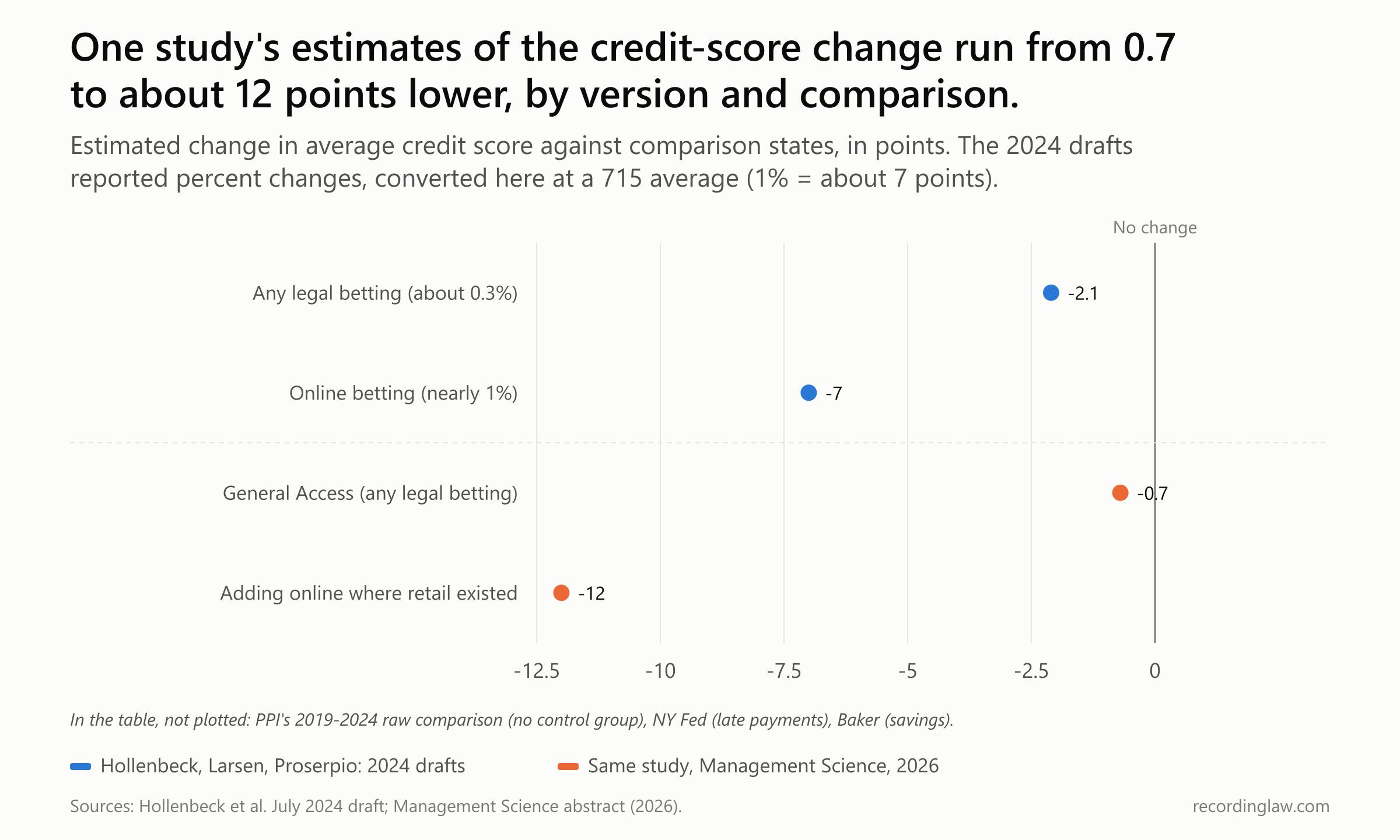
Sources: Hollenbeck, Larsen and Proserpio, July 2024 working paper and Management Science abstract (2026); table also Progressive Policy Institute (September 2025), New York Fed and Baker et al. The 2024 points are converted from percent at a 715 average; see How we measured.
| Estimate | As reported | In points |
|---|---|---|
| Hollenbeck et al., 2024 draft, any legal betting | about 0.3% lower | about 2 lower (converted) |
| Hollenbeck et al., 2024 draft, online betting | nearly 1% lower | about 7 lower (Hollenbeck's own figure) |
| Management Science, 2026, General Access | 0.7 points lower | 0.7 lower |
| Management Science, 2026, adding online where retail existed | about 12 points lower | about 12 lower |
| UCLA Anderson Review brief, 2026 | about 2% lower | basis not stated |
| NPR via Michigan Public, 2026 | 0.8 points lower | version not named |
| Progressive Policy Institute, early mobile states, 2019 to 2024 | up 1.8%, about the national rate | no control group |
| New York Fed staff report (Goss and Mangrum) | share 90 or more days late up 0.36 percentage points | other outcome |
| Baker et al., bank and card data | savings down; $1 of betting, about $1 less in net financial investments | other outcome |
Every estimate from the Hollenbeck team points down. The largest, about 12 points, is the one the journal attaches to adding an app where a counter already existed.
The Progressive Policy Institute's comparison, which used no control group, found scores in early mobile-betting states rising about as fast as the nation's. A control group is a comparison group, places or people the law did not cover, used to estimate what might have happened without it. If scores went up both in states with legal betting and in the comparison states, but went up more in the comparison states, a state's average could rise and the Hollenbeck study would still record a decline there.
Two other teams measured different things, late payments and savings, and both found more strain where betting was legal. How one study came to give so many numbers starts with a Supreme Court ruling and a choice most states made soon after.
Two predictions in one paragraph
The ruling that started it came down on May 14, 2018. In Murphy v. NCAA, the Supreme Court voted 6-3 to strike down the federal sports betting ban, leaving each state to decide for itself.
Justice Samuel Alito's majority opinion took no side on whether that was wise, and set out both sides in one paragraph. "Supporters argue that legalization will produce revenue for the States and critically weaken illegal sports betting operations, which are often run by organized crime," he wrote. "Opponents contend that legalizing sports gambling will hook the young on gambling, encourage people of modest means to squander their savings and earnings, and corrupt professional and college sports."
The warning was older than the case. A 1991 Senate report on the bill that created the federal ban, quoted in a 2026 New York Fed paper, had said, "Once a State legalizes sports gambling, it will be extremely difficult for other States to resist the lure."
New Jersey, the state that won the case, moved within weeks. Monmouth Park racetrack in Oceanport set up a sportsbook with the wagering company William Hill. The Legislature passed a bill to tax in-person bets at 8.5% and online bets at 13%. That taxed a bet on the phone more heavily than a bet at the counter before anyone had measured a difference between them.
The expectations were modest. State Treasurer Elizabeth Muoio predicted that New Jersey would earn about $13 million from sports betting in its first year, NPR reported. The American Gaming Association, the casino industry's trade group, estimated at the time that Americans illegally wagered $150 billion on sports each year. Which of the two ways to bet would win the customers was still an open question.
How the phone took over
Most of the states that followed let people bet on a phone as well as at a counter. How did the states in the Hollenbeck credit study, described below, split by the time its data ended in June 2023?
| Form of legal sports betting, June 2023 | States in the study |
|---|---|
| In-person and online | 21 |
| In-person (retail) only | 8 |
| Online only | 3 |
Source: UCLA Anderson Review (February 4, 2026), summarizing Hollenbeck, Larsen and Proserpio; study window March 2016 to June 2023, Nevada excluded.
States that offered both outnumbered states with in-person, or retail, betting only by more than two to one. Only three let people bet online without a counter.
The governors who pushed for legalization talked about money and about bettors leaving for other states. In his February 2019 budget address, Illinois Gov. J.B. Pritzker said: "Every day we argue about “who’s in and who’s out” is money that goes to other states and to the black market." He asked lawmakers to act "so that Illinois can realize hundreds of millions of dollars, create new jobs, and bring sports betting into a regulated environment that will protect citizens from bad actors." The Associated Press reported that he counted on $200 million in licensing fees to help fill a $3.2 billion budget hole.
New York launched mobile betting on January 8, 2022. In the first 30 days, bettors wagered more than $1.98 billion, and at a 51% tax rate the state collected more than $70.6 million. "Over the past month, we've seen how mobile sports wagering can be an economic engine for New York, driving significant funding to our schools, youth sports, and so much more," Gov. Kathy Hochul said. Her office said the approach "will keep New York bettors in New York, rather than having State residents travel to neighboring states to wager."
State Sen. Joseph Addabbo Jr., who sponsored mobile betting, said the first month's record showed "New York was ready for mobile sports betting and we are providing our state with a new significant revenue, educational and addiction funding source."
The warnings had been on the record since 2018. "Based on studies that we’ve done, folks that gamble on sports tend to gamble more often and have more problems than the average gambler," Lia Nower, director of the Center for Gambling Studies at Rutgers University, told NPR's Here & Now a week after the ruling. Michael Burke of the Michigan Association on Problem Gambling, an advocacy group, said on the same program: "We know that whenever there’s an expansion of legalized sports gaming in the United States, there will be an increase in gambling participation." That, he added, meant more gambling problems too.
Americans bet more than $150 billion on sports in 2024 and some $600 billion overall by early 2026, and more than 95% of that money was gambled online, according to Legal Sports Report figures cited by UCLA's Anderson Review. The split between counter states and app states gave researchers a comparison. If the harm the Court's opponents described was real, it might look different in states where placing a bet took a trip to a counter than in states where it took a phone.
What the credit reports showed in 2024
The paper Hollenbeck would later take to Minnesota began with credit reports. Hollenbeck, of UCLA's Anderson School, wrote it with Poet Larsen and Davide Proserpio, then both of USC's Marshall School. They used the University of California Consumer Credit Panel, a set of credit-bureau records for a representative sample of roughly 7 million Americans.
After dropping people who moved between states and incomplete records, their analysis covered about 4.4 million adults and 90 million quarterly observations from March 2016 to June 2023. Nevada, where sports betting had been legal for decades, was left out.
Their method compared states that legalized at different times with states that had not legalized yet, before and after each state's start date. Economists call this a staggered difference-in-differences design. It does not show who bet, only how a whole state's credit records changed against the comparison states. The UCLA Briskin Fund paid for the work, and the California Policy Lab hosted the data.
The first public draft, in July 2024, found small average changes and one large one. Credit scores fell about 0.3% roughly four years after a state legalized any sports betting, and nearly 1% where online betting was legal. "Three to four years after the legalization of online sports gambling, we observe that the likelihood of bankruptcy filing increases by as much as 25-30% when compared to pre-treatment levels," the authors wrote.
The average amount of debt in collections rose about 8%, or about $30 per consumer, the draft estimated. Credit cards went the other way. "Interestingly, we find a decrease in credit card delinquencies, and more generally, we find a restriction in access to credit in the form of lower credit limits and a higher ratio of secured to unsecured loans," the draft said. Card limits fell about 1.6% in all legal states and nearly 2.7% where betting was online, which the authors read as banks cutting back credit.
The draft did not estimate a separate effect for counter-only states. For the online comparison, it simply set them aside: "Additionally, we removed states that exclusively offer offline gambling venues." The Regulatory Review, published by the University of Pennsylvania's law school, summarized that "In states without online sports betting, bankruptcy filings increased modestly."
Front Office Sports wrote that the paper found "credit scores dipping slightly and bankruptcies exploding." Larsen told the outlet the paper took no side on policy. "Whether it’s so terrible for policymakers that they don’t want to introduce sports gambling is kind of up to them," he said. "That’s the debate for them to decide."
Seven points, by video
Six months later, that debate reached the Minnesota Capitol, where lawmakers were weighing bills to legalize online betting. An October 2024 version of the paper, submitted to the committee, added a national estimate: "roughly 30,000 additional annual bankruptcies and an additional $8 billion in annual collections on account in states with legalized online gambling accessibility."
That version also said what the average could not tell anyone. "It is important to remember that we measure average effects for the full population in states that legalized betting," the authors wrote. "We do not know from our data the proportion of this population that is negatively affected."
Hollenbeck made the same point to the senators. He told them the seven points were averaged over everyone in the state, most of whom do not bet, so people who may be problem gamblers could be seeing far larger drops.
Scott Baker, an economist at Northwestern's Kellogg School, testified at the same hearing from a different kind of data. His team's paper, "Gambling Away Stability," tracked bank and card transactions for more than 200,000 users, so it could see deposits into betting apps directly. It found that the new betting "does not displace other gambling or consumption but significantly reduces savings." Among financially constrained households, "credit card debt increases, available credit decreases, and overdraft frequency rises."
Baker's slides to the committee put it per dollar: "$1 of betting leads to a reduction of about $1 in net financial investments." He told senators, "a lot of this burden seems to fall on more financially constrained households who might already be struggling in other things." That paper was later published in the Journal of Financial Economics.
Who got to testify was itself in dispute. Marty, a longtime opponent, said of industry witnesses who had withdrawn: "They're basically preying on vulnerable people, and they don't want to talk about that." Les Bernal of Stop Predatory Gambling, an anti-gambling advocacy group, said of what he calls predatory gambling: "It's taking a known, dangerous, and addictive product and then blending it with a fraudulent and manipulative financial scheme."
The committee's vice chair, Sen. Nick Frentz, a supporter of legalization, pushed back. "The simple fact is we have had testimony this morning largely ignoring the fact that many Minnesotans want to do this," he said. Blois Olson, spokesman for the Sports Betting Alliance of Minnesota, backed by BetMGM, DraftKings, FanDuel and Fanatics, said in a statement that Minnesotans were already "forced to use offshore and unregulated websites that brazenly flout gaming laws meant to protect consumers."
How the headline number moved
The number Hollenbeck gave the senators did not stay put. In February 2026, UCLA's Anderson Review, the business school's own publication, summarized the study with figures that differ from both 2024 drafts. What did that 2026 summary report for states with online betting?
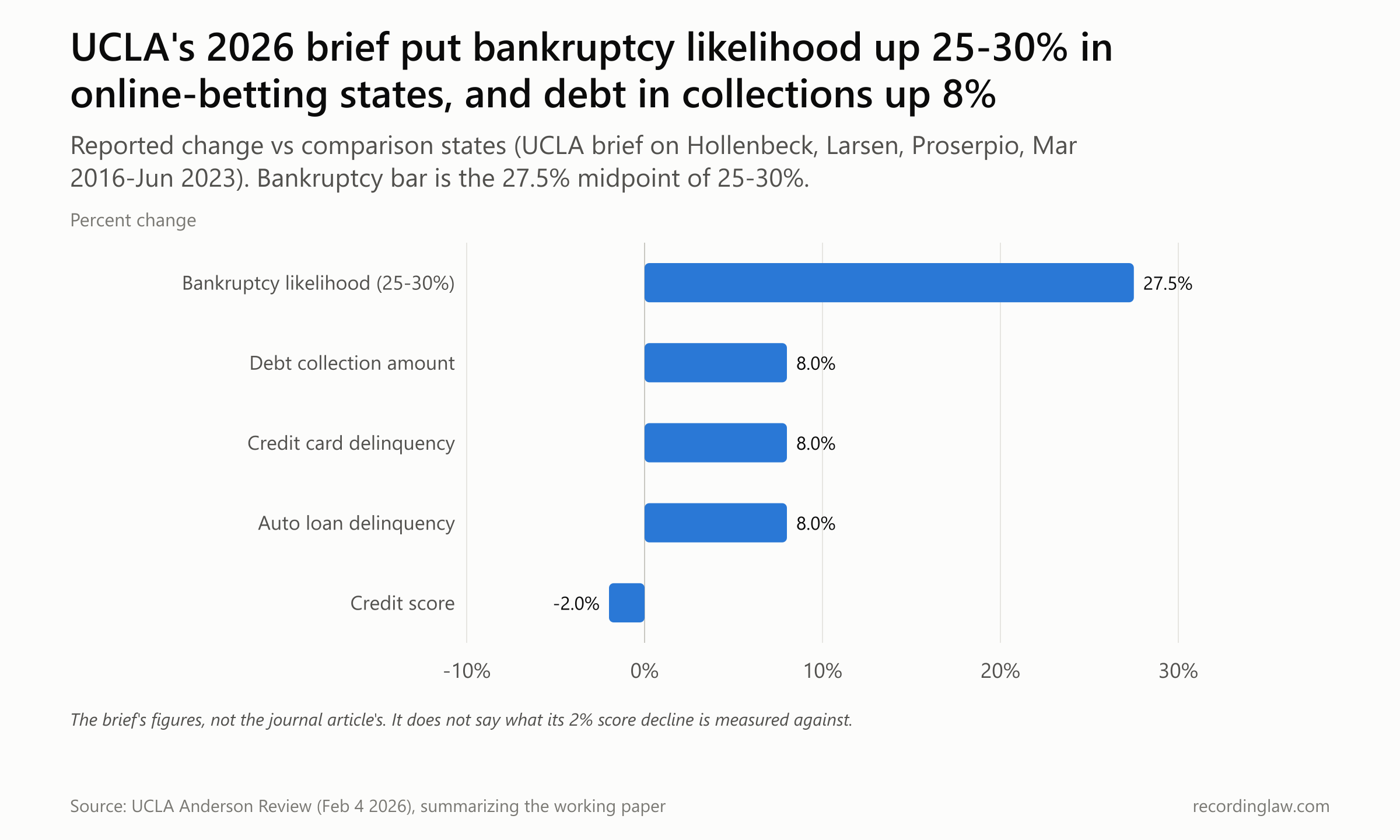
Source: UCLA Anderson Review (February 4, 2026), summarizing Hollenbeck, Larsen and Proserpio. The bankruptcy bar is the midpoint of the brief's 25% to 30% range. These are the brief's figures, not the published article's.
| Outcome in online-betting states | Change reported in the UCLA brief |
|---|---|
| Likelihood of a personal bankruptcy filing | up 25% to 30% |
| Average debt collection amount | up 8% |
| Credit card delinquency | up about 8% |
| Auto loan delinquency | up about 8% |
| Credit score | down about 2% |
The bankruptcy and collections figures match the 2024 drafts. The other two do not. The drafts had card delinquencies falling and scores down nearly 1%.
The brief, which cites the 2024 paper, does not say what its "about 2%" is measured against. The same brief reported that "In states with retail-only gambling, negative effects were very small or not statistically significant."
Two months later, an NPR story carried by Michigan Public reported a third set: credit scores "dipped 0.8 points," with a 10% rise in the likelihood of bankruptcy, from "a study published last year." The story did not say which version of the paper the figures came from.
The journal version came out that summer. Management Science published the article online on July 21, 2026. Its abstract uses General Access to mean any legal sports betting, and it reads: "We find that General Access is associated with a modest decline in average credit scores (0.7 points), whereas the introduction of online sports gambling leads to a substantially larger decline (about 12 points)."
Two differences between the versions are on the record. The first is units. The 2024 drafts measured scores as percentage changes. With average scores near 715 before legalization, 1% is about 7 points, which is where Hollenbeck's "seven literal points" came from.
The second difference is the comparison. The published version reports points, and its second estimate answers a different question.
The 2024 drafts set retail-only states aside and measured online states against states that had not legalized yet. The journal article's 0.7 points is its General Access estimate, for any legal sports betting. Its 12 points is the added effect of introducing online or mobile betting in states that already offered retail betting, which the authors call Retail-to-Online Access.
The published abstract also puts credit card delinquencies among the debts that rise, in its list of "increases in indicators of excessive debt, including bankruptcy filings, debt sent to collections, credit card delinquencies, and auto loan delinquencies." The abstract does not give the size of those increases. The 25% to 30% bankruptcy figure belongs to the 2024 drafts and the 2026 brief, not to the journal article's abstract.
Checking the finding against other data
Other teams, with other data, also found credit problems tied to mobile betting, at different sizes. Jacob Goss of the University of Wisconsin and Daniel Mangrum of the Federal Reserve Bank of New York looked only at mobile legalization. They used sportsbook deposits from anonymized transaction data and the New York Fed's own credit panel, a 5% sample of Equifax records.
"After legalization, the share of consumers 90 or more days past due on any debt product (excluding student loans) rises by 0.36 percentage points," they wrote. The figure is in percentage points, the plain difference between two percentages (from 10% to 12% is two points). For consumers under 40, the increase was 0.74 percentage points, about 5%. Scaled by how many people started betting, that is roughly one more seriously delinquent consumer for every ten new bettors.
They also looked at borders. "In areas within a 15-minute drive of a legal state, delinquency rates for those under age 40 rise by 0.51 percentage points, 68 percent of the increase in legal areas," they wrote, while betting there rose only 22% as much.
The report is preliminary and does not represent the Fed's position. It was revised in October 2026. A March 2026 New York Fed blog post had put the main figure at about 0.3 points. Goss received funding from Arnold Ventures.
The Progressive Policy Institute read the aggregate numbers differently. Michael Mandel compared 2019 with 2024. He found that consumer bankruptcies fell 40% in early-adopter mobile betting states, against 34% nationally. That is a bigger drop in those states than in the nation as a whole.
He also found that credit scores in those states rose 1.8%, about the national rate. "online sports gambling is not producing a tidal wave of consumer bankruptcies and consumer credit downgrades large enough to be seen in the aggregate data," the report said, adding that its results "do not rule out an impact of sports betting on particular subpopulations." The comparison has no control group or trend adjustment, and the report does not name a funder.
National FICO scores rose from 703 in 2019 to 715 in 2024, the institute noted. That rise is roughly the size of the journal article's 12-point estimate. The two numbers measure different things. The institute's is the change in the national average from one year to another.
The journal article instead compares states that added online betting with comparison states over the same quarters, and estimates how far scores in the first group ended up below where they would otherwise have been. If scores went up in both groups but went up more in the comparison states, a state's average could rise over five years and the study would still record a decline there.
The industry's argument runs through a different number. A survey of 2,454 adults by The Innovation Group, commissioned by the American Gaming Association, found that illegal sportsbooks' share of the U.S. market "fell from 36 percent to 24 percent" compared with 2022. "It’s time for a national crackdown on the pervasive illegal market that is draining state coffers and putting people at risk," AGA president Bill Miller said. NPR reported in April 2026 that the AGA could not be reached for its story on the credit research.
Writing the line into law
Lawmakers moved before the journal version appeared. Some acted on the tax side. On June 16, 2025, Pritzker signed a per-bet tax in Illinois. It was 25 cents on each of the first 20 million wagers placed with licensed sportsbooks, and 50 cents after that.
FanDuel and DraftKings each set a 50-cent fee per bet starting September 1. FanDuel had announced its fee on June 10, before the signing.
"We are disappointed that the Illinois Transaction Fee will disproportionately impact lower wagering recreational customers while also punishing those operators who have invested the most to grow the online regulated market in the state," said Peter Jackson, chief executive of FanDuel's parent, Flutter Entertainment. DraftKings chief executive Jason Robins said Illinois "continues to fuel the rapidly growing illegal industry, which pays no taxes or fees and provides none of the consumer protections that regulated operators offer."
Ohio went further. Gov. Mike DeWine signed the 2021 law that legalized both counter and online betting, and in November 2025 he told the Associated Press he "absolutely" regretted it. Repeal, he said, lacked support: "There’s not the votes for that. I can count."
House finance chair Brian Stewart, a fellow Republican, had defended the market: "Ohio legalized sports betting with bipartisan support. It’s a popular activity that adults should be free to enjoy."
On July 1, 2026, Republican Reps. Johnathan Newman and Beth Lear introduced House Bill 971, which would make sports betting available only at retail shops. It would also cap bets at $100, allow eight bets in 24 hours and bar funding accounts with credit cards or borrowed money. "Monetizing addiction to fund public education is the wrong direction for Ohio," Newman said.
The bill would take away most of the market. Covers reported that online betting was 98.5% of the money wagered in Ohio in May 2026, the latest month the Ohio Casino Control Commission had reported when the bill was filed. Covers also reported that retail betting had accounted for about $1 million of the state's year-to-date sports betting tax revenue.
As of November 10, 2026, the legislature's website listed no committee referral for it. In Ohio, a bill not enacted by the end of a General Assembly dies, and the 136th General Assembly's term was set to end with 2026.
Missouri went the other way, by ballot. Amendment 2 was certified on December 5, 2024, with 50.05% of the vote after a record $43 million campaign funded almost entirely by DraftKings and FanDuel. The $14 million opposition was funded entirely by Caesars Entertainment, which runs three of Missouri's 13 casinos.
Each side argued about schools. "Missourians are betting on sports," said Jack Cardetti, spokesman for the yes campaign, Winning for Missouri Education. "They are either doing that through illegal websites, or traveling to one of our seven neighboring states that has legalized betting -- none of which provides any funding to Missourians, or Missouri classrooms." Brooke Foster, speaking for the Caesars-funded opposition, said: "And after DraftKings and FanDuel can take all of these deductions, there's a very real chance that schools could be left with zero."
Mobile betting began on December 1, 2025. In the first month, bettors in Missouri wagered $543 million, more than 99% of it online. That month, the 16 licensed operators handed out more than $125 million in free bets and other promotions. The state's net was about $521,000.
"It doesn’t necessarily match the commercials that got this passed, does it," said Sen. Rusty Black, who chairs Senate Appropriations. Mike Leara, executive director of the Missouri Gaming Commission, said the figures reflected "a market in its early stages, including the impact of significant promotional deductions that are customary during initial rollout."
The New York Fed paper adds a twist for states like Missouri. Near a border, delinquencies among under-40s rose about two-thirds as much as in legal states. Betting there rose about a fifth as much. On that basis its simulation estimated that Missouri "already bore 65 percent of the estimated delinquency increase associated with legalization but only 11 percent of the increase in betting participation" before its own law took effect.
The next deadlines
The national version of the fight sits in Congress. Rep. Paul Tonko of New York and Sen. Richard Blumenthal of Connecticut, both Democrats, reintroduced the SAFE Bet Act in March 2025, a bill to set nationwide standards for the mobile sports betting industry. "In just a few years, the sports gambling industry has become entrenched in every aspect of sports, with every play, pass, pitch, and punt marketed as a moment to bet," Tonko said. Blumenthal described "the science of targeting and tracking gamblers who lose bets and enticing them to bet more and more until they are driven into ruin."
The AGA's Chris Cylke said of the bill's 2024 version that regulated operators are "contributing billions in state taxes across the U.S., protecting consumers from dangerous neighborhood bookies and illegal offshore websites." The National Council on Problem Gambling, which takes no position on legalization, neither backed nor opposed the 2024 version, saying it "lacks the necessary investment in public health infrastructure to adequately address gambling addiction."
The House version was referred to the Energy and Commerce and Natural Resources committees on March 11, 2025. As of November 10, 2026, congress.gov showed no further action. The 119th Congress was scheduled to end on January 3, 2027, and a SAFE Bet Act not passed by then lapses and would have to start over in the next Congress.
A federal route around the states' counter-or-app choices is also in court. Kalshi sells sports event contracts under federal commodities law, and federal appeals courts have split. In September 2026 New Jersey asked the Supreme Court to review the Third Circuit's ruling for Kalshi (No. 26-299); as of November 10, 2026, the Court had not acted on it, and Kalshi's response was due December 7. Closer to home, Missouri's first full year of mobile betting covers December 2025 through November 2026; the figures above are from its first month.
In January 2025, Hollenbeck told a Minnesota committee room of three senators that the online effect was about seven points. The journal's figure for adding the app is about 12, measured a different way.
In Ohio, where online betting took 98.5% of the money wagered in May 2026, the bill to keep only the counter had not reached a committee as of November 10, 2026.
How we measured
The Hollenbeck, Larsen and Proserpio study, by version. We read the July 2024 working paper (a public copy) and the October 2024 version submitted to the Minnesota Senate in full, the UCLA Anderson Review brief of February 4, 2026, and the abstract of the Management Science article (DOI 10.1287/mnsc.2025.02515, published online July 21, 2026, accepted by Jean-Pierre Dube, marketing). Figures attributed to the published article come from its abstract. Each figure in this story is attributed to the version it comes from. The 2024 figures (0.3%, nearly 1%, 25% to 30% bankruptcy, about 8% and about $30 in collections, card limits down 1.6% and nearly 2.7%, card delinquencies falling, 30,000 bankruptcies and $8 billion) are not the published article's figures. The SSRN copy was last revised February 24, 2026.
Units. The 2024 drafts estimated the change in the logarithm of credit scores, which reads as a percentage. With a pre-legalization average near 715, 1% is about 7 points (715 x 0.01 = 7.15). Our arithmetic: 12 points on a 715 base is about 1.7% (12 / 715 = 0.017). The estimates chart converts the 2024 percent figures the same way: about 0.3% of 715 is about 2.1 points (715 x 0.003 = 2.1), and nearly 1% is about 7, Hollenbeck's own figure. The Progressive Policy Institute comparison is in the table but not on the chart. It reports raw 2019-to-2024 changes (scores in early-adopter states up 1.8%, about the national rate) with no control group. It is not an estimate against comparison states, so it has no point on the same scale. The New York Fed and Baker studies are table-only because they measured other outcomes, late payments and savings. The UCLA brief does not say how it got "about 2%," and we do not assume it came from this calculation. NPR did not say which version its figures (0.8 points, 10%) came from.
Samples. Roughly 7 million people is the full credit panel; 4,382,529 people (about 4.4 million) and 90 million quarterly observations is the 2024 analysis sample after dropping movers and incomplete records. The study counts 38 states with legal betting (UCLA brief) or 39 states and the District of Columbia (latest abstract), depending on version and date. The table of states by form of legal betting uses the UCLA brief's counts at the end of the study window, June 2023.
Design and what it cannot show. The Hollenbeck, Baker and New York Fed studies all use staggered difference-in-differences: states that legalized are compared with states that had not yet, before and after each start date. That is the basis for their causal language, and it is not a randomized experiment. The study windows include the pandemic years, when household credit moved nationwide for reasons unrelated to betting; the comparison states absorb nationwide shifts, but not changes specific to the states that legalized. The Hollenbeck and New York Fed estimates are averages over whole populations and do not identify who bet. The 2024 drafts did not estimate a separate retail-only effect; the retail-only description comes from the 2026 UCLA brief and the Regulatory Review's 2024 summary.
Other studies. Baker, Balthrop, Johnson, Kotter and Pisciotta (NBER working paper 33108, November 2024; Journal of Financial Economics, volume 183, 2026) use bank and card transaction data; its abstract and the January 2025 Minnesota slides put the sample at about 230,000 households (the Regulatory Review says over 200,000). Goss and Mangrum (Federal Reserve Bank of New York Staff Report 1184, February 2026, revised October 2026) use the New York Fed Consumer Credit Panel and transaction data from 16 sportsbooks; it is preliminary. The Progressive Policy Institute's September 2025 report compares state bankruptcy counts and average FICO scores in 2019 and 2024 without a control group. The American Gaming Association's illegal-market estimate comes from a survey it commissioned.
Market figures. New York's first-month figures are from the governor's office. Missouri's first-month figures are from the Missouri Independent, as republished by Spectrum News; the state's net was $521,200. Ohio's 98.5% online share and the $1 million retail tax figure are from Covers, citing the Ohio Casino Control Commission. Missouri's vote share is the certified 50.05% reported by the Associated Press.
Frequently Asked Questions
Does sports betting hurt credit scores?
Studies of credit-bureau data find average scores lower in states that legalized, with larger effects where betting is online. The Management Science article by Hollenbeck, Larsen and Proserpio (published online July 21, 2026) reports a 0.7-point decline for any legal sports betting and about 12 points for adding online betting where in-person betting already existed. These are averages over whole state populations, not the change for an individual bettor.
Is online sports betting worse for finances than betting at a casino?
In every version of the Hollenbeck study, effects were larger where betting was online. The 2026 UCLA Anderson Review summary says that in retail-only states the negative effects were very small or not statistically significant. A New York Fed staff report that studied only mobile legalization found the share of consumers 90 or more days late on debt rose 0.36 percentage points.
Did bankruptcies rise after sports betting was legalized?
The July 2024 draft of the Hollenbeck study estimated that the likelihood of a bankruptcy filing rose by as much as 25% to 30% three to four years after online legalization. The 2026 UCLA brief repeats that range. The published article's abstract lists bankruptcy filings among the increases but does not give a size. A Progressive Policy Institute comparison, without a control group, found bankruptcies fell 40% from 2019 to 2024 in early-adopter mobile states, against 34% nationally.
Why do reports of the sports betting credit score study give different numbers?
The figures come from different versions and units. The 2024 drafts reported percent changes (about 0.3% for any legal betting, nearly 1% for online, roughly 7 points). The published 2026 abstract reports points (0.7 and about 12) and defines its online comparison differently. The UCLA brief does not say what its about 2% is measured against, and NPR did not name the version behind its 0.8 points.
How many states allowed only in-person sports betting?
At the end of the Hollenbeck study's window in June 2023, 8 of the states in its sample allowed in-person betting only, 21 allowed both in-person and online, and 3 allowed online only. Nevada was excluded. This story does not list the states by name.
Is Ohio banning online sports betting?
Ohio House Bill 971 was introduced on July 1, 2026 by Republican Reps. Johnathan Newman and Beth Lear. It would make sports betting retail-only, cap bets at $100, allow eight bets in 24 hours and bar funding with credit cards. As of November 10, 2026, the legislature's website listed no committee referral. An Ohio bill not enacted by the end of the 136th General Assembly, whose term was set to end with 2026, dies. Gov. Mike DeWine has said repeal lacks the votes.
What is the SAFE Bet Act?
It is a federal bill from Rep. Paul Tonko and Sen. Richard Blumenthal setting national standards for sports betting. The House version, H.R. 2087, was referred to two committees on March 11, 2025, with no further action shown on congress.gov as of November 10, 2026. Bills not passed by the end of the 119th Congress, scheduled for January 3, 2027, must be reintroduced.
Updates
Reworded for readability. No figures, quotes, sources or findings changed.
Restructured as a feature: chart titles state the finding, side details moved to How we measured. Every figure and quote was re-checked against its source.
Independently fact-checked against the cited primary sources
Independently fact-checked against the cited primary sources
Sources and References
- Murphy v. National Collegiate Athletic Assn., 584 U.S. 453 (2018), preliminary print(supremecourt.gov).gov
- Oyez, Murphy v. NCAA (No. 16-476): decision date and vote(api.oyez.org)
- NPR, Supreme Court Strikes Down Federal Sports Betting Ban (May 14, 2018)(npr.org)
- NPR, Gamblers in New Jersey get their first opportunity to place a legal bet (June 12, 2018)(npr.org)
- NPR Here & Now, sports betting and gambling addiction (May 21, 2018)(npr.org)
- Goss and Mangrum, Sports Betting Across Borders, Federal Reserve Bank of New York Staff Report 1184 (Feb. 2026, revised Oct. 2026)(newyorkfed.org)
- Capitol Fax, text of Gov. Pritzker budget address excerpt (Feb. 25, 2019)(capitolfax.com)
- WCBU / Associated Press, Illinois governor looks to legal sports betting for revenue (Mar. 4, 2019)(wcbu.org)
- Office of the Governor of New York, nearly $2 billion in wagers over first 30 days of mobile sports wagering (Feb. 2022)(governor.ny.gov).gov
- UCLA Anderson Review, As States Permitted Online Sports Gambling, Citizens’ Personal Financial Health Suffered (Feb. 4, 2026)(anderson-review.ucla.edu)
- Hollenbeck, Larsen and Proserpio, The Financial Consequences of Legalized Sports Gambling, working paper (July 2024 version, public copy)(static.poder360.com.br)
- Hollenbeck, Larsen and Proserpio, working paper (October 2024 version), Minnesota Senate Finance Committee(assets.senate.mn).gov
- SSRN abstract page, The Financial Consequences of Legalized Sports Gambling (last revised Feb. 24, 2026)(papers.ssrn.com)
- Hollenbeck, Larsen and Proserpio, Management Science (published online July 21, 2026), abstract(doi.org)
- The Regulatory Review, The Consequences of America’s Big Bet on Sports Gambling (Dec. 10, 2024)(theregreview.org)
- Front Office Sports, gambling study on credit scores and bankruptcies (July 29, 2024)(frontofficesports.com)
- Minnesota Senate Finance Committee, minutes of Jan. 8, 2025(lrl.mn.gov).gov
- Scott R. Baker, presentation to the Minnesota Senate Finance Committee (Jan. 8, 2025)(lrl.mn.gov).gov
- Covers, Minnesota committee hearing on risks of online sports betting (Jan. 2025)(covers.com)
- Baker, Balthrop, Johnson, Kotter and Pisciotta, Gambling Away Stability, NBER Working Paper 33108(nber.org)
- Michigan Public / NPR, When legal sports betting surges, so do Americans’ financial problems (Apr. 4, 2026)(michiganpublic.org)
- Michael Mandel, Progressive Policy Institute, Balancing Innovation and Risk (Sept. 2025)(progressivepolicy.org)
- American Gaming Association, illegal-market analysis by The Innovation Group (Aug. 2025)(americangaming.org)
- Covers, Illinois governor signs budget with sports betting tax increase (June 2025)(covers.com)
- WSET / The National Desk, Ohio governor regrets legalizing sports betting, report says (Nov. 2025)(wset.com)
- Covers, Ohio lawmakers introduce legislation to ban online sports betting (July 2, 2026)(covers.com)
- KY3 / Associated Press, sports betting wins narrow approval in Missouri (Dec. 5, 2024)(ky3.com)
- Fulton Sun, sports betting ballot measure pushed as education funding (Sept. 25, 2024)(fultonsun.com)
- St. Louis Public Radio, foes of Missouri sports betting ballot item (Oct. 21, 2024)(stlpr.org)
- Spectrum News (Missouri Independent), Missouri sports betting tops $543M in first month (Jan. 30, 2026)(spectrumlocalnews.com)
- Rep. Paul Tonko, Tonko, Blumenthal Reintroduce SAFE Bet Act (Mar. 2025)(tonko.house.gov).gov
- American Gaming Association, statement on proposed SAFE Bet Act (Sept. 12, 2024)(americangaming.org)
- National Council on Problem Gambling, statement on the SAFE Bet Act (Sept. 2024)(ncpgambling.org)
- Congress.gov, H.R. 2087 (119th Congress), all actions(congress.gov).gov
- Covers, Kalshi CEO confident amid prospect of Supreme Court showdown (Oct. 22, 2026)(covers.com)