Half the Calls in Massachusetts' 2023 Gambling Helpline Surge Were Logged as Non-Helpline

Independently fact-checked against primary sources (last audited November 10, 2026). · 8 primary sources cited on this page. How we verify our legal content
In the first week of legal sports betting in Ohio, in January 2023, the state's casino regulator moved to fine three of the biggest sportsbooks. The Ohio Casino Control Commission proposed $150,000 fines each against BetMGM, Caesars and DraftKings. Part of the problem, Cleveland 19 reported, was ads that broke rules requiring them to "clearly and conspicuously contain a message designed to prevent problem gambling as well as a helpline number to help access resources."
The phone at that helpline was already ringing more. In December, before the January 1 launch, the Ohio Problem Gambling Helpline averaged 20 calls a day. In January it averaged 48, according to Derek Longmeier, who runs the Problem Gambling Network of Ohio, the network that operates the line. Comparing that January with January 2022, he told WHIO: "Weren't really expecting three times the call volume."
Within months, increases like Ohio's were being quoted far beyond the state. In May 2023, staff at the Massachusetts Gaming Commission set four of them side by side in a single memo: Ohio up 227%, Massachusetts contacts to the national helpline up 730%, Colorado up 45%, Virginia up 77%.
A helpline counts contacts: calls, chats and texts from people in trouble, from their families, from people who misdialed and from people who wanted help with a betting app. The rules that put a helpline number in sports-betting ads put that number in front of everyone who saw the ad.
So what can a jump in helpline calls say about gambling harm, and what can it not? The agencies that run the lines have answered much of that in their own reports. As of November 10, 2026, Massachusetts lawmakers had a bill pending that would rewrite the disclaimer itself.
Four numbers in a memo about taxes
On May 23, 2023, the Massachusetts Gaming Commission met to decide whether sportsbooks could deduct promotional bets from the revenue the state taxes. Promotional bets are the free bets that sportsbooks hand out to win customers. A deduction would shrink the tax, and with it the money for the state's Public Health Trust Fund.
The staff memo for that meeting came from research director Mark Vander Linden and research manager Bonnie Andrews. It was titled "Responsible Gaming Considerations in sports wagering promotional taxation." Under the heading "Increased problem gambling helpline calls," it reported: "However, for the period of February 1, 2023, to March 31, 2023, 872 calls, chats and texts have been received from Massachusetts to the national problem gambling helpline 1-800-Gambler, an increase of 730% increase from the same period last year." Ohio's 227%, Colorado's 45% and Virginia's 77% sat beside it.
Each figure came from a real count, but no two counted the same thing. How large were the jumps? That depended on which line was counted, and over which weeks.
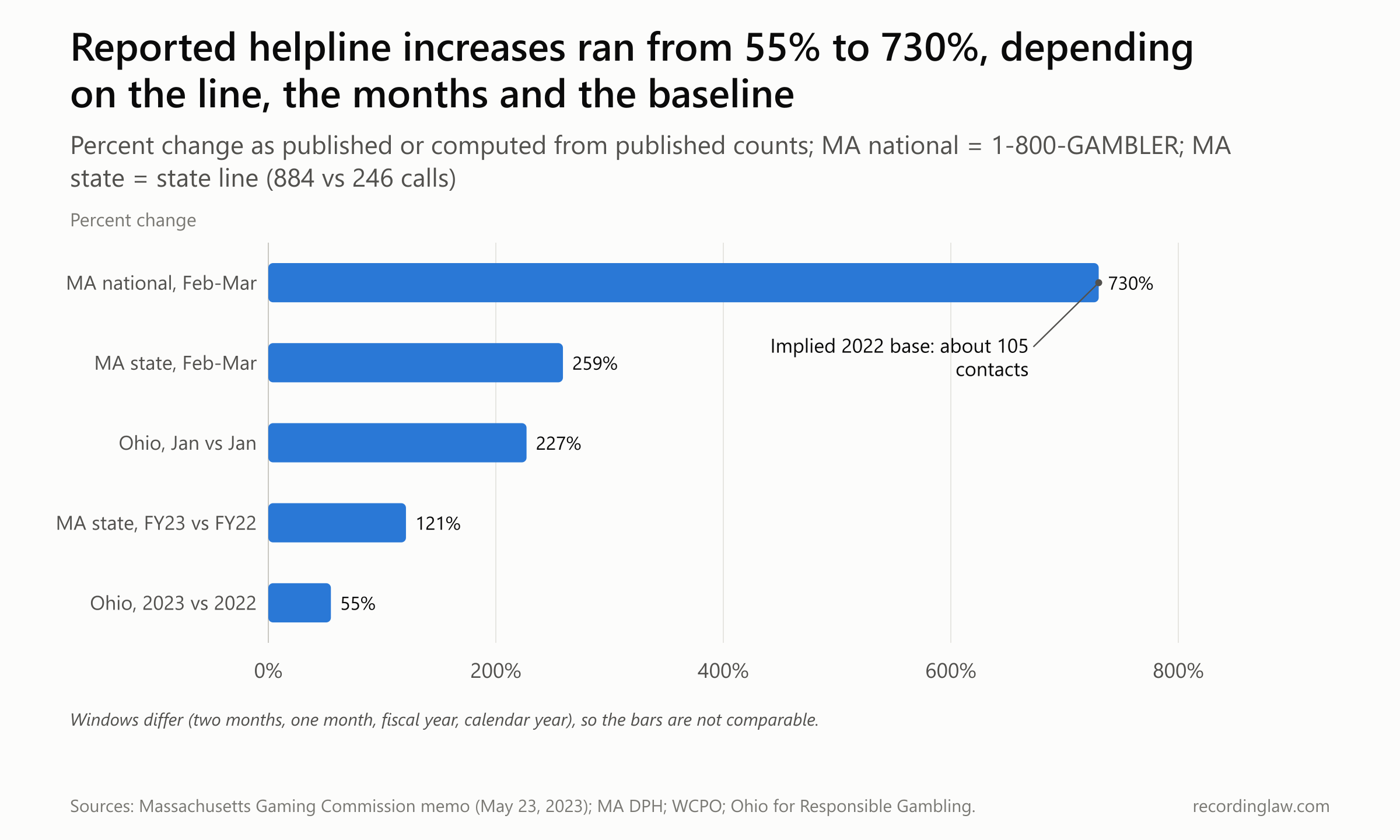
Sources: Massachusetts Gaming Commission memo (May 23, 2023); Massachusetts Department of Public Health helpline reports; WCPO, citing the Problem Gambling Network of Ohio; Ohio for Responsible Gambling.
| Reported increase | Window | Before | After |
|---|---|---|---|
| 730% (MA contacts to national line) | Feb. 1 to Mar. 31, 2023 vs same weeks of 2022 | about 105 (implied) | 872 |
| 259% (MA state line) | Feb. and Mar. 2023 vs Feb. and Mar. 2022 | 246 | 884 |
| 227% (Ohio) | Jan. 2023 vs Jan. 2022 | 456 | 1,492 |
| 121% (MA state line) | Fiscal 2023 vs fiscal 2022 (July to June) | 1,378 | 3,050 |
| 55% (Ohio) | Calendar 2023 vs 2022 | 6,835 | 10,637 |
When each of the four memo figures is traced to its source, it comes with a qualifier. Ohio's 227% compared January 2023 with January 2022. In January 2022 the line took 456 calls, which was fewer than its 2022 monthly average of about 570.
The 730% compared 872 Massachusetts contacts to the national line, 1-800-Gambler, with roughly 105 in the same weeks a year earlier. The memo did not give the 105. It is worked back from the 872 and the 730%. Over those same two months, Massachusetts' own helpline went from 246 calls in 2022 to 884 in 2023.
The memo did not say where Colorado's 45% came from. The same figure appears in an October 2022 KTLA report. In it, Peggy Brown, president of the Problem Gambling Coalition of Colorado, said calls rose from 6,688 in 2020 to 9,686 in 2021.
Colorado's law took effect in May 2020, so the starting year already contained about eight months of legal betting. The year 2020 was also the first year of the COVID-19 pandemic. Brown described the callers this way: "The basic call is coming in in a state of emergency when people have no recourse, they're out of money, they're out of time."
Virginia's 77% came from a September 2021 release by the Virginia Council on Problem Gambling. The release said the council's helpline was funded by the Virginia Lottery.
Among callers seeking help that year, the lottery came first, at 21%. Next, at 18% each, came the video terminals in stores and bars known as skill games and casino or track slot machines. Among the same callers, sports wagering came fourth, at 12%.
Carolyn Hawley, the council's president, said: "The jump in call volume signifies a need for funding to grow a network of treatment professionals who can be available to treat this rising need." She also said: "We do acknowledge that there is more awareness and publication of the helpline phone number that could also be driving the increase in call volume."
The commission voted 5-0 to keep taxing promotional bets, so sportsbooks could not deduct them, Legal Sports Report wrote the next day. The same memo summarised what Rachel Volberg's UMass research team had forecast for the commission before legalization: a possible rise in gambling-related harm, "though the magnitude of these impacts is expected to be modest."
Others expected more. Keith Whyte, then executive director of the National Council on Problem Gambling, told the Boston Globe in April 2023 that he expected Massachusetts "to see an increase in the severity of existing gambling problems and perhaps an increase in the rate of gambling problems."
Rebecca Bishop, project director of the Massachusetts Center of Excellence on Problem Gambling Prevention, told the Globe: "These ads are everywhere. No one can really get away from them." The paper reported that Vander Linden, the commission's research director and a co-author of the memo, said the state's advertising rules were "already among the most rigorous in the country."
Legal Sports Report, describing the commission's presentation, added one more caution: in other new jurisdictions, some of the callers "believe it is customer service." The note said it was unclear whether that was true of Massachusetts bettors. Why would a bettor dial a problem-gambling line for customer service? The rules had put its number in the ads.
Why the ads carry a phone number
The helpline number is the most common rule in sports-betting advertising. The American Gaming Association, the casino and sportsbook trade group, put it in its voluntary marketing code: "Each message will contain a conspicuous responsible gaming message along with a toll-free helpline number, where practical." The same code makes the industry's case for advertising at all: "Further, advertising plays an essential role in migrating players away from the pervasive illegal market."
Researchers at UMass Amherst, reviewing ad rules for the Massachusetts Gaming Commission in 2024, found the same pattern across jurisdictions. "The most common requirement is that gambling advertisers feature a toll-free problem gambling helpline number across different media," their report says.
States wrote their own versions. Massachusetts' rule, 205 CMR 256.05, says each sports-wagering ad "shall include a link to and phone number for the Massachusetts Problem Gambling Helpline using language provided by the Department of Public Health." Ohio's rule requires "messages designed to prevent problem gambling" and lets operators choose among the national line, the Ohio helpline or another approved free line, so Ohio ads did not all carry the same number.
The people behind these rules described them as a way to reach people. "Ohio has been working to raise awareness about the Problem Gambling Helpline prior to the launch of sports gaming and de-stigmatize seeking help," Jessica Franks, the Ohio commission's communications director, told WCPO in February 2023. In Virginia two years earlier, Jessica Fiel of the American Gaming Association put the industry's version plainly: "But that's the reason the legally regulated market is so essential because we can step in to help."
None of the sponsors or regulators quoted here predicted how many calls the number would bring. Longmeier, whose network answers Ohio's line, read the early rise as the system doing its job: "People see the helpline and are making those calls and getting resources to the help they need." He added that as more Ohioans gamble, "more Ohioans will need help, so it's good that we're seeing them seek that help as well." On the Massachusetts line, the people answering the phones had already noticed the callers who took it for customer service.
Who was on the line in Massachusetts?
Online betting began in Massachusetts on March 10, 2023. Three weeks later, the Boston Globe reported from the call center run by Health Resources in Action, which answers the state's helpline at 1-800-327-5050. Some callers, it wrote, mistakenly thought the number in the ads was for customer service, "and their problem involves using the betting app."
The monthly counts show the size of that wave. Retail sportsbooks had opened earlier, on January 31, 2023.
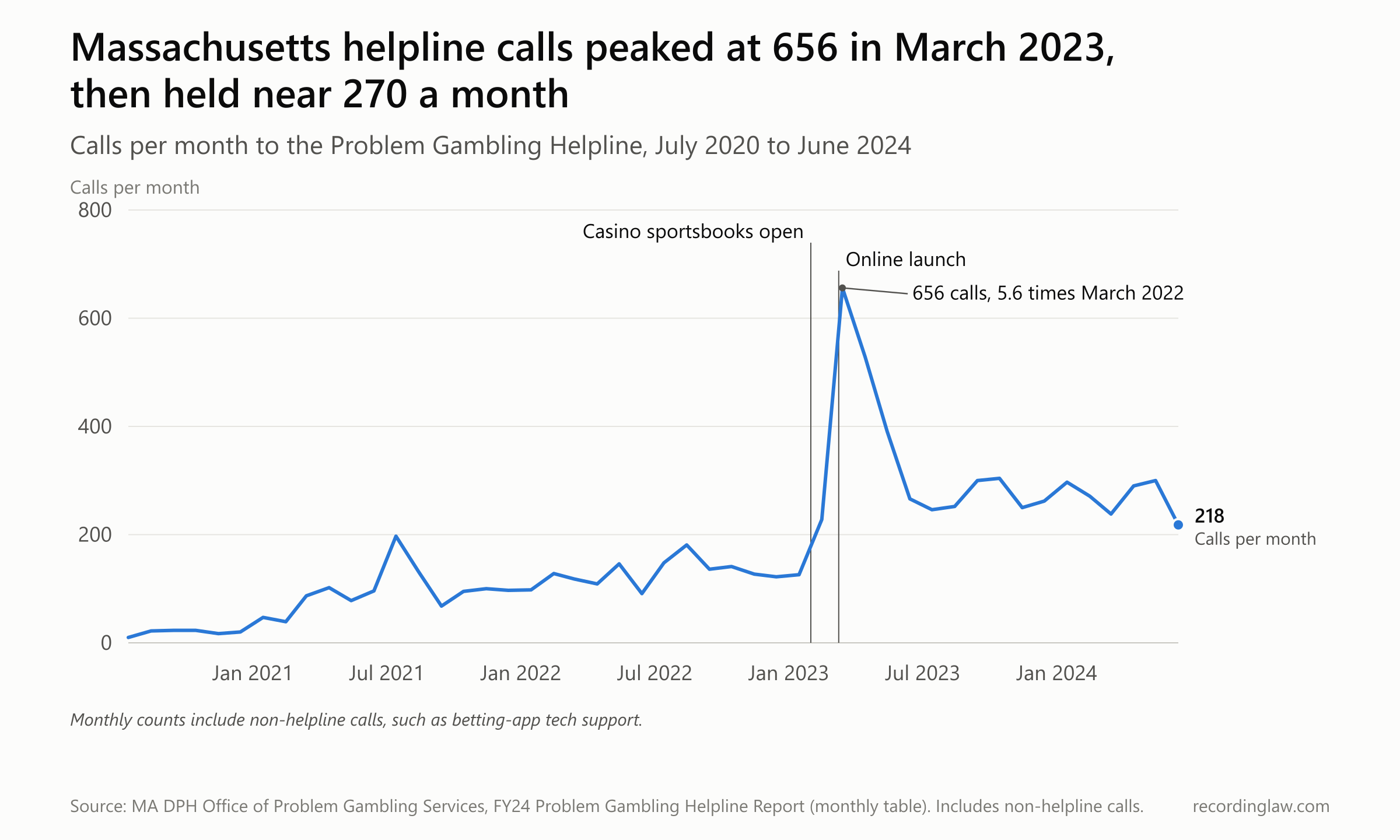
Source: Massachusetts Department of Public Health, Office of Problem Gambling Services, FY24 Problem Gambling Helpline Report (monthly table, fiscal 2021 to 2024).
| Month | Calls | Same month a year earlier |
|---|---|---|
| January 2023 | 126 | 98 |
| February 2023 | 228 | 128 |
| March 2023 | 656 | 118 |
| April 2023 | 528 | 109 |
| May 2023 | 391 | 146 |
| June 2023 | 266 | 91 |
| March 2024 | 238 | 656 |
| June 2024 | 218 | 266 |
Calls peaked at 656 in March 2023. That was more than five times the 118 calls of March 2022.
Massachusetts' fiscal year runs from July to June, so fiscal 2022 ended in June 2022, before any sportsbook opened. After the peak, calls settled at more than twice the monthly level of fiscal 2022, which was about 115 calls a month.
The state health department's report on that year, released on May 15, 2024, said what the peak was made of. "Of the 2,069 calls in that time, 1,043 were non-helpline calls," it said of February through June 2023. "In general, non-helpline calls were callers looking for technical support for their sports wagering mobile applications and platforms." That is about half of the calls in those five months.
The department drew its own conclusion. "There is currently no evidence to support that the increase in call volume and referrals is a direct result of an increase in problem gambling in the Commonwealth," its announcement said. It listed likely explanations: better helpline services, public awareness campaigns, community education "and sports wagering advertisements."
The same reports also count calls that were about gambling help, and those rose too. Calls from individuals seeking help went from 155 in fiscal 2021 to 301 in fiscal 2022. In fiscal 2023 they reached 380. The department said the rise in calls from individuals and their loved ones "could be attributed to the growing visibility of the Problem Gambling Helpline phone number and website, rather than to an increase in the number of individuals experiencing concerns with problem gambling," and that it was monitoring to confirm.
Calls from people in recovery went from 27 in fiscal 2022 to 89 in fiscal 2023. Among calls that ended in a referral, those that named sports betting went from 6 in fiscal 2022 to 73 the next year and 81 the year after.
Victor Ortiz, who directs the department's Office of Problem Gambling Services, spoke to that group when the report came out. "Expanded access to gambling in the Commonwealth poses risks, particularly to those in recovery, and highlights the need to provide responsive referrals to callers based on their needs," he said in the department's announcement. Calls that ended in a referral went from 452 in fiscal 2022 to 636 in fiscal 2023 and 578 in fiscal 2024. In fiscal 2023 and 2024, that was about one in five of all calls to the state's helplines.
The tech-support calls did not go away. In fiscal 2024, total calls to the state's helplines rose 5%, to 3,280. That combined figure also counts gambling calls to the substance use line.
Of those 3,280 calls in fiscal 2024, 881, about 27%, "were related to a technical issue with a sports betting mobile application or platform, which is categorized as a call to the wrong number." The department's proposed fix was in the ad itself: "These calls may be reduced by improving the clarity and visibility of the Helpline on disclaimers for all sports wagering advertisements."
The rule was not always followed either. In August 2025, State Auditor Diana DiZoglio's office reported that "17 advertisements did not provide people affected by gambling addiction with the Massachusetts Problem Gambling Helpline."
Massachusetts' line has data through June 2024. Ohio, which launched a month earlier, has a longer record of what came after the spike.
What happened in Ohio after that first January?
The 1,492 calls Ohio's helpline took in January 2023 were the basis of the 227% figure. A total of 168 of those January 2023 calls "were specifically noted for being about daily fantasy sports or sports betting," Covers reported. That is about one in nine. Ohio for Responsible Gambling offered two reasons for the jump, as Covers relayed them: "Many people were apparently calling to check on 'free money' after placing wagers," and there was "a general interest in the availability of online sports betting generated by publicity surrounding the existence of the problem gambling helpline itself."
The regulator said the same. "Some calls to the helpline are unrelated to seeking help, but this is still an opportunity to reach out to these individuals and let them know about the resources that are available," Franks told WCPO. In the same article, William Roberts, who manages recovery services for Public Health Dayton and Montgomery County, said his program's numbers had "not increased greatly" yet. But he added: "I continue to predict it's going to get a lot worse, especially as they continue to increase easy access and proximity to gambling."
What did the line do after January? Ohio's casino commission published monthly totals from March 2023 to March 2024. February 2023 was not published.
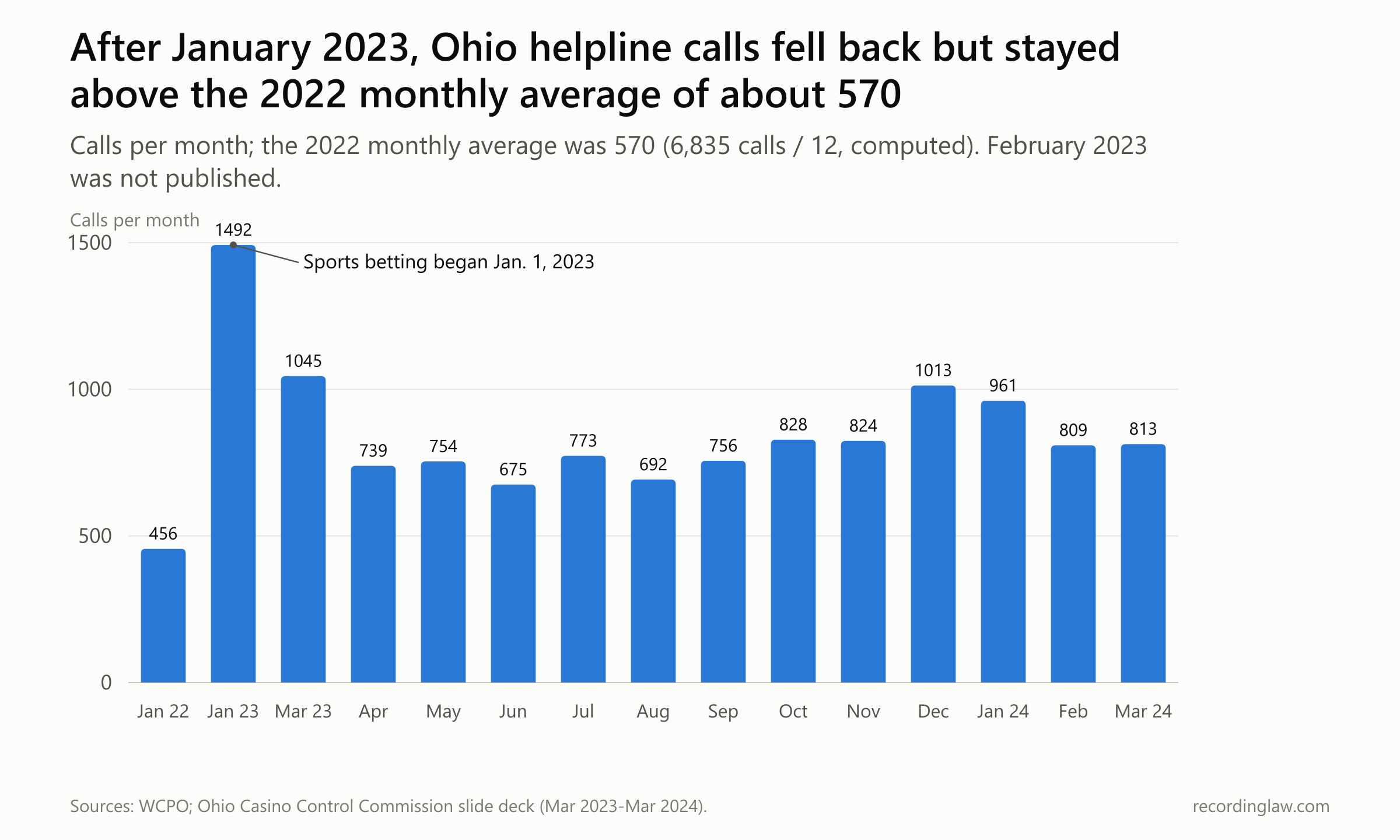
Sources: Problem Gambling Network of Ohio via WCPO (January 2022 and 2023); Ohio Casino Control Commission statistics deck, April 2024 (March 2023 to March 2024).
| Month | Calls |
|---|---|
| January 2022 | 456 |
| January 2023 | 1,492 |
| March 2023 | 1,045 |
| June 2023 | 675 |
| September 2023 | 756 |
| December 2023 | 1,013 |
| January 2024 | 961 |
| March 2024 | 813 |
After January 2023, monthly calls fell back, mostly to between about 700 and 1,000 a month. That was still above the 2022 monthly average of about 570. January 2024, with 961 calls, was about a third below January 2023.
The longer view comes from the state's behavioral health department, which reports to the casino commission each year. Ohio's state fiscal year runs from July to June, so its totals cover different months from the calendar-year totals for Ohio in the table near the top of this story. The helpline took 5,706 calls in fiscal 2022 and 9,448 in fiscal 2023, the year that included the launch. In the two years after that, it took 9,724 in fiscal 2024 and 9,460 in fiscal 2025.
| State fiscal year (July to June) | Helpline calls | Chats |
|---|---|---|
| 2020 | 6,047 | 386 |
| 2021 | 6,301 | 601 |
| 2022 | 5,706 | 715 |
| 2023 | 9,448 | 1,009 |
| 2024 | 9,724 | 538 |
| 2025 | 9,460 | 361 |
The count rose by about two-thirds in the launch year, from 5,706 to 9,448. It has stayed near that level since. The department's November 2025 report described the 9,460 contacts as "peaking in March during Problem Gambling Awareness Month, a signal of increased engagement and outreach efforts."
A reader could take the flat stretch to mean that gambling problems in Ohio leveled off. The count cannot show that, just as the January jump could not show that they had risen. It records how many times people contacted one line, for whatever reason they had.
Ohio's figures give totals and a few labels. Pennsylvania's helpline publishes something rarer: a breakdown of every contact it logs.
What a helpline log contains
The Council on Compulsive Gambling of Pennsylvania logged 26,751 contacts in 2024. Its annual report sorts them into categories, and most are not people asking for help with gambling.
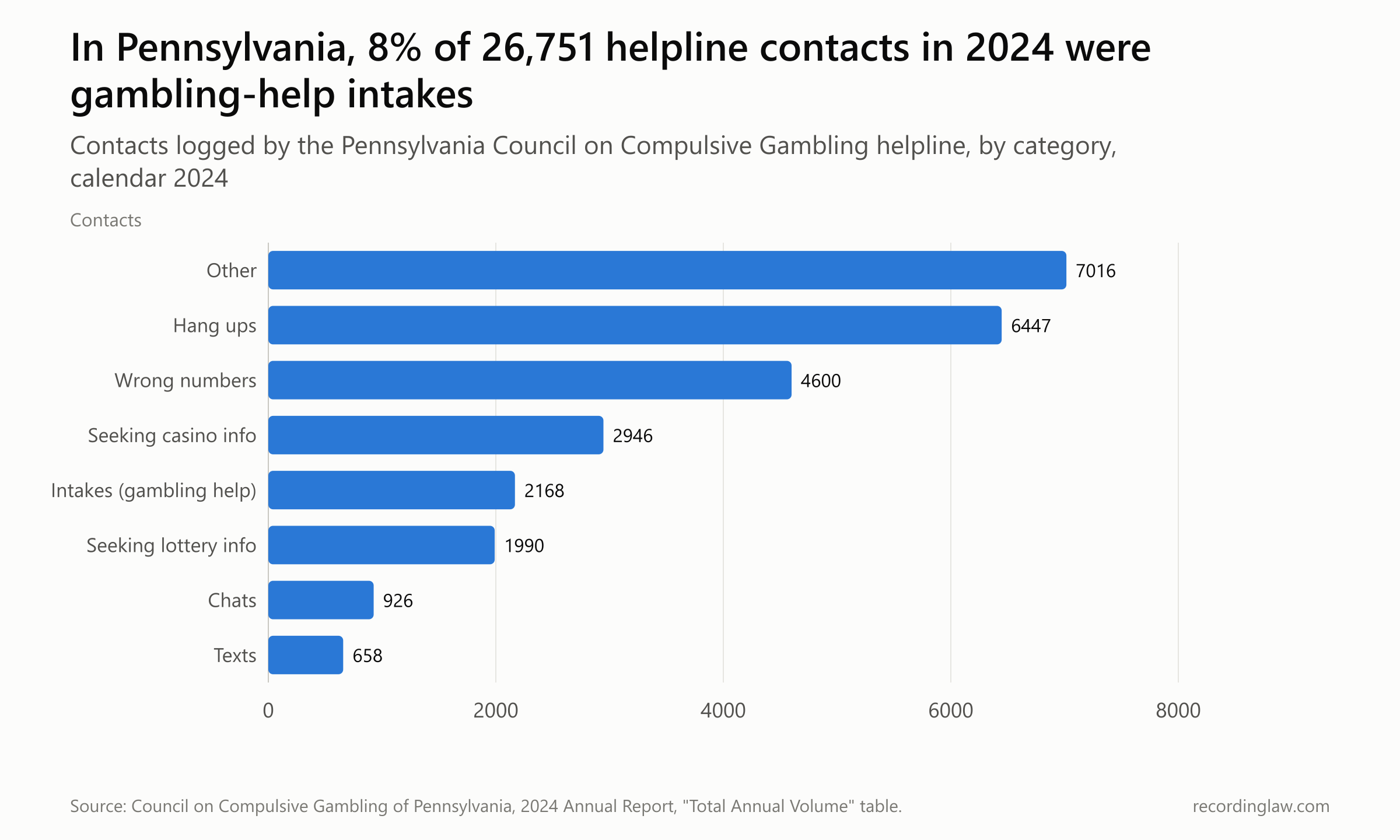
Source: Council on Compulsive Gambling of Pennsylvania, 2024 annual report.
| Category (2024) | Contacts | Share |
|---|---|---|
| Other | 7,016 | 26.2% |
| Hang ups | 6,447 | 24.1% |
| Wrong numbers | 4,600 | 17.2% |
| Seeking casino information | 2,946 | 11.0% |
| Intake calls (gambling help) | 2,168 | 8.1% |
| Seeking lottery information | 1,990 | 7.4% |
| Chats | 926 | 3.5% |
| Texts | 658 | 2.5% |
| Total | 26,751 | 100% |
About one contact in four was a hang-up, and about one in twelve was an intake call.
The council defines intake calls as those from "callers who actually have a gambling problem, have relapsed or know someone with a gambling problem." Wrong numbers are callers who "indicated that they had mistakenly contacted the Helpline Center." Josh Ercole, the council's executive director, told PlayUSA in 2023 that a rise in calls is not entirely bad news.
What a report can say depends on which of those categories it counts. NBC News reported in April 2024 that Pennsylvania's council "saw call volume more than double from 2020 to 2023."
By the council's own tables, total logged contacts rose about 50% over those years, from 11,963 to 17,970. Intake calls rose about 142% over the same years, from 1,115 to 2,693. Either count could sit behind a claim of growth, but only one of them more than doubled. The chart below sets each count's 2020 level at 100, so the 150 for all contacts in 2023 is their 50% rise, and the 242 for intake calls is their 142% rise.
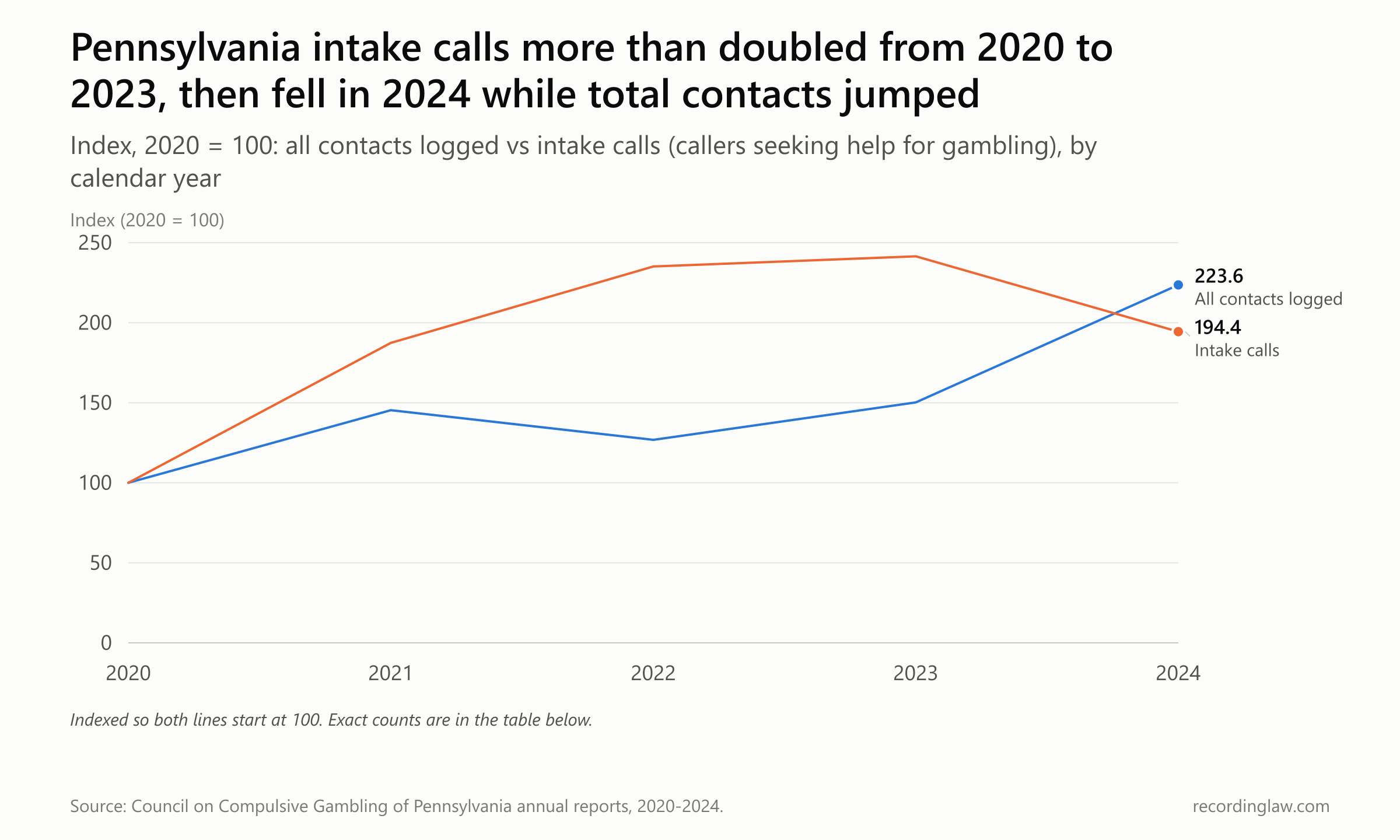
Source: Council on Compulsive Gambling of Pennsylvania annual reports, 2020 to 2024.
| Year | All contacts logged | Intake calls | Total requests for help |
|---|---|---|---|
| 2020 | 11,963 | 1,115 | n/a |
| 2021 | 17,380 | 2,090 | n/a |
| 2022 | 15,166 | 2,621 | 2,963 |
| 2023 | 17,970 | 2,693 | 3,208 |
| 2024 | 26,751 | 2,168 | 2,819 |
In 2024 the two lines moved apart. Total contacts rose by about half, from 17,970 to 26,751, and intake calls fell, from 2,693 to 2,168.
The council also keeps a broader count of requests for help, which adds help-seeking chats, texts and office calls. That count followed the same path as intake calls, falling from 3,208 in 2023 to 2,819 in 2024. Calls about sports betting went the other way, rising from 313 in 2023 to 364 in 2024.
Virginia's line shows the same split from the operator's side. Of the 7,790 calls it received in the first ten months of 2023, "only 764 were from folks seeking help with a gambling problem," Axios Richmond reported. The council read the rest differently, Axios wrote: it "considered those calls the first step toward seeking help as it found the majority of people who end up asking for help have called the hotline before."
Those breakdowns come from state lines. The national line, which carries the largest count in the country, ran into a problem of its own in 2025.
The national count, and the number it lost
The National Problem Gambling Helpline, run by the National Council on Problem Gambling, logged 377,410 contacts in 2025, after 402,504 in 2024. Those counts come from its 2025 annual report, prepared by the Omni Institute and published in May 2026.
What the national line counts has changed several times. Until mid-2022 the series covered calls and texts to 1-800-522-4700 and web chat.
In the report's table of data sources, calls to 1-800-GAMBLER were added from July 2022. The same table adds texts to that number from October 2022 and the 800GAM text line from February 2023. The council's online dashboard gives a different start date for 1-800-GAMBLER traffic, June 1, 2023.
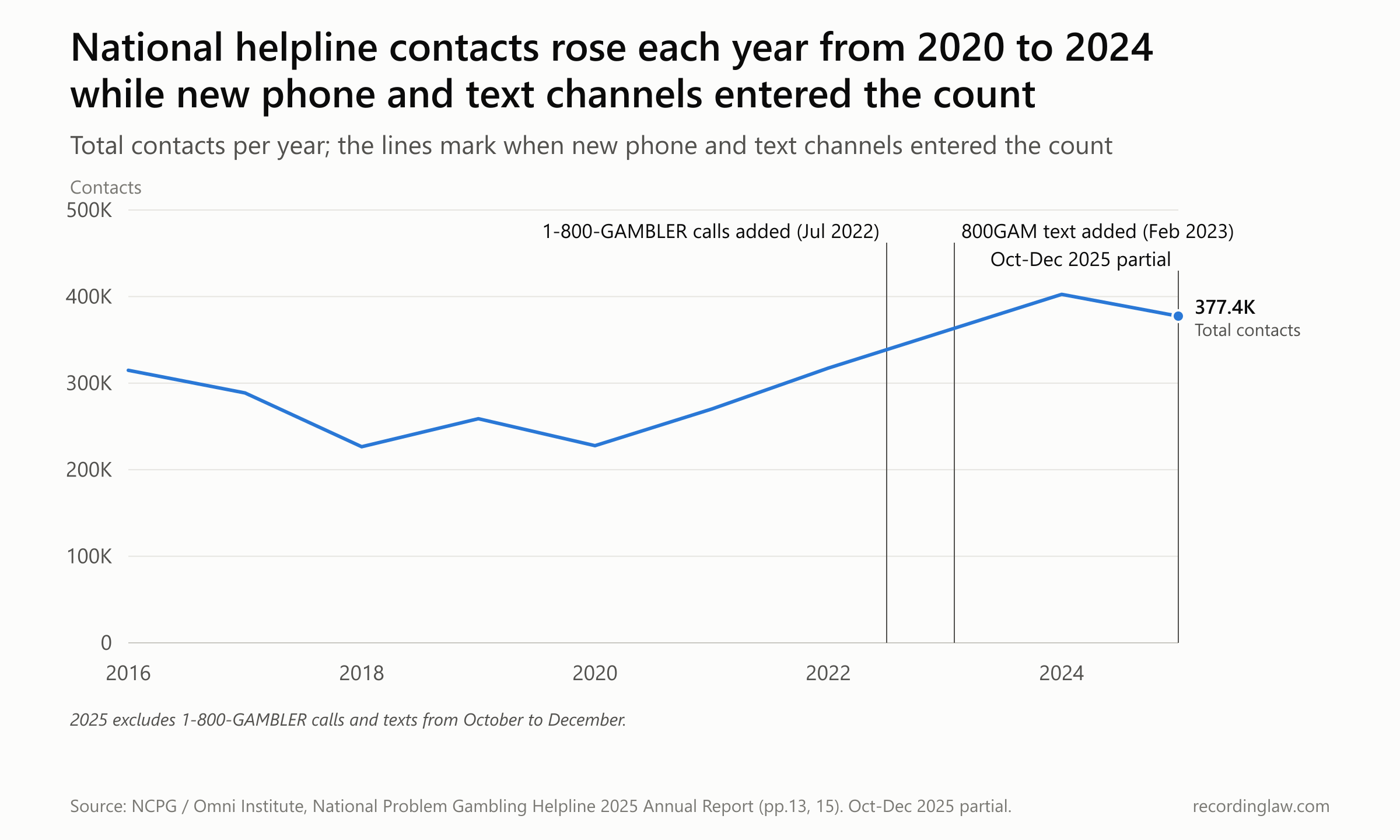
Source: National Council on Problem Gambling and Omni Institute, National Problem Gambling Helpline 2025 Annual Report (pages 13 and 15).
| Year | Total contacts | What was counted |
|---|---|---|
| 2016 | 314,816 | 1-800-522-4700 and web chat |
| 2018 | 226,523 | Same (report cites telecom data gaps) |
| 2020 | 227,819 | Same (report cites telecom data gaps) |
| 2021 | 270,118 | Same |
| 2022 | 317,411 | 1-800-GAMBLER calls added in July, texts in October |
| 2023 | 359,946 | 800GAM texts added in February |
| 2024 | 402,504 | All of the above |
| 2025 | 377,410 | 1-800-GAMBLER calls and texts missing October to December |
Part of the rise from 2022 to 2024 coincides with new phone and text channels entering the count. The 2025 figure is missing the last three months of 1-800-GAMBLER traffic.
1-800-GAMBLER was the number some state rules required operators to advertise. It belonged to the Council on Compulsive Gambling of New Jersey. In September 2025, "following a legal dispute with a long-standing partner organization, a court order required NCPG to cease management and use of 1-800-GAMBLER as the National Problem Gambling Helpline™ number," the annual report says.
The national council warned that "state regulations that require operators to advertise 1-800-GAMBLER as the problem gambling helpline could directly conflict with these trademark restrictions." The New Jersey council's executive director, Luis Del Orbe, told Covers: "There will be no lapse."
On September 29, 2025, the national council said it would run its helpline on its older number, 1-800-522-4700, "until a permanent solution can be determined." In January 2026 it launched a new number, 1-800-MY-RESET, and the older one stayed active. Its annual report opens with an apology: "Most importantly, we are deeply sorry for any confusion or added difficulty experienced by individuals and families seeking help during this transition." As of November 10, 2026, its dashboard says: "Reporting methodology changed on October 1, 2025, so contact volume before and after that date is not directly comparable."
The report says what its own numbers can and cannot mean. "Do not interpret contact volume as a direct measure of harm," it says. It lists awareness or marketing, routing changes and greater comfort with chat and text as other reasons counts move.
In 2025, states where sports betting was legal online only had 114.8 contacts per 100,000 people, and states with both retail and online betting had 116.3. States with no legal sports betting in any format had 101.8. The report says such differences "may reflect a combination of factors, including greater overall gambling participation, increased exposure to helpline messaging through mandatory responsible gambling disclosures in gambling advertisements, and greater public awareness of problem gambling resources available."
Who pays for the national line has become a question of its own. The council describes itself as "neutral on legalized gambling." Its 2024 tax return shows $9.1 million in revenue, 83.9% of it contributions.
The NFL Foundation funds the helpline modernization project with a $6.2 million three-year grant announced in 2021, and the report's acknowledgements say so. FanDuel, DraftKings, Caesars and Bally's sponsored its 2026 conference. Kalshi gave it $2 million in 2026. "NCPG believes that all entities that profit from gambling have both an ethical and financial responsibility to help mitigate gambling-related harm," executive director Heather Maurer said in July 2026.
On June 26, 2026, the Ohio Casino Control Commission's interim executive director, Andromeda Morrison, wrote to withdraw the commission from the council over the Kalshi partnership. "I appreciate NCPG's continued position of neutrality on gambling; however, NCPG's actions are not neutral," she wrote.
Michigan and Nevada groups also left. As of September 2026, the Massachusetts Gaming Commission had stayed. "When it comes up for renewal, I'm sure we'll have another conversation," its chairman, Jordan Maynard, said in September 2026.
Can anyone separate awareness from harm?
One study cited here has tried, and it used the national series. Gorkem Turgut Ozer of the University of New Hampshire, Brad Greenwood of George Mason University and Anand Gopal of Nanyang Technological University compared states that legalized sports betting at different times. The method is called a difference-in-differences comparison, which sets the change in places or groups with the law against the change in those without it over the same period, assuming both would otherwise have moved alike. Their paper, published in Information Systems Research in 2026, reports that "the number of calls associated with problem gambling is uncorrelated with the legalization of physical sportsbooks" but "strongly correlated with the legalization of online sports betting."
In numbers, the University of New Hampshire's September 2026 release says online legalization "was associated with a 22.8% increase in calls to the National Problem Gambling Hotline, and a 3.1% increase in suicide rates." Greenwood, quoted by George Mason, said: "That effect appears to be uniquely digital."
The paper's authors acknowledge "the assistance of the National Council on Problem Gambling in conducting this research." This story relies on the abstract and the universities' releases. Those do not give the confidence intervals, the years covered or whether the model accounts for the 2022 and 2023 changes in what the national series counted.
| What the study compared | Where we read it | Reported result |
|---|---|---|
| Legal physical sportsbooks | Paper abstract | "uncorrelated" with calls associated with problem gambling |
| Legal online sports betting | Paper abstract | "strongly correlated" with those calls |
| Legal online sports betting | University of New Hampshire release | "associated with a 22.8% increase" in National Problem Gambling Hotline calls |
Shown as a table, not a chart: the abstract and the releases give no interval for either finding.
Other readings start from the same counts and land in different places. "We believe, nationwide, the rate and severity of gambling problems have increased across the United States since 2018," Whyte told NBC News in 2024. Writing about a 138% rise in Florida's helpline calls in April 2026, Guy Bentley and Adrian Moore of the Reason Foundation, a libertarian think tank, argued: "Conflating a spike in helpline volume with a spike in gambling disorder is a category error."
In the same NBC News report, the industry spoke to advertising and access rather than to the call counts. Cait DeBaun of the American Gaming Association suggested that advertising is "one of the top reasons that customers move to legal, regulated sportsbooks." FanDuel's spokesperson, Chris Jones, said the company was "making sure that the small percentage of people in the United States that should not be using our platform" are "not able to get access to it."
Weekly counts do not settle the question either. The national report says weeks around major football games, "most notably Super Bowl LIX," had some of 2025's highest weekly volumes. But it says contact records do not typically capture which event prompted a contact, "making it impossible to directly link any given contact to a particular event or sport."
What Massachusetts may change next
In Massachusetts, the state health department that oversees the helpline has already proposed changing how the number appears in ads. Its fiscal 2024 report said the Office of Problem Gambling Services "is currently conducting a research study of disclaimer language on sports betting advertisement to better understand its impact and its clarity on consumers," with a final report to go to the gaming commission and legislators. No published version of that study could be found as of November 10, 2026. On that date, the department's fiscal 2025 helpline report was not yet listed on its site.
Two bills would change the ads. S.240 would "establish a single standardized disclaimer" for sports betting, casino and lottery ads with "a single phone number for the MA Gambling Helpline." It was reported favorably by committee on January 5, 2026, and sent to the Senate Ways and Means Committee.
S.302, the Bettor Health Act from Sen. John Keenan, goes further: a 51% tax rate, a ban on ads during televised games, a ban on proposition bets and doubled contributions to the Public Health Trust Fund. Keenan voted for the 2022 law. He has since apologized for it: "I want to apologize to those who find themselves in the dark spaces of betting addiction, and to those working through recovery and to their families and friends." A hearing on his bill was held on November 13, 2025.
Mark Gottlieb of the Public Health Advocacy Institute at Northeastern University, an advocacy group, testified in support. In March 2025, the Sports Betting Alliance, the trade group for DraftKings, FanDuel and BetMGM, had said in a statement: "Raising taxes on sports betting will only drive Massachusetts residents to use unregulated, offshore apps that actively flout state gaming law and required consumer protections."
S.302 was reported favorably on March 9, 2026. As of November 10, 2026, both bills were still in Senate Ways and Means. On that date, the two-year legislative session was scheduled to end in early January 2027.
Back on the Ohio line
In December 2022, before the first legal bet, Ohio's helpline averaged 20 calls a day. That January it averaged 48. Set against January 2022, that month became the 227% in the Massachusetts memo. In the year to June 2025, its 9,460 calls came to about 26 a day.
How many of those daily callers were in trouble with gambling is something the count does not record.
How we measured
Sources. Massachusetts state-line counts come from the Department of Public Health's Office of Problem Gambling Services: the monthly table and fiscal-year totals in the FY24 Problem Gambling Helpline Report (fiscal 2021 to 2024), the FY23 data report (non-helpline calls, calls from individuals seeking help, calls from people in recovery, website sessions) and the department's May 2024 announcement.
The 872 and 730% figures come from the Massachusetts Gaming Commission's May 23, 2023 meeting memo.
Ohio monthly counts for March 2023 to March 2024 come from the Ohio Casino Control Commission's April 2024 statistics deck (slide 4). January 2022 and January 2023 come from the Problem Gambling Network of Ohio via WCPO. Calendar 2022 and 2023 totals (6,835 and 10,637) come via PlayUSA, and the 55% comes from Ohio for Responsible Gambling's release. State-fiscal-year calls and chats come from the Ohio Department of Behavioral Health's SFY 2025-26 annual report and plan (table on page 11).
Pennsylvania figures come from the Council on Compulsive Gambling of Pennsylvania's annual reports for 2020 to 2024. National figures come from the NCPG and Omni Institute 2025 annual report (published May 22, 2026; annual bar labels on page 15, data sources table on page 13, state rates in Table 7). Colorado and Virginia figures come from the people and releases named in the text; the primary state reports were not located.
Arithmetic. Massachusetts non-helpline share, February to June 2023: 1,043 / 2,069 = 50.4%. Fiscal 2024 tech-issue share: 881 / 3,280 = 26.9%. February plus March on the state line: 128 + 118 = 246 (2022) and 228 + 656 = 884 (2023), an increase of 259%.
The implied 2022 base for the 730%: 872 / 8.3 = about 105. March 2023 against March 2022: 656 / 118 = 5.6.
Monthly level on the problem-gambling line: 1,378 / 12 = 115 in fiscal 2022 and 3,228 / 12 = 269 in fiscal 2024, 2.3 times as many. Referral share: 636 / 3,112 = 20% (fiscal 2023) and 578 / 3,280 = 18% (fiscal 2024), as the department's reports state.
Ohio 2022 monthly average: 6,835 / 12 = 569.6; January 2023 against that average: 1,492 / 569.6 = 2.62. January 2024 against January 2023: 961 / 1,492 = 35.6% lower. Sports or fantasy share of January 2023 calls: 168 / 1,492 = 11.3%.
Ohio calls per day: 1,492 / 31 = 48.1 in January 2023, matching the 48 the network gave; 9,460 / 365 = 25.9 in state fiscal 2025 (July 2024 to June 2025). The December 2022 figure of 20 a day is the network's.
Ohio fiscal 2022 to 2023: 9,448 / 5,706 = 65.6% higher; fiscal 2025 against fiscal 2023: 0.1% higher. Ohio calendar 2023 against 2022: (10,637 - 6,835) / 6,835 = 55.6%, published as 55%.
Pennsylvania index (2020 = 100), used in the chart: total contacts 145.3, 126.8, 150.2 and 223.6 for 2021 to 2024; intake calls 187.4, 235.1, 241.5 and 194.4. Pennsylvania 2020 to 2023: total contacts 17,970 / 11,963 = 50.2% higher, intakes 2,693 / 1,115 = 141.5% higher; 2020 to 2024: total 123.6% higher, intakes 94.4% higher; 2023 to 2024 total contacts: 26,751 / 17,970 = 48.9% higher. Colorado: 9,686 / 6,688 = 44.8% higher.
Windows and breaks. The increases in this story use different windows (single months, two-month windows, state fiscal years from July to June, calendar years) and cannot be compared with each other. Colorado's 2020 base year and Ohio's fiscal 2020 and 2021 (July 2019 to June 2021) fall wholly or partly in the COVID-19 pandemic, so they are unusual baselines.
Massachusetts' problem-gambling line merged with the state's Substance Use Helpline in July 2020, so fiscal 2021 is a ramp-up year. The line's monthly counts include non-helpline calls. Fiscal-year totals in this story are for the problem-gambling line (3,050 in fiscal 2023, 3,228 in fiscal 2024). The department's combined "calls to helplines" figures for the same two years (3,112 and 3,280) add gambling calls to the substance use line.
Ohio's calendar-year and fiscal-year totals cover different months, and Ohio's February 2023 count was not published. Pennsylvania's category labels vary slightly by year.
The national series changed what it counted in July 2022, October 2022, February 2023 and October 2025. Its report attributes dips in 2018 and 2020 to telecom data gaps. The series does not include every state's own contact center.
What the data cannot show. None of these counts measures how many people have a gambling problem. A call is a contact, and one person can call several times, call for someone else, call by mistake or call about an app.
The counts also move with ad exposure, outreach campaigns and changes in phone numbers and channels. The only causal estimate here (the Information Systems Research study) was read through its abstract and the universities' releases, not its full text. No published evaluation of whether the helpline-number ad rule changes who reaches help was found for this story.
What comes next. Ohio's behavioral health department presented its fiscal 2025 report to the casino commission on November 19, 2025. The next one, covering July 2025 to June 2026, had not been posted as of November 10, 2026; it would show whether the flat stretch held for a third year.
The national council's 2025 report came out in May 2026, and its 2026 report, if it follows the same calendar, would arrive around May 2027. It would be the first full year after 1-800-GAMBLER left the count, on a series its own operator says cannot be directly compared with what came before.
Massachusetts' fiscal 2025 helpline report and the health department's disclaimer study had not been published as of November 10, 2026. S.240 and S.302 were still in Senate Ways and Means on that date, with the session scheduled to end in early January 2027.
Frequently Asked Questions
Do more calls to a gambling helpline mean more problem gambling?
Not on their own. The Massachusetts health department said there was no evidence its 2023 rise reflected more problem gambling. The national helpline's 2025 report says contact volume is not a direct measure of harm. Counts include wrong numbers, hang-ups, information requests and app tech-support calls, as well as people seeking help.
Why did gambling helpline calls jump when sports betting launched in Ohio and Massachusetts?
The jumps came in the launch months. From February to June 2023, 1,043 of 2,069 calls to the Massachusetts line were non-helpline calls, mostly betting-app tech support. Calls from people seeking help and people in recovery also rose. Ohio's regulator said some January 2023 calls were unrelated to seeking help.
Why do sports betting ads include a problem gambling helpline number?
State rules require it in places such as Massachusetts (205 CMR 256.05) and Ohio, and the American Gaming Association's voluntary marketing code calls for a toll-free helpline number in each message where practical. Ohio lets operators choose among approved lines, so its ads do not all carry the same number.
What happened to 1-800-GAMBLER?
The number belongs to the Council on Compulsive Gambling of New Jersey. In September 2025 a court order required the National Council on Problem Gambling to stop using it for the national helpline. On September 29, 2025 the national council said it would run the national line on its older number, 1-800-522-4700, until a permanent solution was determined. In January 2026 it launched a new number, 1-800-MY-RESET, and the older number stayed active.
How many calls does the Massachusetts problem gambling helpline get?
The Massachusetts Problem Gambling Helpline (1-800-327-5050) logged 1,378 calls in fiscal 2022, 3,050 in fiscal 2023 and 3,228 in fiscal 2024. Counting gambling calls to the substance use line as well, calls across the state's helplines averaged 273 a month in fiscal 2024. About 27% of fiscal 2024 calls were about technical issues with betting apps.
Does online sports betting increase calls to gambling helplines?
A 2026 study in Information Systems Research, comparing states that legalized at different times, associated online sports betting legalization with a 22.8% increase in national hotline calls and found no such link for retail sportsbooks. The national series it used changed what it counted in 2022 and 2023, and the abstract and the universities' releases do not say whether the model accounts for that.
Updates
Corrected: The closing section called Ohio's rise from 20 calls a day in December 2022 to 48 in January 2023 the jump behind the 227% in a Massachusetts memo. The 227% compares January 2023 with January 2022.
Restructured as a feature: chart titles state the finding, side details moved to How we measured. Every figure and quote was re-checked against its source.
Independently fact-checked against the cited primary sources
Independently fact-checked against the cited primary sources
Sources and References
- Massachusetts Gaming Commission, meeting materials for May 23, 2023, including the staff memo on responsible gaming and promotional-play taxation(massgaming.com)
- Massachusetts Department of Public Health, DPH report shows uptick in calls to state's Problem Gambling Helpline(mass.gov).gov
- Massachusetts DPH Office of Problem Gambling Services, FY23 Problem Gambling data report(mass.gov).gov
- Massachusetts DPH Office of Problem Gambling Services, FY24 Problem Gambling Helpline Report(maproblemgamblinghelpline.org)
- Massachusetts Gaming Commission, 205 CMR 256: Sports Wagering Advertising (final rule)(massgaming.com)
- Volberg et al. (SEIGMA, UMass Amherst) for the Massachusetts Gaming Commission, Impacts of Advertising on Gambling Behavior in Massachusetts (2024)(massgaming.com)
- Office of the Massachusetts State Auditor, Massachusetts Gaming Commission audit, Finding 1(mass.gov).gov
- Massachusetts Legislature, S.240 (194th General Court) bill history(malegislature.gov).gov
- Massachusetts Legislature, S.240 bill text(malegislature.gov).gov
- Massachusetts Legislature, S.302 (194th General Court) bill history(malegislature.gov).gov
- Boston Globe, Will online sports betting increase problem gambling? (April 2, 2023)(bostonglobe.com)
- Boston Globe, Mass. gambling helpline call volume increase (May 15, 2024)(bostonglobe.com)
- Legal Sports Report, MA sports betting promotional deductions nixed by commissioners (May 24, 2023)(legalsportsreport.com)
- State House News Service, Apologetic senator regrets vote to legalize sports betting(statehousenews.com)
- CBS Boston, Massachusetts bill would limit sports betting (March 31, 2025)(cbsnews.com)
- CDC Gaming, Massachusetts regulators opt to stay with NCPG for now (September 2026)(cdcgaming.com)
- Cleveland 19, BetMGM, Caesars, DraftKings fined by Ohio Casino Control Commission (January 7, 2023)(cleveland19.com)
- Ohio Adm.Code 3775-16-08 (sports gaming advertising), via Cornell LII(law.cornell.edu)
- WCPO, Calls to gambling helpline tripled in January (February 20, 2023)(wcpo.com)
- WHIO, Calls tripled to Ohio's problem gambling helpline last month compared to 2022(whio.com)
- Covers, Ohio sees significant rise in problem gaming helpline calls (March 8, 2023)(covers.com)
- PlayUSA, Ohio problem gambling helpline calls rose (2023 and 2022 totals)(playusa.com)
- Ohio for Responsible Gambling release via PR Newswire, Nearly 1 in 5 Ohioans are at risk of problem gambling(streetinsider.com)
- Ohio Casino Control Commission, April 2024 statistics deck (helpline calls by month, March 2023 to March 2024)(dam.assets.ohio.gov).gov
- Ohio Department of Behavioral Health, SFY 2025-26 Ohio Problem Gambling Services Annual Report and Plan (November 19, 2025)(dam.assets.ohio.gov).gov
- Ohio Casino Control Commission letter to NCPG on membership withdrawal (June 26, 2026)(sportsbettingdime.com)
- Council on Compulsive Gambling of Pennsylvania, 2024 annual report(pacouncil.com)
- Council on Compulsive Gambling of Pennsylvania, 2023 annual report(pacouncil.com)
- Council on Compulsive Gambling of Pennsylvania, 2020 annual report(pacouncil.com)
- PlayUSA, The rise in problem gambling calls is a complex reality (March 12, 2023)(playusa.com)
- NBC News via NBC Connecticut, Gambling addiction hotlines say volume is up (April 2024)(nbcconnecticut.com)
- NBC News, Gambling addiction hotline calls and online sports betting (April 6, 2024)(nbcnews.com)
- Axios Richmond, Calls to Virginia's problem gambling hotline (January 9, 2024)(axios.com)
- Virginia Council on Problem Gambling release, helpline sees spike in 2021 call volume (September 2021)(einpresswire.com)
- KTLA report via Fox 5 San Diego, Colorado problem gambling helpline calls (October 2022)(digital-release.fox5sandiego.com)
- National Council on Problem Gambling and Omni Institute, National Problem Gambling Helpline 2025 Annual Report (May 2026)(ncpgambling.org)
- National Council on Problem Gambling, helpline dashboard(ncpgambling.org)
- National Council on Problem Gambling, statement on national access to 1-800-GAMBLER (September 2025)(ncpgambling.org)
- National Council on Problem Gambling, helpline stakeholder FAQ (updated September 29, 2025)(ncpgambling.org)
- Covers, NCPG loses control of 1-800-GAMBLER helpline in court ruling (September 24, 2025)(covers.com)
- ProPublica Nonprofit Explorer, National Council on Problem Gambling Form 990 (2024)(projects.propublica.org)
- CasinoBeats, on NCPG industry funding (July 23, 2026)(casinobeats.com)
- Ozer, Greenwood and Gopal, Let It Ride! An Empirical Investigation of Problem Gambling and the Implications of Legalized Online Sports Betting, Information Systems Research (2026), abstract(pubsonline.informs.org)
- University of New Hampshire, Online sports betting comes at a cost, UNH research finds (September 15, 2026)(unh.edu)
- George Mason University Costello College of Business, on legalized sports betting research (June 2026)(business.gmu.edu)
- Reason Foundation (Bentley and Moore), Florida's surge in gambling helpline calls isn't what it seems (April 15, 2026)(reason.org)
- American Gaming Association, Responsible Marketing Code for Sports Wagering (updated March 28, 2023)(americangaming.org)