State Limits Reached 38% of College Player Bets Offered in the 2026 Men's Tournament, a University of Maryland Count Found

Independently fact-checked against primary sources (last audited November 10, 2026). · 6 primary sources cited on this page. How we verify our legal content
On Feb. 23, 2024, the executive director of the Ohio Casino Control Commission, Matthew T. Schuler, signed a letter that put a price on a kind of bet. By the commission's estimate, Ohio's sportsbooks had taken about $104.6 million in 2023 in wagers that its draft rule would have barred.
The draft covered bets on one college athlete's statistics rather than on a game, which the industry calls player props. It also covered team props that depend half or more on one or two athletes. Those wagers made up 1.35% of everything wagered on sports in the state that year, a total the industry calls the handle.
Schuler's letter carried the arithmetic one step further. Applying Ohio's 20% tax, he wrote, "leads me to extrapolate that Ohio received approximately $2,510,594 in taxes in 2023 from player-specific prop bets." Eight licensed sportsbook operators had filed written objections. He banned the bets anyway, and gave operators until March 1 to void the ones already placed.
The request had come from the NCAA, which said bettors were harassing college athletes over their stat lines and that bets on one player's performance heighten the risks to the integrity of college games. Within six months Maryland, Vermont and Louisiana had taken the same bets off their sportsbooks. Then the list stopped growing. By January 2026 the NCAA's own count of regulators that had agreed was still four, and by September 2026 Missouri and Indiana had said no.
What the bans could reach was measured during the 2026 men's tournament. An analysis by two University of Maryland journalism centers counted nearly 21,000 opportunities to bet on individual college players. It found that state restrictions applied to 38% of them, and that four pick'em fantasy sites offered more such lines than the top six sportsbooks combined. More than two and a half years after Ohio's letter, how far do these bans reach, and does anyone know whether they did what they were for?
Where college player lines were still offered
During the 2026 men's tournament, the Shirley Povich Center for Sports Journalism and the Howard Center for Investigative Journalism at the University of Maryland collected listings from 14 sportsbooks and fantasy platforms. Their dataset held nearly 21,000 unique opportunities to bet on the performance of individual athletes, which this article calls lines.
The analysis was published by Capital News Service, a student-staffed news service. The Howard Center is funded by the Scripps Howard Foundation. The centers describe the count as an incomplete picture.
State restrictions, they found, applied to 38% of those opportunities. Much of the rest sat on pick'em sites, a form of daily fantasy sports (DFS) in which users pick whether an athlete will go over or under a stat line. Sportsbook bans do not cover every platform. How did those sites compare with the sportsbooks the bans were written for?
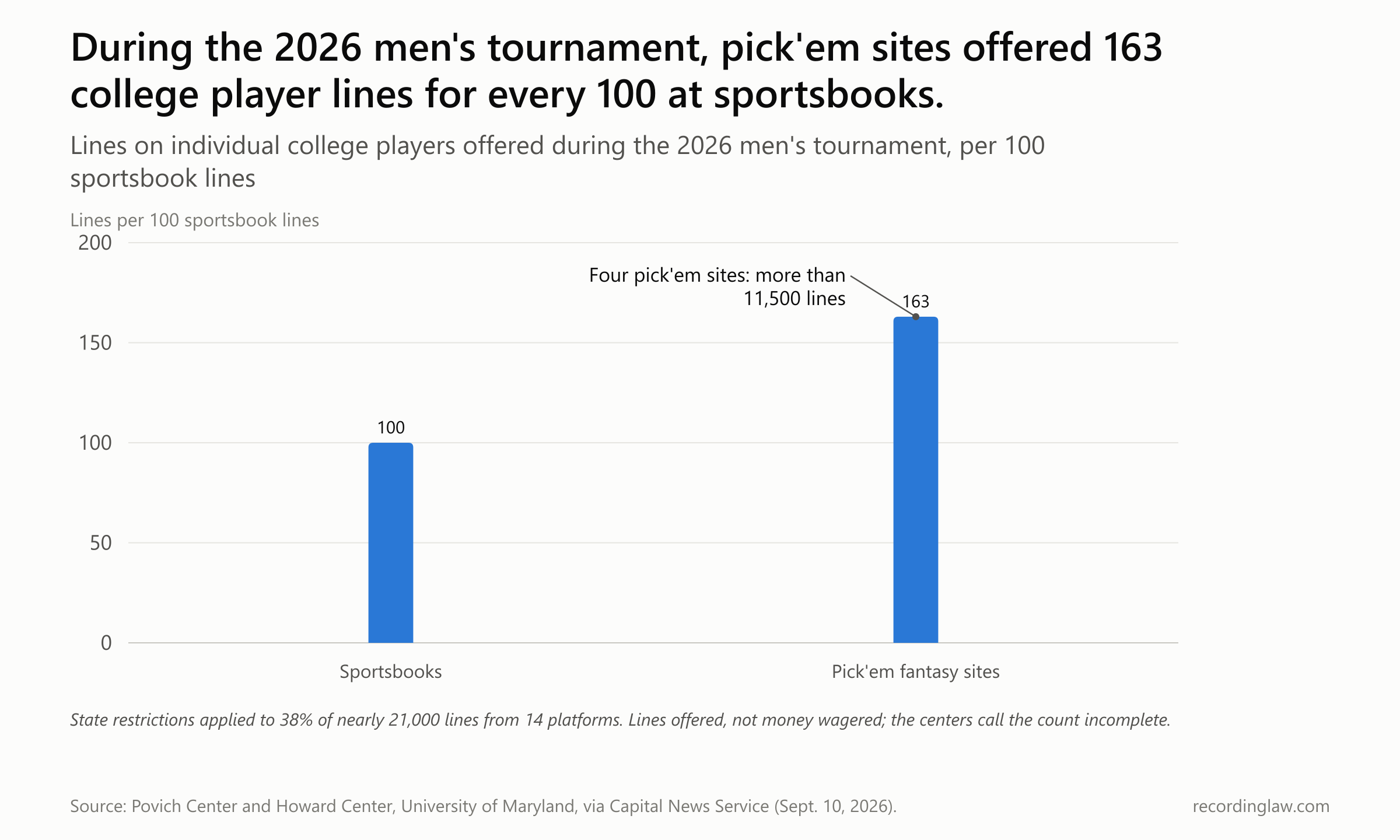
Lines on individual college players offered during the 2026 men's tournament, pick'em sites per 100 at sportsbooks. Source: Povich Center and Howard Center, University of Maryland, via Capital News Service.
| 2026 men's tournament count | Value |
|---|---|
| Unique opportunities to bet on individual college players | nearly 21,000 |
| Share where state restrictions applied | 38% |
| Lines on four pick'em sites | more than 11,500 |
| Pick'em lines for every 100 at sportsbooks | 163 |
| Players listed only on pick'em sites / only at top sportsbooks | 60 / 5 |
Four of those sites offered more than 11,500 such lines on college players during the tournament. That was more than the top six sportsbooks combined, a separate comparison from the chart's, which sets the pick'em sites against all sportsbooks in the count. They listed 60 men's college basketball players who never appeared at the top sportsbooks. Only five players went the other way and were listed only at the top sportsbooks.
Ohio's own players were among those listed. Ohio residents could not legally bet props on any college player in the tournament, including those on Ohio teams. But platforms elsewhere offered more than 200 props on 17 players from four Ohio universities: the University of Akron, Miami of Ohio, Ohio State and Wright State. "Those rules do not reach gamblers outside Ohio," Capital News Service wrote.
The first of the 2024 bans, Ohio's, started with a letter from the NCAA.
Why did the NCAA want these bets gone?
The request arrived by letter dated Jan. 31, 2024. In it, the NCAA asked the commission to prohibit wagers on individual college athletes' performance. It invoked a provision of Ohio's sports gaming law that lets a sports governing body ask the regulator for restrictions.
Ohio had been taking legal sports bets for a year, and the idea was not new there. About two years earlier, News 5 Cleveland reported, Ohio State University wrote to the commission asking it to limit college betting to the outcome of football and basketball games, "no prop bets." That request failed.
This time the governor joined in. "By amending rules to focus bets on the team and away from individual athletes, I believe we can improve the marketplace in Ohio and better protect student-athletes from unnecessary and potentially harmful threats," Gov. Mike DeWine said in early February. NCAA President Charlie Baker, a former Massachusetts governor, added: "The data is clear that student-athletes are getting harassed by bettors."
The NCAA's case was that bets on one player's numbers lead some bettors to go after that player. Schuler's decision put it in the regulator's words: based on what the NCAA provided, it was apparent to him that "player-specific prop bets may be directly related to player-specific harassment." The ban assumed that taking the bet away would reduce the harassment. At that point, no one had measured whether it would.
What the sportsbooks warned
Schuler's decision summarized what the objecting operators had argued. Many argued, in the decision's words, that an outright ban "would drive those in that market to make those bets with illegal operators that have no safeguards in place for customers." Several said they could already investigate customers who bullied or harassed college athletes and take the actions the law required.
The operators' own figures showed how few bets were at stake. Under the same draft definition, an average of 2.2% of the wagering options on each operator's platform would no longer be allowed. That figure counts betting options, not wagers placed.
A second figure counts wagers. The barred bets averaged 0.747% of each operator's 2023 wagers, an average of each operator's own share. The commission's statewide figure was 1.35%, measured against all Ohio sports wagers taken together.
Schuler answered each point with a prediction of his own. On revenue: "While I recognize that there may be a small negative impact to operator and tax revenue, the protection of student-athletes and the integrity of collegiate competitions far outweigh these impacts."
On where the bettors would go, he expected them to stay. "It is likely that many bettors will simply bet on other offerings if player-specific prop bets are not available negating some, if not all, of the revenue impact," he wrote. On the illegal market: "Given the relative small percentage of wagers placed on player-specific prop bets, I perceive the risk of a black market boom to be low."
"The Ohio Casino Control Commission took quick action to protect student-athletes from unnecessary and potentially harmful threats," DeWine said the day of the decision.
Four states in six months
Ohio operators had until Friday, March 1, 2024, to stop taking the bets, with March Madness weeks away. Maryland's sportsbooks stopped taking college player props that day. Bets placed by Feb. 29 were honored and paid out.
Maryland had moved without waiting to be asked. It decided on the ban before an official request from the NCAA, Covers reported. "The intent is to focus college sports wagers on the teams rather than on the individual athletes," a spokesperson for the Maryland Lottery and Gaming Control Agency said.
Vermont, two months into legal betting with three online sportsbooks, rewrote its wagering catalog in early March, Covers reported. A spokesperson for Vermont's Department of Liquor and Lottery told Covers that the department acted after it had reached out to the NCAA itself, and after Covers had asked the department whether the NCAA had been in touch. The department's current sports wagering catalog, dated May 4, 2026, sets the rule: individual player props are prohibited on any NCAA-sanctioned game, and props on the whole team are allowed.
On March 27, Baker took the request national. "Sports betting issues are on the rise across the country with prop bets continuing to threaten the integrity of competition and leading to student-athletes getting harassed," he wrote on social media. The American Gaming Association estimated that $2.7 billion would be bet on that year's men's and women's tournaments through legal sportsbooks, the Associated Press reported.
Louisiana's Gaming Control Board issued its bulletin in April. The bulletin took effect at 8 a.m. on Aug. 1, 2024, before football season. "Some of these bettors get very angry, they lash out at these athletes, they threaten them," said its chairman, Ronnie Johns. He said the board had been working on it before Baker's call: "So the timing on it was coincidental, but we’d actually been working this for a few weeks now."
Johns also expected company. "I think we are going to see roll outs in the next few weeks of orders from a lot of states that have sports betting," he told the Louisiana Radio Network. That prediction would take time to check. For a different question, what Ohio's own ban had cost, the first place to look was the state's monthly betting reports.
Did Ohio's betting shrink?
If the barred bets were 1.35% of handle, and if bettors moved to other wagers as Schuler expected, the ban should be hard to find in Ohio's totals. Does the monthly record show anything at all?
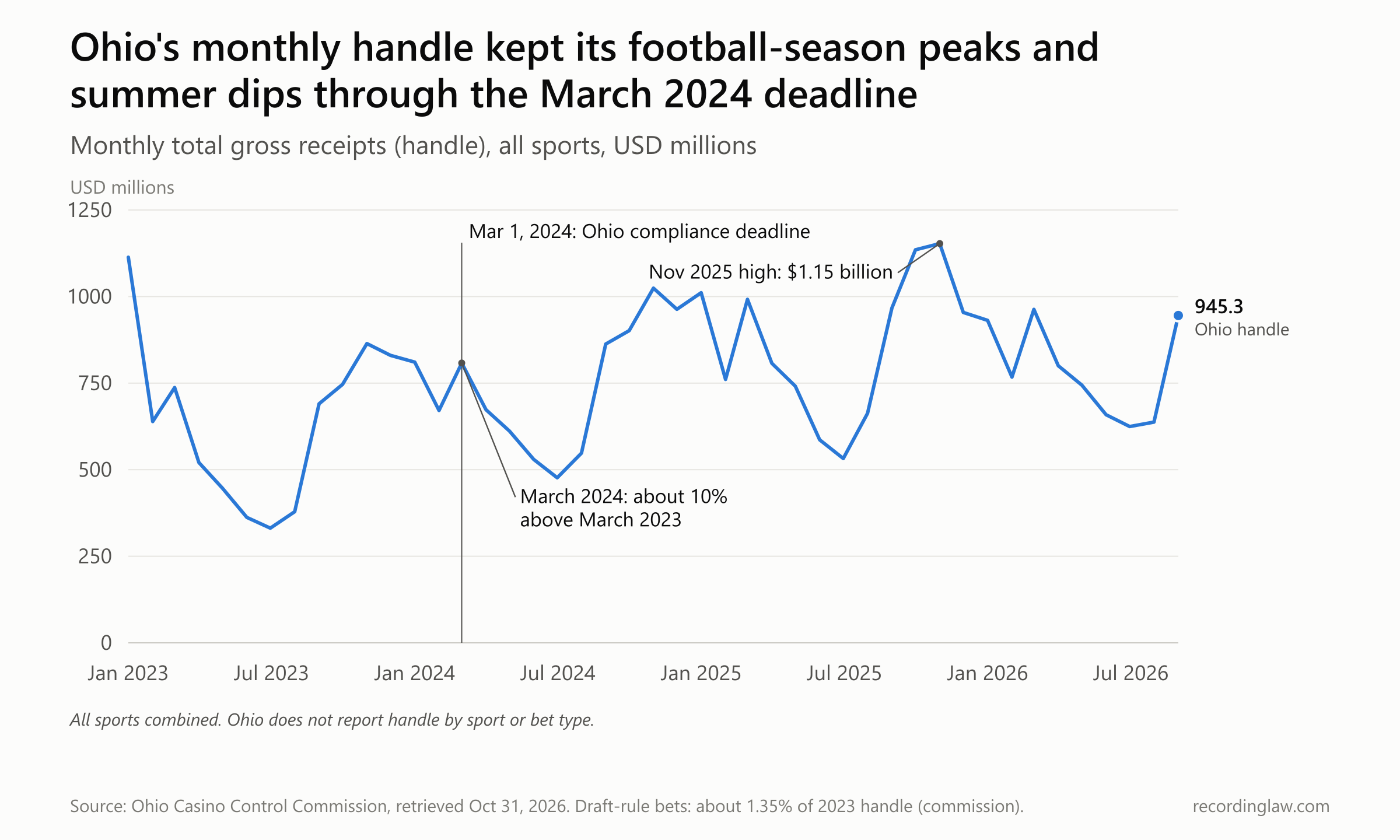
Ohio monthly sports handle, all sports, Jan 2023 to Sep 2026, with the Mar 1, 2024 compliance deadline marked. Source: Ohio Casino Control Commission.
| Month | Ohio handle, all sports |
|---|---|
| March 2023 | $737.32 million |
| February 2024 | $671.04 million |
| March 2024 (ban in effect) | $808.11 million |
| November 2025 (series high) | $1,153.08 million |
| September 2026 (latest in our data) | $945.33 million |
The line rises and falls with the sports calendar. It peaks with football and dips in summer. The ban leaves no visible mark on it. March 2024, the first full month under the rule, came in about 10% above March 2023.
Those seasonal swings make month-to-month moves misleading, so the second chart compares each month with the same month a year earlier.
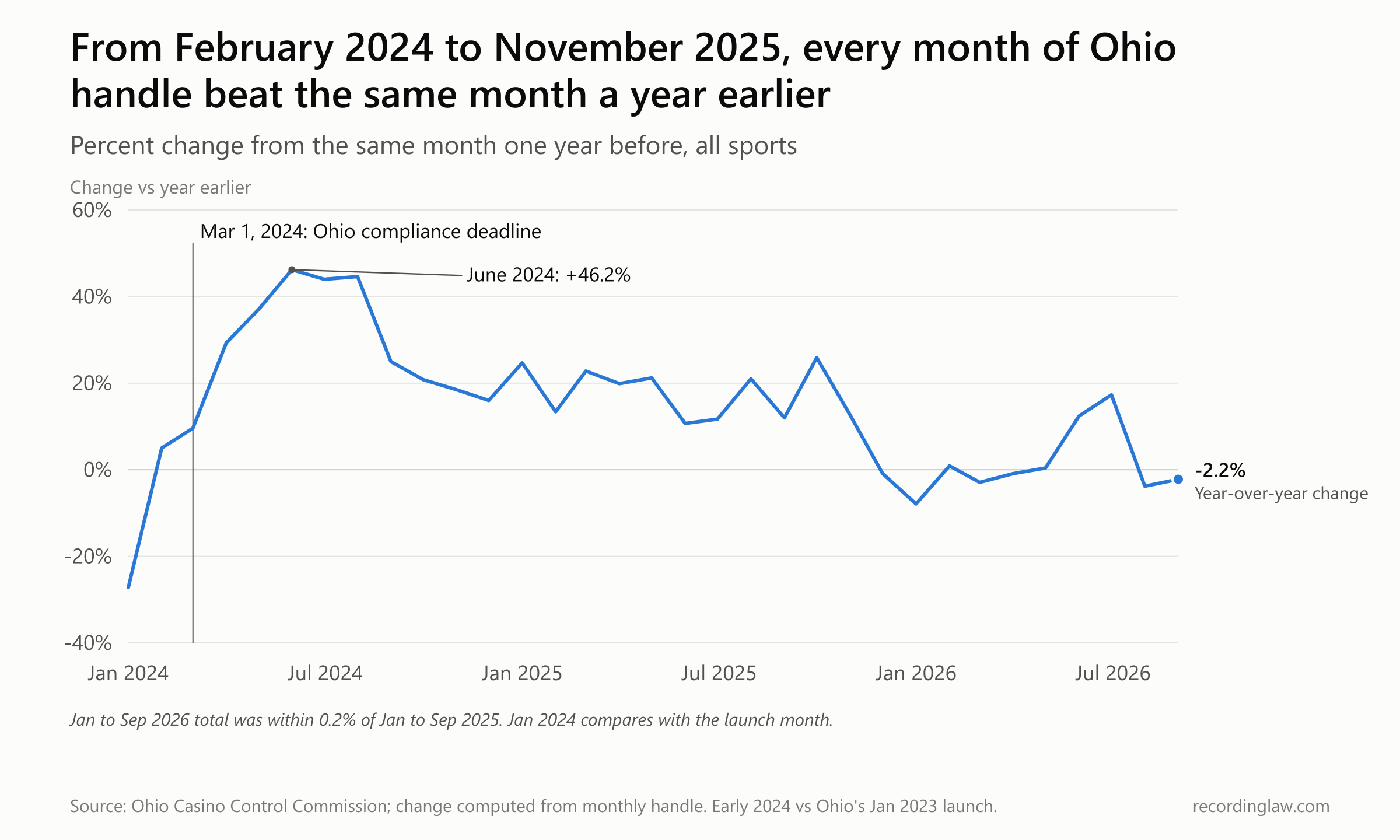
Ohio monthly handle versus the same month a year earlier, 2024 to 2026. Source: Ohio Casino Control Commission, computed.
| Month | Change vs same month a year earlier |
|---|---|
| March 2024 | +9.6% |
| June 2024 | +46.2% |
| March 2025 | +22.8% |
| November 2025 | +12.6% |
| January 2026 | -7.9% |
| September 2026 | -2.2% |
Ohio's handle grew from about $7.7 billion in 2023 to $8.9 billion in 2024 and $10.3 billion in 2025. Then growth stopped in 2026. Through September 2026, the year's handle was within 0.2% of the same months of 2025. The flat stretch began nearly two years after the ban, and the commission's file gives no breakdown that would explain it.
That is as far as the data goes. The commission does not report handle by sport or bet type, so no published Ohio figure shows how much college prop money disappeared, moved to other bets or left the legal market.
The warnings from 2024 had pictured bettors going to illegal operators. How many did is not measured. The Maryland centers' 2026 count instead found college player lines on legal fantasy apps, which states regulate under separate rules.
"Many states were really bad at trying to regulate DFS," said John Holden, an associate professor and sports law expert at Indiana University. Les Bernal, national director of the anti-gambling advocacy group Stop Predatory Gambling, called pick'em platforms "online gambling operators, just masquerading as if they’re not."
The fight over the bans moved to other states, where the question of evidence came up quickly.
The count stays at four
In July 2024, Wyoming's Gaming Commission took up the NCAA's request and tabled it. A staff paper by Michael Steinberg, then its operations manager, reported that "the NCAA was not able to provide any numbers showing whether or not the ban in Ohio reduced athlete harassment," according to iGaming Business.
The sportsbooks' lobby made its case there too. "With the prop ban, you remove a tool from the legal market that could be used to root out other issues like harassment," said Scott Ward, a lobbyist for the Sports Betting Alliance, a lobbying coalition of sportsbook operators including BetMGM, DraftKings, Fanatics and FanDuel. Wyoming chose to go after individual harassers instead. "We decided to focus on the bad actors rather than focus on the type of bet that seemed at the time to be the biggest cause of the harassers," Steinberg, by then the commission's deputy director, said in 2026.
In Ohio, three Republican House members asked that the ban be rescinded. Reps. Cindy Abrams, Jeff LaRe and Jay Edwards pointed to name, image and likeness pay: "Players are now being paid to play (and to perform) in certain sports," they wrote. "That is no different than any other professional sport."
Edwards argued the bet was not the cause. "I don’t care if you have a bet on it or not," he said. "If a quarterback goes out and lays an egg, they’re going get beat up on Twitter, simply for losing the game." The commission said it had no plans to reconsider.
By June 2025, Covers wrote that it had been more than a year since Baker's call, "with little response." That month a New Jersey Senate committee voted 5-0 to advance a ban sponsored by Sen. Kristin Corrado. "This legislation will ban player-specific prop betting in New Jersey, which will help curb that appalling behavior and make college athletic events safer for all participants," she said. The bill never reached a Senate vote.
Counts of how many states ban these bets vary, because many never allowed them. Capital News Service counted 15 states that ban all college player props in 2026, including New York, Pennsylvania and Virginia. It counted more than a dozen others that limit them.
The NCAA counts something different: gaming commissions that had banned the bets since 2024. That count stayed at four. Ohio, 13abc reported, was the first state to remove college player props after previously allowing them.
DeWine, who had signed Ohio's sports betting law, said in December 2025 that he regretted it. "I signed the bill to allow sports betting. I think that was a mistake. If I had to do it over again, I wouldn’t do it," he told 13abc. About three weeks later, a federal indictment gave the NCAA a new reason to press.
A fixing case built on point spreads
On the morning of Jan. 15, 2026, in Philadelphia, U.S. Attorney David Metcalf announced charges against 26 people. The indictment alleges a point-shaving scheme. By its account, the scheme involved more than 39 players on more than 17 Division I men's basketball teams. Those players, it alleges, fixed or tried to fix more than 29 games.
"The stakes here are far higher than anything on a bet slip," Metcalf said. The charges are accusations, and every defendant is presumed innocent unless proven guilty.
The bets in the scheme, as prosecutors described them, were not player props. Fixers allegedly recruited players who would "help ensure that their team failed to cover the spread of the first half of a game or an entire game." The spread is the margin a team has to win or lose by for a bet on it to pay.
The same day, Baker sent state gambling commissions a new letter. "State laws and regulations must be amended to remove the types of bets we know are being manipulated," it said, and it widened the request: "In addition to player prop bets, certain game prop markets such as first half under spreads should be banned."
The letter said NCAA enforcement staff had opened investigations into about 40 athletes at 20 schools over the past year. It also said that 11 athletes from seven schools had been found to have bet on their own performance, shared information with bettors or manipulated games. DeWine urged other states to follow Ohio's lead.
A third channel sits outside state gaming commissions altogether. On Jan. 14, 2026, the day before that letter, Baker had asked the Commodity Futures Trading Commission, which regulates prediction markets, to pause all college sport offerings on them until it adopts regulations.
Missouri and Indiana say no
On Jan. 22, 2026, a week after the NCAA letter, Missouri's Gaming Commission took up the request. Legal betting had been running in Missouri for 52 days. Staff told commissioners that only four of the 39 states with sports betting had agreed to ban college player props.
The Sports Betting Alliance said the indictment showed how legal sportsbooks help catch wrongdoing that might go undetected if the bets went through unregulated bookies, AP reported. Caesars argued that college player props are less susceptible to manipulation because of limits on those bets.
"There’s just so much that we don’t know," said the commission's chair, Jan Zimmerman. Missouri denied the request for now. It already barred props on athletes in games involving its own colleges, AP reported.
Indiana took longer. The NCAA petitioned on March 3, 2026, to end pre-game college player props. In-game college props had been banned before Indiana's 2019 launch. "Bottom line, from an integrity perspective, it’s easy to manipulate and it’s hard to monitor," Mark Hicks, the NCAA's managing director of enforcement, told commissioners.
Joe Maloney, president of the Sports Betting Alliance, the lobbying coalition of sportsbook operators, said a ban would not stop a single harasser. Asked by Commissioner B.R. Lane what a threatening message before a game could do to a player, he said: "Unfortunately, we have not seen any evidence that suggests it has any type of impact on the player’s play."
In September, after nearly seven months, the Indiana Gaming Commission denied the petition unanimously. Several commissioners said harassment was better handled by the legislature.
Legislatures had moved too. Covers' review of 2026 sessions found Washington the only state to expand college prop betting that year, approving player props on athletes from out-of-state teams. The same review found that efforts to restrict or ban the bets gained little traction in any state. Kentucky's 2026 gaming overhaul, Covers reported, bars college props only on athletes who play for Kentucky teams and brings PrizePicks and Underdog under a new regulatory scheme.
Did harassment fall?
The bans were meant to protect players from bettors. More than two and a half years in, is there any evidence of what happened to the abuse?
The NCAA has published three survey figures, and they are easy to read as a trend. They are not one.
In a fall 2025 survey of nearly 6,800 Division I students, 36% of men's basketball players reported social media abuse related to sports betting in the past year. The NCAA's larger GOALS study was fielded from December 2024 to June 2025 and released in February 2026. It found that 46% of men's basketball players had received negative or threatening messages from someone who bet on their game.
A third survey, in February and March 2026, also found 46%. But only 104 men's basketball players answered it. Capital News Service noted that the comparison with the earlier question "is not exact."
The NCAA also contracts a monitoring firm, Signify Group. Its Threat Matrix service scans social media around NCAA championships. Its reviewers judge which abusive posts come from people with a betting interest, from the language used and the accounts involved. What share of the abuse it found did it attribute to bettors?
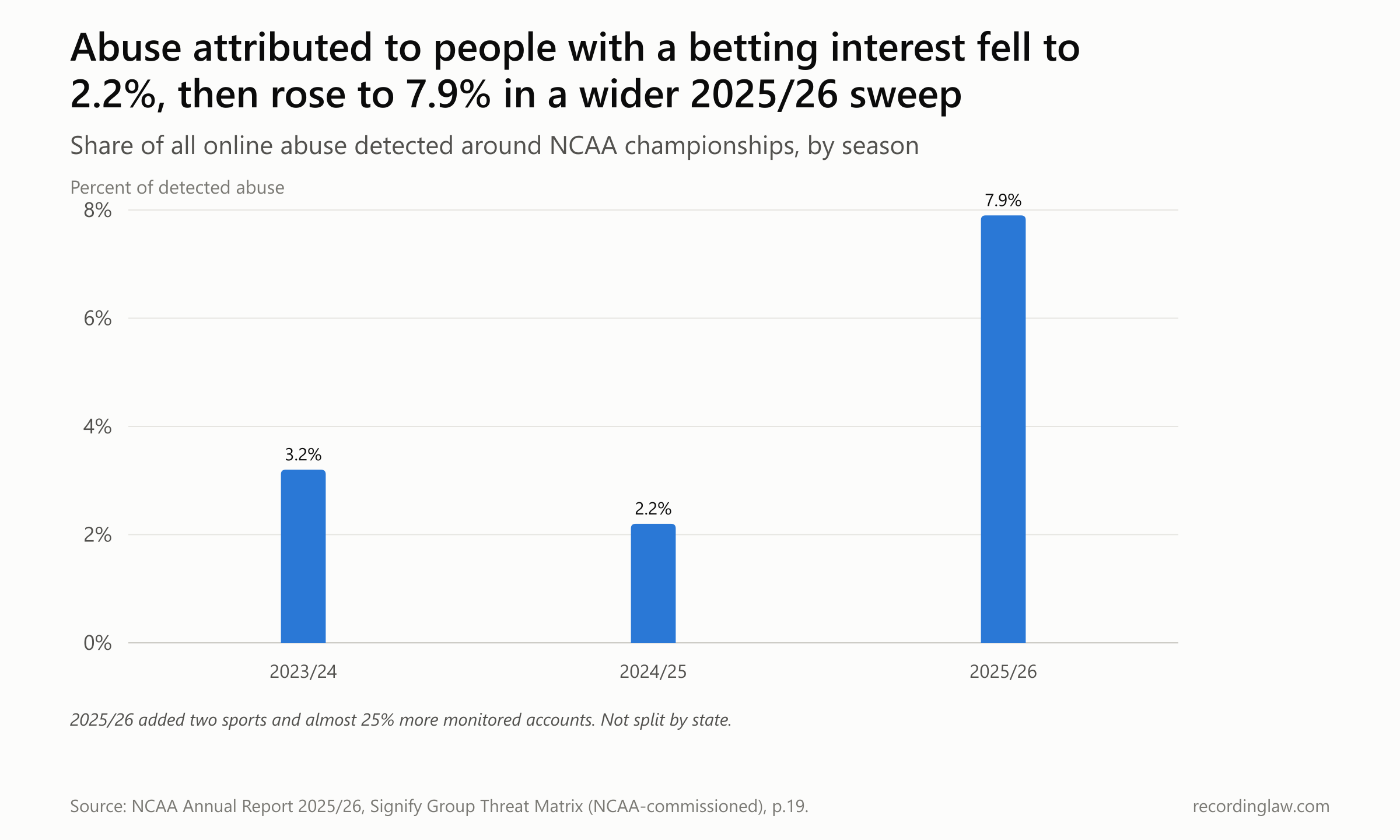
Share of detected online abuse attributable to people with a betting interest, by NCAA season. Source: NCAA Annual Report 2025/26 (Signify Group Threat Matrix).
| Season | Share of detected abuse attributed to people with a betting interest |
|---|---|
| 2023/24 | 3.2% |
| 2024/25 | 2.2% |
| 2025/26 | 7.9% |
The share fell from 3.2% to 2.2%, then more than tripled to 7.9%. In 2025/26 the firm also added two sports and grew the number of monitored accounts by almost 25%. So the seasons do not compare cleanly. The counts cover championships nationally and do not separate states with bans from states without.
Wyoming's staff had raised the same gap in 2024. In a meeting with University of Wyoming officials, Steinberg wrote, the university's officials shared multiple "shocking" and "vile" stories of athlete harassment that "didn’t seem to be connected to betting," iGaming Business reported.
Schuler, speaking in 2026, set his own test: "I would love five years down the road to see a marked decrease in student-athlete harassment." No published figure yet measures harassment before and after any state's ban.
The next test
As of Nov. 10, 2026, the question is open in four states: Maryland, New Jersey, Indiana and Missouri. Maryland's HB 518 would write the state's 2024 regulatory ban into statute. It passed the House 132-0 and cleared a Senate second reading with amendments on April 13, 2026. It went no further that session.
Corrado reintroduced the New Jersey ban in 2026. As of Oct. 14, 2026, Capital News Service reported that New Jersey had not enacted it. Indiana's commissioners pointed the issue to the legislature, and Missouri's denial was explicitly for now.
"We now have more states that don’t permit prop bets than do…. But it’s a hard slog, one state at a time," Baker told Capital News Service, in a story published in October 2026.
Baker has said the NCAA will keep pressing. "We’re going to continue to bang the drum on the fact that the prop bet stuff at a minimum needs to go away. Period," he told Capital News Service.
The next chance to measure anything is the 2026-27 college basketball season, which ends with the men's tournament in 2027. The NCAA fielded its 2026 survey in late February, during the season, and the Threat Matrix reports on championship seasons. The Maryland centers' count could also be repeated. None of those yet compares a state with a ban to one without.
Schuler, the regulator who signed the first letter, does not expect the question to close. "I don’t think our work here is ever going to be done," he said. "We’ll try one thing, and if that doesn’t work, we’re going to try another."
This article reports historical market data and is not investment advice.
How we measured
Ohio handle. Monthly "Total Gross Receipts" on the Total Online and Retail row of each month's tab in the Ohio Casino Control Commission's annual sports gaming revenue workbooks, January 2023 to September 2026 (the latest edition when last checked on Nov. 10, 2026). Gross receipts is the commission's term for amounts wagered and includes wagers made with promotional credits; figures are as reported and subject to later adjustment. Annual totals are sums of the monthly figures: $7,660.3 million (2023), $8,881.0 million (2024), $10,303.1 million (2025). January to September totals were $7,060.9 million (2025) and $7,072.3 million (2026), a 0.2% difference.
Year-over-year changes divide each month by the same month a year earlier. January 2024 compares with Ohio's launch month and is not meaningful.
What the handle data cannot show. The commission does not break out handle by sport or bet type. The commission estimated the barred bets at about $104.6 million, or 1.35% of 2023 handle. It computed that figure under its draft definition, which also covered team props that depend half or more on one or two athletes. An amount that size is too small to detect in an all-sports total that also moved with market growth, promotions and the sports calendar.
Our own sum of the 2023 workbook ($7,660.3 million) gives 1.37%; the commission's figure is 1.35%. The decision letter also used a 12% hold, which it defines as an estimate across all Ohio sports wagering in 2023, to estimate the tax; it is not a measured hold on college props. The commission's exact figure for the barred bets is $104,604,320. In human terms, $104.6 million a year is about $2 million a week (104.6 / 52).
Ban dates and counts. Ohio: decision and catalogue change effective Feb. 23, 2024; compliance deadline March 1, 2024 (commission decision letter). Maryland: March 1, 2024 (Maryland Lottery and Gaming spokesperson via Covers and Sports Betting Dime; original order not opened). Vermont: reported by trade press in March 2024; the original notice was not found, and the rule is quoted from the Department of Liquor and Lottery's current catalog (dated May 4, 2026). Louisiana: Gaming Control Board bulletin, effective Aug. 1, 2024.
The 15-state count is Capital News Service's; no primary list was located. Sports Betting Dime called Maryland the 26th state to prohibit or limit these bets in March 2024, and AP wrote in January 2026 that more than a dozen states place no limits while nearly as many prohibit all such bets; the counts use different definitions.
Covers and another trade outlet, CasinoBeats, described Washington's 2026 law differently; we did not resolve the difference at the legislature's site. Kentucky's 2026 provisions are as reported by Covers; effective dates were not verified.
Harassment measures. Three NCAA-run surveys: SNAP, Sept. 30 to Oct. 5, 2025 (nearly 6,800 Division I students at 153 schools; voluntary; betting items for sophomores and above), 36%; GOALS 2025 (more than 20,000 student-athletes), 46%, released Feb. 5, 2026; SNAP 2026, Feb. 23 to March 2, 2026 (7,493 respondents at 154 schools, 104 men's basketball players, opt-in), 46%. The questions differ, so the figures are not a trend.
Signify Group's Threat Matrix (NCAA-commissioned) attributes abuse to people with a betting interest by reviewer judgment; monitored sports grew from seven to nine and monitored accounts by almost 25% in 2025/26, and its category definitions changed that year. In 2025/26 it identified 18 individuals, with four cases related to sports betting. None of these sources compares states with and without bans, and we found no independent before-and-after study of any ban.
The 2026 tournament count. Shirley Povich Center for Sports Journalism and Howard Center for Investigative Journalism, University of Maryland, published by Capital News Service (student-staffed; Howard Center funded by the Scripps Howard Foundation; no funder named for this analysis). Listings from 14 sportsbooks and fantasy platforms (BetMGM, BetRivers, Caesars, DraftKings, DraftKings Pick6, FanDuel, Fliff, Hard Rock, PartyCasino, PrizePicks, Sleeper, SugarHouse, theScore, Underdog), gathered from platform sites and aggregators, nearly 21,000 unique opportunities; the centers call it incomplete. Opportunities are lines offered, not money wagered. The tournament chart shows the centers' own ratio, 163 pick'em lines for every 100 at sportsbooks, with sportsbook lines set to 100. The ratio compares the pick'em sites with all sportsbooks in the count; "more than the top six sportsbooks combined" is the centers' separate comparison. Their full methodology page was not located; we used the CNS publication. We found no public statement from the pick'em companies on college player lines in the reporting used here.
The federal case. As described in the U.S. Attorney's Office for the Eastern District of Pennsylvania press release of Jan. 15, 2026; the indictment itself was not opened. We do not name any athlete.
Frequently Asked Questions
Which states ban prop bets on college players?
Capital News Service counted 15 states that ban all college player props in 2026, including Maryland, Ohio, Louisiana, New York, Pennsylvania and Virginia. It counted more than a dozen others that limit them. According to the NCAA, four state gaming commissions, in Ohio, Maryland, Vermont and Louisiana, banned the bets in 2024.
When did Ohio ban college player prop bets?
The Ohio Casino Control Commission approved the NCAA's request on Feb. 23, 2024, and operators had until March 1, 2024, to stop taking the bets and void existing ones. The decision was signed by executive director Matthew T. Schuler.
How much money did Ohio's college prop ban affect?
The commission estimated $104.6 million in 2023 wagers that its draft rule would have barred. The draft covered bets on individual college athletes and team props that depend half or more on one or two athletes. That was 1.35% of the state's sports handle and about $2.5 million in state tax. Ohio does not report handle by sport, so the actual effect on betting after the ban cannot be measured from its data.
Did the bans reduce harassment of college athletes?
No published study measures harassment before and after a ban. NCAA surveys found 36% and 46% of Division I men's basketball players reporting betting-related abuse, but those are different surveys with different questions. In 2024 Wyoming regulators reported that the NCAA had no numbers showing whether Ohio's ban reduced harassment.
Can you still bet on college players in states with a ban?
Sportsbook bans do not cover every platform. During the 2026 men's tournament, a University of Maryland analysis found state restrictions applied to 38% of nearly 21,000 opportunities to bet on individual college players. In the same analysis, four pick'em fantasy sites offered more than 11,500 of them. Rules differ by state and platform.
Was the 2026 college basketball point-shaving case about prop bets?
Federal prosecutors described the scheme announced on Jan. 15, 2026, as recruiting players to make their team fail to cover the spread for the first half or the full game. The NCAA's letter the same day asked states to ban player props and first-half under spreads. The defendants are presumed innocent.
Which states rejected the NCAA's request?
Wyoming tabled it in 2024, Missouri denied it for now in January 2026, and Indiana's Gaming Commission denied a petition on pre-game college player props unanimously in September 2026. Missouri already bars props on athletes in games involving its own colleges.
Updates
Reworded for readability. No figures, quotes, sources or findings changed.
Restructured as a feature: chart titles state the finding, side details moved to How we measured. Every figure and quote was re-checked against its source.
Independently fact-checked against the cited primary sources
Independently fact-checked against the cited primary sources
Sources and References
- Ohio Casino Control Commission, Response to the NCAA Regarding Proposition Wagers on Student Athletes (decision letter, Feb. 23, 2024)(dam.assets.ohio.gov).gov
- Ohio Casino Control Commission, sports gaming revenue reports (monthly workbooks, 2023 to September 2026)(casinocontrol.ohio.gov).gov
- U.S. Attorney's Office, Eastern District of Pennsylvania, 26 people charged in alleged bribery and point-shaving scheme (Jan. 15, 2026)(justice.gov).gov
- Louisiana Gaming Control Board, bulletin suspending college player prop bets (April 2024)(lgcb.dps.louisiana.gov).gov
- Vermont Department of Liquor and Lottery, sports wagering catalog (May 4, 2026)(liquorandlottery.vermont.gov).gov
- Maryland General Assembly, HB 518 (2026 session) status(mgaleg.maryland.gov).gov
- NCAA, NCAA urges gambling commissions to eliminate prop bets (Jan. 15, 2026)(ncaa.org)
- NCAA, call for the CFTC to pause college sport prediction markets (Jan. 14, 2026)(ncaa.org)
- NCAA, SNAP survey findings on DI men's basketball harassment by bettors (2025)(ncaa.org)
- NCAA, GOALS 2025 study release (Feb. 5, 2026)(ncaa.org)
- Signify Group, Threat Matrix NCAA Annual Report 2025/26 (NCAA-commissioned)(ncaaorg.s3.amazonaws.com)
- Capital News Service, Povich Center and Howard Center analysis of college player prop and pick'em listings in the 2026 men's tournament (Sept. 10, 2026)(cnsmaryland.org)
- University of Maryland Merrill College, Howard Center for Investigative Journalism (funding)(merrill.umd.edu)
- Capital News Service via Maryland Matters, State laws aim to limit prop betting, shield players from abuse (Oct. 14, 2026)(marylandmatters.org)
- Capital News Service via Maryland Matters, NCAA SNAP survey 2026 findings(marylandmatters.org)
- ESPN, Ohio gaming regulators ban betting on NCAA player props (Feb. 2024)(espn.com)
- Sports Handle, Ohio bans player-specific prop bets for college sports (Feb. 2024)(sportshandle.com)
- News 5 Cleveland, DeWine joins NCAA in calling for end of individual college prop bets (Feb. 5, 2024)(news5cleveland.com)
- Spectrum News 1, Player-specific prop bets on college sports no longer allowed in Ohio (Feb. 23, 2024)(spectrumnews1.com)
- Covers, Maryland ends college player prop wagering (March 4, 2024)(covers.com)
- Sports Betting Dime, Maryland prohibits college player props (March 2024)(sportsbettingdime.com)
- Covers, Vermont bans college player prop betting (March 12, 2024)(covers.com)
- Associated Press via WHYY, NCAA president urges state lawmakers to ban prop betting on college athletes (March 27, 2024)(whyy.org)
- Louisiana Radio Network, Louisiana to ban college player prop bets (April 4, 2024)(louisianaradionetwork.com)
- CDC Gaming Reports, Louisiana Gaming Control Board chairman explains decision to ban prop betting(cdcgaming.com)
- iGaming Business, Wyoming Gaming Commission tables college player prop ban (July 2024)(igamingbusiness.com)
- WCPO, Ohio legislators argue college prop rule should be rescinded (Aug. 2024)(wcpo.com)
- Covers, New Jersey Senate committee advances bill to ban college player prop betting (June 20, 2025)(covers.com)
- 13abc, Ohio governor regrets signing sports betting bill (Dec. 22, 2025)(13abc.com)
- Cleveland 19, DeWine says point-shaving case shows need to ban collegiate prop bets (Jan. 16, 2026)(cleveland19.com)
- Associated Press via Jefferson City News Tribune, Missouri considers ban on college athlete prop bets (Jan. 23, 2026)(newstribune.com)
- Legal Sports Report, Missouri denies NCAA request to ban certain college props for now (Jan. 2026)(legalsportsreport.com)
- Legal Sports Report, Indiana regulators deny NCAA request to end pre-game college player props (Sept. 24, 2026)(legalsportsreport.com)
- Covers, 5 most consequential gaming bills passed in 2026 legislative sessions (May 21, 2026)(covers.com)
- Snell & Wilmer, Louisiana bans prop bets for betting integrity and athlete safety(swlaw.com)