Sweepstakes Casino Laws Reached Ten States in 2025-26. Licensed Online Casino Revenue Grew in New Jersey, Connecticut and No-Ban Pennsylvania.

Independently fact-checked against primary sources (last audited November 10, 2026). · 44 primary sources cited on this page. How we verify our legal content
On March 7, 2025, the New York Attorney General's office sent letters to the operators of online sweepstakes casinos, sites that offer casino-style games played with virtual coins. One sentence was blunt: "Most sweepstakes casinos are illegal in New York."
The letters took aim at the industry's central defense, that anyone can get coins free, for example "by mailing in a handwritten request for coins to the sweepstakes casino operator." They gave each operator a deadline. "Please confirm in writing that you have done so by no later than March 28, 2025."
Eighteen months later, the office announced that VGW, the company behind Chumba Casino, LuckyLand Slots and Global Poker, would pay $8 million. VGW had offered its games to New Yorkers since 2012, the office said, and its investigation found that players received "approximately one coin for every dollar spent on the platform."
New York was one front in a fast legal turn. From August 2025 to October 2026, nine states put a law in force aimed at these sites, and Oklahoma's took effect on Nov. 1, 2026. Supporters, including the licensed casino industry, gaming tribes and state attorneys general, said the sites were unlicensed gambling that reached minors and paid no tax. The sweepstakes industry said it ran lawful promotions and warned that a ban would strip $1 billion a year from California's economy alone.
Two questions run under all of it. What exactly did each state outlaw, when lawmakers, trade lists and even one governor disagreed about whether the games were already illegal? And did the money move to the licensed online casinos that pushed for the laws, the state-regulated sites the industry calls iGaming? Licensed online casino revenue kept growing in New Jersey and Connecticut, which have bans, and in Pennsylvania, which has none, and the comparison cannot separate the laws from other changes.
Ten laws, one effective date at a time
New Jersey's law took effect first, on Aug. 15, 2025, the day it was signed. Oklahoma's became the tenth on Nov. 1, 2026. In between, the count climbed one state at a time.
How fast did the count build? The chart counts each state on the day its law took effect.
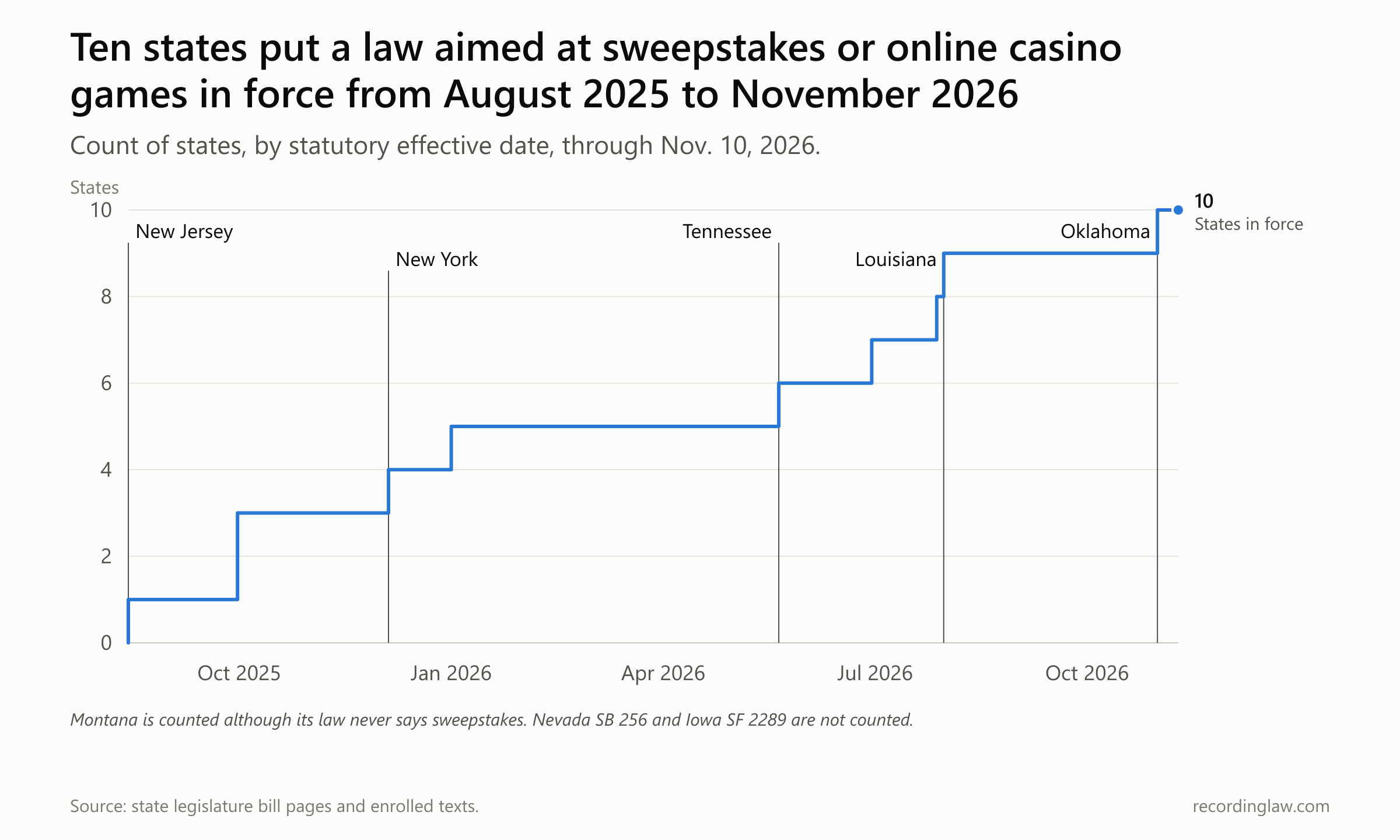
Source: state legislature bill pages and enrolled texts. A state is counted on its law's effective date. Montana is counted although its law does not use the word sweepstakes; Nevada and Iowa are not counted. Oklahoma is counted from Nov. 1, 2026.
The count went from one state in August 2025 to nine by the end of October 2026, and Oklahoma made it ten on Nov. 1. The 2026 sessions alone added five.
| State | Law | Signed | In force |
|---|---|---|---|
| New Jersey | A5447 (P.L.2025 c.128) | Aug. 15, 2025 | Aug. 15, 2025 |
| Montana | SB 555 | May 12, 2025 | Oct. 1, 2025 |
| Connecticut | SB 1235 (PA 25-112, sec. 14) | June 24, 2025 | Oct. 1, 2025 |
| New York | S5935A (ch. 605) | Dec. 5, 2025 | Dec. 5, 2025 |
| California | AB 831 (ch. 623) | Oct. 11, 2025 | Jan. 1, 2026 |
| Tennessee | SB 2136 (Pub. Ch. 1117) | May 22, 2026 | May 22, 2026 |
| Indiana | HB 1052 (P.L. 153) | March 12, 2026 | July 1, 2026 |
| Maine | LD 2007 (P.L. c.645) | April 6, 2026 | July 29, 2026 |
| Louisiana | HB 883 (Act 182) | May 15, 2026 | Aug. 1, 2026 |
| Oklahoma | SB 1589 | Veto overridden May 14, 2026 | Nov. 1, 2026 |
Which laws belong in that count is itself disputed. And the laws grew out of one argument that started before any of them: whether the games were gambling at all.
What were the states trying to stop?
The product looked and played like an online casino, and its operators said it was not one. New York's investigation of VGW described the model: its sites used a virtual coin called "sweeps coins," "which VGW claimed were provided for free and therefore did not constitute gambling." The free mail-in route was what operators said kept the whole thing a sweepstakes. New York's investigators found that players in fact got sweeps coins "the same way one might purchase chips in a casino."
The American Gaming Association, the trade group for commercial casino companies, laid out the opposing view in a memo it circulated in August 2024. "Sweepstakes casinos claim that because they don't require real money for their gameplay, they are not offering gambling under the letter of the law," it wrote. "However, functionally, sweepstakes casinos look and play like an online casino while using a dual-currency system to avoid licensing and regulation."
A dual-currency site, in the memo's term, runs on two kinds of virtual coin, one of them the sweeps coin that operators say anyone can get free. Louisiana and Oklahoma later wrote the term into their laws.
The memo told lawmakers what to do about it. "Where state laws and regulations are not clear, legislatures should consider enacting legislation to prevent unlicensed operators from exploiting loopholes in sweepstakes regulations to offer online real money gambling."
The operators organized the same season. In September 2024, eleven companies launched the Social and Promotional Games Association. "By creating this association, we are committed to helping regulators and policymakers understand how our industry's products work and how they comply with the appropriate state and federal laws," said Seth Schorr, chief executive of FSG Digital Inc., at the launch.
The AGA also put numbers on the market's reach, from data it compiled or paid for. It said Sensor Tower data showed sweepstakes ads made up half of the online real-money casino ads viewed in the U.S. in early 2025. A survey it commissioned from the firm Interpret, of 2,250 players in June 2025, found that "90% of sweepstakes casino users consider the activity to be gambling." Before any of the new laws, though, the first tool states reached for was a letter.
Letters first, then the limits of letters
Regulators who believed the games were already illegal started with cease-and-desist letters, formal written demands that a company stop. In New York, the letters led to a June 2025 announcement: "all 26 platforms are ending the sale of sweepstakes coins in New York," Attorney General Letitia James's office said. "Online sweepstakes casinos are illegal, dangerous, and can seriously ruin people's finances," James said.
Louisiana's Gaming Control Board said in June 2025 that it had sent "more than 40 additional cease-and-desist letters to offshore wagering platforms and online sweepstakes operators." Tennessee's attorney general announced in December 2025 that it had sent cease-and-desist orders to 38 platforms, according to the AGA's annual report. The report said all of them agreed to stop doing business in the state.
Pennsylvania showed what letters could and could not do. Its Gaming Control Board told a House committee in the spring of 2025 that it had sent 18 cease-and-desist letters and that all 18 operators complied, Covers, a gambling trade outlet, reported. "Sweepstakes casinos, despite their misleading presentation, are, in our assessment, illegal online gambling," said Cyrus Pitre, the board's chief enforcement counsel.
The board also told legislators it lacked authority to sue. "The shear volume of these sites creates a whack-a-mole scenario," Pitre said. "For every site we manage to shut down, dozens of others emerge or become operational each day." Other states were already writing statutes to give their regulators more than letters.
The first laws, and what they actually say
New Jersey's law was the first to take effect, although Montana's was signed earlier. New Jersey's Assembly passed A5447 by 69-10-1 and its Senate by 34-5 on June 30, 2025, and Gov. Phil Murphy signed it on Aug. 15. The act says it "shall take effect immediately," so it did. Some operators did not wait: Funzpoints and Spree had already added New Jersey to their excluded states that July, Sweepsy, a sweepstakes review site, reported.
The same June 30 session also raised New Jersey's tax on internet casino gaming from 15% to 19.75%, under a separate law approved that day. Legal Sports Report, a trade outlet, read the two together when the ban was signed. "Banning sweepstakes casinos is clearly a positive for regulated online casino operators," it wrote. "Online casino operators needed a win after they were included in a bill that increased taxes across multiple gaming sectors."
Connecticut's law took effect Oct. 1, 2025, in section 14 of a broader gaming act Gov. Ned Lamont signed in June. It bars anyone not licensed for online casino gaming or sports betting from running a sweepstakes that allows "real or simulated online casino gaming or sports wagering," in the words of the legislature's summary. Before that, in March 2025, Connecticut had filed criminal charges against High 5 Games. iGaming Business, a trade outlet, said the charges "apparently marked the first time a state brought criminal charges versus a US sweepstakes casino."
The settlement that followed in May 2025 laid out the scale of one unlicensed site. Over 25 months, according to iGaming Business's account of the state's findings, "1,065 customers made at least $3.1 million in deposits."
Montana's law is where the counting gets slippery. SB 555, sponsored by Sen. Vince Ricci, a Billings Republican, passed the Senate 40-8 and the House 88-11 and was signed in May 2025, according to the Montana Free Press legislative tracker. Trade outlets often list it as the first sweepstakes ban of 2025.
Its text never uses the word "sweepstakes." It rewrites the state's definition of internet gambling, in its title's words, "TO INCLUDE ONLINE CASINOS," with "AN EXCEPTION FOR ONLINE CASINOS THAT DO NOT ALLOW THE USE OF CURRENCY OF ANY KIND." It names no effective date, so Montana's default of Oct. 1 applied.
Two other laws show up on trade lists without banning anything, Nevada's in 2025 and Iowa's in 2026. Nevada's SB 256, effective Oct. 1, 2025, passed 42-0 and 20-0. Its title is about making violators hand over their profits, "the disgorgement of any profit, gain, gross receipt or other benefit related to certain illegal gaming activities," and the word sweepstakes does not appear.
One trade outlet, the Public Gaming Research Institute, headlined the bill as "Nevada One Step Closer to Criminalizing Sweepstakes Casinos." The AGA's own count of 2025 prohibitions names five states and leaves Nevada out.
California was still open. That fight would split California's gaming tribes.
California: tribes on both sides of one bill
In California, the push for a ban came from tribal governments. Assemblymember Avelino Valencia, an Anaheim Democrat, rewrote AB 831 into a sweepstakes ban in June 2025 with three tribal co-sponsors: the Yuhaaviatam of San Manuel Nation, the California Nations Indian Gaming Association (CNIGA) and the Tribal Alliance of Sovereign Indian Nations. "We cannot look the other way while these platforms exploit legal grey areas," Valencia said.
CNIGA's chairman, James Siva, put the tribes' stake in money. "Tribal government gaming contributes nearly $25 billion to California's economy, sustains over 112,000 jobs, and funds critical community programs," he said. "Unregulated online sweepstakes threaten this voter-approved system by imitating casino gaming without oversight, accountability, or community investment." Those figures are CNIGA's own.
Not every tribe agreed. The Kletsel Dehe Wintun Nation, which has 297 enrolled citizens, had just announced a partnership with VGW. At a Senate Appropriations hearing on Aug. 18, 2025, Eric Wright, chief executive of its economic development authority, testified against the bill.
"This bill lacks unanimous support among California tribes, has advanced without meaningful consultation with many of us, and threatens our inherent right to create legitimate revenue streams to support our people," Wright said. Of the large, established gaming tribes backing the bill, he added: "It is self-serving for them to advocate for policies that restrict emerging digital commerce opportunities for others."
The Social Gaming Leadership Alliance, a sweepstakes-industry group, made the economic case. By mid-September it had combined with the Social and Promotional Games Association, the group eleven companies launched in September 2024. The alliance's lobbyist told the same hearing that nearly 1,200 jobs would be lost and that California should "instead regulate and tax it, which could generate between $200 [million] to $300 million dollars a year in new revenue," Legal Sports Report reported.
The alliance's $1 billion estimate and its tax-revenue figures also appear in a study by the consultancy Eilers & Krejcik Gaming. The alliance commissioned that study, and Sweepsy reported on it on Aug. 21, three days after the hearing.
In the legislature, the split did not show up in the votes. The Senate passed AB 831 36-0 on Sept. 8, 2025, and the Assembly concurred 79-0 four days later. The alliance's executive director, Jeff Duncan, asked Gov. Gavin Newsom for a veto, saying the bill "will immediately strip $1 billion out of the state's economy." At the time, Legal Sports Report gave one sponsor as the main reason for the unanimous votes: "The biggest reason for the overwhelming legislative support is that the California Nations Indian Gaming Association supported the bill."
Newsom signed it on Oct. 11. The law makes offering an online sweepstakes game a misdemeanor, punishable by a fine of $1,000 to $25,000, up to a year in county jail, or both. It also reaches past the operators, to any "financial institution, payment processor, geolocation provider, gaming content supplier, platform provider, or media affiliate" that would "knowingly and willfully support" one.
The bill text names no effective date. Under California's constitution, it took effect Jan. 1, 2026. VGW told Sweepsy it would stop players from collecting sweeps coins in California from Dec. 30, 2025. "This is a disappointing outcome for players and the State," a spokesperson said, calling the law "a rushed, misinformed ban pushed by powerful tribes and gaming groups."
New York's law arrived after most operators had left
New York's statute came last of the 2025 group, and by then the market it targeted had largely gone. Sen. Joseph Addabbo Jr., a Democrat, filed S5935 in March 2025 with a memo arguing that the sites "evade consumer protection, responsible gaming, and anti-money laundering requirements" and that "These products and operations are untaxed and unregulated." The memo predicted the bill would be "a powerful deterrent" to operators entering the state and would push those already there to withdraw.
The operators' association answered with an argument that Louisiana's governor would later make from the other side. It cited Addabbo's bill as "a clear signal that these games are legal," adding that any ban "would be unnecessary if they were already prohibited under state law." It accused the state of "overreach" and said its members "pay appropriate taxes and adhere to a strict code of conduct."
VGW did not wait for the vote. While the bill was still pending in mid-2025, it told Gambling Insider, a trade outlet, that it had "informed players of a decision to phase out Promotional Play (sweepstakes promotions) in the state of New York." The Senate passed the bill 57-2 in June, and Gov. Kathy Hochul signed it on Dec. 5, 2025. "Most operators have left New York already, though, since the legislature passed the bill back in June," Legal Sports Report wrote that day.
The two official documents disagree on when it took effect. Addabbo's memo says the act "shall take effect in the following fiscal year." The signed text says "This act shall take effect immediately," and the text is the law. By November 2025, VGW's sites excluded 12 jurisdictions, including New York, New Jersey, Connecticut and Montana, Yogonet, a trade outlet, reported.
The governor who called it a solution in search of a problem
In Louisiana, the first bill against these sites was vetoed. In 2025 the Louisiana House passed SB 181 by 99-0. On June 12, Gov. Jeff Landry vetoed it. The gaming bill, in his words, "attempts to criminalize certain secondary gambling activities on the internet," and he said the activity was "already prohibited in Louisiana."
"As such, this bill is a solution in search of a problem that is already being solved by our current system," Landry wrote. He added that "some of the language in this bill is overly broad and could be interpreted in an adverse manner which may harm or impede our current enforcement actions taken against these bad actors."
That was the operators' New York argument with the conclusion turned around. In New York, the operators said a ban would be needed only if the games were legal, so a ban bill showed they were legal. In Louisiana, Landry said the games were already illegal, so a ban bill was not needed.
The state's enforcers kept going. The Gaming Control Board sent its 40-plus letters five days after the veto. Attorney General Liz Murrill's office wrote that "Our laws and the veto of SB181 do not legalize these purported “sweepstakes” or “social gaming” websites," and Murrill said she would "enforce our laws." In September 2025 CDC Gaming, a trade outlet, reported that the state Department of Revenue had sued VGW and the operator of WOW Vegas for $44.4 million in taxes, interest and penalties.
A year later the legislature tried again. HB 883, by Rep. Laurie Schlegel, passed the House 99-0 and the Senate 35-0, and Landry signed it on May 15, 2026. The new law adds "the offering of dual-currency games that simulate any form of gambling" to the state's crime of gambling by computer and raises the penalty to up to a $100,000 fine and five years in prison. It took effect Aug. 1, 2026.
The second wave, and the veto that did not hold
Besides Louisiana, the 2026 sessions added four more states. Indiana's HB 1052, signed March 12, lets the state Gaming Commission levy a $100,000 civil penalty on anyone who "knowingly uses the Internet to conduct a sweepstakes game." It took effect July 1. Tennessee's SB 2136, signed May 22 and effective the same day, declares online sweepstakes games and "other forms of online or app-based gambling" unlawful and a violation of the state's Consumer Protection Act.
Maine's vote was the closest recorded here. LD 2007, sponsored by Sen. Craig Hickman, passed the House 87-55 and was signed April 6. It took effect July 29, 2026, Maine's general effective date for that session. It sets fines of $10,000 to $100,000, and it sends every fine to the state's Gambling Addiction Prevention and Treatment Fund.
Oklahoma's governor also vetoed a ban, and was overridden. Gov. Kevin Stitt vetoed SB 1589 on May 7, 2026. "This bill is so broad that it criminalizes everyday apps people use for fun," he wrote. "It also unnecessarily creates a new felony and extends criminal liability to businesses and service providers."
A week later, on May 14, the Senate overrode him 34-10 on a motion by Sen. Todd Gollihare, and the House followed 68-19. The law defines "representative of value" to include "any and all currency used as part of a dual-currency system of payment." It took effect on Nov. 1, 2026.
Operators reacted to the dates, not just the votes. High 5 Casino posted a notice that from June 16, 2026, it would no longer offer its sweepstakes platform to players in Indiana and Iowa, Sweepsy reported. Iowa's law, signed May 15, 2026, gives the state gaming commission power to issue cease-and-desist orders and seek injunctions against "illegal sweepstakes," but does not itself ban them.
Did the money move to the licensed sites?
The licensed industry says the laws did what it asked. "Working alongside state and tribal regulators, attorneys general, and law enforcement, we successfully stopped the advance of sweepstakes casinos and saw them pushed out of many key markets," the AGA wrote in its 2026 State of the States report.
That claim is about where sweepstakes sites operate. No public data can test it directly, because sweepstakes operators publish no revenue, player or app figures. What can be measured is the other side of the promise, the revenue of licensed online casinos in states that have them.
New Jersey and Connecticut have both licensed online casinos and a sweepstakes law. Pennsylvania has licensed online casinos and no sweepstakes statute, and its monthly figures run long enough to compare.
Each state reports a version of gross gaming revenue, broadly the money the casinos keep from players' bets after paying out winnings. If customers who lost their sweepstakes sites moved to licensed ones, New Jersey's and Connecticut's lines should pull away from Pennsylvania's after their laws took effect. Did they?
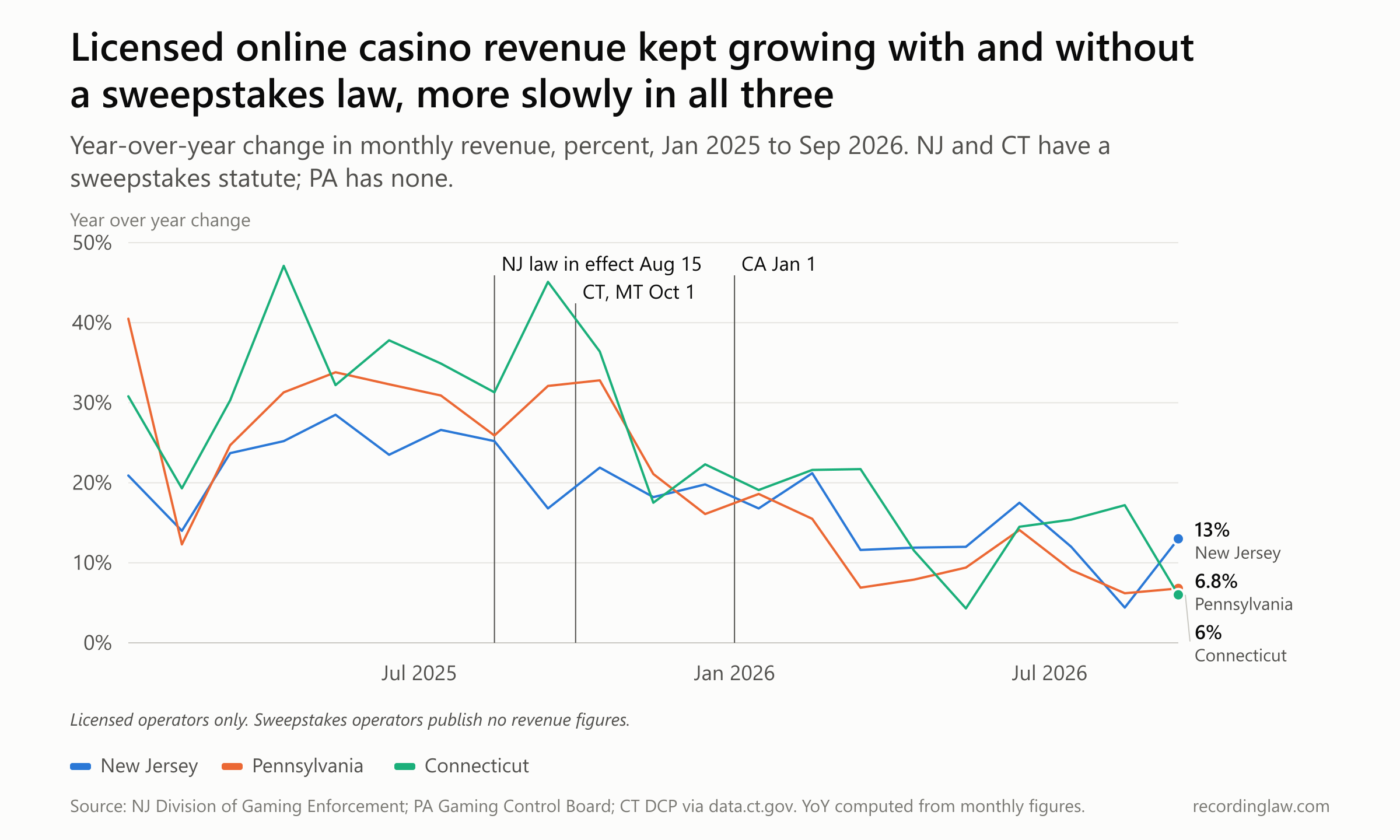
Source: New Jersey Division of Gaming Enforcement monthly releases; Pennsylvania Gaming Control Board interactive gaming reports; Connecticut Department of Consumer Protection data on data.ct.gov. Year-over-year change computed from monthly figures.
All three kept growing, and all three grew more slowly in 2026 than in 2025, Pennsylvania included. In the single month of September 2026, New Jersey's online casinos had $274.8 million in revenue, 13% more than a year earlier. In the same month, Pennsylvania's revenue rose about 7% and Connecticut's about 6%, each against a year earlier.
The month-to-month lines are noisy, so longer windows are a steadier test. The next chart compares January through July 2025, before any of the laws, with September 2025 through September 2026, each against the same months a year earlier.
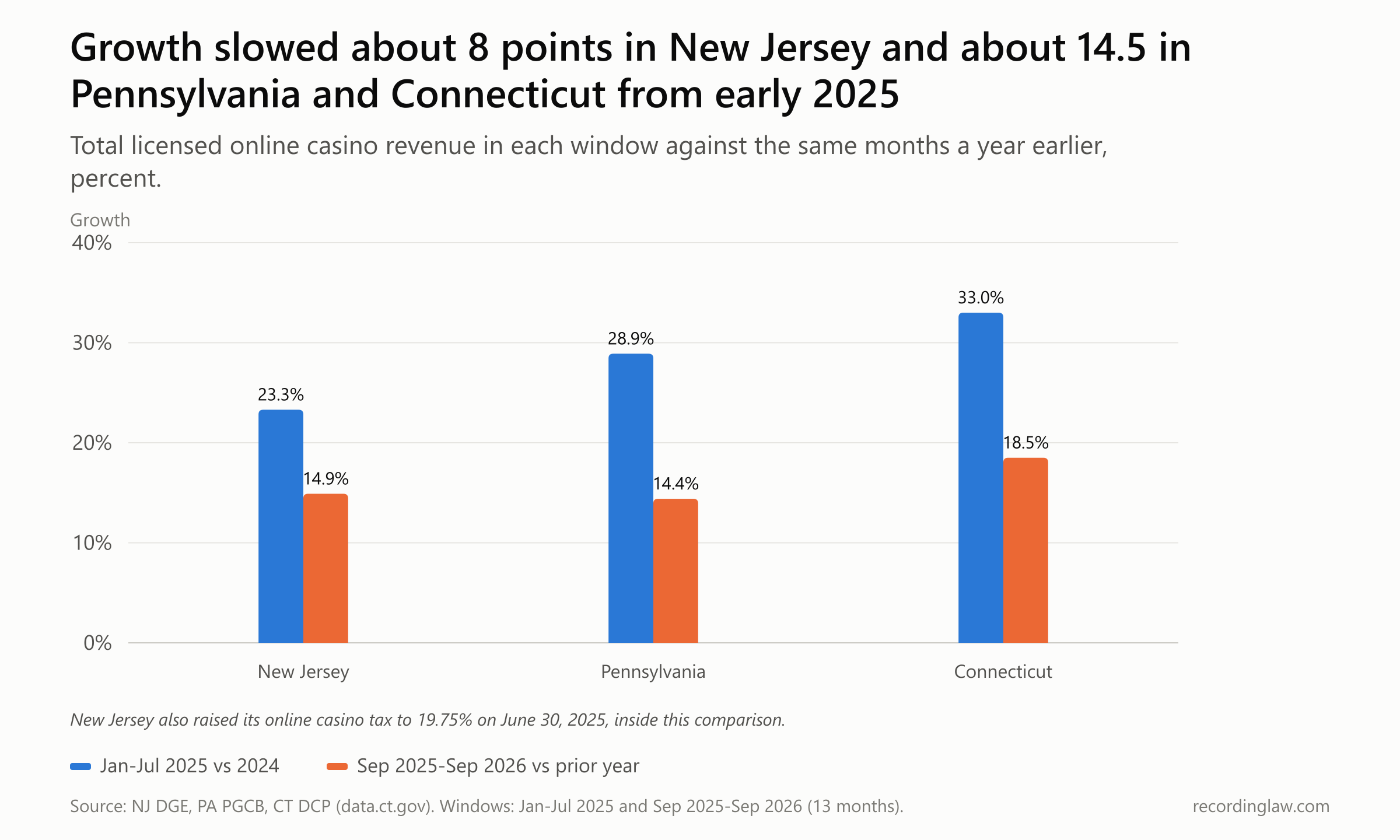
Source: NJ Division of Gaming Enforcement, PA Gaming Control Board, CT Department of Consumer Protection (data.ct.gov). Growth is total revenue in the window against the same months a year earlier.
Growth slowed in all three states. New Jersey went from about 23% in the early window to about 15% in the later one, a drop of about 8 percentage points. Pennsylvania started faster, at about 29%, and fell about 14.5 points to about 14%. That put the two states at nearly the same rate in the later window.
Connecticut also fell about 14.5 points, from 33% to about 18.5%. Measured against its own early-2025 pace, New Jersey slowed about 6 points less than Pennsylvania: about 8 points against about 14.5. Connecticut slowed by about the same amount as Pennsylvania.
| State | Sweepstakes statute | Growth, Jan-Jul 2025 vs. 2024 | Growth, Sep 2025-Sep 2026 vs. prior year | Sep 2026 revenue ($ millions) |
|---|---|---|---|---|
| New Jersey | Yes, Aug. 15, 2025 | 23.3% | 14.9% | 274.8 |
| Pennsylvania | No | 28.9% | 14.4% | 249.3 |
| Connecticut | Yes, Oct. 1, 2025 | 33.0% | 18.5% | 57.0 |
That comparison cannot rule out an effect from the laws, because two other changes hit the same markets in the same months. New Jersey raised its online casino tax to 19.75% on the day its legislature passed the ban. And Pennsylvania, the comparison state, was not untouched: its regulator had already pushed 18 operators out with letters in the spring of 2025.
The one cross-state comparison of players comes from the AGA-funded survey, which found "2x higher usage in states without sweepstakes prohibitions compared to states with restrictions." It was a single snapshot taken in June 2025, before most of the laws took effect, and it cannot say whether the laws or something else explains the difference. No independent or peer-reviewed study of the bans turned up.
Where the fight goes next
States without a statute are using the courts. On Aug. 19, 2026, Florida Attorney General James Uthmeier sued Stake and VGW, along with payment processors, in Hillsborough County Circuit Court under existing gambling law and the state's deceptive trade practices act. "These so-called ‘sweepstakes’ and ‘social casinos’ are illegal online gambling operations," he said. The suits seek permanent injunctions, disgorgement and civil penalties, and no ruling in either had been reported as of Nov. 10, 2026.
Cities have sued too. The Los Angeles City Attorney filed suit against Stake.us in August 2025 that also named vendors including Veriff, Pragmatic Play and Evolution, and Baltimore sued six operators in March 2026, the Public Gaming Research Institute reported. New York's $8 million VGW settlement came out of a law-enforcement action begun before its statute existed.
In Pennsylvania, HB 2801, introduced Sept. 24, 2026, would ban online sweepstakes games with fines of up to $500,000 per violation. As of Nov. 10, 2026, it had not left the House Gaming Oversight Committee. The two-year session it belongs to ends Nov. 30, 2026. So a ban not passed by then would have to be filed again in the session beginning Jan. 5, 2027.
If a ban passes in either session, Pennsylvania, whose regulator described a whack-a-mole problem, would have a statute of its own. It would also no longer be a licensed online casino state without a ban. All three states in this comparison would then have a law, and none would be left to show what licensed revenue did without one. The revenue comparison runs through September 2026, which New Jersey reported on Oct. 19, and each later monthly release extends it.
In Wyoming, lawmakers have weighed both a ban and an authorization. On July 30, 2026, in Casper, a legislative committee co-chair moved to forward a prohibition draft for the 2027 session, and the motion "failed for lack of a second." The other co-chair then asked for a draft that would instead give Wyoming "regulatory authority for online sweepstakes," based on revisions VGW had submitted.
At its next meeting, Oct. 5-6 in Rock Springs, the committee went the other way. Its official minutes record that it amended the prohibition draft, renamed it "Online sweepstakes prohibited," and approved it 6-0 for a favorable recommendation to the legislature's Management Council, which decides whether to sponsor it as a 2027 bill. The draft that would have authorized online sweepstakes "was not moved." A committee vote is not a law; any Wyoming bill still has to pass the 2027 legislature.
In March 2025, New York had told the operators that most sweepstakes casinos were illegal in the state, and VGW later paid New York $8 million. Nineteen months after those letters, a representative of VGW spoke during public comment on the Wyoming ban draft in Rock Springs, and the committee voted for it 6-0.
How we measured
The law count. We counted a state when a law aimed at sweepstakes or dual-currency casino games took effect, using the effective date in the enacted text or, where the text has none, the state's default date. Ten laws meet that test: New Jersey, Montana, Connecticut, New York, California, Tennessee, Indiana, Maine, Louisiana and Oklahoma. Bill status, votes and signing dates come from each legislature's bill page and enrolled text, opened Oct. 31, 2026.
Three judgment calls affect the count. Montana is counted although SB 555 never uses the word sweepstakes. The law redefines internet gambling to include online casinos that use currency of any kind, and its signing date is from the Montana Free Press legislative tracker.
California's AB 831 has no effective-date clause. Its date of Jan. 1, 2026, follows from Article IV, section 8(c) of the California Constitution.
New York's sponsor memo and signed text disagree on the effective date, and we used the text ("immediately"). Maine is dated July 29, 2026, the legislature's general effective date, not mid-July as some trade reports said.
Nevada's SB 256 and Iowa's SF 2289 are not counted. Nevada's raises penalties and requires disgorgement for illegal gaming without mentioning sweepstakes. Iowa's gives its gaming commission cease-and-desist and injunction power over "illegal sweepstakes" but does not prohibit them. We did not verify claims that other states (Idaho, Michigan, Washington and others) bar the games under existing law, and we did not count enforcement letters or lawsuits as laws.
Revenue. New Jersey: internet gaming win for casinos and their partners, as stated in each monthly Division of Gaming Enforcement release, January 2023 to September 2026, rounded by the publisher to $0.1 million. Pennsylvania: our sum of the three lines in the Gaming Control Board's monthly interactive gaming workbook (slots gross revenue, table games gross revenue and poker revenue), July 2023 to September 2026; the workbook has no single total. Connecticut: total gross gaming revenue after promotional deductions, summed across all licensee entities reported for the state's two online casino operators, from the state's "Selected Online Casino Gaming Data" set on data.ct.gov, October 2021 to September 2026.
The three measures are defined differently, so we compare growth rates, not dollar levels. Year-over-year change is each month against the same month a year earlier. The windows sum revenue over January-July 2025 (before any law) and September 2025-September 2026 (13 months, beginning a month after New Jersey's law took effect and one month before Connecticut's), each against the same months a year earlier. For New Jersey, the early window totaled $1,633.3 million against $1,325.0 million a year earlier, and the later window totaled $3,433.8 million against $2,988.5 million.
Growth fell 8.4 points in New Jersey (23.3% to 14.9%), 14.5 points in Pennsylvania (28.9% to 14.4%) and 14.5 points in Connecticut (33.0% to 18.5%). August 2025 is left out of both windows because New Jersey's law took effect mid-month.
What the data cannot show. All three revenue series cover licensed operators only. Sweepstakes operators publish no revenue, player or app-store data, and market-size estimates in trade coverage could not be traced to their original reports, so none are used here. New Jersey's tax increase to 19.75% (approved June 30, 2025) and Pennsylvania's spring 2025 enforcement letters both overlap the comparison.
Michigan, another licensed online casino state without a sweepstakes statute, is not in the comparison. It reports a different measure, adjusted gross receipts, which its Gaming Control Board said rose 18.4% for online casino games in September 2026 against a year earlier. That is a single month, on a different measure from the September figures above. With three states and no way to separate these changes, the comparison describes what happened and cannot estimate what the laws caused.
Wyoming. The July 30, 2026 motion and the request for a regulation draft are from that meeting's minutes. The Oct. 5-6 votes are from the committee's Summary of Proceedings for that meeting, which the Legislative Service Office calls the official record, as posted on the committee's page and opened Nov. 10, 2026.
Sources and their stakes. The American Gaming Association represents commercial casino companies, which compete with sweepstakes sites. Its memo, survey (conducted by Interpret, online, June 11-24, 2025, 2,250 players, margin of error plus or minus 3.6 points per audience) and annual report are attributed as AGA material. The Social and Promotional Games Association and the Social Gaming Leadership Alliance represent sweepstakes operators. The Eilers & Krejcik estimates they cite were commissioned by the alliance and were not opened at the source.
Legal Sports Report, Covers, CDC Gaming, iGaming Business, Gambling Insider, Yogonet and the Public Gaming Research Institute are gambling-industry trade outlets, and Sweepsy is a sweepstakes review site that says it may earn a commission when readers sign up with operators through its links. All of them are used for what they reported at the time and for statements companies gave them, not as primary sources.
Frequently Asked Questions
Which states have banned sweepstakes casinos?
By Nov. 1, 2026, ten states had a law in force aimed at online sweepstakes or dual-currency casino games: New Jersey (Aug. 15, 2025), Montana and Connecticut (Oct. 1, 2025), New York (Dec. 5, 2025), California (Jan. 1, 2026), Tennessee (May 22, 2026), Indiana (July 1, 2026), Maine (July 29, 2026), Louisiana (Aug. 1, 2026) and Oklahoma (Nov. 1, 2026). Montana's law does not use the word sweepstakes; it redefines internet gambling to include online casinos that use currency of any kind.
Did Nevada and Iowa ban sweepstakes casinos?
Not by their own text. Nevada's SB 256, effective Oct. 1, 2025, raises penalties and requires disgorgement of profits from illegal gaming and does not mention sweepstakes. Iowa's SF 2289, signed May 15, 2026, gives the state gaming commission power to issue cease-and-desist orders and seek injunctions against illegal sweepstakes, but does not itself prohibit them.
What is a sweepstakes casino?
It is an online site that offers casino-style games played with virtual coins, under what the American Gaming Association calls a dual-currency system. A dual-currency site runs on two kinds of virtual coin. Operators say the games are lawful sweepstakes because the coins that matter can be obtained free, for example by a mail-in request. New York's attorney general found that VGW players received approximately one sweeps coin for every dollar spent.
What are the penalties under California's AB 831?
Offering an online sweepstakes game in California is a misdemeanor punishable by a fine of $1,000 to $25,000, up to one year in county jail, or both. The law also makes it unlawful for payment processors, geolocation providers, game suppliers, platform providers and media affiliates to knowingly and willfully support such a game in the state.
When did Oklahoma's sweepstakes law take effect?
It took effect on Nov. 1, 2026. Gov. Kevin Stitt vetoed SB 1589 on May 7, 2026, and the Senate (34-10) and House (68-19) overrode the veto on May 14, 2026.
Did online casino revenue rise in states that banned sweepstakes casinos?
It kept rising in both ban states and in Pennsylvania, which has no sweepstakes statute. From September 2025 through September 2026, licensed online casino revenue grew 14.9% in New Jersey, 18.5% in Connecticut and 14.4% in Pennsylvania against the same months a year earlier. Growth was lower than in January-July 2025 in all three, and New Jersey slowed the least. A New Jersey tax increase and Pennsylvania's own enforcement letters overlap the period, so the figures cannot isolate the effect of the bans.
Is Pennsylvania considering a sweepstakes casino ban?
A bill was introduced. HB 2801, introduced Sept. 24, 2026 and referred to the House Gaming Oversight Committee, would ban online sweepstakes games with fines of $50,000 to $500,000 per violation, among broader gaming changes. It had not left committee as of Nov. 10, 2026. It belongs to the 2025-2026 session, which ends Nov. 30, 2026. If it does not pass by then, a ban would have to be filed again in the session beginning Jan. 5, 2027.
Updates
Reworded for readability. No figures, quotes, sources or findings changed.
Restructured as a feature: chart titles state the finding, side details moved to How we measured. Every figure and quote was re-checked against its source.
Independently fact-checked against the cited primary sources
Independently fact-checked against the cited primary sources
Sources and References
- New York Attorney General, letters to sweepstakes casino operators, March 7, 2025(ag.ny.gov).gov
- New York Attorney General, Attorney General James stops illegal online sweepstakes casinos, June 6, 2025(ag.ny.gov).gov
- New York Attorney General, $8 million settlement with VGW, Sept. 9, 2026(ag.ny.gov).gov
- New York Senate, S5935A bill page, text, votes and sponsor memo(nysenate.gov).gov
- New York Senate, S5935 original sponsor memo(nysenate.gov).gov
- American Gaming Association, sweepstakes casino memo(americangaming.org)
- American Gaming Association, Sweepstakes Casino Player Profile and Online Casino Advertising Trends (survey by Interpret)(americangaming.org)
- American Gaming Association, State of the States 2026(americangaming.org)
- Legal Sports Report, sweepstakes operators launch trade group, Sept. 5, 2024(legalsportsreport.com)
- Louisiana Gaming Control Board, cease-and-desist press release, June 17, 2025(ag.louisiana.gov).gov
- Louisiana Attorney General, alert on online sweepstakes and social gaming sites(ag.louisiana.gov).gov
- Covers, Pennsylvania goes after sweepstakes gaming, April 11, 2025(covers.com)
- New Jersey Legislature, A5447 bill page(njleg.state.nj.us).gov
- New Jersey Legislature, A5447 text(pub.njleg.gov).gov
- New Jersey Legislature, A5803 statement (internet gaming tax increase)(pub.njleg.state.nj.us).gov
- New Jersey Legislature, A5803 bill page (P.L.2025, c.66)(njleg.state.nj.us).gov
- Sweepsy, Spree and Funzpoints exit New Jersey, July 21, 2025(sweepsy.com)
- Legal Sports Report, New Jersey governor signs sweepstakes ban, Aug. 15, 2025(legalsportsreport.com)
- Connecticut General Assembly, SB 1235 bill status(cga.ct.gov).gov
- Connecticut Office of Legislative Research, Public Act 25-112 summary(cga.ct.gov).gov
- iGaming Business, High 5 Games regains Connecticut license(igamingbusiness.com)
- Montana Free Press Capitol Tracker, SB 555(projects.montanafreepress.org)
- Montana SB 555 enrolled text (hosted by Montana Free Press)(projects.montanafreepress.org)
- Montana Code Annotated 1-2-201, effective date of statutes(archive.legmt.gov).gov
- Nevada Legislature, SB 256 overview(leg.state.nv.us).gov
- Nevada Legislature, SB 256 enrolled text(leg.state.nv.us).gov
- Public Gaming Research Institute, Nevada SB 256 coverage, April 2025(publicgaming.com)
- Assemblymember Avelino Valencia, AB 831 press release, June 24, 2025(valencia.asmdc.org)
- Legal Sports Report, California tribe signs sweepstakes deal and opposes ban bill, Aug. 2025(legalsportsreport.com)
- Legal Sports Report, sweepstakes group asks Newsom to veto ban bill, Sept. 18, 2025(legalsportsreport.com)
- California Legislative Information, AB 831 history(leginfo.legislature.ca.gov).gov
- California Legislative Information, AB 831 chaptered text and digest(leginfo.legislature.ca.gov).gov
- California Constitution, Article IV, section 8(leginfo.legislature.ca.gov).gov
- Sweepsy, VGW statement on California exit, Dec. 18, 2025(sweepsy.com)
- GamingAmerica, SPGA statement on New York Attorney General action(gamingamerica.com)
- Gambling Insider, VGW withdraws from New York ahead of bill(gamblinginsider.com)
- Legal Sports Report, New York sweepstakes ban signed, Dec. 5, 2025(legalsportsreport.com)
- Yogonet, VGW phasing out sweepstakes casinos in West Virginia, Nov. 12, 2025(yogonet.com)
- Louisiana Legislature, 2025 SB 181 bill page(legis.la.gov).gov
- Gov. Jeff Landry, veto message on SB 181, June 2025(legis.la.gov).gov
- CDC Gaming, Louisiana sues two sweepstakes operators, Sept. 2025(cdcgaming.com)
- Louisiana Legislature, 2026 HB 883 bill page (Act 182)(legis.la.gov).gov
- Louisiana Legislature, HB 883 digest(legis.la.gov).gov
- Indiana General Assembly, HB 1052 details(iga.in.gov).gov
- Indiana HB 1052 enrolled act(iga.in.gov).gov
- Tennessee General Assembly, SB 2136 bill information(wapp.capitol.tn.gov).gov
- Maine Legislature, LD 2007, Public Law chapter 645(legislature.maine.gov).gov
- Maine Legislature, LD 2007 docket and roll call(legislature.maine.gov).gov
- Maine Legislature, LD 2007 summary(legislature.maine.gov).gov
- Maine Legislature, general effective date notice for the Second Regular Session(legislature.maine.gov).gov
- Oklahoma Senate Journal, May 14, 2026 (veto message and override votes)(oksenate.gov).gov
- Oklahoma Legislature, SB 1589 bill information(oklegislature.gov).gov
- Oklahoma SB 1589 enrolled text(oklegislature.gov).gov
- Sweepsy, operators post Iowa exit notices, June 2026(sweepsy.com)
- Iowa Legislature, SF 2289 bill book(legis.iowa.gov).gov
- Iowa SF 2289 enrolled text(legis.iowa.gov).gov
- New Jersey Division of Gaming Enforcement, September 2026 revenue release(nj.gov).gov
- New Jersey Division of Gaming Enforcement, August 2025 revenue release(nj.gov).gov
- Pennsylvania Gaming Control Board, monthly interactive gaming revenue reports(gamingcontrolboard.pa.gov).gov
- Connecticut Department of Consumer Protection, Selected Online Casino Gaming Data (data.ct.gov)(data.ct.gov).gov
- News4JAX, Florida attorney general sues online sweepstakes casinos, Aug. 19, 2026(news4jax.com)
- Public Gaming Research Institute, state bans and lawsuits, July 2, 2026(publicgaming.com)
- Wyoming Select Committee on Gaming, July 30, 2026 meeting minutes(wyoleg.gov).gov
- Wyoming Select Committee on Gaming, 2026 meetings(wyoleg.gov).gov
- Covers, Pennsylvania lawmakers propose sweepstakes casino ban, Oct. 13, 2026(covers.com)
- Michigan Gaming Control Board, September 2026 iGaming and online sports betting revenue(michigan.gov).gov
- Pennsylvania General Assembly, HB 2801 (2025-2026 Regular Session)(palegis.us).gov
- Wyoming Select Committee on Gaming, Oct. 5-6, 2026 Summary of Proceedings(wyoleg.gov).gov