Florida's First Post-Surfside Inspection Count Listed 54 Condo Buildings Unsafe or Uninhabitable

Independently fact-checked against primary sources (last audited November 10, 2026). · 18 primary sources cited on this page. How we verify our legal content
In January 2021, the association at Champlain Towers South in Surfside held about $706,000 in reserves, the money a condo building sets aside for its big repairs. A study by the firm Association Reserves had recommended it hold nearly $10.3 million. "That means the Surfside condo's homeowners association had just 6.9% of the money it needed on hand," Bill Hughes, research director at the University of Florida's Bergstrom Real Estate Center, later wrote.
On June 24, 2021, part of the building collapsed. Ninety-eight people died.
Eleven months later, Florida lawmakers set out to make sure no older tower would sit on a fraction of its repair money again. The law they passed in May 2022 ordered structural inspections for older buildings, required each building to study what its structure would cost to keep up, and ended owners' power to vote those reserves away.
The law's supporters said it would make the buildings safe. The worry about cost came early, and it came from the Senate's own sponsor, who, during the first attempt at the law, argued for a version that avoided "crushing financial burdens" on owners.
Four years on, the first statewide count of inspection results lists 54 buildings declared unsafe or uninhabitable. Most of them were not vacated. But the city behind 19 of them says they were listed in error.
Florida condo values fell behind house values after 2023. Over the same years, condo values fell behind houses in most other states too. What did the inspections find, what has the law cost owners, and can anyone yet separate its effect from everything else that hit Florida condos at the same time?
When condo and house values split
For more than a year after the law passed, Florida condo values kept pace with houses. Then the two lines came apart.
Zillow's index of typical condo values in Florida rose from about $284,000 in May 2022 to a peak of about $314,000 in November 2023. Single-family values peaked six months later. By September 2026 the condo index was down 16% from its peak, and the single-family index was down 6% from its own. Did the condo line turn when the law's deadlines approached?
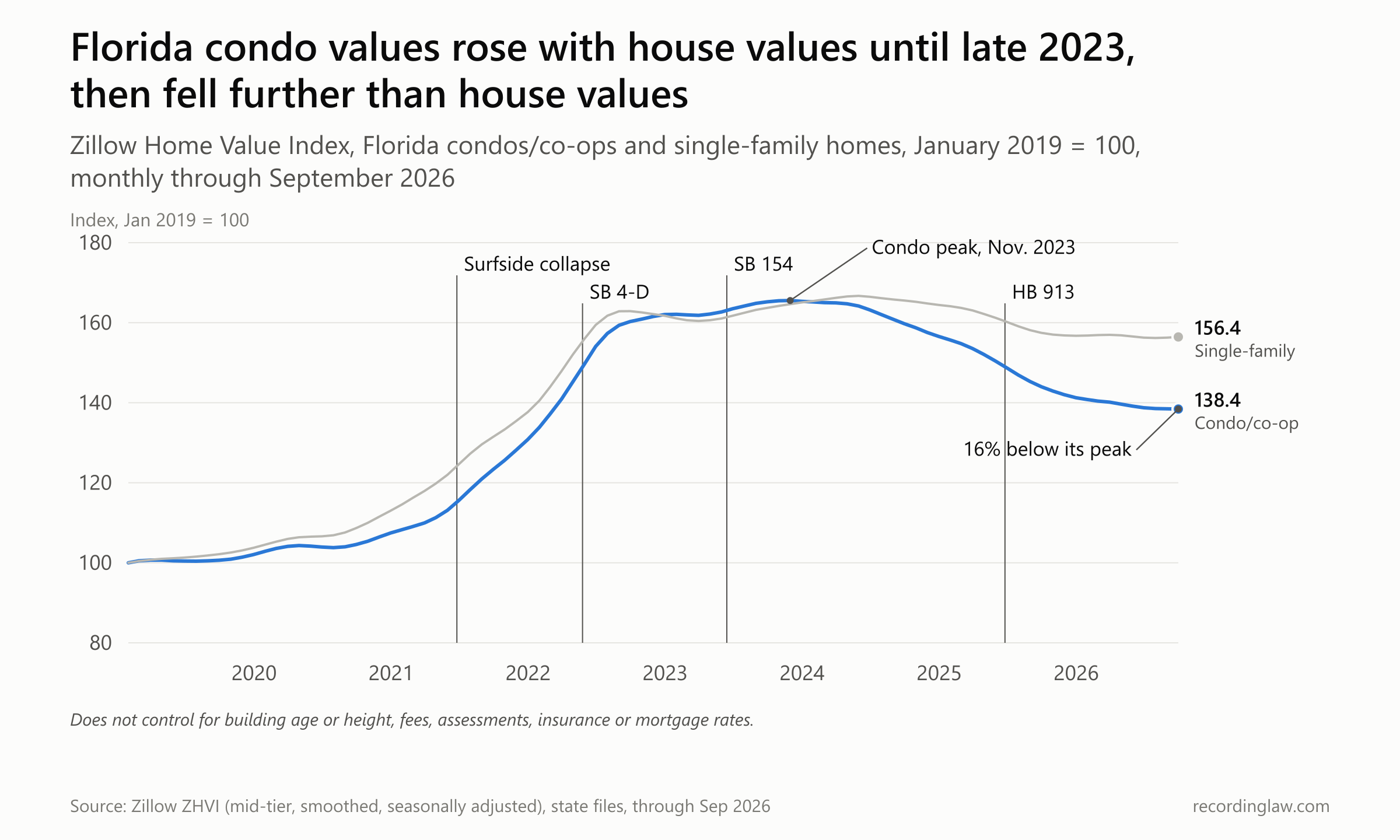
Source: Zillow Home Value Index (mid-tier, smoothed, seasonally adjusted), Florida state files, January 2019 to September 2026. Law markers are placed at the month of passage or signing.
| Month | Condo/co-op value | Single-family value | Condo as % of single-family |
|---|---|---|---|
| June 2021 (Surfside) | $219,229 | $316,100 | 69.4% |
| May 2022 (SB 4-D passed) | $283,962 | $395,672 | 71.8% |
| June 2023 | $310,167 | $410,273 | 75.6% |
| November 2023 (condo peak) | $314,049 | $417,589 | 75.2% |
| May 2024 (single-family peak) | $311,441 | $422,863 | 73.7% |
| December 2024 | $297,034 | $417,095 | 71.2% |
| December 2025 | $267,974 | $397,561 | 67.4% |
| September 2026 | $262,592 | $396,809 | 66.2% |
The condo line turned down in 2024. That was the year older buildings' first milestone inspections, the structural inspections the 2022 law ordered, came due. The ban on waiving structural reserves began with budgets adopted on or after December 31, 2024. On its own, that timing cannot show what the law did.
Listings moved the same way. Florida Realtors, the state's Realtor trade association, reports months of supply: how long the homes for sale would last at the current pace of sales.
In September 2022, condos and townhouses had about 2.3 months of supply. By September 2025 they had 9.1 months, roughly four times as much. Single-family homes went from 2.5 months to 5.1 over the same years.
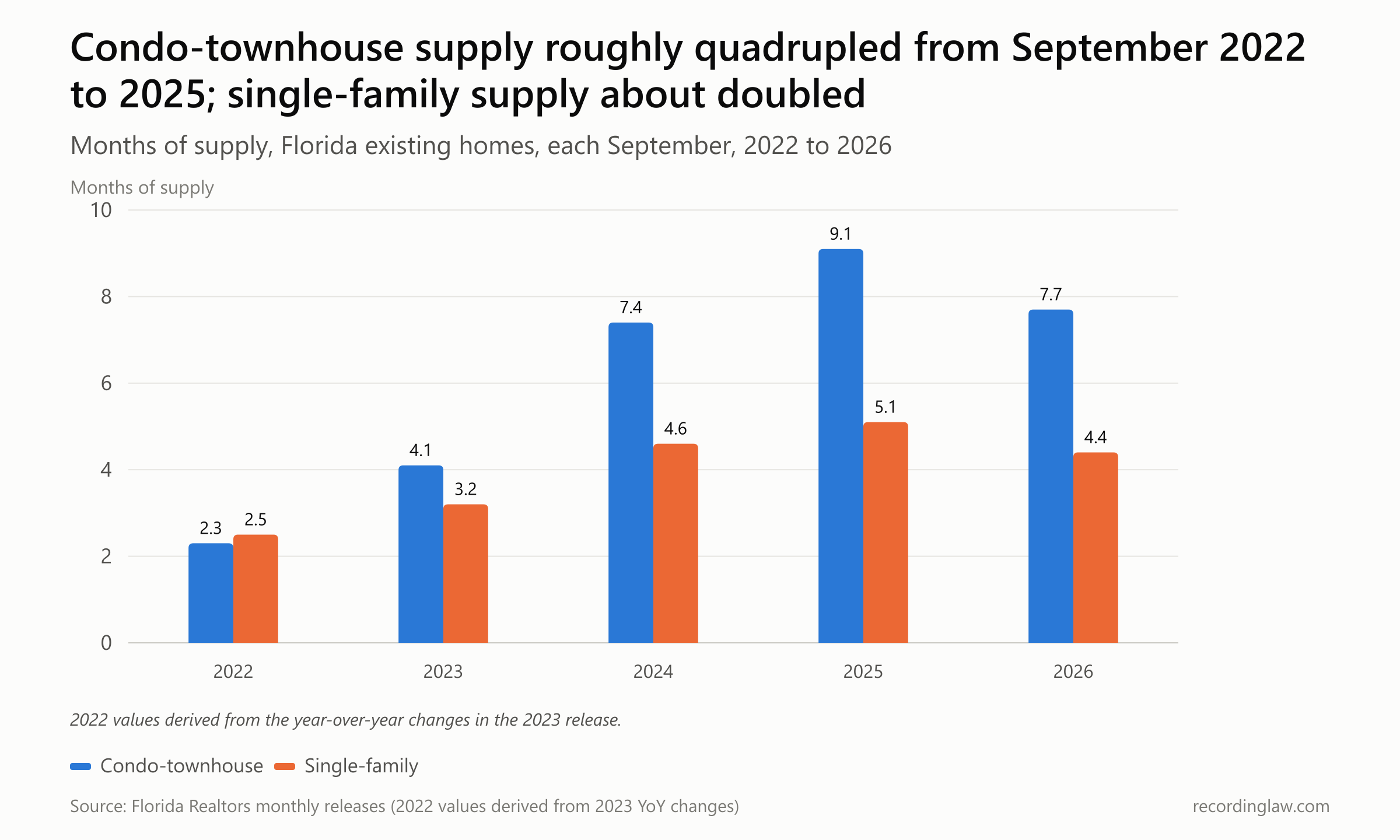
Source: Florida Realtors September releases, existing homes, not seasonally adjusted. 2022 supply values derived from the year-over-year changes stated in the 2023 release.
| September | Condo-townhouse supply (months) | Single-family supply (months) | Condo-townhouse median | Single-family median |
|---|---|---|---|---|
| 2022 | 2.3 | 2.5 | $307,250 | $403,880 |
| 2023 | 4.1 | 3.2 | $324,990 | $409,243 |
| 2024 | 7.4 | 4.6 | $314,000 | $410,000 |
| 2025 | 9.1 | 5.1 | $299,000 | $410,000 |
| 2026 | 7.7 | 4.4 | $293,500 | $415,000 |
Condo supply rose faster than house supply every year through 2025. Then both eased in 2026.
Sale prices split too. The median September sale price for condos and townhouses rose to about $325,000 in 2023. By September 2026 it had fallen to about $294,000.
The single-family median edged up to $415,000 in September 2026, its seventh straight month above the year before. The gap between the two medians was $121,500 in September 2026.
To judge whether the law had anything to do with that split, start with what it asked of owners. That was fought out in the Legislature in 2022, well before the lines parted.
The reserve fight that sank the first bill
Florida's first attempt at a post-Surfside law died in March 2022 over one question: whether owners could keep voting to skip their reserves.
The House sponsor, Rep. Daniel Perez, a Miami Republican, would not drop the reserve mandate. "That was not a negotiable piece for us," he told NBC 6 South Florida. "We were never going to negotiate the waiving of reserves because that is part of the problem that caused the incident at Surfside."
The Senate sponsor, Sen. Jennifer Bradley, a Fleming Island Republican, said the Senate's version "ensured safety of our state's condominiums while not creating crushing financial burdens on the millions of Floridians living in condominiums." Bill Sklar, who chaired a Florida Bar task force formed after the collapse, told NBC 6 that the Senate worried many condo associations would go bankrupt if they had to come up with all the required reserves within three years. NBC 6 reported at the time that the House mandate "could raise the cost for condo owners by hundreds or possibly thousands of dollars a year upfront, depending on the specific building."
The regular session ended on March 11 with no condo bill. "One of the worst building collapses in U.S. history will not have a response from state lawmakers," NBC 6 wrote.
The response came ten weeks later, in a special session called for property insurance. The bill lawmakers used was SB 4-D, a roofing and building code bill filed by Sen. Jim Boyd.
On May 24, the Senate adopted Bradley's amendment, which replaced the bill's text with the condo provisions. The bill passed the Senate 38-0 that day, and it passed the House 110-0 the next day. Gov. Ron DeSantis signed it on May 26, 2022, the AP reported.
The Community Associations Institute (CAI), the trade group for condo and homeowner associations and the managers and businesses that serve them, said the law was "largely based on CAI condominium safety public policy recommendations." "CAI mourned, prayed, and committed to doing whatever we could to make sure this never happened again," it wrote.
The senator who represents Surfside, Democrat Jason Pizzo, said there was time to fix what needed fixing. "We're going to be back in regular session at least one more time before any of this really kicks in, which gives ample time to tweak, amend, hear from the public and people on the ground," he told the AP.
He also warned, as the AP put it, that "the state doesn't have enough structural engineers to handle the workload." He put the number of certified structural engineers in Florida at about 650. "Tell your nieces and daughters and sons to go study engineering," he said.
What every older tower now owed
The law that passed put two obligations on condo and co-op buildings three stories or taller. Both remain in Florida statute.
The first is a milestone inspection, due by December 31 of the year a building turns 30 and every 10 years after that. Local officials may start the clock at 25 years, for example for buildings near salt water. The inspection comes in two phases, and phase one must be finished within 180 days after the owners receive the local government's notice. Buildings that had already turned 30 before July 1, 2022 had to finish the first inspection before December 31, 2024.
The second is a structural integrity reserve study (SIRS), which must be completed at least every 10 years. It sets how much the association must hold in reserves for its structural repairs. For budgets adopted on or after December 31, 2024, the owners of a covered association "may not determine to provide no reserves or less reserves than required" for those items. Nor may they vote to spend that money on anything else.
The law reached a lot of homes. A legislative analysis that year, the Associated Press reported, counted more than 1.5 million condo units in Florida. It counted nearly 28,000 associations running them. More than 912,000 of those units were older than 30 years, and they were home to more than 2 million residents.
The governor's office later summed up the purpose. The law, it said, "requires condominiums and cooperatives to conduct structural integrity reserve studies for buildings three stories or higher to ensure the funding necessary for future structural repairs is available and prohibits waiver of funding for certain structural reserves." It also required that inspection reports and reserve studies be provided to anyone buying a unit. A building's condition would now follow it onto the market.
When the bills reached owners
The cost the Senate had warned about began to surface in 2023, and the Senate's own sponsor said so on the record.
In February 2023, lawmakers took up SB 154, a cleanup bill that let local officials extend inspection deadlines for owners who had hired an engineer. "We don't want to have a gotcha," Bradley said.
In that debate, Sen. Shevrin Jones asked what would "provide relief" to owners. "I cannot sit here today and tell you that there is not an owner in the state of Florida who won't see an increase," Bradley answered. She described the law as an "effort on the part of the Legislature to make sure that folks that live in condos are safe."
Lenders had tightened their rules too. Fannie Mae made its post-Surfside condo requirements permanent, saying they were designed "to protect borrowers from physically unsafe or financially unstable projects, which could translate to significant spikes in homeownership costs." It kept a confidential list of buildings it would not back.
That list held 1,770 properties nationwide in May 2023 and 2,308 by October, nearly 35% of them in Florida, the Miami Herald reported, citing the Boston Globe.
Fannie Mae said that in June 2023 just 1.2% of the projects in its database were marked "unavailable," meaning ineligible under its guidelines. Most of those, it said, were listed for reasons such as litigation, hotel-style use or inadequate insurance rather than repairs.
By August 2023, Fort Lauderdale's City Commission was discussing a resolution asking the Legislature for grants or low-interest loans to help owners pay. "Our senior citizens are essentially being pushed out of their homes because of decades of deferred maintenance and failure to adequately fund the reserves," Commissioner John Herbst told Bisnow.
A year later, the pressure had reached the governor. At roundtables in Miami Lakes and Pinellas Park in September 2024, DeSantis urged lawmakers to act. "I don't think the intent of what the legislature did was to have people leave their units because they can no longer afford to be in," he said.
Rep. Tom Fabricio, a Miami Lakes Republican, said owners who tried to sell had to disclose the assessments and required repairs, "so, that's causing issues with the market throughout." WKMG in Orlando reported new costs facing some Central Florida owners, "some as high as $100,000 per resident."
Senate President Kathleen Passidomo had already ruled out a special session before the election. "In my view, no law is perfect," she wrote in an August 2024 memo, but she said the committee weeks and regular session after the election were the better place to fix it.
Rep. Vicki Lopez, a Miami Republican who sponsored the 2024 and 2025 condo bills, told The New York Times in October 2024 how the reserves had been allowed to run down. "Many waived reserve requirements because there were retirees on the board, and other people in the condo were retirees," she said. "They kicked the can down the road."
She also said: "The crisis is coming. It's like watching a tidal wave."
One estimate of the monthly cost comes from Miami-Dade. A policy brief from Florida International University's Metropolitan Center, which has not been peer reviewed, estimated that after the 2022 law, monthly association fees for condos in buildings three stories or higher were about $65 a month higher, or $777 a year, after accounting for inflation.
The brief split that $65 in two. About $21 a month was the extra for buildings three stories or higher, which the law covers. The other $44 or so appeared across all condos, including lower-rise buildings the law does not cover. The same brief found no statistical evidence that having a reserve fund raised fees.
Hughes, the University of Florida researcher, defended the laws in The Conversation in October 2024. "These new expenses simply reflect more of the true cost of living in a condo near the ocean," he wrote. "Properties that face significant financial shocks from SB-4D are, by definition, undermaintained or underfunded."
How much of the gap is the law?
Florida's condos fell behind its houses after 2023. But condos lost ground to houses in most of the country over the same years, and Florida's law applies only in Florida. So the Florida charts alone cannot show what the law did.
From May 2022, the month SB 4-D passed, to September 2026, condo values lost ground to single-family values in 39 of 51 areas, the 50 states and DC, by Zillow's indexes. Over that time, Florida's condo index fell about 7.5% while its single-family index rose 0.3%. That is a gap of 7.8 percentage points.
The gap is measured in percentage points, the plain difference between two percentages (from 10% to 12% is two points). New York's gap was 30 points. Florida's ranked ninth of the 51.
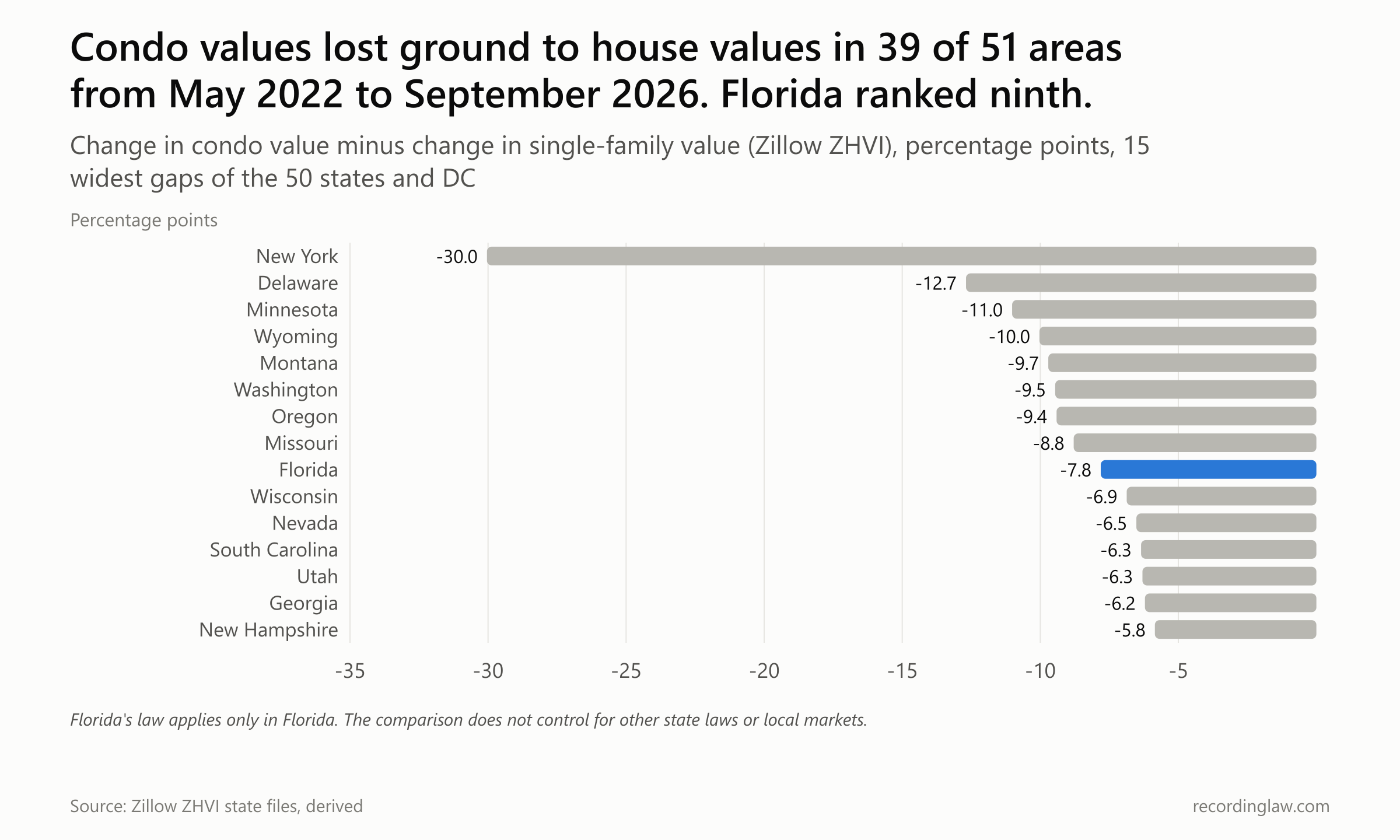
Source: Zillow Home Value Index state files, condo/co-op and single-family, change from May 2022 to September 2026; our calculation.
| State | Condo change | Single-family change | Gap (points) | Rank of 51 |
|---|---|---|---|---|
| New York | -3.61% | +26.42% | -30.04 | 1 |
| Florida | -7.53% | +0.29% | -7.81 | 9 |
| Georgia | -2.13% | +4.08% | -6.21 | 14 |
| Texas | -9.15% | -3.37% | -5.77 | 16 |
Florida's condos lost more ground to its houses than condos did in most states.
Georgia and Texas, two other large Southern states, show the same shape. In both, condo values also slipped as a share of single-family values after mid-2023.
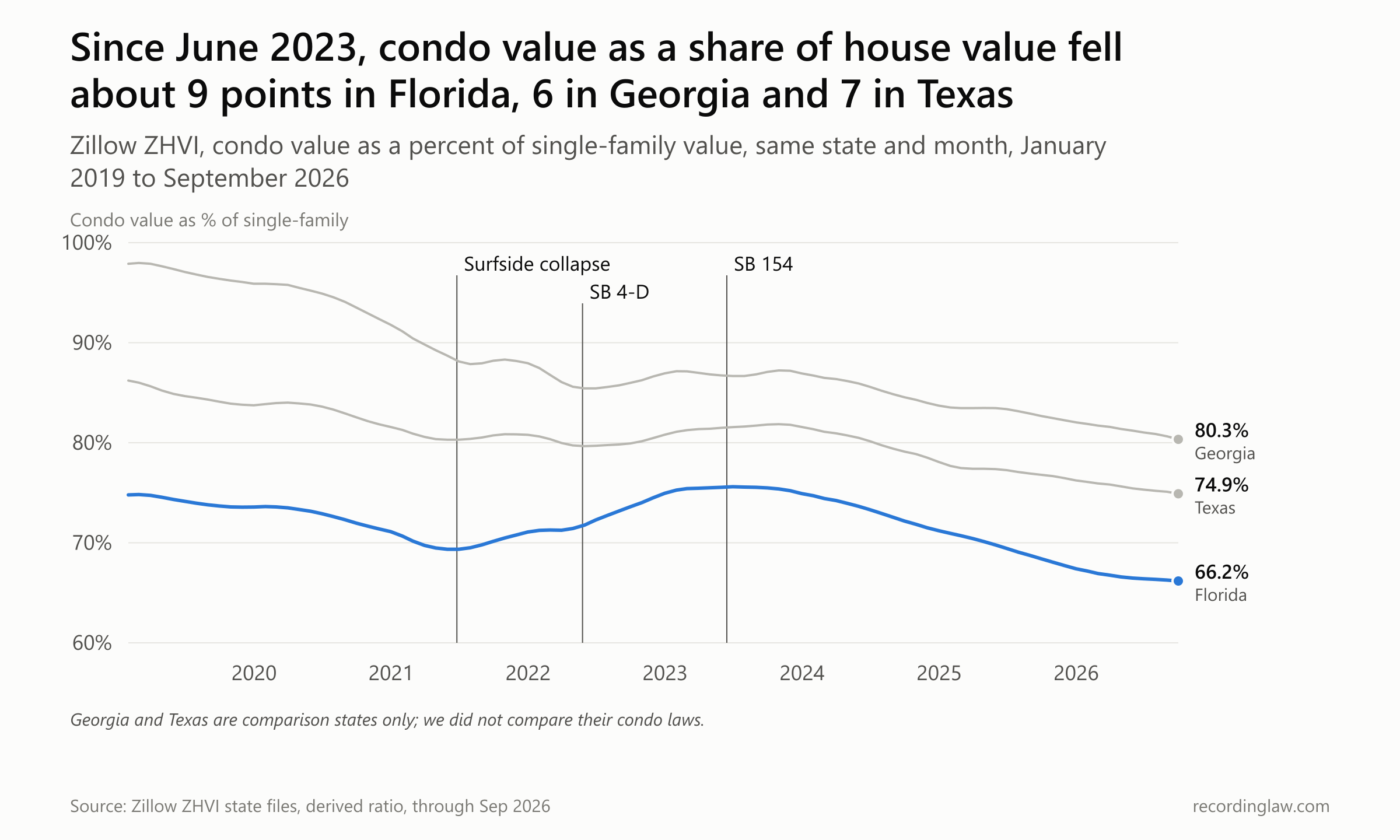
Source: Zillow Home Value Index state files; condo value divided by single-family value in the same state and month.
| State | January 2019 | June 2023 | September 2026 | Change since June 2023 (points) |
|---|---|---|---|---|
| Florida | 74.8% | 75.6% | 66.2% | -9.4 |
| Georgia | 97.9% | 86.7% | 80.3% | -6.3 |
| Texas | 86.2% | 81.6% | 74.9% | -6.7 |
Since June 2023, Florida's condo share fell by about three points more than Georgia's or Texas's.
Other costs moved over the same years. Insurance Journal reported in August 2026 that condo association premiums doubled from 2022 to 2024, citing news reports of state insurance regulator data. A broker told it premiums have since fallen "by as much as 40% in some cases," a softening brokers credited largely to Florida's separate 2022 property-insurance reforms, which targeted claims litigation.
WUSF described 2025 as the fourth straight year of falling condo sales in South Florida "as the market digests the pandemic-era buying spree, higher borrowing costs and the impact of condominium reforms." A single index for the whole state cannot separate any of these from the law.
One study tries. Shaoming Cheng, of Florida International University's Department of Public Policy and Administration, used statewide Florida Department of Revenue condo sales from 2020 to 2024. The paper compared sales in buildings inferred to be three stories or more, which the law covers, with sales in lower-rise buildings, which it does not.
The method asks whether prices of the covered condos changed relative to the uncovered ones after each event, first the collapse and then the law. It is called difference-in-differences.
Measured against the lower-rise condos, Cheng found "an estimated relative price decline of approximately 3.4%" in the period after the collapse and before the law. After the law, the estimate was "approximately 6.1%".
The paper is a working paper posted to arXiv, and it has not been peer reviewed. We found no funding statement in it.
Its estimates differ by type of building. The larger post-law discounts were "among younger and higher-valued properties, with weaker evidence for properties closest to the coast." It measures only how condos above the three-story line did against those below it, not the whole market, and its data end in 2024.
Realtor trade groups have tracked a split inside the condo market itself. WUSF reported in January 2026 that Miami Realtors' data showed 2025 sales of condos in buildings less than 25 years old up 2% and sales in older buildings down 6%. WUSF called the result "a bifurcated condo market." Gay Cororaton, the Miami Realtors Association's chief economist, wrote that lower mortgage rates and legislation "providing financial relief for condo owners and increasing transparency and accountability of condo associations" are "reviving the condo market."
Florida Realtors' October 2026 release said condo and townhouse sales had shown greater resilience, "helped in part by their relative affordability and the market's ongoing adjustment to reserve requirements and other regulations." Closed condo and townhouse sales rose 3.1% in the third quarter of 2026 from a year earlier, to 22,664.
Relief in 2025, and second thoughts
By the spring of 2025, the Legislature was rewriting the law for the third time, after SB 154 in 2023 and HB 1021 in 2024, and this time the aim was cost.
"With each milestone inspection, our condos are becoming safer, but financial impacts are reverberating," Bradley told the Senate on April 30, 2025. "Our commitment remains steadfast to assist condo owners who have absorbed a tremendous amount of change." She said the bill, HB 913, offered "options, flexibility, and relief" without "moving one step backwards on safety."
Other senators spoke to both sides in the same debate. Sen. Nick DiCeglie, an Indian Rocks Beach Republican, said: "Folks are hurting financially. They are up against making decisions of whether or not they are going to leave the dream called Florida."
Sen. Gayle Harrell, a Stuart Republican, credited the law with saving lives: "We had two condos in my district that were on the verge of falling down. You have really saved lives along the way, but you've also listened."
The final votes were 37-0 in the Senate and 112-0 in the House, after an earlier House vote of 113-2. DeSantis signed it on June 23, 2025, at a press conference at Island Way Grill on Clearwater Beach. "People need to be able to afford to live in these units," he said. He added that where the integrity of the structure is not at risk, owners "need to be able to work those out, and you shouldn't have this mandate applied in that way."
Sen. Ed Hooper, a Clearwater Republican who had voted for the 2022 law, spoke at the signing, the Florida Phoenix reported. "We all attempted to make sure that there was never a collapse again, like what happened at Surfside," he said. "We overreacted, probably, and now it's time to make the change. People were losing their homes."
The governor's office said the new law extended the reserve study requirement by one year. It said the law also let associations pause reserve contributions for up to two years to pay for critical repairs found in a milestone inspection. The pause is open only to budgets adopted on or before December 31, 2028, and only with the approval of a majority of all the association's voting interests.
How many associations had done their studies was still unclear. In February 2025, Melanie Griffin, secretary of the Department of Business and Professional Regulation (DBPR), which regulates condo associations, told House members that about 36% of the condominiums required to get the study had done so by February 10. She said the figure might not be accurate because associations reported it themselves.
Earlier in the session, Lopez's House version had proposed a sharper enforcement tool, barring Citizens Property Insurance, the state-backed insurer, from covering associations without a study.
"It is the stick," she said. "Look, they've had two and a half years to get a structural integrity reserve study done. It literally doesn't take that much."
Bradley opposed it. She said she was "very concerned about making sure that they don't compound their troubles by not being able to secure insurance."
What NIST found at Champlain Towers South
In June 2026, federal investigators reported what had brought the building down. Their answer pointed mainly to how it was designed and built.
The National Institute of Standards and Technology (NIST) found that "punching shear failure" at two columns in the garage under the pool deck in early June 2021 began the collapse, which came three weeks later. NIST describes that kind of failure this way: forces pushing down on a steel-reinforced concrete slab can make it bend and crack around a supporting column, which weakens the connection holding the slab in place until it fails.
"When building structures are designed and built to required codes and standards, they have margins against failure," said Judith Mitrani-Reiser, a co-lead of the investigation. "In the case of Champlain Towers South, however, these margins against failure were too narrow from the start."
Added weight and decay played a part too. Loads added over the building's life, including pool deck modifications, "further diminished the margins against failure, as did long-term degradation from corrosion," NIST wrote.
At an advisory committee meeting in September 2026, NIST stressed that "the principal causes of the Champlain Towers South collapse were original design and construction deficiencies," and that other issues were "opportunities to improve codes and standards rather than evidence that comparable buildings are broadly unsafe." When we checked on November 10, 2026, its final report and recommendations were still being written, with no release date announced.
What the first inspection count found
A month after NIST's findings, the Legislature's research office, the Office of Program Policy Analysis and Government Accountability (OPPAGA), published the first statewide count of what the inspections had turned up.
Building officials reported 8,736 completed phase one inspections in 2024 and 2025. They reported 1,575 completed phase two inspections, the second stage.
They also reported 903 permit applications for repairs that those phase two inspections identified. The estimated repairs ranged from under $1,000 to $30 million.
Inspections declared 30 buildings unsafe or uninhabitable in 2024 and 24 in 2025, across eight counties.
Most of those buildings were not vacated, building officials told OPPAGA. In 2024, the officials who responded said 5 of the 30 had been vacated. For 2025, three officials answered the question, for five of the 24 buildings. They said none of those five had been vacated.
State law does not define "unsafe" or "uninhabitable." Nineteen of 2025's 24 came from one city, Aventura, which did not answer OPPAGA's question about vacating them.
Aventura disputes them. "Aventura has zero unsafe structures," city spokesperson Evan Ross told WUSF. He called the classification of the 19 an error, and he said the city was asking OPPAGA to revise the report. OPPAGA declined WUSF's questions, citing a statutory "work paper" disclosure exemption.
Two counties told WUSF what happened next. Osceola County, with 10 on the list, said none required evacuation. It said six had been fully repaired by the time the report came out and the other four were still being repaired. St. Lucie County's three were evacuated, and residents have since returned.
Pizzo's 2022 warning about engineers shows up in the same report. Officials granted 1,587 extensions to inspection deadlines, 94% of them in coastal jurisdictions, for reasons including "difficulty finding engineers to complete inspections and delays in completing inspections due to engineer workloads."
Zana Raybon, executive director of the Florida Board of Professional Engineers, had told Bisnow in 2025: "If you're an engineer and your license is important to you, you may not want to put your license on the line to do this type of work." A rigorous inspection typically costs at least $35,000, William O'Donnell of DeSimone Consulting Engineers told Bisnow.
The count is incomplete. DBPR received 2024 data from 71% of local jurisdictions and 2025 data from 64%. WUSF called it the first statewide picture of how Florida's aging condo buildings are faring, "though it's not a full picture."
A Miami lawmaker and the associations' trade group read the report differently. "It doesn't paint a confident picture of where we are with a lot of these buildings," said Rep. Juan Carlos Porras, a Miami Republican. "I think there were a lot of buildings that could have been probably deemed unsafe that weren't."
Dawn Bauman, CEO of CAI, said: "Condominiums are overwhelmingly safe in the state of Florida, if you look at the numbers. I don't think there's anything alarming coming from this report."
Phil Masi, a condo insurance broker with Gallagher, told Insurance Journal the part of the report that confused him was the 54 buildings "deemed unsafe and uninhabitable in 2024 and 2025 yet are still occupied." "There has to be more to the story there," he said. OPPAGA's count shows at least five of them were vacated.
Porras's bill to rein in homeowner associations, HB 657, passed the House 108-2 in March 2026 and died in the Senate Rules Committee on March 13. Asked whether more changes were needed, Bauman said: "No, I would like to see things settle."
The deadline at the end of 2026
The final backstop for existing associations' first reserve studies is December 31, 2026. Associations whose milestone inspection falls due by then must finish their study by that day; the statute says that "in no event" may it be completed later.
December 31, 2026 is also when local building officials' next year of milestone inspection data is due to DBPR. That data could feed a second OPPAGA report in 2027.
The law requires DBPR's division to list the associations that have completed their studies in an annual report due each September 30. As of November 10, 2026, DBPR's reserve-study reporting page posted no such list, only filing instructions. The next report is due September 30, 2027.
The division must post an inflation-adjusted minimum reserve threshold by February 1 each year. The next one is due February 1, 2027. The two-year reserve pause expires for budgets adopted after December 31, 2028. As of November 10, 2026, NIST's final report had no announced date.
The 2026-27 state budget required DBPR to report how many associations had submitted the study in the 2025-26 fiscal year to the Legislature's budget chairs and the governor's budget office by December 1, 2026.
In January 2021, one association in Surfside had about 6.9% of the reserves its study recommended. Florida now requires every covered building to have that study and bars owners from voting its structural reserves away, apart from the temporary pause. On November 10, 2026, the state's reserve-study reporting page gave no count of how many buildings have one.
This article reports historical market data and is not financial or investment advice.
How we measured
Prices. Condo and single-family values are the Zillow Home Value Index (ZHVI) state files for condo/co-op and single-family homes. They are mid-tier (33rd to 67th percentile) estimated values, smoothed and seasonally adjusted, and they run monthly through September 2026, the latest posted when we checked on October 31, 2026. ZHVI is an estimate of typical value, not a sale price. Indexes set January 2019 at 100.
"Condo as % of single-family" divides the condo value by the single-family value for the same state and month. Peak-to-latest changes: condo $314,049 (November 2023) to $262,592 (September 2026), down 16.4%; single-family $422,863 (May 2024) to $396,809, down 6.2%.
The state comparison. For each of the 50 states and DC we took the percentage change in each index from May 2022 to September 2026 and subtracted the single-family change from the condo change. Thirty-nine areas had a negative gap and 12 a positive one. Georgia and Texas were chosen as comparison states; we did not compare their condo laws.
Supply and medians. Months of supply and median sale prices are Florida Realtors' statewide September figures for existing homes, from each October release, not seasonally adjusted. Florida Realtors' "condo-townhouse" category includes townhouses; Zillow's covers condos and co-ops. The 2022 supply figures are derived from the 2023 release's year-over-year changes (4.1 months was up 78.3%, giving about 2.3; 3.2 months was up 28%, giving 2.5).
The 2022 medians are quoted in the 2023 release. "Roughly four times" is 9.1 divided by 2.3 (about 3.96); single-family supply "about doubled" is 5.1 divided by 2.5 (2.04). The first chart's "16% below its peak" is the condo index at 138.42 in September 2026 against its November 2023 peak of 165.54 (January 2019 = 100). The condo-share chart's changes since June 2023: Florida 75.6% to 66.2% (9.4 points), Georgia 86.7% to 80.3% (6.3), Texas 81.6% to 74.9% (6.7).
What the price data cannot show. None of these series controls for building age or height, association fees, special assessments, insurance costs or mortgage rates. A statewide index cannot separate the law from those forces or from the national condo pattern above. The Cheng paper (arXiv 2607.02791, version 2, September 23, 2026) is the only study we found that uses a comparison group defined by the law's three-story threshold; it is a working paper and not peer reviewed.
The FIU Metropolitan Center fee brief covers Miami-Dade only and is a policy brief, not peer reviewed. Insurance premium figures are second-hand, via Insurance Journal; we did not open the state's data.
The reserve gap at Champlain Towers South. Figures for the building's reserves differ between sources. We use one: the Association Reserves study as reported by the University of Florida's Bill Hughes (about $706,000 held as of January 2021 against nearly $10.3 million recommended, 6.9%).
The law. SB 4-D (2022 Special Session D) is chapter 2022-269. It passed the Senate 38-0 on May 24, 2022 and the House 110-0 on May 25. The AP and CAI report it was signed May 26, 2022; the Senate's bill page lists the governor's approval entry under June 29, 2022.
Later changes: SB 154 (chapter 2023-203, approved June 2023), HB 1021 (chapter 2024-244, June 14, 2024) and HB 913 (chapter 2025-175, June 2025; the Senate page lists approval June 24, the governor's office announced the signing June 23). A 2026 act, chapter 2026-14, amended the statute only to delete expired and obsolete provisions. Inspection and reserve rules are in sections 553.899 and 718.112 of the Florida Statutes; the annual report is in section 718.501.
Inspections. Counts are from OPPAGA Report 26-04 (July 2026), which analyzed data DBPR collected from local building officials for 2024 and 2025 plus OPPAGA's follow-up questions to officials. The 36% study-completion figure is self-reported, as of February 10, 2025.
For another state's reserve-funding legislation, see our report on California's AB 2050.
Frequently Asked Questions
What did Florida's condo law after Surfside require?
SB 4-D, passed in May 2022, requires condo and co-op buildings three stories or taller to have a milestone inspection by the end of the year they turn 30 (25 if the local government chooses) and every 10 years after. It also requires a structural integrity reserve study at least every 10 years. For budgets adopted on or after December 31, 2024, owners cannot vote to waive or cut reserves for the structural items in the study.
When is the Florida SIRS deadline?
Associations that existed on or before July 1, 2022 had to complete the structural integrity reserve study by December 31, 2025. Associations whose milestone inspection is due on or before December 31, 2026 may do both together, but under the statute the study may not be completed after December 31, 2026.
Have Florida condo prices fallen since the 2022 law?
Zillow's Florida condo index rose from about $284,000 in May 2022 to a peak of about $314,000 in November 2023, then fell 16% to about $263,000 by September 2026. The single-family index ended the period slightly above May 2022. Condo values also fell behind single-family values in 39 of 51 areas nationally. Insurance and borrowing costs changed at the same time. So the index alone cannot show how much was caused by the law.
Is there a study of the law's effect on condo prices?
A Florida International University working paper by Shaoming Cheng, not peer reviewed, compared condos in buildings of three stories or more with lower-rise condos from 2020 to 2024. It estimated a relative price decline of about 3.4% after the collapse and about 6.1% after SB 4-D.
How many Florida condo buildings were found unsafe?
OPPAGA Report 26-04, from the Legislature's research office, says milestone inspections identified 30 buildings in 2024 and 24 in 2025 as unsafe or uninhabitable, across eight counties. Building officials reported most were not vacated. The City of Aventura, which reported 19 of the 2025 buildings, told WUSF it has no unsafe structures and is asking OPPAGA to revise the report. State law does not define either term. The Department of Business and Professional Regulation (DBPR) received data from 71% of jurisdictions for 2024 and 64% for 2025.
Can a Florida condo association pause reserve contributions?
Under HB 913 (2025), for budgets adopted on or before December 31, 2028, an association that completed a milestone inspection in the previous two calendar years may, with approval from a majority of all voting interests, pause reserve contributions for up to two consecutive annual budgets to fund repairs the inspection identified.
What caused the Champlain Towers South collapse?
NIST reported in June 2026 that punching shear failure at two garage columns under the pool deck in early June 2021 began the collapse. It said the principal causes were original design and construction deficiencies, with added loads and corrosion further reducing the building's margins. NIST's final report has no announced date.
Updates
Reworded for readability. No figures, quotes, sources or findings changed.
Restructured as a feature: chart titles state the finding, side details moved to How we measured. Every figure and quote was re-checked against its source.
Independently fact-checked against the cited primary sources
Independently fact-checked against the cited primary sources
Sources and References
- NIST, technical findings on what caused the 2021 partial collapse of Champlain Towers South (June 2026)(nist.gov).gov
- NIST, National Construction Safety Team Advisory Committee meeting summary, September 23-24, 2026(nist.gov).gov
- OPPAGA Report 26-04, Milestone Inspection Reporting Data 2024 and 2025 (July 2026)(oppaga.fl.gov).gov
- Florida Senate, SB 4-D (2022 Special Session D) bill history(flsenate.gov).gov
- Florida Senate, bill summary of SB 4-D, Building Safety(flsenate.gov).gov
- Florida Senate, SB 154 (2023) bill history(flsenate.gov).gov
- Florida Senate, HB 1021 (2024) bill history(flsenate.gov).gov
- Florida Senate, HB 913 (2025) bill history(flsenate.gov).gov
- Florida House Commerce Committee staff analysis of HB 913 (2025)(flsenate.gov).gov
- Florida Senate, HB 657 (2026) bill history(flsenate.gov).gov
- Florida Statutes s. 553.899, mandatory structural inspections for condominium and cooperative buildings(leg.state.fl.us).gov
- Florida Statutes s. 718.112, condominium budgets and reserves(leg.state.fl.us).gov
- Florida Statutes s. 718.501, Division powers and annual report(leg.state.fl.us).gov
- Florida DBPR, condominium and cooperative SIRS reporting(myfloridalicense.com).gov
- Office of the Governor of Florida, release on condominium safety (June 2023)(flgov.com).gov
- Office of the Governor of Florida, second condominium safety roundtable (September 2024)(flgov.com).gov
- Office of the Governor of Florida, HB 913 signing release (June 2025)(flgov.com).gov
- Zillow Home Value Index, condo/co-op, state level (through September 2026)(files.zillowstatic.com)
- Zillow Home Value Index, single-family, state level (through September 2026)(files.zillowstatic.com)
- Florida Realtors, September 2026 housing market release(floridarealtors.org)
- Florida Realtors, third-quarter 2026 condo and townhouse sales(floridarealtors.org)
- Florida Realtors, September 2025 housing market release(floridarealtors.org)
- Florida Realtors, September 2024 housing market release(floridarealtors.org)
- Florida Realtors, September 2023 housing market release(floridarealtors.org)
- News Service of Florida via Florida Realtors, lawmakers reconsider condo safety requirements (February 2023)(floridarealtors.org)
- Shaoming Cheng (FIU), Capitalizing Risk, Regulation, and Revised Perceptions: Sequential Shocks in Florida's Condominium Market, arXiv working paper (2026)(arxiv.org)
- FIU Metropolitan Center, Determinants of Condominium Association Fees (2025 policy brief)(metropolitan.fiu.edu)
- Bill Hughes (UF Bergstrom Real Estate Center), The Conversation, republished by UF News (October 2024)(news.ufl.edu)
- Fannie Mae, perspective on the future of condo lending (July 2023)(fanniemae.com)
- NBC 6 South Florida, Florida lawmakers fail to pass condo safety reform (March 2022)(nbcmiami.com)
- WUSF, property insurance and condo bills scrapped (March 2022)(wusf.org)
- Associated Press via WSLS, DeSantis signs bill addressing safety after condo collapse (May 2022)(wsls.com)
- Community Associations Institute, Florida lawmakers pass condominium safety legislation (May 2022)(advocacy.caionline.org)
- Miami Herald via Yahoo News, condo lending blacklist (December 2023)(news.yahoo.com)
- Bisnow, South Florida looks for solutions as expensive repairs threaten an exodus of residents (August 2023)(bisnow.com)
- News Service of Florida via WLRN, Miami Lakes condo roundtable (September 2024)(wlrn.org)
- WCJB, DeSantis urges Legislature to fix condo law (September 2024)(wcjb.com)
- WKMG ClickOrlando, DeSantis pledges solutions as condo owners struggle with post-Surfside fees (September 2024)(gmg-wkmg-prod.cdn.arcpublishing.com)
- The New York Times via WLRN, owning and buying a Florida condo (October 2024)(wlrn.org)
- WUSF, condo sales fall again in 2025 (January 2026)(wusf.org)
- Florida Phoenix, bill blocking Citizens policies for noncompliant condos advances (March 2025)(floridaphoenix.com)
- Associated Press via NBC 6, lawmakers approve changes to condo safety law (April 2025)(nbcmiami.com)
- News Service of Florida via Jacksonville Today, Legislature eases financial burden on condo owners (May 2025)(jaxtoday.org)
- Florida Phoenix, DeSantis signs legislation to relieve financial burdens on condo owners (June 2025)(floridaphoenix.com)
- Bisnow, Florida engineers shy away from condo work (June 2025)(bisnow.com)
- WUSF via WLRN, Florida condo inspection report finds unsafe buildings and reporting gaps (July 2026)(wlrn.org)
- Insurance Journal, on the OPPAGA condo inspection report (August 2026)(insurancejournal.com)
- WFSU, Florida House passes a bill to rein in homeowner associations (March 2026)(news.wfsu.org)
- Laws of Florida, Chapter 2026-232 (HB 5001-E), 2026-27 General Appropriations Act, DBPR proviso to Specific Appropriation 2290(laws.flrules.org).gov