By 2024, Minneapolis Was Permitting Apartments at About a Tenth of Its 2017-2019 Pace, and St. Paul at Under a Third

Independently fact-checked against primary sources (last audited November 10, 2026). · 7 primary sources cited on this page. How we verify our legal content
On Dec. 7, 2018, the Minneapolis City Council voted 12-1 to approve a plan that would let up to three homes stand on lots where only one had been allowed. A lawsuit to stop it had already been filed. That same week, a judge had refused the plaintiffs' request for an order blocking the vote.
The plan was Minneapolis 2040, the city's comprehensive plan: its long-range guide to land use and growth. Upzoning means changing the rules to allow more homes on the same land, and Bloomberg CityLab called the plan "the most ambitious upzoning guide yet passed by an American city." With 75 percent of residents living in areas zoned for single-family homes, it wrote, the plan "promises to bring dramatic change to the fabric of Minneapolis."
Three years later, across the Mississippi, St. Paul voters went the other way. On Nov. 2, 2021, 53% of them approved a cap of 3% a year on rent increases, with no exemption for new buildings, according to the Minnesota Reformer.
The city calls the cap rent stabilization. Others, including some quoted below, call it rent control. The Reformer called it "one of the most stringent policies in the country."
Both cities said they wanted rents their residents could afford. Minneapolis bet on letting more get built. St. Paul bet on limiting what landlords could charge.
The Census Bureau tracks apartment construction with a category for buildings of five or more units. By 2024 both cities were permitting only a few hundred units a year in that category, down from thousands. Measured against its own pace of permits in 2017-2019, Minneapolis, the city with no cap, had fallen further. What did each bet do to building and to rents, and what can the record not separate?
Which city's building fell further?
The chart below measures each place against its own 2017-2019 average, which is set at 100. On that scale, St. Paul stood at 31 in 2024, Minneapolis at 10 and the rest of the Minnesota metro at 75. So Minneapolis permitted about a tenth as many units in 2024 as in an average year from 2017 to 2019. Counted in units rather than on that scale, the suburbs fell too, from 9,393 in 2022 to 3,693 in 2024, and then rose to 4,754 in 2025.
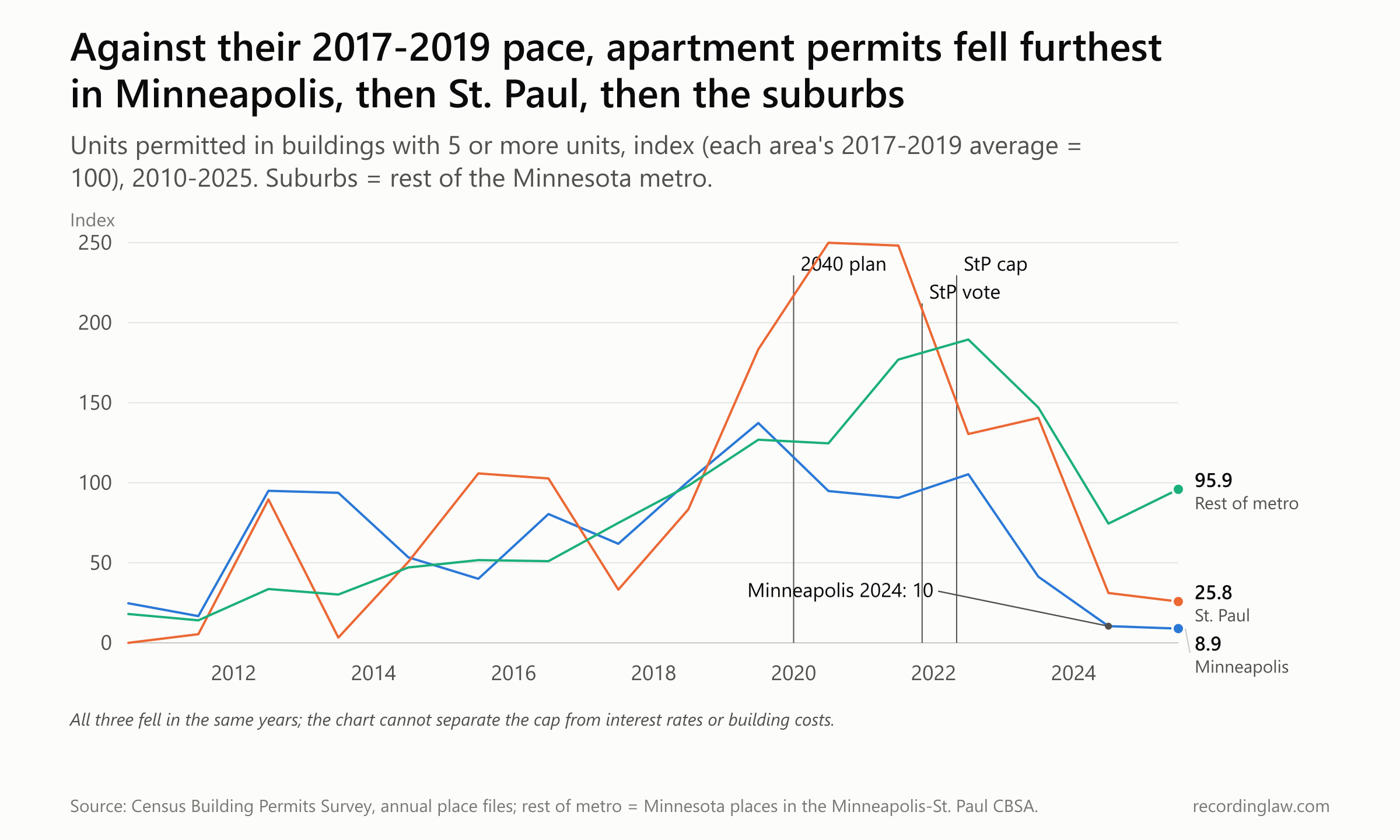
5+ unit permits indexed to each area's 2017-2019 average (=100): Minneapolis, St. Paul and the rest of the Minnesota part of the metro. Source: U.S. Census Bureau, Building Permits Survey.
| Year | Minneapolis | St. Paul | Rest of metro (MN) |
|---|---|---|---|
| 2021 | 90.6 | 248.2 | 177.0 |
| 2022 | 105.3 | 130.5 | 189.5 |
| 2023 | 41.3 | 140.5 | 147.0 |
| 2024 | 10.4 | 31.1 | 74.5 |
| 2025 | 8.9 | 25.8 | 95.9 |
So on that measure both cities fell further than their suburbs did, and Minneapolis fell furthest. The base years matter, though; How we measured gives a second base.
Because all three dropped in the same years, this comparison cannot say how much of St. Paul's drop came from its cap, from interest rates or from the same forces that hit Minneapolis.
Each city reached that low by its own road. Minneapolis's road started with the council vote in December 2018.
What Minneapolis voted for
The plan began bigger than the one the council passed. In the draft released in March 2018, MinnPost reported, the proposal to allow fourplexes, buildings of up to four units, "in all parts of the city" had become its most controversial idea. The draft drew more than 10,000 comments, MPR News reported.
By September, city planners had cut fourplexes to triplexes, three-unit buildings, on lots about 40 feet wide or less. Heather Worthington, the city's long-range planning director, told MinnPost that planners found a four-unit building on a 40-foot lot "resulted in a pretty awkward structure." Neighbors for More Neighbors, a group that campaigns for more housing, objected that the fourplex had itself been "a compromise that only went part way toward ending the historical inequities enshrined in the zoning code," as a volunteer for the group wrote to MinnPost.
The plan's own text was careful about what zoning could do. The plan includes a Built Form map, which guides what size of building each part of the city allows.
"The Built Form map on its own cannot affect housing cost," the plan says, but allowing growth "is intended to result in overall lower housing costs than would occur if no more supply was built." So the promise was lower rents than Minneapolis would have had without new building. That other Minneapolis does not exist, so no data set can observe it directly.
Council President Lisa Bender made the case in plainer terms. "Our city is growing. Our population is growing. And so we know we need more housing for people," she said in November 2018. "We have one of the lowest rental vacancy rates in the country."
She also set expectations low. Bender predicted that developers would not quickly move to divide up their properties, FOX 9 reported. Four years earlier, the city had allowed accessory dwelling units, which FOX 9 described as effectively turning homes into duplexes. Only about 100 had been built since, Bender said.
Opponents warned about who would use the new rules and what they would not fix. Council member Linea Palmisano, the lone no vote, called the process "haphazard" and "chaotic," and said the plan would let absentee landlords split up rental homes, tripling their profit, FOX 9 reported. Lisa McDonald, a former council member and co-founder of the opposition group Minneapolis for Everyone, told MinnPost the city had an affordable housing crisis but "those things are solved in different ways," adding that triplexes were "not going to solve the affordable housing problem."
Mayor Jacob Frey framed the plan as a break with the past. He said it "pushes back against a history of redlining, commits our City to sound climate policies, and combats our housing and workforce shortages." Bender said that wealth and poverty in the city "are often found along lines of race, the consequence of decisions that were made over decades to exclude people from neighborhoods."
Not every observer expected the zoning to reach that far. Hamline University political scientist David Schultz said in 2022 that ending single-family zoning "probably makes sense from a densification point of view, but there's very little evidence that it's going to address the problems of racial disparities."
The December 2018 vote sent the plan to the Metropolitan Council, the regional planning body that reviews Twin Cities comprehensive plans. The Metropolitan Council approved it on Sept. 25, 2019. The city council then adopted it in final form on Oct. 25, 2019, by a 10-1 vote, FOX 9 reported.
The plan's policies took effect Jan. 1, 2020, the same day as the zoning change allowing three units per lot. Frey said Minneapolis was "leading the nation in the fight to create affordable housing." In Minneapolis, the lawsuit filed before the first vote was still moving.
A plan ordered back to 2030
For more than five years, a lawsuit hung over the plan. It came from Smart Growth Minneapolis, joined by the Audubon Chapter of Minneapolis and Minnesota Citizens for the Protection of Migratory Birds. Using the Minnesota Environmental Rights Act, a state law that lets people sue over harm to the environment, they argued the city should have studied the plan's environmental effects first. More housing density, the suit said, as summarized by WCCO, would "increase traffic and noise, decrease air quality and green space and negatively impact local wildlife and water quality."
On June 15, 2022, Hennepin County Judge Joseph R. Klein ruled for the plaintiffs without a trial, on summary judgment. He also blocked the plan with an injunction, a court order barring the city from carrying it out. He wrote that "the one truly meaningful time to challenge a Comprehensive Plan, particularly one as far-reaching as the 2040 Plan, is when it is still just that--a plan." He ordered the city to restore the residential development portions of its old 2030 plan, as they stood on Dec. 4, 2018.
"This decision is a pivotal win for the residents of Minneapolis and the environment," said Rebecca Arons, Smart Growth Minneapolis's executive director. On Dec. 27, 2022, the Court of Appeals upheld the ruling against the city. But it found the record was not enough to support the injunction, and it sent the injunction back to the district court. The district court issued an amended injunction on Sept. 5, 2023.
Three weeks later, Frey stood outside a turquoise fourplex on 16th Avenue South, built by the Minneapolis Public Housing Authority on what had been a single-family site. "A judge recently smashed our ability to put up this kind of housing," he said. "This would not be possible but for the 2040 plan, this won't be possible going forward if this ruling stands."
On May 13, 2024, the Court of Appeals reversed. It did not decide whether either side's arguments were right, MPR News reported; it held that the lower court had wrongly put the burden of proof on the city rather than the plaintiffs.
Days later, the Legislature settled the larger question. "A couple paragraphs tucked into a 1400-page bill," as the Reformer put it, exempted comprehensive plans from environmental review. The exemption was retroactive, reaching back to the most recent round of plans. The bill passed on May 19, 2024, and Gov. Tim Walz signed it.
The exemption was pushed by environmentalists, on the other side from the bird groups. "Environmental law was being used against the environment and we put a stop to that," said Peter Wagenius, the Sierra Club's legislative director, Twin Cities Business reported. Smart Growth Minneapolis called the pending bill a "bail out," MPR News reported, and its attorney Nekima Levy Armstrong said "people of color will be disproportionately impacted when governmental bodies are allowed to not comply with environmental laws."
The plaintiffs argued the new law was not retroactive for all their claims. On Aug. 21, 2024, the Minnesota Supreme Court denied their petition for further review, FOX 9 reported. The suit had been filed in December 2018, more than five and a half years earlier. Across the river, St. Paul had already tried a different tool.
What St. Paul voted for
The St. Paul measure was written by tenant advocates, not the city. Its backers, the Housing Equity Now St. Paul coalition, based the 3% figure on University of Minnesota research on past rent increases, MinnPost reported. "Our goal is to make sure that, as the cost of housing increases, it does so at a rate that's humane, that keeps people in place, that allows people to grow in their communities," said Tram Hoang of The Alliance, a coalition member. Hoang managed Keep St. Paul Home, the campaign for the measure, that fall.
Covering new buildings was deliberate, and so was the rule that rents did not reset when a tenant moved out, which, MPR News reported, would stop landlords from dramatically raising rents between tenants. "If it doesn't protect everyone, it doesn't work as well," Hoang said. "And we found that if you have loopholes, they will be taken advantage of." Council member Mitra Jalali said cities needed both things at once: "you need a combination of an abundance of new homes at a whole range of income levels, and then protections for people at the very bottom of the market."
Mayor Melvin Carter's support was qualified. He tweeted that he would vote yes "not because the policy is flawless as drafted," but because "it's a start," adding that the city "can and must make it better, quickly." Four of the seven council members said they would not vote for it.
The warnings were specific. Cecil Smith of the Minnesota Multi Housing Association, the landlord group that led the opposition, said the measure would shrink future rental development, which would push rents up, MinnPost reported. "The Twin Cities is in a global market for capital for real estate," said Tony Barranco of Ryan Companies, the developer of the Highland Bridge project. "A big amount of fuel comes from institutional investors who have choices about where they invest their dollars globally."
Others pointed at inflation and upkeep. "If inflation never goes above 3%, that's one thing. But if it does, that could spur lots of owners to appeal which, if not successful, could lead to long-term problems with the ability of owners to properly maintain the stock," said Mark Willis of New York University's Furman Center. Joe Abraham, whose company manages about 500 older apartments in both cities, said, "The product will just deteriorate year after year after year." The president of the St. Paul Area Association of Realtors warned of condo conversions.
Building-trades unions opposed it too. "What this initiative doesn't tackle is supply," said Adam Duininck of the North Central States Regional Council of Carpenters. Council member Jane Prince called it "a very blunt instrument."
The opposition spent more than $4.3 million, the Reformer reported. Keep St. Paul Home raised $206,000, by the Reformer's count.
The measure passed anyway, carrying six of seven wards, according to the Reformer. "Passage of this proposal marks a significant step towards addressing the affordable housing crisis in St. Paul," Hoang said on election night. Two weeks later, parts of the Highland Bridge redevelopment were postponed.
What did builders do in St. Paul?
On Nov. 17, 2021, the Reformer reported that Ryan Companies was postponing parts of Highland Bridge, the redevelopment of the old Ford plant site, where construction was underway on 3,800 new homes, including 760 affordable units. The cap had not yet taken effect. Hoang answered at a public web event: "Scare tactics are their tactics."
Before the cap took effect, the Reformer later reported, developers announced they were halting projects. "We can't get financing," Barranco said. "The reality is there is no money for housing with this ordinance in place."
The cap took effect on May 1, 2022. From then on, landlords had to limit increases to 3% in a 12-month period or request an exception. Did builders pull back?
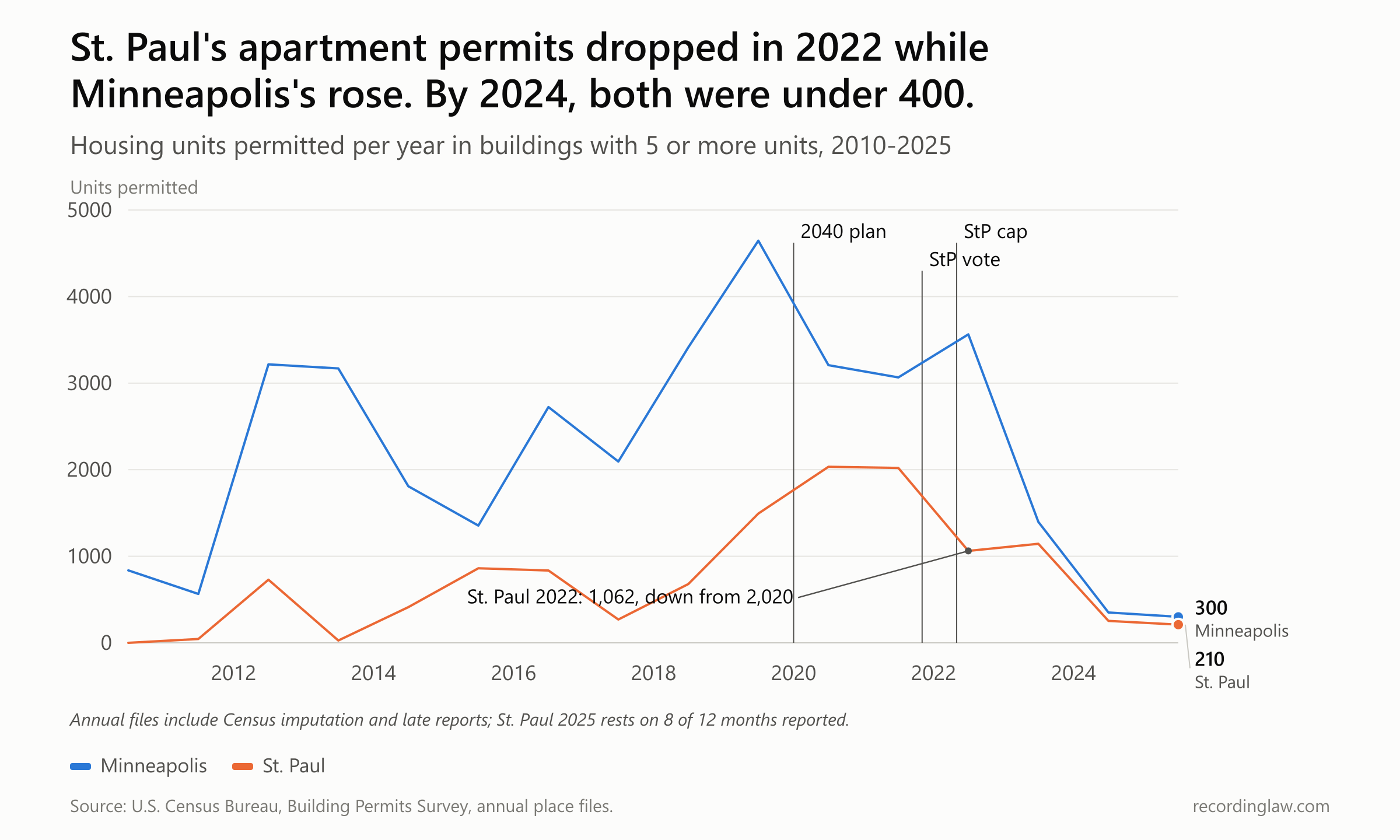
Units permitted in 5+ unit buildings, Minneapolis and St. Paul, 2010-2025. Source: U.S. Census Bureau, Building Permits Survey annual place files. St. Paul 2025: 8 of 12 months reported.
| Year | Minneapolis | St. Paul |
|---|---|---|
| 2018 | 3,414 | 679 |
| 2019 | 4,646 | 1,493 |
| 2020 | 3,207 | 2,034 |
| 2021 | 3,066 | 2,020 |
| 2022 | 3,563 | 1,062 |
| 2023 | 1,398 | 1,144 |
| 2024 | 351 | 253 |
| 2025 | 300 | 210 |
St. Paul's count fell first. Units permitted in buildings of five or more dropped from 2,020 in 2021 to 1,062 in 2022, a fall of 47%. Over the same year, Minneapolis's count rose.
The mix of new rentals changed too. More than four in five new St. Paul rental units had been market-rate in 2020 and 2021, and in 2022 less than half were, the Minneapolis Fed reported from Metropolitan Council data.
Less than five months after the cap took effect, on Sept. 21, 2022, the city council voted 5-2 to change it. Low-income housing was exempted, new construction was exempted for 20 years, and rents could rise more after tenants moved out, starting Jan. 1, 2023.
Jalali, one of the two no votes, said: "I will not vote to take rent stabilization away from my constituents who need it the most."
Consumer prices rose 6.5% from December 2021 to December 2022, the Bureau of Labor Statistics reported. That was above 3%. Willis had warned that if inflation went above 3%, lots of owners could appeal, and the exception requests followed that path.
By May 2023, the Pioneer Press reported, about 26,000 of the city's 78,000 rental units were exempt. A landlord could also file a self-certification request, certifying its own need for a larger increase.
The Pioneer Press reported that 86% of landlords who filed one in 2022, citing inflation and other rising costs, had been allowed increases of up to 8%. On May 22, 2023, U.S. District Judge Nancy Brasel upheld the ordinance against a challenge from two property owners.
Not everyone agreed the cap explained the drop. "Many renters and advocates say they don't believe that policy prevented new development," the Reformer reported. The nearest test sat across the river, in a city with no cap, where apartment permits, measured against their 2017-2019 pace, were about to fall further.
Why did Minneapolis, with no cap, fall further?
Minneapolis permitted 3,563 units in buildings of five or more in 2022. In 2023 it permitted 1,398, by the Census Bureau's annual count.
In 2024 it was 351, and in 2025, 300, less than a tenth of the 2022 count. Those were also the years the plan was under court orders to restore the 2030 rules, first issued in June 2022 and reissued in September 2023, until the Court of Appeals reversed in May 2024. We did not test whether the injunction changed permit counts.
The last time the city permitted 300 or fewer multifamily units in a year, the Minneapolis Fed noted, was 2008, at the bottom of the Great Recession.
The Fed measured Minneapolis's drop at 91.6%, from a recent peak in 2022 to a trough in 2025. It also built a comparison group of similar cities, and that group's permits fell 64.3%, from a recent high point in 2021 to a low point in 2024.
Margaret Kaplan, president of the Housing Justice Center, made the comparison in 2025, MPR News reported. She disputed that changing St. Paul's ordinance would lead to more development. "When we say that the cause of a reduction in building permits in St. Paul is due to rent stabilization," she asked, "why are we not looking at the same reduction in multi-family units permitted in Washington County, or Anoka County, or Minneapolis, or cities around the country?"
The Minneapolis Fed asked developers in summer 2026 why Minneapolis had stalled. They cited low rents, rising costs, Minneapolis-specific rules and the city's own talk of rent control. Minneapolis voters had given their council the power to enact rent control in 2021. As of May 2025, the Minnesota Reformer reported, the council had not passed an ordinance.
Rents were the core of it, by the Fed's account. Adjusted for inflation, Minneapolis rents fell nearly 20% from January 2020 to August 2026, against just over 10% in its comparison cities. "Unless there are substantial decreases in construction, operating, and borrowing expenses, rents in Minneapolis will remain too low for new development to be financially viable without additional support," the Fed wrote. Developers the Fed interviewed praised some of the plan's aspects: "The 2040 Plan makes Minneapolis one of the most developer-friendly cities in the country," one said.
In the Fed's account, the 2040 plan let developers build more on a lot, but a developer builds only when the rent a new unit can charge covers what it costs to build, borrow and run. In Minneapolis, rents fell after inflation while those costs rose. So, in the Fed's reading of its interviews and rent data, fewer projects paid, and permits fell with the zoning still in place. That leaves the plan's signature change, the triplex, and what it produced while it was in force.
How many two- to four-unit homes did Minneapolis permit?
The headline change of 2018 was the triplex on a single-family lot. From 2020 through 2025, the Minneapolis Fed counted 317 new units permitted in duplexes, triplexes and fourplexes, in 106 buildings. Forty-seven of those buildings are on parcels that had allowed only a single-family home.
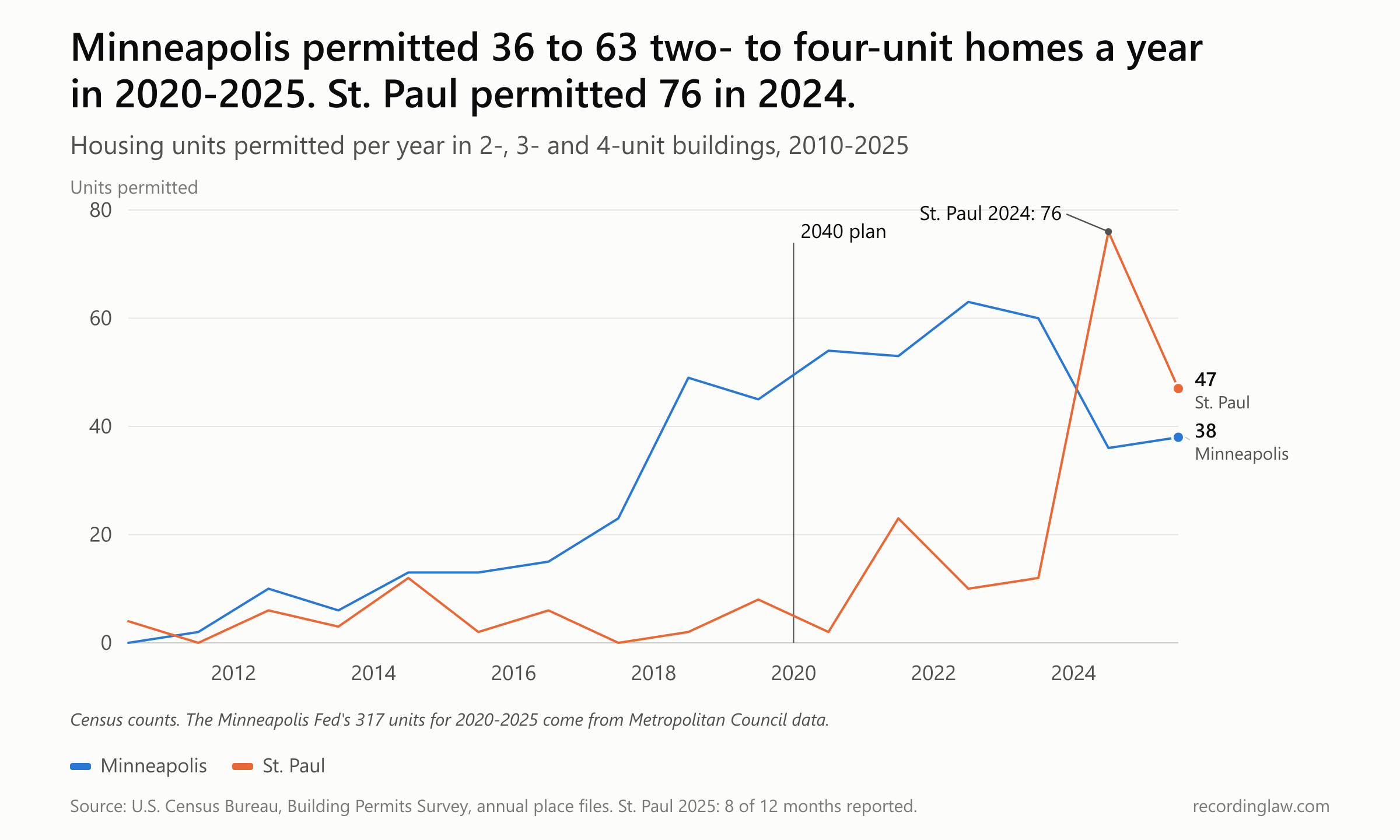
Units permitted in 2-4 unit buildings, Minneapolis and St. Paul, 2010-2025. Source: U.S. Census Bureau, Building Permits Survey.
| Year | Minneapolis | St. Paul |
|---|---|---|
| 2019 | 45 | 8 |
| 2020 | 54 | 2 |
| 2021 | 53 | 23 |
| 2022 | 63 | 10 |
| 2023 | 60 | 12 |
| 2024 | 36 | 76 |
| 2025 | 38 | 47 |
The Fed found that the 317 units were about 2% of the 12,335 units Minneapolis permitted in multifamily buildings over the same years. It also compared them with its comparison group of similar cities, scaled to Minneapolis's size. Over the six years, Minneapolis permitted only 2.4 more of these units than that group did.
Census counts put the 2020-2025 total at 304. The Fed's 317 comes from Metropolitan Council data, which differs from Census counts. Pew, looking at 2017 through 2022, found that of nearly 21,000 units permitted in the city, 87% were in buildings of 20 or more and just 1% in buildings of two to four.
Bender had predicted in 2018 that developers would not quickly divide up their properties, and the 317 units came slowly, spread over six years. Janne Flisrand, a co-founder of Neighbors for More Neighbors, told Governing in 2022 that the reforms likely to produce most of the new units were the end of parking minimums, the rules that required new buildings to include parking, and upzoning along transit corridors. "But it is hard to measure precise effects so far," Governing wrote.
St. Paul, the rent-control city, rezoned too. Its 2023 rules allow fiveplexes or sixplexes on nearly all residential land, and in 2024 it permitted 76 units in two- to four-unit buildings, 18% of all its permitted units, the Minneapolis Fed reported. That one year equalled the previous ten years combined, and it was more than Minneapolis permitted in any single year from 2010 to 2025. Whether the building that did happen held rents down is where the studies split.
What happened to rents, and why do the studies disagree?
Two studies looked at Minneapolis rents after the plan, and both found them rising slowly. They differ in design. Pew compared Minneapolis with the rest of Minnesota. The Minneapolis Fed built an estimate of what rents would have done without the plan, and then it checked whether the city had actually built more than places like it.
The Pew Charitable Trusts, whose housing program advocates zoning reform, made the case for supply in January 2024. "From 2017 to 2022, Minneapolis increased its housing stock by 12% while rents grew by just 1%," Pew wrote. "Over the same period, the rest of Minnesota added only 4% to its housing stock while rents went up by 14%." Pew concluded that "despite increased demand, Minneapolis was able to limit rent growth by building more housing."
Pew's rent figures came from Apartment List, comparing 2017 and 2022 averages. It did not build a counterfactual, an estimate of what rents would have done without the plan.
The Federal Reserve Bank of Minneapolis did, in August 2025. It blended 126 similar cities into one comparison, giving each city more or less weight so that, together, they matched Minneapolis's trends before 2019. That method is called synthetic control. Then it compared rents from three private sources from January 2019 to December 2023.
All three sources put Minneapolis well below the comparison cities. On Apartment List, Minneapolis rents fell 3.5% while the comparison cities' rose 22.4%. On CoStar, Minneapolis rents rose 3.2%, against 17.5%. On Zillow, they rose 10.0%, against 32.2%.
Minneapolis fell from the 29th-highest rent among the 126 cities to the 74th, the largest drop in rank of any of them. How far apart are the estimates, and does any point the other way? The chart below subtracts each comparison area's rent change from Minneapolis's, so Pew's 1% against 14% becomes a gap of minus 13 percentage points.
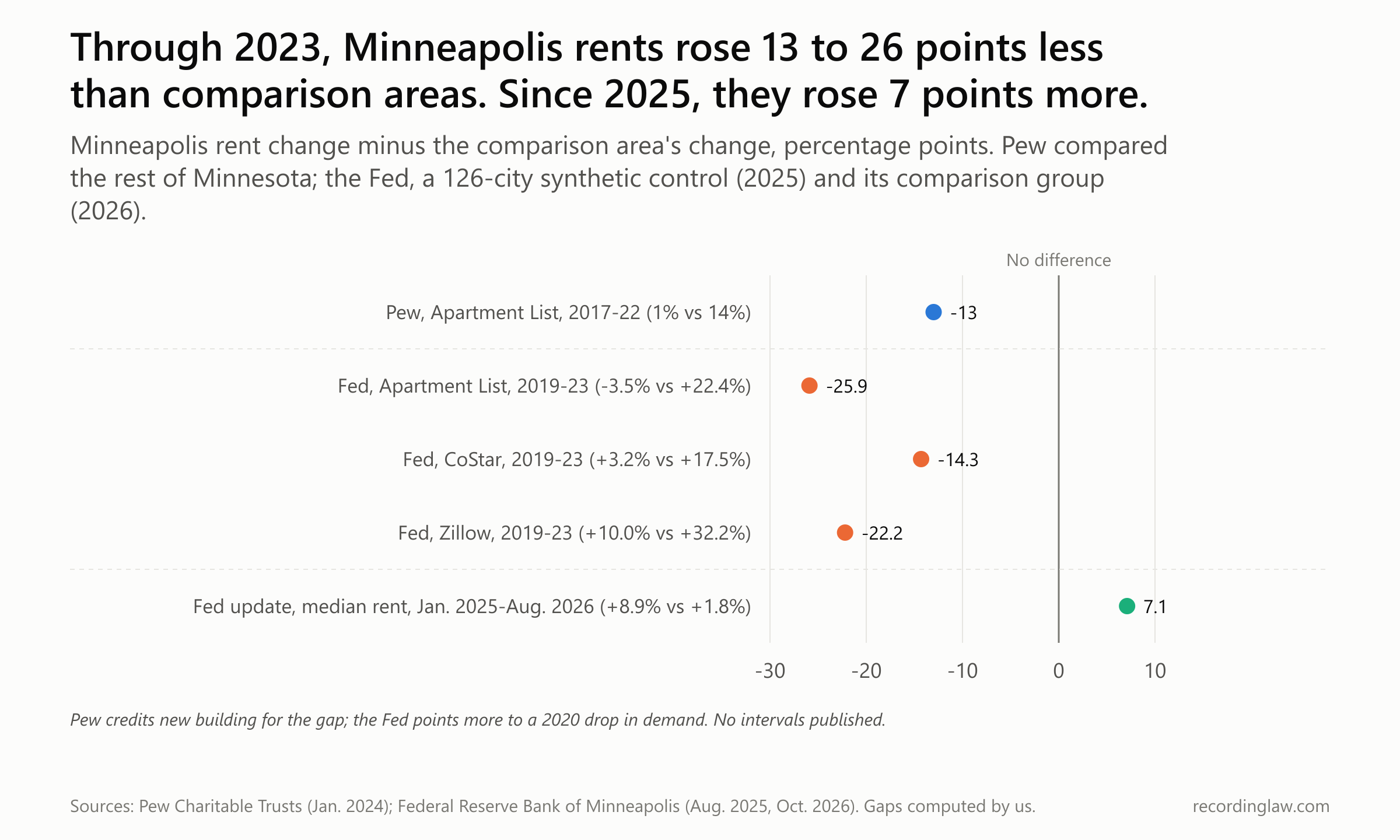
Minneapolis rent change minus the comparison area's change, in percentage points. Sources: Pew Charitable Trusts (January 2024); Federal Reserve Bank of Minneapolis (August 2025 and its 2026 update). Gaps computed by us.
| Study and rent source | Period | Minneapolis | Comparison | Gap (points) |
|---|---|---|---|---|
| Pew, Apartment List | 2017-2022 | +1% | +14% (rest of Minnesota) | -13 |
| Minneapolis Fed, Apartment List | Jan. 2019-Dec. 2023 | -3.5% | +22.4% (126-city synthetic control) | -25.9 |
| Minneapolis Fed, CoStar | Jan. 2019-Dec. 2023 | +3.2% | +17.5% | -14.3 |
| Minneapolis Fed, Zillow | Jan. 2019-Dec. 2023 | +10.0% | +32.2% | -22.2 |
| Minneapolis Fed update, median rent | Jan. 2025-Aug. 2026 | +8.9% | +1.8% (comparison group) | +7.1 |
Every estimate through 2023 puts Minneapolis below its comparison. The one from 2025 on puts it above.
The Fed's reading differed from Pew's. Slow rent growth "may result more from a negative housing demand shock specific to the Minneapolis market in 2020 than the expected impact of changes in the housing supply," it wrote. That is, the Fed points more to a 2020 drop in demand for housing in Minneapolis than to new building.
The Fed's reasoning went in two steps. First, if extra building had held rents down, Minneapolis should have built much more than its comparison cities. But from 2018 to 2022 it permitted only about 2% more multifamily housing than they did.
Second, demand dropped. The Fed's sign of that was the city's rental vacancy rate, which peaked at 9.5% in October 2020. "The findings do not imply that the 2040 Plan has or has not been successful to date," the Fed added. It also noted that at least a third of its comparison cities have since loosened their own land-use rules.
Since 2025 the direction has reversed for Minneapolis. From January 2025 through August 2026, its median rent rose 8.9%, against 1.8% for the Fed's comparison group. In August 2026 it reached $1,469, a new high by the Fed's measure. Frey had said in 2022 that the plan was meant to allow "a greater supply of housing, which is perhaps the main indicator for rents."
How did both cities' rents move against the region and the country? Zillow's Observed Rent Index (ZORI), a monthly rent series Zillow publishes for cities, metro areas and the nation, gives one consistent measure for all four. The Fed's nearly 20% fall was adjusted for inflation, and levels and changes differ by source, so these figures will not match the Fed's.
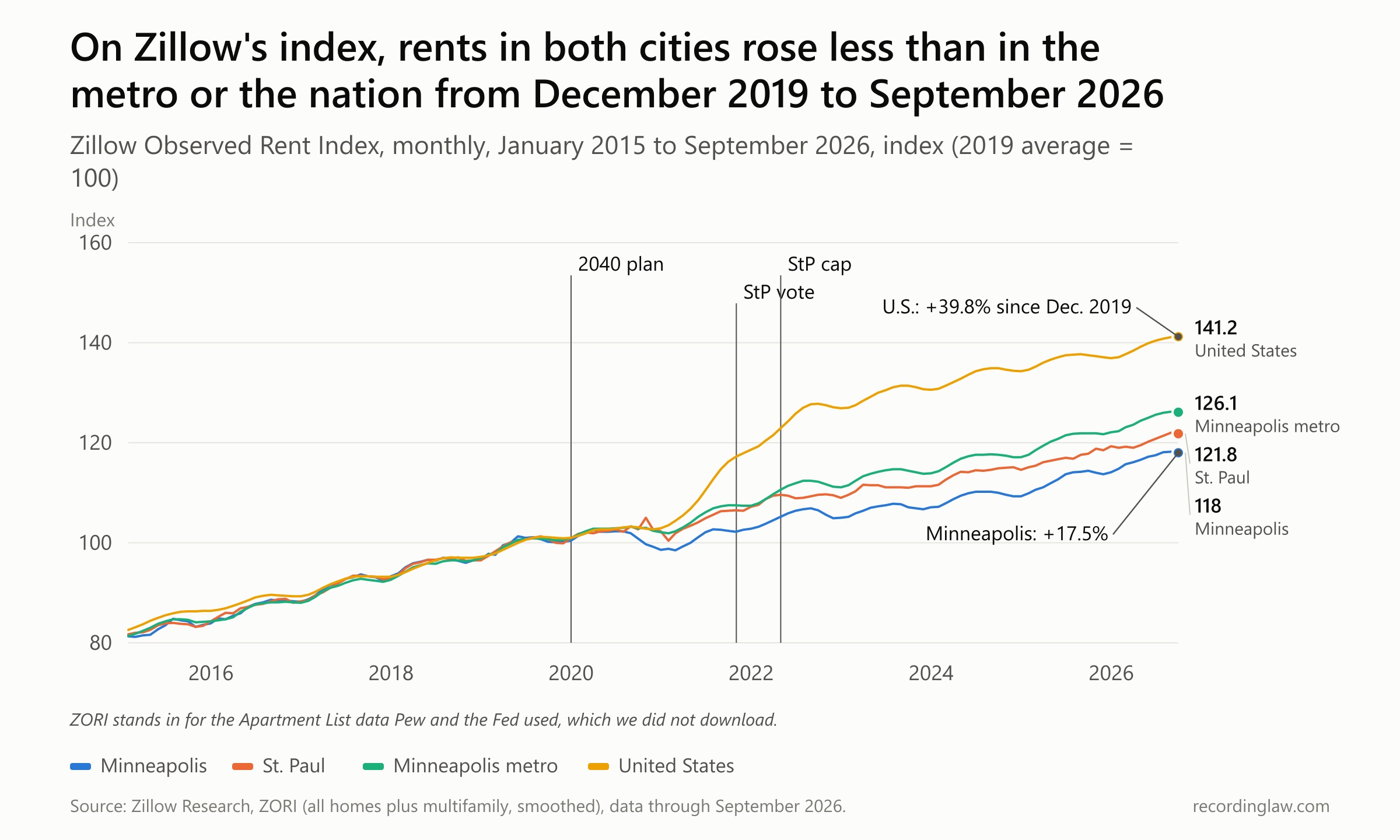
Zillow Observed Rent Index (ZORI), 2019 average = 100, monthly, January 2015 to September 2026. Source: Zillow Research. ZORI stands in for the Apartment List data Pew and the Fed used, which we did not download.
| Area | Sept. 2026 ZORI | Change, Dec. 2019 to Sept. 2026 | Change, Nov. 2021 to Sept. 2026 |
|---|---|---|---|
| Minneapolis | $1,747 | +17.5% | +15.0% |
| St. Paul | $1,524 | +20.7% | +14.5% |
| Minneapolis metro | $1,736 | +25.0% | +17.5% |
| United States | $1,932 | +39.8% | +19.8% |
The four lines moved together from 2015 through 2019, then split. On Zillow's index, rents rose less in both cities than in the metro or the country, and less in Minneapolis than in St. Paul. From the month of the St. Paul vote, the two cities rose almost the same amount, about 15%.
In St. Paul, the Fed's 2026 study found Zillow's index, adjusted for inflation, fell 10% from October 2020 to March 2026. The median sale price per apartment unit fell 36%, from $160,525 in 2020 to $103,249 in 2025, adjusted for inflation to 2025 dollars. Apartment owners in aggregate paid 27% less property tax in 2025 than in 2022, adjusted for inflation, while the tax on the median-priced single-family home rose from $3,442 to $4,264. The study said it had no hard data on what caused the drop in building, but that owners and developers it interviewed "feel that rent stabilization has had a profound effect on the market."
Two economists put a number on property values. In a 2022 National Bureau of Economic Research working paper, Kenneth Ahern and Marco Giacoletti estimated that "rent control caused property values to fall by 6-7%, for an aggregate loss of $1.6 billion," as their abstract puts it. They also found that the tenants who gained most had higher incomes and were more likely to be white, while the owners who lost most had lower incomes and were more likely to be minorities. Ahern discloses that he owns rent-controlled property in California, none in Minnesota.
The second rollback, and the elections after it
On May 7, 2025, the St. Paul council voted 4-3 to permanently exempt new construction and rentals built after 2004, at Carter's request. "We've seen plummeting housing production, plummeting permits being pulled," said Council President Rebecca Noecker. "We knew we needed to take a step to really send a strong, clear signal to the market that St. Paul is open for development." Carter said, "Our housing equity goals cannot be achieved without building more homes."
Hoang, by then the campaign's former manager, warned about the cutoff date. "As time goes on, a higher portion of our housing supply is exempt from the protections," she said. In a March 25 city release announcing proposed rent stabilization amendments, Council Vice President Hwa Jeong Kim had said, "Weakening rent stabilization will not address the need for more deeply affordable housing."
The affordable-housing builders had a stake in the vote too. Scott Cordes of Project for Pride in Living, a nonprofit developer that opposed the ordinance from the start, said 500 planned affordable units at Highland Bridge were on hold and might not be built without a change, MPR News reported. The change took effect June 13, 2025. After it, one interviewee told the Minneapolis Fed, developers at Highland Bridge were "reengaging at the site."
Both cities elected mayors that November. On Nov. 4, 2025, Carter lost the St. Paul mayor's race to state Rep. Kaohly Her. The Reformer wrote that the 2021 initiative "has been deemed such a failure that the City Council earlier this year exempted units built after 2004." In Minneapolis, Frey won a third term, and Twin Cities Business wrote that "prospects for Minneapolis to follow St. Paul on rent control appear dim."
Where the two bets stand
Preliminary 2026 numbers show both cities permitting more apartments than a year earlier. Through September, Minneapolis permitted 429 units in buildings of five or more, against 240 in the same months of 2025, Census year-to-date files show. St. Paul permitted 90, against 65, though it reported 9 months in the 2026 file and only 6 in the 2025 one.
In St. Paul, the city council has sought proposals for an outside study that will "evaluate the implementation and enforcement of Saint Paul's rent stabilization ordinance, including recent policy changes." Proposals closed Sept. 9, 2026; as of late October, the city had not announced a report date.
And the plan that was voted on in December 2018 has a successor due a decade later. Minneapolis must submit its 2050 plan to the Metropolitan Council by Dec. 31, 2028. Whether that plan keeps, widens or narrows the rules the council voted on in 2018 is still open.
Nearly eight years after the 12-1 vote, the plan it set in motion is in force, and the lawsuit filed before the vote is over. By the end of 2025, the Minneapolis Fed counted 47 buildings of two to four homes on lots that had allowed only one.
Across the river, the 3% cap St. Paul voters approved in 2021 was still the law in August 2026, when the council sought proposals for a study of it. It no longer covers new construction or rentals built after 2004.
How we measured
Permits. Units authorized by building permits come from the U.S. Census Bureau's Building Permits Survey annual place files for the Midwest region, 2010 to 2025 (Minneapolis place code 43000, St. Paul 58000). We use units in buildings with five or more units as the "apartment" measure, plus the 1-unit and 2-4 unit columns.
Annual files include late reports and Census imputation, which means the Census Bureau's estimates for permit activity that went unreported. So they differ from sums of monthly files. For Minneapolis in 2023, the annual file shows 1,398 units, while the twelve monthly files add up to 1,043, the figure the Minneapolis Fed uses.
The same choice affects St. Paul. On the sum of its monthly files, its 2021 count is 1,624, which would make the 2022 drop about 35% rather than 47%. St. Paul's 2025 annual figure rests on 8 of 12 months reported, with the rest imputed by Census. The 2026 figures are from preliminary year-to-date files through September; St. Paul reported 9 months in the 2026 file and 6 in the 2025 one.
Rest of metro. This group is every Minnesota place in the Census Minneapolis-St. Paul metro area (CBSA 33460) except the two cities. The metro's Wisconsin counties are excluded. The group held 201 or 202 places from 2010 to 2013 and between 216 and 230 from 2014 on. With the two cities included, the counts are 203-204 and 218-232.
The index chart divides each year's units by that area's 2017-2019 average. That base matters. St. Paul's 2017 figure of 270 rests on 11 of 12 months reported. On a 2019-2021 base, the 2024 index is about 10 for Minneapolis and 14 for St. Paul, so Minneapolis is still lower but the gap is smaller.
Percent changes we computed. St. Paul 2022 vs. 2021: 1,062 / 2,020 = 52.6%, a 47% drop. Minneapolis 2025 vs. 2022: 300 / 3,563 = 8.4%, less than a tenth. Minneapolis 2-4 unit units 2020-2025: 54 + 53 + 63 + 60 + 36 + 38 = 304.
The Minneapolis Fed's 317 uses Metropolitan Council data, which differs from Census counts. Earlier reports of St. Paul permit drops of 79% to 86% use other windows, sources or statistics; we did not reproduce them and use the Census annual series instead.
Rents. Zillow Observed Rent Index (ZORI), smoothed, all homes plus multifamily, city and metro files, January 2015 to September 2026, indexed to each area's 2019 monthly average. Pew used Apartment List medians; the Minneapolis Fed used the American Community Survey, Apartment List, CoStar and Zillow. Levels and changes differ by source, so we name the source with every rent figure.
ZORI substitutes here for Apartment List, which we did not download. We had no data on what tenants who stayed in place under St. Paul's cap actually paid.
Rent gaps we computed. The estimates chart subtracts each comparison area's rent change from Minneapolis's, using the figures each study published: Pew 1 - 14 = -13; Fed Apartment List -3.5 - 22.4 = -25.9; CoStar 3.2 - 17.5 = -14.3; Zillow 10.0 - 32.2 = -22.2; Fed 2026 update 8.9 - 1.8 = +7.1. The studies publish no intervals for these figures, and the rows are not strictly comparable: periods, rent sources and comparison areas differ.
Studies. Pew (January 2024) is a descriptive comparison of Minneapolis with the rest of Minnesota, 2017-2022; Pew's housing work advocates zoning reform. The Minneapolis Fed's August 2025 article uses synthetic control against 126 cities; its October 2026 Minneapolis update and June 2026 St. Paul article add Metropolitan Council permit data and developer interviews. The NBER paper (Ahern and Giacoletti, 2022) is a difference-in-differences study of St. Paul property values; we opened the 2022 working-paper abstract only and did not review later versions of the paper.
What this cannot show. This is a description of two cities, not a controlled study. Both laws arrived around a pandemic, a 2020 drop in Minneapolis rental demand that the Fed documents, and rising interest rates and building costs that affected the whole region. Minneapolis also changed parking and other rules around the same time.
The vote count for St. Paul's 2021 measure is the Minnesota Reformer's 53%; we did not retrieve the certified Ramsey County canvass, the county's official count.
What comes next. The Census Bureau posted its 2025 annual place file in May 2026; if the 2026 file follows the same timing, the full 2026 count would arrive around May 2027. The Minneapolis Fed says it will keep updating its housing dashboard until the 2050 plan is adopted. At the Capitol, a statewide Starter Home Act that would have required cities to allow up to four units per lot on a third of their residential land failed again in 2026. Its sponsor, Rep. Michael Howard, said he has "hope and optimism that in 2027 we'll make some of these changes," and the 2027 session opens in January.
Minnesota's statewide tenant rules, which apply in both cities alongside St. Paul's ordinance, are covered in our Minnesota landlord-tenant guide.
Frequently Asked Questions
What did the Minneapolis 2040 plan change?
In neighborhoods that had been zoned for single-family homes, it allowed up to three homes on a lot. The city council approved it 12-1 on Dec. 7, 2018, and adopted it in final form on Oct. 25, 2019. It took effect Jan. 1, 2020.
Is the Minneapolis 2040 plan still in effect?
Yes. A Hennepin County judge enjoined it, which means the court barred the city from carrying it out, in June 2022 and again in September 2023. The Minnesota Court of Appeals reversed on May 13, 2024, and that same month the Legislature exempted comprehensive plans from environmental review. The Minnesota Supreme Court denied further review on Aug. 21, 2024. Minneapolis must submit a 2050 plan by Dec. 31, 2028.
Does St. Paul still have rent control?
Yes, with exemptions. Voters approved a 3% annual cap on Nov. 2, 2021, and it took effect May 1, 2022. In September 2022 the council exempted new construction for 20 years and allowed bigger increases after a tenant moves out. On May 7, 2025, it permanently exempted new construction and rentals built after 2004, effective June 13, 2025.
Did rent control cause St. Paul's drop in building permits?
The record does not settle it. Units permitted in St. Paul buildings of five or more fell 47% from 2021 to 2022. Owners and developers interviewed by the Minneapolis Fed say rent stabilization had a profound effect. Measured against each city's 2017-2019 average, Minneapolis, with no rent control, fell further by 2024 and 2025, and the suburbs fell too, as interest rates and costs rose.
How many triplexes did Minneapolis build after ending single-family zoning?
The Minneapolis Fed counts 317 units permitted in duplexes, triplexes and fourplexes from 2020 through 2025. They are in 106 buildings, and 47 of those buildings are on formerly single-family parcels. That is about 2% of the 12,335 multifamily units the city permitted in those years.
Did Minneapolis rents stay flat because of the 2040 plan?
Studies disagree. Pew, whose housing program advocates zoning reform, credits building for 1% rent growth from 2017 to 2022. A Minneapolis Fed synthetic-control study, which compared the city with a weighted group of 126 similar cities, found rents grew slowly. It attributed that more to a 2020 drop in demand than to new supply. Since January 2025, Minneapolis rents have risen faster than the Fed's comparison cities.
How much are rents in Minneapolis and St. Paul now?
In September 2026, Zillow's Observed Rent Index was about $1,747 a month in Minneapolis and $1,524 in St. Paul, against $1,932 nationally. From December 2019 to September 2026 it rose 17.5% in Minneapolis, 20.7% in St. Paul and 39.8% in the U.S.
Did other states follow Minneapolis in allowing more homes per lot?
Oregon did. By July 2019, its Legislature had voted for a statewide version, House Bill 2001, which NPR said experts called 'the first state-level legalization of a housing type that has become very difficult to build in much of the U.S.' Oregon's results are not covered here.
Does Minneapolis have rent control?
Not as of May 2025. Minneapolis voters gave the city council the power to enact rent control in November 2021, but the council had not passed an ordinance by then, the Minnesota Reformer reported.
Updates
Reworded for readability. No figures, quotes, sources or findings changed.
Restructured as a feature: chart titles state the finding, side details moved to How we measured. Every figure and quote was re-checked against its source.
Independently fact-checked against the cited primary sources
Independently fact-checked against the cited primary sources
Sources and References
- U.S. Census Bureau, Building Permits Survey, Midwest Region place files (annual 2010-2025; year-to-date through September 2026)(census.gov).gov
- U.S. Census Bureau, Building Permits Survey methodology(census.gov).gov
- Zillow Research, Zillow Observed Rent Index (ZORI), city file(files.zillowstatic.com)
- Zillow Research, Zillow Observed Rent Index (ZORI), metro and U.S. file(files.zillowstatic.com)
- Federal Reserve Bank of Minneapolis, Unpacking Supply and Demand in Rent Trends Since the Minneapolis 2040 Plan (Aug. 2025)(minneapolisfed.org)
- Federal Reserve Bank of Minneapolis, Minneapolis 2040 Plan indicators point to stable rents, stalled development (Oct. 2026)(minneapolisfed.org)
- Federal Reserve Bank of Minneapolis, Housing policies in Saint Paul yield mixed results, data and developers say (June 2026)(minneapolisfed.org)
- The Pew Charitable Trusts, Minneapolis Land Use Reforms Offer a Blueprint for Housing Affordability (Jan. 2024)(pew.org)
- Ahern and Giacoletti, NBER Working Paper 30083 (2022)(nber.org)
- City of Minneapolis, Minneapolis 2040, Policy 3: Access to Housing(minneapolis2040.com)
- City Council takes final action on Minneapolis 2040 (city release, Oct. 2019)(minneapolis.org)
- City of Minneapolis, comprehensive plan (Minneapolis 2050)(minneapolismn.gov).gov
- Bloomberg CityLab, How Minneapolis Mayor Jacob Frey scored a rezoning win (Dec. 7, 2018)(bloomberg.com)
- WCCO/CBS Minnesota, Minneapolis City Council approves 2040 plan (Dec. 2018)(cbsnews.com)
- MPR News, Minneapolis City Council adopts 2040 plan (Dec. 7, 2018)(mprnews.org)
- FOX 9, Minneapolis 2040 plan nears approval despite concerns (Nov. 2018)(fox9.com)
- FOX 9, City Council gives final approval to Minneapolis 2040 plan (Oct. 2019)(fox9.com)
- MinnPost, what to expect from a revised Minneapolis 2040 plan (Sept. 2018)(minnpost.com)
- MPR News, What is new in the new Minneapolis 2040 plan (Oct. 1, 2018)(mprnews.org)
- MinnPost, what the fight over Minneapolis 2040 says about Minneapolis (Oct. 2018)(minnpost.com)
- Governing, How important was the single-family housing ban in Minneapolis? (May 2022)(governing.com)
- NPR, Oregon legislature votes to essentially ban single-family zoning (July 1, 2019)(npr.org)
- WCCO/CBS Minnesota, judge orders Minneapolis to halt implementation of 2040 plan (June 2022)(cbsnews.com)
- Hennepin County District Court, order in Smart Growth Minneapolis v. City of Minneapolis, 27-CV-18-19587 (June 15, 2022)(interactive.kare11.com)
- FOX 9, Minneapolis 2040 plan halted by judge's order (June 2022)(fox9.com)
- Minnesota Reformer, public housing authority unveils new affordable housing as mayor fights for 2040 plan in court (Sept. 26, 2023)(minnesotareformer.com)
- Fredrikson & Byron, Minnesota Court of Appeals overturns injunction on Minneapolis 2040 plan (May 2024)(fredlaw.com)
- MPR News, appeals court lifts injunction on Minneapolis 2040 plan (May 13, 2024)(mprnews.org)
- Minnesota Reformer, Legislature passes law protecting Minneapolis 2040 plan (May 20, 2024)(minnesotareformer.com)
- Twin Cities Business, Are lawsuits against housing density plans over? (June 2024)(tcbmag.com)
- FOX 9, Minnesota Supreme Court denies review of Minneapolis 2040 lawsuit (Aug. 21, 2024)(fox9.com)
- MinnPost, The push for rent control in St. Paul, explained (Aug. 2021)(minnpost.com)
- Minnesota Reformer, St. Paul voters could pass one of the country's most stringent rent control policies (Oct. 26, 2021)(minnesotareformer.com)
- MPR News, What's on the ballot: rent control (Oct. 2021)(mprnews.org)
- Minnesota Reformer, St. Paul, Minneapolis poised to enact first rent control policies in Midwest (Nov. 2, 2021)(minnesotareformer.com)
- Minnesota Reformer, rent control advocates push back as developers rethink projects (Nov. 17, 2021)(minnesotareformer.com)
- City of Saint Paul, Rent Stabilization(stpaul.gov).gov
- Minnesota Reformer, St. Paul City Council passes sweeping overhaul of rent control ordinance (Sept. 21, 2022)(minnesotareformer.com)
- Pioneer Press, One-third of St. Paul now exempt from rent control as exceptions pile up (May 28, 2023)(twincities.com)
- MPR News, Federal judge upholds St. Paul rent control ordinance (May 2023)(mprnews.org)
- MPR News, St. Paul City Council plan to exempt properties from rent control ordinance (May 5, 2025)(mprnews.org)
- City of Saint Paul, council announces consideration of tenant protections and rent stabilization (Mar. 2025)(stpaul.gov).gov
- KSTP, St. Paul City Council votes to roll back rent stabilization ordinance (May 2025)(kstp.com)
- Minnesota Reformer, St. Paul walks back rent control (May 8, 2025)(minnesotareformer.com)
- Minnesota Reformer, Kaohly Her wins St. Paul mayoral race (Nov. 4, 2025)(minnesotareformer.com)
- Twin Cities Business, Jacob Frey wins against backdrop of more progressive city council (Nov. 2025)(tcbmag.com)
- City of Saint Paul, council releases housing study request for proposals (Aug. 2026)(stpaul.gov).gov
- KTTC, Minnesota housing leads optimistic federal bill can help pave path for state reform (July 17, 2026)(kttc.com)
- U.S. Bureau of Labor Statistics, "Consumer Price Index: 2022 in review" (The Economics Daily)(bls.gov).gov