Did Evictions Surge When the CDC Moratorium Ended in 2021? Court Filings Stayed Below Two-Thirds of Normal That Fall

Independently fact-checked against primary sources (last audited November 9, 2026). · 19 primary sources cited on this page. How we verify our legal content
Late on Thursday, August 26, 2021, the Supreme Court ended the federal eviction moratorium in an unsigned opinion, 6-3. The CDC had built the order on one provision of a federal public-health law, Section 361(a). "Originally passed in 1944, this provision has rarely been invoked--and never before to justify an eviction moratorium," the majority wrote, and it cited examples of what it had been used for, including a 1975 rule "banning small turtles known to be carriers of salmonella." "Section 361(a) is a wafer-thin reed on which to rest such sweeping power," the Court said.
The reactions that day were predictions. Diane Yentel, president of the National Low Income Housing Coalition (NLIHC), a tenant-advocacy group, said the outcome "will be millions of people losing their homes this fall and winter, just as the delta variant ravages communities and lives." The National Association of Realtors, which backed the Alabama and Georgia Realtor associations that brought the suit, called the decision "the correct one, from both a legal standpoint and a matter of fairness."
The order had run for almost a year, and it never stopped landlords from going to court. Princeton's Eviction Lab, which tracks court filings in dozens of cities, found filings at less than half the usual level while it was in force and estimated it helped prevent 1.55 million filings nationwide. In the three months after the ruling, filings in the places it tracks rose about 20% over the order's last three months.
That rise started from about half of normal. So even the busiest month afterward reached only about 63% of a typical pre-pandemic month, and filings did not get back to their old level until late 2022. In 2025, the cities where filings nearly stopped under the order filed more cases than they did before the pandemic. What did the federal order hold back, and what happened once it was gone?
How low did filings go, and for how long?
To measure the pace, Eviction Lab compares each city's filings with that city's own average for the same month in the years before the pandemic. The Lab calls that baseline the historical average; this story also calls it the pre-pandemic average, or normal.
What did the whole stretch look like, from the first court closures to 2025?
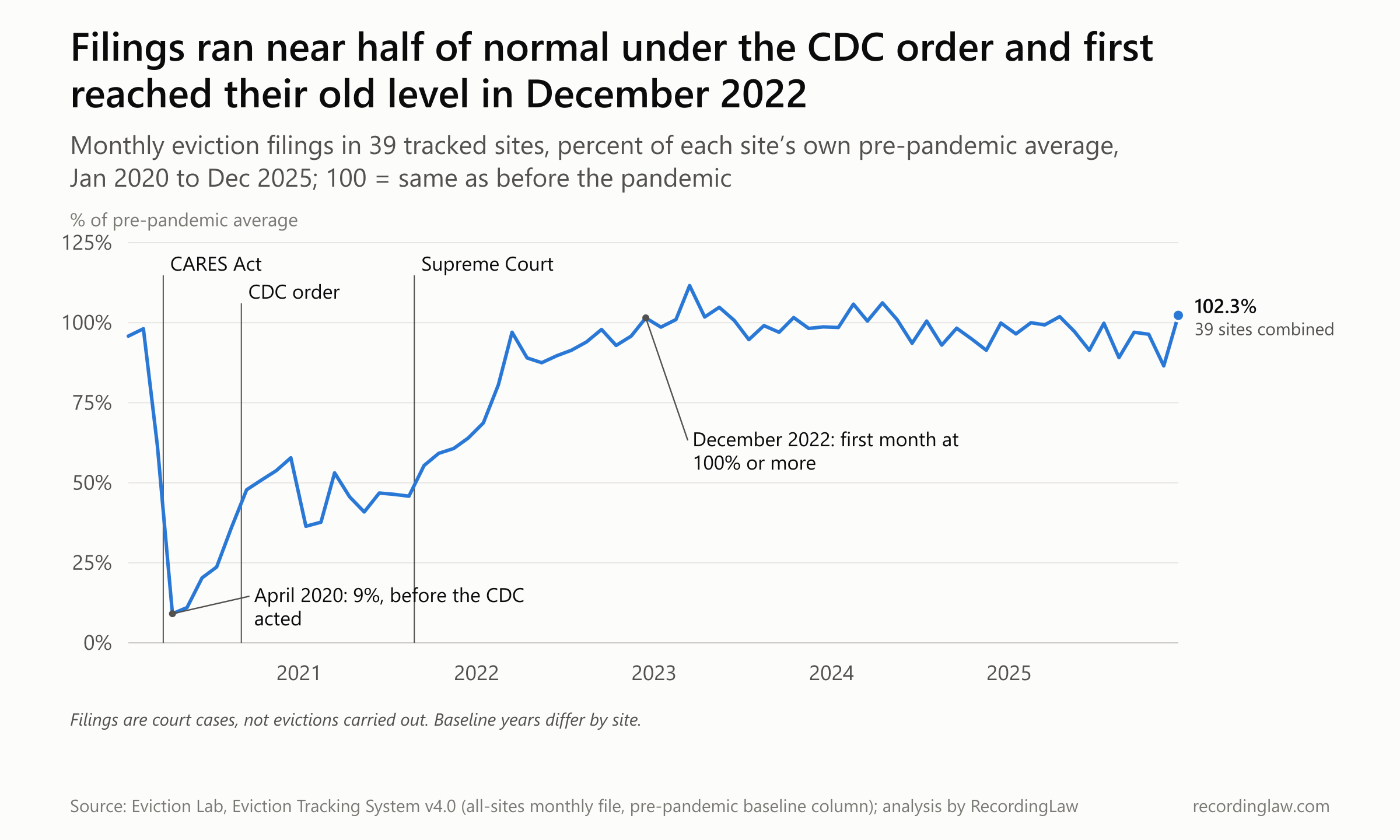
Monthly eviction filings in 39 tracked sites as a share of each site's pre-pandemic average, January 2020 to December 2025, with CARES Act, CDC order and Supreme Court dates marked. Source: Eviction Lab ETS v4.0 all-sites monthly file (pre-pandemic baseline column); RecordingLaw aggregation.
| Month | Filings, 39 sites | Pre-pandemic average | Percent of average |
|---|---|---|---|
| January 2020 | 72,057 | 75,185.9 | 95.8% |
| April 2020 | 5,478 | 60,446.9 | 9.1% |
| August 2020 | 28,134 | 77,904.7 | 36.1% |
| December 2020 | 38,059 | 65,840.4 | 57.8% |
| February 2021 | 24,334 | 64,600.6 | 37.7% |
| August 2021 | 35,645 | 77,881.9 | 45.8% |
| December 2021 | 42,142 | 65,842.7 | 64.0% |
| September 2022 | 70,041 | 71,563.2 | 97.9% |
| December 2022 | 66,821 | 65,846.2 | 101.5% |
| December 2025 | 67,390 | 65,843.5 | 102.3% |
The deepest drop came before the CDC acted at all. In April 2020, with some courts closed, the CARES Act in force and state orders such as Minnesota's in effect, filings in the 39 areas tracked by Eviction Lab that have a pre-pandemic baseline fell to about 9% of their pre-pandemic average. By August, after the CARES ban expired, they had climbed back to 36%.
For the 11 months of the order, filings stayed between about 36% and 58% of normal. The combined line did not reach its old level again until December 2022.
Both sides had argued over that stretch before it began. The argument started with a narrower rule, written by Congress.
What did Washington promise renters in 2020?
The federal government's first eviction rule of the pandemic came from Congress, and it was narrow. The CARES Act, which passed the Senate 96-0 and the House by voice vote and was signed on March 27, 2020, barred landlords of "covered" dwellings from filing nonpayment cases for 120 days. Covered meant federally assisted or federally backed housing. The CDC later put the federally backed part at "Approximately 12.3 million rental units," or 28% of renters, plus more than 2 million housing vouchers and about 2 million other federally assisted rental units.
"The CARES Act eviction moratorium expired on July 24, 2020," the CDC wrote. Two weeks later, President Donald Trump signed an executive order. "With the failure of the Congress to act, my Administration must do all that it can to help vulnerable populations stay in their homes in the midst of this pandemic," it said. It directed health officials to consider whether halting evictions was necessary, but did not halt any itself.
On September 1, the White House announced that the CDC would act. "I want to make it unmistakably clear that I'm protecting people from evictions," the President said in the fact sheet. The same document added that renters who were protected "are still obligated to pay accrued rent or housing payments in accordance with their lease or contract."
The order took effect on September 4, 2020. It covered every residential renter who gave the landlord a signed declaration, in every state without equal or stronger protection of its own, and it carried penalties for landlords of up to $100,000 and a year in jail.
Its legal hook was disease control, not housing costs: the CDC said homelessness "increases the likelihood of individuals moving into congregate settings, such as homeless shelters." It also gave a scale for the risk. "In the absence of State and local protections, as many as 30-40 million people in America could be at risk of eviction," the order said, citing research by the Aspen Institute and the COVID-19 Eviction Defense Project.
Both sides spoke on NPR as the order was announced. Yentel described "a feeling of tremendous relief" at a measure that would "prevent tens of millions of people from losing their homes in the middle of a pandemic." She also called it "a half measure," because the rent would still be due when the order ended.
Greg Brown of the National Apartment Association (NAA), the landlord trade federation, asked the question owners would repeat for a year. "Who's going to help them pay their bills?" The NAA's chief executive, Bob Pinnegar, said in a statement that the order "risks creating a cascade that will further harm the economy, amplify the housing affordability crisis and destroy the rental housing industry."
The NPR hosts raised a third question. The order "doesn't, though, seem on its face like something the agency would have the power to do," one said. The Supreme Court would answer that a year later. First came the question of what the order actually stopped.
What did the order stop, and what did it leave alone?
The order paused removals, not court cases, and the filings kept coming at about half the usual pace. Eviction Lab wrote in March 2021 that in October 2020 "the CDC clarified that the order was intended to halt the execution of eviction cases," but not court operations such as receiving filings. Landlords "could continue to file eviction cases and challenge tenant eligibility in court." That is why the court counts never fell to zero under the federal order.
Eviction Lab counted 368,398 filings in its sites from September 4, 2020 to July 31, 2021. "This represents less than half as many eviction filings (47.2%) as we would expect over the same period in a typical year," it wrote.
Put another way, the Lab said, the eviction filing rate in the areas it monitors is normally about 8.1% over that stretch, and with the order in place "that fell to around 3.8%." Extending its city counts to most of the country with a regression model, it estimated that the order "helped to prevent 1.55 million eviction filings nationwide." Counting state and local rules too, it put the total at "at least 2.45 million" since March 15, 2020.
Eviction Lab, a Princeton research group founded with support from the Gates, JPB and Ford Foundations and the Chan Zuckerberg Initiative, also argued against the order's design. "By allowing the continued filing of cases, the CDC moratorium contributes to long-term housing instability and undermines its stated goal of reducing displacement," it wrote in March 2021.
Half of normal was an average. Underneath it, cities were doing very different things.
Why did filings nearly stop in Austin but keep coming in Tampa?
The federal order set a floor, and some states and cities built well above it. The order itself said it did "not apply in any State, local, territorial, or tribal area with a moratorium on residential evictions that provides the same or greater level of public-health protection." Where local rules went further, filings fell much further.
Minnesota had acted first. On March 23, 2020, Gov. Tim Walz signed an emergency order that suspended eviction filings themselves. "Losing a home is catastrophic at any time," it said.
In Austin, city and county orders barred notices to vacate for nonpayment where rent was $2,475 a month or less. "Whether or not the Texas Supreme Court affects the Justices of the Peace, no evictions are allowed to even start until after July under our current rules," Council Member Greg Casar told the Austin Monitor in May 2020. In December, extending the city and county protections, Mayor Steve Adler said, "The data shows eviction actions like ours have saved many lives during this pandemic."
Florida had no comparable local moratorium in the sites Eviction Lab tracked. Six months into the CDC order, the Lab wrote, "Filings are near 90% of average in Tampa and Jacksonville, and aren't far behind in Gainesville (84.3%)." The spread widened as the months passed: in September 2020 the cities it monitored ran from 32.3% of average in Philadelphia to 80% in Gainesville, and by February 2021 from 15.2% in Richmond to 104.8% in Tampa.
How much did local rules line up with lower filings over the whole order?
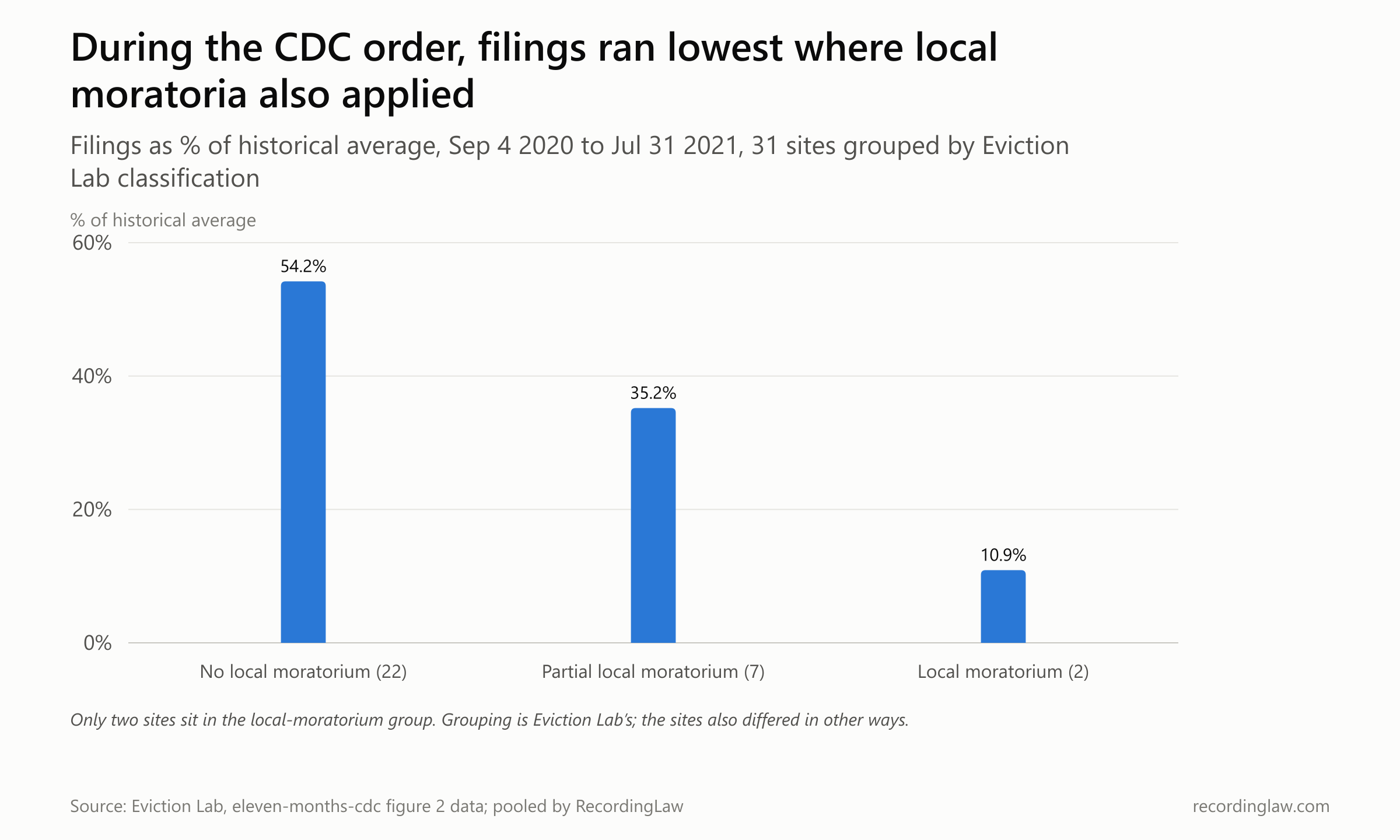
Filings as percent of historical average during the CDC order, 31 sites pooled by Eviction Lab's local-moratorium classification. Source: Eviction Lab, eleven-months-cdc figure 2 data; pooled by RecordingLaw.
| Local protection (Eviction Lab classification) | Sites | Filings | Historical average | Percent of average |
|---|---|---|---|---|
| No local moratorium | 22 | 220,608 | 407,281.4 | 54.2% |
| Partial local moratorium | 7 | 98,725 | 280,176 | 35.2% |
| Local moratorium | 2 | 1,716 | 15,724.3 | 10.9% |
The sites with their own full moratorium, Austin and the Twin Cities, ran at about a tenth of normal. Eviction Lab wrote that filings were "below 12% of historical average in Austin, TX and the Twin Cities, sites in which state or local governments adopted stronger protections," and above 75% "in all three sites we track in Florida, as well as Columbus, Ohio." In some areas, it added, filings were close to historical average, "meaning that the CDC order had little if any effect on eviction patterns."
The grouping is Eviction Lab's, only two sites sit in the strictest group, and the places differed in many other ways, from rents to how quickly courts reopened. The chart shows which places had lower filings. It cannot say how much lower the local rules made them.
Las Vegas did not fit the pattern. Filings there ran at 91% of historical average under the order, though Eviction Lab classed it as having partial local protection. The Lab later tied the city's 2021 filings to its economy: "reductions in tourism affected the large number of renters working in the service sector."
The stricter rules carried their own fight. In June 2021, the Minnesota Multi Housing Association sued over Walz's order, and its chief executive, Cecil Smith, told MPR News, "We're just looking for some certainty. And we're asking the governor to end the moratorium." Its complaint said, "If it is safe to go to the State Fair, it is safe for property owners to exercise their contractual and statutory rights to remove tenants who have violated the material terms of their leases or rental agreements."
Lawmakers agreed that month on a phased off-ramp. "While Governor Walz's eviction moratorium assuredly saved lives, our agreement to off-ramp the moratorium will save the livelihood of Minnesotans," said Rep. Michael Howard (DFL-Richfield). Minnesota's current rules are on our Minnesota landlord-tenant laws page.
Everywhere, the order was meant to hold until rent money arrived. The money was slow.
Could the rent money arrive before the order ended?
The order was supposed to be a bridge, and the bridge kept getting extended. Congress extended it by one month in December 2020, in the second COVID-19 relief act, and created a $25 billion Emergency Rental Assistance program (ERA) run by the Treasury. "By early February, Treasury had paid state, local, and Tribal governments the full $25 billion available in the first round of ERA (ERA1)," the department later wrote. Getting it from those governments to landlords and tenants took longer.
The CDC then extended the order itself, through March, June and July. Landlords counted the cost in their own figures. The National Association of Realtors reported that "the industry says they've had to absorb about $13 billion in unpaid rent each month due to the moratorium." Pinnegar said in June 2021 that "Flawed eviction moratoriums leave renters with insurmountable debt and housing providers holding the bag as our nation's housing affordability crisis spirals into a housing affordability disaster."
Those are the industry's own totals, and we found no independent check of them. The only systematic survey of small owners in our reporting came from the Terner Center for Housing Innovation at UC Berkeley. Funded by Fannie Mae, it surveyed 1,690 owners and managers. "Overall, about 1 in 3 small rental property owners reported revenue declines in 2020," it found, and the owners of about 13% of the units covered "reported that they have taken steps to sell off one or more units as a result of the pandemic."
On June 29, 2021, the order reached the Supreme Court for the first time and survived, 5-4. Four justices would have ended it. The fifth vote to keep it came from Justice Brett Kavanaugh, who wrote that "the Centers for Disease Control and Prevention exceeded its existing statutory authority by issuing a nationwide eviction moratorium."
He voted to leave it in place anyway, "because those few weeks will allow for additional and more orderly distribution of the congressionally appropriated rental assistance funds." Anything past July 31, he wrote, would need "clear and specific congressional authorization (via new legislation)."
The CDC had already called its last extension final. "CDC does not plan to extend the Order further," Director Rochelle Walensky's June order said, adding that the extra 30 days would allow "additional distribution of emergency rental assistance funds." That order also cited a study by researchers at UCLA, Johns Hopkins and other universities, funded by federal health agencies and the Robert Wood Johnson Foundation, that compared 27 states whose moratoria ended before September 2020 with 17 that kept theirs. It estimated "433,700 more COVID-19 cases and 10,700 more deaths" in summer 2020 than if the moratoria had continued; the authors noted they could not measure actual evictions in the states that ended their bans.
The money was speeding up. Treasury reported that "More than $1.5 billion in assistance was delivered to eligible households in the month of June," more than in all earlier reporting periods combined.
By the end of July, programs had spent "more than $5.1 billion" of the first $25 billion, about a fifth. On July 29, Pinnegar put it in his group's terms: "only $3 billion of the $47 billion in rental assistance has been distributed." The deadline the CDC had called final was two days away.
How did a lapsed order come back for three weeks?
The order lapsed on July 31, 2021, and came back within four days. Two days earlier, Press Secretary Jen Psaki had said the moratorium "prevented hundreds of thousands of Americans from experiencing the heartbreak, homelessness, and health risks that too often emanate from evictions," and that "the Supreme Court has made clear that this option is no longer available." The administration asked Congress to act.
A House bill to extend it "came up short Friday," July 30, the Associated Press reported, and lawmakers left for the August recess. That night Rep. Cori Bush, a Missouri Democrat, started sleeping on the steps of the Capitol. "Am I supposed to just go home? No, I'm an organizer," she said. Over five days the crowd on the steps grew to "roughly a hundred people at points," Forbes reported.
On August 2, the White House said that "CDC Director Rochelle Walensky and her team have been unable to find legal authority for a new, targeted eviction moratorium." The next day, President Joe Biden was asked whether a new order would survive. "The bulk of the constitutional scholarship says that it's not likely to pass constitutional muster," he said. "But, at a minimum, by the time it gets litigated, it will probably give some additional time while we're getting that $45 billion out to people who are, in fact, behind in the rent and don't have the money."
Hours later the CDC issued a new order, through October 3, limited to counties with substantial or high COVID-19 transmission. House Majority Leader Steny Hoyer said he was "very glad that the Biden-Harris Administration has taken action today to prevent millions of Americans from being evicted." On August 13, after a federal district judge left the new order in place, Psaki called it "a proper use of its lawful authority to protect the public health." Pinnegar said in a statement the same day, "The CDC's eviction moratorium is unlawful, plain and simple."
Before it ruled on the federal order, the Supreme Court took up a state's. On August 12 it blocked the part of New York's moratorium that let tenants certify their own hardship with no hearing for the landlord, citing the rule that "no man can be a judge in his own case." Two weeks later it ended the federal order. The majority counted "At least 80% of the country, including between 6 and 17 million tenants at risk of eviction," inside the new order's reach, and wrote that "If a federally imposed eviction moratorium is to continue, Congress must specifically authorize it."
The majority also gave the landlords' side of the stakes. "Despite the CDC's determination that landlords should bear a significant financial cost of the pandemic, many landlords have modest means," it wrote. Justice Stephen Breyer, joined by Justices Sonia Sotomayor and Elena Kagan, dissented. He noted that the CDC projected a "likelihood of mass evictions nationwide" without the order, and that Congress had appropriated "more than $46.5 billion to help pay rent and rental arrears."
Psaki said that "families will face the painful impact of evictions." Yentel predicted millions of lost homes "this fall and winter." The court records from that fall are the closest test the data allow.
How far did filings rise in the fall of 2021?
Filings rose that fall, but they started from about half of normal and stayed well below it. Over the summer, before the ruling, filings in Eviction Lab's sites "had been around 49% of historical average."
How did each month after August 26 compare with the summer before it?
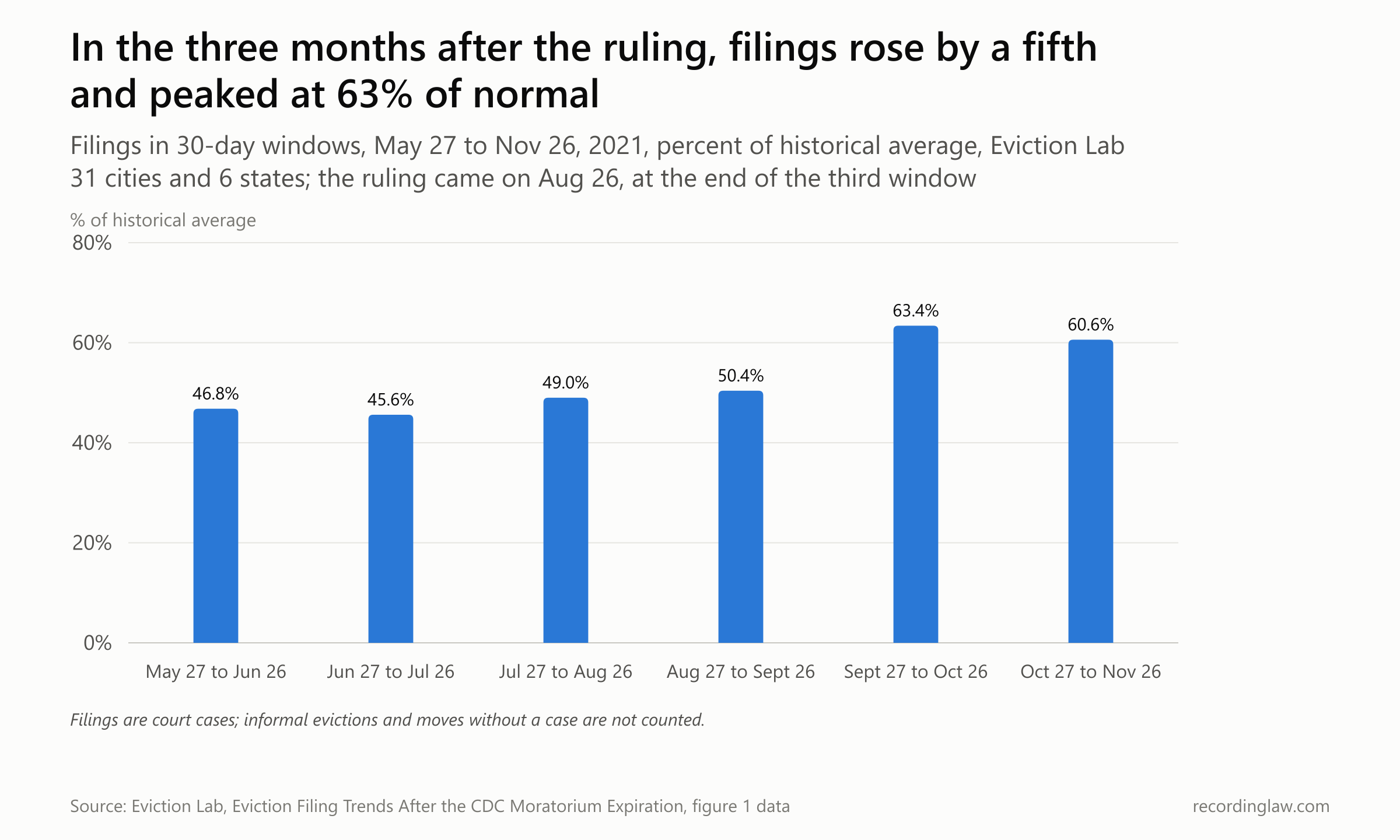
Filings in six consecutive 30-day windows, May 27 to November 26, 2021, as percent of historical average. Source: Eviction Lab post-moratorium brief, figure 1 data.
| 30-day window, 2021 | Filings | Historical average | Percent of average |
|---|---|---|---|
| May 27 to June 26 | 34,924 | 74,576 | 46.8% |
| June 27 to July 26 | 34,675 | 75,977 | 45.6% |
| July 27 to August 26 | 39,059 | 79,634 | 49.0% |
| August 27 to September 26 | 39,445 | 78,236 | 50.4% |
| September 27 to October 26 | 48,387 | 76,363 | 63.4% |
| October 27 to November 26 | 42,945 | 70,884 | 60.6% |
Filings rose in the second month and then eased. "Overall, we observed 20.4% more cases filed in the three months after the moratorium than over the final three months that it was in place," Eviction Lab wrote. At the peak, the 48,387 cases filed from late September to late October "was still only 63.4% of historical average."
The rise was uneven. Twenty-three of the 31 cities rose at least 10 percentage points relative to their averages, including Houston (39 points), New Orleans (33) and Milwaukee (31). In Houston, 8,199 cases were filed in the three months before the ruling and 13,283 in the three months after, still 12.8% below the city's historical average.
New York did not move. Gov. Kathy Hochul called a special session, and on September 1 lawmakers extended the state's moratorium to January 15, 2022 and added $25 million for tenants' legal services. Las Vegas went the other way: 11,799 cases filed from August 27 to November 26, "about 126% of historical average."
Austin's local ban also outlasted the federal order. KUT, Austin's public radio station, reported in October 2021 that Adler and Travis County Judge Andy Brown had extended it again and planned to phase it out by the end of the year.
Treasury, grading its own program years later, wrote that "the predicted wave of evictions and these consequences that would have accompanied it never materialized." It reported that the first round of rental assistance alone made 8 million payments to more than 3 million households. Beacon Economics, in a September 2021 analysis commissioned by the California Apartment Association, a landlord group, argued that federal aid offset renters' income losses, and that its findings "help explain why the 'avalanche' or 'tsunami' of evictions never happened."
Court filings cannot settle Yentel's prediction on their own, because it was about homes lost, not cases filed. Eviction Lab said so in the same brief: "it may be that the low rates of eviction filing reported here mask an increase in displacement following lease expirations or informal evictions. We are only able to monitor eviction cases filed with the courts."
Nor can the filings separate the order from the rest of the help that arrived at the same time. In 2021, the Lab noted, "More households received ERA payments over the course of 2021 (3.8 million) than receive an eviction filing in a typical year (3.7 million)." What the filings do show is the climb, and how long it lasted.
Did filings go back to normal?
Filings kept climbing through 2022 and reached the old normal by the end of that year. Across the 39 tracked areas with a pre-pandemic baseline, they ran at 90% of their pre-pandemic average for 2022 as a whole, then about 101% in 2023, 98% in 2024 and 96% in 2025, the last year that baseline covers.
Underneath that national line, the cities at the two ends of the order have traded places. The places where filings nearly stopped were well above their old normal in 2025.
How have the cities with the strictest and loosest pandemic rules moved since?
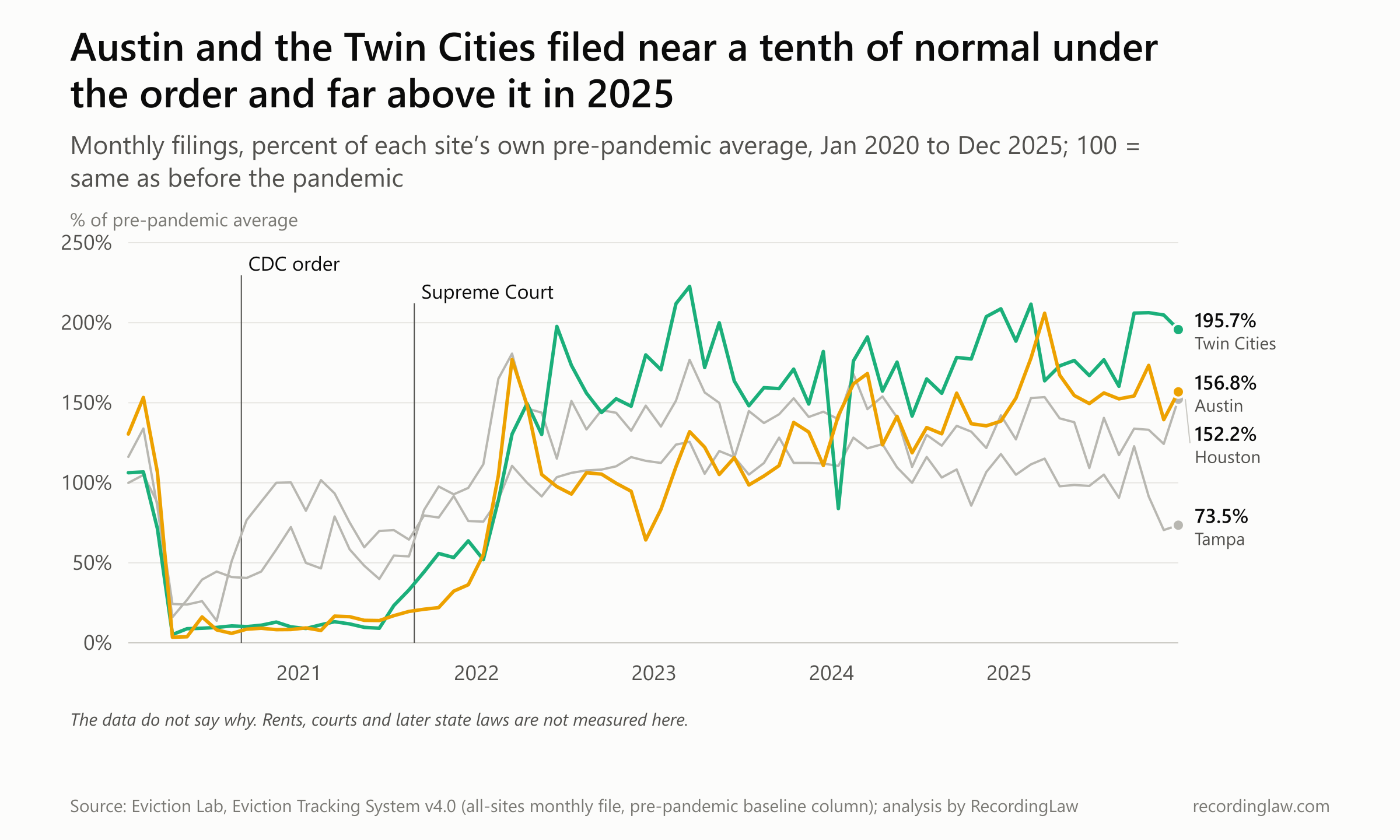
Monthly filings as a share of pre-pandemic average in Houston, Tampa, the Twin Cities and Austin, January 2020 to December 2025. Source: Eviction Lab ETS v4.0 all-sites monthly file (pre-pandemic baseline column).
| Site | October 2020 (during the order) | 2025 | Filings, 2025 | Pre-pandemic average for 2025 |
|---|---|---|---|---|
| Austin, TX | 9.1% | 160.6% | 14,800 | 9,216.7 |
| Minneapolis-Saint Paul, MN | 11.0% | 185.4% | 15,065 | 8,127.6 |
| Houston, TX | 44.5% | 133.4% | 77,882 | 58,373 |
| Tampa, FL | 88.2% | 98.1% | 17,254 | 17,588 |
Austin, which ran at about a tenth of normal during the order, filed about 61% more cases in 2025 than its pre-pandemic average. The Twin Cities filed about 85% more. Tampa, which ran at about four-fifths of normal under the order, was about 2% below. Eviction Lab's own 2025 report measures against a different baseline, the 2023-2024 average, and by that measure Austin's county was also up: "In Travis County, TX (the greater Austin area), landlords filed 27% more eviction filings than normal in 2025."
Texas's current rules are on our Texas landlord-tenant laws page, and Florida's on our Florida landlord-tenant laws page.
The data do not say why Austin and the Twin Cities were higher in 2025. Rents, population, court practice and later state laws could all play a part, and none of them is measured here. They are not the highest in the panel either: Portland, Oregon, filed about twice its old level in 2025, and Little Rock about 91% more. The largest sites split even more widely.
Where did the biggest eviction courts stand in 2025?
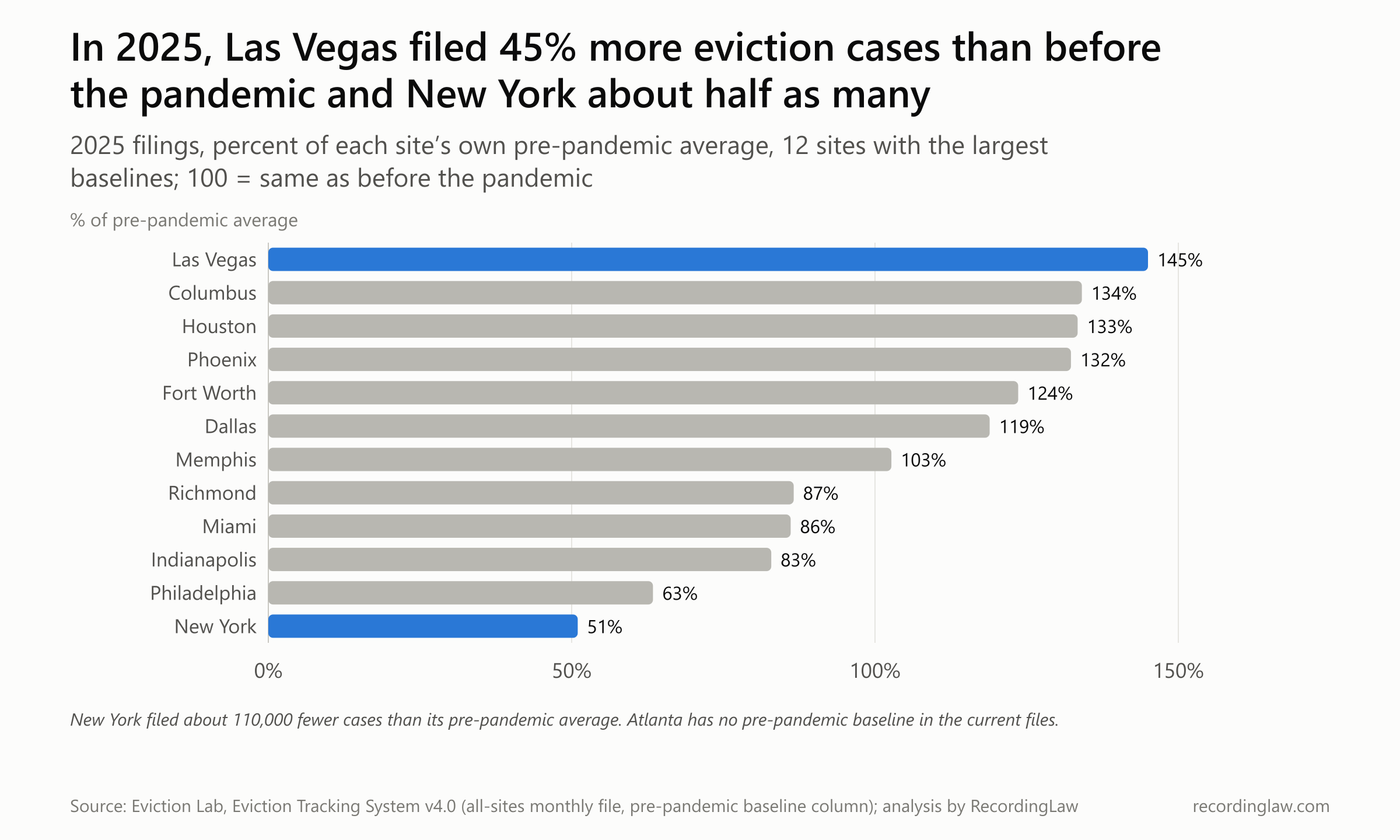
Calendar 2025 filings as percent of pre-pandemic average for the 12 sites with the largest pre-pandemic baselines. Atlanta has no pre-pandemic baseline in the current files and is not included. Source: Eviction Lab ETS v4.0 all-sites monthly file (pre-pandemic baseline column).
| Site | Filings, 2025 | Pre-pandemic average | Percent of average |
|---|---|---|---|
| Las Vegas, NV | 52,949 | 36,505.8 | 145.0% |
| Columbus, OH | 24,561 | 18,309 | 134.1% |
| Houston, TX | 77,882 | 58,373 | 133.4% |
| Phoenix, AZ | 84,602 | 63,932 | 132.3% |
| Fort Worth, TX | 46,410 | 37,546.5 | 123.6% |
| Dallas, TX | 47,995 | 40,359.3 | 118.9% |
| Memphis, TN | 27,659 | 26,925.3 | 102.7% |
| Richmond, VA | 21,031 | 24,273.3 | 86.6% |
| Miami | 15,853 | 18,403.9 | 86.1% |
| Indianapolis, IN | 24,722 | 29,823.5 | 82.9% |
| Philadelphia, PA | 13,403 | 21,144.8 | 63.4% |
| New York, NY | 114,873 | 225,440 | 51.0% |
Las Vegas filed about 45% more cases in 2025 than before the pandemic, and Houston and Phoenix about a third more. New York filed about half as many, some 110,000 fewer than its pre-pandemic average, which is why the 39-site total sits just under 100% while 20 of the 39 sites are above it. Without New York, the other 38 sites filed about 13% more than before the pandemic.
Who pays for the year the order stood?
One fight is still open in November 2026, over whether the government owes landlords for the order. In late July 2021, days before the order lapsed, the NAA sued the United States for compensation, Bloomberg reported. The case became Darby Development Co. v. United States.
Darby is a claim for money, heard in different courts from the one that ended the order. On August 7, 2024, a divided Federal Circuit panel agreed the complaint stated a claim for a physical taking and sent it back. As the NAA summarized it, the appeals court "determined that the CDC's moratorium was 'authorized' in the way takings law contemplates."
The appeals court denied the government's request for rehearing on June 6, 2025. The Solicitor General got more time, to November 3, 2025, to ask the Supreme Court to step in, and the California Apartment Association reported that "The federal government opted not to seek U.S. Supreme Court review." The case went back to the Court of Federal Claims to decide compensation.
Landlords filed a third amended complaint there on April 10, 2026. More than 2,600 landlords had joined the case by a September 2026 filing, CRE Daily reported, and the deadline to join has passed. Nothing has been agreed, and we found no ruling on compensation as of November 2026.
In 2021, landlords won in the Supreme Court by arguing that the CDC had no authority to issue the order, and the Court called the provision under it "a wafer-thin reed." In Darby, the landlords argue that the order was authorized enough to count as the government taking their property.
Five years after that ruling, the two sides are working out what the year the order stood is worth. In May, John McDermott, a lawyer for the plaintiffs, told Multifamily Dive the sides were moving toward a settlement. "We have been operating under the assumption that it's going to be about a billion dollars, but to prove it, we've got to have everyone submit their data," he said.
How we measured
Sources. Monthly and weekly filings come from Eviction Lab's Eviction Tracking System (ETS), Version 4.0 (Princeton University, 2026), all-sites files downloaded October 31, 2026; most sites were last updated in October 2026. We aggregated the 39 city-level sites that carry a pre-pandemic baseline; Atlanta, Toledo and Other Oregon Counties have none in the current files, and Oklahoma City's data begin in 2023. The 2021 figures quoted from Eviction Lab (47.2%, 1.55 million, 2.45 million, 20.4%, 63.4%, the per-city results) come from its published analyses of the CDC order and its aftermath and from the CSV files behind their figures.
Comparison. Each site is compared with its own pre-pandemic average for the same month, the files' filings_avg_prepandemic_baseline column. Those baseline years differ by site (for example Houston 2012-2015, New York 2016-2018, Portland 2019 only, Austin 2014-2019), so "normal" is not one common period. The files also carry a filings_avg column, which in this version is the 2023-2024 average (each site's 2023-2024 filings divided by it come to about 100%) that Eviction Lab's 2025 report calls the post-pandemic average; we do not use it. The panel percentages are total filings divided by total baseline filings across all 39 sites, so large sites such as New York, Phoenix and Houston weigh most.
Different site sets. Eviction Lab's 2021 analyses used 31 cities and 6 states; our panel uses 39 city-level sites in today's revised files. On our panel, filings from the week starting September 6, 2020 to the week starting July 25, 2021 were 345,242 against a pre-pandemic baseline of 742,165, or 46.5%, close to Eviction Lab's 47.2%. Comparing the 13 weeks before and after August 26, 2021, our panel rose from 100,655 filings (45.9% of baseline) to 122,993 (58.1%), an increase of 22.2%, close to the Lab's 20.4%. Calendar-year ratios on our panel: 2020, 47.2%; 2021, 49.2%; 2022, 90.4%; 2023, 100.5%; 2024, 98.4%; 2025, 96.3% (799,546 filings against 830,424.1).
Arithmetic in the text. All 2025 site figures are calendar 2025 against the pre-pandemic baseline. Austin: 14,800 / 9,216.7 = 1.61. Twin Cities: 15,065 / 8,127.6 = 1.85. Tampa: 17,254 / 17,588 = 0.98; under the order, 82% in Eviction Lab's per-site data. Portland: 17,481 / 8,556 = 2.04. Little Rock: 5,381 / 2,822 = 1.91. New York: 114,873 / 225,440 = 0.51, a shortfall of 110,567; the other 38 sites: 684,673 / 604,984.1 = 1.13. Houston's post-ruling count: 13,283 against 8,199 before. Rental assistance spent by the end of July 2021: $5.1 billion of $25 billion, about a fifth. The 12 largest sites were chosen by the size of their 2025 pre-pandemic baseline, not by their recent results.
The 1.55 million estimate. Eviction Lab extended what it saw in its sites to all counties with historical filing data (about 39 million of 43 million renter households) with a regression model it has not published, so the figure cannot be reproduced from the public files. Its counterfactual is a typical pre-pandemic year.
The moratorium groups. The local-moratorium classification in the third chart is Eviction Lab's, from its published per-site data for September 4, 2020 to July 31, 2021; we pooled filings and baselines within each group. We did not independently compile state and local moratorium dates for each city.
Series breaks. The latest months are incomplete and sites update at different speeds; the panel stops at December 2025 because the pre-pandemic baseline column is blank from January 2026 for most sites. Some filings have no usable address and sit in sealed rows; they are kept in the totals. Several courts (Philadelphia, New Orleans, Pittsburgh, Providence) had months with zero filings in 2020 because they were closed. Census tract boundaries in the baselines were revised to 2020 definitions in August 2024, which does not change site totals.
The last CARES Act clause. One line of the 2020 federal response is still in the statute. The CARES Act's filing ban is long gone, but its Section 4024(c) says a landlord of a covered unit "may not require the tenant to vacate the covered dwelling unit before the date that is 30 days after the date on which the lessor provides the tenant with a notice to vacate." H.R. 1078, the Respect State Housing Laws Act from Rep. Barry Loudermilk, a Georgia Republican, would strike it. How notice periods work in each state is on our landlord-tenant laws hub.
The House Financial Services Committee majority called the clause "a drafting error" that "created a temporary 30-day eviction notice to tenants in federally assisted or federally backed housing that expired in July 2020." The minority answered that "the CARES Act was signed into law by President Trump and did not include a provision saying it would cease to apply after COVID ended." The committee reported the bill on February 25, 2026, and the bill-status record, last updated in June 2026, shows no floor vote. A Senate companion, S. 470 from Sen. Cindy Hyde-Smith, sits in the Banking Committee.
What comes next. Eviction Lab's report on 2025 came out on April 16, 2026; if it keeps that timing, the next edition lands around April 2027, with monthly updates in between. It will show whether Austin and the Twin Cities, the places where the 2020 rules went furthest and filings nearly stopped, are still filing more than they did before the pandemic. In Darby, nothing has been agreed and we found no ruling on compensation as of November 2026. H.R. 1078 awaits a House floor vote.
What the data cannot show. A filing is a court case, not an eviction carried out; courts differ in what they count, and Eviction Lab removes duplicate case numbers and commercial cases. Informal evictions, lease non-renewals and tenants who moved without a case are not counted anywhere here. Rental assistance, stimulus payments, unemployment benefits, court closures and state and local moratoria all overlapped with the CDC order, and none of these comparisons separates their effects. "The overlapping nature of these supports makes causal inference difficult, but not impossible," Eviction Lab wrote. Industry figures on unpaid rent (the NAA's and the National Association of Realtors') are reported as their claims and were not verified. Treasury's closeout report for the first round of rental assistance is dated January 2025 on its cover but cites figures as of September 30, 2025.
Frequently Asked Questions
When did the CDC eviction moratorium end?
The original CDC order took effect on September 4, 2020 and was extended several times before it expired on July 31, 2021. The CDC issued a narrower order on August 3, 2021, and the Supreme Court ended it on August 26, 2021, in Alabama Association of Realtors v. Department of Health and Human Services, ruling 6-3 that the CDC had exceeded its authority.
Did the CDC moratorium stop eviction filings?
No. The order paused the removal of tenants who gave their landlord a signed declaration, but landlords could still file cases and challenge eligibility in court. Eviction Lab counted filings at 47.2% of a typical year in the places it tracked from September 4, 2020 to July 31, 2021. The CARES Act's earlier 120-day ban, which did bar filings, covered only federally assisted or federally backed housing.
How many evictions did the CDC moratorium prevent?
Eviction Lab estimated that the CDC order helped prevent 1.55 million eviction filings nationwide from September 2020 to July 2021, and that federal, state and local policies together prevented at least 2.45 million filings from March 15, 2020. These are estimates of court filings avoided, based on an unpublished regression model, not counts of households that kept their homes.
Did evictions surge after the Supreme Court ended the moratorium?
Filings rose but stayed below normal. Eviction Lab found 20.4% more cases filed in the three months after the ruling than in the order's last three months, and the highest 30-day window reached 63.4% of the historical average. Some cities rose sharply, such as Houston, while New York, which extended its own moratorium, did not. Filings do not capture informal evictions or tenants who moved without a court case.
Are eviction filings back to pre-pandemic levels?
In the 39 areas tracked by Eviction Lab that have a pre-pandemic baseline, filings first reached their pre-pandemic average in December 2022 and ran at 96.3% of it in 2025. Sites differ widely: the Twin Cities were at 185% and Austin at 161% of their pre-pandemic averages, while New York was at 51%.
Can landlords get compensation for the CDC eviction moratorium?
A landlords' claim, Darby Development Co. v. United States, backed by the National Apartment Association, is pending. The Federal Circuit ruled in August 2024 that the complaint stated a claim for a physical taking and returned it to the Court of Federal Claims to decide compensation. The California Apartment Association reported that the government did not seek Supreme Court review. One of the plaintiffs' lawyers told Multifamily Dive in May 2026 that the two sides were moving toward a settlement he expected to be about $1 billion, and CRE Daily reported that more than 2,600 landlords had joined by a September 2026 filing. Nothing has been agreed, and no ruling on compensation had been found as of November 2026.
Is any federal pandemic eviction rule still in effect?
The CARES Act's Section 4024(c), which requires 30 days' notice to vacate for tenants in covered federally assisted or federally backed housing, remains in the statute. The House Financial Services Committee majority calls it a drafting error that expired in July 2020, and the minority says it has no sunset. H.R. 1078 would repeal it; the committee reported it on February 25, 2026, and no floor vote had been recorded in the bill-status record last updated in June 2026.
Updates
Restructured as a feature: chart titles state the finding, side details moved to How we measured. Every figure and quote was re-checked against its source.
Independently fact-checked against the cited primary sources
Independently fact-checked against the cited primary sources
Sources and References
- Eviction Lab, Preliminary Analysis: 11 months of the CDC Moratorium (August 2021), with figure 2 data(evictionlab.org)
- Eviction Lab, six-month analysis of the CDC eviction moratorium (March 2021)(evictionlab.org)
- Eviction Lab, Eviction Filing Trends After the CDC Moratorium Expiration (December 2021), with figure 1 data(evictionlab.org)
- Eviction Lab, Preliminary Analysis: Eviction Filing Patterns in 2021 (March 2022)(evictionlab.org)
- Eviction Lab, Preliminary Analysis: Eviction Filing Patterns in 2025 (April 16, 2026)(evictionlab.org)
- Eviction Lab, Eviction Tracking System Version 4.0, Get the Data (baseline years and update dates)(evictionlab.org)
- Eviction Lab, ETS all-sites monthly file (v4.0, downloaded October 31, 2026)(eviction-lab-data-downloads.s3.amazonaws.com)
- Eviction Lab, ETS all-sites weekly file (v4.0, downloaded October 31, 2026)(eviction-lab-data-downloads.s3.amazonaws.com)
- Eviction Lab, About (founding funders)(evictionlab.org)
- Supreme Court of the United States, Alabama Association of Realtors v. HHS, No. 21A23 (August 26, 2021)(supremecourt.gov).gov
- Supreme Court of the United States, Alabama Association of Realtors v. HHS, No. 20A169, order and Kavanaugh concurrence (June 29, 2021)(supremecourt.gov).gov
- Supreme Court of the United States, Chrysafis v. Marks, No. 21A8, docket (August 12, 2021)(supremecourt.gov).gov
- Supreme Court of the United States, docket 25A228 (extension of time in Darby Development Co.)(supremecourt.gov).gov
- CDC, Temporary Halt in Residential Evictions To Prevent the Further Spread of COVID-19, 85 FR 55292 (September 4, 2020)(federalregister.gov).gov
- CDC, extension order, 86 FR 34010 (June 2021)(federalregister.gov).gov
- CDC, order for communities with substantial or high transmission (August 3, 2021)(federalregister.gov).gov
- CARES Act, Public Law 116-136, Section 4024(congress.gov).gov
- GovInfo, bill status for H.R. 748 (CARES Act votes)(govinfo.gov).gov
- Executive Order 13945 (August 8, 2020)(govinfo.gov).gov
- House Report 119-521 on H.R. 1078, Respect State Housing Laws Act (February 2026)(govinfo.gov).gov
- American Presidency Project, White House fact sheet on stopping evictions (September 1, 2020)(presidency.ucsb.edu)
- American Presidency Project, statement by Press Secretary Jen Psaki (July 29, 2021)(presidency.ucsb.edu)
- American Presidency Project, statement by Press Secretary Jen Psaki on eviction prevention efforts (August 2, 2021)(presidency.ucsb.edu)
- American Presidency Project, President Biden remarks and exchange with reporters (August 3, 2021)(presidency.ucsb.edu)
- American Presidency Project, statement by Press Secretary Jen Psaki (August 13, 2021)(presidency.ucsb.edu)
- American Presidency Project, statement by Press Secretary Jen Psaki on the Supreme Court ruling (August 26, 2021)(presidency.ucsb.edu)
- American Presidency Project, Treasury press release on June 2021 Emergency Rental Assistance data(presidency.ucsb.edu)
- U.S. Treasury, press release on July 2021 Emergency Rental Assistance data(home.treasury.gov).gov
- U.S. Treasury, ERA1 Closeout report(home.treasury.gov).gov
- House Majority Leader Steny Hoyer, statement on the new CDC eviction moratorium (August 3, 2021)(leaderarchive-hoyer.house.gov).gov
- NPR Morning Edition transcript (September 1, 2020)(npr.org)
- National Low Income Housing Coalition, statement by Diane Yentel on the Supreme Court ruling (August 26, 2021)(nlihc.org)
- National Apartment Association, statement on the CDC order (September 1, 2020)(assets.noviams.com)
- National Apartment Association, statement on the June 2021 extension(naahq.org)
- National Apartment Association, statement of July 29, 2021(naahq.org)
- National Apartment Association, statement of August 13, 2021(naahq.org)
- National Apartment Association, summary of the Federal Circuit ruling in Darby(naahq.org)
- National Association of Realtors news, on the June 29, 2021 order(nar.realtor)
- National Association of Realtors statement on the August 26, 2021 ruling, as reposted by the Dulles Area Association of Realtors(dullesarea.com)
- Minnesota Emergency Executive Order 20-14 (March 23, 2020)(leg.mn.gov).gov
- Minnesota House, Rep. Michael Howard news release on the eviction off-ramp (June 14, 2021)(house.mn.gov).gov
- MPR News, landlord group sues over Minnesota eviction restrictions (June 15, 2021)(mprnews.org)
- Austin Monitor, on Austin eviction protections (May 2020)(austinmonitor.com)
- FOX 7 Austin, Austin and Travis County extend eviction protections (December 2020)(fox7austin.com)
- KUT, Austin and Travis County eviction protections phase-out (October 25, 2021)(kut.org)
- Associated Press via WDIV, Rep. Cori Bush and the eviction fight (August 4, 2021)(clickondetroit.com)
- Forbes, as reposted by Rep. Katherine Clark (August 3, 2021)(katherineclark.house.gov).gov
- New York State Bar Association, state lawmakers extend eviction moratoriums (September 2, 2021)(nysba.org)
- Office of Gov. Kathy Hochul, release on New York eviction moratorium law (September 2021)(governor.ny.gov).gov
- Terner Center for Housing Innovation, UC Berkeley, survey of small rental property owners (Fannie Mae-funded, July 2021)(ternercenter.berkeley.edu)
- UCLA Fielding School of Public Health, on Leifheit et al., American Journal of Epidemiology(ph.ucla.edu)
- Aspen Institute Financial Security Program, eviction risk estimate (August 2020)(aspeninstitute.org)
- Beacon Economics for the California Apartment Association, rental eviction analysis (September 2021)(caanet.org)
- Bloomberg via WealthManagement.com, landlords sue U.S. over eviction moratorium (July 2021)(wealthmanagement.com)
- U.S. Court of Appeals for the Federal Circuit, Darby Development Co. v. United States, No. 22-1929 (August 7, 2024)(cafc.uscourts.gov).gov
- Duane Morris client alert on denial of rehearing in Darby (June 2025)(duanemorris.com)
- California Apartment Association, government declines Supreme Court review in Darby (November 2025)(caanet.org)
- Multifamily Dive, Pandemic eviction freeze lawsuit could cost federal government over $1B (May 13, 2026)(multifamilydive.com)
- CRE Daily, Landlord Eviction Moratorium Lawsuit Grows to 2,600 (September 10, 2026)(credaily.com)