Evictions Fell Faster in New York's First Right-to-Counsel ZIP Codes, 2017 to 2019. By Mid-2025, 44% of Tenants in Eviction Court Had a Lawyer.

Independently fact-checked against primary sources (last audited November 9, 2026). · 18 primary sources cited on this page. How we verify our legal content
On Aug. 11, 2017, Mayor Bill de Blasio signed New York City's right-to-counsel law at the offices of Community Action for Safe Apartments, a tenant organizing group in the Concourse area of the Bronx. He described what a tenant would do after an eviction notice. "The next thing they're gonna do is they're gonna reach for their phone and they're gonna call 3-1-1 and they're gonna get a lawyer to defend them," he said, according to DNAinfo. "It's gonna be as simple as that."
Less than five years later, on April 5, 2022, the Legal Aid Society and the New York Legal Assistance Group announced that their attorneys would be "unable to take new cases in Queens for the month of April." Two weeks after that, Legal Aid said it was stopping new cases in Manhattan and Brooklyn too. It estimated that 230 cases in those two boroughs would go forward that month without a lawyer. In March 2025, the city comptroller's office found that 30% of tenants facing eviction that month had a lawyer.
City Hall said New York would be the first city in the country to guarantee lawyers to tenants facing eviction, and it switched the right on one ZIP code at a time. For roughly three years that made a rare test, with lawyers in some neighborhoods and not in others. Then the pandemic ended the test, the whole city became eligible at once, and after the courts reopened in 2022 the eligible cases grew faster than the money to pay lawyers to take them.
By 2025 the city's marshals were carrying out more evictions than in 2019. What did the lawyers change where they arrived first, and what happened once more tenants qualified than the program's lawyers could take on?
A right switched on one ZIP code at a time
The promise was written in plain terms. "That means that beginning today, no low-income city resident will lose a home because he or she can’t afford a lawyer," Council Member Mark Levine, the bill's lead sponsor, wrote in a City & State op-ed dated July 19, 2017, for the Council's vote the next day. Forty-three Council members had signed on as co-sponsors. At the signing, co-sponsor Vanessa Gibson said in the city's release that tenants "will finally be on an even playing field with the landlords taking them to court."
City Hall attached a size and a price. The program would "serve 400,000 tenants when it is fully implemented in five years," the mayor's office said, and would cost $155 million a year once it was. Low-income meant under 200% of the federal poverty level, the line for a lawyer on the whole case.
Two lines in the law shaped everything after. Every obligation in it is "subject to appropriation," which the comptroller's office later read to mean "funds for RTC are not guaranteed and are subject to approval by the Mayor and City Council each fiscal year." And the full right did not have to exist until July 31, 2022, so the city chose where the lawyers went first.
It chose neighborhoods with high shelter entries, rent-regulated housing and heavy eviction caseloads. The Office of Civil Justice, which runs the program inside the Human Resources Administration, targeted ten ZIP codes in the first year and added five more in each of the next three fiscal years, for 25 in all. "Eviction rates, poverty rates, and the share of rental households were all higher in RTC zip codes," the Community Service Society of New York later wrote of the first 20.
Inside those ZIP codes, far more tenants stood in court with a lawyer: 62% in the 20 covered ZIP codes in the last quarter of fiscal 2019, against just over 32% citywide. For a few years New York had neighborhoods with lawyers and neighborhoods without them, side by side, in the same courts.
Did evictions fall faster where the lawyers came first?
If the lawyers were keeping tenants in their homes, executed evictions, the ones a city marshal actually carries out, should have dropped faster in the first group.
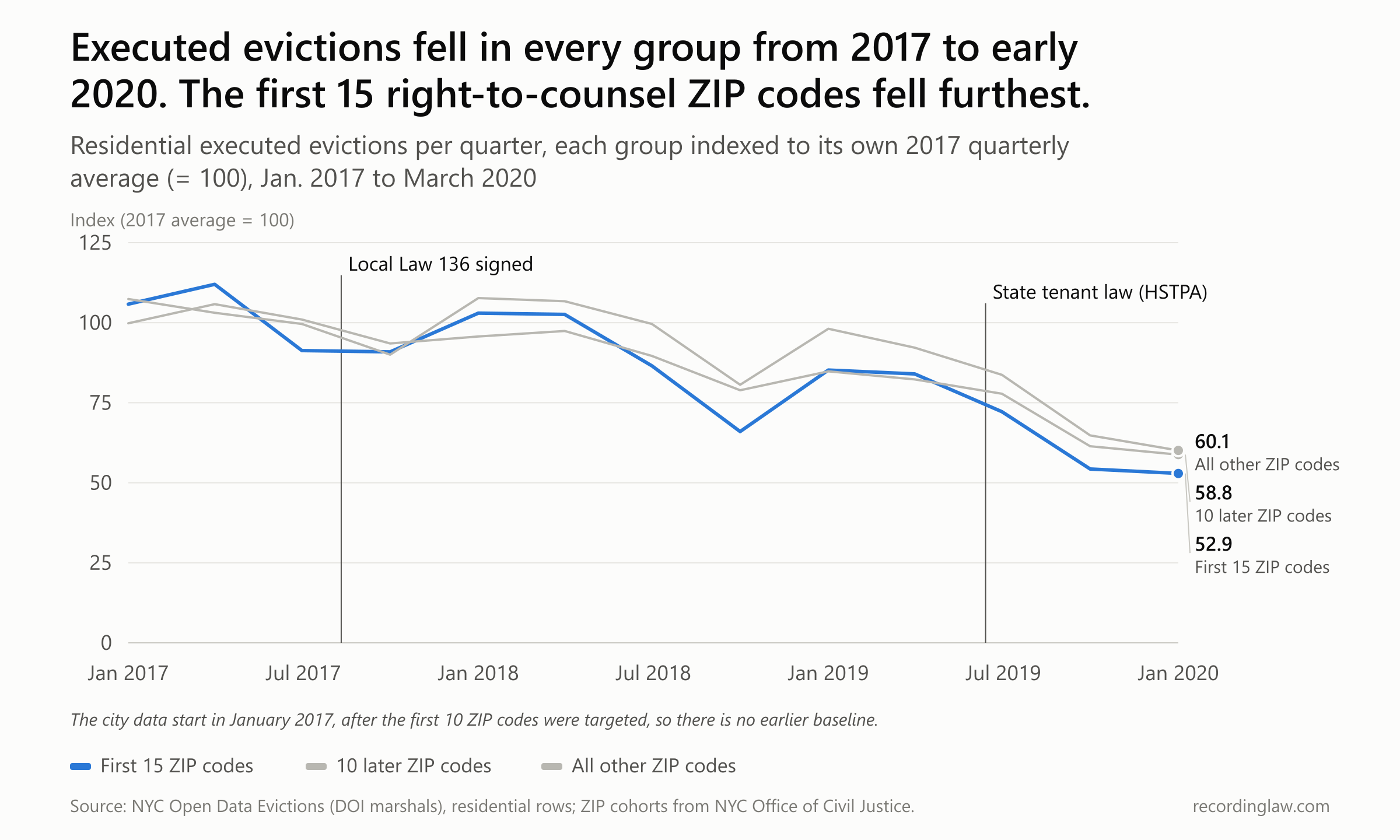
Quarterly executed evictions, 2017 to the first quarter of 2020, each group indexed to its own 2017 average. Source: NYC Open Data Evictions (Department of Investigation marshal records); ZIP cohorts from NYC Office of Civil Justice annual reports.
| ZIP group | 2017 | 2019 | Change |
|---|---|---|---|
| 15 ZIPs covered by fiscal 2018 | 3,322 | 2,457 | -26.0% |
| 5 ZIPs added fiscal 2019 | 1,268 | 809 | -36.2% |
| 5 ZIPs added fiscal 2020 | 1,561 | 1,357 | -13.1% |
| All other ZIPs | 14,652 | 12,413 | -15.3% |
| Citywide | 20,803 | 17,036 | -18.1% |
All three groups fell. The 15 earliest ZIP codes fell by about a quarter in two years, the rest of the city by about 15%.
The first to make this comparison was an advocate. In March 2019 the Community Service Society, an anti-poverty nonprofit that argued in the same brief for extending the law to moderate-income tenants, compared 2017 with 2018; the brief does not name a funder. Evictions fell 11% in the 20 ZIP codes with the right and 2% in 80 comparable ZIP codes without it. "With the law in effect for just over a year, evictions declined more than five times faster in RTC zip codes than in similar non-RTC zip codes," the brief said. NPR graphed the comparison three days later.
Our recount of the city's open marshal data comes out close: from 2017 to 2018, evictions fell 12% in the same 20 ZIP codes and 1% in every ZIP code outside the program. CSS dropped the lowest-need ZIP codes to build its comparison group and ours keeps them all, so the two are not the same test.
The spread inside the program is wide. The five ZIP codes added in fiscal 2019 fell 36%. The five added in fiscal 2020, which had the right for less than a year before March 2020, fell 13%, slightly less than the rest of the city.
Four things keep these counts from settling the question. ZIP codes chosen because their shelter entries and eviction caseloads were high can fall back toward the average on their own. In June 2019 the state passed the Housing Stability and Tenant Protection Act, which applied to every ZIP code at once; the comptroller's office says eviction filings fell 22% in 2019. Evictions had been falling in program and non-program ZIP codes alike since 2011, according to the two Princeton economists whose study comes next. And the city had been paying for more tenant lawyers since 2014: representation in Housing Court, the city court where landlords bring eviction cases, rose from 1% in 2013 to 27% in 2016, City Hall said.
The city's open data also starts in January 2017, when the first ten ZIP codes were already targeted, so there is no clean "before." To get closer to cause, researchers went inside the cases.
What did a lawyer change for the tenant who got one?
What separates the studies is what they count. CSS and our recount count evictions in neighborhoods the city picked partly because their eviction caseloads were heavy. Michael Cassidy and Janet Currie, economists at Princeton, followed the cases.
With address-level Housing Court data from 2016 to 2019 provided by the state court system, they compared cases within the same ZIP code before and after the program arrived. The rollout raised a tenant's chance of having a lawyer by 12.4 percentage points, about one tenant in eight, and they used that jump to estimate what a lawyer did for the tenants who got one.
A New York eviction case moves in steps. The court enters a possessory judgment, which gives the landlord the right to the apartment; it issues a warrant of eviction; and a city marshal executes the warrant.
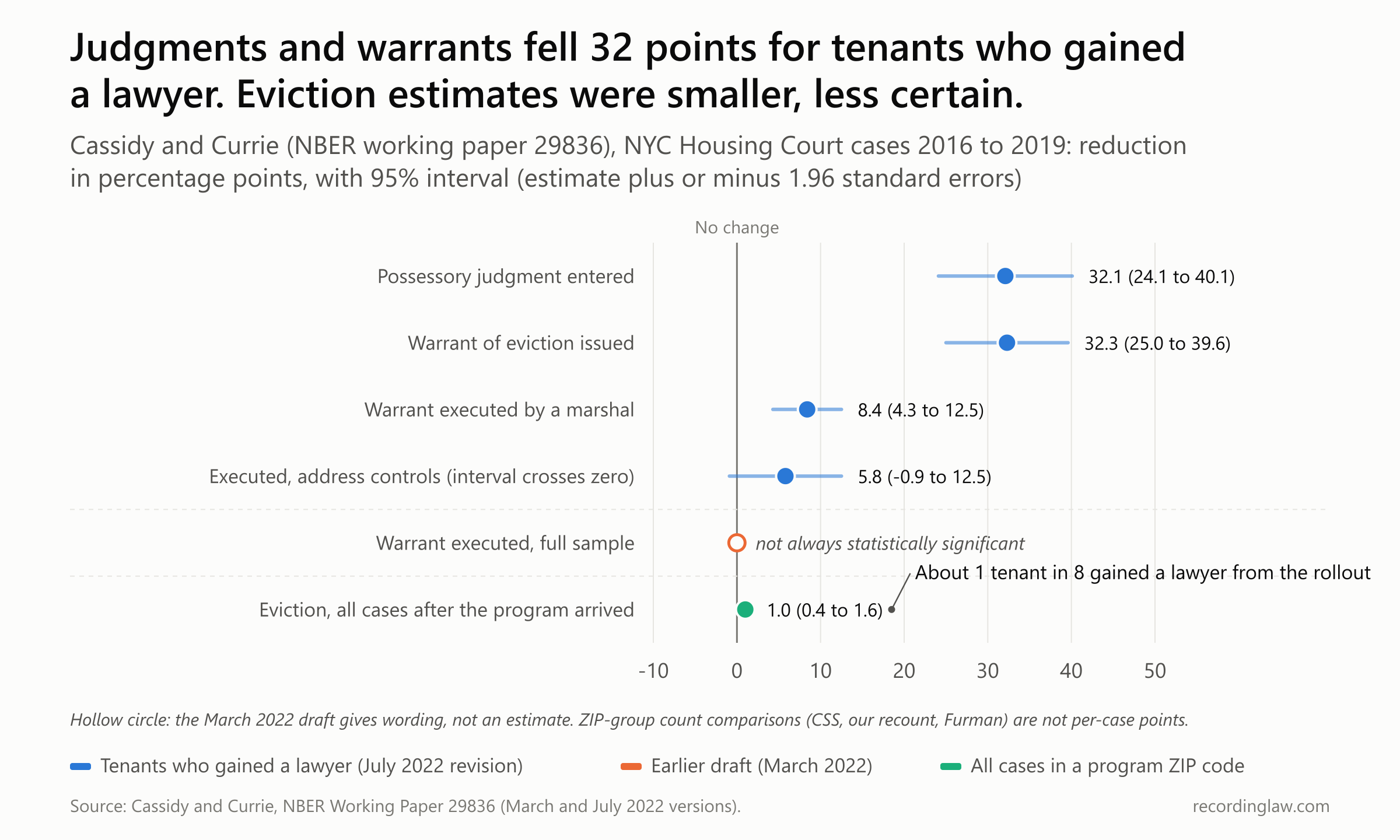
Estimated effect of representation, in percentage points. July 2022 revision of NBER Working Paper 29836 unless marked. Source: Cassidy and Currie, NBER Working Paper 29836.
| Outcome (Cassidy and Currie) | Reduction, percentage points (95% interval) |
|---|---|
| Possessory judgment, tenants who gained a lawyer | 32.1 (24.1 to 40.1) |
| Warrant issued, tenants who gained a lawyer | 32.3 (25.0 to 39.6) |
| Warrant executed, tenants who gained a lawyer | 8.4 (4.3 to 12.5) |
| Warrant executed, with address-level controls | 5.8 (-0.9 to 12.5; significant at the 90% level only) |
| Eviction, all cases in a ZIP code after the program arrived | 1.0 (0.4 to 1.6) |
The lawyers' effects on the steps before the marshal arrives were large. At the marshal's step the effect was much smaller. A simple comparison understated the effects, the authors wrote, because "the people who get representation are those most likely to have negative outcomes."
The marshal's step is also the estimate that moved between versions. The March 2022 draft said, "We do not always find statistically significant effects on warrant executions, but we do find large and statistically significant effects in relatively poor neighborhoods and in those with large shares of noncitizens." The 8.4-point figure comes from the July 2022 revision. The peer-reviewed paper, published in the Journal of Public Economics in June 2023, says in its abstract that tenants with lawyers "are less likely to be evicted."
The rollout gave a lawyer to about one tenant in eight who would not otherwise have had one. An 8.4-point drop for each of those tenants, spread across every case in the ZIP code, comes to about 1 point. That is the figure Cassidy and Currie got when they measured all cases at once.
Before running their estimates, the authors raised a doubt of their own. "Having a lawyer does not necessarily address the underlying problems that lead a family to end up in housing court," they wrote. "It is conceivable that having a lawyer may only delay the inevitable, possibly by only a few weeks or months."
So they followed the same apartment addresses for 15 months after each filing, for cases filed through December 2018. They found "no effect on case filings," which they read as landlords not filing new cases, and outcomes "quite similar" to their main estimates. The pandemic, they noted, limited how far ahead they could follow tenants.
Other teams looked at the same rollout. Researchers at NYU's Furman Center found executed warrants declined in early ZIP codes relative to later ones, and called their results preliminary; Cassidy and Currie, rerunning that kind of ZIP-level comparison on their own data, found essentially no association with court outcomes. Two health studies looked past the courtroom; they measure births and emergency-room visits, not evictions, and are described in How we measured. Every one of these studies stops before March 2020. That was when the test stopped.
March 2020: the whole city at once
In March 2020 the Office of Civil Justice dropped ZIP code screening "to make services accessible to tenants citywide." Eviction moratoria followed, and they ran, with extensions, until January 2022. From then on, there were no ZIP codes without the right, and so no comparison group.
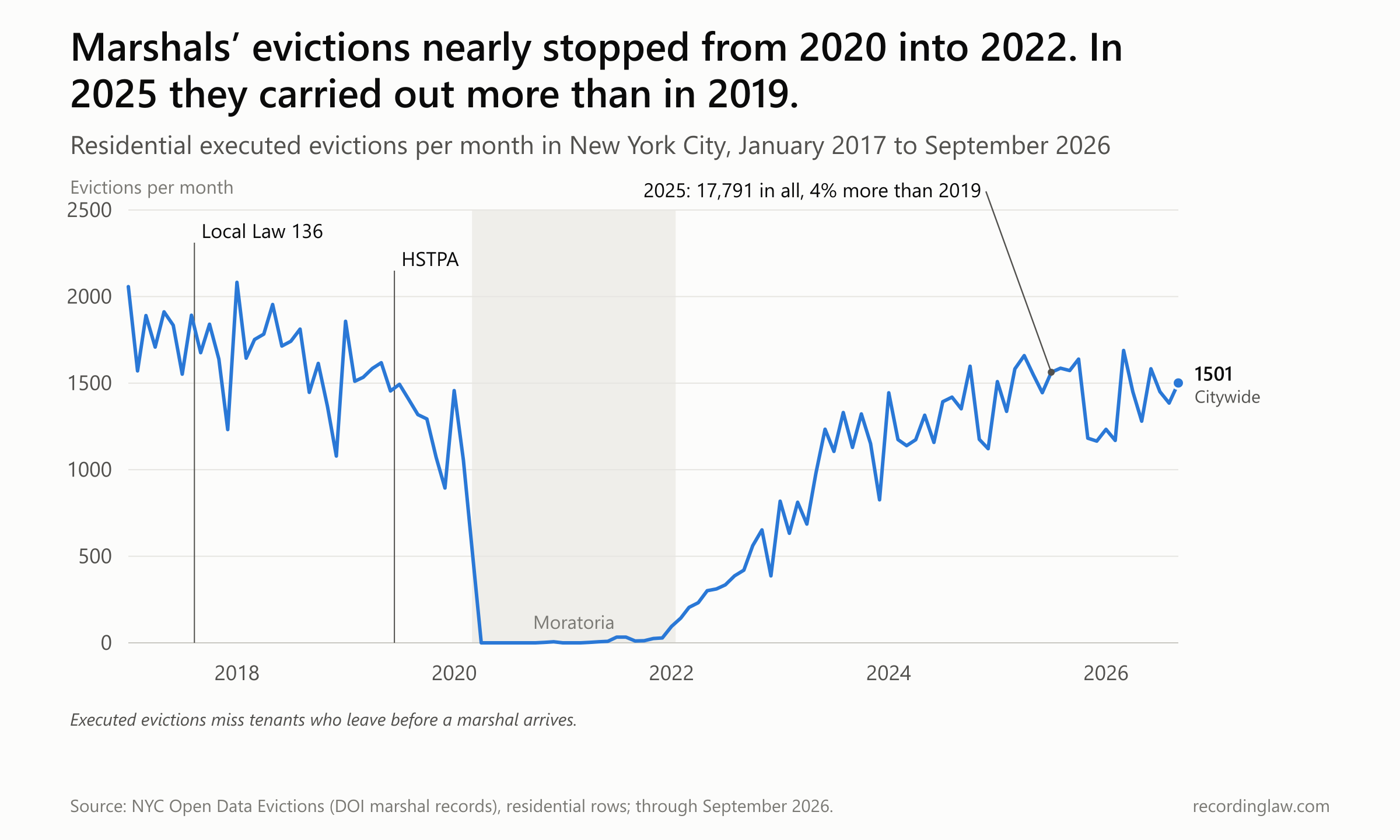
Residential executed evictions per month in New York City, January 2017 to September 2026. Source: NYC Open Data Evictions (Department of Investigation marshal records).
| Year | Residential executed evictions |
|---|---|
| 2017 | 20,803 |
| 2018 | 19,988 |
| 2019 | 17,036 |
| 2020 | 3,064 |
| 2021 | 160 |
| 2022 | 4,029 |
| 2023 | 12,025 |
| 2024 | 15,461 |
| 2025 | 17,791 |
Marshals carried out 3,064 residential evictions in 2020, almost all before April, and 160 in 2021. While executions were stopped, the representation rate climbed. In the last quarter of fiscal 2021, more than 71% of tenants who appeared in Housing Court for eviction cases had a lawyer, the Office of Civil Justice reported.
The Council moved to lock in the citywide right before the moratorium ended. "We must ensure that every single person facing an eviction as we come out of the pandemic has the basic security of having an attorney," Levine said at a January 2021 hearing, warning of "an avalanche of evictions." The office running the program said it was already serving tenants citywide, and its Jordan Dressler said the bill could "hinder" its ability to help tenants with problems outside the right.
The Rent Stabilization Association, a landlord trade group, did not oppose the right. Its president, Joseph Strasburg, said the group "has supported the Right to Counsel," and that legislators should be "focusing their attention on far more pressing issues," including unpaid rent. The bill became Local Law 54 of 2021 in May 2021.
What happened when the courts reopened?
The state moratorium lapsed on Jan. 15, 2022. The news site THE CITY had called it a stress test: "A legacy left by former mayor Bill de Blasio will be put to the test."
The flood of new filings that housing advocates had warned about did not arrive. By early March 2022, landlords had filed 10,847 eviction cases that year, against more than 37,000 in the first two months of 2019, according to state court data cited by Law360. But more than 219,000 cases were already active, most of them filed before the pandemic, in court data compiled by groups including the Housing Data Coalition and the Right to Counsel Coalition, a coalition of tenants, advocates and legal service providers formed to build support for the 2017 law.
The fight that followed was between two of the program's partners. The providers, nonprofits paid by the city to supply the lawyers, asked the court system to slow its calendars. The state Office of Court Administration said no.
"The court will not reduce its calendars at a provider's request, based on its particular caseload concerns or otherwise," spokesperson Lucian Chalfen told Law360 on March 4. If a provider declined a case, he said, it would "move on to the resolution parts without counsel for the tenant."
On March 28, outside Bronx Housing Court, Levine, by then Manhattan borough president, made the opposite request. "Slow down the pace of cases," he said. "Do not allow any case to move forward if the tenant does not have an attorney."
The court system blamed the providers. "It is about legal services providers who are incapable of carrying out their contractual obligations regarding assigned counsel," Chalfen said in April, adding that "money is being left on the table by the providers." A court system spokesperson had already told Norwood News that Legal Services NYC declined more than 475 Bronx cases in March. The providers blamed the calendars. Legal Aid's Adriene Holder said the court was "essentially gutting New York’s historic Right To Counsel initiative."
Those were the weeks of the intake shutdowns at the top of this story, Queens on April 5 and Manhattan and Brooklyn on April 18, and Legal Services NYC capped its new Queens cases at 60. By late May, court data shared with the Daily News showed about 2,500 tenants eligible for the right had faced eviction proceedings without lawyers since March. By August, Legal Aid estimated the backlog at 70,000 cases or more.
How far did representation fall?
From its mid-2021 peak, the share of tenants with a lawyer in court fell for three straight years.
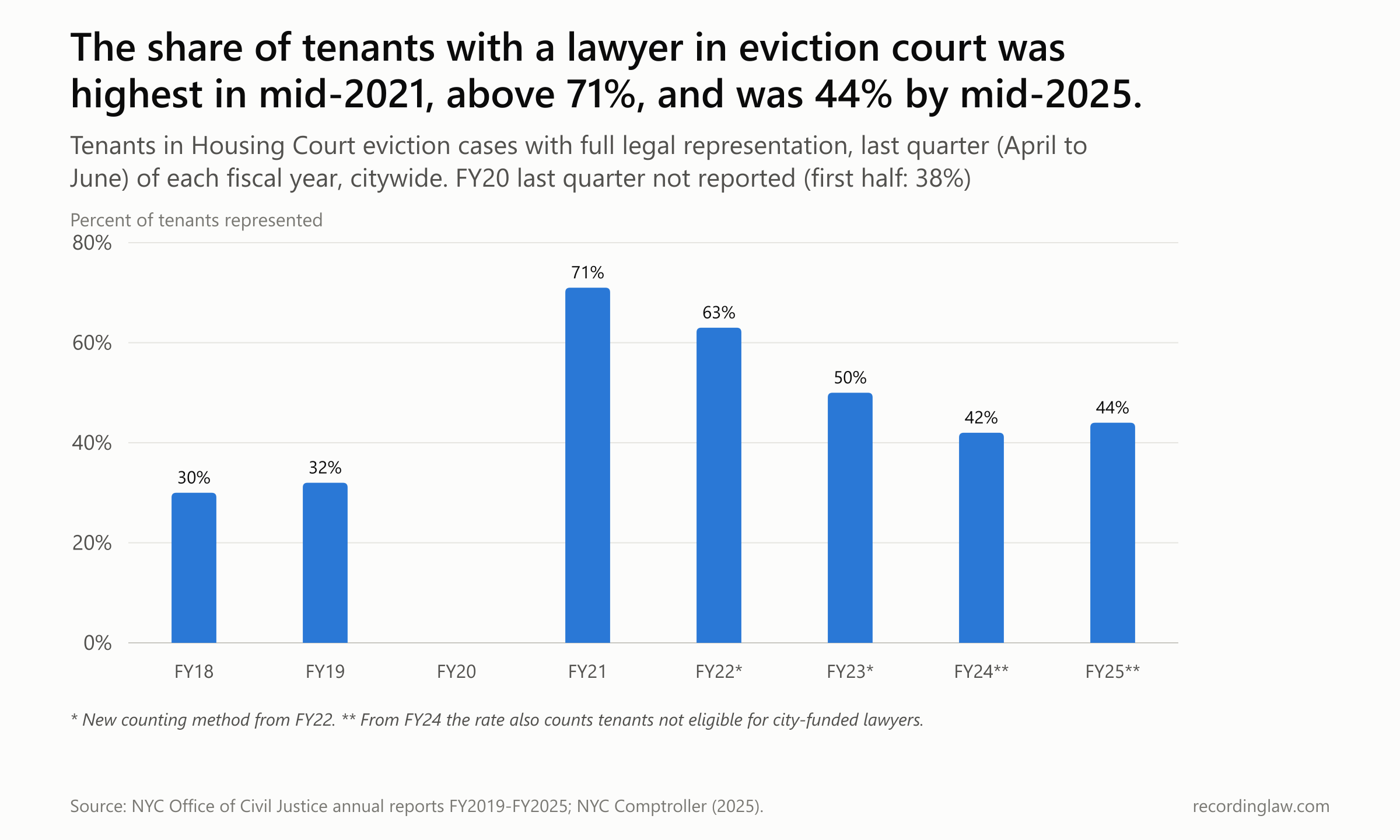
Share of tenants in Housing Court eviction cases with full legal representation, last quarter of each fiscal year (April to June). Fourth quarter of fiscal 2020 not reported (first half: 38%). Method changed in fiscal 2022; from fiscal 2024 the rate includes tenants not eligible for city-funded lawyers. Source: NYC Office of Civil Justice annual reports; NYC Comptroller (2025).
| Fiscal year (fourth quarter) | Tenants with full representation |
|---|---|
| 2018 | 30% |
| 2019 | over 32% |
| 2020 | not reported (first half: 38%) |
| 2021 | more than 71% |
| 2022 | more than 63% |
| 2023 | 50% |
| 2024 | 42% |
| 2025 | 44% |
The line is not perfectly like for like. The office changed its counting in fiscal 2022, and from fiscal 2024 the rate is a share of all tenants in court, including those not eligible for a free lawyer (details in How we measured).
The comptroller's month-by-month count, the source of the 30% figure at the top of this story, ran lower. Representation stayed under 50% for three years and reached "a low point of just 30% in March 2025," the comptroller's office, then led by Brad Lander, reported in May 2025.
The Independent Budget Office, the city's nonpartisan fiscal monitor, counted the cases and the money. From 2019 to 2024, it estimated, the number of eligible cases rose from about 15,700 to about 50,500 a year, up 222%. "Over the same period, program spending increased only 129%, failing to keep pace with eligibility," it wrote in September 2025.
The help also got thinner. In 2024 more than half of tenants served got only brief advice rather than a lawyer for the whole case, against 10% from 2017 through 2019. The city also stopped paying for representation in cases that ran longer than a year.
Did the money and the lawyers keep up?
In the budget office's reading, the money had not kept up with the cases. The argument over what the program would cost was older than the law. A 2016 study done pro bono by the firm Stout Risius Ross for the New York City Bar Association, which backed the bill, projected net savings of $320 million a year, mostly from avoided shelter costs and preserved affordable apartments. The city's Independent Budget Office and the Council's Finance Division had instead estimated a net cost, between $100 million and $203 million a year (IBO) and $66 million (Finance), as the City Bar summarized them.
Both sets of estimates assumed coverage up to 125% of the federal poverty level. The law set the line at 200%.
The lawyers were the other constraint. The Furman Center had warned about staffing in 2018: as City Limits summarized its report, providers would have to "hire and train large new teams of attorneys." A court working group later recommended a cap of 48 full cases a year for an experienced attorney; providers reported carrying 50 to 80.
The city's 2023 solicitation offered $408 million over fiscal 2025 to 2027 for 44,000 cases a year, a rate the comptroller's office put at about $3,063 a case. Providers estimated nearly 71,000 eligible households a year, and told the comptroller that city money covered "between 60-80% of their current operational costs."
The administration answered with its own numbers. A Department of Social Services spokesperson said spending on tenant legal services rose from $62.4 million in 2021 to $155 million in 2025, and that households served grew from 12,754 in fiscal 2021 to nearly 30,000 in fiscal 2024. In October 2025 the agency told the Council that fiscal 2025 "saw the highest number of clients receiving full legal representation in the program’s history," with tenant services funding up from $165 million to more than $228 million.
What landlords say the right changed
In the landlord groups' public statements since 2021, the complaint is time: how long a case takes to end.
"The massive delays in housing court are causing an emergency funding crisis, with non-payment proceedings often taking more than a year to be adjudicated," Jay Martin, executive director of the Community Housing Improvement Program, a landlord trade group, said in September 2023. CHIP estimated from a survey of its members that rent arrears in rent-stabilized buildings had reached $1.25 billion. Among its proposals was expanding the 18-b panel of assigned attorneys to represent tenants with the right, a change in who supplies the lawyers rather than whether tenants get them.
Martin went further in an interview with Reason, the libertarian magazine, that December: "you have attorneys on the other side who are intentionally delaying [cases] as long as possible."
In February 2024 the LeFrak Organization, which owns more than 60,000 apartments in the city, sued the court system in Queens. "Landlords have been forced to merely accept the game as rigged," its complaint said, asking for trials within three to eight days and adjournments only on request. John Ketcham made the delay argument that June in City Journal, published by the free-market Manhattan Institute. A landlord attorney told The Real Deal in 2022 that judges became more apt to postpone cases where tenants lacked a lawyer, and that "when the case gets adjourned, another month of rent accrues."
A trade-press columnist disagreed. In a March 2024 opinion column, Real Deal journalist Erik Engquist wrote, "But right-to-counsel is not really the problem," citing a landlord attorney who found cases easier to resolve when the tenant had a lawyer. The same column said judges "routinely" give tenants "two or three months to find a free lawyer."
Trade coverage as recently as August 2026 has said the 2017 law requires judges to adjourn hearings until a tenant has a lawyer. The law's text contains no adjournment provision. In 2023 the court system said Housing Court had long adjusted its calendars and adjourned cases so legal services providers could assess them. In 2022 the court system said a tenant whose case a provider declines at a first appearance proceeds without counsel.
Where the first ZIP codes, and the promise, ended up
Once the moratoria lifted, every part of the city climbed back toward its 2017 level, and the head start the first ZIP codes had built mostly disappeared.
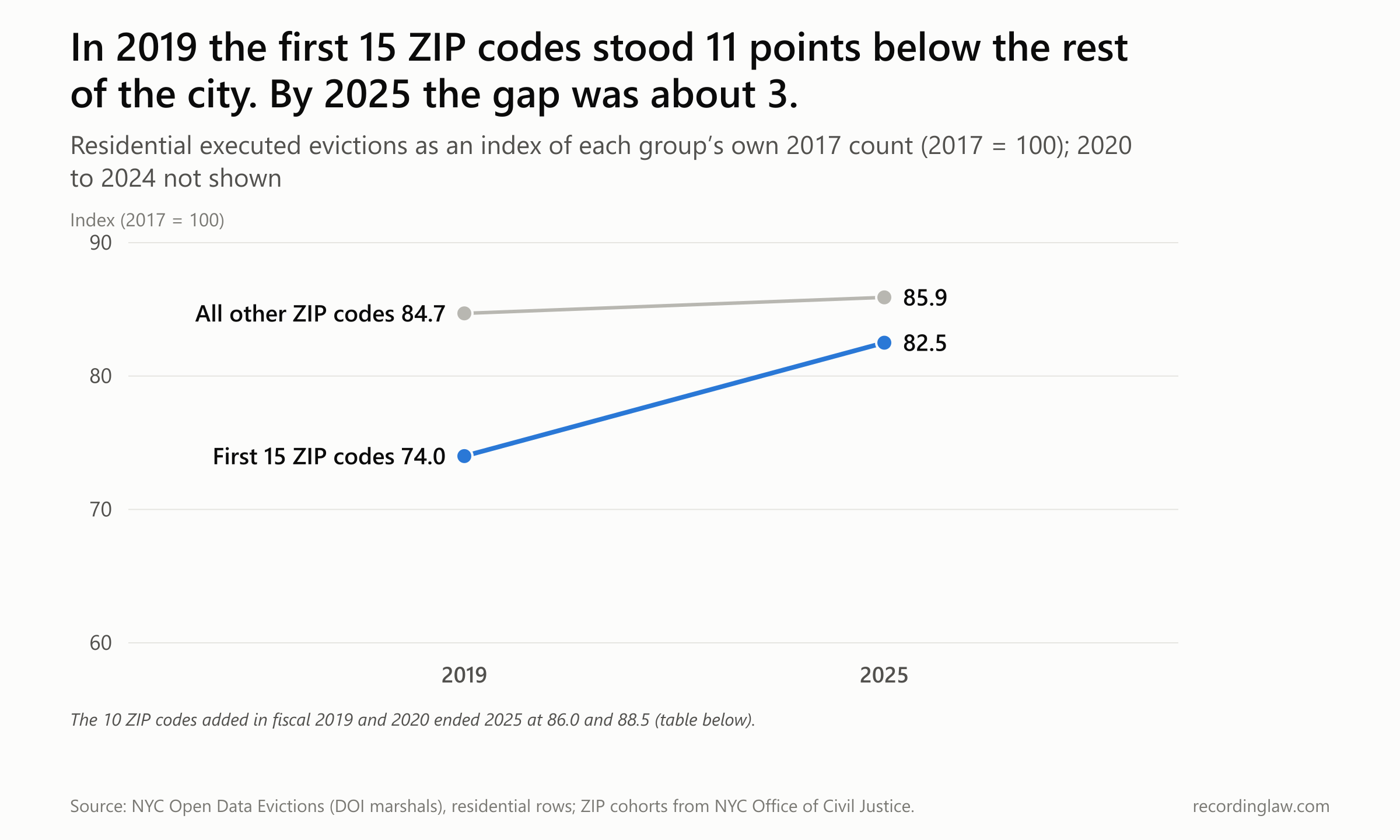
Calendar-year residential executed evictions in 2019 and 2025 as an index of 2017 (2017 = 100), by right-to-counsel ZIP group. 2020 to 2024 omitted. Source: NYC Open Data Evictions; ZIP cohorts from NYC Office of Civil Justice annual reports.
| ZIP group | 2019 (2017 = 100) | 2025 (2017 = 100) | 2025 evictions |
|---|---|---|---|
| 15 ZIPs covered by fiscal 2018 | 74.0 | 82.5 | 2,740 |
| 5 ZIPs added fiscal 2019 | 63.8 | 86.0 | 1,091 |
| 5 ZIPs added fiscal 2020 | 86.9 | 88.5 | 1,381 |
| All other ZIPs | 84.7 | 85.9 | 12,579 |
| Citywide | 81.9 | 85.5 | 17,791 |
By 2025 every group was back to between 82% and 89% of its 2017 level. In 2019 the 15 early ZIP codes stood about 11 points below the rest of the city on this index; in 2025 they stood about 3 points below.
Citywide, marshals carried out 17,791 residential evictions in 2025, about 49 a day. That is 4% more than in 2019 and 14% fewer than in 2017. Through September 2026, the count was 12,741, about 8% below the same months of 2025.
The number of new cases has moved the other way. Eviction filings fell from 247,000 in 2013 to 118,000 in 2024, the comptroller's office reported, "as landlords likely stopped filing frivolous and serial eviction cases" under stronger tenant laws. The Office of Civil Justice warned in its fiscal 2025 report that "because warrants of evictions tend to occur one to two years after a case is filed, there is still an increase that we will be monitoring."
The budget line has grown, and advocates are asking for more. The adopted fiscal 2027 budget carries $195.1 million for full representation, up $32 million from the fiscal 2026 modified figure, and a City Hall spokesperson put the mayor's fiscal 2028 plan at $222.4 million. The Right to Counsel NYC Coalition has asked for at least $350 million, and Gibson, the 2017 co-sponsor who is now Bronx borough president, urged the city in March to "expand funding and hire more defenders." The current provider contracts run through June 30, 2027, the same date the fiscal 2028 budget is due for adoption.
The Independent Budget Office told the Council in October 2025 that the program "is now struggling to meet its original intention." Mark Levine, who wrote that no low-income New Yorker would lose a home for want of a lawyer, became city comptroller in 2026. His office now hosts the report that counted 30% in March 2025.
In the Bronx in 2017, de Blasio said a tenant would call 311 and get a lawyer, "as simple as that." In the spring of 2025, 44 of every 100 tenants in the city's eviction court had one.
How we measured
Executed evictions. NYC Open Data "Evictions" (dataset 6z8x-wfk4), compiled from Department of Investigation marshal records, covering executions from Jan. 3, 2017, to Oct. 28, 2026 (136,351 rows; retrieved Oct. 31, 2026). We counted residential rows only. Rows can include more than one per court case: for 2024 there are 15,461 residential rows and 14,484 distinct court index numbers. The comptroller's May 2025 report gives 13,955 for 2024 from a download it dates March 8, 2024; we did not reconcile the two and use the Open Data rows throughout. Annual figures are calendar years; 2026 is shown only as January to September. Figures before 2017 (29,000 in 2013, 18,830 in 2016) come from the comptroller and are not in this dataset.
ZIP groups. Cohorts follow Table A.1 of Cassidy and Currie (NBER Working Paper 29836) and the Office of Civil Justice annual reports: 10 ZIP codes in fiscal 2017 (10457, 10467, 11216, 11221, 10026, 10027, 11433, 11434, 10302, 10303), 5 in fiscal 2018 (10468, 11225, 10025, 11373, 10314), 5 in fiscal 2019 (10462, 11226, 10031, 11385, 10310) and 5 in fiscal 2020 (10453, 11207, 10029, 10034, 11691). "Other ZIPs" are the 215 ZIP codes outside those 25 with at least one residential execution from 2017 to 2026. The quarterly chart combines the ten ZIP codes added in fiscal 2019 and 2020 into one "later" group. The Community Service Society's comparison used 80 ZIP codes selected to resemble the program ZIPs; we could not rebuild that set, so our comparison includes lower-need ZIP codes. Counts are not adjusted for the number of rental units per ZIP code. Go-live dates are known by fiscal year only.
Representation inside the program ZIP codes. In the ten first-targeted ZIP codes, 48% of tenants in Housing Court had representation in 2017, up from 16% in 2015, the Office of Civil Justice reported. In the last quarter of fiscal 2018, 56% of tenants facing eviction in the covered ZIP codes had an attorney, against 30% citywide, CSS reported; in the last quarter of fiscal 2019 it was 62% in the 20 covered ZIP codes and just over 32% citywide.
Outside New York. The National Apartment Association opposes right-to-counsel laws nationally. "That money would be much better spent if it was helping to avoid eviction in the first place," Nicole Upano of the association told NPR in 2023.
Before 2017. When it announced the deal with the Council in February 2017, City Hall said, "Since beginning an unprecedented expansion of tenant legal aid two years ago, evictions have dropped by 24 percent." That was the administration's own reading of the trend, not a measured effect. De Blasio called stopping wrongful evictions something that "makes both ethical and economic sense." At the signing, Levine also said, "The era of any New Yorker losing their home because they simply didn't have an attorney ends today, for tenants in private housing and tenants in public housing as well."
The 2016 cost estimates. The Stout Risius Ross study for the City Bar put avoided shelter costs at $251 million and preserved affordable apartments at $250 million; leaving out the apartments and the emergency-room and law-enforcement savings, it still projected $52 million in net savings. The IBO and Finance Division figures are as the City Bar summarized them.
Indexes and rates. Each group's index divides its count by its own 2017 count (annual) or 2017 quarterly average (quarterly). Per-day figures divide the calendar-year count by 365 (17,791 / 365 = 48.7 in 2025). The 2025 versus 2019 change is 17,791 / 17,036 - 1 = 4.4%; the 2026 year-to-date change is 12,741 / 13,805 - 1 = -7.7%. The 2019 gap on the index is 84.7 - 74.0 = 10.7 points; the 2025 gap is 85.9 - 82.5 = 3.4 points.
Representation. Rates are from Office of Civil Justice annual reports for the last quarter of each fiscal year (the fourth quarter of fiscal 2020 was not reported; the first half was 38%) and the comptroller's May 2025 report. The office changed its method in fiscal 2022, adding court appearances in certain legal provider assignment parts, in the first year when "providers did not always appear at housing court." The Adams administration also said case counting changed after 2021. In the fiscal 2024 and 2025 reports, the rate "includes respondents that are not eligible for the City-funded full representation," and counts private and union-plan lawyers. The Community Service Society put the fiscal 2021 figure at 74%, not 71%. The 30% figure for March 2025 is a single month from the comptroller's analysis of court data. The 44% in the closing line is the last quarter of fiscal 2025 (April to June 2025) and counts all tenants in Housing Court eviction cases.
The comptroller's report. "Evictions Up, Representation Down" now sits on the comptroller's site marked "ARCHIVE from Comptroller Lander's Administration." Lander released it while running for mayor, the day after Mayor Eric Adams called his budget the "best budget ever," and set against it "evictions rising, representation falling, rents going up, more families being evicted, more families are going to end up homeless." An Adams spokesperson, answering the budget dig, said, "If Brad believes that permanently funding child care, education programs, and social services is a bad idea, he should just say so."
Studies. Cassidy and Currie's estimates are instrumental-variable estimates for tenants who gained a lawyer because of the rollout, using 2016 to 2019 court data; their main sample ends with cases filed by June 14, 2019, to set aside the 2019 state tenant law. We cite the July 2022 NBER revision; the March 2022 draft found executed-eviction effects not always significant, and the June 2023 Journal of Public Economics version (vol. 222) was checked only at the abstract, so the figures here come from the July 2022 working paper, not the journal tables. In a version with address-level controls the executed-eviction effect falls to 5.8 points, significant only at the 90% level. Each interval on the estimates chart is the estimate plus or minus 1.96 times its standard error (clustered by ZIP code) from Table 2, columns 2 and 4, and Appendix Table A.3, column 1, of the July 2022 paper: 4.1 points for possessory judgments (24.1 to 40.1), 3.7 for warrants issued (25.0 to 39.6), 2.1 for warrants executed (4.3 to 12.5), 3.4 with address-level controls (-0.9 to 12.5, an interval that includes zero) and 0.3 for all cases (0.4 to 1.6). The 1.0-point figure is the paper's estimate of the program's arrival across all cases in a ZIP code; 12.4% of 8.4 points is about 1.0, the scaling the paper describes. "About one tenant in eight" is the 12.4-point first stage, rounded. The CSS comparison and our recount are before-and-after comparisons of ZIP groups, not randomized; the program ZIP codes were chosen for high shelter entries and eviction caseloads, evictions had been falling since 2011, and the 2019 state tenant law and the pre-2017 expansion of tenant lawyers overlap the period. The CSS comparison, our recount and the Furman Center's preliminary analysis compare counts across ZIP groups rather than estimating a per-tenant effect in percentage points, so they appear in the quarterly chart and its table rather than on the estimates chart. None of these sources can separate the right to counsel from the moratoria, rent relief and court changes after March 2020.
The health studies. A 2024 study in JAMA Pediatrics, whose lead author reported grants from UCLA's Ziman Center for Real Estate and the National Institute of Nursing Research, found that the right during pregnancy was associated with lower rates of low birth weight and preterm birth among Medicaid-insured births. She also disclosed an unpaid role with the National Coalition for a Civil Right to Counsel, outside the study. In October 2026 a study in the Journal of General Internal Medicine, led by Katherine Chen of UCLA's medical school, estimated about 26 fewer emergency-room visits per 10,000 uninsured or Medicaid-insured residents in the first 10 ZIP codes, using visits from January 2016 to February 2020. It found no significant change in the later rollout phases or across all phases combined, and visits tied to mental health and substance use rose. Chen told THE CITY the team could not say for sure that the right to counsel caused the drop, and the study was funded by the National Institutes of Health and UCLA's Ziman Center for Real Estate. These measure different outcomes from the eviction studies, so they are not on the estimates chart.
Outcomes for represented tenants. In fiscal 2025, 83% of represented households with a reported outcome, 4,352 of 5,232, were "allowed to remain," a count that includes households given extra time to move out as well as those that avoided eviction. That is a fraction of the roughly 22,700 households represented. The office reported 84% in fiscal 2019 and 89% in fiscal 2024. City Limits reported in May that households assisted by the program fell 15% in the first four months of 2026 compared with a year earlier.
What comes next. The court and City Hall have started changing how Housing Court runs. In April 2026 Chief Administrative Judge Joseph Zayas created a Housing Court advisory committee of judges, lawyers, advocates and officials. In August, Mayor Zohran Mamdani announced a fast track for vacate orders and hazardous-conditions cases. The New York Apartment Association, formed in September 2024 from the merger of the Rent Stabilization Association and CHIP, criticized it. "This plan creates a presumption of guilt for violation cases and presumption of innocence for nonpayments," its chief executive, Kenny Burgos, said. The law also requires the Office of Civil Justice to hold a public hearing every year; it held none in 2022. The 2017 law set a Sept. 1 deadline each year for the Office of Civil Justice's annual report; the fiscal 2026 report was not on its site as of Oct. 31, 2026, and a five-year strategic plan the agency said it expected "in the spring of 2026" had not appeared either. The current provider contracts run through fiscal 2027, which ends June 30, 2027, and the agency told the Council in October 2025 that it would approach the next procurement early in the new year. The fiscal 2028 budget, with its right-to-counsel line, is due for adoption by the same date, and a statewide right-to-counsel bill could return when the Legislature's 2027 session opens in January.
What the data cannot show. Executed evictions miss tenants who leave before a marshal arrives. We have no consistent annual series of filings or of program spending; city figures for the program's budget differ by source and line item, so we quote each with its source rather than combining them. For the state rules that govern these cases, see our guide to New York landlord-tenant laws.
Frequently Asked Questions
What is New York City's right to counsel for tenants?
Local Law 136 of 2017, signed Aug. 11, 2017, requires the city's Office of Civil Justice to provide low-income tenants facing eviction in Housing Court with legal services, subject to annual funding. Full representation is for households under 200% of the federal poverty level. It was phased in by ZIP code and became citywide in March 2020, a change written into law by Local Law 54 of 2021.
Did right to counsel reduce evictions in New York City?
In the rollout years, executed evictions fell faster in the first right-to-counsel ZIP codes: 26% from 2017 to 2019 in the first 15, against 15% elsewhere. Princeton economists using the rollout found lawyers cut possessory judgments and warrants sharply; their July 2022 working paper estimates an 8.4-point drop in executed evictions for tenants who gained a lawyer. The ZIP codes were chosen for high shelter entries and eviction caseloads, and a 2019 state law also applied, so the raw comparison is not proof of cause.
What share of NYC tenants facing eviction have a lawyer?
The Office of Civil Justice reported 44% full representation in the last quarter of fiscal 2025, up from 42% a year earlier and down from more than 71% in fiscal 2021. The rate counts all tenants in Housing Court eviction cases, including those not eligible for city-paid lawyers, and the method changed in fiscal 2022.
How many evictions happen in New York City each year?
City marshals carried out 17,791 residential evictions in 2025, about 49 a day, according to NYC Open Data. That compares with 20,803 in 2017, 17,036 in 2019 and 160 in 2021, when moratoria were in place. From January to September 2026 the count was 12,741.
How much does NYC spend on right to counsel?
The city projected $155 million a year at full implementation in 2017. The adopted fiscal 2027 budget carries $195.1 million for full representation, and a City Hall spokesperson put the fiscal 2028 plan at $222.4 million. The Right to Counsel NYC Coalition has asked for at least $350 million. City figures differ by source and budget line.
Was right to counsel expected to save the city money?
Estimates disagreed before the law passed. A 2016 study by Stout Risius Ross for the New York City Bar Association, which backed the bill, projected net savings of $320 million a year. The city's Independent Budget Office estimated a net cost of $100 million to $203 million a year and the Council's Finance Division $66 million, as the City Bar summarized them. All assumed coverage up to 125% of the federal poverty level; the law set the line at 200%.
Do tenants with a lawyer in NYC Housing Court get to stay in their homes?
The Office of Civil Justice reported that in fiscal 2025, 83% of represented households with a reported outcome, 4,352 of 5,232, were allowed to remain. That count includes households given extra time to move out as well as those that avoided eviction, and covers a fraction of the roughly 22,700 households represented. The office reported 84% in fiscal 2019 and 89% in fiscal 2024.
What have New York landlord groups proposed instead?
The Community Housing Improvement Program, a landlord trade group, proposed in 2023 expanding the 18-b panel of assigned attorneys to represent tenants with the right, a change in who supplies the lawyers rather than whether tenants get them. Its executive director, Jay Martin, told The Real Deal that landlords pay their own legal bills, typically $1,000 or $2,000 for a basic nonpayment case, while tenants' lawyers are paid by the city and state. CHIP also proposed a voluntary mediation program; the tenant-side Right to Counsel Coalition said mediation would undermine tenants' right to free legal services.
Does the right to counsel mean a judge must wait for my lawyer?
The 2017 law contains no adjournment requirement. The court system said in 2023 that Housing Court had long adjusted its calendars and adjourned cases so legal services providers could assess them, and a Real Deal columnist wrote in 2024 that judges routinely give tenants two or three months to find a free lawyer. But in 2022 the Office of Court Administration said that when a provider declines a case, the tenant proceeds without counsel. This article describes the law and its data and is not legal advice.
Updates
Restructured as a feature: one chart now compares every study of the effect, including those that found none; side details moved to How we measured. Every figure and quote was re-checked against its source.
Independently fact-checked against the cited primary sources
Independently fact-checked against the cited primary sources
Sources and References
- NYC Open Data, Evictions (Department of Investigation marshal records), retrieved Oct. 31, 2026(data.cityofnewyork.us)
- NYC Office of Civil Justice, Annual Report FY2025(nyc.gov).gov
- NYC Office of Civil Justice, Annual Report FY2024(nyc.gov).gov
- NYC Office of Civil Justice, Universal Access annual report FY2023(nyc.gov).gov
- NYC Office of Civil Justice, Universal Access annual report FY2022(nyc.gov).gov
- NYC Office of Civil Justice, Universal Access annual report FY2021(nyc.gov).gov
- NYC Office of Civil Justice, Universal Access annual report FY2020(nyc.gov).gov
- NYC Office of Civil Justice, Universal Access annual report FY2019(nyc.gov).gov
- NYC Human Resources Administration, release on the Office of Civil Justice second annual report (March 2018)(nyc.gov).gov
- NYC Comptroller (Lander administration), Evictions Up, Representation Down (May 2025)(comptroller.nyc.gov).gov
- NYC Independent Budget Office, report on the expansion of the Right to Counsel program (September 2025)(ibo.nyc.gov).gov
- NYC Independent Budget Office, testimony on Right to Counsel (October 2025)(ibo.nyc.gov).gov
- NYC DSS/HRA testimony on Right to Counsel in Housing Court (Oct. 30, 2025)(nyc.gov).gov
- NYC Office of Civil Justice public hearing transcript (Dec. 9, 2025)(nyc.gov).gov
- NYC Office of Management and Budget, adopted budget supporting schedules (Department of Social Services, budget code 9455)(nyc.gov).gov
- Text of Intro 214-B (Local Law 136 of 2017)(intro.nyc)
- New York City Council, Int. 0214-2014 legislative record(legistar.council.nyc.gov).gov
- Office of the Mayor, release on signing Intro 214-B (Aug. 11, 2017), Wayback Machine capture(web.archive.org)
- DNAinfo, coverage of the Aug. 11, 2017 signing in the Bronx(dnainfo.com)
- Mark Levine, op-ed in City & State (July 19, 2017)(cityandstateny.com)
- City Limits, on the February 2017 right-to-counsel agreement(citylimits.org)
- New York City Bar Association, release on the Stout Risius Ross cost study (April 2016)(nycbar.org)
- 6sqft, on the five-year phase-in and the 200% poverty line (August 2017)(6sqft.com)
- City Limits, on the NYU Furman Center implementation report (December 2018)(citylimits.org)
- Community Service Society of New York, first-year right-to-counsel analysis (March 2019)(cssny.org)
- NPR graphic of the Community Service Society comparison (March 2019)(apps.npr.org)
- Community Service Society of New York, on fiscal 2021 representation(cssny.org)
- Cassidy and Currie, NBER Working Paper 29836, revised July 2022(nber.org)
- Cassidy and Currie, NBER Working Paper 29836, March 2022 version(nber.org)
- Cassidy and Currie, Journal of Public Economics (2023), abstract(collaborate.princeton.edu)
- NYU Furman Center, early evidence on Universal Access to Counsel(furmancenter.org)
- Leifheit et al., JAMA Pediatrics (2024), right to counsel and birth outcomes (PubMed)(pubmed.ncbi.nlm.nih.gov).gov
- The Real Deal, January 2021 hearing on the citywide bill(therealdeal.com)
- THE CITY, on the end of the moratorium (January 2022)(thecity.nyc)
- Law360, court system response to providers (March 2022)(law360.com)
- Norwood News, Bronx Housing Court rally and court system response (April 2022)(norwoodnews.org)
- Queens Eagle, court system and provider statements (April 2022)(queenseagle.com)
- The Legal Aid Society, Queens intake statement (April 5, 2022)(legalaidnyc.org)
- The Legal Aid Society, Manhattan and Brooklyn intake statement (April 18, 2022)(legalaidnyc.org)
- NY Daily News, reposted by the Manhattan Borough President (May 2022)(manhattanbp.nyc.gov).gov
- The Real Deal, Housing Court delays (August 2022)(therealdeal.com)
- City Limits, on the Office of Civil Justice hearing (March 2023)(citylimits.org)
- Legal Aid Society release on the court system caseload working group (September 2023)(legalaidnyc.org)
- THE CITY, on the comptroller report and the administration's response (May 2025)(thecity.nyc)
- New York City Bar Association, civil legal services hearing testimony (2026)(nycbar.org)
- Community Housing Improvement Program, statement on rent arrears (September 2023)(medium.com)
- Reason, on Housing Court delays (December 2023)(reason.com)
- The Real Deal, CHIP mediation proposal (November 2023)(therealdeal.com)
- Inman, LeFrak Organization lawsuit (February 2024)(inman.com)
- City Journal (Manhattan Institute), on Housing Court (June 2024)(city-journal.org)
- The Real Deal, The Daily Dirt opinion column by Erik Engquist (March 2024)(therealdeal.com)
- NPR via KUNC, on right-to-counsel laws nationally (July 2023)(kunc.org)
- Bisnow, on the Housing Court fast track (August 2026)(bisnow.com)
- New York State Unified Court System, release on the Housing Court advisory committee (April 2026)(nycourts.gov).gov
- Commercial Observer, RSA and CHIP join to form the New York Apartment Association (Sept. 4, 2024)(commercialobserver.com)
- City Limits, on right-to-counsel funding (May 2026)(citylimits.org)
- National Low Income Housing Coalition, on the campaign for the NYC right to counsel and the Right to Counsel NYC Coalition (August 2017)(nlihc.org)
- THE CITY, on a Journal of General Internal Medicine study of emergency-room visits and the right-to-counsel rollout (Oct. 21, 2026)(thecityreporter.nyc)
- Chen et al., Tenant Right-to-Counsel and Emergency Department Use in Low-Income and Uninsured Populations, Journal of General Internal Medicine (Oct. 21, 2026)(link.springer.com)