A 2024 Chicago Study Put 65% of Detroit's Cheapest Homes Over the 50% Limit. The City's 2025 Study Found an Average Assessment of 50.1%.

Independently fact-checked against primary sources (last audited November 10, 2026). · 8 primary sources cited on this page. How we verify our legal content
On March 26, 2024, the Detroit City Council unanimously passed two emergency resolutions. The first asked the city assessor to cut assessments by 30% on every home valued at $34,700 or less. The second asked Wayne County Treasurer Eric Sabree to pull owner-occupied homes in that range from that year's tax foreclosure auction.
Sabree turned it down. Over-assessment, he said, is "not a valid reason to withhold properties from foreclosure."
The $34,700 line came from a University of Chicago study released earlier that month. It marked the top of the cheapest tenth of Detroit homes sold between April 2023 and March 2024. The study found that 65% of those homes were assessed above half their sale price, the ceiling in Michigan's constitution. In the most expensive tenth, the share was 11%.
The city's chief assessor, Alvin Horhn, spoke at the same session. "There is not – there is not – there is not a systemic problem with assessments in this city," he said, repeating the point for emphasis, BridgeDetroit reported. The deadline to appeal that year's assessments had passed on March 11. Horhn said appeals had been filed for 566 parcels out of 400,000 across the city.
In 2024 the city paid the International Association of Assessing Officers (IAAO), the profession's standards body, to study its assessments. The city released the report in April 2025. It found the citywide average inside the law, at 50.1% of value. It also found that the spread between how cheap and expensive homes were assessed was outside industry standards.
The assessor cites the first finding as proof that there is no systemic over-assessment. The critics cite the second as proof that the cheapest homes are still assessed too high. Are the homes below the $34,700 line still assessed over the limit? And why do two studies of the same city seem to answer so differently?
Horhn has said there is no question Detroit homeowners were overtaxed after the Great Recession, when the city failed to calculate accurately how far home values had sunk. The fight since then has been about whether the city stopped over-assessing. The city points to a cut in 2014 and a citywide reappraisal in 2017. Researchers at the University of Chicago and a coalition of Detroit groups say the cheapest homes were never brought into line.
Below the $34,700 line
The Chicago study came from the university's Center for Municipal Finance. It sorted Detroit's recent home sales into ten equal price groups, and it asked how each group was assessed. It used 3,452 arm's-length home sales, meaning ordinary market sales, from April 1, 2023, to March 14, 2024.
It compared each sale price with the city's tentative 2024 assessment, and it took both from the city's open data portal. Tentative values can change before the final assessments in April, so the authors called the findings preliminary. The Coalition for Property Tax Justice, a group of Detroit organizations, released the study. The report does not state who paid for it.
Where in the price range were homes assessed above the legal limit?
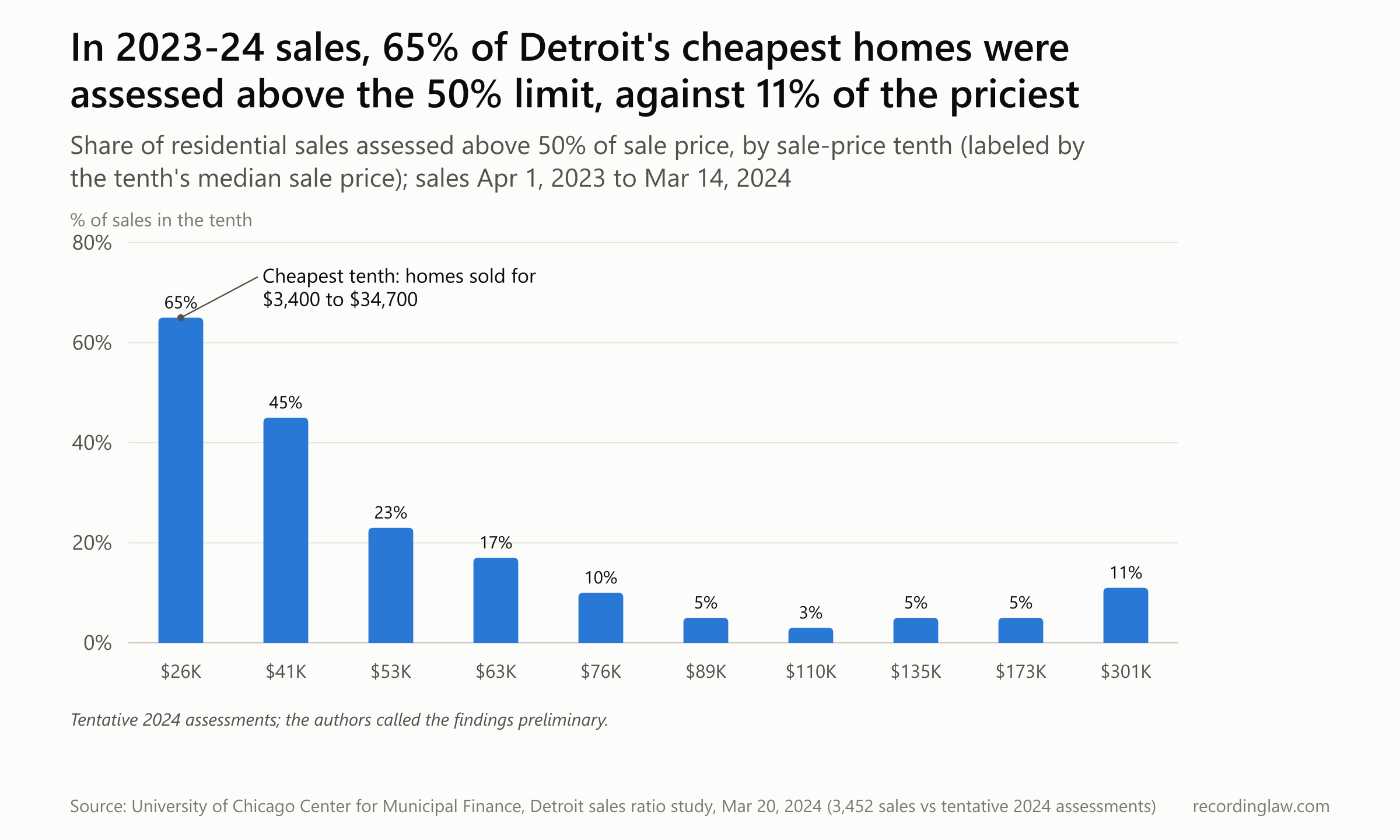
Share of Detroit residential sales assessed above 50% of sale price, by sale-price tenth (decile), sales April 2023 to March 2024 against tentative 2024 assessments. Source: University of Chicago Center for Municipal Finance, March 20, 2024.
| Price tenth | Median sale price | Share above 50% |
|---|---|---|
| 1 (cheapest) | $26,250 | 65% |
| 2 | $41,423 | 45% |
| 3 | $52,500 | 23% |
| 4 | $63,000 | 17% |
| 5 | $75,600 | 10% |
| 6 | $89,250 | 5% |
| 7 | $110,250 | 3% |
| 8 | $135,450 | 5% |
| 9 | $173,250 | 5% |
| 10 (most expensive) | $301,350 | 11% |
The share falls steeply through the bottom half and then ticks back up at the top. The study noted that homes selling for $210,000 to $2.4 million were more likely to be over-assessed than homes selling for $84,000 to $210,000.
The median ratio is the assessment of the typical home in each tenth, as a share of its sale price. It follows the same pattern. The median home in the cheapest tenth was assessed at 58% of its sale price. In the most expensive three tenths, the medians ran from 23% to 28%.
Median and mean assessment as a share of sale price, by sale-price tenth, same 3,452 sales. Legal limit 50%. Source: University of Chicago Center for Municipal Finance, March 20, 2024, p. 6.
| Price tenth | Median ratio | Mean ratio |
|---|---|---|
| 1 | 57.9% | 56.8% |
| 2 | 47.6% | 48.3% |
| 3 | 38.8% | 40.9% |
| 4 | 37.1% | 37.9% |
| 5 | 31.8% | 34.0% |
| 6 | 27.8% | 29.7% |
| 7 | 26.8% | 27.8% |
| 8 | 23.4% | 26.4% |
| 9 | 22.7% | 26.0% |
| 10 | 28.4% | 30.3% |
At the other end, about a quarter of the homes that sold for more than $84,000 (24.7%) were assessed at under 20% of market value. The report also ran an older window, sales from 2021 to 2023. In that window it found 72% of the cheapest tenth over the limit.
Michigan Public led with 65% that week, and the Metro Times led with 72%. Both numbers are in the same report.
Christopher Berry, the University of Chicago professor whose center produced the study, credited the improvement and named what remained. "There have been substantial improvements over the last few years, and I think it's important to acknowledge the progress that's been made," he told Michigan Public. "Nevertheless, significant problems remain with respect to the lowest-priced homes." The report said most homes that sold for more than $35,000 were not over-assessed, "a notable improvement over prior years."
Detroit's assessment problems go back to the Great Recession, and to a number in Michigan's constitution.
The 50% limit and the foreclosure years
Michigan's constitution says property shall be "uniformly assessed" at a proportion of its true cash value, the law's term for market value, "which shall not, after January 1, 1966, exceed 50 percent." Studies test the rule by dividing each home's assessment by its sale price. That share is the assessment ratio, and the legal ceiling for it is 50%.
Proposal A, approved by voters on March 15, 1994, added a second number, called taxable value. It is the figure tax bills are calculated on. For an owner who stays put, it cannot rise in a year by more than inflation or 5%, whichever is less. In the tax year after a sale, taxable value uncaps and becomes equal to assessed value.
By 2022, Michigan Public reported, the city and its critics agreed that Detroit had over-assessed most of its homes from 2009 to 2015, between 55% and 85% of them according to one study. Its lead author, the law professor Bernadette Atuahene, also founded the Coalition for Property Tax Justice, which campaigns on the issue.
The money involved was large. A 2020 Detroit News investigation put the over-taxation at around $600 million from 2010 to 2016, Michigan Public reported.
The Citizens Research Council of Michigan, a privately funded nonprofit research group, put it at "at least $600 million over a six year period," and it found that 52% of it was levied by overlapping governments, meaning governments other than the city. Mayor Mike Duggan said in 2020: "But the lion’s share of that money went to the Detroit Public Schools."
Over the same years, Detroit went through a wave of tax foreclosures. "Between 2011 and 2015, one out of every four properties in Detroit, and 30 percent of Detroit homes, went into foreclosure because of failure to pay property taxes," Berry said in 2018. In 2015 alone, Wayne County foreclosed on nearly 25,000 properties, more than 9,000 of them occupied.
Berry and Atuahene tried to measure the link. Their 2019 paper, "Taxed Out," found that homes sold in Detroit since 2009 with higher assessment ratios were more likely to go into tax foreclosure later, controlling for purchase price, location and time of sale. They estimated that 10% of those foreclosures, about 10,000 properties, were "caused by illegally inflated tax assessments."
The estimate was heaviest at the bottom. Among the cheapest fifth of properties, they found, half went through tax foreclosure, and only 37% would have if assessments had followed the constitution.
The method is observational. It controlled for purchase price, location and time of sale, meaning the analysis adjusted for measured differences in purchase price, location and time of sale; it cannot adjust for things the study did not measure. The authors' word "caused" is their reading of the method. When WXYZ asked in 2018, the city said it could not comment because it did not have the raw data or the methodology.
By then the city had already started cutting.
A cut in 2014, then every house reappraised
Duggan took office in January 2014 and moved first on assessments. "I campaigned against that every single day in 2013. And in January of 2014, my first month in office, we cut assessments in the city 22 percent," he told WDET in 2020. City statements have put the same cut at 20%.
That year the city also began a parcel-by-parcel reappraisal of every home, the first in nearly 60 years. The new values, based on sales from October 2014 to September 2016, took effect in 2017. City officials expected modest changes. They expected 53% of owners to see reductions of 10% or less, and 41% to see increases of 10% or less.
The notices went out late. By the city's own account in 2026, more than 260,000 residential notices were mailed on February 14, 2017, four days before the deadline printed on them to appeal.
Did the reappraisal bring the low end into line? Berry's team at the university's Center for Municipal Finance tested it in 2020 on sales from spring 2016 to early 2018.
Across all homes, it looked that way. The average assessment fell from 57% of sale price to 47%. The share over the legal limit fell from half of all homes to one-third.
The cheapest homes went the other way. Before the reappraisal, homes that sold for $1,800 to $10,000 were assessed at nearly 90% of their price on average, and homes that sold for $60,000 and up at less than 30%. After it, the bottom tenth's average ratio rose.
The report's term for that pattern is regressivity, meaning cheaper homes are assessed at a higher share of their value than expensive ones. "Overall regressivity has gotten worse rather than better following the 2017 reappraisal," the report concluded. The team noted that the assessor's office had not answered its request for definitions of the data fields, so it worked from stated assumptions.
How far did the overall problem shrink after that? Two analyses tracked it. They used different samples and methods, so each analysis can be compared only with its own other figures.
The chart also shows Atuahene's 2009-15 estimate, as Michigan Public reported it in 2017 and 2022. The other rows count homes that sold, and they compare each assessment with the sale price. Atuahene's estimate is different: it is a range of the yearly shares of homes over-assessed, not a share of sales.
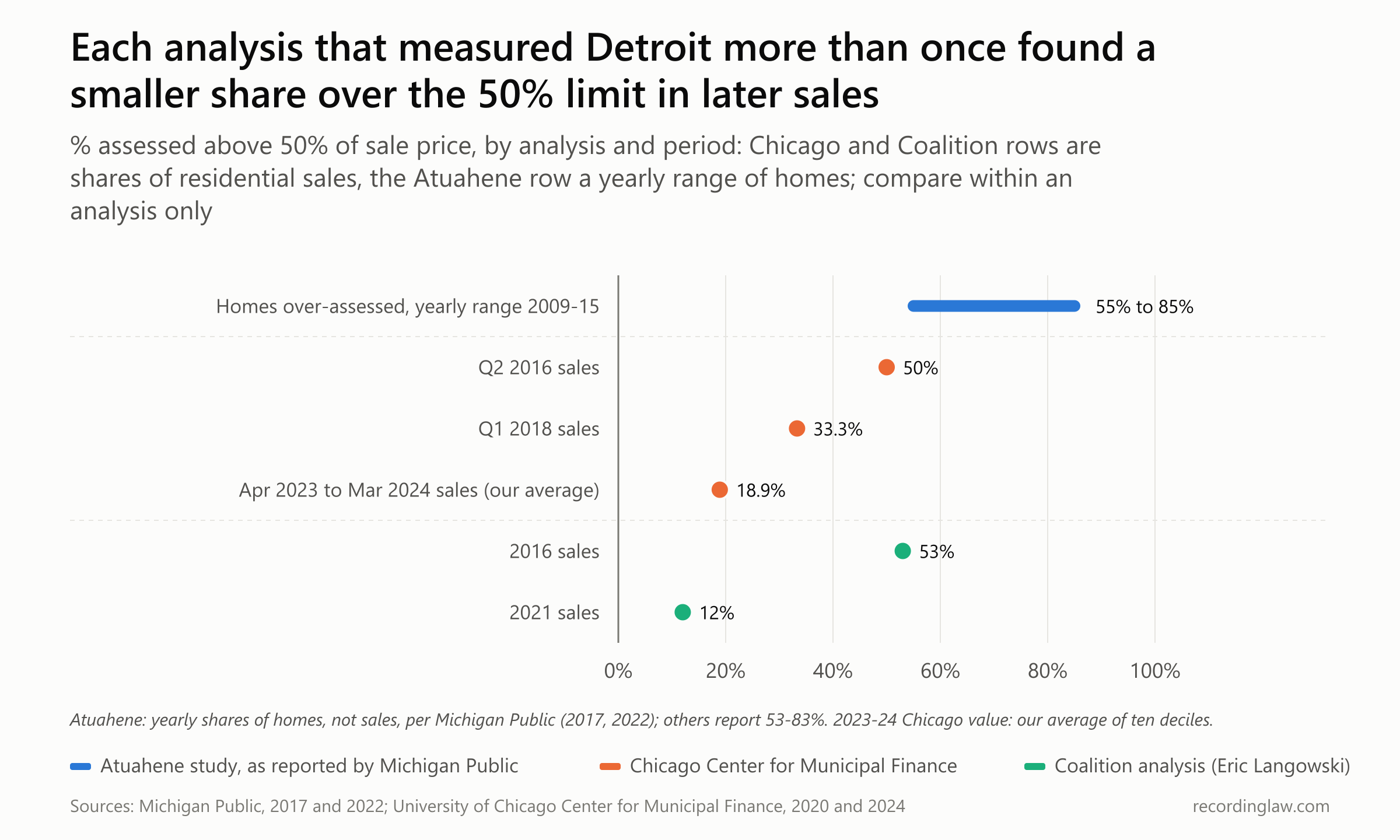
Share of Detroit residential sales assessed above 50% of sale price, by analysis; the Atuahene row is the range of yearly shares of homes over-assessed in 2009-15. Compare within an analysis only. Sources: University of Chicago Center for Municipal Finance (2020, 2024); Atuahene range via Michigan Public (2017, 2022); Coalition for Property Tax Justice analysis via Michigan Public (2022).
| Analysis | Sale period | Share above 50% |
|---|---|---|
| Atuahene study, as reported by Michigan Public | 2009 to 2015 | 55% to 85% of homes over-assessed each year |
| Center for Municipal Finance | Q2 2016 | half of all homes |
| Center for Municipal Finance | Q1 2018 | one-third of all homes |
| Center for Municipal Finance | Apr 2023 to Mar 2024 | 18.9% (average of the ten decile shares) |
| Coalition analysis (Eric Langowski) | 2016 | 53% |
| Coalition analysis (Eric Langowski) | 2021 | 12% |
In the Coalition's analysis, the share fell by more than half, from 53% in 2016 to 12% in 2021. The two Chicago reports, on different data, show a similar fall, from half of all homes in spring 2016 to 18.9% in 2023-24. That 18.9% is our average of the shares in the ten price tenths. The center did not publish an overall share.
Foreclosures fell too. Tax foreclosures of owner-occupied homes dropped 88%, from 6,408 in 2015 to 768 in 2017, Shelterforce reported. The county's preliminary 2018 list is a separate count, not part of that series. It held 4,676 properties, and 1,499 of them were occupied.
The record does not say how much of that drop came from assessments. The same years brought payment plans and exemptions that Sabree credits with keeping families housed. In July 2018 a settlement of a lawsuit by the ACLU of Michigan, the NAACP Legal Defense Fund and Covington & Burling let eligible owners buy back foreclosed homes for $1,000.
What the fixes did not touch was the money already collected.
The argument over refunds
Duggan's answer to calls for refunds, in March 2020, was that today's taxpayers would pay for them. "If you do that, you would blow the property tax rates in this city through the roof," he told WDET. He said only "a politician who tells people what they want to hear" would say, "Yeah, you’re going to get a check."
The Citizens Research Council made the same arithmetic point in 2021. The money "has already been distributed among and spent by the city and the overlapping jurisdictions," it wrote, so a refund "would result in taxing Detroiters today to compensate those that paid Detroit tax bills in the past."
In October 2020, Duggan proposed something else. His proposal was preferences in city housing programs for owners hurt by over-assessment. "Years of over assessment took that from families, and this is an effort to ensure some of what was lost is restored," he said. The City Council rejected the plan in November 2020; it covered only owners affected from 2010 to 2013, CBS Detroit reported.
Critics kept pressing in court and in the Council. Five homeowners sued in early 2020 over the late 2017 notices. U.S. Rep. Rashida Tlaib, a Detroit Democrat who had worked on the issue as an attorney with Detroit's Sugar Law Center, said: "In 2017, Detroiters had no real right to appeal their systematic inflated assessments due to the city’s failure to mail timely notices of assessment and the right to appeal."
In October 2022 the city's Law Department concluded that paying money through a reimbursement fund would be an unlawful "lending of credit." Atuahene answered that "Mayor Mike Duggan cannot hide behind a faulty interpretation of state law as a cover for a political decision."
The Coalition said Attorney General Dana Nessel had pledged a legal opinion on compensation within 90 days. "The opinion from the attorney general is critical," said Mary Sheffield, then president of the City Council. No such opinion turned up in our search of the record.
By then the argument had narrowed. Since Duggan "overhauled the city assessor’s office, the problem has decreased dramatically," Michigan Public summarized in 2022, a point both sides accepted. The Coalition's data scientist, Eric Langowski, added the exception: "the ones that are remaining to be over assessed are the lowest-valued homes."
In November 2023 the Council passed a property tax reform ordinance, 6-3, over the administration's objection. Atuahene called it a measure that "places the burden of correctly assessing properties on the City rather than the homeowners." The city's corporation counsel, Conrad Mallett, said it "illegally reduces the role of the Chief Financial Officer" in the assessment process. Under the ordinance, the city hired the IAAO to grade its work.
Before that study was finished, the Chicago team published the study behind the 65%.
The answers to the 65%
Sheffield, still Council President, named the critics' central complaint. "The most egregious part of the systematic over-assessment of properties in Detroit has been this issue of regressivity, which is when the low-valued homes are assessed at a higher percentage of their true market value than our high-valued homes," she said. "While we recognize the assessor’s job is difficult, the stakes are too high to sit idly by while the city’s lowest-valued homes are consistently overassessed."
Atuahene went further: "We have tens of thousands of homes that are still being overassessed. We need systemic change." Activists, the Metro Times reported, were worried about another wave of foreclosures on the lowest-value houses.
The city rejected the method. Horhn said the Chicago methods "violate Michigan tax law and the practices that every assessor in Michigan is legally required to follow," the Metro Times reported. In a statement, he said the study "used an impermissible methodology under Michigan law that assumes location of property does not affect its value." He also said the city's new assessments "have been reviewed and approved by the State Tax Commission."
The Chicago team's choice of sales was deliberate. It used sales that took place after the assessment date. The report said this follows guidance in the IAAO's standard that ratio studies "should strive to use sales taking place after the assessment date to ensure the independence of assessments and sales prices."
The report also noted that the State Tax Commission, in Bulletin 18 of 2023, recommends an earlier window, sales from April 2021 to March 2023. The team called its own approach, testing on the later sales, out-of-sample testing, and it wrote that it believed "out-of-sample testing is more appropriate." It also ran the state's earlier window, as a supplement. That supplement is the source of the 72% figure for the cheapest tenth given in the first section.
Three months after the Council's emergency vote, the city's own study got its contract.
The study the city paid for
The city's own study asked a different question from the Chicago one. The Chicago team reported how homes in each price tenth were assessed. The city's study reported a citywide average and industry measures of uniformity, and it had no table by price tier.
It was done by the profession's standards body. On July 2, 2024, the Council unanimously approved a $230,000 contract with the IAAO, five months after the deadline the ordinance had set. The work went to the association's wholly owned consulting arm.
The consulting arm studied 12,498 sales from April 2021 to March 2023 (12,002 after removing outliers) against 2024 assessments. It adjusted the sale prices for market change. It grouped the homes by the assessor's neighborhood areas.
Its first finding was the one the city had argued for. The average assessment came to 50.1% of value, and the report said that met the constitutional requirement to assess at 50%. Around that average, the report gave a 95% confidence interval, the range of values that fit the study's data reasonably well, by a method that would catch the true value in about 95 of 100 repeat studies. For the average, that range ran from 49.7% to 50.5%.
The next sentence was the one the critics had argued for. "However, in reviewing the additional statistics included in Table 1 as compared to the expectations listed in IAAO's Standard on Ratio Studies the city is not meeting industry performance standards," the report said.
Two of those statistics carry the dispute. The first is the coefficient of dispersion, or COD, which measures how far individual assessments stray from the typical one. Detroit's COD was 36.6%, against an industry range the report put at 5% to 20%. The Chicago reports put the acceptable range at 5 to 15.
The second is the price-related differential, or PRD. It measures whether cheaper homes are assessed at higher ratios than expensive ones. Detroit's PRD was 1.14, against an acceptable range of 0.98 to 1.03.
Both teams studied one sale window in common, April 2021 to March 2023. On that window, their PRD readings were close: 1.17 in the Chicago team's supplement on 2021-23 sales and 1.14 in the IAAO report.
Had the PRD or the COD moved much since the Chicago team's 2020 report, on sales from 2016 to 2018? Five readings from three reports, each with its own sale window and sample rules, put Detroit's PRD between 1.14 and 1.35. All five are above the 1.03 ceiling.
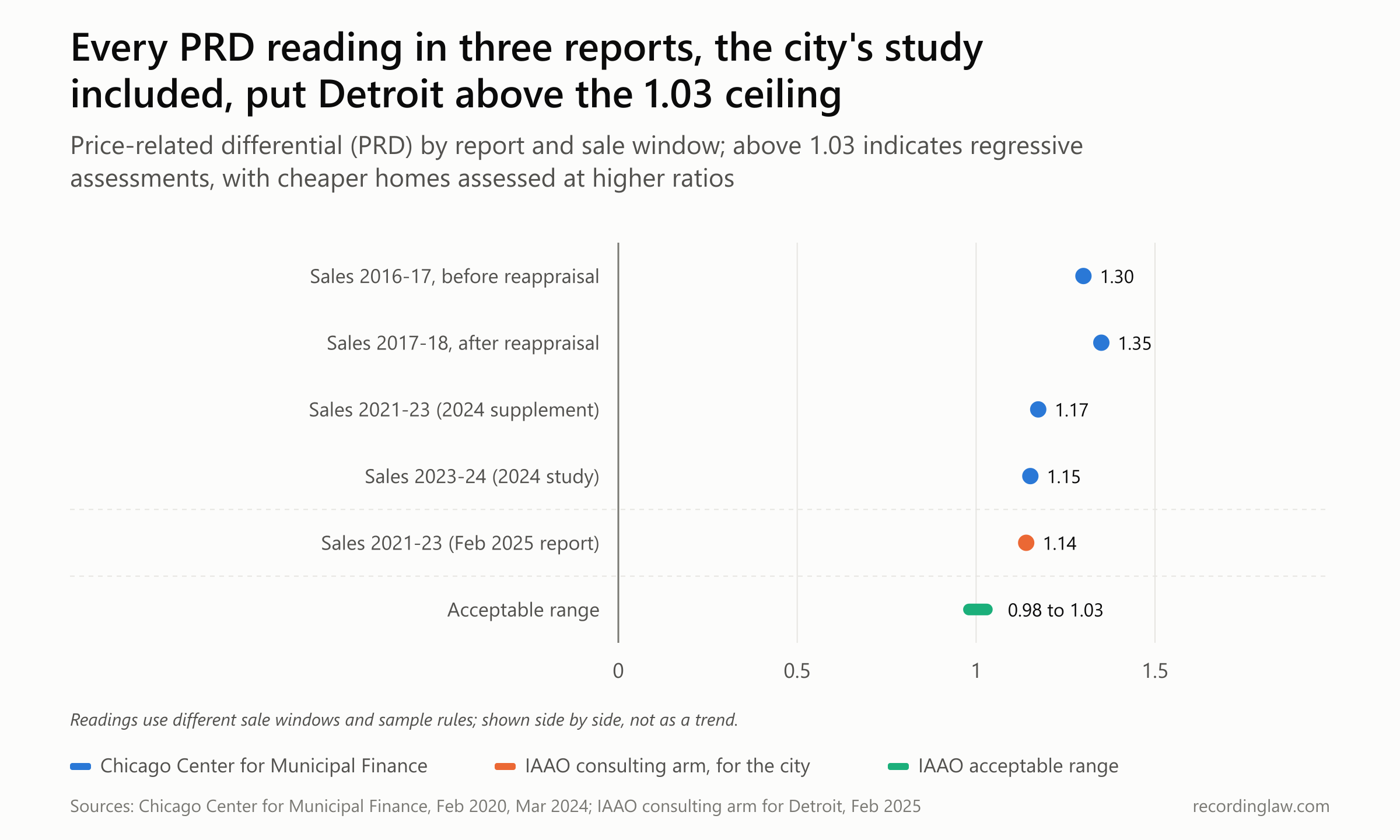
Price-related differential in five readings from three reports; above 1.03 indicates regressive assessments. Sources: University of Chicago Center for Municipal Finance (2020, 2024); IAAO consulting arm for the City of Detroit (February 2025).
| Report and sale window | PRD | COD |
|---|---|---|
| Chicago CMF, 2016-17 (before reappraisal) | 1.30 | 46.26 |
| Chicago CMF, 2017-18 (after reappraisal) | 1.35 | 50.08 |
| Chicago CMF supplement, 2021-23 | 1.1736 | 37.05 |
| Chicago CMF, 2023-24 | 1.1516 | 39.58 |
| IAAO for the city, 2021-23 | 1.14 | 36.6 |
The COD readings in the same table moved the same way. The recent ones are lower than in 2016 to 2018, and they are still nearly twice 20, the top of the range the IAAO used for Detroit.
The IAAO report did not stop at the statistics. It said the low-price sales showed "regressivity concerns that need to be further investigated," and that the city should look into "the cause of this apparent disparate treatment of low and high value property assessments in the city."
It also said "The jurisdiction has no obligation to achieve industry standards." The city's only legal duty, the report said, is to comply with Michigan law, and the industry statistics should carry no weight in judging that.
It flagged a sales-screening practice too. City staff told the consultants that the county generally counts only warranty-deed sales as valid, a practice that "eliminates quit claim and other deed types that are commonly used for sales of lower value properties."
The report recommended reviewing all deed types. It warned that routinely dropping so many sales could push estimates of market value upward.
And it gave a mechanical reason the bottom of the market looks worse in any ratio study: "an assessed value missed by $2,000 on a $20,000 sale has a much greater impact on the sales ratio compared to an assessed value missed by $2,000 on a $200,000 sale."
The city's release on April 16, 2025, led with the average. The study, Horhn said, "shows there is no systemic overassessment taking place at any level of the residential housing market." The release added that "the report also acknowledges that methods critics have urged the city to use are not allowed under Michigan law," and quoted as its example the deed-type recommendation above.
Atuahene answered with arithmetic. "10+60+80 divided by three, is 50, right, the average of those three numbers is 50; but within that, the 60 and the 80 are both unconstitutional, right?" she told WDET in May 2025.
At a Council hearing in June, Berry said the study showed Detroit still missed industry standards and that lower-valued homes were still over-assessed. Horhn told the same hearing the standards rest on an ideal model that does not account for the nuances of Detroit properties.
The city also counted appeals. The Coalition filed 544 appeals in 2024, and taxable value went down on 11 of them, or 2%. It filed 251 in 2025, and taxable value went down on 10, or 4%.
The city read that as "nearly 98% percent of the property assessments were accurate." The Coalition's position, built into the 2023 ordinance, is that the burden should not rest on owners to appeal at all.
The city's last argument is about who pays. "In Michigan the assessed value does not determine the amount paid in property taxes for the homeowner who remains in their home," its release said, because taxable value is capped. That is true for owners who stay.
The same rules, in the city's own taxpayer guide, say that in the tax year after a sale, "the taxable value will 'uncap' and become equal to the 'assessed value'." Every home in a sales ratio study has just sold. So for those buyers, from the tax year after the sale, the bill follows the assessed value. No study in the record measured that effect; it is how the two rules combine.
By the next winter, the Council President who had led the 2024 resolutions was mayor.
From Council president to mayor
Sheffield succeeded Duggan as mayor on January 1, 2026. Her first executive order, signed January 30, was about assessments. In announcing it, she started from the ground the city had defended. "While the IAAO ratio study has confirmed that the Office of the Assessor is compliant with Michigan law, and our Assessment Roll has been certified and equalized by the state’s own practices, there is still doubt as to the fairness of assessments in this city," Sheffield said in the city's release.
"I believe that all Detroiters deserve accurate property tax assessments. No matter how much your house is worth or which neighborhood you call home," she said at the press conference.
The order directs the assessor to adopt the IAAO's ratio standards, "provided that these standards comply with both Michigan law and the requirements of the State Tax Commission." It requires a review of every residential Economic Condition Factor, the neighborhood adjustments the assessor applies, by December 31, 2026.
It also calls for a Mass Appraisal Report starting in 2027 and every two years after. The city also made its February assessor review window permanent, from February 1 to 22.
Atuahene told the Detroit Free Press the Coalition's leaders were "disappointed" with the order "because it merely scratches the surface and does not go far enough." She said the group was more concerned with an assessment ratio study, which in the Coalition's own version of the order "evaluates whether these values are fair, accurate, and uniform."
Three weeks later, on February 20, the city announced it had settled the suit over the 2017 notices. In the settlement, it said, "the City of Detroit acknowledges that the late mailing of property tax assessment notices in 2017 did not provide many Detroit homeowners adequate notice of opportunities to appeal their 2017 property tax assessments." The city's release mentioned no payment.
Two years after the $34,700 line
As of early November 2026, neither side had published a new ratio study. The newest Chicago study dates from March 2024, and the newest city-side study dates from February 2025. So the two numbers the dispute turns on, 65% at the bottom and 50.1% on average, both come from sales that ended more than two years ago.
The first test of the mayor's order is due December 31, 2026, when the neighborhood adjustment review is supposed to be finished. Assessment notices for 2027 follow in late January or early February.
The assessor review, the first appeal window, is open February 1 to 22. The Board of Review, the panel that hears appeals, follows in March. In 2026, Wayne County's deadline to enroll in a payment plan and avoid foreclosure was March 31.
Some time in 2027, the month not yet set, the assessor is due to issue its first Mass Appraisal Report. It is an open question whether it will report ratios by price tier, the measure behind the $34,700 line the Council drew in March 2024. The attorney general's opinion on compensation, pledged in 2022, has not appeared.
The county held its line. In March 2026, two years after Sabree turned down the Council's request to pull the cheapest owner-occupied homes from the auction, the Council asked him to seek a state moratorium on tax foreclosures of owner-occupied homes.
His office called the resolution "political theatre" and urged the Council to deal with the city's high property tax rates.
How we measured
Sources for the ratio figures. Price-tenth shares and ratios come from the University of Chicago Center for Municipal Finance's Detroit study dated March 20, 2024 (an expanded update of a March 11 release). It used 3,452 arm's-length residential sales from April 1, 2023, to March 14, 2024, against tentative 2024 assessments from the City of Detroit Open Data Portal. Shares by tenth were read from the data labels printed on the report's chart; median and mean ratios and median sale prices come from its table on page 6. The cheapest tenth covers sales of $3,400 to $34,700. The 72% and 55% figures for the cheapest two tenths come from the same report's supplement on 2021-23 sales. The 2016-18 figures come from the center's February 2020 report (Table 1, Table 2 and its text). That report used assessor-provided sales from the second quarter of 2016 to the first quarter of 2018. Because the assessor's office gave no definitions, it assumed the field labeled "assessed when sold" was the assessed value. The center's reports do not state their funding; the Coalition for Property Tax Justice released the 2024 study.
The city-side study. The IAAO figures come from the February 2025 report by Professional Consulting Services of IAAO, LLC, released by the city on April 16, 2025 (Table 1). It covers 12,498 sales from April 2021 to March 2023, 12,002 after removing outliers, against 2024 assessments, with sale prices time-adjusted 8.5% a year. The report has no ratio table by price tier, so there is no city-side figure to set beside the 65%. The city said its proposed 2026 assessments rested on more than 16,500 sales from April 2023 to March 2025; no ratio study of those has been published.
Why the readings are not one series. Each study differs in sale window, definition of an arm's-length sale, outlier trimming and price adjustment. The 2024 Chicago study used sales after the assessment date and tentative assessments; the IAAO study used earlier sales and final assessments, grouped by neighborhood. The acceptable COD range is 5 to 15 in the Chicago reports and 5 to 20 in the IAAO report for Detroit. "Nearly twice the top of the range" compares COD readings of 36.6 to 39.6 with 20. We show the PRD and COD readings side by side, not as a trend. The median and mean ratios by price tenth and the COD readings appear in tables rather than charts.
Derived figures. The 18.9% overall share for 2023-24 is our average of the ten decile shares (65, 45, 23, 17, 10, 5, 3, 5, 5, 11), valid because each tenth holds the same number of sales; the center did not publish an overall share. "About a quarter" is the report's 24.7%. "Fell by more than half" compares 53% to 12% in the Coalition's analysis. The two Chicago points (half of homes in 2016, 18.9% in 2023-24) come from separate reports using different data files and assessment years, so we call that a similar fall, not one series. "Lower than in 2016 to 2018" for COD compares 46.26 and 50.08 with 36.6 to 39.58. The PRD of 1.17 is the Chicago supplement's 1.1736, rounded; 1.15 is its main study's 1.1516. The share chart's title compares readings within each analysis only: the center's 50%, 33.3% and 18.9%, and the Coalition's 53% and 12%. Atuahene's 2009-15 estimate is a single range, so it has no second reading.
Other analyses. The Coalition's 53% and 12% figures are an advocacy analysis by its data scientist, Eric Langowski, as reported by Michigan Public in September 2022; we did not see a published paper. The 2009-2015 range of 55% to 85% is a range of yearly shares of homes, not of sales, cited as Michigan Public reported it in 2017 and 2022, a range Atuahene has also given in interviews; other outlets report 53% to 83%. The $600 million figure traces to a 2020 Detroit News investigation; we cite it as Michigan Public and the Citizens Research Council reported it; the Council describes itself as privately funded. "Taxed Out" (Atuahene and Berry, UC Irvine Law Review, 2019) is cited from its abstract and the University of Chicago's 2018 summary; neither states its funding.
Foreclosure figures. There is no clean annual series. The 2015 and 2018 counts are Wayne County totals reported by Michigan Public in July 2018 (2018 is preliminary); the 6,408 and 768 owner-occupied counts are as reported by Shelterforce in June 2025. We found no 2026 foreclosure totals.
The open-data check. We re-ran the Chicago method on the city's current open data files. Our sample (6,750 sales) did not match the published one (3,452), and the assessment-roll fields are ambiguous about which year's value the study tested, so we report only the published figures.
What the data cannot show. No study in the record measures how many current Detroit homeowners pay more tax because of the ratios shown here. The taxable-value cap limits the effect for owners who have not sold; the uncapping after a sale is stated in the city's taxpayer guide and its January 2026 release; applying it to the homes in ratio studies is our reading, not a finding of any study. The foreclosure estimates in "Taxed Out" are observational and cover sales since 2009, a span that begins before the 2014 cut and the 2017 reappraisal.
Frequently Asked Questions
What is the legal limit on property assessments in Michigan?
Since January 1, 1966, the Michigan Constitution (art. IX, sec. 3) has required property to be uniformly assessed at no more than 50 percent of its true cash value, the law's term for market value. Since Proposal A in 1994, taxes have been levied on taxable value. Taxable value is whichever is lower: the assessed value, or a capped value that cannot rise in a year by more than inflation or 5%, whichever is less. In the tax year after a sale, taxable value uncaps and becomes equal to assessed value.
Is Detroit still over-assessing its cheapest homes?
The studies disagree. A University of Chicago study of sales from April 2023 to March 2024 found that 65% of the cheapest tenth of homes were assessed above 50% of sale price. In the most expensive tenth, the share was 11%. The city says that study used a method not allowed under Michigan law. The city's own IAAO study of 2021-23 sales found an average of 50.1%, meeting the law. But it said the city was not meeting industry standards, and that apparent disparate treatment of low and high value homes needed further investigation. Neither side had published a newer study as of early November 2026.
What did the IAAO study of Detroit's assessments find?
The February 2025 report was written by the IAAO's consulting arm under a $230,000 city contract. It found an average assessment ratio of 50.1% (95% confidence interval 49.7% to 50.5%), which it said met the constitutional requirement. The coefficient of dispersion measures how far individual assessments stray from the typical one, and Detroit's was 36.6%, against an industry range of 5% to 20%. The price-related differential measures whether cheaper homes are assessed at higher ratios than expensive ones, and Detroit's was 1.14, against 0.98 to 1.03. The report also said the city has no legal obligation to meet industry standards.
How much were Detroit homeowners overtaxed, and will they get money back?
A 2020 Detroit News investigation put the over-taxation at around $600 million from 2010 to 2016. The Citizens Research Council of Michigan says 52% of it was levied by governments other than the city. No refund program exists. Mayor Mike Duggan opposed cash repayment, and the city's Law Department said in 2022 that a reimbursement fund would be unlawful. An attorney general opinion on compensation, pledged in 2022 according to the Coalition for Property Tax Justice, had not appeared in our search of the record.
Did inflated assessments cause Detroit's tax foreclosures?
A 2019 paper by Bernadette Atuahene and Christopher Berry looked at Detroit homes sold since 2009. It found that those with higher assessment ratios were more likely to go into tax foreclosure, controlling for purchase price, location and time of sale. It estimated that 10% of those foreclosures were caused by illegally inflated assessments. The study is observational. Owner-occupied tax foreclosures fell from 6,408 in 2015 to 768 in 2017, a period that also brought payment plans and exemptions, followed in July 2018 by a buyback settlement.
When can Detroit homeowners appeal their assessment?
The city has permanently set its Assessor Review window at February 1 to 22, after notices arrive in late January or early February. The March Board of Review follows, and in 2026 it ran March 4 to 28. Detroit's HOPE poverty exemption is a separate program. Its 2026 application deadline was 4:30 p.m. on November 6, 2026.
Updates
Reworded for readability. No figures, quotes, sources or findings changed.
Restructured as a feature: chart titles state the finding, side details moved to How we measured. Every figure and quote was re-checked against its source.
Independently fact-checked against the cited primary sources
Independently fact-checked against the cited primary sources
Sources and References
- University of Chicago Center for Municipal Finance, An Analysis of Property Tax Assessments in Detroit (March 20, 2024)(bpb-us-w2.wpmucdn.com)
- University of Chicago Center for Municipal Finance, An Evaluation of Residential Property Tax Assessments in the City of Detroit, 2016-2018 (February 2020)(harris.uchicago.edu)
- Professional Consulting Services of IAAO for the City of Detroit, Sales Verification Analysis and 2024 Sales Ratio Study (February 2025)(detroitmi.gov).gov
- City of Detroit, release on the IAAO study (April 16, 2025)(detroitmi.gov).gov
- City of Detroit, Mayor Sheffield release on Executive Order 2026-01 (January 30, 2026)(detroitmi.gov).gov
- City of Detroit, Executive Order 2026-01 (January 30, 2026)(detroitmi.gov).gov
- City of Detroit, release on settlement of the 2017 assessment notice suit (2026)(detroitmi.gov).gov
- City of Detroit Office of the Assessor, Assessment Information Packet for Taxpayers (2018)(detroitmi.gov).gov
- City of Detroit, HOPE property tax exemption(detroitmi.gov).gov
- Michigan Constitution, article IX, section 3(legislature.mi.gov).gov
- UChicago News, Inflated tax assessments spurred historic Detroit foreclosures, study finds (July 2, 2018)(news.uchicago.edu)
- Atuahene and Berry, Taxed Out, 9 UC Irvine Law Review 847 (2019), abstract(repository.law.wisc.edu)
- Atuahene and Hodge, Stategraft, 91 Southern California Law Review 263 (2018), abstract(repository.law.wisc.edu)
- Citizens Research Council of Michigan, Understanding How Detroit's Property Tax Assessment Process Contributed to the $600 Million Over-Assessment (2021)(crcmich.org)
- Michigan Public, Study: Detroit continues to over-assess its least valuable properties (March 25, 2024)(michiganpublic.org)
- Michigan Public, Property tax coalition, Detroit officials spar over city assessments (September 16, 2022)(michiganpublic.org)
- Michigan Public, Coalition: Nessel will issue opinion on possible cash compensation (October 20, 2022)(michiganpublic.org)
- Michigan Public, Detroit wraps up city-wide property tax reassessment (January 24, 2017)(michiganpublic.org)
- Michigan Public, Detroit tax foreclosures fall for third straight year (July 13, 2018)(michiganpublic.org)
- Michigan Public, Detroit City Council passes ordinance reforming the city's property tax system (November 22, 2023)(michiganpublic.org)
- Michigan Public, Detroit Mayor Sheffield signs first executive order on property assessments (January 31, 2026)(michiganpublic.org)
- Michigan Public, Detroit faces reckoning, lawsuit from over-taxed homeowners (February 14, 2020)(michiganpublic.org)
- BridgeDetroit, Council responds to overtaxation study (March 2024)(bridgedetroit.com)
- BridgeDetroit, on the 2024 Wayne County foreclosure deadline and the assessor and treasurer statements (March 2024)(bridgedetroit.com)
- BridgeDetroit, on the city Law Department memo and compensation (October 2022)(bridgedetroit.com)
- BridgeDetroit, Detroit council urges Wayne County to seek tax foreclosure moratorium (March 2026)(bridgedetroit.com)
- Metro Times, Detroit City Council takes action after study suggests lowest-valued homes were overtaxed (March 2024)(metrotimes.com)
- Metro Times, Detroit illegally inflated taxes on lowest-value homes, study suggests (March 25, 2024)(metrotimes.com)
- Metro Times, on the Council's IAAO contract (July 2024)(metrotimes.com)
- Metro Times, Duggan unveils plan to help homeowners over-billed by inflated tax assessments (October 2020)(metrotimes.com)
- Metro Times, on compensation for over-assessed Detroiters (October 2022)(metrotimes.com)
- CBS Detroit, City Council rejects mayor's plan for over-assessed homeowners (November 2020)(cbsnews.com)
- WDET, Duggan exploring options to help over-assessed homeowners (March 3, 2020)(wdet.org)
- WDET, Coalition says city misinterpreted recent study on over-assessed homes (May 19, 2025)(wdet.org)
- Shelterforce, on Detroit property tax assessments (June 16, 2025)(shelterforce.org)
- WXYZ, Grassroots organization fighting unconstitutional foreclosures in Detroit (2018)(wxyz.com)
- WXYZ, Detroit home values surge $500 million in one year (January 2026)(wxyz.com)
- NAACP Legal Defense Fund, LDF and ACLU settle tax foreclosure case (July 3, 2018)(naacpldf.org)
- USC Gould School of Law, Tackling systemic inequality (profile of Bernadette Atuahene)(gould.usc.edu)
- Detroit Free Press (via Yahoo News), Sheffield signs 1st executive order, touts property value increase, January 30, 2026(yahoo.com)