Central African Republic E-Scooter Laws: The Item 58 Catch-All (2026)
This article is general information about e-scooter laws in the Central African Republic and is not legal advice. Confirm current requirements with a Central African lawyer or the Ministere des Transports before riding. Information last verified on 23 July 2026.
What Central African Republic's law actually says about a motorized scooter
Start from the text itself rather than the question of whether a scooter is legal. The Central African Republic has not enacted its own scooter, moped, or micromobility statute of any kind. Its operative road law is the CEMAC Code Communautaire de la Route, Reglement n04/01-UEAC-089-CM-06, a single instrument shared with five neighbouring states and confirmed applicable to the country as one of the six CEMAC members.
That code's numbered definitions article gives exactly two powered categories below a car. Motocycle is set at any two-wheeler whose engine tops 50 cubic centimetres. The other, item 58, is worded so loosely that it does almost all the work in this article: any road-going vehicle carrying its own propulsion motor, excused only if it runs on rails. Read together, one category names a floor and the other names almost everything else.
A reader used to other Francophone road codes will expect a third rung on this ladder, a cyclomoteur or moped definition pitched below the motocycle line for a smaller device to claim. Central African Republic's code, via CEMAC, skips that rung. Scan the full numbered list and the word cyclomoteur turns up exactly twice, both times folded into descriptions of bicycle lanes, never as an entry of its own. With that middle rung missing, a scooter too light to register on the 50cc scale is not stranded in some undefined space between categories; the broad item 58 wording was drafted to catch precisely that kind of gap, and it does.
The missing middle tier makes the rule stricter, not looser
Most people assume a country with no scooter-specific statute has left the question open. Here the opposite is true, because there is no lenient middle category to be gentle: a scooter is treated as the same class of thing as a car for registration and licensing purposes, not as a smaller, easier case.
An old domestic ordinance is not a way around that outcome either. Article 176, tucked into the code's final provisions, wipes out anything that came before it on this subject and installs the CEMAC text as the operative law in every member country, the Central African Republic included.
What would count as a scooter under this text
No CEMAC or Central African source defines an e-scooter, kick scooter, or personal mobility device on its own terms, so the answer comes from ruling things out one at a time. A bicycle definition (item 15) is limited to muscle power alone, which a battery motor plainly is not. A motocycle definition is pinned to displacement, which an electric motor does not have. Neither box fits, which leaves only the broad one: vehicule a moteur.
Where riding is and is not addressed
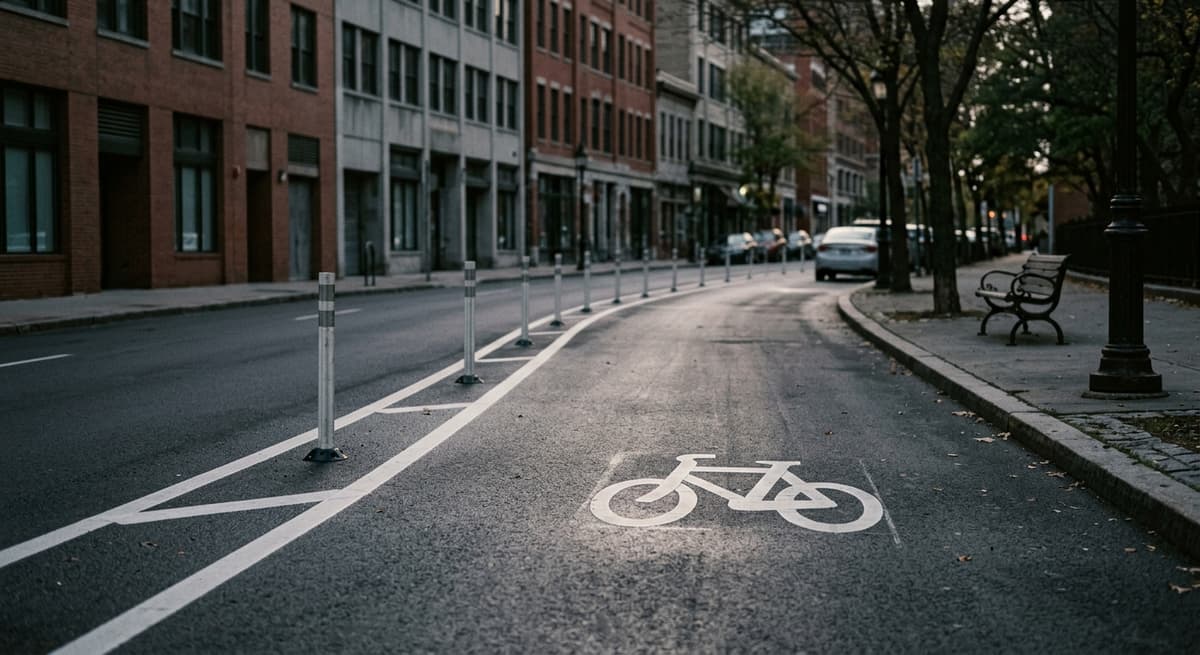
The code gives cycle lanes to human-powered vehicles specifically. A device classified as vehicule a moteur has no textual claim to that space and would in principle be expected to use the general road network under the same terms as a car or motorcycle.
What the law asks of a rider
Article 1 of the CEMAC code requires a valid driving permit to operate a vehicule a moteur, and Article 75 requires that vehicle to be registered with the competent transport authority. Look at how the Central African Republic sizes its own permit classes and the problem becomes visible: every tier is pegged either to an engine's cubic centimetres or a car's weight in kilograms. Neither measurement describes an object with no engine block and a curb weight in single-digit kilograms, so the paperwork the text demands has no obvious form to fill out.
What enforcement data exists
Bangui has produced no documented rental operator, no reported seizure, and no police statement about scooters in this research. Read that as an absence of information, not as tolerance; a legal position built on a definitions clause does not soften just because nobody has been recorded acting on it yet.
The domestic-code question: 38 files, nothing on point
Whether the Central African Republic has ever issued its own supplementing road code was checked directly rather than assumed. Its complete legislative footprint on droit-afrique.com, the region's principal Francophone legal archive, comes to 38 separate documents once retrieved in full. Every one sits in a different sector, mining concessions, forestry management, labour rules, telecoms licensing, public finance, and not one addresses roads or circulation. That is a genuine gap in what this research could reach, not a confirmed finding that no such text exists anywhere, and it leaves the CEMAC community code as the only instrument this page can cite with confidence.
Frequently Asked Questions
Is there a Central African Republic law specifically about electric scooters?
No such text was located. The country relies on the CEMAC regional road code, which does not name e-scooters either but has a catch-all broad enough to cover one.
What happens if I try to register an e-scooter in Bangui?
The CEMAC code requires registration for a vehicule a moteur, but this research found no permit or registration class actually built for a device this small, so no confirmed lawful process exists.
Why does a code with no moped category still catch an e-scooter?
Because the code's catch-all definition for motor vehicles has no size floor and does not require a combustion engine. Anything self-propelled that is not a bicycle or a train falls into it by elimination.
Could an older Central African ordinance override the CEMAC rule?
CEMAC's Article 176 states the regional code repeals all earlier provisions and applies in every member state, which leaves little room for an older domestic instrument to displace it on this question.
Are there rental e-scooters in Bangui?
None were found in this research.
Sources and References
- CEMAC Reglement n04/01-UEAC-089-CM-06 portant adoption du Code Communautaire revise de la Route, Art. 176 (repeal of prior provisions, entry into force in all CEMAC member states)(web.archive.org)
- CEMAC Reglement n04/01-UEAC-089-CM-06, definitions item 58 (vehicule a moteur catch-all, no cyclomoteur category exists in this code)(web.archive.org)
- CEMAC Reglement n04/01-UEAC-089-CM-06, definitions items 15 and 38 (cycle and motocycle definitions)(web.archive.org)
- CEMAC Reglement n04/01-UEAC-089-CM-06, Art. 1 (driving permit mandatory) and Art. 75 (registration mandatory)(web.archive.org)
- Wayback Machine CDX listing of droit-afrique.com archived legislation for the Central African Republic (38 files, no road or circulation code among them)(web.archive.org)