North Dakota
North Dakota Car Seat Laws (2026): Ages, Rules & Penalties
Independently fact-checked against primary sources (last audited September 17, 2026). · Reviewed by the RecordingLaw editorial team. · Law checked current as of August 20, 2026. · 7 primary sources cited on this page. How we verify our legal content
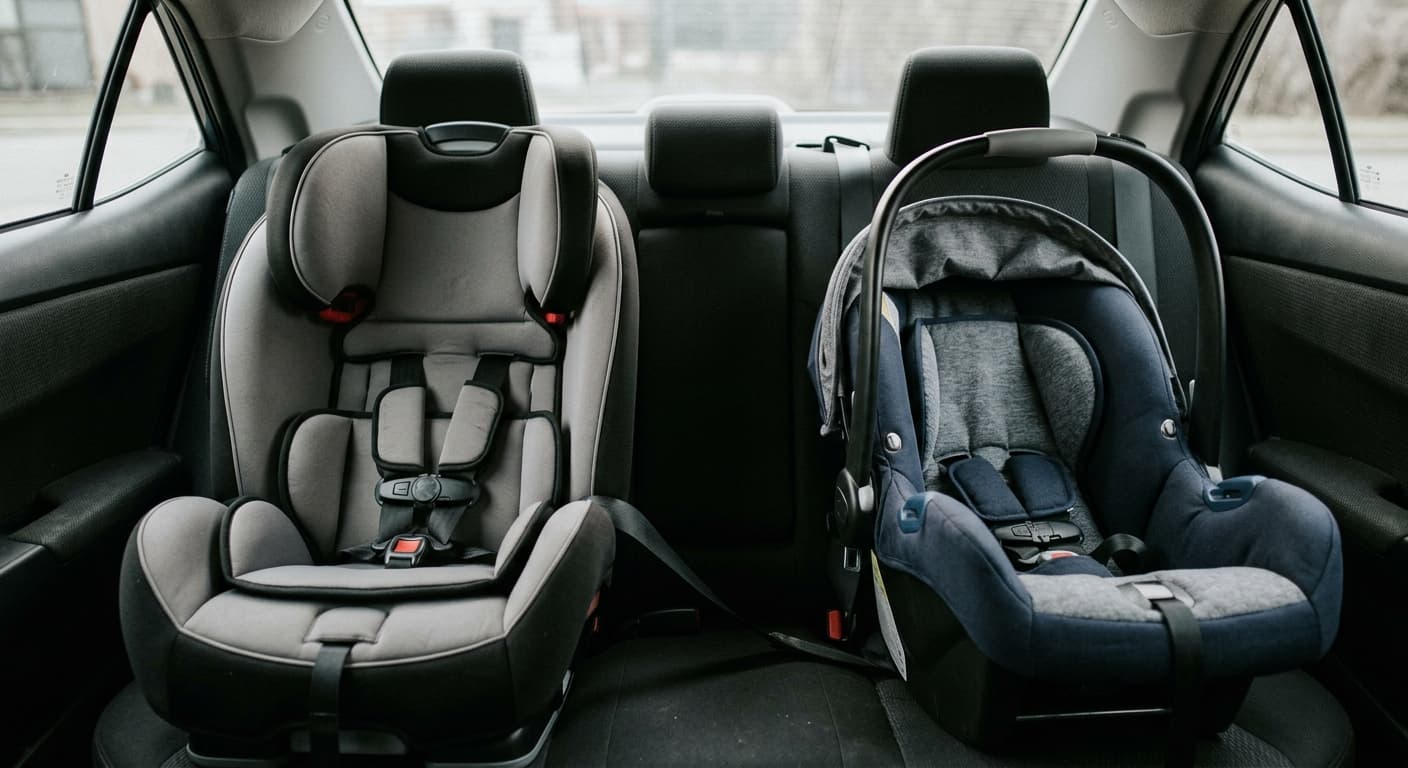
North Dakota requires a child restraint system for every child under 8 in a vehicle, unless the child is at least 57 inches tall, in which case a correctly buckled seat belt is enough, under N.D.C.C. § 39-21-41.2. Children 8 through 17 must be in an approved restraint system or a correctly buckled seat belt. This page reflects the statute's text as of September 2026.
Jurisdiction scope: This article covers car seat and child-restraint law in the state of North Dakota only. It does not address any other state. For other states, see the car seat laws hub.
| Stage | Who | Rule | Statute |
|---|---|---|---|
| Child restraint system | Under 8 and shorter than 57 inches | Vehicle must be equipped with a federally compliant child restraint system, and the child must actually be properly secured in it while the vehicle is moving | N.D.C.C. § 39-21-41.2(1) |
| Seat belt permitted | Under 8 and at least 57 inches tall | Not required to use a child restraint system, but must be correctly buckled in a safety belt | § 39-21-41.2(1) |
| Restraint system or seat belt | Ages 8 through 17 | Approved child restraint system per manufacturer's instructions, or correctly buckled safety belt | § 39-21-41.2(1) |
North Dakota's restraint duty and the 57-inch exception
North Dakota's statute is built around a single age-8 line, not a rear-facing/forward-facing/booster progression, and it has no front-seat or seating-position rule at all. Section 39-21-41.2(1) states plainly: "If a child, under eight years of age, is present in a motor vehicle, that motor vehicle must be equipped with at least one child restraint system for the child." The one exception written into the same subsection is height-based rather than weight-based: "A child under the age of eight who is at least fifty-seven inches tall is not required to use a child restraint system, but must be correctly buckled in a safety belt." A child who hits that height mark before turning 8 can lawfully move to a seat belt; a child who hasn't reached it still needs the restraint system regardless of weight.
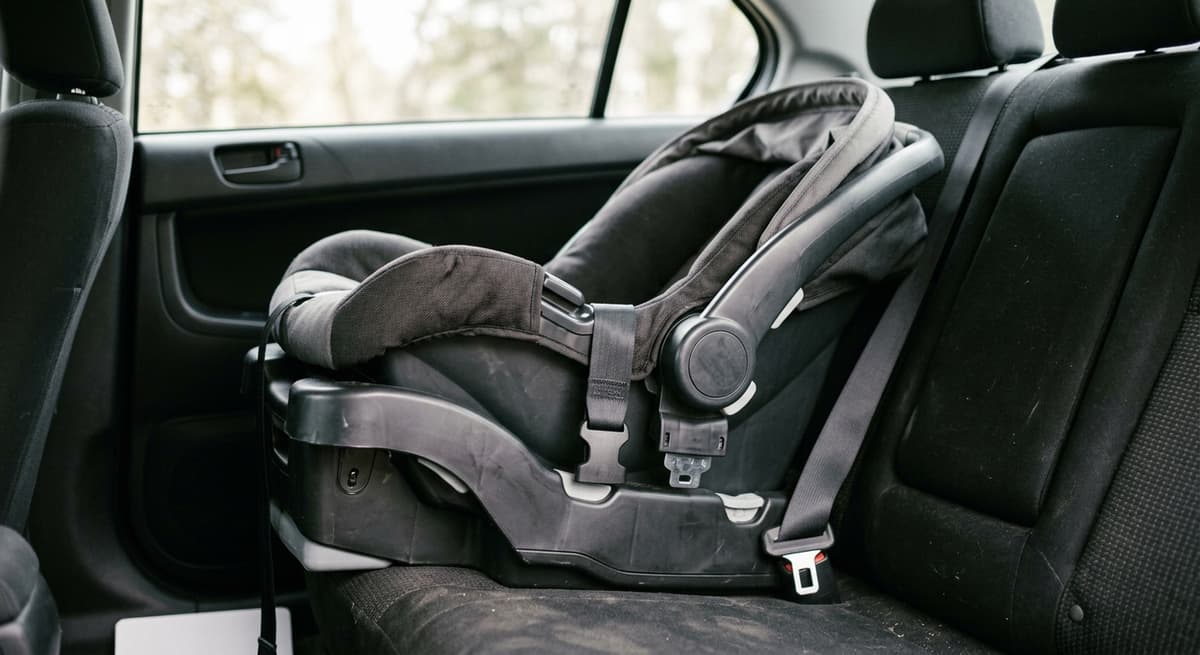
Two more operative duties sit in the same subsection. The restraint device itself has to meet a federal standard: "The child restraint system must meet the standards adopted by the United States department of transportation for those systems," which is FMVSS 213 (49 CFR 571.213). And having the restraint present in the vehicle isn't enough on its own: "While the motor vehicle is in motion, the child must be properly secured in the child restraint system in accordance with the manufacturer's instructions." That second duty is a use requirement, not a product standard, and it's what a citation for an unbuckled child in an otherwise-present car seat would rest on.
Ages 8 through 17: restraint system or seat belt
Once a child turns 8, the same subsection gives families a choice rather than mandating one device: "Each child of eight through seventeen years of age who is in the motor vehicle must be in an approved child restraint system in accordance with the manufacturer's instructions or correctly buckled in a safety belt." Either option satisfies the law for this age range.
Exemptions
North Dakota's child-restraint statute doesn't apply to motor vehicles that weren't equipped with safety belts when they were manufactured, and it doesn't apply to a child being transported during a genuine emergency situation. The section also closes with a civil-liability rule: a violation isn't, in itself, evidence of negligence, and the fact of a violation isn't admissible in any proceeding other than one charging the violation.
Separately, North Dakota's general seat belt statute for older occupants, section 39-21-41.4, carries its own exemptions, including implements of husbandry, farm vehicle operators, rural mail carriers on duty, a medical exemption backed by a signed writing from a physician, physician assistant, or advanced practice registered nurse, EMS personnel providing direct patient care, and situations where every safety belt in the vehicle is already in use by other occupants. That statute governs seat belt use generally rather than the child-restraint requirement specifically.
Penalty for a car seat violation
North Dakota fixes the amount by statute. N.D.C.C. section 39-06.1-06, in the fee schedule for a noncriminal disposition, sets a $25 fee specifically for "a violation of section 39-21-41.2," the child-restraint statute. That fee is assessed under the same noncriminal-disposition process that covers other moving violations; a separate catch-all provision elsewhere in chapter 39-21, section 39-21-46, applies only to an act for which a fee or penalty isn't otherwise provided, which isn't the case here since section 39-06.1-06 already sets one. Separately, the Department of Transportation's demerit-point schedule, section 39-06.1-10, assesses 1 point against a driving record for failing to have a minor in a child restraint system or seat belt in violation of section 39-21-41.2.
A 2023 change to enforcement
North Dakota repealed section 39-21-41.5 in 2023 (S.L. 2023, ch. 362, § 2). That section had made the general seat belt law secondary enforcement only, meaning an officer could only cite a seat belt violation after stopping a driver for something else. With it repealed, nothing in the code caps the seat belt or child-restraint requirements to secondary enforcement, so an officer is no longer barred by that specific provision from stopping a vehicle for a belt or restraint violation on its own. This is a change in what the law permits; drivers should treat it as a real but recent legal shift rather than a settled, long-standing rule.
Federal guidance vs North Dakota law
The federal standard that governs child car seats as products, FMVSS 213 (49 CFR 571.213), regulates what a manufacturer may sell, not how a parent must use the seat; North Dakota's own statute, described above, sets the use requirement. The National Highway Traffic Safety Administration and the American Academy of Pediatrics separately recommend keeping a child rear-facing as long as the seat's own height and weight limits allow. That's safety guidance, not a North Dakota legal floor, and it can call for a longer rear-facing period than North Dakota's own 57-inch, under-8 framework requires.
Related North Dakota traffic law pages
Disclaimer: This article provides general legal information about North Dakota's car seat law as of September 2026. It is not legal advice. Statutes, exemptions, and penalties change; verify the current text of the law before relying on it, and talk to a lawyer licensed in North Dakota about a specific situation.
Statutes cited reflect their in-force version as of 2026-09-16. Last updated: 2026-09-16.
Frequently Asked Questions
At what age can a child stop using a car seat in North Dakota?
A child under 8 needs a child restraint system unless already at least 57 inches tall, in which case a correctly buckled seat belt is enough. From 8 through 17, a child may use either an approved restraint system or a seat belt, under N.D.C.C. section 39-21-41.2(1).
What is the fine for a car seat violation in North Dakota?
$25, under N.D.C.C. section 39-06.1-06's fee schedule for a violation of section 39-21-41.2. The Department of Transportation separately assesses 1 demerit point for failing to have a minor in a child restraint system or seat belt.
Did North Dakota change its seat belt enforcement rules recently?
Yes. In 2023, North Dakota repealed the statute that had made the seat belt law secondary enforcement only. With it gone, nothing in the code caps the belt or child-restraint requirements to secondary enforcement, so an officer isn't barred by that provision from stopping a vehicle for the violation alone.
Does North Dakota's car seat law apply to every vehicle?
No. It doesn't apply to vehicles that weren't equipped with safety belts when manufactured, or to a child being transported during a genuine emergency situation.
Updates
Rebuilt from the current statute text after an independent review: restraint stages, exemptions, front-seat rules and penalties re-verified against the statute.
Independently fact-checked against the cited primary sources
Corrected North Dakota's car-seat coverage rule: the law requires a child restraint system for children under 8, but a child who reaches 4 feet 9 inches tall before age 8 is legally allowed to use a seat belt instead (this height threshold was previously described only as Department of Health advice, not as part of the legal test), per N.D.C.C. § 39-21-41.2.
Independently fact-checked against the cited primary sources; governing law re-checked for recent changes
Corrected the top-line intro claim that rear-facing is legally 'required' until age 2 -- NDCC 39-21-41.2 contains no orientation requirement; rear-facing-until-2 is a Department of Health recommendation, matching how the rest of the page already (correctly) frames it.
Governing law re-checked for recent changes
Reviewed and approved by an editor
The Law Behind This Article
This article rests on the statutory provisions below, held in our own legal record and retrieved from the official source. Tap a section to read the operative text.
North Dakota Century Code
§ 39-21-41.2Child restraint devices - EvidenceIn force
If a child, under eight years of age, is present in a motor vehicle, that motor vehicle must be equipped with at least one child restraint system for the child. However, a child under the age of eight who is at least fifty-seven inches [1.45 meters] tall is not required to use a child restraint system, but must be correctly buckled in a safety belt. The child restraint system must meet the standards adopted by the United States department of transportation for those systems [49 CFR 571.213]. While the motor vehicle is in motion, the child must be properly secured in the child restraint system in accordance with the manufacturer's instructions. While the motor vehicle is moving, each child of eight through seventeen years of age who is in the motor vehicle must be in an approved child restraint system in accordance with the manufacturer's instructions or correctly buckled in a safety belt. Use of child restraint systems and safety belts is not required in motor vehicles that were not equipped with safety belts when manufactured. If a child is being transported in an emergency situation, this section does not apply.
Official text (excerpt) · last checked 2026-09-14 · Read the full text in our law library · Verify at ndlegis.gov
§ 39-06.1-10Entries against driving record - Director duties - Hearings - Demerit schedule - SuspensionIn forcecited in 2 of our articles
If a report of a conviction of a traffic offense, or admission or adjudication of a traffic violation is received by the director, the director shall proceed to enter the proper points on the licensee's driving record. If the driving record shows that the licensee has accumulated a total of twelve or more points, assigned on the basis of the schedule contained in subsection 3, the director shall notify the licensee of the director's intention to suspend the operator's license under section 39-06-33. For the purposes of this chapter, the director also may receive and act on reports of traffic offense convictions forwarded by federal, military, and tribal courts in this state.
Official text (excerpt) · last checked 2026-07-30 · Read the full text in our law library · Verify at ndlegis.gov
Cited in 10 court opinions in our collectionLatest citing opinion in our collection: 2020
Opinions citing this section in our collection:
- State v. Bettenhausen (North Dakota Supreme Court 1990, 460 N.W.2d 394)“…oxicating liquor in violation of NDCC 39-08-01. Pursuant to NDCC 39-06.1-10, 24 points were assessed against Betten…”
- Doyle Ex Rel. Doyle v. Sprynczynatyk (North Dakota Supreme Court 2001, 621 N.W.2d 353)“…nts on the driving record. [¶ 12] A related statute, N.D.C.C. § 39-06.1-10(1) provides: When a report of a…”
- City of Grand Forks v. Mata (North Dakota Supreme Court 1994, 517 N.W.2d 626)“…ear revocation of his license to a 91-day suspension. See N.D.C.C. § 39-06.1-10(7)(a). Mata obtained counsel and move…”
Identified automatically from the court opinions citing this section — not a ranking of which case controls.
Also relied on in: North Dakota Reckless Driving Laws: Penalties, Points and Racing
§ 39-21-41.4Use of safety belts required in certain motor vehicles - Enforcement - EvidenceIn force
A driver may not operate upon a highway a motor vehicle designed for carrying fewer than eleven passengers, which was originally manufactured with safety belts unless each occupant is wearing a properly adjusted and fastened safety belt. This section does not apply to a child in a child restraint or safety belt in accordance with section 39-21-41.2; to drivers of implements of husbandry; to operators of farm vehicles as defined in subsection 5 of section 39-04-19; to rural mail carriers while on duty delivering mail; to an occupant with a medical or physically disabling condition that prevents appropriate restraint in a safety belt, if a qualified physician, physician assistant, or advanced practice registered nurse states in a signed writing the nature of the condition and the reason restraint is inappropriate; to an occupant who is an emergency medical services personnel, during the provision of direct patient care; or when all safety belts are in use by other occupants. A physician, physician assistant, or advanced practice registered nurse who, in good faith, provides a statement that restraint would be inappropriate is not subject to civil liability.
Official text (excerpt) · last checked 2026-07-30 · Read the full text in our law library · Verify at ndlegis.gov
Cited in 1 court opinions in our collectionLatest citing opinion in our collection: 2000
Opinions citing this section in our collection:
- United States v. Stacy Lee Peltier (Court of Appeals for the Eighth Circuit 2000, 217 F.3d 608)“…elt in violation of North Dakota statutes, see N.D. CentCode § 39-21-41.4 (1997), and decided to ticket Peltier f…”
Identified automatically from the court opinions citing this section — not a ranking of which case controls.
§ 39-21-41.5Secondary enforcementRepealed
Official text (excerpt) · last checked 2026-07-30 · Read the full text in our law library · Verify at ndlegis.gov
Cited in 1 court opinions in our collectionLatest citing opinion in our collection: 2000
Opinions citing this section in our collection:
- United States v. Stacy Lee Peltier (Court of Appeals for the Eighth Circuit 2000)“…ned the driver of the motor vehicle for another violation.” N.D. Cent.Code § 39-21-41.5 (1997). Contrary to the district court’…”
Identified automatically from the court opinions citing this section — not a ranking of which case controls.
§ 39-21-46Scope and effect of equipment requirements - PenaltyIn force
It is unlawful for any person to drive or move, or for the owner to cause or knowingly permit to be driven or moved, on any highway any vehicle or combination of vehicles which the actor knows does not contain those parts or is not at all times equipped with lamps and other equipment in proper condition and adjustment as required in this chapter, or which the actor knows is equipped in any manner in violation of this chapter, or for any person to do any act forbidden or fail to perform any act required under this chapter for which a fee or penalty for its violation is not otherwise provided. A person who drives or moves, or any owner who causes or knowingly permits to be driven or moved upon a highway, any vehicle or combination of vehicles which that person knows is in such unsafe condition as to endanger a person is guilty of an infraction. The superintendent of the state highway patrol shall, under chapter 28-32, adopt necessary rules concerning the safe operation of motor vehicles and when and how motor carrier audits or inspections will be conducted.
Official text (excerpt) · last checked 2026-07-30 · Read the full text in our law library · Verify at ndlegis.gov
Cited in 2 court opinions in our collectionLatest citing opinion in our collection: 2005
Opinions citing this section in our collection:
- Farmers Union Grain Terminal Ass'n v. Briese (North Dakota Supreme Court 1971, 192 N.W.2d 170)“…n 39-21-01, N.D.C.C., shall be lighted].” Section 39-21-15, N.D.C.C. Section 39-21-46(1), N.D.C.C., provides the scope and ef…”
- State v. Bartelson (North Dakota Supreme Court 2005, 704 N.W.2d 824)“…atedly for the same, fine-only, equipment infraction. See N.D.C.C. § 39-21-46(1) (providing a person violating N.D.C.…”
Identified automatically from the court opinions citing this section — not a ranking of which case controls.
Code of Federal Regulations Title 49
§ 571.213Child restraint systems; Applicable unless a vehicle or child restraint system is certified to § 571.213b.In forcecited in 51 of our articles
S1. Scope. This standard specifies requirements for child restraint systems used in motor vehicles and aircraft. S2. Purpose. The purpose of this standard is to reduce the number of children killed or injured in motor vehicle crashes and in aircraft. S3. Application. This standard applies to passenger cars, multipurpose passenger vehicles, trucks and buses, and to child restraint systems for use in motor vehicles and aircraft, manufactured before December 5, 2026. FMVSS No. 213b applies to child restraint systems manufactured on or after December 5, 2026. S4. Definitions. Add-on child restraint system means any portable child restraint system. Backless child restraint system means a child restraint, other than a belt-positioning seat, that consists of a seating platform that does not extend up to provide a cushion for the child's back or head and has a structural element designed to restrain forward motion of the child's torso in a forward impact.
Official text (excerpt) · last checked 2026-07-28 · Read the full text in our law library · Verify at ecfr.gov
Cited in 16 court opinions in our collectionLatest citing opinion in our collection: 2022
Opinions citing this section in our collection:
- Welsh Ex Rel. Welsh v. Century Products, Inc. (District Court, D. Maryland 1990, 745 F. Supp. 313)“…afety Act”) and Federal Motor Vehicle Safety Standard 213, 49 C.F.R. § 571.213 (1989) (“FMVSS 213”). In particular, C…”
- Hendrix Ex Rel. Gp v. Evenflo Co., Inc. (Court of Appeals for the Eleventh Circuit 2010, 609 F.3d 1183)“…meets the requirements imposed by federal regulations. See 49 C.F.R. § 571.213. When used properly, the base is positio…”
- Hendrix v. Evenflo Co. (District Court, N.D. Florida 2009, 255 F.R.D. 568)“…ance requirements and a testing procedure for CRS modules. 49 C.F.R. § 571.213 . Van Arsdell’s mechanical engineering…”
Identified automatically from the court opinions citing this section — not a ranking of which case controls.
Also relied on in: Car Seat Laws by State 2026: Rear-Facing, Booster, Front Seat Rules, Alabama Car Seat Laws (2026): Ages, Stages & Penalties, Alaska Car Seat Laws (2026): 5 Stages & Penalties
Sources and References
- N.D.C.C. 39-21-41.2 - Child restraint devices - Evidence(ndlegis.gov).gov
- N.D.C.C. 39-21-41.4 - Occupant restraining device required (general seat belt law)(ndlegis.gov).gov
- N.D.C.C. 39-06.1-06 - Amount of statutory fees ($25 fee for a 39-21-41.2 violation)(ndlegis.gov).gov
- N.D.C.C. 39-06.1-10 - Entries against driving record - Demerit schedule(ndlegis.gov).gov
- N.D.C.C. 39-21-41.5 - Secondary enforcement (repealed, S.L. 2023, ch. 362, 2)(ndlegis.gov).gov
- N.D.C.C. 39-21-46 - Scope and effect of equipment requirements - Penalty(ndlegis.gov).gov
- 49 CFR 571.213 - FMVSS No. 213, Child restraint systems(ecfr.gov).gov
- American Academy of Pediatrics - Car Safety Seats: Information for Families(healthychildren.org)