Montana Traffic Camera Ticket Laws: Why Red Light and Speed Cameras Are Banned
Independently fact-checked against primary sources (last audited August 12, 2026). · 3 primary sources cited on this page. How we verify our legal content

Montana bans automated camera enforcement attached to a traffic control device, and that single rule does most of the work: it eliminates red light cameras and any speed camera mounted on a signal or speed-limit sign, the two setups almost every camera-ticket program nationwide relies on. What the statute does not clearly resolve is the free-standing photo-radar van, and that gap is worth understanding rather than assuming your way past.
The Ban, and What It Actually Reaches
Montana's prohibition appears twice, in near-identical language, at MCA 61-8-206 and MCA 61-8-203: «An automated enforcement system designed to detect traffic violations that is attached to a traffic control device may not be used to enforce traffic laws.» The only carved-out exception is for railroad grade crossings.
The key phrase is «attached to a traffic control device.» MCA 61-8-102 defines an official traffic control device broadly, as «all signs, signals, markings, and devices... placed or erected by authority of a public body or official having jurisdiction for the purpose of regulating, warning, or guiding traffic.» A camera bolted to a traffic signal is covered. A camera bolted to a speed-limit sign is covered. That reaches the overwhelming majority of how red light and sign-mounted speed cameras are actually built and installed, which is why Montana is treated as a clean ban state in practice.
The Free-Standing Van Question: A Real Gap, Not a Loophole to Rely On
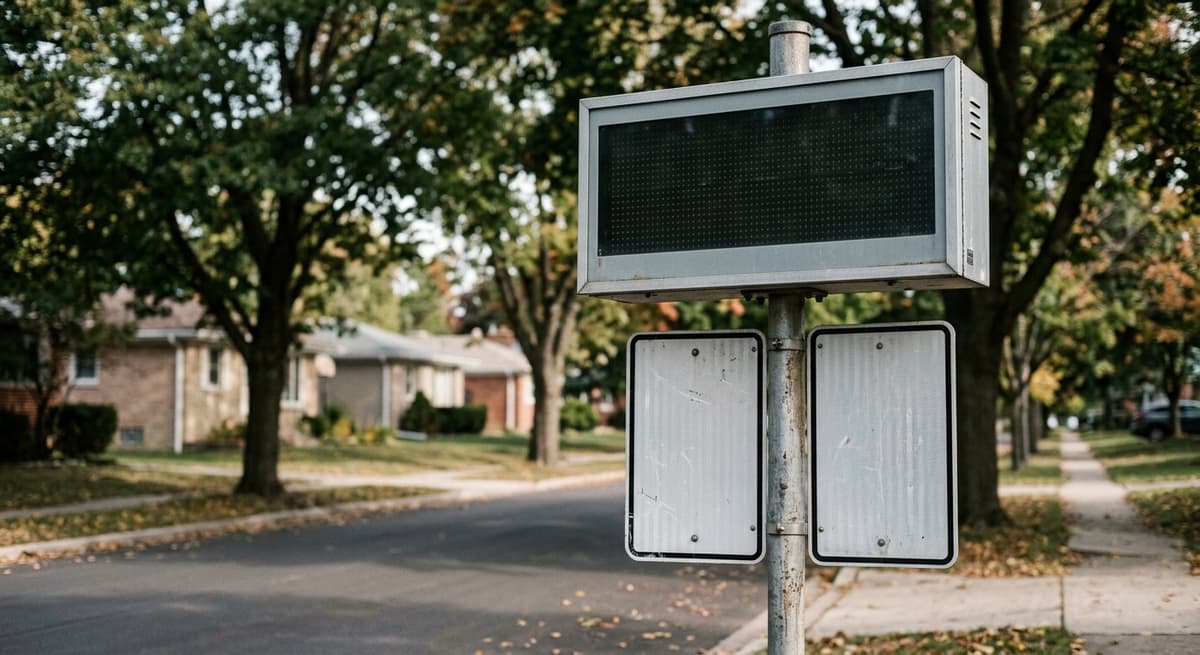
Here is the nuance every Montana camera-ticket page should carry honestly: a free-standing photo-radar van, parked on a shoulder and not physically attached to any sign or signal, is not obviously covered by the literal text of the ban. That is a genuine ambiguity in the statute, one that Montana's own traffic agencies have not resolved through published guidance found this session, and it should not be read as an invitation to assume standalone vans are lawful and active in Montana.
Montana's radar-enforcement statutes narrow that gap further, and they are the closest on-point authority the state has. MCA 61-8-703 permits a warrantless arrest in a radar case only where the arresting officer is in uniform or displays a badge and has either observed the speed of the vehicle being recorded by radio microwaves or another electrical device, or received a radio message from the officer who did, dispatched immediately after the speed was recorded. The same section requires that the arrest be made «immediately after the observation or radio message and as the result of uninterrupted pursuit.»
MCA 61-8-704(2) adds a second constraint: any municipality using radio microwaves or another electrical device for law enforcement must erect and maintain notice signs at or near its corporate limits, on each state highway and arterial street entering the municipality. Read together, the only radar-enforcement framework Montana has legislated is built around a uniformed officer making a contemporaneous stop under posted notice, not around a photograph mailed to a registered owner weeks later. Two caveats keep that from being a driver's trump card: 61-8-703 governs arrest rather than civil owner liability, so it does not by its own terms outlaw a mailed notice, and 61-8-704(3) says the absence of radar signs may not in itself invalidate an otherwise proper arrest. The point is directional rather than dispositive. Montana legislated for officer-initiated radar stops and has never legislated for automated ones.
There is a third, independent reason a van program would face a legal obstacle even if it dodged the attachment language: Montana has no statute anywhere authorizing an automated traffic enforcement program in the first place. Every state in this cluster that runs owner-liability camera tickets does so under an enabling statute that creates the civil-penalty process, the notice requirements, and the appeal rights. Montana has none of that. So even a hypothetical standalone van would have no independent legal mechanism to turn a photograph into an enforceable citation the way an authorized state's law does. The honest summary for a Montana driver is: no camera tickets currently have a clear legal basis in this state, full stop, and the van question is an unresolved theoretical gap rather than a confirmed practice.
History
The prohibition was added to Montana's traffic code by a 2009 law (ch. 447), layered on top of the state's older traffic-control-device statutes, and it has not been narrowed or expanded since. There is no pending Montana legislation found this session that would create a camera-enforcement program or otherwise revisit the ban.
Toll Cameras Are a Different Question
Montana's ban addresses traffic-law enforcement cameras specifically. It does not speak to toll-collection cameras, though Montana has few toll facilities of the kind that raise this issue elsewhere. If you encounter a camera-based notice tied to a toll road rather than a traffic-signal or speed violation, that would be a separate enforcement mechanism from the ban discussed on this page.

Information last verified on 2026-08-12. This article has not yet been reviewed by a licensed lawyer.

Related Resources
- Traffic Camera Ticket Laws by State
- Do You Have to Pay a Camera Ticket?
- How to Fight a Camera Ticket
- Automated License Plate Reader Laws
- Can You Get a Speeding Ticket Without Being Pulled Over?
Last updated: 2026-08-12.
More Montana Laws
Frequently Asked Questions
Are red light cameras legal in Montana?
No. MCA 61-8-206 and the identical language in MCA 61-8-203 bar an automated enforcement system attached to a traffic control device from being used to enforce traffic laws, which covers red light cameras directly.
Are speed cameras legal in Montana?
Not when mounted on a traffic control device, such as a speed-limit sign or signal, which the same ban covers. A free-standing photo-radar van sits in a genuine legal gray area, discussed below, rather than being clearly authorized.
Can a free-standing photo-radar van issue tickets in Montana?
This is an unresolved question, not a confirmed yes. Montana's ban text only reaches a system «attached to a traffic control device,» and a standalone van arguably falls outside that specific wording. But Montana also has no statute authorizing any automated enforcement program, so a van-based system would lack independent legal authority to issue a citation either way. Montana's radar statutes point the same direction: MCA 61-8-703 permits a warrantless radar arrest only by a uniformed officer who observed the recording or got an immediate radio relay and who acts in uninterrupted pursuit, and MCA 61-8-704(2) requires a municipality using radar to post notice signs at its corporate limits.
What counts as a traffic control device under Montana's ban?
MCA 61-8-102 defines official traffic control devices broadly as all signs, signals, markings, and devices placed by a public authority to regulate, warn, or guide traffic. A camera attached to a speed-limit sign is covered by the ban; a camera not attached to any such device is the unresolved category above.
Does Montana's ban have any exceptions?
One narrow exception: automated enforcement at railroad grade crossings is excluded from the ban.
Updates
Added Montana's radar-enforcement statutes (MCA 61-8-703 and 61-8-704) to the discussion of free-standing photo-radar vans, since they require a uniformed officer acting on an immediate observation and posted notice of radar use.
Independently fact-checked against the cited primary sources
The Law Behind This Article
This article rests on the statutory provisions below, held in our own legal record and retrieved from the official source. Tap a section to read the operative text.
Montana Code Annotated, Title 61
§ 61-8-206Local Traffic Control DevicesIn force
61-8-206. Local traffic control devices. (1) Local authorities in their respective jurisdictions shall place and maintain traffic control devices upon highways under their jurisdiction that they consider necessary to indicate and to carry out the provisions of this chapter or local traffic ordinances or to regulate, warn, or guide traffic. All traffic control devices must conform to the state manual and specifications. (2) (a) An automated enforcement system designed to detect traffic violations that is attached to a traffic control device may not be used to enforce traffic laws. (b) Subsection (2)(a) does not apply to automated enforcement systems attached to traffic control devices at railroad grade crossings.
Official text (excerpt) · last checked 2026-09-16 · Read the full text in our law library · Verify at mca.legmt.gov
Cited in 1 court opinions in our collectionLatest citing opinion in our collection: 2013
Opinions citing this section in our collection:
- Dick Irvin Inc. v. State (Montana Supreme Court 2013, 372 Mont. 58)“…he statute. The State compares § 61-8-203, MCA (2003), with § 61-8-206, MCA (2003), to illustrate that it does not…”
Identified automatically from the court opinions citing this section — not a ranking of which case controls.
§ 61-8-203Department Of Transportation To Place Traffic Control Devices On Highways It Maintains And Approve Traffic Control Devices On Highways Under Its JurisdictionIn force
61-8-203. Department of transportation to place traffic control devices on highways it maintains and approve traffic control devices on highways under its jurisdiction. (1) The department of transportation shall place and maintain traffic control devices, conforming to its manual and specifications, upon all highways maintained by the department of transportation that the department considers necessary to carry out the provisions of chapter 9 and this chapter or to regulate, warn, or guide traffic. (2) A local authority or other entity may not place or maintain a traffic control device upon a highway under the jurisdiction of the department of transportation except with the department's permission. (3) The unauthorized erection of a sign, marker, emblem, or other traffic control device on a highway under the jurisdiction of the department of transportation by any other entity is a misdemeanor and is punishable as provided in 61-8-712.
Official text (excerpt) · last checked 2026-07-29 · Read the full text in our law library · Verify at mca.legmt.gov
Cited in 4 court opinions in our collectionLatest citing opinion in our collection: 2013
Opinions citing this section in our collection:
- Runkle v. Burlington Northern (Montana Supreme Court 1980, 188 Mont. 286)“…d Highway Act of 1973, Pub. L. No. 93-87, 87 Stat. 250; and section 61-8-203, MCA. Throughout the trial, it was the…”
- Dick Irvin Inc. v. State (Montana Supreme Court 2013, 372 Mont. 58)“…elegable duty to Irvin? ¶20 Irvin argues on appeal that § 61-8-203, MCA (2003), imposed a statutory duty on the…”
- Brohman v. State (Montana Supreme Court 1988, 230 Mont. 198)“…ds therefore, that the State breached its obligation under 5 61-8-203, MCA: The department of highways…”
Identified automatically from the court opinions citing this section — not a ranking of which case controls.
§ 61-8-102Uniformity Of Interpretation -- DefinitionsIn force
61-8-102. Uniformity of interpretation -- definitions. As used in this chapter, unless the context requires otherwise, the following definitions apply: (1) "Authorized emergency vehicle" means a vehicle of a governmental fire agency organized under Title 7, chapter 33, an ambulance, or an emergency vehicle designated or authorized by the department. (2) "Bicycle" means a vehicle propelled solely by human power on which any person may ride, irrespective of the number of wheels, except scooters, wheelchairs, and similar devices. The term includes an electrically assisted bicycle. (3) "Bicycle trailer" means a device with one or more wheels that is designed to be towed by a bicycle. (4) "Business district" means the territory contiguous to and including a highway when within any 600 feet along a highway there are buildings in use for business or industrial purposes, including but not limited to hotels, banks, office buildings, railroad stations, and public buildings that occupy at least 300 feet of frontage on one side or 300 feet collectively on both sides of the highway.
Official text (excerpt) · last checked 2026-07-29 · Read the full text in our law library · Verify at mca.legmt.gov
Cited in 1 court opinions in our collectionLatest citing opinion in our collection: 2011
Opinions citing this section in our collection:
- Myers v. Dee (Montana Supreme Court 2011, 362 Mont. 178)“…definition of “residence” to §§ 61-3-711 through -733, MCA; § 61-8-102, MCA, limits that definition of “residence”…”
Identified automatically from the court opinions citing this section — not a ranking of which case controls.
United States Code Title 23
§ 148Highway safety improvement programIn forcecited in 3 of our articles
In this section, the following definitions apply: The term “high risk rural road” means any roadway functionally classified as a rural major or minor collector or a rural local road with significant safety risks, as defined by a State in accordance with an updated State strategic highway safety plan. The term “highway basemap” means a representation of all public roads that can be used to geolocate attribute data on a roadway. The term “highway safety improvement program” means projects, activities, plans, and reports carried out under this section. The term “highway safety improvement project” means strategies, activities, and projects on a public road that are consistent with a State strategic highway safety plan and— correct or improve a hazardous road location or feature; or address a highway safety problem. The term “highway safety improvement project” only includes a project for 1 or more of the following: An intersection safety improvement that provides for the safety of all road users, as appropriate, including a multimodal roundabout. Pavement and shoulder widening (including addition of a passing lane to remedy an unsafe condition).
Official text (excerpt) · last checked 2026-07-28 · Read the full text in our law library · Verify at uscode.house.gov
Cited in 6 court opinions in our collectionLatest citing opinion in our collection: 2021
Opinions citing this section in our collection:
- Loren Van Abbema and Barbara Van Abbema, and Edward R. Koeber and Mary D. Koeber v. Paul Fornell, D/B/A Warsaw Barge Loading Facility John O. Marsh, Secretary of the Army, and Lt. Gen. J.K. Bratton, Chief of Engineers, Department of the Army, Loren Van Abbema and Barbara Van Abbema, and Edward R. Koeber and Mary D. Koeber, People of the State of Illinois, Plaintiff-Intervenor-Appellant v. Paul Fornell, D/B/A Warsaw Barge Loading Facility John O. Marsh, Secretary of the Army, and Lt. Gen. J.K. Bratton, Chief of Engineers, Department of the Army (Court of Appeals for the Seventh Circuit 1986, 807 F.2d 633)“…er) and its surroundings. See Appellants' Brief at 22-33; 23 U.S.C. 148. However, not only did the Federal Hi…”
- Abbema v. Fornell (Court of Appeals for the Seventh Circuit 1986, 807 F.2d 633)“…er) and its surroundings. See Appellants’ Brief at 22-33; 23 U.S.C. 148. However, not only did the Federal Highw…”
- Diana Glazer v. State of Arizona (Arizona Supreme Court 2015, 237 Ariz. 160)“…Opinion of the Court travel. See 23 U.S.C. § 148(c)(1) (requiring a state to implement a…”
Identified automatically from the court opinions citing this section — not a ranking of which case controls.
Also relied on in: Maine Traffic Camera Ticket Laws: Why Red Light and Speed Cameras Are Banned, Maryland Traffic Camera Ticket Laws: Red Light, Speed & Work Zone Cameras Explained
Search our full record of US law — 2.1 million sections, every state + federal →
Sources and References
- MCA 61-8-206, Local traffic control devices; automated enforcement system attachment prohibition(mca.legmt.gov).gov
- MCA 61-8-203, State traffic control devices; identical automated enforcement prohibition(mca.legmt.gov).gov
- MCA 61-8-102, Definition of official traffic control devices(mca.legmt.gov).gov
- 23 U.S.C. 148, Federal Highway Safety Improvement Program (no camera-specific national mandate)(law.cornell.edu)
- MCA 61-8-703, Arrest without warrant in radar cases (uniformed officer, immediate observation or radio relay, uninterrupted pursuit)(mca.legmt.gov)
- MCA 61-8-704, Erection of signs; municipality using radar for law enforcement must post notice at its corporate limits(mca.legmt.gov)