
Montana
Montana Ring Doorbell Laws: What You Need to Know in 2026
Independently fact-checked against primary sources (last audited August 17, 2026). · Reviewed by the RecordingLaw editorial team. · Law checked current as of August 17, 2026. · 6 primary sources cited on this page. How we verify our legal content
Montana is one of the most restrictive states in the country for Ring doorbell owners who want to use audio recording. The state's all-party consent law (MCA 45-8-213) requires every person in a conversation to know the recording is happening. Montana also has a constitutional right to individual privacy written directly into Article II, Section 10 of the Montana Constitution, giving residents stronger privacy protections than most other states.
If you own a Ring doorbell in Montana or plan to install one, the audio recording feature creates significant legal exposure. Unlike one-party consent states where your own participation in a conversation is enough to record it, Montana law treats any secret audio recording as a criminal offense. This guide breaks down exactly what Montana law allows and prohibits.

Audio Recording Laws and Ring Doorbells in Montana
Montana's privacy in communications statute, MCA 45-8-213, is the law that Ring doorbell owners need to understand first. The statute makes it unlawful to record a conversation "by use of a hidden electronic or mechanical device" without the knowledge of all parties.
This is an all-party consent standard. Every person participating in a conversation near your Ring doorbell needs to know the recording is happening. In a one-party consent state, your own knowledge of the recording is enough. In Montana, it is not.
The "Hidden Device" Element
MCA 45-8-213 specifically targets recordings made by "hidden" devices. A Ring doorbell mounted visibly on your front door is not hidden. This distinction matters. The statute's language suggests that openly visible recording equipment combined with clear notice may fall outside the prohibition, because the device is not concealed and the recording is not secret.
However, relying solely on the visibility of the device is risky. The safer legal position is to combine visible installation with posted signage warning visitors that audio and video recording is in progress.
The Warning Exception
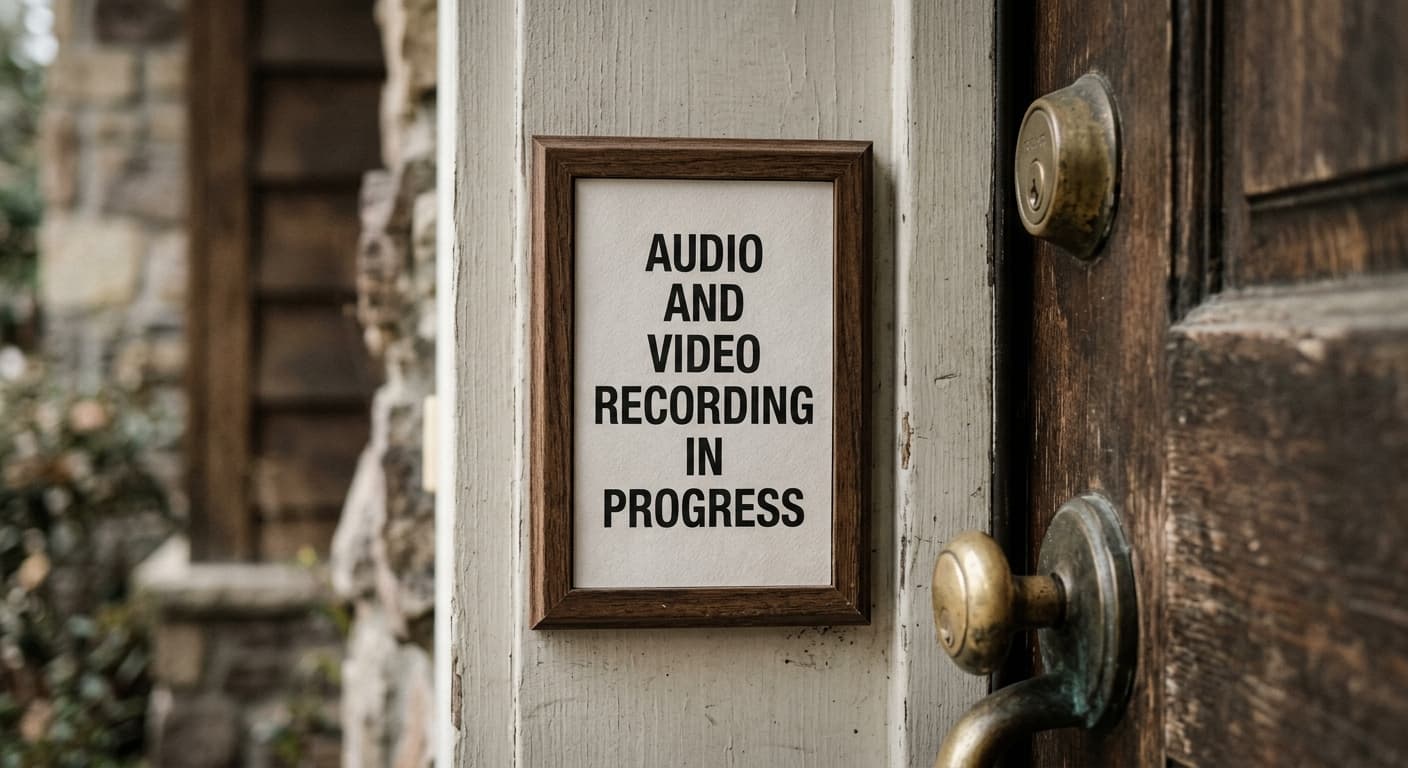
MCA 45-8-213 contains an important exception: the prohibition does not apply to "recordings of individuals given a warning of the recording." This is the most practical protection for Montana Ring doorbell owners. By posting a clear, visible sign near your Ring doorbell that states "Audio and Video Recording in Progress," you provide the required warning. The statute is explicit that if one person provides the warning, either party may record.
This warning exception effectively transforms Montana's all-party consent requirement into a notice-and-continue model for Ring doorbell purposes. The key is that the warning must be conspicuous and positioned where visitors will see it before reaching the doorbell.
Additional Statutory Exceptions
MCA 45-8-213 also exempts recordings by elected or appointed public officials and public employees acting in their official duties, recordings of individuals speaking at public meetings, and recordings of certain healthcare emergency communications made by healthcare facilities.

Montana's Constitutional Right to Privacy
Montana is one of only a handful of states with an explicit right to privacy in its constitution. Article II, Section 10 states: "The right of individual privacy is essential to the well-being of a free society and shall not be infringed without the showing of a compelling state interest."
The Montana Supreme Court has interpreted this right broadly, providing protections that go beyond the federal Constitution. The court has applied these protections to modern surveillance technologies, including thermal imaging and GPS tracking by law enforcement.
For Ring doorbell owners, this constitutional provision creates an additional layer of legal concern. A neighbor or visitor who feels their privacy was violated by your Ring doorbell recording could potentially raise a constitutional privacy claim in addition to a statutory one. While no Montana court has directly addressed Ring doorbells under Article II, Section 10, the broad interpretation of this right suggests that courts would take such claims seriously.

Video Recording Laws and Ring Doorbells
Montana's approach to video surveillance is more permissive than its audio recording rules, but it still carries important restrictions.
Video recording of areas visible from your property, like your porch, driveway, and front walkway, is generally legal. These areas carry no reasonable expectation of privacy because they are open to public view. A Ring doorbell pointed at your own front door and immediate surroundings records what any passerby could see with their own eyes.
Surreptitious Visual Observation (MCA 45-5-223)
Montana's surreptitious visual observation statute, MCA 45-5-223, prohibits secretly watching, photographing, or filming another person in a place of residence without their consent. This law targets voyeuristic surveillance rather than standard doorbell cameras, but it sets boundaries.
Deliberately aiming a Ring doorbell or additional Ring cameras in order to watch or record a neighbor inside their residence, through windows, bedrooms, bathrooms, or other private areas, could violate MCA 45-5-223. The statute has a purpose element: it requires that the person purposely or knowingly hide, wait, or otherwise loiter, in person or by means of a remote electronic device, in or near the residence for the purpose of observing or recording an occupant without the occupant's knowledge. A camera aimed at your own entryway that inadvertently takes in part of a neighbor's home does not meet those elements. The penalties for this offense are:
| Offense | Maximum Fine | Maximum Jail Time |
|---|---|---|
| First offense | $500 | 6 months |
| Second offense | $1,000 | 1 year |
| Third or subsequent offense | $10,000 | 5 years |
The penalty escalation is steep. A third conviction carries potential felony-level punishment, reflecting Montana's strong stance on privacy violations.
Keeping Ring Video Legal
Point your Ring doorbell at your own property. Avoid capturing detailed views of your neighbor's windows or private outdoor spaces (fenced backyards, enclosed patios). If your Ring doorbell's wide-angle lens inadvertently captures a sliver of a neighbor's property, that is generally acceptable as long as the camera is not aimed at their private areas.
Ring's privacy zone feature allows you to block out specific areas of the camera's field of view from recording. Using this feature to mask neighbor windows or other sensitive areas is a practical step to reduce legal exposure.
HOA Rules and Ring Doorbells in Montana
Montana does not have a unified HOA statute. Most HOAs operate under the Montana Nonprofit Corporation Act and their own governing documents (CC&Rs, bylaws, and architectural guidelines).
HOAs can regulate Ring doorbell installation by classifying them as exterior modifications that require architectural review committee approval. Common restrictions involve camera placement, device color and size, and rules about recording common areas.
Montana's Restriction on New HOA Rules (MCA 70-17-901)
Montana enacted an important homeowner protection in MCA 70-17-901. This statute prohibits HOAs from compelling homeowners to follow restrictions that are "more onerous" than those that existed when the homeowner purchased the property, unless the homeowner provides written agreement to the new restrictions at the time they are adopted.
MCA 70-17-901's protection is limited to the statute's defined "types of use": residential, agricultural, or commercial use of the property, the ability to rent it, and the ability to develop it. Because camera or doorbell restrictions are not among those defined "types of use," it is unclear whether this statute would prevent an HOA from adopting a new security-camera ban after you bought your home. Homeowners facing a new camera restriction should review their CC&Rs and consult an attorney rather than assume MCA 70-17-901 applies.
However, if the original CC&Rs required architectural approval for all exterior modifications, a Ring doorbell would likely fall under that existing requirement.

Landlord and Tenant Rights for Ring Doorbells
Montana's Residential Landlord and Tenant Act (MCA Title 70, Chapter 24) governs the relationship between landlords and tenants but does not specifically address doorbell cameras.
Tenant Installation
Tenants in Montana who want to install a Ring doorbell should review their lease for language about exterior modifications. If the lease prohibits alterations to the exterior of the property, installing a wired Ring doorbell could be a lease violation. Battery-powered Ring models that use adhesive mounting may not qualify as structural modifications, but tenants should get written landlord permission to avoid disputes.
A tenant who installs a Ring doorbell owns the Ring account and controls all footage. The landlord has no right to access tenant recordings without the tenant's consent or a court order.
Landlord Installation
Landlords can install security cameras on exterior common areas of rental properties. However, Montana's all-party consent law (MCA 45-8-213) applies to landlord-installed devices with audio recording capabilities. A landlord recording tenant conversations through a doorbell camera without proper notice would face the same criminal penalties as any other person violating the statute.
Landlords cannot install cameras in areas where tenants have a reasonable expectation of privacy, including inside the rental unit, in enclosed backyards, or in other private areas. Doing so could violate MCA 45-5-223.
Law Enforcement Access to Ring Doorbell Footage in Montana
Montana's strong constitutional privacy protections shape how law enforcement can access Ring doorbell footage.
The Montana Constitution's right to privacy (Article II, Section 10) requires a "compelling state interest" before the government can infringe on individual privacy. Montana courts have applied this standard to surveillance technology, requiring warrants for thermal imaging and GPS tracking.
As of January 2024, Ring (owned by Amazon) requires law enforcement to present a warrant, subpoena, or court order before releasing customer footage. Ring ended its previous Neighbors app feature that allowed police to directly request user footage.
Montana police can ask you to voluntarily share Ring footage. You have no legal obligation to comply. If law enforcement presents a valid search warrant signed by a Montana judge, you (or Ring) must provide the requested footage.
Under federal law (18 U.S.C. 2702), Ring can disclose footage to law enforcement without a warrant in emergency situations involving imminent danger of death or serious physical injury. Ring states it evaluates each emergency request individually.
Penalties for Illegal Recording in Montana
Montana's penalty structure for recording violations escalates with each offense:
Privacy in Communications (MCA 45-8-213)
The secret-recording provision that applies to Ring doorbell audio (subsection (1)(c)) carries a flat penalty no matter how many convictions a person has:
| Offense | Maximum Fine | Maximum Jail/Prison |
|---|---|---|
| Any conviction for secret recording | $500 | 6 months |
MCA 45-8-213's escalating penalties, up to $1,000 and 1 year for a second offense and up to $10,000 and 5 years for a third or subsequent offense, apply only to repeat convictions under the statute's threatening-communication and extortion provisions (subsections (1)(a) and (1)(b)), not to repeat secret-recording convictions.
Surreptitious Visual Observation (MCA 45-5-223)
| Offense | Maximum Fine | Maximum Jail/Prison |
|---|---|---|
| First offense | $500 | 6 months |
| Second offense | $1,000 | 1 year |
| Third or subsequent | $10,000 | 5 years |
MCA 45-5-223's escalating penalty structure means repeated violations of that statute can result in felony-level consequences, with a third conviction carrying potential prison time of up to 5 years. MCA 45-8-213's escalation works differently: it applies only to repeat convictions for its threatening-communication and extortion provisions, not to repeat secret-recording convictions, which remain subject to the same $500 fine and 6-month jail term regardless of how many times a person is convicted.
Beyond criminal penalties, victims of illegal recording in Montana can pursue civil remedies, including lawsuits for invasion of privacy under Montana's common law. The constitutional right to privacy strengthens these civil claims.
How to Use a Ring Doorbell Legally in Montana
Montana's all-party consent law and constitutional privacy right demand careful attention from Ring doorbell owners. These steps help ensure legal compliance:
Disable audio recording or post clear signage. The safest option in Montana is to turn off Ring's audio recording feature entirely. If you want audio enabled, post a clearly visible sign near your doorbell that reads "Audio and Video Recording in Progress." The MCA 45-8-213 warning exception protects recordings made after a person receives notice.
Position the camera at your own property. Aim the Ring doorbell at your front door, porch, and walkway. Use Ring's privacy zone feature to block out any areas that capture a neighbor's windows or private spaces.
Check your HOA's CC&Rs before installation. If architectural review approval is required, submit your application before mounting the device. Remember that under MCA 70-17-901, new HOA restrictions that did not exist when you purchased your home may not be enforceable without your written consent.
Get written permission from your landlord. Tenants should confirm in writing that the landlord approves the installation, especially for models that require drilling.
Manage footage responsibly. Do not share Ring footage on social media or with third parties in ways that could violate someone's privacy. Share with law enforcement only in response to a valid warrant or voluntarily at your own discretion.
Review Ring's privacy settings regularly. Check your audio toggle, motion zones, and sharing preferences. Ring updates its software and settings periodically.
More Montana Laws
Montana has specific laws covering many areas that affect residents. These related guides provide detailed information on other legal topics in the state:
- Montana Recording Laws explain the full scope of all-party consent rules for phone calls, in-person conversations, and electronic communications.
- Montana Hit and Run Laws cover reporting requirements and penalties for leaving the scene of an accident.
- Montana Lemon Law outlines protections for buyers of defective new vehicles.
This article provides general legal information about Ring doorbell camera laws in Montana. Montana's all-party consent requirement and constitutional right to privacy create higher legal risk for audio recording than most states. Laws change, and their application depends on specific facts. Consult a Montana attorney for advice specific to your situation. Information is current as of April 2026.
Frequently Asked Questions
Is Ring doorbell audio recording legal in Montana?
Montana is an all-party consent state under MCA 45-8-213. Recording audio without the knowledge of all parties is a criminal offense. However, the statute includes an exception for recordings where individuals are given a warning. Posting a clearly visible sign near your Ring doorbell indicating audio recording is in progress satisfies this exception.
What happens if I record someone without consent in Montana?
Recording someone without consent under MCA 45-8-213 carries up to 6 months in jail and a $500 fine, whether it is a first offense or a repeat offense. The statute's escalating penalties, up to 1 year and $1,000 for a second offense and up to 5 years and $10,000 for a third or later offense, apply only to its threatening-communication and extortion provisions, not to repeat secret-recording violations.
Can my Montana HOA ban Ring doorbells?
Montana HOAs can regulate Ring doorbell installation through their CC&Rs and architectural guidelines. MCA 70-17-901 limits HOAs from imposing new restrictions on a member's statutorily defined types of use of their property (residential, agricultural, or commercial use, rental ability, and development ability) that are more onerous than what existed when the member bought the property, unless the member consents in writing. Whether that protection extends to a new security-camera restriction specifically is unclear, since camera rules are not one of the statute's defined types of use.
Does Montana's constitutional right to privacy affect Ring doorbells?
Montana's Constitution includes an explicit right to individual privacy under Article II, Section 10. The Montana Supreme Court has interpreted this right broadly and applied it to modern surveillance technology. While no court has ruled specifically on Ring doorbells, this constitutional protection strengthens privacy claims against intrusive doorbell camera use.
Can Montana police access my Ring doorbell footage without a warrant?
Ring requires law enforcement to present a warrant, subpoena, or court order before releasing footage. Montana's constitutional right to privacy provides additional protection. Police can ask you to voluntarily share footage, but you have no obligation to do so. In narrow emergency situations involving imminent danger, federal law allows Ring to disclose footage without a warrant.
Updates
Corrected the description of Montana's all-party consent rule to require knowledge rather than agreement, and added the purpose element that MCA 45-5-223 requires before an aimed camera becomes surreptitious visual observation.
Removed a fabricated 'minor victim, public place' $5,000/2-year penalty tier for MCA 45-5-223 that does not exist in the statute; the law has only three tiers based on conviction count (first, second, third-or-later), which now render consistently in both penalty tables on the page.
Independently fact-checked against the cited primary sources; governing law re-checked for recent changes
Corrected a blocking error: MCA 45-8-213's escalating penalties (up to 5 years/$10,000 for repeat offenses) apply only to that statute's threatening-communication and extortion provisions, not to the secret-recording provision that governs Ring doorbell audio, which stays at a flat $500/6-month penalty regardless of prior convictions. Also hedged an overstated claim about HOA camera-ban restrictions under MCA 70-17-901.
Governing law re-checked for recent changes
Reviewed and approved by an editor
The Law Behind This Article
This article rests on the statutory provisions below, held in our own legal record and retrieved from the official source. Tap a section to read the operative text.
Montana Code Annotated, Title 45
§ 45-8-213Privacy In CommunicationsIn forcecited in 50 of our articles
45-8-213. Privacy in communications. (1) Except as provided in 69-6-104, a person commits the offense of violating privacy in communications if the person knowingly or purposely: (a) with the purpose to terrify, intimidate, threaten, harass, or injure, communicates with a person by electronic communication and threatens to inflict injury or physical harm to the person or property of the person or makes repeated use of obscene, lewd, or profane language or repeated lewd or lascivious suggestions; (b) uses an electronic communication to attempt to extort money or any other thing of value from a person or to disturb by repeated communications the peace, quiet, or right of privacy of a person at the place where the communications are received; (c) records or causes to be recorded a conversation by use of a hidden electronic or mechanical device that reproduces a human conversation without the knowledge of all parties to the conversation; (d) with the purpose to terrify, intimidate, threaten, harass, or injure or to obtain money or other valuable consideration, publishes, distributes, or discloses real or digitally fabricated printed or electronic photographs, pictures, images, or…
Official text (excerpt) · last checked 2026-09-24 · Read the full text in our law library · Verify at mca.legmt.gov
Cited in 23 court opinions in our collectionLatest citing opinion in our collection: 2025
In the courts (editorial summary, independently checked):State v. Dugan (2013) struck the statute's prima facie intent clause as overbroad. State v. Brown (1988) noted the statute still bars recording without all participants' permission and rejected an overbreadth attack on its public-official exception. State v. DuBray (2003) found no violation where the defendant knew of the recording.
Opinions citing this section in our collection:
- State v. Smith (Montana Supreme Court 2004, 322 Mont. 206)✓A man who phoned threats to kill his estranged wife's boyfriend argued he should have been charged under section 45-8-213(1)(a) instead of assault with a weapon. The court held the two statutes punish different conduct, so the charge was within prosecutorial discretion.
- State v. Dugan (Montana Supreme Court 2013, 369 Mont. 39)“…rbroad, the Court today strikes the prima facie language in § 45-8-213, MCA. However, a narrow application would be…”
- In re C.S. (Montana Supreme Court 1984, 210 Mont. 144)“…n of privacy in communication, a misdemeanor as provided in Section 45-8-213, MCA. The facts underlying the offense were…”
Identified automatically from the court opinions citing this section — not a ranking of which case controls.
Also relied on in: Montana Recording Laws (2026): Announcement Exception and Penalties, Montana Landlord-Tenant Recording Laws: Camera Rules, Privacy Rights, and Disputes (2026), Montana Security Camera Laws: Home, Business, and Surveillance Rules (2026)
§ 45-5-223Surreptitious Visual Observation Or Recordation -- Place Of Residence -- Public Place -- ExceptionsIn forcecited in 12 of our articles
45-5-223. Surreptitious visual observation or recordation -- place of residence -- public place -- exceptions. (1) A person commits the offense of surreptitious visual observation or recordation in a place of residence if the person purposely or knowingly hides, waits, or otherwise loiters in person or by means of a remote electronic device within or in the vicinity of a private dwelling house, apartment, or other place of residence for the purpose of: (a) watching, gazing at, or looking upon any occupant in the residence in a surreptitious manner without the occupant's knowledge; or (b) by means of an electronic device, surreptitiously observing or recording the visual image of any occupant in the residence without the occupant's knowledge. (2) A person commits the offense of surreptitious visual observation or recordation in public if the person purposely or knowingly observes or records a visual image of the sexual or intimate parts of another person in a public place without the other person's knowledge when the victim has a reasonable expectation of privacy.
Official text (excerpt) · last checked 2026-08-31 · Read the full text in our law library · Verify at mca.legmt.gov
Cited in 1 court opinions in our collectionLatest citing opinion in our collection: 2026
Opinions citing this section in our collection:
- United States v. Watkins (Court of Appeals for the Tenth Circuit 2026)“…nn. § 609.746;1 Miss. Code Ann. § 97-29-61;2 MPC § 250.12;1 Mont. Code Ann. 45-5-223;3 Neb. Rev. Stat. § 28-311.08; Nev. Rev…”
Identified automatically from the court opinions citing this section — not a ranking of which case controls.
Also relied on in: Montana Video Recording Laws: Consent Rules, Surveillance, and Penalties (2026), Montana Laws on Recording in Public: First Amendment Rights and Limitations (2026), Montana Workplace Recording Laws: Employee Rights, Employer Monitoring, and the WDEA (2026)
Montana Code Annotated, Title 70
§ 70-17-901Homeowners' Association Restrictions -- Real Property RightsIn force
70-17-901. Homeowners' association restrictions -- real property rights. (1) (a) A homeowners' association may not enter into, amend, or enforce a covenant, condition, or restriction in such a way that imposes more onerous restrictions on the types of use of a member's real property than those restrictions that existed when the member acquired the member's interest in the real property, unless the member who owns the affected real property expressly agrees in writing at the time of the adoption or amendment of the covenant, condition, or restriction. (b) When a member claims the benefit of this subsection (1), the member shall request that the homeowners' association record, or allow recording of, the exception applicable to the member. Upon request by the member, the homeowners' association, the member, or a designee shall record the member's exception with the office of the county clerk and recorder of the county where the real property is situated. The member shall provide the homeowners' association with the date the real property was conveyed to the member and shall pay the recording fees for the document setting forth the exception.
Official text (excerpt) · last checked 2026-07-29 · Read the full text in our law library · Verify at mca.legmt.gov
United States Code Title 18
§ 2702Voluntary disclosure of customer communications or recordsIn forcecited in 19 of our articles
Except as provided in subsection (b) or (c)— a person or entity providing an electronic communication service to the public shall not knowingly divulge to any person or entity the contents of a communication while in electronic storage by that service; and a person or entity providing remote computing service to the public shall not knowingly divulge to any person or entity the contents of any communication which is carried or maintained on that service— on behalf of, and received by means of electronic transmission from (or created by means of computer processing of communications received by means of electronic transmission from), a subscriber or customer of such service; solely for the purpose of providing storage or computer processing services to such subscriber or customer, if the provider is not authorized to access the contents of any such communications for purposes of providing any services other than storage or computer processing; and a provider of remote computing service or electronic communication service to the public shall not knowingly divulge a record or other information pertaining to a subscriber to or customer of such service (not including the contents of…
Official text (excerpt) · last checked 2026-07-28 · Read the full text in our law library · Verify at uscode.house.gov
Cited in 259 court opinions in our collectionLatest citing opinion in our collection: 2026
In the courts (editorial summary, independently checked):Freeman v. Directv, Inc. (2006) held Sections 2702 and 2707 do not support secondary liability claims such as aiding and abetting or conspiracy. Alexander v. Verizon Wireless (2017) applied Section 2702(c)(4)'s emergency exception and found a provider's good-faith reliance on a law enforcement request a complete defense.
Opinions citing this section in our collection:
- Matthew Alexander v. Verizon Wireless Services, LL (Court of Appeals for the Fifth Circuit 2017, 875 F.3d 243)✓A detective sent Verizon a certified emergency form after an arson, and Verizon released the subscriber's non-content cell records; the Fifth Circuit applied an objective good faith standard to section 2702(c)(4) and held Verizon statutorily immune from the SCA suit.
- Doe 1 v. AOL LLC (Court of Appeals for the Ninth Circuit 2009, 552 F.3d 1077)“…rs, alleging violations of federal electronic privacy law, 18 U.S.C. § 2702 (a). A subclass of AOL members who are…”
- Freeman v. Directv, Inc. (Court of Appeals for the Ninth Circuit 2006, 457 F.3d 1001)✓Users whose message board posts were seized from a website operator and passed to DirecTV sued for aiding and abetting and conspiracy; the Ninth Circuit held sections 2702 and 2707 name who can be liable and do not support secondary liability, affirming dismissal.
Identified automatically from the court opinions citing this section — not a ranking of which case controls.
Also relied on in: Stored Communications Act Explained: 18 U.S.C. § 2701, Georgia Ring Doorbell Laws: What You Need to Know in 2026, Hawaii Ring Doorbell Laws: What You Need to Know in 2026
Search our full record of US law — 2.1 million sections, every state + federal →
Sources and References
- MCA 45-8-213 - Privacy in Communications(mca.legmt.gov).gov
- Montana Constitution Article II, Section 10 - Right of Privacy(mca.legmt.gov).gov
- MCA 45-5-223 - Surreptitious Visual Observation or Recordation(archive.legmt.gov).gov
- MCA 70-17-901 - Homeowners Association Restrictions, Real Property Rights(mca.legmt.gov).gov
- Montana Residential Landlord and Tenant Act - MCA Title 70 Chapter 24(mca.legmt.gov).gov
- Montana Department of Justice - Tenants and Landlords(dojmt.gov).gov
- Ring Law Enforcement Information Requests Policy(ring.com)
- Ring Law Enforcement Guidelines(ring.com)
- 18 U.S.C. 2702 - Voluntary Disclosure of Customer Communications(law.cornell.edu)
- University of Montana - Article II Section 10 Right of Privacy Analysis(umt.edu)