
Tennessee
Tennessee Nursing Home Camera Laws: No Statute, Resident Rights
Independently fact-checked against primary sources (last audited August 14, 2026). · 1 primary source cited on this page. How we verify our legal content
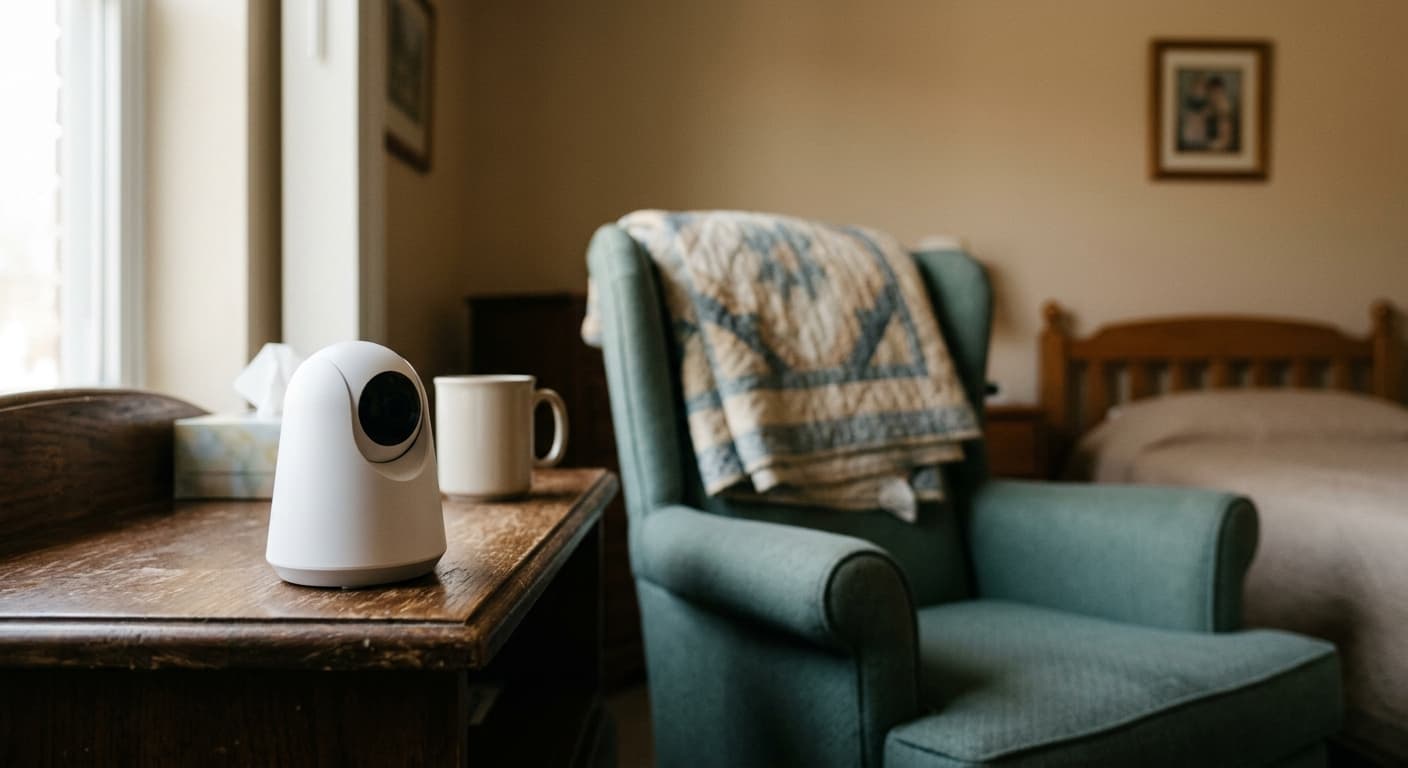
Tennessee has no statute or rule giving a nursing home resident or family a right to install a camera in a resident's room. This article covers what a full reading of Tennessee's own resident bill of rights found, the general recording law that applies instead, and where to turn if a facility interferes.
This page addresses Tennessee specifically. For the 18 states with an enacted electronic-monitoring statute, see the nursing home camera laws hub and the state-by-state comparison.
Does Tennessee Have a Nursing Home Camera Law?
No. Tennessee's operative nursing home resident bill of rights, Tenn. Code Ann. Section 68-11-901, enumerates 26 specific rights, and each one was read in full for this article. They cover privacy during treatment and personal care, including a standard of at least visual privacy in multi-bed rooms, conjugal-visit and room-sharing rights, private visitation, telephone and mail privacy, grievance rights, physician choice, confidentiality of records, freedom from restraints and abuse, and the right to the "quiet enjoyment" of one's own room, including closing the door. None of the 26 subsections mentions electronic monitoring, cameras, or a resident's or family's own recording device.
The rest of Tennessee's nursing home resident-rights part, Sections 68-11-902 through 68-11-910, covers retaliation bans, complainant confidentiality, and transfer or discharge procedure, again with no monitoring content. A genuine full-text search of the Tennessee General Assembly's own Advanced Bill Search tool, run across both the 113th (2023-2024) and 114th (2025-2026) General Assemblies, found no nursing-home electronic-monitoring bill in either session. Tennessee is a genuine no-law state on this question.
Tennessee's Recording and Consent Law: What Applies to a Camera
With no nursing-home-specific statute, the general recording-consent law governs a camera installed without the facility's agreement. Tennessee is a one-party consent state under Tenn. Code Ann. Section 39-13-601(b)(5). A person not acting under color of law may lawfully intercept a wire, oral, or electronic communication where that person is a party to the communication, or where one of the parties has given prior consent, unless the communication is intercepted for the purpose of committing any criminal or tortious act in violation of the constitution or laws of Tennessee.
That criminal-or-tortious-purpose proviso is the only condition the statute attaches to the one-party exception, and it is the limit that bites hardest on a device placed covertly. A separate threshold question sits underneath it: Tennessee protects an "oral communication" only where it was uttered by a person exhibiting an expectation that it is not subject to interception, under circumstances justifying that expectation. That definition, at Tenn. Code Ann. Section 40-6-303, supplies the terms used in Section 39-13-601, and the expectation it describes attaches to whoever is speaking rather than only to someone outside the conversation.

Unlawful interception is a Class D felony under Tenn. Code Ann. Section 39-13-602, punishable by 2 to 12 years and up to a $5,000 fine.
A notable change took effect in May 2024: Tennessee's former state-law civil remedy for illegal recording, Section 39-13-603, was repealed. A victim of unlawful interception in Tennessee today relies on the federal civil cause of action instead, 18 U.S.C. Section 2520. Under that section a court "may assess" as damages whichever is greater of the plaintiff's actual damages plus any profits the violator made, or statutory damages of the greater of $100 a day for each day of violation or $10,000. The award is discretionary rather than a floor a plaintiff is entitled to, so no one should plan around $10,000 as assured. See our Tennessee recording laws guide for the full framework.
Facility Policy Decides Whether a Camera Is Allowed
Because no Tennessee statute grants a resident a right to a camera, the facility's admission agreement is what actually governs day to day. A facility can permit a camera, condition it on notice, or prohibit one outright as a matter of its own contract terms. Federal nursing home rules under 42 CFR 483.10 protect resident privacy and dignity broadly but say nothing about cameras, so no federal rule fills the gap either.
The Practical Risk of a Hidden Camera
A family considering a camera without the facility's knowledge should weigh Tennessee's one-party framework carefully. The one-party exception protects a person who is actually a party to the conversation being recorded, or who has the prior consent of a party. An unattended device left running in a resident's room while the family member is elsewhere captures conversations to which that family member is not a party and to which no party consented, so the exception does not reach it, and the state's felony wiretapping statute can be in play. Recording for a criminal or tortious purpose also forfeits the exception even where the recorder is a party. Openly disclosing a camera to the facility and any roommate, and getting written acknowledgment where possible, is the more defensible path in a state with no statutory right either way.
Using Camera Footage as Evidence of Abuse or Neglect
Footage that appears to show abuse or neglect can support a report to Adult Protective Services or the ombudsman, and it can support a civil claim, though it is typically reviewed alongside medical and staffing records rather than on its own. For a broader look at how a nursing home abuse or neglect claim works, see Nursing Home Abuse & Neglect.
Harmed by a product or exposure? Speak with an attorney about your options
If you or a loved one may have been harmed, you can speak with an attorney about your legal options at no cost. Whether you have a claim depends on the specific facts. This is attorney advertising, not a guarantee that you qualify or of any particular outcome.
Where to Turn: Tennessee's Long-Term Care Ombudsman
The Tennessee Office of the State Long-Term Care Ombudsman investigates complaints affecting the health, safety, welfare, and rights of residents in nursing homes and assisted living, under authority tracing to the federal Older Americans Act. A camera dispute, a facility's refusal to discuss monitoring, or a suspected retaliation concern are all within its scope.

Information last verified on 2026-08-31, drawn from Tenn. Code Ann. Section 68-11-901's complete text, the text of Sections 39-13-601, 39-13-602 and 40-6-303, 18 U.S.C. Section 2520, and a Tennessee General Assembly bill-database search of the 113th and 114th General Assemblies. This article has not yet been reviewed by a licensed lawyer and is general legal information, not legal advice for your specific situation.
Related Resources
- Nursing Home Camera Laws by State covers every state's regime, including the 18 states with an enacted statute.
- Nursing Home Camera Laws: State-by-State Comparison breaks down the 18 states with a full statutory right.
- Tennessee Recording Laws covers Tennessee's one-party consent framework in full.
- Nursing Home Abuse & Neglect covers how an abuse or neglect claim works once evidence, including camera footage, is in hand.
- US Recording Laws by State covers the general consent framework nationwide.
Last updated: 2026-08-31.
Frequently Asked Questions
Is it legal to put a camera in a nursing home room in Tennessee?
Tennessee has no statute addressing the question either way. Whether a camera is allowed depends on the facility's own admission agreement and policy, since no state law grants or forbids the right.
Does Tennessee's resident bill of rights cover cameras?
No. Tenn. Code Ann. Section 68-11-901 enumerates 26 specific resident rights, and none of them address electronic monitoring, cameras, or a resident's own recording device.
Can I record conversations in a Tennessee nursing home room?
Tennessee is a one-party consent state under Tenn. Code Ann. Section 39-13-601(b)(5), so a participant in a conversation may record it without telling the others, unless the recording is made for the purpose of committing a criminal or tortious act. The statute attaches no separate condition about a non-participant's privacy. Tennessee does protect an 'oral communication' only where the speaker showed an expectation, justified by the circumstances, that it would not be intercepted, and that threshold applies to whoever is speaking.
What happens if someone illegally records me in a Tennessee nursing home?
Tennessee's own state-law civil remedy for illegal recording was repealed in May 2024. A victim can pursue a federal civil claim instead under 18 U.S.C. Section 2520, under which a court may award whichever is greater of actual damages plus the violator's profits, or statutory damages of the greater of $100 a day or $10,000. That award is discretionary, not a guaranteed minimum.
What can I do if a Tennessee facility refuses to let me install a camera?
Contact the Tennessee Office of the State Long-Term Care Ombudsman, which investigates complaints affecting resident rights at nursing homes and assisted living facilities and covers monitoring disputes.
Updates
Corrected Tennessee's one-party consent rule to state the statute's actual criminal-or-tortious-purpose proviso instead of a condition the statute does not contain, and corrected the federal wiretap remedy: 18 U.S.C. § 2520 statutory damages are discretionary, not a guaranteed $10,000 minimum.
Independently fact-checked against the cited primary sources
The Law Behind This Article
This article rests on the statutory provisions below, held in our own legal record and retrieved from the official source. Tap a section to read the operative text.
Tennessee Code Annotated
§ 68-11-901Enumeration of minimum rights.In force
Every nursing home resident/patient has the following minimum rights: (1) To privacy during treatment and personal care. Residents/patients shall be assured of at least visual privacy in multi-bed rooms and in the bathtub, shower and toilet rooms; (2) If married, to visit in private with their…
Official text (excerpt) · last checked 2021-05-21 · Read the full text in our law library
Cited in 3 court opinions in our collectionLatest citing opinion in our collection: 2011
Opinions citing this section in our collection:
- Dennis W. Blackmon v. LP Pigeon Forge, LLC (Court of Appeals of Tennessee 2011)“…law accords nursing home residents certain minimum rights, T.C.A. § 68-11-901. At the time of Mrs. Pierce’s admission…”
- Shawn Howell, Individually and as Administrator for the Estate of Jesse Franklin Browning, Jr. v. Claiborne and Hughes Health Center (Court of Appeals of Tennessee 2010)“…based upon the Tennessee Nursing Home Residents Rights Act, Tenn. Code Ann. § 68-11-901 et seq.; gross negligence, willful, wan…”
- Brown v. Sun Healthcare Group, Inc. (District Court, E.D. Tennessee 2007, 476 F. Supp. 2d 848)“…ions governing nursing homes in Tennessee. See Tenn.Code Ann. § 68-11-901; Tenn. Comp. R. & Regs. 1200 -8-6-.01.…”
Identified automatically from the court opinions citing this section — not a ranking of which case controls.
§ 39-13-601Wiretapping and electronic surveillance — Prohibited acts — Exceptions.In forcecited in 20 of our articles
(a)(1) Except as otherwise specifically provided in §§ 39-13-601 — [former] 39-13-603 [repealed] and title 40, chapter 6, part 3, a person commits an offense who: (A) Intentionally intercepts, endeavors to intercept, or procures any other person to intercept or endeavor to intercept, any wire, oral
Official text (excerpt) · last checked 2026-09-24 · Read the full text in our law library · Verify at publications.tnsosfiles.com
Cited in 25 court opinions in our collectionLatest citing opinion in our collection: 2026
In the courts (editorial summary, independently checked):Lawrence v. Lawrence held a parent may vicariously consent under Section 39-13-601 to recording a 2 1/2-year-old child's phone call with the other parent. State of Tennessee v. Henry Floyd Sanders noted that a body-wire recording made with one party's consent is lawful under the section's exceptions.
Opinions citing this section in our collection:
- Lawrence v. Lawrence (Court of Appeals of Tennessee 2010, 360 S.W.3d 416)“…called upon to construe the term “consent” as it is used in Tenn. Code Ann. § 39-13-601 to determine whether Mother had an “unr…”
- Harold Dean McDaniel v. Kimberly Ruth McDaniel (Court of Appeals of Tennessee 2010)“…ourt: I have had an opportunity to look at T.C.A. 39-13-601(a)(1), (A) and (B), and…”
- State of Tennessee v. Henry Floyd Sanders (Tennessee Supreme Court 2014, 452 S.W.3d 300)✓Police recorded a front yard conversation in which a man admitted touching his ex-partner's daughter; the court upheld admission of the recording as a voluntary statement to a confidante and noted that this type of recording is sanctioned as lawful by 39-13-601(b)(4)-(5).
Identified automatically from the court opinions citing this section — not a ranking of which case controls.
Also relied on in: Tennessee Recording Laws (2026): One-Party Consent Rules, Tennessee Voyeurism and Hidden Camera Laws: Statutes and Penalties, Tennessee Audio Recording Laws: One-Party Consent Rules and Penalties
§ 39-13-602Penalty for violations.In forcecited in 6 of our articles
A person who violates § 39-13-601(a) commits a Class D felony.
Official text (excerpt) · last checked 2021-05-21 · Read the full text in our law library
Also relied on in: Tennessee Phone Call Recording Laws: One-Party Consent Rules, Tennessee Ring Doorbell Laws: What You Need to Know in 2026, Tennessee Smart Glasses Recording Laws 2026
§ 39-13-603Civil actions — Injunctive relief — Damages — Defenses — Limitation of actions.Repealedcited in 13 of our articles
(a) Except as provided in § 39-13-601(b)(4), any aggrieved person whose wire, oral or electronic communication is intentionally intercepted, disclosed, or used in violation of § 39-13-601 or title 40, chapter 6, part 3 may in a civil action recover from the person or entity that engaged in that…
Official text (excerpt) · last checked 2026-08-06 · Read the full text in our law library · Verify at publications.tnsosfiles.com
Cited in 8 court opinions in our collectionLatest citing opinion in our collection: 2018
Opinions citing this section in our collection:
- Robinson v. Fulliton (Court of Appeals of Tennessee 2003, 140 S.W.3d 312)“…il damages provision of the Tennessee wiretapping statutes, Tenn. Code Ann. § 39-13-603. The trial court, sitting without a jur…”
- Montgomery v. Montgomery (Court of Appeals of Tennessee 2005, 181 S.W.3d 720)“…0), whichever is greater” plus attorney fees and costs. See Tenn. Code Ann. § 39-13-603(a)(1). On appeal, Defendant argues that…”
- State of Tennessee v. William Keith Paulson, alias (Court of Criminal Appeals of Tennessee 2009)“…ted.” Violation of subsection (a) is a Class A misdemeanor. T.C.A. § 39-13-603(a)(3). As previously noted, subsection…”
Identified automatically from the court opinions citing this section — not a ranking of which case controls.
Also relied on in: Tennessee Landlord-Tenant Recording Laws: Rights and Restrictions, Tennessee Medical Recording Laws: Patient Rights and Provider Rules, Tennessee Security Camera Laws: Home, Business, and HOA Rules
United States Code Title 18
§ 2520Recovery of civil damages authorizedIn forcecited in 130 of our articles
Except as provided in section 2511(2)(a)(ii), any person whose wire, oral, or electronic communication is intercepted, disclosed, or intentionally used in violation of this chapter may in a civil action recover from the person or entity, other than the United States, which engaged in that violation such relief as may be appropriate. In an action under this section, appropriate relief includes— such preliminary and other equitable or declaratory relief as may be appropriate; damages under subsection (c) and punitive damages in appropriate cases; and a reasonable attorney’s fee and other litigation costs reasonably incurred.
Official text (excerpt) · last checked 2026-07-28 · Read the full text in our law library · Verify at uscode.house.gov
Cited in 860 court opinions in our collectionLatest citing opinion in our collection: 2026
In the courts (editorial summary, independently checked):Walker v. Darby (1990) held a 2520 plaintiff need not prove the contents of intercepted conversations, only interception and a justified expectation against it. Bartnicki v. Vopper (2001) barred 2520 damages against defendants who took no part in the interception, obtained the tape lawfully, and disclosed a matter of public concern.
Opinions citing this section in our collection:
- Jessie Walker v. Thomas E. Darby, Hugh L. Robinson, Jr., and Kenneth Day (Court of Appeals for the Eleventh Circuit 1990, 911 F.2d 1573)✓A postal letter carrier said three supervisors wired an intercom near his workstation to listen in. Reversing summary judgment, the Eleventh Circuit held a section 2520 plaintiff can show interception without proving the contents of specific conversations.
- Gelbard v. United States (Supreme Court of the United States 1972, 408 U.S. 41)“…disclosure, or use is entitled to recover civil damages, 18 U. S. C. § 2520 . Title III also bars the use as eviden…”
- DirecTV, Inc. v. Hoa Huynh (Court of Appeals for the Ninth Circuit 2007, 503 F.3d 847)“…7 U.S.C. § 605 (e)(4), or alternatively, for violations of 18 U.S.C. § 2520 (a), or alternatively, for violations o…”
Identified automatically from the court opinions citing this section — not a ranking of which case controls.
Also relied on in: US Recording Laws by State (2026): All 50 States Explained, One-Party Consent States: Complete 2026 Guide, Alabama Audio Recording Laws: Consent Rules and Penalties
Code of Federal Regulations Title 42
§ 483.10Resident rights.In forcecited in 19 of our articles
(a) Residents rights. The resident has a right to a dignified existence, self-determination, and communication with and access to persons and services inside and outside the facility, including those specified in this section. (1) A facility must treat each resident with respect and dignity and care for each resident in a manner and in an environment that promotes maintenance or enhancement of his or her quality of life, recognizing each resident's individuality. The facility must protect and promote the rights of the resident. (2) The facility must provide equal access to quality care regardless of diagnosis, severity of condition, or payment source. A facility must establish and maintain identical policies and practices regarding transfer, discharge, and the provision of services under the State plan for all residents regardless of payment source. (b) Exercise of rights. The resident has the right to exercise his or her rights as a resident of the facility and as a citizen or resident of the United States.
Official text (excerpt) · last checked 2026-07-28 · Read the full text in our law library · Verify at ecfr.gov
Cited in 85 court opinions in our collectionLatest citing opinion in our collection: 2026
In the courts (editorial summary, independently checked):Courts reviewing CMS penalties have applied the notice duty then codified at section 483.10(b)(11). Claiborne-Hughes Health Center v. Sebelius (2010) upheld noncompliance where a facility did not promptly consult the physician or notify family after a resident's decline; Senior Rehabilitation (2010) sustained a similar finding.
Opinions citing this section in our collection:
- Roudachevski v. All-American Care Centers, Inc. (Court of Appeals for the Eighth Circuit 2011, 648 F.3d 701)✓A doctor cut off from his nursing home patients sought an injunction, arguing residents' right under Section 483.10(d)(1) to choose a physician made the public interest favor him; the Eighth Circuit affirmed the denial, finding that interest not presently ascertainable.
- CLAIBORNE-HUGHES HEALTH CENTER v. Sebelius (Court of Appeals for the Sixth Circuit 2010, 609 F.3d 839)✓A resident's food intake fell sharply for three weeks and he lost 18.5 pounds before the nursing home called his doctor or family; the Sixth Circuit upheld findings that it violated Section 483.10(b)(11)'s immediate-notification duty and that the lapse was immediate jeopardy.
- Gray Panthers Advocacy Committee v. Louis W. Sullivan, M.D., Secretary, Department of Health and Human Services (Court of Appeals for the D.C. Circuit 1991, 936 F.2d 1284)“…how to apply for and use Medicare and Medicaid benefits.” 42 C.F.R. § 483.10 (b)(9) (1990). On the topic of property…”
Identified automatically from the court opinions citing this section — not a ranking of which case controls.
Also relied on in: Alabama Nursing Home Camera Laws: No Statute, What Applies, Colorado Nursing Home Camera Laws: No Statute, What Applies, Massachusetts Nursing Home Camera Laws: All-Party Consent Risks
Search our full record of US law — 2.1 million sections, every state + federal →
Sources and References
- Tenn. Code Ann. § 68-11-901, Enumeration of Minimum Rights(law.justia.com)
- Tenn. Code Ann. § 39-13-601, Unlawful Interception, Disclosure or Use of Wire, Oral or Electronic Communications(law.justia.com)
- 18 U.S.C. § 2520, Recovery of Civil Damages Authorized(law.cornell.edu)
- 42 CFR § 483.10, Resident Rights(law.cornell.edu)
- Tennessee Office of the State Long-Term Care Ombudsman(tn.gov).gov
- Tennessee Public Chapter 1045 (2024), repealing Tenn. Code Ann. § 39-13-603(publications.tnsosfiles.com)