
Pennsylvania
Is Jaywalking Illegal in Pennsylvania? Crossing Rules and Fines (2026)
Independently fact-checked against primary sources (last audited October 10, 2026). · 22 primary sources cited on this page. How we verify our legal content

In Pennsylvania, crossing a street outside a crosswalk is not banned everywhere, but it comes with a duty and several flat prohibitions. Under 75 Pa.C.S. 3543, a pedestrian crossing anywhere other than a crosswalk at an intersection or a marked crosswalk must yield the right-of-way to all vehicles; crossing between adjacent signalized intersections in an urban district is allowed only in a marked crosswalk, and diagonal crossing of an intersection is barred unless authorized. Municipalities can go further: state law presumes it reasonable for local authorities to bar crossing outside a crosswalk in a business district or on a designated highway (75 Pa.C.S. 6109(a)(16)), and such a ban takes effect once official traffic-control devices giving notice of it are erected (6109(c)). A pedestrian who violates these rules commits a summary offense with a $5 fine (75 Pa.C.S. 3552), and court costs and other charges can be added. Traffic lights "apply to drivers of vehicles and pedestrians," and unless a pedestrian-control signal directs otherwise, pedestrians facing a steady red signal alone "shall not enter the roadway" (75 Pa.C.S. 3112(a)). Section 3541(b) adds that "Local authorities by ordinance may require pedestrians to obey traffic and pedestrian-control signals as provided in sections 3112 (relating to traffic-control signals) and 3113 (relating to pedestrian-control signals)." To compare other states, see our guide to jaywalking laws by state.
Information last verified on 2026-10-10. This article has not been reviewed by a licensed lawyer.
Jurisdiction scope: This article covers Pennsylvania state law in Title 75 of the Pennsylvania Consolidated Statutes (the Vehicle Code): the pedestrian subchapter, sections 3541 to 3552; the traffic and pedestrian-control signal sections 3112 and 3113; the definitions in section 102; local authority powers in section 6109; the point schedule in section 1535; the general fine in section 6502; the surcharge in section 6506; and the stop-and-identify duty in section 6308. It does not cover the text of any city's, borough's or township's ordinances (including Philadelphia's or Pittsburgh's), the exact court costs on a particular citation, injury claims after a crash, or the law of other states.
Is jaywalking illegal in Pennsylvania?
Pennsylvania's Vehicle Code does not use the word jaywalking. It sets a general yield rule, a short list of places where crossing outside a crosswalk is barred outright, and a power for municipalities to add more.
The core rule is 75 Pa.C.S. 3543:
"(a) General rule.-- Every pedestrian crossing a roadway at any point other than within a crosswalk at an intersection or any marked crosswalk shall yield the right-of-way to all vehicles upon the roadway."
Under subsection (a), crossing mid-block is a duty to let traffic pass first, not a prohibition, unless one of the bans below applies where the pedestrian is crossing.
Subsection (b) sets the same duty where a tunnel or bridge for pedestrians exists:
"(b) At pedestrian tunnel or overhead crossing.-- Any pedestrian crossing a roadway at a point where a pedestrian tunnel or overhead pedestrian crossing has been provided shall yield the right-of-way to all vehicles upon the roadway."
At such a point, the driver's crosswalk yield duty in section 3542(a) does not apply: "Subsection (a) does not apply under the conditions stated in section 3543(b)" (3542(d)).
The same section bars two kinds of crossing outright:
"(c) Between controlled intersections in urban district.-- Between adjacent intersections in urban districts at which traffic-control signals are in operation pedestrians shall not cross at any place except in a marked crosswalk. (d) Crossing intersection diagonally.-- No pedestrian shall cross a roadway intersection diagonally unless authorized by official traffic-control devices or at the direction of a police officer or other appropriately attired person authorized to direct, control or regulate traffic. When authorized to cross diagonally, pedestrians shall cross only in accordance with the signal pertaining to the crossing movements."
Subsection (c) applies only in an urban district, which section 102 defines as "The territory contiguous to and including any street which is built up with structures devoted to business, industry or dwelling houses situated at intervals of less than 100 feet for a distance of a quarter of a mile or more." Between those two signalized intersections, the only lawful place to cross is a marked crosswalk.
| Situation | Pennsylvania state rule | Source |
|---|---|---|
| Crossing outside a crosswalk at an intersection or a marked crosswalk | Allowed, but the pedestrian must yield the right-of-way to all vehicles | 75 Pa.C.S. 3543(a) |
| Crossing where a pedestrian tunnel or overhead crossing has been provided | Allowed, but the pedestrian must yield the right-of-way to all vehicles | 3543(b) |
| Crossing between adjacent intersections with operating signals, in an urban district | Only in a marked crosswalk | 3543(c) |
| Crossing an intersection diagonally | Barred unless authorized by official traffic-control devices or a person directing traffic; when authorized, only in accordance with the signal pertaining to the crossing movements | 3543(d) |
| Crossing outside a crosswalk in a business district or on a designated highway | Barred where a local authority has prohibited it, once official traffic-control devices giving notice of the ban are erected | 6109(a)(16), (c) |
| Crossing at an unmarked crosswalk | May be restricted by a local authority | 6109(a)(17) |
| Facing a steady red signal alone, with no pedestrian signal directing otherwise | Pedestrians shall not enter the roadway | 3112(a)(3)(iii) |
| Starting to cross on DON'T WALK | Section 3113(a) says pedestrians should not start; a municipality may establish a summary offense, and local authorities by ordinance may require pedestrians to obey signals | 3113(a)(2), (b), 3541(b) |
| Suddenly leaving a curb into the path of a close vehicle | Barred | 3542(b) |
| Disobeying a police officer or other authorized person directing traffic | Barred | 3541(a) |
Local rules can ban mid-block crossing
Municipal ordinances can turn the yield rule into a ban. Section 6109(a) provides that the Vehicle Code "shall not be deemed to prevent the department on State-designated highways and local authorities on streets or highways within their physical boundaries from the reasonable exercise of their police powers," and lists among the exercises "presumed to be reasonable":
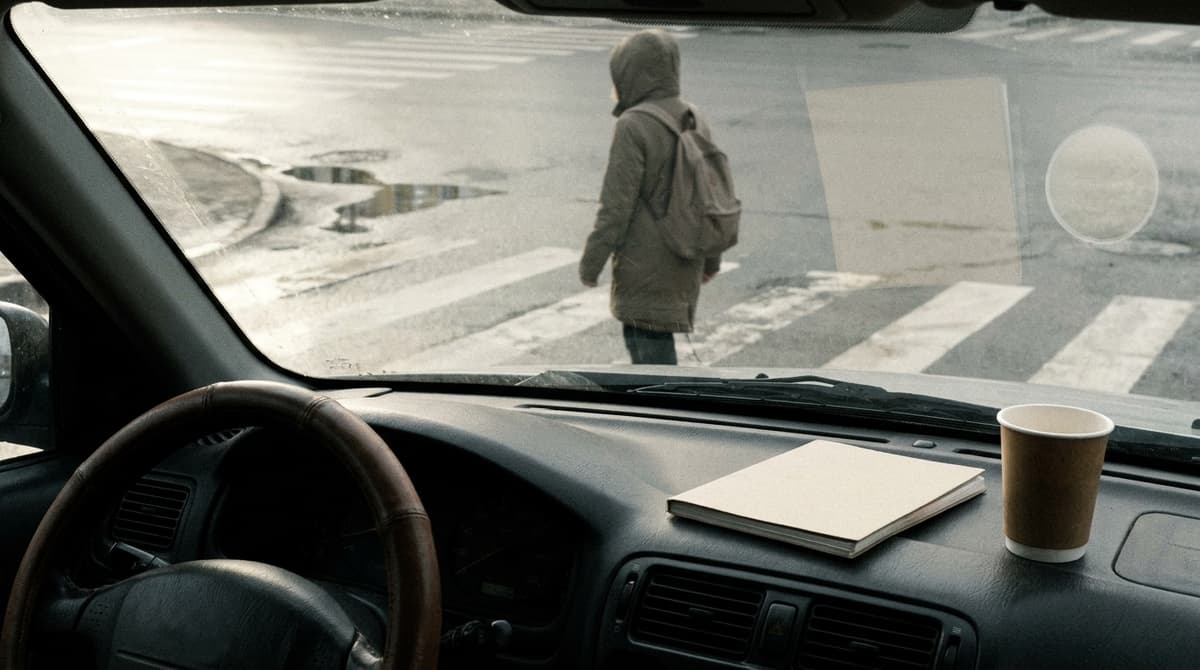
"(16) Prohibiting pedestrians from crossing a roadway in a business district or any designated highway except in a crosswalk. (17) Restricting pedestrian crossings at unmarked crosswalks."
A ban under paragraph (16) has a posting condition. Under section 6109(c), no ordinance enacted under paragraph (16), among others, "shall be effective until official traffic-control devices giving notice of the traffic regulations or ordinances are erected upon or at the entrances to the highway or part thereof affected as may be most appropriate."
So in a borough, township or city that has enacted such a ban and erected those devices, crossing outside a crosswalk in its business district, or on a highway it has designated, can be an offense even when no car is coming. Check your municipality's code of ordinances and the signs posted at the crossing.
Section 102 defines "Business district" as "The territory contiguous to and including a highway when within any 600 feet along the highway there are buildings in use for business or industrial purposes, including but not limited to hotels, banks, or office buildings, railroad stations and public buildings which occupy at least 300 feet of frontage on one side or 300 feet collectively on both sides of the highway."
Crossing against the light in Pennsylvania
Section 3112(a) provides that traffic-signal lights "shall indicate and apply to drivers of vehicles and pedestrians." Section 3541, in the pedestrian subchapter, adds a local layer:
"(a) Traffic-control devices.-- A pedestrian shall obey the instructions of a police officer or other appropriately attired person authorized to direct, control or regulate traffic. (b) Traffic and pedestrian-control signals.-- Local authorities by ordinance may require pedestrians to obey traffic and pedestrian-control signals as provided in sections 3112 (relating to traffic-control signals) and 3113 (relating to pedestrian-control signals)."
Subsection (a), obeying an officer or authorized person directing traffic, applies everywhere. Subsection (b) lets local authorities require obedience to signals by ordinance. Section 3112 itself, however, says the lights apply to pedestrians and that a pedestrian facing a steady red signal alone "shall not enter the roadway," and section 6502(a) provides that "It is a summary offense for any person to violate any of the provisions of this title unless the violation is by this title or other statute of this Commonwealth declared to be a misdemeanor or felony." Do not treat crossing against a red light as lawful where no local ordinance exists.
The traffic-light rules in section 3112 say, each time "Unless otherwise directed by a pedestrian-control signal as provided in section 3113":
- Facing any green signal, "pedestrians facing any green signal may proceed across the roadway within a crosswalk" (3112(a)(1)(iii)).
- Facing a steady yellow, pedestrians "are thereby advised that there is insufficient time to cross the roadway before a red indication is shown and no pedestrian shall then start to cross the roadway" (3112(a)(2)(ii)).
- Facing a steady red signal alone, pedestrians "shall not enter the roadway" (3112(a)(3)(iii)).
For WALK / DON'T WALK heads, section 3113(a) uses "should" for pedestrians:
(1) Word "Walk" or walking person symbol.-- Pedestrians facing the signal should proceed across the roadway in the direction of the signal and shall be given the right-of-way by the drivers of all vehicles. ... (2) Phrase "Don't Walk" or upraised hand symbol.-- Pedestrians should not start to cross the roadway in the direction of the signal, but any pedestrian who has partially completed his crossing on the "Walk" signal should proceed to a sidewalk or safety zone while the "Don't Walk" signal is showing.
Section 3113(b) adds: "This section does not prohibit a municipality from establishing a summary offense for violation of subsection (a)(2) or (4)," meaning the steady and flashing DON'T WALK phases. Check the municipality's ordinance for any penalty it sets.
Pennsylvania's crosswalk definition
Because the yield rule turns on where a crosswalk is, the statutory definition matters. Section 102 defines "Crosswalk" as:
"(1) That part of a roadway at an intersection included within the connections of the lateral lines of the sidewalks on opposite sides of the highway, measured from the curbs or, in the absence of curbs, from the edges of the traversable roadway; and, in the absence of a sidewalk on one side of the roadway, that part of a roadway included within the extension of the lateral lines of the existing sidewalk. (2) Any portion of a roadway at an intersection or elsewhere distinctly indicated for pedestrian crossing by lines or other markings on the surface."
Part (1) creates an unmarked crosswalk at an intersection where sidewalks line up, including where only one side of the road has a sidewalk. Part (2) covers painted or otherwise marked crossings, at an intersection or mid-block.
Section 102 defines "Pedestrian" to include "(1) An individual afoot," an individual with a mobility-related disability on a self-propelled wheelchair or an electrical mobility device designated for the exclusive use of such an individual, and "(3) A personal delivery device." A personal delivery device is therefore a pedestrian under the code's definition.
Walking along a road and other pedestrian rules
Section 3544 governs walking along a highway:
"(a) Mandatory use of available sidewalk.-- Where a sidewalk is provided and its use is practicable, it is unlawful for any pedestrian to walk along and upon an adjacent roadway. (b) Absence of sidewalk.-- Where a sidewalk is not available, any pedestrian walking along and upon a highway shall walk only on a shoulder as far as practicable from the edge of the roadway. (c) Absence of sidewalk and shoulder.-- Where neither a sidewalk nor a shoulder is available, any pedestrian walking along and upon a highway shall walk as near as practicable to an outside edge of the roadway and, if on a two-way roadway, shall walk only on the left side of the roadway. (d) Right-of-way to vehicles.-- Except as otherwise provided in this subchapter, any pedestrian upon a roadway shall yield the right-of-way to all vehicles upon the roadway."
Other rules in the pedestrian subchapter:
- "No pedestrian shall suddenly leave a curb or other place of safety and walk or run into the path of a vehicle which is so close as to constitute a hazard" (3542(b)).
- No person shall "(1) Stand on a roadway for the purpose of soliciting a ride" or "(2) Stand on a roadway for the purpose of soliciting employment, business or contributions from the occupant of any vehicle" (3545).
- "Upon the immediate approach of an emergency vehicle making use of audible and visual signals meeting the requirements of this title, every pedestrian shall yield the right-of-way to the emergency vehicle" (3548(a)). The emergency driver keeps the duty to drive with due regard for everyone's safety and to exercise due care to avoid colliding with any pedestrian (3548(b)).
- "A pedestrian who is under the influence of alcohol or any controlled substance to a degree which renders the pedestrian a hazard shall not walk or be upon a highway except on a sidewalk" (3550).
- "No pedestrian shall pass through, around, over or under any crossing gate or barrier at a railroad grade crossing or bridge while the gate or barrier is closed or is being opened or closed" (3551(b)).
What drivers owe pedestrians in Pennsylvania
The driver duties apply statewide; section 3541(b) concerns local signal ordinances for pedestrians, not drivers.
- Crosswalks without working signals. "When traffic-control signals are not in place or not in operation, the driver of a vehicle shall yield the right-of-way to a pedestrian crossing the roadway within any marked crosswalk or within any unmarked crosswalk at an intersection" (3542(a)). A violation is a summary offense with a fine of $50 (3542(e)) and carries 2 points (1535(a)). Subsection (a) does not apply where a pedestrian crosses at a point where a pedestrian tunnel or overhead crossing has been provided (3542(d), 3543(b)).
- No passing a stopped car. When a vehicle is stopped at a crosswalk at an intersection or at a marked crosswalk to let a pedestrian cross, "the driver of any other vehicle approaching from the rear shall not overtake and pass the stopped vehicle" (3542(c)).
- Green lights and turns. Vehicles facing a circular green, "including vehicles turning right or left, shall yield the right-of-way to other vehicles and to pedestrians lawfully within the intersection or an adjacent crosswalk at the time the signal is exhibited" (3112(a)(1)(i)). Drivers turning on red "shall yield the right-of-way to pedestrians lawfully within an adjacent crosswalk and to other traffic lawfully using the intersection" (3112(a)(3)(ii)).
- WALK and flashing DON'T WALK. A pedestrian facing WALK "shall be given the right-of-way by the drivers of all vehicles" (3113(a)(1)); during a flashing DON'T WALK, "all drivers of vehicles shall yield to the pedestrian" who partly completed the crossing on WALK (3113(a)(4)). A driver who violates section 3113(a) commits a summary offense with a $50 fine; that subsection "shall not apply to those municipalities that establish a summary offense as authorized under subsection (b) with a fine in excess of $50" (3113(c)).
- Sidewalks across driveways. A driver emerging from or entering an alley, building, private road or driveway "shall yield the right-of-way to any pedestrian approaching on any sidewalk extending across the alley, building entrance, road or driveway" (3547). Failure to yield to a pedestrian on a sidewalk carries 3 points (1535(a)).
- Blind pedestrians. Drivers must yield to "any totally or partially blind pedestrian carrying a clearly visible white cane or accompanied by a guide dog" and stop if necessary to prevent injury or danger (3549(a)); the fine is $50 to $150 (3549(c)), with 3 points (1535(a)).
- Safety zones. "No vehicle shall at any time be driven through or within a safety zone" (3546(a)).
Jaywalking fine and penalty in Pennsylvania
The pedestrian penalty is in section 3552:
"Except as otherwise provided for in this subchapter, any pedestrian violating any provision of this subchapter is guilty of a summary offense and shall, upon conviction, be sentenced to pay a fine of $5."
That $5 fine covers a pedestrian's violation of the yield rule, the urban-district and diagonal-crossing bans, and the other rules in sections 3541 to 3551, unless the subchapter sets a different penalty. Section 3551 does: a violation of its bridge and railroad warning-signal rules "constitutes a summary offense punishable by a fine of not less than $50 nor more than $150" (3551(c)).
The $5 is only the fine. Title 75 levies, "In addition to any fines, fees or penalties levied or imposed as provided by law," a surcharge of $45 "Upon conviction for any violation of the provisions of this title ... which is a traffic violation" (75 Pa.C.S. 6506(a)(1)), and the minor judiciary charges costs on a summary conviction (42 Pa.C.S. 1725.1(b)). The citation or the magisterial district court states the exact amount due. The code's general fine for a summary offense "for which another penalty is not provided" is $25 (6502(a)); section 3552 provides the pedestrian penalty, so that general figure is not the one that applies to these rules.
The point schedule in section 1535(a) lists the driver offenses in sections 3542(a), 3547 and 3549(a); it lists no pedestrian rule from the subchapter.
A pedestrian stopped for a suspected violation has a duty to identify. Under 75 Pa.C.S. 6308(a), "any pedestrian reasonably believed to have violated any provision of this title shall stop upon request or signal of any police officer and shall, upon request, exhibit ... other means of identification if a pedestrian or driver of a pedalcycle, and shall write their name in the presence of the police officer if so required for the purpose of establishing identity."
| Violation | Penalty | Source |
|---|---|---|
| Pedestrian violation of the state rules in sections 3541 to 3550 (yield rule, urban-district and diagonal bans, walking along a road, soliciting on a roadway) | Summary offense, $5 fine | 75 Pa.C.S. 3552 |
| Pedestrian violating the bridge or railroad warning-signal rules | Summary offense, $50 to $150 fine | 3551(c) |
| Pedestrian entering the roadway facing a steady red signal alone | Summary offense for violating a provision of the title (6502(a)); a local signal ordinance may set its own penalty | 3112(a)(3)(iii), 6502(a), 3541(b) |
| Pedestrian starting on DON'T WALK, where a municipality has established a summary offense | See the local ordinance | 3113(b) |
| Driver failing to yield in a crosswalk without working signals | Summary offense, $50 fine, 2 points | 3542(e), 1535(a) |
| Driver violating the pedestrian-signal rules | Summary offense, $50 fine (not applicable in a municipality that has set a summary offense under 3113(b) with a fine over $50) | 3113(c) |
| Driver failing to yield to a blind pedestrian | Summary offense, $50 to $150 fine, 3 points | 3549(c), 1535(a) |
Pending legislation
House Bill 918 of the 2025-2026 session would amend Title 75, "in general provisions, further providing for definitions; in general provisions relating to operation of vehicles, further providing for traffic-control signals and for pedestrian-control signals," among other changes. Its last listed action is referral to the House Transportation Committee on March 17, 2025. It is a bill, not law, and the rules above remain in force unless it is enacted.
If a pedestrian is hit by a car
Whether a pedestrian was crossing lawfully can come up after a collision, alongside the driver's duties above. For how fault and insurance work after a crash, see Pennsylvania car accident laws. Electric scooter riders follow their own rules, covered in Pennsylvania e-scooter laws.
Related pages
- Jaywalking laws by state
- Pennsylvania car accident laws
- Pennsylvania e-scooter laws
- Ohio jaywalking laws
- New York jaywalking laws
This article provides general legal information about Pennsylvania law, not legal advice. For advice about a specific situation, contact a lawyer licensed in Pennsylvania or your local magisterial district court.
Last updated: 2026-10-10.
Frequently Asked Questions
Is jaywalking illegal in Pennsylvania?
Not everywhere. A pedestrian may cross outside a crosswalk if they yield the right-of-way to all vehicles (75 Pa.C.S. 3543(a)), but crossing between adjacent signalized intersections in an urban district is allowed only in a marked crosswalk, diagonal crossing is barred unless authorized (3543(c), (d)), and a municipality may bar crossing outside a crosswalk in a business district or on a designated highway once official traffic-control devices giving notice of the ban are erected (6109(a)(16), (c)).
What is the fine for jaywalking in Pennsylvania?
A pedestrian who violates the pedestrian subchapter commits a summary offense with a $5 fine (75 Pa.C.S. 3552). The $5 is only the fine: Title 75 levies a $45 surcharge, in addition to any fines, upon conviction for a violation of the title that is a traffic violation (6506(a)(1)), and the minor judiciary charges costs on a summary conviction (42 Pa.C.S. 1725.1(b)), so the citation or the court states the amount due. Disobeying a bridge or railroad warning signal, gate or barrier is fined $50 to $150 (3551(c)), and a local signal ordinance sets its own penalty.
Is it illegal to cross against a DON'T WALK signal in Pennsylvania?
Section 3113(a) says pedestrians should not start to cross on DON'T WALK, and section 3113(b) lets a municipality establish a summary offense for starting to cross on a steady or flashing DON'T WALK. Under 75 Pa.C.S. 3541(b), local authorities by ordinance may require pedestrians to obey traffic and pedestrian-control signals as provided in sections 3112 and 3113. Separately, section 3112 says traffic lights apply to pedestrians, and a pedestrian facing a steady red signal alone, with no pedestrian signal directing otherwise, shall not enter the roadway (3112(a)(3)(iii)).
Can I cross in the middle of the block in Pennsylvania?
Under state law, yes, if you yield to all vehicles (3543(a)) and you are not between two adjacent intersections with operating signals in an urban district, where only a marked crosswalk is allowed (3543(c)). A local ordinance may bar it in a business district or on a designated highway once official traffic-control devices giving notice of the ban are erected (6109(a)(16), (c)).
Do drivers have to stop for pedestrians in a crosswalk in Pennsylvania?
Where signals are not in place or not operating, drivers must yield to a pedestrian in any marked crosswalk or unmarked crosswalk at an intersection, and may not pass a vehicle stopped to let a pedestrian cross (75 Pa.C.S. 3542(a), (c)). Failing to yield is a $50 summary offense with 2 points (3542(e), 1535(a)). The yield duty does not apply where a pedestrian crosses at a point where a pedestrian tunnel or overhead crossing has been provided (3542(d), 3543(b)).
Is there a crosswalk at every intersection in Pennsylvania?
An unmarked crosswalk exists at an intersection within the connections of the lateral lines of the sidewalks on opposite sides of the highway, or within the extension of the existing sidewalk where one side has none (75 Pa.C.S. 102). Any marked crossing, at an intersection or elsewhere, is also a crosswalk.
Which side of the road should I walk on in Pennsylvania?
Where a sidewalk is provided and its use is practicable, walking along and upon the adjacent roadway is unlawful; where there is no sidewalk, walk only on a shoulder as far as practicable from the edge of the roadway (75 Pa.C.S. 3544(a), (b)). Where neither a sidewalk nor a shoulder is available, walk as near as practicable to an outside edge of the roadway and, on a two-way roadway, only on the left side (3544(c)). A pedestrian on a roadway must yield the right-of-way to all vehicles except as the subchapter otherwise provides (3544(d)).
Updates
Independently fact-checked against the cited primary sources
The Law Behind This Article
This article rests on the statutory provisions below, held in our own legal record and retrieved from the official source. Tap a section to read the operative text.
Pennsylvania Consolidated Statutes Title 75 (Vehicles)
§ 3543Pedestrians crossing at other than crosswalksIn force
(a) General rule.--Every pedestrian crossing a roadway at any point other than within a crosswalk at an intersection or any marked crosswalk shall yield the right-of-way to all vehicles upon the roadway. (b) At pedestrian tunnel or overhead crossing.--Any pedestrian crossing a roadway at a point where a pedestrian tunnel or overhead pedestrian crossing has been provided shall yield the right-of-way to all vehicles upon the roadway. (c) Between controlled intersections in urban district.--Between adjacent intersections in urban districts at which traffic-control signals are in operation pedestrians shall not cross at any place except in a marked crosswalk. (d) Crossing intersection diagonally.--No pedestrian shall cross a roadway intersection diagonally unless authorized by official traffic-control devices or at the direction of a police officer or other appropriately attired person authorized to direct, control or regulate traffic. When authorized to cross diagonally, pedestrians shall cross only in accordance with the signal pertaining to the crossing movements.
Official text (excerpt) · last checked 2026-07-29 · Read the full text in our law library · Verify at palegis.us
§ 3541Obedience of pedestrians to traffic-control devices and regulationsIn force
(a) Traffic-control devices.--A pedestrian shall obey the instructions of a police officer or other appropriately attired person authorized to direct, control or regulate traffic. (b) Traffic and pedestrian-control signals.--Local authorities by ordinance may require pedestrians to obey traffic and pedestrian-control signals as provided in sections 3112 (relating to traffic-control signals) and 3113 (relating to pedestrian-control signals).
Official text (excerpt) · last checked 2026-07-29 · Read the full text in our law library · Verify at palegis.us
§ 3542Right-of-way of pedestrians in crosswalksIn force
(a) General rule.--When traffic-control signals are not in place or not in operation, the driver of a vehicle shall yield the right-of-way to a pedestrian crossing the roadway within any marked crosswalk or within any unmarked crosswalk at an intersection. (b) Exercise of care by pedestrian.--No pedestrian shall suddenly leave a curb or other place of safety and walk or run into the path of a vehicle which is so close as to constitute a hazard. (c) Limitation on vehicles passing.--Whenever any vehicle is stopped at any crosswalk at an intersection or at any marked crosswalk to permit a pedestrian to cross the roadway, the driver of any other vehicle approaching from the rear shall not overtake and pass the stopped vehicle. (d) Application of section.--Subsection (a) does not apply under the conditions stated in section 3543(b) (relating to pedestrians crossing at other than crosswalks). (e) Penalties.--The driver of a vehicle who violates subsection (a) commits a summary offense and shall, upon conviction, be sentenced to pay a fine of $50.
Official text (excerpt) · last checked 2026-07-29 · Read the full text in our law library · Verify at palegis.us
§ 6109Specific powers of department and local authoritiesIn force
(a) Enumeration of police powers.--The provisions of this title shall not be deemed to prevent the department on State-designated highways and local authorities on streets or highways within their physical boundaries from the reasonable exercise of their police powers. The following are presumed to be reasonable exercises of police power: (1) Except as limited by subsections (g) and (h), regulating or prohibiting stopping, standing or parking. (2) Regulating traffic by means of police officers or official traffic-control devices. (3) Subject to subsections (j) and (j.1), regulating or prohibiting processions, special activities or assemblages on highways. (4) Designating particular highways or roadways for use by traffic moving in one direction as authorized in section 3308 (relating to one-way roadways and rotary traffic islands). (5) Establishing speed limits for vehicles in public parks. (6) Designating any highway as a through highway or designating any intersection or junction of roadways as a stop or yield intersection or junction.
Official text (excerpt) · last checked 2026-07-29 · Read the full text in our law library · Verify at palegis.us
§ 3112Traffic-control signalsIn force
(a) General rule.--Whenever traffic is controlled by traffic-control signals exhibiting different colored lights, or colored lighted arrows, successively one at a time or in combination, only the colors green, red and yellow shall be used, except for special pedestrian signals carrying a word legend, and the lights shall indicate and apply to drivers of vehicles and pedestrians as follows: (1) Green indication.-- (i) Vehicular traffic facing a circular green signal may proceed straight through or turn right or left unless a sign at such place prohibits either such turn except that vehicular traffic, including vehicles turning right or left, shall yield the right-of-way to other vehicles and to pedestrians lawfully within the intersection or an adjacent crosswalk at the time the signal is exhibited. (ii) Vehicular traffic facing a green arrow signal, shown alone or in combination with another indication, may enter the intersection only to make the movement indicated by the arrow, or such other movement as is permitted by other indications shown at the same time.
Official text (excerpt) · last checked 2026-07-29 · Read the full text in our law library · Verify at palegis.us
Search our full record of US law — 2.1 million sections, every state + federal →
Sources and References
- 75 Pa.C.S. 3543, Pedestrians crossing at other than crosswalks(www.legis.state.pa.us).gov
- 75 Pa.C.S. 6109, Specific powers of department and local authorities(www.legis.state.pa.us).gov
- 75 Pa.C.S. 3552, Penalties for pedestrian violations(www.legis.state.pa.us).gov
- 75 Pa.C.S. 3541, Obedience of pedestrians to traffic-control devices and regulations(www.legis.state.pa.us).gov
- 75 Pa.C.S. 3542, Right-of-way of pedestrians in crosswalks(www.legis.state.pa.us).gov
- 75 Pa.C.S. 1535, Schedule of convictions and points(www.legis.state.pa.us).gov
- 75 Pa.C.S. 102, Definitions (crosswalk, pedestrian, urban district, business district)(www.legis.state.pa.us).gov
- 75 Pa.C.S. 3551, Compliance with bridge and railroad warning signals(www.legis.state.pa.us).gov
- 75 Pa.C.S. 3112, Traffic-control signals(www.legis.state.pa.us).gov
- 75 Pa.C.S. 3113, Pedestrian-control signals(www.legis.state.pa.us).gov
- 75 Pa.C.S. 3544, Pedestrians walking along or on highway(www.legis.state.pa.us).gov
- 75 Pa.C.S. 3545, Pedestrians soliciting rides or business(www.legis.state.pa.us).gov
- 75 Pa.C.S. 3548, Pedestrians to yield to emergency vehicles(www.legis.state.pa.us).gov
- 75 Pa.C.S. 3550, Pedestrians under influence of alcohol or controlled substance(www.legis.state.pa.us).gov
- 75 Pa.C.S. 3547, Right-of-way of pedestrians on sidewalks(www.legis.state.pa.us).gov
- 75 Pa.C.S. 3549, Blind pedestrians(www.legis.state.pa.us).gov
- 75 Pa.C.S. 3546, Driving through or around safety zone(www.legis.state.pa.us).gov
- 75 Pa.C.S. 6502, Summary offenses(www.legis.state.pa.us).gov
- 75 Pa.C.S. 6506, Surcharge(www.legis.state.pa.us).gov
- 75 Pa.C.S. 6308, Investigation by police officers(www.legis.state.pa.us).gov
- 42 Pa.C.S. 1725.1, Costs(www.legis.state.pa.us).gov
- House Bill 918 of 2025, Pennsylvania General Assembly(www.palegis.us).gov