
New York
Is Jaywalking Illegal in New York? State Law and Fines (2026)
Independently fact-checked against primary sources (last audited October 10, 2026). · 24 primary sources cited on this page. How we verify our legal content
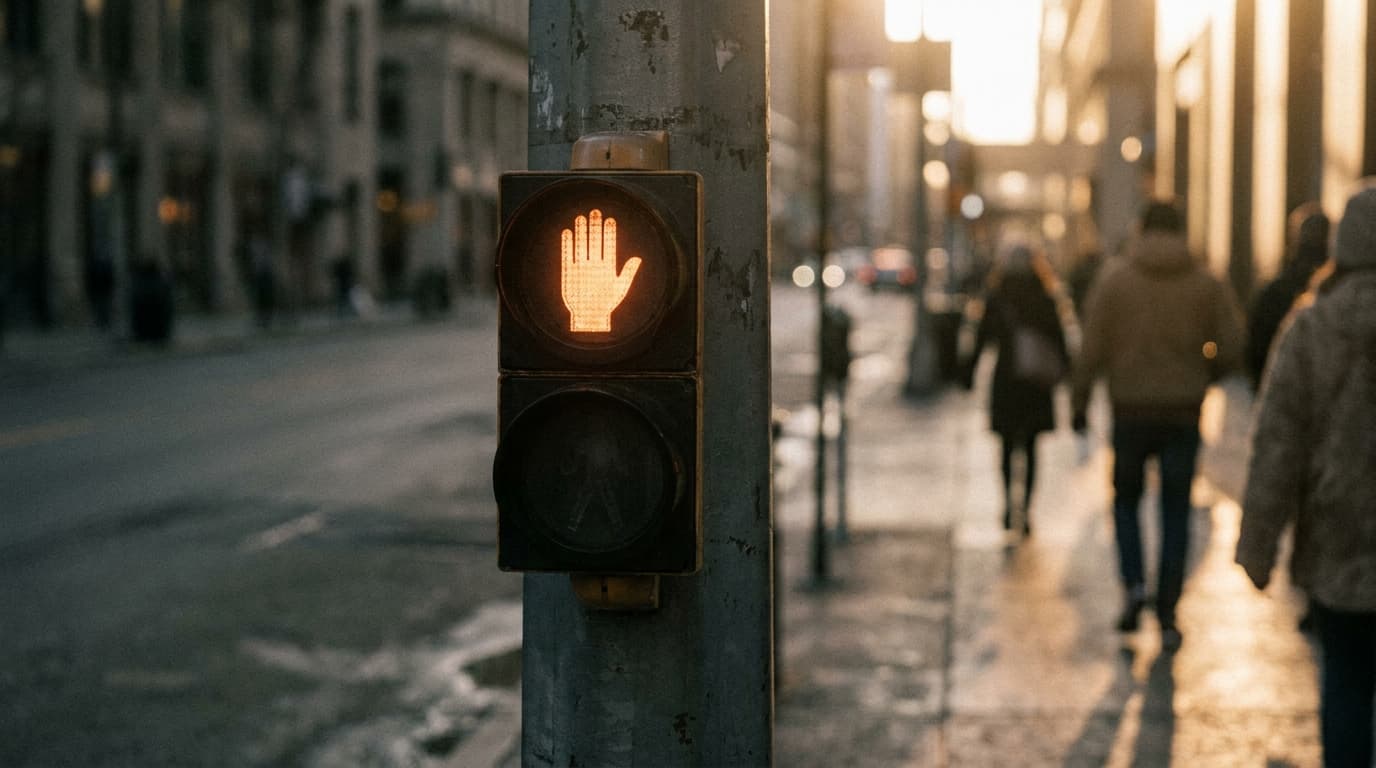
In New York State, crossing outside a crosswalk is allowed as long as you yield the right of way to all vehicles on the roadway (Vehicle and Traffic Law 1152(a)). Crossing an intersection diagonally is barred unless official traffic-control devices authorize it (VTL 1152(c)), and pedestrians must obey traffic lights and WALK / DON'T WALK signals (VTL 1111, 1112). A violation is a traffic infraction (VTL 1800(a)), and a first conviction carries a fine of up to $150, up to 15 days in jail, or both (VTL 1800(b)(1)). Cities, villages and towns may regulate pedestrian crossing (VTL 1640(a)(3), 1660(a)(14)), so the rule where you are can be stricter or more permissive than the state rule. New York City's local law, as amended by Local Law 98 of 2024, lets pedestrians cross any roadway other than a limited access highway at any point, yielding to traffic that has the right of way. To compare other states, see our guide to jaywalking laws by state.
Information last verified on 2026-10-10. This article has not been reviewed by a licensed lawyer.
Jurisdiction scope: This article covers New York State's Vehicle and Traffic Law (VTL): the pedestrian article (sections 1150 to 1157), the signal sections 1111 and 1112, the driver due-care section 1146, the definitions in sections 110 and 130, the local-authority sections 1621, 1630, 1640, 1642, 1660 and 1684, the penalty sections 1800 and 1809, and New York City's pedestrian crossing section (Administrative Code 19-195, as amended by Local Law 98 of 2024). It does not cover any other city's, village's or town's local laws, driver license points, injury claims after a crash, or the law of other states.
Is jaywalking illegal in New York?
New York's crossing rule is VTL 1152, titled "Crossing at other than crosswalks":
"(a) Every pedestrian crossing a roadway at any point other than within a marked crosswalk or within an unmarked crosswalk at an intersection shall yield the right of way to all vehicles upon the roadway. (b) Any pedestrian crossing a roadway at a point where a pedestrian tunnel or overhead pedestrian crossing has been provided shall yield the right of way to all vehicles upon the roadway. (c) No pedestrian shall cross a roadway intersection diagonally unless authorized by official traffic-control devices; and, when authorized to cross diagonally, pedestrians shall cross only in accordance with the official traffic-control devices pertaining to such crossing movements."
Subsection (a) is a duty to yield, not a ban. A pedestrian who crosses mid-block and gives way to every vehicle is complying with it; one who steps out in front of an approaching car is not. Subsection (c) is the only flat crossing-location ban in the section: no diagonal crossing of an intersection unless signs or signals allow it.
Section 1152 also has no clause requiring pedestrians to use a crosswalk between adjacent intersections that have traffic signals. Local law can add or change crossing rules, though, and New York City's does (see "Local rules" below).
VTL 1150 ties the article together: "Pedestrians shall be subject to traffic-control signals as provided in section eleven hundred eleven of this title, but at all other places pedestrians shall be accorded the privileges and shall be subject to the restrictions stated in this article."
| Situation | State rule | Source |
|---|---|---|
| Crossing outside a marked crosswalk or an unmarked crosswalk at an intersection | Allowed, but the pedestrian must yield the right of way to all vehicles | VTL 1152(a) |
| Crossing where a pedestrian tunnel or overhead crossing has been provided | Must yield the right of way to all vehicles | VTL 1152(b) |
| Crossing an intersection diagonally | Barred unless official traffic-control devices authorize it | VTL 1152(c) |
| Starting to cross on a flashing DON'T WALK or upraised hand | Barred; finish to a sidewalk or safety island if already crossing | VTL 1112(b) |
| Starting to cross on a steady DON'T WALK or upraised hand | Barred; finish to a sidewalk or safety island if already crossing | VTL 1112(c) |
| Starting to cross on a steady yellow | Barred, unless a pedestrian-control signal directs otherwise | VTL 1111(b)(3) |
| Entering the roadway on a steady red | Barred, unless a pedestrian-control signal directs otherwise | VTL 1111(d)(4) |
| Suddenly leaving a curb into the path of a vehicle too close to yield | Barred | VTL 1151(b) |
| Walking in the roadway where a usable sidewalk is provided | Unlawful | VTL 1156(a) |
| Standing in a roadway to solicit a ride or to sell to a vehicle occupant | Barred | VTL 1157(a) |
What counts as a crosswalk in New York
The yield rule turns on whether you are within a crosswalk. VTL 110 defines "crosswalk" as:
"(a) That part of a roadway at an intersection included within the connections of the lateral lines of the sidewalks on opposite sides of the highway between the curbs or, in the absence of curbs, between the edges of the traversable roadway. (b) Any portion of a roadway at an intersection or elsewhere distinctly indicated for pedestrian crossing by lines or other markings on the surface."
Part (a) is the unmarked crosswalk: the area at an intersection within the connections of the lateral lines of the sidewalks on opposite sides of the highway. Part (b) is any painted or otherwise marked crossing, at an intersection or mid-block. A pedestrian, under VTL 130, is "Any person afoot or in a wheelchair," so these rules apply to wheelchair users too.
Traffic lights and WALK / DON'T WALK signals
Ordinary traffic lights bind pedestrians under VTL 1111, each time "Unless otherwise directed by a pedestrian-control signal as provided in section eleven hundred twelve":
- Facing a steady green, "except when the sole green signal is a turn arrow," pedestrians "may proceed across the roadway within any marked or unmarked crosswalk" (1111(a)(3)).
- Facing a steady yellow, pedestrians "are thereby advised that there is insufficient time to cross the roadway before a red indication is shown and no pedestrian shall then start to cross the roadway" (1111(b)(3)).
- Facing a steady red, pedestrians "shall not enter the roadway" (1111(d)(4)).
Where a pedestrian signal is in place, VTL 1112 governs:
"(a) Steady WALK or walking person. Pedestrians facing such signal may proceed across the roadway in the direction of the signal and shall be given the right of way by other traffic. (b) Flashing DON'T WALK or upraised hand. No pedestrian shall start to cross the roadway in the direction of such signal, but any pedestrians who have partially completed their crossing on the WALK or walking person signal shall proceed to a sidewalk or safety island while the flashing DON'T WALK or upraised hand signal is showing. (c) Steady DON'T WALK or upraised hand. No pedestrians shall start to cross the roadway in the direction of such signal, but any pedestrians who have partially completed their crossing on the WALK or flashing DON'T WALK signal shall proceed to a sidewalk or safety island while the steady DON'T WALK signal is showing."
The violation under 1112(b) and (c) is starting to cross. A pedestrian already partway across when the hand starts flashing or turns steady is told to keep going to a sidewalk or safety island, not to turn back. New York City's local law treats a steady upraised hand differently (see "Local rules" below).
Walking along the road and other pedestrian rules
VTL 1156 covers walking along a road:
"(a) Where sidewalks are provided and they may be used with safety it shall be unlawful for any pedestrian to walk along and upon an adjacent roadway. (b) Where sidewalks are not provided any pedestrian walking along and upon a highway shall when practicable walk only on the left side of the roadway or its shoulder facing traffic which may approach from the opposite direction. Upon the approach of any vehicle from the opposite direction, such pedestrian shall move as far to the left as is practicable."
The sidewalk rule in (a) applies only where the sidewalk "may be used with safety."
Other rules in the pedestrian article:
- "No pedestrian shall suddenly leave a curb or other place of safety and walk or run into the path of a vehicle which is so close that it is impractical for the driver to yield" (1151(b)).
- "Pedestrians shall move, whenever practicable, upon the right half of crosswalks" (1155).
- "No person shall stand in a roadway for the purpose of soliciting a ride, or to solicit from or sell to an occupant of any vehicle" (1157(a)), and "No person shall occupy any part of a state highway, except in a city or village, in any manner for the purpose of selling or soliciting" (1157(c)).
What drivers owe pedestrians in New York
The pedestrian duties above sit alongside separate duties for drivers:
- "When traffic-control signals are not in place or not in operation the driver of a vehicle shall yield the right of way, slowing down or stopping if need be to so yield, to a pedestrian crossing the roadway within a crosswalk on the roadway upon which the vehicle is traveling, except that any pedestrian crossing a roadway at a point where a pedestrian tunnel or overpass has been provided shall yield the right of way to all vehicles" (1151(a)).
- When a vehicle is stopped at a marked crosswalk or an unmarked crosswalk at an intersection to let a pedestrian cross, "the driver of any other vehicle approaching from the rear shall not overtake and pass such stopped vehicle" (1151(c)).
- On a steady WALK or walking person signal, pedestrians "shall be given the right of way by other traffic" (1112(a)).
- Outside a city of one million or more (New York City), where a right turn on a steady red is permitted, the turning traffic "shall yield the right-of-way to pedestrians within a marked or unmarked crosswalk at the intersection and to other traffic lawfully using the intersection" (1111(d)(2)(a)).
- "The driver of a vehicle emerging from or entering an alleyway, building, private road or driveway shall yield the right of way to any pedestrian approaching on any sidewalk extending across such alleyway, building entrance, road or driveway" (1151-a).
- Every driver approaching an intersection or crosswalk "shall yield the right of way to a pedestrian crossing or attempting to cross the roadway when such pedestrian is accompanied by a guide dog or using a cane which is metallic or white in color or white with a red tip" (1153(a)).
The broadest driver duty is in VTL 1146(a): "every driver of a vehicle shall exercise due care to avoid colliding with any bicyclist, pedestrian, or domestic animal upon any roadway and shall give warning by sounding the horn when necessary." Under 1146(b)(1), a driver "who causes physical injury as defined in article ten of the penal law to a pedestrian or bicyclist while failing to exercise due care in violation of subdivision (a) of this section, shall be guilty of a traffic infraction punishable by a fine of not more than five hundred dollars or by imprisonment for not more than fifteen days or by both such fine and imprisonment."
If the injury is a serious physical injury, the fine rises to up to $750, and the driver faces up to 15 days, a required motor vehicle accident prevention course, or a combination, plus suspension of a license or registration (1146(c)(1)). A violation of 1146(b) or (c) by a driver convicted of either within the preceding five years is a class B misdemeanor with a fine of up to $1,000 in addition to other penalties (1146(d)).
Jaywalking fine and penalty in New York
A pedestrian violation is a traffic infraction. VTL 1800(a) provides: "It is a traffic infraction for any person to violate any of the provisions of this chapter or of any local law, ordinance, order, rule or regulation adopted pursuant to this chapter, unless such violation is by this chapter or other law of this state declared to be a misdemeanor or a felony."
VTL 1150, 1151, 1152, 1156 and 1157 set no fine of their own, so the general penalty in VTL 1800(b)(1) applies to a traffic infraction "for which another penalty is not provided":
| Conviction | Maximum fine | Maximum jail | Source |
|---|---|---|---|
| First conviction | $150 | 15 days (or both fine and jail) | VTL 1800(b)(1) |
| Second violation, both within 18 months | $300 | 45 days (or both fine and jail) | VTL 1800(b)(1) |
| Third or later violation, all within 18 months | $450 | 90 days | VTL 1800(b)(1) |
These are maximums, not a set ticket amount. The court handling the ticket sets the fine within the range.
One cost that applies to most traffic tickets does not apply here. VTL 1809(1) levies a crime victim assistance fee and a mandatory surcharge on traffic convictions "other than a traffic infraction involving standing, stopping, or parking or violations by pedestrians or bicyclists." The version of 1809 that contains this text is marked effective until September 1, 2027, and a later version follows it.
Local rules, including New York City
State law lets cities, villages and towns write their own pedestrian rules. VTL 1640(a) provides that the legislative body of any city or village, "subject to the limitations imposed by section sixteen hundred eighty-four," may by local law, ordinance, order, rule or regulation "Regulate the crossing of any roadway by pedestrians" (1640(a)(3)). For the largest cities, VTL 1642(a) adds that "the legislative body of any city having a population in excess of one million, may by local law, ordinance, order, rule, regulation or health code provision prohibit, restrict or regulate traffic on or pedestrian use of any highway."
A town board has the same power for highways outside villages (1660(a)(14)), and may prohibit pedestrians on controlled-access highways (1660(a)(12)). The state Department of Transportation may regulate pedestrian crossing on state highways and may prohibit pedestrians on controlled-access highways (VTL 1621(a)(2), (5)), and the Thruway Authority and other listed authorities may prohibit or regulate pedestrian use of the highways they run (VTL 1630). A city, village or town rule affecting traffic on a state highway maintained by the state takes effect only with the Department of Transportation's written approval (VTL 1684).
Because of these powers, a local rule can be stricter or more permissive than the state rules described on this page, and violating a local rule adopted under the VTL is itself a traffic infraction (1800(a)).
New York City (local law). For a city of over one million, VTL 1642(a) makes the city's local laws supersede the state law where they conflict on subjects that include "Right of way of vehicles and pedestrians," "Use of the highway by pedestrians" and "Traffic signal legend applicable to pedestrians." Local Law 98 of 2024, enacted October 26, 2024 and in effect 120 days after it became law, amended New York City Administrative Code 19-195 to read: "Pedestrians crossing at points outside of a marked or unmarked crosswalk do not have the right of way. Pedestrians may cross any roadway, other than a limited access highway, at any point, including points outside of a marked or unmarked crosswalk, but shall yield to other traffic that has the right of way, provided that a failure to yield shall not be a violation of this section."
The same section now says pedestrians crossing against a steady upraised hand "do not have the right of way," and that they "may proceed across the roadway in the direction of a steady upraised hand but shall yield to other traffic that has the right of way, provided that a failure to yield shall not be a violation of this section." It also provides that nothing in the section relieves anyone "from the duty of due care for their safety or the safety of others in a roadway."
This page does not cover any other city's, village's or town's rules. To check the rule where you are, look up the local code, or the agency or court named on a ticket.
Pending bills
Two 2025-2026 Senate bills would change driver duties toward pedestrians. Senate Bill S7549 would amend VTL 1151 and is described as requiring that vehicles yield the right of way to multi-use trail users, and Senate Bill S1494 "Relates to penalties for striking a pedestrian crossing." On October 10, 2026, both bills were in the Senate Transportation Committee. Neither bill is law.
If a pedestrian is hit by a car
Whether a pedestrian was crossing lawfully can come up after a collision, alongside the driver's duty of due care in VTL 1146. For how New York's no-fault insurance and injury claims work, see New York car accident laws. Electric scooter riders follow separate rules, covered in New York e-scooter laws.
Related pages
- Jaywalking laws by state
- New York car accident laws
- New York e-scooter laws
- New York traffic camera ticket laws
- Connecticut jaywalking laws
This article provides general legal information about New York law, not legal advice. For advice about a specific situation, contact a lawyer licensed in New York or the court named on your ticket.
Last updated: 2026-10-10.
Frequently Asked Questions
Is jaywalking illegal in New York?
Under state law, crossing outside a crosswalk is allowed if you yield the right of way to all vehicles on the roadway (VTL 1152(a)), but crossing an intersection diagonally is barred unless authorized (VTL 1152(c)) and pedestrians must obey traffic and pedestrian signals (VTL 1111, 1112). Cities, villages and towns may regulate pedestrian crossing (VTL 1640(a)(3), 1660(a)(14)), and New York City's local law, as amended by Local Law 98 of 2024, lets pedestrians cross any roadway other than a limited access highway at any point if they yield to traffic that has the right of way, so check the local rules where you are.
What is the fine for jaywalking in New York?
A pedestrian violation is a traffic infraction. Under VTL 1800(b)(1), a first conviction carries a fine of up to $150, up to 15 days in jail, or both; a second within 18 months up to $300 or 45 days; and a third within 18 months up to $450 or 90 days. The mandatory surcharge and crime victim assistance fee do not apply to violations by pedestrians (VTL 1809(1)).
Is jaywalking a crime in New York?
No. VTL 1800(a) makes a violation of the Vehicle and Traffic Law a traffic infraction unless the law declares it a misdemeanor or felony, and VTL 1152 does not declare a crossing violation a misdemeanor or felony.
Can I cross in the middle of the block in New York?
Under state law, yes, if you yield the right of way to all vehicles on the roadway (VTL 1152(a)). New York's statute has no rule limiting crossing to crosswalks between adjacent signalized intersections, but a city, village or town may regulate pedestrian crossing (VTL 1640(a)(3), 1660(a)(14)). In New York City, Administrative Code 19-195, as amended by Local Law 98 of 2024, lets pedestrians cross any roadway other than a limited access highway at any point, outside a crosswalk, but they do not have the right of way and must yield to traffic that has it.
Can I cross on a DON'T WALK in New York?
Under state law, you may not start to cross on a flashing or steady DON'T WALK or upraised hand, and a pedestrian who has partly crossed shall proceed to a sidewalk or safety island (VTL 1112(b), (c)). In New York City, Administrative Code 19-195, as amended by Local Law 98 of 2024, lets pedestrians proceed against a steady upraised hand but says they do not have the right of way and must yield to traffic that has it.
Do drivers have to stop for pedestrians in New York?
Where traffic signals are not in place or not in operation, a driver must yield to a pedestrian crossing within a crosswalk on the roadway the vehicle is traveling, slowing down or stopping if need be (VTL 1151(a)). On a steady WALK, pedestrians shall be given the right of way by other traffic (VTL 1112(a)), and every driver must exercise due care to avoid colliding with any pedestrian (VTL 1146(a)).
Which side of the road should I walk on in New York?
Where sidewalks are provided and can be used with safety, walking along the adjacent roadway is unlawful. Where there are no sidewalks, walk when practicable on the left side of the roadway or its shoulder, facing traffic, and move as far left as practicable when a vehicle approaches from the opposite direction (VTL 1156).
Updates
Independently fact-checked against the cited primary sources
The Law Behind This Article
This article rests on the statutory provisions below, held in our own legal record and retrieved from the official source. Tap a section to read the operative text.
New York Vehicle and Traffic Law
§ 1152Crossing at other than crosswalksIn force
Crossing at other than crosswalks. (a) Every pedestrian crossing a roadway at any point other than within a marked crosswalk or within an unmarked crosswalk at an intersection shall yield the right of way to all vehicles upon the roadway. (b) Any pedestrian crossing a roadway at a point where a pedestrian tunnel or overhead pedestrian crossing has been provided shall yield the right of way to all vehicles upon the roadway. (c) No pedestrian shall cross a roadway intersection diagonally unless authorized by official traffic-control devices; and, when authorized to cross diagonally, pedestrians shall cross only in accordance with the official traffic-control devices pertaining to such crossing movements.
Official text (excerpt) · last checked 2026-07-29 · Read the full text in our law library · Verify at legislation.nysenate.gov
§ 1111Traffic-control signal indicationsIn force
Traffic-control signal indications. Whenever traffic is controlled by traffic-control signals, other than lane direction control signal indications provided in section eleven hundred sixteen, exhibiting different colored lights, or colored lighted arrows, successively, one at a time or in combination, only the colors green, yellow and red shall be used, and said lights shall indicate and apply to drivers of vehicles and to pedestrians as follows: (a) Green indications: 1. Traffic, except pedestrians, facing a steady circular green signal may proceed straight through or turn right or left unless a sign at such place prohibits either such turn. Such traffic, including when turning right or left, shall yield the right of way to other traffic lawfully within the intersection or an adjacent crosswalk at the time such signal is exhibited. 2.
Official text (excerpt) · last checked 2026-07-29 · Read the full text in our law library · Verify at legislation.nysenate.gov
§ 1151Pedestrians' right of way in crosswalksIn force
Pedestrians' right of way in crosswalks. (a) When traffic-control signals are not in place or not in operation the driver of a vehicle shall yield the right of way, slowing down or stopping if need be to so yield, to a pedestrian crossing the roadway within a crosswalk on the roadway upon which the vehicle is traveling, except that any pedestrian crossing a roadway at a point where a pedestrian tunnel or overpass has been provided shall yield the right of way to all vehicles. (b) No pedestrian shall suddenly leave a curb or other place of safety and walk or run into the path of a vehicle which is so close that it is impractical for the driver to yield. (c) Whenever any vehicle is stopped at a marked crosswalk or at any unmarked crosswalk at an intersection to permit a pedestrian to cross the roadway, the driver of any other vehicle approaching from the rear shall not overtake and pass such stopped vehicle.
Official text (excerpt) · last checked 2026-07-29 · Read the full text in our law library · Verify at legislation.nysenate.gov
§ 1153Provisions relating to blind or visually impaired personsIn force
Provisions relating to blind or visually impaired persons. (a) Notwithstanding the foregoing provisions of this article every driver of a vehicle approaching an intersection or crosswalk shall yield the right of way to a pedestrian crossing or attempting to cross the roadway when such pedestrian is accompanied by a guide dog or using a cane which is metallic or white in color or white with a red tip. (b) No person, unless blind or visually impaired, shall use on any street or highway a cane which is metallic or white in color or white with a red tip. (c) This section shall not be construed as making obligatory the employment of the use of a guide dog or of a cane or walking stick of any kind by a person blind or visually impaired.
Official text (excerpt) · last checked 2026-07-29 · Read the full text in our law library · Verify at legislation.nysenate.gov
Search our full record of US law — 2.1 million sections, every state + federal →
Sources and References
- N.Y. Vehicle and Traffic Law 1152, Crossing at other than crosswalks(nysenate.gov).gov
- N.Y. Vehicle and Traffic Law 1111, Traffic-control signal indications(nysenate.gov).gov
- N.Y. Vehicle and Traffic Law 1112 (WALK and DON'T WALK signals)(nysenate.gov).gov
- N.Y. Vehicle and Traffic Law 1800 (traffic infraction penalties)(nysenate.gov).gov
- N.Y. Vehicle and Traffic Law 1640 (city and village traffic regulations)(nysenate.gov).gov
- N.Y. Vehicle and Traffic Law 1150 (pedestrians and traffic-control signals)(nysenate.gov).gov
- N.Y. Vehicle and Traffic Law 1151, Pedestrians' right of way in crosswalks(nysenate.gov).gov
- N.Y. Vehicle and Traffic Law 1156 (walking along roadways)(nysenate.gov).gov
- N.Y. Vehicle and Traffic Law 1157 (soliciting from a roadway)(nysenate.gov).gov
- N.Y. Vehicle and Traffic Law 110, Crosswalk (definition)(nysenate.gov).gov
- N.Y. Vehicle and Traffic Law 130, Pedestrian (definition)(nysenate.gov).gov
- N.Y. Vehicle and Traffic Law 1155 (right half of crosswalks)(nysenate.gov).gov
- N.Y. Vehicle and Traffic Law 1151-a (drivers crossing sidewalks)(nysenate.gov).gov
- N.Y. Vehicle and Traffic Law 1153, Provisions relating to blind or visually impaired persons(nysenate.gov).gov
- N.Y. Vehicle and Traffic Law 1146 (driver due care)(nysenate.gov).gov
- N.Y. Vehicle and Traffic Law 1809 (mandatory surcharge and crime victim assistance fee)(nysenate.gov).gov
- N.Y. Vehicle and Traffic Law 1642 (cities over one million)(nysenate.gov).gov
- New York Senate Bill S7549 (2025-2026 session)(nysenate.gov).gov
- New York Senate Bill S1494 (2025-2026 session)(nysenate.gov).gov
- N.Y. Vehicle and Traffic Law 1660 (traffic regulation in towns)(nysenate.gov).gov
- N.Y. Vehicle and Traffic Law 1621 (Department of Transportation regulations on state highways)(nysenate.gov).gov
- N.Y. Vehicle and Traffic Law 1630 (highways under public authorities and commissions)(nysenate.gov).gov
- N.Y. Vehicle and Traffic Law 1684 (state highways maintained by the state)(nysenate.gov).gov
- New York City Council, Int. No. 346-A (Local Law 98 of 2024), amending Administrative Code 19-195(legistar.council.nyc.gov).gov