
Ohio
Is Jaywalking Illegal in Ohio? Rules and Fines (2026)
Independently fact-checked against primary sources (last audited October 10, 2026). · 26 primary sources cited on this page. How we verify our legal content

In Ohio, crossing the street outside a crosswalk is not banned everywhere, but it comes with a strict duty and several flat prohibitions. Under Ohio Revised Code 4511.48, a pedestrian crossing anywhere other than a marked crosswalk or an unmarked crosswalk at an intersection must yield the right of way to all vehicles, may not cross between adjacent intersections with operating traffic signals except in a marked crosswalk, and may not cross an intersection diagonally unless traffic control devices allow it. Posted no-crossing signs and other local traffic control devices also apply. A violation is a minor misdemeanor, which carries a fine of not more than $150 (R.C. 2929.28) plus court costs, and the offense level rises for a person with a recent prior traffic conviction. To compare other states, see our guide to jaywalking laws by state.
Information last verified on 2026-10-10. This article has not been reviewed by a licensed lawyer.
Jurisdiction scope: This article covers Ohio state statutes on pedestrians and the drivers around them: Ohio Revised Code 4511.01 (crosswalk definition), 4511.051, 4511.06, 4511.07, 4511.12, 4511.13, 4511.132, 4511.14, 4511.441, 4511.452, 4511.46 to 4511.51, 4511.511, 4511.514 and 4511.99, along with the misdemeanor fine and citation rules in R.C. 2929.28 and 2935.26, the identification rule in R.C. 2921.29, and the license point rules in R.C. 4510.01 and 4510.036 and the pending House Bill 714. It does not cover any city's or township's traffic ordinances, a particular court's fine schedule or court costs, injury claims after a crash, or the law of other states.
Is jaywalking illegal in Ohio?
Ohio's pedestrian crossing rules sit in R.C. 4511.48, and they work in two layers: a general duty to yield when crossing outside a crosswalk, and specific places where crossing outside a crosswalk is not allowed at all.
The general rule is R.C. 4511.48(A):
"Every pedestrian crossing a roadway at any point other than within a marked crosswalk or within an unmarked crosswalk at an intersection shall yield the right of way to all vehicles, trackless trolleys, or streetcars upon the roadway."
So an ordinary mid-block crossing on a street without signals at both ends is not itself the offense. The offense is failing to yield while doing it. Under 4511.48(B), a pedestrian who crosses at a point where a pedestrian tunnel or overhead crossing has been provided also yields to traffic on the roadway.
The flat bans are in 4511.48(C) and (D):
"(C) Between adjacent intersections at which highway traffic signals are in operation, pedestrians shall not cross at any place except in a marked crosswalk. (D) No pedestrian shall cross a roadway intersection diagonally unless authorized by official traffic control devices;"
Note the wording of division (C): between two signalized intersections, the only lawful crossing point is a marked crosswalk, even when no car is coming.
Freeways have their own ban. Under R.C. 4511.051(A)(1), unless directed by a police officer, no person may, as a pedestrian, "occupy any space within the limits of the right-of-way of a freeway," except "in a rest area; on a facility that is separated from the roadway and shoulders of the freeway and is designed and appropriately marked for pedestrian use; in the performance of public works or official duties; as a result of an emergency caused by an accident or breakdown of a motor vehicle; or to obtain assistance." A violation is a minor misdemeanor with the same escalation for prior predicate offenses (4511.051(B)).
| Situation | Rule under Ohio law | Source |
|---|---|---|
| Crossing outside a marked crosswalk or an unmarked crosswalk at an intersection | Allowed, but the pedestrian must yield to all vehicles on the roadway | R.C. 4511.48(A) |
| Crossing where a pedestrian tunnel or overhead crossing has been provided | Pedestrian yields to traffic on the roadway | R.C. 4511.48(B) |
| Crossing between adjacent intersections where highway traffic signals are operating | Only in a marked crosswalk | R.C. 4511.48(C) |
| Crossing an intersection diagonally | Barred unless official traffic control devices authorize it | R.C. 4511.48(D) |
| Being on foot anywhere within a freeway right-of-way | Barred except in a rest area, on a separated and marked pedestrian facility, on official duty, after a crash or breakdown, or to get help | R.C. 4511.051(A)(1) |
| Stepping off the curb into the path of a vehicle so close it is an immediate hazard | Barred | R.C. 4511.46(B) |
| Starting to cross on a steady yellow light | Barred unless a pedestrian signal or other device directs otherwise | R.C. 4511.13 |
| Entering the roadway on a steady red light or red arrow | Barred unless a pedestrian signal or other device directs otherwise | R.C. 4511.13 |
| Starting to cross on a flashing upraised hand | Barred; a pedestrian already crossing on the walking person proceeds to the far side | R.C. 4511.14(B) |
| Entering the roadway on a steady upraised hand | Barred | R.C. 4511.14(C) |
What counts as a crosswalk in Ohio
Because the yield duty turns on whether you were in a crosswalk, the definition matters. R.C. 4511.01(LL) provides:
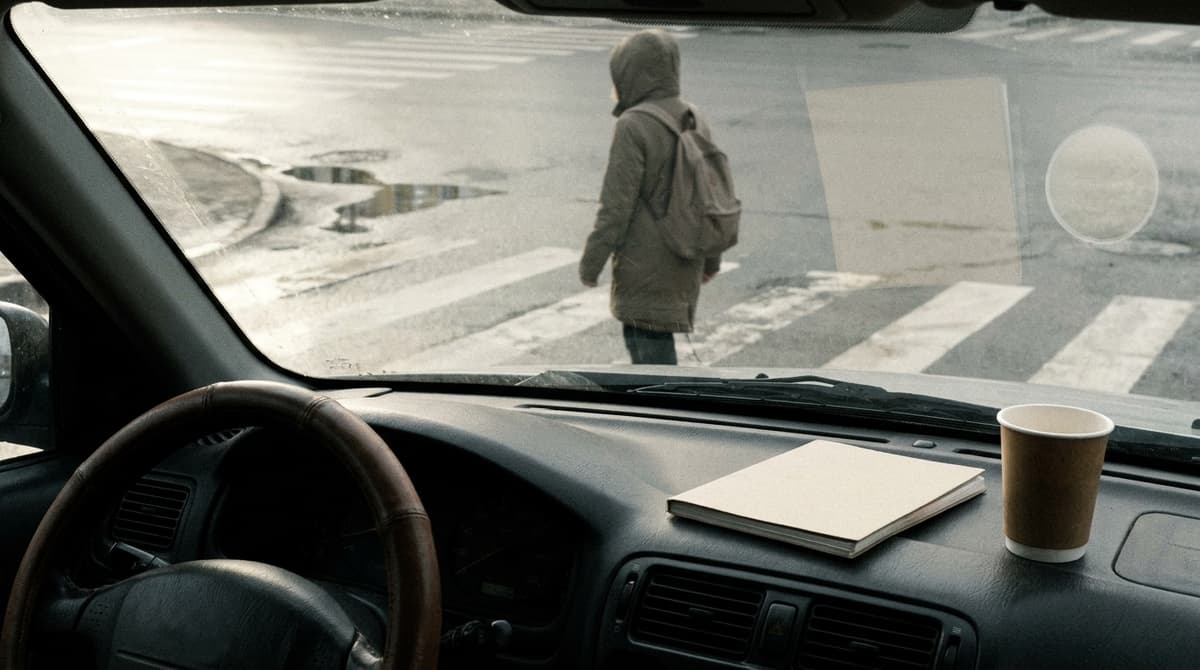
""Crosswalk" means: (1) That part of a roadway at an intersection included within the connections of the lateral lines of the sidewalks on opposite sides of the highway measured from the curbs, or, in the absence of curbs, from the edges of the traversable roadway, and in the absence of a sidewalk on one side of the roadway, the part of a roadway included within the extension of the lateral lines of the sidewalk at right angles to the center line; (2) Any portion of a roadway at an intersection or elsewhere, distinctly indicated for pedestrian crossing by lines or other markings on the surface, which might be supplemented by contrasting pavement texture, style, or color; (3) Notwithstanding divisions (LL)(1) and (2) of this section, "crosswalk" does not include an area where local authorities have placed signs indicating no crossing."
Division (1) describes the unmarked crosswalk at an intersection: the area between the sidewalk lines on opposite sides of the highway, or, where there is a sidewalk on only one side, the extension of that sidewalk's lines straight across the road. Division (2) covers a painted or otherwise marked crossing, at an intersection or mid-block. Division (3) is the one people miss: where local authorities have posted no-crossing signs, the area is not a crosswalk, even if it would otherwise qualify.
Traffic lights and WALK signals
Ohio's signal rules bind pedestrians directly. Under R.C. 4511.13, each of these applies unless a pedestrian signal under 4511.14 (or, for yellow and red, another traffic control device) directs otherwise:
- Green ball. Pedestrians facing a circular green "are permitted to proceed across the roadway within any marked or unmarked associated crosswalk," but "shall yield the right-of-way to vehicles lawfully within the intersection or so close as to create an immediate hazard at the time that the green signal indication is first displayed" (4511.13(A)(3)(a)).
- Green arrow. Pedestrians facing a green arrow "shall not cross the roadway" unless a pedestrian signal or other traffic control device directs otherwise (4511.13(A)(3)(b)). This catches people who step out when the only green they see is a turn arrow.
- Steady yellow. Pedestrians "shall not start to cross the roadway" (4511.13(B)(3)).
- Steady red or red arrow. Pedestrians "shall not enter the roadway" (4511.13(C)(3)).
- Flashing yellow or flashing red. Pedestrians at an intersection may cross within any marked or unmarked associated crosswalk, but must yield to vehicles lawfully within the intersection when the flashing signal is first displayed (4511.13(E)(3), (F)(2)).
Where a pedestrian signal is installed, R.C. 4511.14 controls:
"(A) A steady walking person signal indication, which symbolizes "walk," means that a pedestrian facing the signal indication is permitted to start to cross the roadway in the direction of the signal indication, possibly in conflict with turning vehicles. The pedestrian shall yield the right-of-way to vehicles lawfully within the intersection at the time that the walking person signal indication is first shown."
A flashing upraised hand, which symbolizes "don't walk," means a pedestrian "shall not start to cross the roadway in the direction of the signal indication, but that any pedestrian who has already started to cross on a steady walking person signal indication shall proceed to the far side of the traveled way" (4511.14(B)). A steady upraised hand means a pedestrian "shall not enter the roadway in the direction of the signal indication" (4511.14(C)). In other words, if the hand starts flashing while you are mid-crossing, the rule is to keep going, not to turn back.
Signs count too. R.C. 4511.12(A) provides that "No pedestrian, driver of a vehicle, or operator of a streetcar or trackless trolley shall disobey the instructions of any traffic control device placed in accordance with this chapter, unless at the time otherwise directed by a police officer."
Walking along the road and other pedestrian rules
R.C. 4511.50 sets where to walk when you are going along a road rather than across it. It works in order of preference: sidewalk, then shoulder, then the edge of the roadway. Where there is neither:
"(C) Where neither a sidewalk nor a shoulder is available, any pedestrian walking along and upon a highway shall walk as near as practicable to an outside edge of the roadway, and, if on a two-way roadway, shall walk only on the left side of the roadway. (D) Except as otherwise provided in sections 4511.13 and 4511.46 of the Revised Code, any pedestrian upon a roadway shall yield the right-of-way to all vehicles, trackless trolleys, or streetcars upon the roadway."
A violation of 4511.50 is a minor misdemeanor (4511.50(E)).
A few other sections in the same part of the code also govern people on foot:
- "Pedestrians shall move, whenever practicable, upon the right half of crosswalks" (4511.49(A)).
- "A pedestrian who is under the influence of alcohol, any drug of abuse, or any combination of them to a degree that renders the pedestrian a hazard shall not walk or be upon a highway" (4511.481(A)).
- "No person while on a roadway outside a safety zone shall solicit a ride from the driver of any vehicle," and, subject to an exception in division (B)(2), "no person shall stand on a highway for the purpose of soliciting employment, business, or contributions from the occupant of any vehicle" (4511.51(A), (B)(1)).
- "Upon the immediate approach of a public safety vehicle, as stated in section 4511.45 of the Revised Code, every pedestrian shall yield the right-of-way to the public safety vehicle" (4511.452(A)). A violation is a minor misdemeanor, with the same escalation for prior predicate offenses (4511.452(C)).
- "No pedestrian shall pass through, around, over, or under any crossing gate or barrier at a railroad grade crossing or bridge while the gate or barrier is closed or is being opened or closed" (4511.511(B)).
Sidewalk scooter riders owe pedestrians a duty too: an operator of a low-speed micromobility device may not "Fail to yield the right-of-way to all pedestrians at all times" or "Fail to give an audible signal before overtaking and passing a pedestrian" (4511.514(B)). For the riders' side of those rules, see Ohio e-scooter laws.
What drivers owe pedestrians in Ohio
Pedestrian rules do not shift every duty onto the person on foot. The main driver duty is R.C. 4511.46(A):
"(A) When highway traffic signals are not in place, not in operation, or are not clearly assigning the right-of-way, the driver of a vehicle, trackless trolley, or streetcar shall yield the right of way, slowing down or stopping if need be to so yield or if required by section 4511.132 of the Revised Code, to a pedestrian crossing the roadway within a crosswalk when the pedestrian is upon the half of the roadway upon which the vehicle is traveling, or when the pedestrian is approaching so closely from the opposite half of the roadway as to be in danger."
Other driver duties in the code:
- Turning on green or flashing yellow. Drivers facing a green light or green arrow, including drivers turning right or left, must yield to pedestrians lawfully within an associated crosswalk (4511.13(A)(1)(a), (A)(2)); the same applies on a flashing yellow light or flashing yellow arrow (4511.13(E)(1)(a), (E)(2)(a)).
- Right turn on red. A right turn on a steady red is allowed only after stopping, and the right to proceed is "subject to the provisions that are applicable after making a stop at a stop sign" (4511.13(C)(1)(b)).
- Sidewalks. "The driver of a vehicle shall yield the right-of-way to any pedestrian on a sidewalk" (4511.441(A)).
- No passing a stopped car at a crosswalk. When a vehicle is stopped at a marked crosswalk or an unmarked crosswalk at an intersection to let a pedestrian cross, a driver approaching from the rear "shall not overtake and pass the stopped vehicle" (4511.46(D)).
- Dark or failed signals. At a signal that is dark or not clearly assigning the right-of-way, a driver must "Stop at a clearly marked stop line, but if none, stop before entering the crosswalk on the near side of the intersection, or, if none, stop before entering the intersection" (4511.132).
- Blind pedestrians. "The driver of every vehicle shall yield the right of way to every blind pedestrian guided by a guide dog, or carrying a cane which is predominantly white or metallic in color, with or without a red tip" (4511.47).
- Due care even when the pedestrian is wrong. The crossing rules in 4511.48 do "not relieve the operator of a vehicle, streetcar, or trackless trolley from exercising due care to avoid colliding with any pedestrian upon any roadway" (4511.48(E)).
A driver's violation of 4511.46 is a minor misdemeanor, rising to a fourth-degree misdemeanor with one prior predicate motor vehicle or traffic conviction within a year (4511.46(E)).
Jaywalking fine and penalty in Ohio
Ohio treats a pedestrian crossing violation as a criminal offense at the lowest level, a minor misdemeanor, not a civil infraction. R.C. 4511.48(F) provides:
"(F) Except as otherwise provided in this division, whoever violates this section is guilty of a minor misdemeanor. If, within one year of the offense, the offender previously has been convicted of or pleaded guilty to one predicate motor vehicle or traffic offense, whoever violates this section is guilty of a misdemeanor of the fourth degree. If, within one year of the offense, the offender previously has been convicted of two or more predicate motor vehicle or traffic offenses, whoever violates this section is guilty of a misdemeanor of the third degree."
The fine for a minor misdemeanor is capped by R.C. 2929.28(A)(2)(a)(v): "For a minor misdemeanor, not more than one hundred fifty dollars." That section applies "in addition to imposing court costs pursuant to section 2947.23," so the amount due on a ticket can be higher than the fine alone.
Some pedestrian rules have no penalty of their own. The pedestrian signal section, 4511.14, is one. For those, R.C. 4511.99 supplies the same ladder: "Whoever violates any provision of sections 4511.01 to 4511.76 of the Revised Code for which no penalty otherwise is provided in the section violated" is guilty of a minor misdemeanor, a fourth-degree misdemeanor with one prior predicate offense within a year, or a third-degree misdemeanor with two or more.
| Charge | Offense level | Source |
|---|---|---|
| Crossing violation under 4511.48 (failing to yield outside a crosswalk, signalized-block crossing, diagonal crossing) | Minor misdemeanor; fine not more than $150 plus court costs | R.C. 4511.48(F), 2929.28 |
| Same, with one prior predicate traffic conviction within one year | Fourth-degree misdemeanor | R.C. 4511.48(F) |
| Same, with two or more prior predicate traffic convictions within one year | Third-degree misdemeanor | R.C. 4511.48(F) |
| Pedestrian signal violation under 4511.14 | Same ladder, through the residual penalty | R.C. 4511.99 |
| Stepping into the path of a close vehicle under 4511.46(B) | Minor misdemeanor, with the same escalation | R.C. 4511.46(E) |
| Walking along the roadway in violation of 4511.50 | Minor misdemeanor | R.C. 4511.50(E) |
| Pedestrian within a freeway right-of-way in violation of 4511.051 | Minor misdemeanor, with the same escalation | R.C. 4511.051(B) |
Ohio license points are assessed for the offenses listed in R.C. 4510.036(C), whose catch-all covers "moving violations," and R.C. 4510.01(E) excludes from that term "a violation of any statute or ordinance regulating pedestrians."
Each court sets its own amounts within those limits. R.C. 2935.26(E) provides: "Each court shall establish a fine schedule that shall list the fine for each minor misdemeanor, and state the court costs." The citation or the court named on it shows what is due.
Can police stop or arrest you for jaywalking in Ohio?
For a minor misdemeanor, the default is a ticket, not an arrest. R.C. 2935.26(A) provides that when an officer "is otherwise authorized to arrest a person for the commission of a minor misdemeanor, the officer shall not arrest the person, but shall issue a citation, unless one of the following applies: (1) The offender requires medical care or is unable to provide for the offender's own safety. (2) The offender cannot or will not offer satisfactory evidence of the offender's identity. (3) The offender refuses to sign the citation." The section lists further exceptions.
The practical point is the second exception: a pedestrian stopped for a crossing violation who cannot or will not offer satisfactory identification falls outside the cite-instead-of-arrest rule. Refusing to sign the citation does too.
Separately, R.C. 2921.29 makes it a fourth-degree misdemeanor for a person in a public place to refuse to give their name, address, or date of birth when requested by an officer who reasonably suspects the person is committing, has committed, or is about to commit a criminal offense (2921.29(A)(1), (B)). It does not require answering any questions beyond name, address, and date of birth (2921.29(C)).
Paying the ticket is not a neutral act. Under R.C. 2935.26, "Remittance by mail of the fine and costs to the office of the clerk of the court stated in the citation constitutes a guilty plea and waiver of trial whether or not the guilty plea and waiver of trial provision of the citation are signed by the defendant." A person who wants to contest the ticket should not mail in the payment.
Ohio's pedestrian sections, R.C. 4511.46 to 4511.52, contain no provision limiting when police may stop or cite a pedestrian for a crossing violation.
Local rules and posted signs
The state crossing rules apply across Ohio, but local authorities shape them in two ways. First, under R.C. 4511.07(A), the state traffic chapters "do not prevent local authorities from carrying out the following activities with respect to streets and highways under their jurisdiction and within the reasonable exercise of the police power," including "(2) Regulating traffic by means of police officers or traffic control devices." Second, a posted no-crossing sign removes an area from the definition of crosswalk (4511.01(LL)(3)), and disobeying a traffic control device is its own violation (4511.12(A)).
The state rules are uniform statewide, and "No local authority shall enact or enforce any rule in conflict with such sections" (R.C. 4511.06). So the signs at a particular crossing matter, and a city may also have its own traffic ordinances. To see whether your city adds pedestrian rules, look up its code of ordinances or ask the court named on a citation.
Pending legislation
House Bill 714 of the 136th General Assembly is titled "To amend sections 2903.08, 2903.081, 4511.14, and 4511.46 of the Revised Code to alter the laws governing vehicular assault and failing to yield the right of way to pedestrians." It is aimed at drivers who fail to yield to pedestrians and at vehicular assault; it does not amend the pedestrian crossing rules in 4511.48. As of October 2026, the legislature's bill page lists only the as-introduced version and shows Senate passage as not completed, so it is not law.
The current text of 4511.13, 4511.46 and 4511.48 took effect June 30, 2025, through House Bill 54 of the 136th General Assembly.
If a pedestrian is hit by a car
Whether a pedestrian crossed lawfully can matter after a collision, alongside the driver's yield duties and the duty of due care in 4511.48(E). For how fault and insurance claims work after a crash, see Ohio car accident laws.
Related pages
- Jaywalking laws by state
- Ohio car accident laws
- Ohio e-scooter laws
- Michigan jaywalking laws
- Indiana jaywalking laws
This article provides general legal information about Ohio law, not legal advice. For advice about a specific situation, contact a lawyer licensed in Ohio.
Last updated: 2026-10-10.
Frequently Asked Questions
Is jaywalking illegal in Ohio?
Crossing outside a crosswalk is allowed in Ohio only if you yield the right of way to all vehicles (R.C. 4511.48(A)). It is barred outright between adjacent intersections with operating traffic signals, except in a marked crosswalk, and when crossing an intersection diagonally unless traffic control devices allow it (4511.48(C), (D)). Posted no-crossing signs also control, and pedestrians may not be within a freeway right-of-way except in limited situations (R.C. 4511.051).
What is the fine for jaywalking in Ohio?
A violation of R.C. 4511.48 is a minor misdemeanor, and the fine for a minor misdemeanor is not more than $150 (R.C. 2929.28), plus court costs. Each court posts a fine schedule listing the fine and costs (R.C. 2935.26(E)).
Can jaywalking become more than a minor misdemeanor in Ohio?
Yes. Under R.C. 4511.48(F), it is a fourth-degree misdemeanor if the person was convicted of or pleaded guilty to one predicate motor vehicle or traffic offense within one year of the offense, and a third-degree misdemeanor with two or more.
Can you be arrested for jaywalking in Ohio?
For a minor misdemeanor the officer generally must issue a citation instead of arresting (R.C. 2935.26(A)). Exceptions include a person who needs medical care, cannot or will not offer satisfactory evidence of identity, or refuses to sign the citation. Separately, refusing to give your name, address, or date of birth to an officer who reasonably suspects you of a criminal offense is a fourth-degree misdemeanor (R.C. 2921.29).
Is paying a jaywalking ticket by mail a guilty plea in Ohio?
Yes. R.C. 2935.26 provides that mailing the fine and costs to the clerk of the court named in the citation constitutes a guilty plea and waiver of trial, whether or not the plea portion of the citation is signed.
Can I cross on a flashing DON'T WALK hand in Ohio?
You may not start to cross on a flashing upraised hand, but if you already started on the walking person signal you should continue to the far side (R.C. 4511.14(B)). A steady upraised hand means do not enter the roadway (4511.14(C)).
Do drivers have to stop for pedestrians in a crosswalk in Ohio?
When signals are not in place, not operating, or not clearly assigning the right of way, a driver must yield, slowing or stopping if needed, to a pedestrian in a crosswalk on the driver's half of the road or approaching so closely from the other half as to be in danger (R.C. 4511.46(A)). Drivers also may not pass a vehicle stopped at a crosswalk for a pedestrian (4511.46(D)).
Which side of the road should I walk on in Ohio?
Use the sidewalk or shoulder where available. Where neither exists, walk as near as practicable to an outside edge of the roadway and, on a two-way road, only on the left side (R.C. 4511.50(C)).
Updates
Independently fact-checked against the cited primary sources
The Law Behind This Article
This article rests on the statutory provisions below, held in our own legal record and retrieved from the official source. Tap a section to read the operative text.
Ohio Revised Code
§ 4511.48Right-of-way yielded by pedestrianIn force
(A) Every pedestrian crossing a roadway at any point other than within a marked crosswalk or within an unmarked crosswalk at an intersection shall yield the right of way to all vehicles, trackless trolleys, or streetcars upon the roadway.
Official text (excerpt) · last checked 2026-07-31 · Read the full text in our law library · Verify at codes.ohio.gov
§ 4511.46Right-of-way of pedestrian within crosswalkIn force
(A) When highway traffic signals are not in place, not in operation, or are not clearly assigning the right-of-way, the driver of a vehicle, trackless trolley, or streetcar shall yield the right of way, slowing down or stopping if need be to so yield or if required by section 4511.132 of the…
Official text (excerpt) · last checked 2026-07-31 · Read the full text in our law library · Verify at codes.ohio.gov
§ 4511.14Special pedestrian control signalsIn force
Whenever special pedestrian control signals exhibiting the words "walk" or "don't walk," or the symbol of a walking person or an upraised palm are in place, such signals shall indicate the following instructions: (A) A steady walking person signal indication, which symbolizes "walk," means that a…
Official text (excerpt) · last checked 2026-07-31 · Read the full text in our law library · Verify at codes.ohio.gov
§ 4511.13Highway traffic signal indications; section not applicable to railroad crossingsIn force
Highway traffic signal indications for vehicles and pedestrians shall have the following meanings: (A) Steady green signal indication: (1)(a) Vehicular traffic, streetcars, and trackless trolleys facing a circular green signal indication are permitted to proceed straight through or turn right or…
Official text (excerpt) · last checked 2026-07-31 · Read the full text in our law library · Verify at codes.ohio.gov
§ 4511.01Traffic laws - operation of motor vehicles definitionsIn forcecited in 4 of our articles
As used in this chapter and in Chapter 4513. of the Revised Code: (A) "Vehicle" means every device, including a bicycle, motorized bicycle, and an electric bicycle, in, upon, or by which any person or property may be transported or drawn upon a highway.
Official text (excerpt) · last checked 2026-07-31 · Read the full text in our law library · Verify at codes.ohio.gov
Cited in 299 court opinions in our collectionLatest citing opinion in our collection: 2026
Opinions citing this section in our collection:
- Norris v. Ohio Standard Oil Co. (Ohio Supreme Court 1982, 70 Ohio St. 2d 1)“…21 and 4511.25, together with “right of way” as defined in R. C. 4511.01 (UU), were violated and whose negligenc…”
- State v. Darrah (Ohio Supreme Court 1980, 64 Ohio St. 2d 22)“…ice, the disobedience of which constitutes a misdemeanor. R. C. 4511.01 (QQ) essentially defines a traffic cont…”
- Manufacturer's National Bank v. Erie County Road Commission (Ohio Supreme Court 1992, 63 Ohio St. 3d 318)“…Although not in effect at the time of the accident, present R.C. 4511.01(UU)(2) is helpful and defines “right-of…”
Identified automatically from the court opinions citing this section — not a ranking of which case controls.
Also relied on in: Ohio E-Scooter Laws: Sidewalk, Helmet & Age Rules (2026), Self-Driving Car Laws by State: Are They Legal? (2026), Is Lane Splitting Legal in Ohio? (2026 Law)
Search our full record of US law — 2.1 million sections, every state + federal →
Sources and References
- Ohio Revised Code 4511.48, Right-of-way yielded by pedestrian(codes.ohio.gov).gov
- Ohio Revised Code 2929.28, Financial sanctions for misdemeanors(codes.ohio.gov).gov
- Ohio Revised Code 4511.13, Highway traffic signal indications(codes.ohio.gov).gov
- Ohio Revised Code 4511.14, Special pedestrian control signals(codes.ohio.gov).gov
- Ohio Revised Code 2935.26, Citation instead of arrest for minor misdemeanor(codes.ohio.gov).gov
- Ohio Revised Code 4511.46, Right-of-way of pedestrian within crosswalk(codes.ohio.gov).gov
- Ohio Revised Code 4511.01, Definitions (crosswalk)(codes.ohio.gov).gov
- Ohio Revised Code 4511.12, Obeying traffic control devices(codes.ohio.gov).gov
- Ohio Revised Code 4511.50, Pedestrians walking along roadways(codes.ohio.gov).gov
- Ohio Revised Code 4511.49, Pedestrians on right half of crosswalks(codes.ohio.gov).gov
- Ohio Revised Code 4511.481, Intoxicated pedestrian on highway(codes.ohio.gov).gov
- Ohio Revised Code 4511.51, Soliciting rides, employment, business or contributions(codes.ohio.gov).gov
- Ohio Revised Code 4511.511, Pedestrians at bridges and railroad crossing gates(codes.ohio.gov).gov
- Ohio Revised Code 4511.514, Low-speed micromobility device operation(codes.ohio.gov).gov
- Ohio Revised Code 4511.132, Malfunctioning traffic signals(codes.ohio.gov).gov
- Ohio Revised Code 4511.47, Right-of-way of blind pedestrians(codes.ohio.gov).gov
- Ohio Revised Code 4511.99, Penalty for traffic violations with no other penalty(codes.ohio.gov).gov
- Ohio Revised Code 4511.07, Local traffic regulations(codes.ohio.gov).gov
- Ohio House Bill 714, 136th General Assembly(legislature.ohio.gov).gov
- Ohio Revised Code 4511.051, Prohibitions on freeways(codes.ohio.gov).gov
- Ohio Revised Code 4511.441, Right-of-way of pedestrians on sidewalks(codes.ohio.gov).gov
- Ohio Revised Code 4511.452, Pedestrian yields to public safety vehicle(codes.ohio.gov).gov
- Ohio Revised Code 4511.06, Uniform application of traffic laws(codes.ohio.gov).gov
- Ohio Revised Code 2921.29, Failure to disclose personal information(codes.ohio.gov).gov
- Ohio Revised Code 4510.01, Definitions (moving violation)(codes.ohio.gov).gov
- Ohio Revised Code 4510.036, Point system(codes.ohio.gov).gov