
Florida
Is Jaywalking Illegal in Florida? Crossing Rules and $15 Fine (2026)
Independently fact-checked against primary sources (last audited October 10, 2026). · 7 primary sources cited on this page. How we verify our legal content
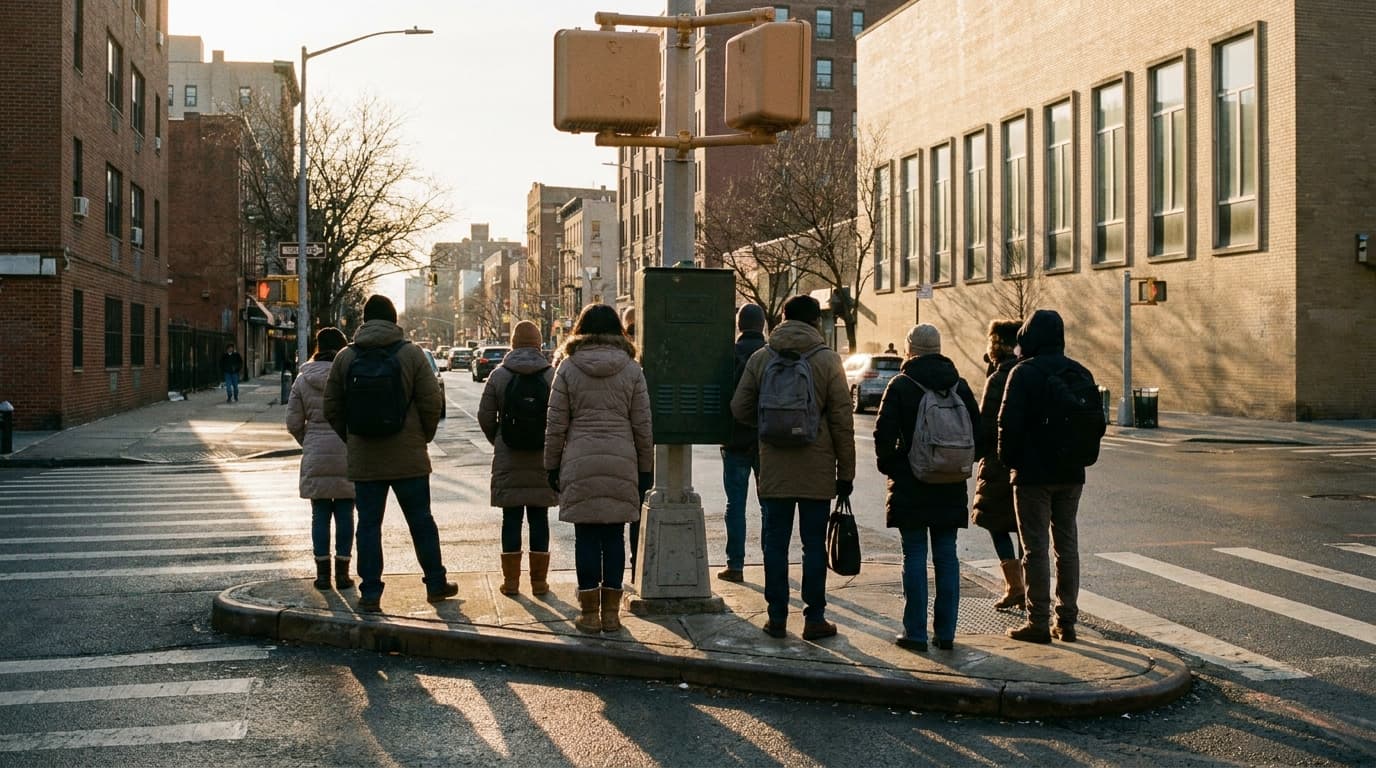
What most people call jaywalking is governed in Florida by Fla. Stat. 316.130, the pedestrian section of the state traffic code. A pedestrian may cross outside a crosswalk only by yielding the right-of-way to all vehicles, may not cross between two adjacent intersections with working traffic signals except in a marked crosswalk, and may not cross an intersection diagonally unless traffic control devices allow it. Cities and counties may also prohibit crossing in a business district or on a designated highway except on a crosswalk (Fla. Stat. 316.008(1)(q)). A violation is a noncriminal traffic infraction, and Fla. Stat. 318.18(1)(a) sets the civil penalty for pedestrian infractions at $15. For how other states handle the same question, see our guide to jaywalking laws by state.
Information last verified on 2026-10-10. This article has not been reviewed by a licensed lawyer.
Jurisdiction scope: This article covers Florida state law: the pedestrian rules in Fla. Stat. 316.130, the pedestrian signal rules in Fla. Stat. 316.075, the local-authority powers in Fla. Stat. 316.008, the noncriminal infraction procedure in Fla. Stat. 318.14, and the pedestrian penalty and court-cost provisions of Fla. Stat. 318.18. Statute text reflects the Florida Statutes as published by the Florida Legislature on 2026-10-10. It does not cover the text of any city or county ordinance, driver license points, injury claims after a crash, or the law of other states.
Is jaywalking illegal in Florida?
It depends on where and how you cross. Florida's pedestrian section mixes two kinds of rules. Some are duties to yield: crossing outside a crosswalk is allowed, but the pedestrian must let traffic go first. Others are flat prohibitions that apply even when the road is clear, such as crossing mid-block between two signalized intersections outside a marked crosswalk.
| Situation | Florida rule |
|---|---|
| Crossing outside a marked crosswalk or an unmarked crosswalk at an intersection | Allowed under state law, but the pedestrian must yield the right-of-way to all vehicles (316.130(10)); a city or county may require a crosswalk in a business district or on a designated highway (316.008(1)(q)) |
| Crossing between adjacent intersections with traffic control signals in operation | Only in a marked crosswalk (316.130(11)) |
| Crossing outside a marked crosswalk at an angle | Barred; the route must be at right angles to the curb or the shortest route to the opposite curb (316.130(12)) |
| Crossing an intersection diagonally | Barred unless authorized by official traffic control devices (316.130(14)) |
| Crossing where a pedestrian tunnel or overhead crossing is provided | Allowed, but the pedestrian must yield the right-of-way to all vehicles (316.130(7)(c)) |
| Suddenly leaving a curb or other place of safety into the path of a vehicle too close to yield | Barred (316.130(8)) |
| Starting to cross on a steady yellow, or entering the roadway on a steady red, with no pedestrian signal directing otherwise | Barred (316.075(1)(b)2, (1)(c)2.b) |
| Ignoring a traffic control device that applies to pedestrians | Barred unless a police officer directs otherwise (316.130(1)) |
| Walking in the roadway where sidewalks are provided | Barred unless other circumstances require it (316.130(3)) |
| Walking on a limited access facility or its connecting ramps | Barred, except for government maintenance personnel (316.130(18)) |
Each row is a noncriminal traffic infraction if violated (316.130(19), 316.075(4)).
Crossing outside a crosswalk
Subsection (10) of Fla. Stat. 316.130 is the basic rule for crossing anywhere other than a crosswalk:

"(10) Every pedestrian crossing a roadway at any point other than within a marked crosswalk or within an unmarked crosswalk at an intersection shall yield the right-of-way to all vehicles upon the roadway."
This is a duty to yield, not a ban. A pedestrian who crosses mid-block when no vehicle is approaching, or who waits for a gap and lets cars pass first, complies with subsection (10), subject to the route and location rules below and to any local rule described under "City and county rules." The violation under subsection (10) is failing to yield.
Subsection (10) also treats two kinds of crosswalks the same way: a marked crosswalk, and an unmarked crosswalk at an intersection. A pedestrian crossing at an intersection within an unmarked crosswalk is not crossing "at any point other than" a crosswalk, so subsection (10)'s yield duty does not apply there. The other crossing rules below are narrower: subsections (11) and (12) refer only to a marked crosswalk.
Fla. Stat. 316.003 defines a crosswalk as either the part of a roadway at an intersection within the connections of the lateral lines of the sidewalks on opposite sides of the highway, measured from the curbs or, without curbs, from the edges of the traversable roadway, or any portion of a roadway, at an intersection or elsewhere, distinctly indicated for pedestrian crossing by lines or other markings on the surface. An intersection can therefore have a crosswalk with no paint on the road.
Crossing between signalized intersections and diagonally
Three more rules in 316.130 limit where and how a pedestrian may cross:
"(11) Between adjacent intersections at which traffic control signals are in operation, pedestrians shall not cross at any place except in a marked crosswalk. (12) No pedestrian shall, except in a marked crosswalk, cross a roadway at any other place than by a route at right angles to the curb or by the shortest route to the opposite curb."
"(14) No pedestrian shall cross a roadway intersection diagonally unless authorized by official traffic control devices"
Subsection (11) is the closest Florida comes to a flat mid-block ban. It applies only on a stretch of road between two adjacent intersections where traffic control signals are in operation. On that stretch, yielding to traffic is not enough: the crossing must be in a marked crosswalk.
Subsection (12) governs the path. Outside a marked crosswalk, a pedestrian must cross straight across, at right angles to the curb or by the shortest route to the other side, rather than angling down the road. Subsection (14) bars cutting diagonally through an intersection unless official traffic control devices authorize it.
Two more rules in the same section govern crossings. Where a tunnel or overpass has been built, subsection (7)(c) provides: "Any pedestrian crossing a roadway at a point where a pedestrian tunnel or overhead pedestrian crossing has been provided shall yield the right-of-way to all vehicles upon the roadway." Subsection (8), which applies even in a crosswalk, provides: "No pedestrian shall suddenly leave a curb or other place of safety and walk or run into the path of a vehicle which is so close that it is impossible for the driver to yield."
City and county rules
The state rules can be tightened locally. Fla. Stat. 316.008(1) provides that chapter 316 does not prevent local authorities, "with respect to streets and highways under their jurisdiction and within the reasonable exercise of the police power," from "(q) Prohibiting pedestrians from crossing a roadway in a business district or any designated highway except on a crosswalk" and "(r) Regulating pedestrian crossings at unmarked crosswalks." Where a city or county has adopted such a rule, crossing mid-block there can be cited even if the pedestrian yields. Check local rules and posted signs before crossing outside a crosswalk in a business district.
Walk signals and traffic lights
Pedestrians in Florida must follow the signals and devices that apply to them. Fla. Stat. 316.130 provides:
"(1) A pedestrian shall obey the instructions of any official traffic control device specifically applicable to the pedestrian unless otherwise directed by a police officer. (2) Pedestrians shall be subject to traffic control signals at intersections as provided in s. 316.075, but at all other places pedestrians shall be accorded the privileges and be subject to the restrictions stated in this chapter."
Subsection (1) covers any official traffic control device specifically applicable to pedestrians. Subsection (2) ties pedestrians at intersections to the ordinary traffic signal rules in Fla. Stat. 316.075, which address pedestrians directly. Unless a pedestrian control signal directs otherwise, pedestrians facing any green signal, except when the sole green signal is a turn arrow, "may proceed across the roadway within any marked or unmarked crosswalk" (316.075(1)(a)3). Facing a steady yellow, "no pedestrian shall start to cross the roadway" (316.075(1)(b)2), and facing a steady red, pedestrians "shall not enter the roadway" (316.075(1)(c)2.b). A violation of 316.075 is a noncriminal traffic infraction, punishable under chapter 318 as a pedestrian violation (316.075(4)).
Where a separate pedestrian signal is installed, it controls instead of the vehicle light. Fla. Stat. 316.0755 provides that pedestrian indicators "must conform to the requirements of the most recent Manual on Uniform Traffic Control Devices," and 316.130(1) requires pedestrians to obey a device specifically applicable to them. Away from intersections, the pedestrian rules in chapter 316 apply instead. Under subsection (1), directions from a police officer take precedence over the device.
Walking along the road
Florida also regulates walking along a road, not just crossing it:
"(3) Where sidewalks are provided, no pedestrian shall, unless required by other circumstances, walk along and upon the portion of a roadway paved for vehicular traffic. (4) Where sidewalks are not provided, any pedestrian walking along and upon a highway shall, when practicable, walk only on the shoulder on the left side of the roadway in relation to the pedestrian's direction of travel, facing traffic which may approach from the opposite direction."
Limited access facilities are off limits on foot. Subsection (18) provides: "No pedestrian shall walk upon a limited access facility or a ramp connecting a limited access facility to any other street or highway; however, this subsection does not apply to maintenance personnel of any governmental subdivision."
What drivers owe pedestrians
A pedestrian's duty to yield outside a crosswalk sits alongside duties that 316.130 places on drivers. At signalized intersections, subsection (7)(a) provides:

"(7)(a) The driver of a vehicle at an intersection that has a traffic control signal in place shall stop before entering the crosswalk and remain stopped to allow a pedestrian, with a permitted signal, to cross a roadway when the pedestrian is in the crosswalk or steps into the crosswalk"
The other driver duties in the same section:
- At any crosswalk where signage so indicates, the driver must stop and remain stopped for a pedestrian in the crosswalk on the driver's half of the roadway, or approaching so closely from the opposite half as to be in danger (316.130(7)(b)).
- Where traffic control signals are not in place or in operation and no signage indicates otherwise, the driver must yield to a pedestrian crossing within a crosswalk on the driver's half of the roadway, or approaching so closely from the opposite half as to be in danger, "slowing down or stopping if need be to so yield" (316.130(7)(c)).
- When a vehicle is stopped at a marked crosswalk or an unmarked crosswalk at an intersection to let a pedestrian cross, a driver approaching from the rear "shall not overtake and pass such stopped vehicle" (316.130(9)).
- Notwithstanding the other rules, every driver "shall exercise due care to avoid colliding with any pedestrian," give warning when necessary, and exercise proper precaution upon observing any child or any obviously confused or incapacitated person (316.130(15)).
At a green light, drivers turning right or left must also yield to pedestrians lawfully within the intersection or an adjacent crosswalk (316.075(1)(a)1).
The same section also reaches people operating vehicles. Under 316.130(19), if a violation of the section "resulted from the operation of a vehicle," it is punished as a moving violation rather than as a pedestrian violation.
Jaywalking fine and penalty in Florida
Jaywalking is not a crime in Florida. Fla. Stat. 316.130(19) provides:
"(19) A violation of this section is a noncriminal traffic infraction, punishable pursuant to chapter 318 as either a pedestrian violation or, if the infraction resulted from the operation of a vehicle, as a moving violation."
Chapter 318 supplies the procedure and the amount. Under Fla. Stat. 318.14(1), a person cited for a violation of chapter 316 "is charged with a noncriminal infraction and must be cited for such an infraction and cited to appear before an official."
The amount comes from Fla. Stat. 318.18, which opens: "The penalties required for a noncriminal disposition pursuant to s. 318.14 or a criminal offense listed in s. 318.17 are as follows: (1) Fifteen dollars for: (a) All infractions of pedestrian regulations."
| Item | Amount | Source |
|---|---|---|
| Civil penalty, any pedestrian infraction | $15 | Fla. Stat. 318.18(1)(a) |
| Court costs for pedestrian infractions | $4 (the clerk remits $1 of it to the Department of Revenue) | Fla. Stat. 318.18(12)(a)1 |
| Additional court costs per infraction | $2.50, plus $3, plus a further $2 when assessed by a municipality or county | Fla. Stat. 318.18(12)(c), (d) |
| Additional cost in certain counties | Up to $3 in counties authorized by the special acts listed in the statute | Fla. Stat. 318.18(12)(b) |
| County court-facilities surcharge | Up to $30 if the county imposes it by ordinance; the court may not waive it | Fla. Stat. 318.18(14)(a)1 |
The $15 penalty is the statutory figure for every infraction of the pedestrian regulations, whether the citation is for failing to yield mid-block, crossing diagonally, or walking on a limited access road. These are the figures the statute states; the citation itself or the clerk of court in the county where it was issued shows the total amount due.
A person who pays within 30 days "shall be deemed to have admitted the infraction and to have waived his or her right to a hearing," although that admission "shall not be used as evidence in any other proceedings" (Fla. Stat. 318.14(4)). A person who elects to appear before the official gives up the $15 schedule in 318.18; if the infraction is proven, "the official may impose a civil penalty not to exceed $500" (318.14(5)).
Can police stop you for jaywalking in Florida?
Yes. A pedestrian violation is handled by citation: 318.14(1) applies to "any person cited for a violation of chapter 316," which includes 316.130. Fla. Stat. 316.130 contains no provision limiting police stops for pedestrian violations, and its history line shows no amendment since chapter 2008-33, Laws of Florida.
If a pedestrian is hit by a car
Whether a pedestrian was crossing legally can come up after a collision, alongside the driver duties in 316.130(7), (9) and (15). For how no-fault insurance, fault and filing deadlines work after a crash, see Florida car accident laws. Electric scooter riders follow a separate set of rules, covered in Florida e-scooter laws.
Related pages
- Jaywalking laws by state
- Florida car accident laws
- Florida e-scooter laws
- Georgia jaywalking laws
- Alabama jaywalking laws
This article provides general legal information about Florida law, not legal advice. For advice about a specific situation, contact a lawyer licensed in Florida.
Last updated: 2026-10-10.
Frequently Asked Questions
Is jaywalking illegal in Florida?
Under state law, crossing outside a crosswalk is allowed only if you yield the right-of-way to all vehicles (Fla. Stat. 316.130(10)), and a city or county may prohibit crossing in a business district or on a designated highway except on a crosswalk (316.008(1)(q)). Between adjacent intersections with working traffic signals you may cross only in a marked crosswalk (316.130(11)), and diagonal crossing at an intersection is barred unless traffic control devices authorize it (316.130(14)).
What is the fine for jaywalking in Florida?
Fla. Stat. 318.18(1)(a) sets a $15 civil penalty for all infractions of pedestrian regulations. Court costs are added: $4 for pedestrian infractions plus per-infraction costs of $2.50 and $3 (and $2 more when assessed by a municipality or county), and a county may add a court-facilities surcharge of up to $30 (318.18(12), (14)). Paying is deemed an admission of the infraction; a person who elects a hearing gives up the $15 schedule and faces a civil penalty of up to $500 if the infraction is proven (318.14(4), (5)). Check the citation or the county clerk of court for the total due.
Is jaywalking a crime in Florida?
No. Fla. Stat. 316.130(19) makes a violation of the pedestrian section a noncriminal traffic infraction, punished under chapter 318 as a pedestrian violation.
Can I cross in the middle of the block in Florida?
Under state law, yes, if you yield the right-of-way to all vehicles (316.130(10)) and cross at right angles or by the shortest route to the opposite curb (316.130(12)). Between two adjacent intersections with traffic control signals in operation, you may cross only in a marked crosswalk (316.130(11)). A city or county may also prohibit crossing in a business district or on a designated highway except on a crosswalk (Fla. Stat. 316.008(1)(q)), so check local rules and posted signs.
Can I cross an intersection diagonally in Florida?
Only where official traffic control devices authorize it. Fla. Stat. 316.130(14) says no pedestrian shall cross a roadway intersection diagonally unless authorized by official traffic control devices.
Which side of the road should I walk on in Florida?
Use the sidewalk where one is provided (316.130(3)). Where there is no sidewalk, Fla. Stat. 316.130(4) says to walk, when practicable, only on the shoulder on the left side of the roadway, facing oncoming traffic.
Can you walk on a highway ramp or limited access road in Florida?
No. Fla. Stat. 316.130(18) bars pedestrians from walking on a limited access facility or a ramp connecting one to another street or highway; the rule does not apply to government maintenance personnel.
Do drivers have to stop for pedestrians in Florida?
Yes. At an intersection with a traffic control signal, a driver must stop before entering the crosswalk and remain stopped to let a pedestrian with a permitted signal cross (Fla. Stat. 316.130(7)(a)); the same stop duty applies at crosswalks where signage so indicates (7)(b). Where no signal is in place or operating, a driver must yield to a pedestrian within a crosswalk, slowing or stopping if need be (7)(c). Drivers may not pass a vehicle stopped for a pedestrian at a crosswalk (316.130(9)) and must exercise due care to avoid colliding with any pedestrian (316.130(15)).
Can I start crossing on a yellow light in Florida?
No, unless a pedestrian signal directs otherwise. Under Fla. Stat. 316.075(1)(b)2, no pedestrian facing a steady yellow signal shall start to cross the roadway, and under 316.075(1)(c)2.b, pedestrians facing a steady red signal shall not enter the roadway. On a green signal other than a lone turn arrow, pedestrians may cross within any marked or unmarked crosswalk (316.075(1)(a)3).
Updates
Independently fact-checked against the cited primary sources
The Law Behind This Article
This article rests on the statutory provisions below, held in our own legal record and retrieved from the official source. Tap a section to read the operative text.
Florida Statutes
§ 316.130Pedestrians; traffic regulations.In force
(1) A pedestrian shall obey the instructions of any official traffic control device specifically applicable to the pedestrian unless otherwise directed by a police officer. (2) Pedestrians shall be subject to traffic control signals at intersections as provided in s. 316.075, but at all other places pedestrians shall be accorded the privileges and be subject to the restrictions stated in this chapter. (3) Where sidewalks are provided, no pedestrian shall, unless required by other circumstances, walk along and upon the portion of a roadway paved for vehicular traffic. (4) Where sidewalks are not provided, any pedestrian walking along and upon a highway shall, when practicable, walk only on the shoulder on the left side of the roadway in relation to the pedestrian’s direction of travel, facing traffic which may approach from the opposite direction. (5) No person shall stand in the portion of a roadway paved for vehicular traffic for the purpose of soliciting a ride, employment, or business from the occupant of any vehicle.
Official text (excerpt) · last checked 2026-07-28 · Read the full text in our law library · Verify at leg.state.fl.us
§ 316.075Traffic control signal devices.In force
(1) Except for automatic warning signal lights installed or to be installed at railroad crossings, whenever traffic, including municipal traffic, is controlled by traffic control signals exhibiting different colored lights, or colored lighted arrows, successively one at a time or in combination, only the colors green, red, and yellow shall be used, except for special pedestrian signals carrying a word legend, and the lights shall indicate and apply to drivers of vehicles and pedestrians as follows:(a) Green indication.—1. Vehicular traffic facing a circular green signal may proceed cautiously straight through or turn right or left unless a sign at such place prohibits either such turn. But vehicular traffic, including vehicles turning right or left, shall yield the right-of-way to other vehicles and to pedestrians lawfully within the intersection or an adjacent crosswalk at the time such signal is exhibited. 2.
Official text (excerpt) · last checked 2026-07-28 · Read the full text in our law library · Verify at leg.state.fl.us
§ 316.003Definitions.In forcecited in 4 of our articles
The following words and phrases, when used in this chapter, shall have the meanings respectively ascribed to them in this section, except where the context otherwise requires:(1) AUTHORIZED EMERGENCY VEHICLES.—Vehicles of the fire department, fire patrol, police vehicles, emergency management vehicles, organ transport vehicles, and ambulances and emergency vehicles of municipal and county departments, volunteer ambulance services, public service corporations operated by private corporations, the Fish and Wildlife Conservation Commission, the Department of Environmental Protection, the Department of Health, the Department of Transportation, the Department of Agriculture and Consumer Services, and the Department of Corrections as are designated or authorized by their respective departments or the chief of police of an incorporated city or any sheriff of any of the various counties. (2) AUTOCYCLE.—A three-wheeled motorcycle that has two wheels in the front and one wheel in the back; is equipped with a roll cage or roll hoops, a seat belt for each occupant, brakes that meet the requirements of Federal Motor Vehicle Safety Standard No.
Official text (excerpt) · last checked 2026-07-28 · Read the full text in our law library · Verify at leg.state.fl.us
Cited in 20 court opinions in our collectionLatest citing opinion in our collection: 2025
Opinions citing this section in our collection:
- In re Standard Jury Instructions in Criminal Cases-Report No. 2012-05 (Supreme Court of Florida 2013, 131 So. 3d 755)“…ent disfigurement] was caused to (victim). Definition. Fla. Stat. § 316.003 (21). Motor vehicle means a self-pr…”
- In re Standard Jury Instructions in Criminal Cases-Rreport No. 2012-08 (Supreme Court of Florida 2013, 131 So. 3d 692)“…be done to persons or property. Optional-Definitions.- Fla. Stat. § 316.003 (75). A “vehicle” is any device in,…”
- In Re STANDARD JURY INSTRUCTIONS IN CRIMINAL CASES-REPORT NO. 2013-04 (Supreme Court of Florida 2015, 166 So. 3d 161)“…satisfies this element of the offense. Definitions. Fla. Stat. § 316.003(75). A “vehicle” is every device,…”
Identified automatically from the court opinions citing this section — not a ranking of which case controls.
Also relied on in: Florida E-Scooter Laws: Sidewalk, Helmet & Age Rules (2026), Can You Get a DUI in a Self-Driving Car or Waymo? (2026), Is Lane Splitting Legal in Florida? (2026 Law and Fines)
Search our full record of US law — 2.1 million sections, every state + federal →
Sources and References
- Fla. Stat. 316.130, Pedestrians; traffic regulations(leg.state.fl.us).gov
- Fla. Stat. 318.18, Amount of penalties(leg.state.fl.us).gov
- Fla. Stat. 318.14, Noncriminal traffic infractions; procedure(leg.state.fl.us).gov
- Fla. Stat. 316.075, Traffic control signal devices(leg.state.fl.us).gov
- Fla. Stat. 316.0755, Pedestrian control signals(leg.state.fl.us).gov
- Fla. Stat. 316.008, Powers of local authorities(leg.state.fl.us).gov
- Fla. Stat. 316.003, Definitions (crosswalk)(leg.state.fl.us).gov