
Georgia
Is Jaywalking Illegal in Georgia? Crossing Rules and Penalties (2026)
Independently fact-checked against primary sources (last audited October 10, 2026). · 1 primary source cited on this page. How we verify our legal content

"Jaywalking" is not a term in the Georgia Code, but O.C.G.A. 40-6-92 covers what most people mean by it. A pedestrian crossing outside a marked crosswalk or an unmarked crosswalk at an intersection must yield the right of way to all vehicles, unless already safely in the roadway; between two adjacent intersections with working traffic signals, pedestrians may cross only in a marked crosswalk; and diagonal crossing at an intersection is barred unless traffic-control devices authorize it. A violation is a misdemeanor under O.C.G.A. 40-6-1(a). For how other states handle the same question, see our guide to jaywalking laws by state.
Information last verified on 2026-10-10. This article has not been reviewed by a licensed lawyer.
Jurisdiction scope: This article covers Georgia state law in the Official Code of Georgia Annotated (O.C.G.A.): the pedestrian rules in 40-6-90, 40-6-91, 40-6-92, 40-6-93 and 40-6-96, the signal rules in 40-6-21 and 40-6-22, the crosswalk definition in 40-1-1, the general penalty rule in 40-6-1, and the misdemeanor sentencing limits in 17-10-3. It does not cover city or county ordinances, court fine schedules, driver license points, injury claims after a crash, or the law of other states.
Is jaywalking illegal in Georgia?
It depends on where you cross. The Georgia Governor's Office of Highway Safety puts it plainly: "'Jaywalking' is not a legal term and does not appear in the Georgia Code." What the Code does contain is a set of specific pedestrian rules. Some are duties to yield, which a pedestrian meets by letting traffic go first. Others are flat prohibitions that apply even on an empty road.
| Situation | Georgia rule |
|---|---|
| Crossing outside a marked crosswalk or an unmarked crosswalk at an intersection | Allowed, but the pedestrian must yield to all vehicles unless already, and under safe conditions, in the roadway (40-6-92(a)) |
| Crossing between adjacent intersections with traffic-control signals in operation | Only in a marked crosswalk (40-6-92(c)) |
| Crossing an intersection diagonally | Barred unless authorized by official traffic-control devices (40-6-92(d)) |
| Crossing the roadway where a pedestrian tunnel or overhead crossing is provided | Allowed, but a pedestrian who uses the roadway instead must yield the right of way to all vehicles (40-6-92(b)) |
| Starting to cross on a steady yellow, or entering the roadway on a steady red or red arrow, with no pedestrian signal directing otherwise | Barred (40-6-21) |
| Ignoring a traffic-control device that applies to pedestrians | Barred unless a police officer directs otherwise (40-6-90(a)) |
| Starting to cross on a flashing or steady DON'T WALK | Barred (40-6-22(2)) |
| Suddenly leaving a curb into the path of a vehicle too close to yield | Barred (40-6-91(b)) |
| Standing or striding along the roadway next to a sidewalk | Barred, with two exceptions (40-6-96(b)) |
Crossing outside a crosswalk
O.C.G.A. 40-6-92(a) sets the basic rule, and its last clause matters:
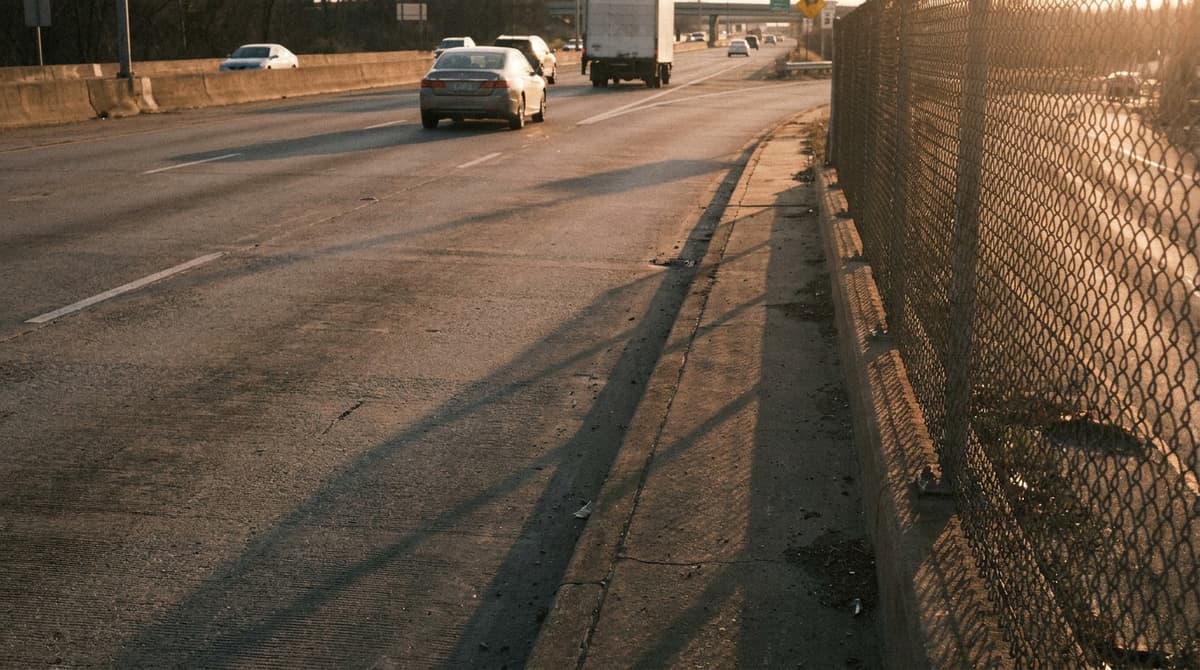
"(a) Every pedestrian crossing a roadway at any point other than within a marked crosswalk or within an unmarked crosswalk at an intersection shall yield the right of way to all vehicles upon the roadway unless he has already, and under safe conditions, entered the roadway."
This is a duty to yield, not a ban on crossing mid-block. A pedestrian outside a crosswalk who waits for a gap and lets vehicles pass meets it. The final clause limits the duty: it does not run against a pedestrian who "has already, and under safe conditions, entered the roadway." The clause is conjunctive: the pedestrian must already be in the roadway, and must have entered under safe conditions.
Subsection (a) also names two kinds of crosswalk: a marked crosswalk, and an unmarked crosswalk at an intersection. A pedestrian crossing within an unmarked crosswalk at an intersection is not crossing "at any point other than" a crosswalk, so subsection (a)'s yield duty does not apply there. Subsection (c), discussed next, is narrower and requires a marked crosswalk.
O.C.G.A. 40-1-1 defines a crosswalk as either the part of a roadway at an intersection within the connections of the lateral lines of the sidewalks on opposite sides of the highway, measured from the curbs or, without curbs, from the edges of the traversable roadway, or any portion of a roadway, at an intersection or elsewhere, distinctly indicated for pedestrian crossing by lines or other markings on the surface. An intersection can therefore have a crosswalk with no paint on the road.
Separately, O.C.G.A. 40-6-91(b) provides: "No pedestrian shall suddenly leave a curb or other place of safety and walk or run into the path of a vehicle which is so close that it is impractical for the driver to yield."
Crossing between signalized intersections and diagonally
Two rules in 40-6-92 are flat limits rather than yield duties:
"(c) Between adjacent intersections at which traffic-control signals are in operation, pedestrians shall not cross at any place except in a marked crosswalk. ... (d) No pedestrian shall cross a roadway intersection diagonally unless authorized by official traffic-control devices."
Subsection (c) applies only on a block bounded by two adjacent intersections that both have traffic-control signals in operation. On that block, yielding to traffic is not enough: a crossing outside a marked crosswalk violates the subsection even if no car is coming. Subsection (d) bars cutting diagonally through an intersection unless official traffic-control devices authorize it.
Subsection (b) covers places with a tunnel or overpass: "Any pedestrian crossing a roadway at a point where a pedestrian tunnel or overhead pedestrian crossing has been provided shall yield the right of way to all vehicles upon the roadway if he uses the roadway instead of such tunnel or crossing."
WALK and DON'T WALK signals
Georgia pedestrians must follow both devices aimed at them and the signal rules. O.C.G.A. 40-6-90 provides:
"(a) A pedestrian shall obey the instructions of any official traffic-control device specifically applicable to him, unless otherwise directed by a police officer. (b) Pedestrians shall be subject to traffic and pedestrian control signals as provided in Code Sections 40-6-21 and 40-6-22."
Code Section 40-6-22 governs pedestrian signal heads. Under its WALK paragraph, "Pedestrians facing such signal may proceed across the roadway in the direction of the signal" (40-6-22(1)). Its DON'T WALK paragraph reads:
"(2) Flashing or steady DON'T WALK. No pedestrian shall start to cross the roadway in the direction of such signal, but any pedestrian who has partially completed his crossing on the WALK signal shall proceed to sidewalk or safety island while the DON'T WALK signal is showing."
A flashing DON'T WALK is therefore not permission to start: the rule bars starting on either a flashing or steady signal, while letting someone already partway across on WALK finish to the sidewalk or a safety island. Under 40-6-90(b), pedestrians are also subject to traffic-control signals as provided in Code Section 40-6-21, which matters at intersections with no pedestrian signal. Unless a pedestrian signal directs otherwise, pedestrians facing any green indication, except when the sole green indication is a turn arrow, "may proceed across the roadway within any marked or unmarked crosswalk." Facing a steady yellow, "no pedestrian shall then start to cross the roadway," and facing a steady circular red alone or a steady red arrow, pedestrians "shall not enter the roadway" (40-6-21(a)).
Walking along the road
O.C.G.A. 40-6-96(b) limits walking in the roadway where a sidewalk exists:
"(b) Where a sidewalk is provided, it shall be unlawful for any pedestrian to stand or stride along and upon an adjacent roadway unless there is no motor vehicle traveling within 1,000 feet of such pedestrian on such roadway or the available sidewalk presents an imminent threat of bodily injury to such pedestrian."
The rule has two exceptions, and either one is enough: no motor vehicle traveling within 1,000 feet of the pedestrian on that roadway, or a sidewalk that presents an imminent threat of bodily injury.
The same section covers roads with no sidewalk. Where a shoulder is available, a pedestrian standing or striding along the highway "shall stand or stride only on the shoulder, as far as practicable from the edge of the roadway" (40-6-96(c)). Where there is neither a sidewalk nor a shoulder, the pedestrian keeps as near as practicable to an outside edge of the roadway and, on a two-lane roadway, only on the left side (40-6-96(d)). Except as otherwise provided in the chapter, "any pedestrian upon a roadway shall yield the right of way to all vehicles upon the roadway" (40-6-96(e)).
What drivers owe pedestrians
A pedestrian's duty to yield does not relieve drivers of theirs. At crosswalks, O.C.G.A. 40-6-91(a) requires drivers to stop, not merely yield:
"(a) The driver of a vehicle shall stop and remain stopped to allow a pedestrian to cross the roadway within a crosswalk when the pedestrian is upon the half of the roadway upon which the vehicle is traveling, or when the pedestrian is approaching and is within one lane of the half of the roadway on which the vehicle is traveling or onto which it is turning."
For this rule, "half of the roadway" means all traffic lanes carrying traffic in one direction of travel. The stop duty applies at marked and unmarked crosswalks, but not where a pedestrian uses the roadway instead of a provided tunnel or overhead crossing (40-6-91(c)). When a vehicle is stopped at a crosswalk to let a pedestrian cross, a driver approaching from the rear "shall not overtake and pass such stopped vehicle" (40-6-91(d)).
At signals, every driver "shall stop and remain stopped" for pedestrians crossing on a WALK signal (40-6-22(1)), and drivers facing a green light, including turning drivers, or turning right on red must stop and remain stopped for a pedestrian in the crosswalk on the same half-of-the-roadway terms (40-6-21(a)).
O.C.G.A. 40-6-93 applies "notwithstanding other provisions of this chapter":
"Notwithstanding other provisions of this chapter, every driver of a vehicle shall exercise due care to avoid colliding with any pedestrian upon any roadway, shall give warning by sounding his horn when necessary, and shall exercise proper precautions upon observing any child or any obviously confused, incapacitated, or intoxicated person."
The duty reaches "any pedestrian upon any roadway," including one crossing outside a crosswalk, and it adds a heightened duty of proper precautions around children and anyone obviously confused, incapacitated or intoxicated.
Jaywalking penalty in Georgia
Georgia's pedestrian sections quoted here set no fine of their own, so the general penalty rule for Chapter 6 of Title 40 applies. O.C.G.A. 40-6-1(a) provides:
"(a) It is unlawful and, unless otherwise declared in this chapter with respect to particular offenses, it is a misdemeanor for any person to do any act forbidden or fail to perform any act required in this chapter."
The general misdemeanor sentencing statute, O.C.G.A. 17-10-3(a)(1), provides that "Except as otherwise provided by law, every crime declared to be a misdemeanor shall be punished" by "a fine not to exceed $1,000.00 or by confinement in the county or other jail ... for a total term not to exceed 12 months, or both."
| Layer | Georgia rule | Source |
|---|---|---|
| Classification | Misdemeanor, unless Chapter 6 declares otherwise for the particular offense | O.C.G.A. 40-6-1(a) |
| Maximum fine | Up to $1,000 | O.C.G.A. 17-10-3(a)(1) |
| Maximum confinement | Up to 12 months, or fine and confinement both | O.C.G.A. 17-10-3(a)(1) |
Those are statutory ceilings, not a ticket price. The Code sections covered here do not set a fixed amount for a pedestrian citation; the citation or the court that handles it states what is owed.
Can police stop you for jaywalking in Georgia?
The pedestrian sections covered here (40-6-90 through 40-6-94 and 40-6-96) contain no provision limiting police stops for pedestrian violations, and 40-6-1(a) treats a violation of them as a misdemeanor.
If a pedestrian is hit by a car
Whether a pedestrian was crossing legally can come up after a collision, alongside the driver duties in 40-6-91 and 40-6-93. For how fault, insurance and filing deadlines work after a crash, see Georgia car accident laws. Electric scooter riders follow a separate set of rules, covered in Georgia e-scooter laws.
Related pages
- Jaywalking laws by state
- Georgia car accident laws
- Georgia e-scooter laws
- Florida jaywalking laws
- Alabama jaywalking laws
This article provides general legal information about Georgia law, not legal advice. For advice about a specific situation, contact a lawyer licensed in Georgia.
Last updated: 2026-10-10.
Frequently Asked Questions
Is jaywalking illegal in Georgia?
Crossing outside a crosswalk is allowed if you yield to all vehicles, unless you have already, and under safe conditions, entered the roadway (O.C.G.A. 40-6-92(a)). Between adjacent intersections with working traffic signals you may cross only in a marked crosswalk (40-6-92(c)), and diagonal crossing at an intersection is barred unless authorized (40-6-92(d)).
Is jaywalking a misdemeanor in Georgia?
Yes. O.C.G.A. 40-6-1(a) makes it a misdemeanor to do any act forbidden or fail to perform any act required in Chapter 6 of Title 40, which contains the pedestrian rules, unless the chapter declares otherwise for the particular offense.
What is the fine for jaywalking in Georgia?
The Code sections covered here set no fixed amount for a pedestrian citation. As a misdemeanor, a violation is punishable by a fine of up to $1,000, up to 12 months in jail, or both (O.C.G.A. 17-10-3(a)(1)); the citation or the court handling it states what is owed.
Can I cross in the middle of the block in Georgia?
Yes, if you yield to all vehicles (O.C.G.A. 40-6-92(a)), but not between two adjacent intersections where traffic-control signals are operating unless you use a marked crosswalk (40-6-92(c)).
Can I start crossing on a flashing DON'T WALK in Georgia?
No. O.C.G.A. 40-6-22(2) bars starting to cross on a flashing or steady DON'T WALK. A pedestrian who has partly crossed on WALK proceeds to the sidewalk or a safety island.
Can I walk in the road if there is a sidewalk in Georgia?
Generally not. O.C.G.A. 40-6-96(b) makes it unlawful to stand or stride along the adjacent roadway where a sidewalk is provided, unless no motor vehicle is traveling within 1,000 feet or the sidewalk presents an imminent threat of bodily injury.
Do drivers have to watch out for jaywalkers in Georgia?
Yes. Under O.C.G.A. 40-6-93, every driver must exercise due care to avoid colliding with any pedestrian upon any roadway, sound the horn when necessary, and take proper precautions on observing any child or obviously confused, incapacitated or intoxicated person. At a crosswalk, marked or unmarked, a driver must stop and remain stopped for a pedestrian on the driver's half of the roadway or within one lane of it (40-6-91(a)), and may not pass a vehicle stopped for a pedestrian (40-6-91(d)). Drivers must also stop and remain stopped for pedestrians crossing on a WALK signal (40-6-22(1)).
Can I cross on a yellow or red light in Georgia if there is no walk signal?
No. Unless a pedestrian signal directs otherwise, O.C.G.A. 40-6-21 says no pedestrian facing a steady yellow shall start to cross the roadway, and pedestrians facing a steady red signal alone or a steady red arrow shall not enter the roadway. On a green indication other than a lone turn arrow, pedestrians may cross within any marked or unmarked crosswalk.
Updates
Independently fact-checked against the cited primary sources
The Law Behind This Article
This article rests on the statutory provisions below, held in our own legal record and retrieved from the official source. Tap a section to read the operative text.
Official Code of Georgia Annotated
§ 40-6-92Crossing roadway elsewhere than at crosswalk.In force
(a) Every pedestrian crossing a roadway at any point other than within a marked crosswalk or within an unmarked crosswalk at an intersection shall yield the right of way to all vehicles upon the roadway unless he has already, and under safe conditions, entered the roadway. (b) Any pedestrian…
Official text (excerpt) · last checked 2021-08-17 · Read the full text in our law library
§ 40-6-91Right of way in crosswalks.In force
(a) The driver of a vehicle shall stop and remain stopped to allow a pedestrian to cross the roadway within a crosswalk when the pedestrian is upon the half of the roadway upon which the vehicle is traveling, or when the pedestrian is approaching and is within one lane of the half of the roadway on…
Official text (excerpt) · last checked 2021-08-17 · Read the full text in our law library
§ 40-6-21Meaning of traffic signals.In force
(a) The following meanings shall be given to highway traffic signal indications, except those on pedestrian signals: (1) Green indications shall have the following meanings: (A) Traffic, except pedestrians, facing a CIRCULAR GREEN signal may proceed straight through or turn right or left unless a…
Official text (excerpt) · last checked 2021-08-17 · Read the full text in our law library
Search our full record of US law — 2.1 million sections, every state + federal →
Sources and References
- Georgia Governor's Office of Highway Safety, What GA Codes Say About Pedestrians (text of O.C.G.A. 40-6-91, 40-6-92, 40-6-22 and the 40-1-1 crosswalk definition)(gahighwaysafety.org).gov
- Official Code of Georgia Annotated, free public access (O.C.G.A. 40-6-1, 40-6-21, 40-6-90, 40-6-93, 40-6-96 and 17-10-3)(lexisnexis.com)