
Oregon
Oregon Fireworks Laws (2026): Ban, Permit Window, Penalties
Independently fact-checked against primary sources (last audited September 18, 2026). · 15 primary sources cited on this page. How we verify our legal content
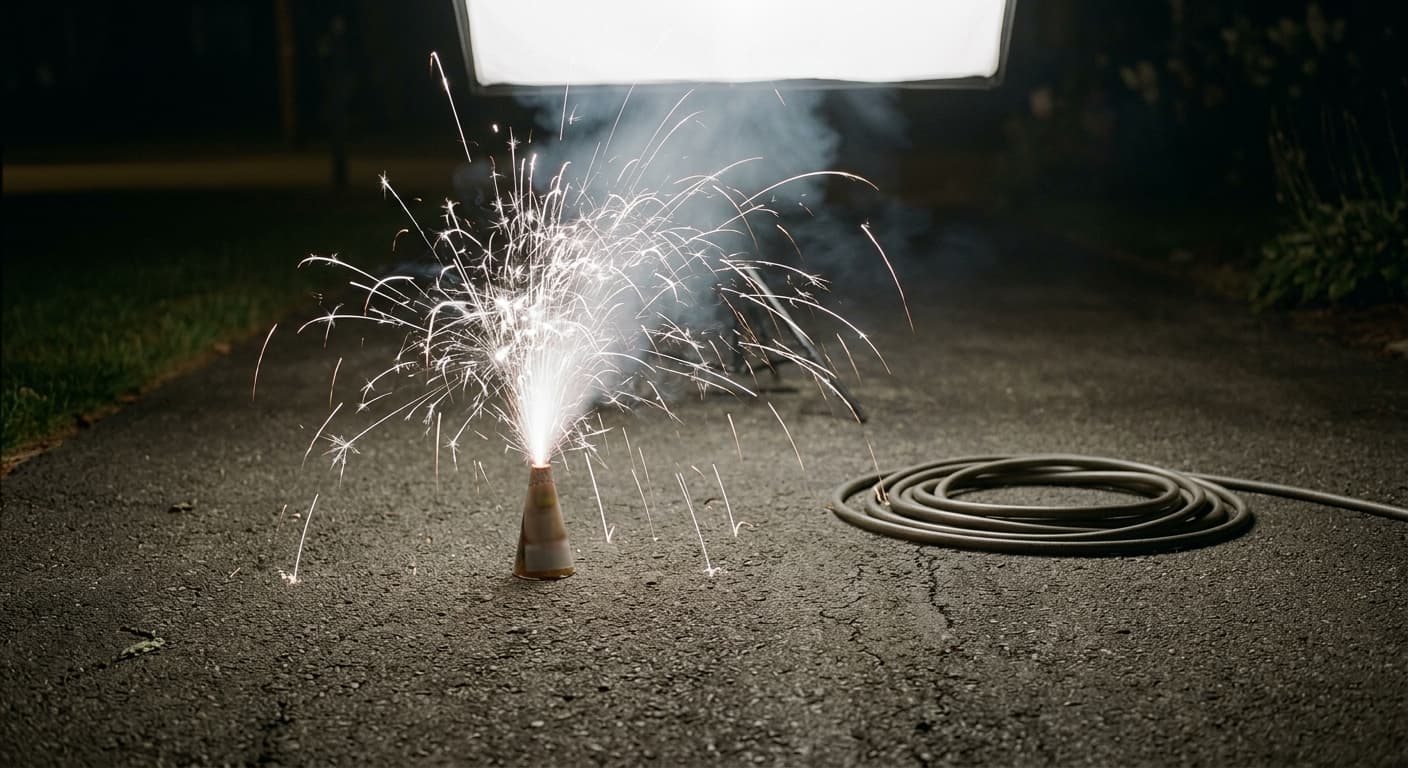
Oregon bans the sale, possession, and use of fireworks outright, then carves out narrow exceptions, the most important of which is a retail sales permit for a tightly defined "consumer fireworks" list during a 14 day summer window, under ORS 480.120 and ORS 480.111 to 480.165.
Jurisdiction scope: This article addresses Oregon's state fireworks law under ORS 480.111 to 480.165 and ORS 480.990(5): the general prohibition and its exceptions, the consumer fireworks definition and device caps, the retail sales permit and window, local-option authority, parental liability, and penalties. It does not cover the separate display-fireworks permit process for professional pyrotechnic shows or the explosives-licensing chapter (ORS 480.200 to 480.290), which is a different regulatory scheme.
Oregon Starts From a Ban, Then Carves Out Exceptions
Oregon's baseline rule is not permissive. ORS 480.120(1) makes it unlawful to "sell, keep or offer for sale, expose for sale, possess, use, explode or have exploded any fireworks within Oregon," then lists its own exceptions: manufacturer and wholesaler sales to out-of-state customers, sales to a State Fire Marshal display permit holder, transportation-signal and athletic blank cartridges, ammunition components for legal firearms, and, most relevant to a consumer, direct-delivery retail sales of the ORS 480.127 consumer fireworks category to a member of the public by a permitted retail seller. Two further exceptions sit outside ORS 480.120 entirely, each framed as an override of the general ban rather than an item on its list: ORS 480.123 lets a person with a State Fire Marshal permit purchase, possess, use, and explode fireworks to repel birds or other animals from a farm, forest, waste or recycling facility, airport, golf course, commercial fish or seafood property, estuary, property outside an incorporated city, or another property type the State Fire Marshal identifies by rule under ORS 480.123(4)(i), and ORS 480.124 lets a federal or state agency purchase, maintain, use, and explode fireworks for predatory-animal control under ORS 610.002 to 610.020. Everything not covered by ORS 480.120's exception list or by ORS 480.123 or 480.124, including a firecracker, bottle rocket, aerial shell, or Roman candle purchased out of state, is unlawful to possess or use in Oregon regardless of season.

"Consumer Fireworks" Is a Defined, Mostly Closed List
ORS 480.111(2) defines "consumer fireworks" two ways. The first is a closed list of named items:
"'Consumer fireworks' means: (a) A cone fountain, a cylindrical fountain, a flitter sparkler, a ground spinner, an illuminating torch or a wheel, or a combination of two or more of those items; and"
ORS 480.111(2)(a)
The second prong is narrower than a blanket allowance, but it is not fully closed: ORS 480.111(2)(b) also includes "any other items, other than exempt fireworks, containing 500 grams or less of pyrotechnic composition that the State Fire Marshal recognizes by rule to be suitable for retail sale to members of the general public for individual use." In practice, that means the State Fire Marshal, not the statute itself, can add items to the sellable list by administrative rule, so long as each stays at or under 500 grams of composition.
The Oregon State Fire Marshal's own consumer guidance restates this list in plain terms for buyers: it names novelty devices, wheels, flitter sparklers, fountains, smoke devices, and ground spinners as legal, and sky lanterns, missiles, rockets, firecrackers, cherry bombs, M-80s, Roman candles, and bottle rockets as illegal, which tracks the ORS 480.111(2) consumer fireworks list on one side and the display-fireworks and exempt-fireworks categories described below on the other.
Each named device also carries its own individual cap in the definitions section: a cone fountain up to 50 grams (up to 200 grams combined on a common base with less than half an inch of separation, or 500 grams with at least half an inch of separation), a cylindrical fountain up to 75 grams (same 200/500 gram combination rule), a flitter sparkler up to 5 grams, a ground spinner up to 20 grams, an illuminating torch up to 100 grams, and a wheel up to 60 grams per driver tube and 200 grams total, under ORS 480.111(1), (3), (9), (10), (11), and (18).
Separately, ORS 480.111(5) defines "exempt fireworks," a different category that includes novelties and trick noisemakers, snake or smoke items under 100 grains, model rockets, low-powder paper caps, and transportation or ceremonial signaling devices such as blank cartridges. Exempt fireworks are not "consumer fireworks" and are not sold under the ORS 480.127 retail permit and window described below.
Display Fireworks Are a Separate, Non-Consumer Category
Aerial and explosive-effect devices fall under "display fireworks," defined in ORS 480.111(4) as devices designed for flight or projection that are classified by the U.S. Department of Transportation as Division 1.3 compatibility group G explosives, Division 1.4 compatibility group G explosives, or, if over 500 grams of pyrotechnic composition, Division 1.4 compatibility group E or S explosives. Display fireworks are used only in a professional, supervised show under a State Fire Marshal display permit issued under ORS 480.150, not sold to the public at retail. A device that is a normal consumer purchase in a broader-allow neighboring state, such as an aerial shell, does not fall inside Oregon's consumer category at all.
Sale Window and Retail Permit
Anyone who wants to sell consumer fireworks at retail to the public must apply in writing to the State Fire Marshal for a permit at least 15 days before the proposed sale, and the Fire Marshal issues it only if satisfied the sale will comply with the chapter, under ORS 480.127(1). A retail sales permit authorizes sale only during a fixed annual window:

"A retail sales permit issued under this section authorizes the sale of consumer fireworks only in the year for which the permit is issued during the period that begins on June 23 and ends on July 6 of the year for which the permit is issued."
ORS 480.127(2)
A permit holder must also store consumer fireworks under fire codes the State Fire Marshal adopts by rule, which may draw on U.S. Department of Transportation hazardous-materials storage requirements, under ORS 480.127(3). A separate permit under ORS 480.130 covers wholesale sales to a retail permit holder and public displays; a display permit is valid for no more than 10 days and authorizes only one display. ORS 480.152 separately bars publishing any advertisement for the sale of fireworks whose sale is unlawful under the chapter, or for sale within a jurisdiction that has itself prohibited that sale.
Local Option: Cities, Counties, and Fire Protection Districts
Oregon's statute does not preempt a stricter local rule against fireworks. Under ORS 480.160(1):
"Nothing in ORS 480.111 to 480.165, nor in any permit issued thereunder, shall authorize the manufacture, sale, use or discharge of fireworks in any city, county or fire protection district in which such manufacture, sale, use or discharge is otherwise prohibited by law or municipal ordinance; nor shall any city, county or fire protection district authorize the sale or use of any fireworks prohibited by the provisions of ORS 480.111 to 480.165."
That cuts in one direction only, against the state: a city or county's own ban stands even though the state permits sales, but a city or county cannot use its own ordinance to legalize something the state chapter itself prohibits. No one may deliver consumer fireworks into a county, municipality, or rural fire protection district for retail sale if that jurisdiction has, by law or ordinance, prohibited the sale or use, under ORS 480.160(3).
A rural fire protection district's own regulatory power is narrower still, and it does not include an outright ban. Under ORS 480.160(4), a district's governing body may regulate manufacture, sale, use, or discharge by its own ordinance, but only if all four conditions hold: (a) the ordinance is adopted after public notice and hearing, no later than January 1 of the year it takes effect; (b) it is not operative inside the boundaries of any city within the district that already regulates the same subject by city ordinance; (c) it may not prohibit the manufacture, sale, use, or discharge of fireworks that ORS 480.111 to 480.165 itself authorizes; and (d) it may not limit sales to fewer than five days per calendar year, and must include the five consecutive day period beginning June 30. Condition (c) is the one that matters most for a reader: a rural fire protection district can tighten the terms around state-authorized consumer fireworks, but it cannot ban them outright the way a city or county can under ORS 480.160(1).
Age Requirements
Oregon sets no statewide minimum purchase or possession age for consumer fireworks in ORS chapter 480. The only minor-related provision in the chapter is ORS 480.158, a parental-liability provision described below, which is not itself an age restriction. A buyer should not assume an age-18 rule applies here the way it does in many other states; check directly with a permitted retail seller or the Oregon State Fire Marshal before relying on any particular age.
Parental Liability for Fire-Suppression Costs
Separate from any penalty on the person who uses fireworks, ORS 480.158 makes the custodial parent or parents of an unemancipated minor liable for a public fire agency's costs in suppressing a fire the minor's fireworks use caused, capped at $5,000 payable to the same claimant for one or more acts. A parent without legal custody at the time of the fire is not liable, and the rule does not apply to foster parents.

Penalties: Both a Civil Fine and a Criminal Misdemeanor Apply
Oregon layers two separate penalty tracks onto the same conduct. First, a civil penalty:
"In addition to any other penalty provided by law, any person who violates any provision of ORS 480.111 to 480.165, or any rule adopted by the State Fire Marshal pursuant thereto, is subject to a civil penalty imposed by the State Fire Marshal in an amount not to exceed $500 per violation. However, an individual member of the general public who possesses fireworks of a retail value less than $50 is not subject to a civil penalty. Each day a violation continues shall be considered a separate offense."
ORS 480.165(1)
The "in addition to any other penalty provided by law" language matters, because ORS 480.990(5) separately makes any violation of ORS 480.111 to 480.165 a criminal offense:
"Violation of any provision of ORS 480.111 to 480.165 is a Class B misdemeanor. Violations thereof may be prosecuted in state or municipal courts when violations occur within the municipality served thereby. Justice courts shall have concurrent jurisdiction with circuit courts in all proceedings arising within ORS 480.111 to 480.165."
ORS 480.990(5)
Civil penalty money collected under ORS 480.165 goes to the State Fire Marshal Fund and is imposed under Oregon's general administrative civil-penalty procedure, ORS 183.745.
Crossing State Lines
Federal law sets the floor: 16 CFR 1500.17 and Part 1507 define which consumer devices may be sold at all; 27 CFR 555.141(a)(7) exempts the importation, distribution and storage of consumer fireworks from ATF licensing (manufacture is not exempt); 18 U.S.C. 836 makes it a federal offense, punishable by up to one year, to transport fireworks into any state whose law specifically prohibits or regulates their use, in violation of that law, except in the course of continuous interstate transportation, with exceptions for common carriers, water carriers and federal agencies; and USPS Publication 52 § 341.22 bars fireworks from the mail entirely. Because Oregon's ORS 480.120 general ban and its narrow consumer-fireworks list exclude firecrackers, bottle rockets, and aerial devices outright, bringing one of those in from a broader-allow neighboring state can violate Oregon's own device limits, the federal transport statute, or both.
For a broader-allow neighbor with a wider device category, see Nevada's fireworks laws; for another state with a narrow, defined consumer category, see Idaho's fireworks laws.
For how Oregon's rule compares with every other state, see the fireworks laws by state comparison.
Disclaimer: This article provides general legal information about fireworks laws in the United States as of September 2026. It is not legal advice. Fireworks statutes, local ordinances, sale and use windows, and penalties change frequently and are often further restricted by county or city ordinance beyond what state law requires; verify the current rule for your specific city and county before buying, selling, or using fireworks, and consult a lawyer licensed in your state for advice about a specific situation.
Statutes cited reflect their in-force version as of 2026-09-17. Last updated: 2026-09-17.
Frequently Asked Questions
Are fireworks legal in Oregon?
Oregon starts from a general ban on selling, possessing, or using fireworks, under ORS 480.120(1). The main exception is a narrow "consumer fireworks" list, cone fountains, cylindrical fountains, flitter sparklers, ground spinners, illuminating torches, and wheels, sold at retail under a State Fire Marshal permit. Firecrackers, bottle rockets, and aerial devices are not in this category.
When can you buy fireworks in Oregon?
Retail sale under a State Fire Marshal permit is authorized only during a 14 day window, June 23 through July 6, under ORS 480.127(2). Cities, counties, and rural fire protection districts may restrict this further by local ordinance.
Is there an age minimum to buy fireworks in Oregon?
Oregon sets no statewide purchaser or possession age minimum anywhere in ORS chapter 480. Check with a retail permit holder or the Oregon State Fire Marshal directly rather than assuming an age of 18.
What is the penalty for a fireworks violation in Oregon?
Two separate penalties can apply to the same violation: a civil penalty up to $500 per violation imposed by the State Fire Marshal under ORS 480.165, and a Class B misdemeanor under ORS 480.990(5) for any violation of ORS 480.111 to 480.165. An individual possessing fireworks worth less than $50 in retail value is exempt from the civil penalty.
Can a city or county in Oregon ban fireworks even though the state allows them?
Yes. Under ORS 480.160(1), state law and any state permit never authorize a sale, use, or discharge that a city, county, or fire protection district has separately prohibited by ordinance. A rural fire protection district can add its own ordinance under ORS 480.160(4), but it cannot go as far as a city or county: it cannot prohibit anything the chapter itself authorizes, and it must allow at least five sale days a year including the five consecutive days beginning June 30.
Is a parent liable if their child causes a fire with fireworks in Oregon?
Yes. Under ORS 480.158, the custodial parent of an unemancipated minor is liable for up to $5,000 in costs a public fire agency incurs suppressing a fire the minor's fireworks use caused. A non-custodial parent and a foster parent are not liable under this section.
Updates
Independently fact-checked against the cited primary sources
Sources and References
- ORS 480.111 - Definitions for ORS 480.111 to 480.165 (consumer fireworks, display fireworks, exempt fireworks, device-specific gram caps)(oregonlegislature.gov).gov
- ORS 480.120 - Sale, possession and use of fireworks prohibited; exceptions; enforcement(oregonlegislature.gov).gov
- ORS 480.127 - Permit for retail sale of consumer fireworks; fee; rules; sale window(oregonlegislature.gov).gov
- ORS 480.150 - Permits for fireworks sales or displays; rules; security(oregonlegislature.gov).gov
- ORS 480.152 - Publication of advertisement for sale of unlawful fireworks prohibited(oregonlegislature.gov).gov
- ORS 480.158 - Parents of minor liable for costs incurred in suppressing fires caused by use of fireworks by minor; exception(oregonlegislature.gov).gov
- ORS 480.160 - Local regulation and effect of state law; local enforcement authority(oregonlegislature.gov).gov
- ORS 480.165 - Civil penalty for fireworks law violations(oregonlegislature.gov).gov
- ORS 480.990(5) - Penalties: violation of ORS 480.111 to 480.165 is a Class B misdemeanor(oregonlegislature.gov).gov
- 16 C.F.R. § 1500.17 - CPSC banned-hazardous-substance device standards for fireworks(ecfr.gov).gov
- 16 C.F.R. Part 1507 - Fireworks devices consumer product safety standard(ecfr.gov).gov
- 27 C.F.R. § 555.141(a)(7) - ATF explosives-licensing exemption for importation, distribution, and storage (not manufacture) of consumer fireworks(ecfr.gov).gov
- 18 U.S.C. § 836 - Transportation of fireworks into a state that specifically prohibits or regulates their use(uscode.house.gov).gov
- USPS Publication 52 § 341.22 - All fireworks are nonmailable explosives(pe.usps.com).gov
- Oregon State Fire Marshal - Fireworks (plain-language legal/illegal device guidance)(oregon.gov).gov