Buyer's Agent Commissions Held Near 2.4% in the First Year of the 2024 Realtor Settlement Rules

Independently fact-checked against primary sources (last audited November 10, 2026). · 3 primary sources cited on this page. How we verify our legal content
On August 17, 2024, the rules for paying a home buyer's agent changed across the United States. A sale can involve two agents: the listing agent, who works for the seller, and the buyer's agent. The buyer's agent's fee, the buyer's agent commission, is a percentage of the sale price, and the seller has typically paid it.
Local agents market homes for sale on a shared database called a multiple listing service, or MLS. Until that day, a seller listing a home on an MLS was obligated to offer compensation to the agent who brought the buyer.
From that day the offer could no longer appear in MLS listings at all. A seller could still agree to pay the buyer's agent, but off the MLS. Buyers also had to sign a written agreement with their own agent, called a written buyer agreement, before touring homes.
Redfin, a brokerage that tracks these fees, was watching the average month by month. Its monthly figures put the average buyer's agent commission at 2.38% of the sale price in July 2024 and 2.35% in August. By December the average was back at 2.38%, "exactly where it was before the rules took effect," Redfin wrote.
The new rules came from the settlement of a lawsuit brought by home sellers. In March 2024, five months before the rules took effect, Steve Berman, whose firm describes him as the lawyer leading the home sellers' case, had summed up that settlement in two words: "Mission accomplished."
The National Association of Realtors (NAR), the agents' trade association, agreed in the settlement to pay $418 million. A Wall Street analyst told investors that commissions should fall 25% to 50%.
NAR had argued that sellers' offers to pay the buyer's agent made representation more accessible. It had warned that many first-time buyers could not afford to pay an agent out of pocket.
Redfin's quarterly figures, from a later report, now run through September 2025. They put the average buyer's agent commission at 2.43% in January to March 2024, the quarter the deal was announced. In July to September 2025, a year after the new rules took effect, it was 2.42%. The deep cut one side forecast does not show up clearly in those figures. The other side's warning, that first-time buyers would go without an agent, does not show up clearly in the surveys covered below.
Some people, called objectors, fought the settlement in court and appealed it, and those appeals are nearly over. The objectors have one step left, a petition asking the Supreme Court to review the case.
Meanwhile the settlement itself ended the main source of data on buyer-agent pay, because MLS listings no longer carry the offers. And Redfin has not published a commission report since December 2025. Why did a price that so many people expected to move stay near 2.4%, and who will be able to tell if it moves now?
What did the average commission do?
If the plaintiffs' side, the home sellers who brought the case and their lawyers, was right, the average should have dropped well below its level in early 2024. Redfin's quarterly series covers both sides of the August 2024 date.
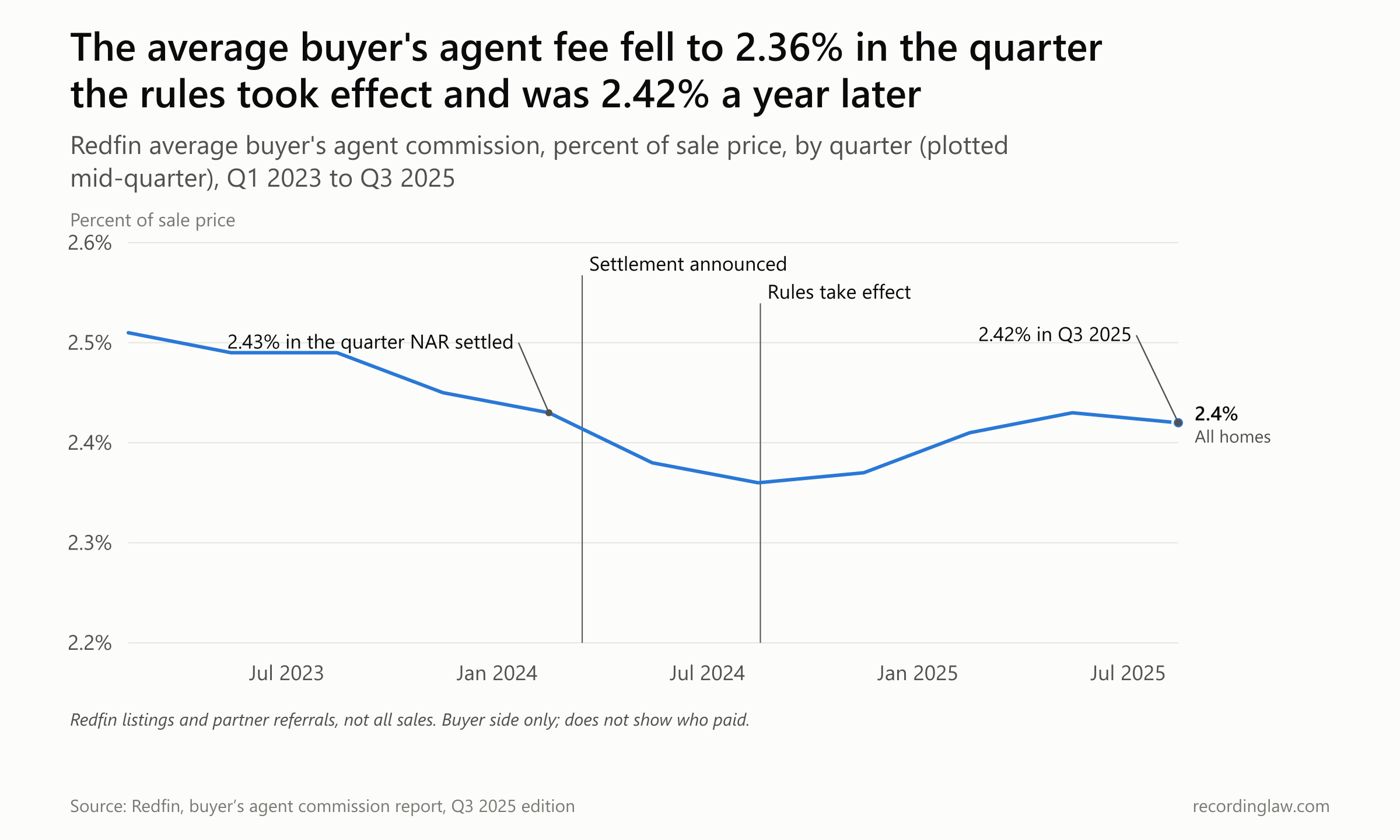
Average buyer's agent commission, percent of sale price, Q1 2023 to Q3 2025. Source: Redfin, Q3 2025 report.
| Quarter | Average buyer's agent commission |
|---|---|
| Q1 2023 | 2.51% |
| Q2 2023 | 2.49% |
| Q3 2023 | 2.49% |
| Q4 2023 | 2.45% |
| Q1 2024 (settlement announced) | 2.43% |
| Q2 2024 | 2.38% |
| Q3 2024 (new rules, Aug. 17) | 2.36% |
| Q4 2024 | 2.37% |
| Q1 2025 | 2.41% |
| Q2 2025 | 2.43% |
| Q3 2025 | 2.42% |
The line slid through 2023 and early 2024. It bottomed at 2.36% in the quarter the rules took effect, and it climbed back to 2.42% a year later.
From the quarter the settlement was announced to that low, the average went from 2.43% to 2.36%. Subtracting one rate from the other gives a fall of 0.07 of a percentage point. Measured against the 2.43% it started from, that is a fall of about 3%. A cut of 25% to 50% from 2.43%, the range the Wall Street analyst forecast, would have meant an average between about 1.2% and 1.8%.
Part of the slide was older than the lawsuit. In a mid-2024 report, Redfin said buyer's agent commissions had fallen from an average of 2.89% in 2013 to 2.66% in 2023. It later revised its whole series lower, so the older figures do not line up with the newer series and are not on the chart. Federal Reserve Board economists, in a May 2025 note using about half of all MLS listings, found the average rate advertised in those listings fell "from about 3 percent in the late 1990s to about 2.7 percent today."
Not every source saw the same thing in late 2024. RISMedia, a real estate trade publisher, reported in October 2024 that its paywalled study found commissions "did in fact drop after the Aug. 17 deadline."
Redfin's own chief economist, Daryl Fairweather, said that month that commissions "may face more downward pressure next year if we see a resurgence of bidding wars." Through 2025, Redfin's quarterly average rose.
Redfin has a business interest in commission levels. It is a low-fee brokerage, and it left NAR in October 2023. Its series covers its own listings and the deals it refers to partner agents, which is thousands of sales a quarter rather than all of them.
It is still the only continuous public series of closed sales since the rule change. That change began with a jury verdict less than a year before it took effect.
A verdict in Kansas City
The case that changed the rule reached a jury in Kansas City, Missouri, in October 2023. It was a class action, a lawsuit brought on behalf of a whole group of people in the same position. The plaintiffs represented a class of Missouri home sellers, reported at about 500,000, who had listed their homes on certain MLSs in Missouri, Kansas and Illinois. They claimed that requiring sellers to offer buyer-broker commissions in MLS listings violated antitrust law and inflated costs.
On October 31 the jury found NAR, Keller Williams and HomeServices of America liable. It awarded $1.785 billion in damages, an amount the antitrust laws allow to be tripled.
NAR's president at the time, Tracy Kasper, answered within moments. "The reality is that NAR rules prioritize consumers, support market-driven pricing and promote business competition," she said. NAR's spokesman, Mantill Williams, said, "This matter is not close to being final as we will appeal the jury's verdict." A Keller Williams spokesman put it more briefly: "This is not the end."
CNN wrote that the verdict "may mark the beginning of the end of how homes are bought and sold." The same story carried a quieter line from inside the business: "Not much is expected to change in the near term with regard to how commissions are set, agents say."
Stephen Brobeck, then a senior fellow at the Consumer Federation of America, a coalition of nonprofit consumer groups, said the outcome depended on what the court ordered next. "We hope that the court will sever the ties between listing agent and buyer agent compensation, freeing sellers from the obligation and need to compensate buyer agents," he told CNN.
NAR did not wait for an appeal. On March 15, 2024, it announced a settlement. It would pay $418 million over about four years, without admitting wrongdoing.
HomeServices agreed separately to pay $250 million. With the other defendants' payments, the fund passed $1 billion.
The settlement set the plaintiffs' lawyers' fees at $333 million, one-third of the fund. Because the case was a class action, the deal would bind a class of tens of millions of home sellers once a judge approved it.
"Ultimately, continuing to litigate would have hurt members and their small businesses," said Nykia Wright, NAR's interim chief executive. Kevin Sears, its president, said, "while the settlement comes at a significant cost, we believe the benefits it will provide to our industry are worth that cost."
The deal stopped short of what Brobeck had asked for. NAR agreed to a new rule "prohibiting offers of broker compensation on the MLS," but its release said such offers "could continue to be an option consumers can pursue off-MLS through negotiation."
NAR said in March that the changes would take effect in mid-July 2024. They took effect on August 17. What would that partial change do to the price?
Billions in savings, or buyers left alone
The plaintiffs' side expected the price to come down. Hagens Berman, one of the plaintiffs' firms, said the settlement "could save consumers billions of dollars a year in broker fees." It predicted changes "including potentially lowering broker commission rates that are higher in the United States than anywhere else in the world."
Berman, its managing partner, explained the goal in a sentence. "This settlement changes those rules so that competition will occur at the commission level," he said. "Mission accomplished." Benjamin Brown of Cohen Milstein, another of the negotiators, said the deal would "bring sweeping reforms that will help countless American families."
Wall Street and consumer groups put numbers on it. Analysts at Keefe, Bruyette & Woods, an investment bank, wrote that the new rules "should result in significant price competition for buyer agent commissions." Jaret Seiberg of TD Cowen told the firm's investors that commissions should fall 25% to 50%.
The Consumer Federation of America estimated a 20% to 30% reduction in commissions. Later that year Brobeck said he expected total commissions, for both agents, to fall over time from an average of 5% to 6% of the price to 3% to 4%. NBC News reported that consumer advocates predicted "the ranks of real estate agents will thin, further driving down commission prices."
Some on that side added a clock. "It may take some time for the changes to impact the marketplace," said Robby Braun, a lawyer in a separate, parallel Chicago case filed in 2019.
The warnings came from the industry, and they were about who would be hurt. NAR's settlement release argued that offers of compensation "help make professional representation more accessible, decrease costs for home buyers to secure these services, increase fair housing opportunities, and increase the potential buyer pool for sellers." At the verdict, NAR had told members that "many first-time home buyers, among others, couldn’t afford to pay for representation out of pocket."
The same TD Cowen note that forecast the big drop flagged the same risk: first-time buyers "may be unable to pay for an agent." In August 2024 Joseph Ventrone, a contract senior policy advisor for NAR, wrote that the shift "disproportionately affects those most in need," naming first-time buyers, immigrants, veterans and those without generational wealth. The Northwest MLS in Washington state said full separation of the two agents' pay, meaning buyers and sellers each pay their own agents, "invites brokers to make deals in secret, creating opportunities for deceptive practices, discrimination and unfair housing."
There was a third forecast, and it came from the federal government a month before NAR signed. It came in a separate Boston federal case over a Massachusetts listing service's rules. There, the Justice Department's Antitrust Division noted that the Northwest MLS had already made two sets of similar changes, and "neither revision appears to have led to a decrease in buyer-broker commissions." The Northwest MLS called that an "ill-informed, ill-supported critique."
The Justice Department wanted buyers to set their own agents' pay, which it said could bring flat fees or hourly rates. In November 2024 it told the Kansas City court that the new written buyer agreement rule "may harm buyers and limit how brokers compete for clients."
If the Justice Department's reading of the Northwest MLS record in Washington state was right, the average should barely move once the rules took effect.
What the economists expected, and what they could test
Economists had tried to model the change before data arrived, and neither model tested the settlement as it was signed. Gi Heung Kim, then a Wharton doctoral researcher funded by Wharton's Zell/Lurie Real Estate Center, simulated full separation of buyer and seller pay. Using 2009 to 2015 sales in Riverside, California, Kim found it "reduces commissions paid by 53%." The settlement did not go that far: sellers can still offer to pay the buyer's agent.
Four economists writing for the National Bureau of Economic Research (NBER), in a paper not yet peer reviewed, modeled what lower commissions would do if they came. Their model found that lower fees "tend to increase house prices," with "limited benefits for prospective buyers," and concluded that "lower agent fees are unlikely to significantly improve housing affordability and access."
The closest thing to a test came from the Federal Reserve Board in May 2025. Two staff economists looked at about 46.9 million MLS listing records from 1995 to 2023. They compared states that already required written buyer agreements, the settlement's main new tool, with states that did not.
"At least in these data," they wrote, "these policies do not appear to have material effects on advertised commission rates." That is a comparison across states before the settlement, not a measurement of what happened after it.
How far apart were the forecasts, the model and the record?
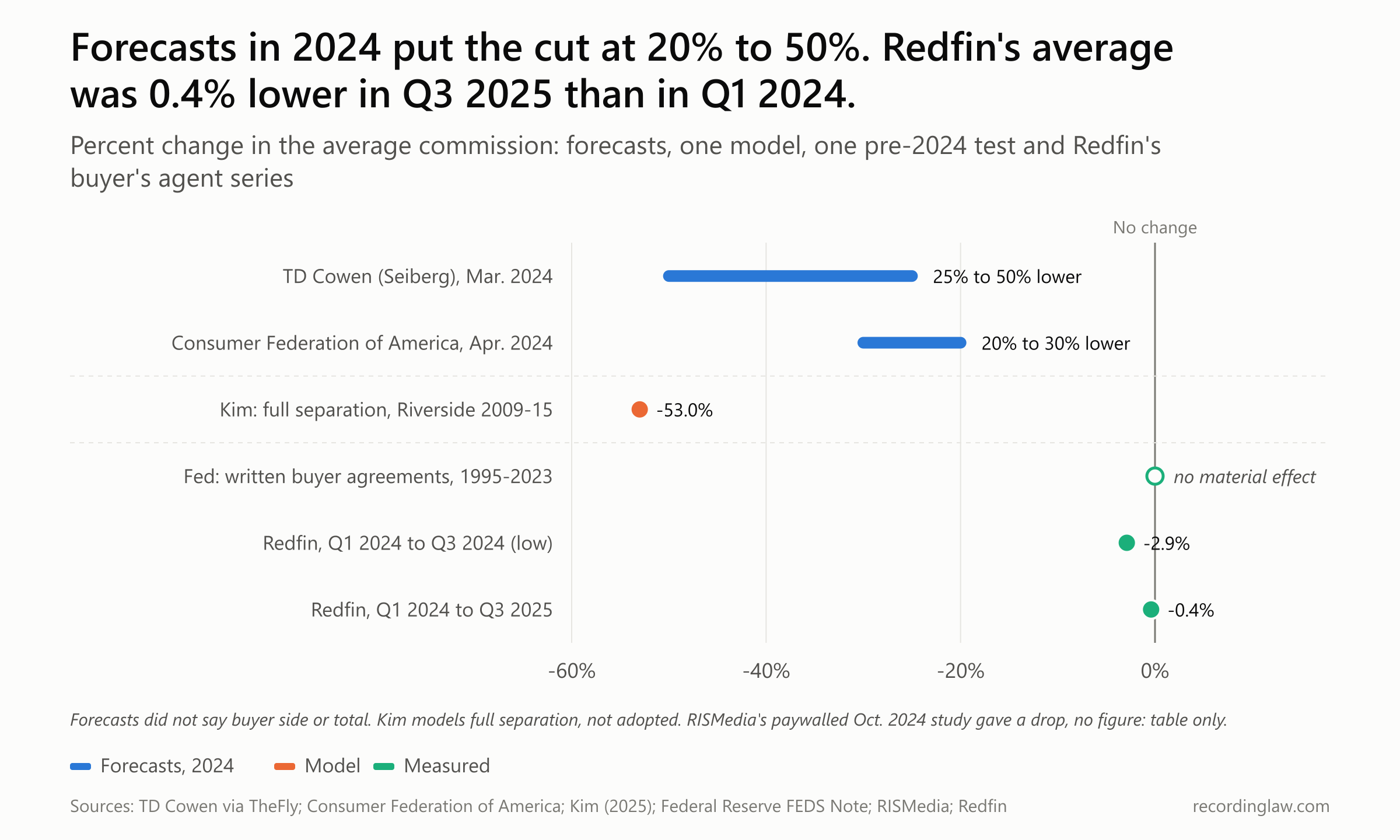
Percent change in the average commission: 2024 forecasts, one model, one pre-2024 test and Redfin's buyer's agent series. Sources: TD Cowen via TheFly; Consumer Federation of America; Kim (2025); Federal Reserve Board FEDS Note (May 2025); RISMedia (October 2024); Redfin, Q3 2025 report.
| Source | What it is | Change in the average commission |
|---|---|---|
| TD Cowen (Jaret Seiberg), March 2024 | Forecast | 25% to 50% lower |
| Consumer Federation of America, April 2024 | Forecast | 20% to 30% lower |
| Kim (2025), Riverside, Calif., 2009 to 2015 sales | Model of full separation of buyer and seller pay | 53% lower |
| Federal Reserve Board note (May 2025), MLS listings 1995 to 2023 | States with written buyer agreements vs states without | No material effect on advertised rates |
| RISMedia, October 2024 | Study, paywalled | Reported a drop; no public figure |
| Redfin, Q1 2024 to Q3 2024 | Measured, closed sales in Redfin's sample | 2.9% lower (2.43% to 2.36%) |
| Redfin, Q1 2024 to Q3 2025 | Measured, closed sales in Redfin's sample | 0.4% lower (2.43% to 2.42%) |
Only the Redfin rows give a measured figure after the rules changed, and both come from one brokerage's sample. Every figure in this chart is a percent change in the average commission, not a commission rate. The forecasts did not say whether they meant the buyer's side or both agents' fees. Because of that, the chart shows how large the forecasts were next to Redfin's change, but it cannot test whether any one forecast was right. The NBER paper models house prices rather than commission rates, so it is not on the chart.
The next measurement came from people posing as home buyers.
Asking for 3%
From July to September 2025, researchers posing as home buyers interviewed 281 buyer's agents by phone and email at the most active brokerages in 26 metropolitan areas. The study came from the Consumer Policy Center, a think tank that Brobeck joined after leaving the Consumer Federation of America. The center says it is self-funded by its senior fellows, and the report disclosed no outside funding. The chart and table below call this study the 2025 mystery shop.
Of the 269 agents who answered the question about their rate, nearly all, 95%, quoted between 2.5% and 3%. "Only one agent quoted a rate above 3%," the center reported. In 20 cities that a 2022 study had also covered, the share of quotes at exactly 3% went up.
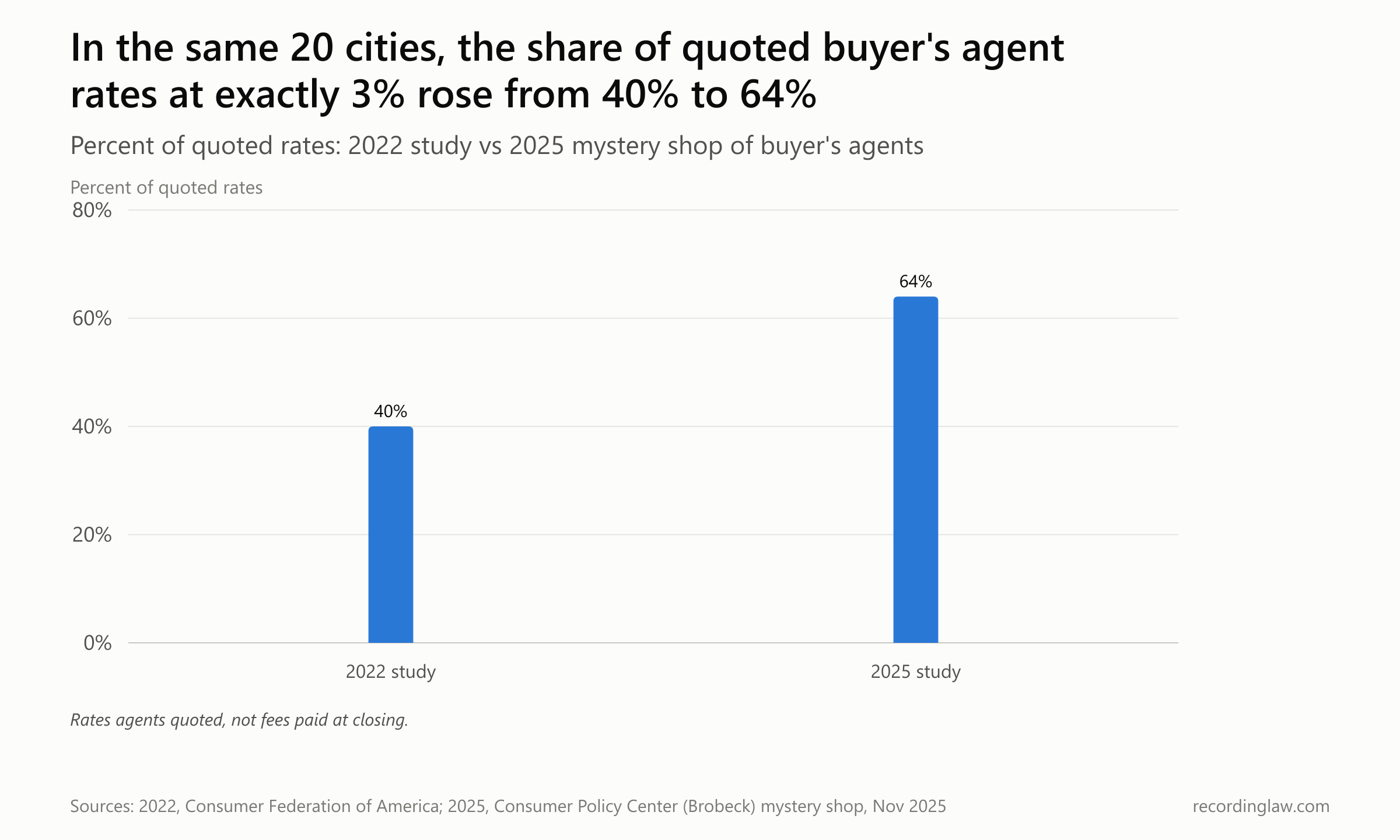
Share of quoted buyer-agent rates equal to 3%, 2022 vs 2025, same 20 cities. Sources: Consumer Federation of America (2022 study); Consumer Policy Center, an advocacy think tank funded by its senior fellows (Nov 2025 mystery shop).
| Study | Share of quoted rates at 3% |
|---|---|
| 2022 study, 20 cities | 40% |
| 2025 mystery shop, same 20 cities | 64% |
In those 20 cities, the share of 3% quotes rose from 40% to 64%. The center's reading was that some agents may treat a higher ask as a "risk premium," a cushion to keep their pay above 2.5% when sellers push back. On that reading, an agent who asks for 3% and is talked down can still end above 2.5%. That is the authors' interpretation, not something the calls measured.
Asked what they would actually take, many of the same agents went lower. Of 254 who answered, 39.4% said they charged or would accept 2% or less. Two-thirds said they would take a lower rate from a seller than the one they asked for in the offer, and nearly a third of those would take at least a full percentage point less.
These are asking prices on the phone, not closed sales, from a group whose senior author had argued for full separation of the two agents' pay. Like Redfin's closed-sale averages, they show no broad drop. The lower figures were what agents said they charged or would accept, not what they first quoted.
Agents split on what they saw in their own markets. Redfin commissioned a survey of 500 agents, which Ipsos fielded in December 2024 and January 2025. About half, 48%, said the average commission in their area had stayed about the same since the settlement took effect. Another 43% said commissions had declined, and 4% said they had risen.
In early 2026, about two-thirds of 213 agents surveyed by Cotality and ResiClub reported no significant shift in commission levels since the settlement. "You don’t want to rely solely on survey data," said Lance Lambert, ResiClub's co-founder. "But if there was a really big shift, we would be at least seeing something bigger than what we’re seeing right now."
Inman's report on the survey noted that over the past three years, fewer homes were resold, for the size of the population, than at any time in more than four decades. With so few homes changing hands, no series can tell how much of the flat line came from the slow market and how much from the settlement. A flat average can also hide different stories by price.
Cheaper homes, higher rates
Redfin also splits its figures into three tiers by sale price. They show the cheapest homes, under $500,000, carrying the highest rates, before and after the rule change.
By the third quarter of 2025, the gap between the cheapest homes and the most expensive, $1 million or more, had widened. It was 0.17 of a percentage point in the first quarter of 2024. In the third quarter of 2025 it was 0.30 point.
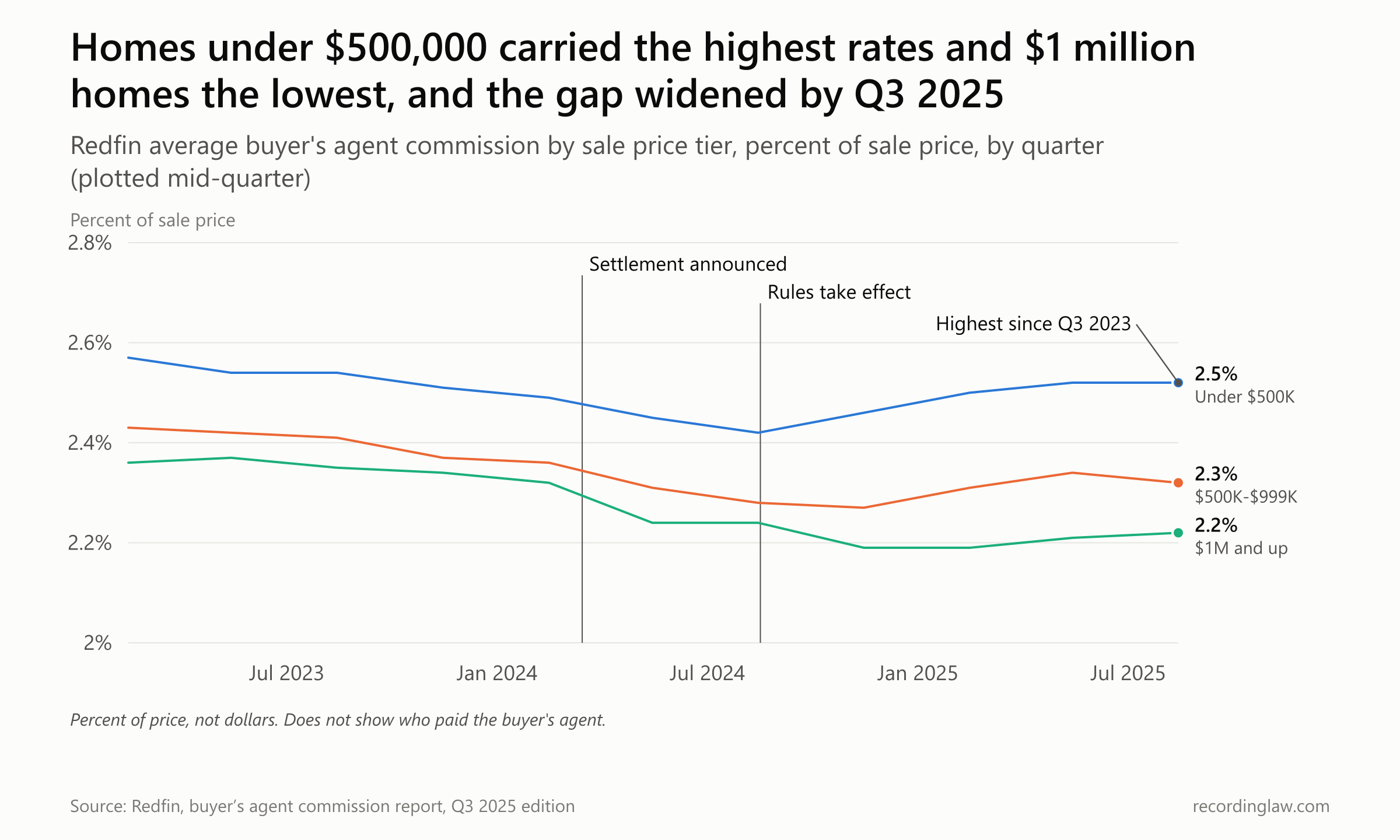
Average buyer's agent commission by sale price tier, Q1 2023 to Q3 2025. Source: Redfin, Q3 2025 report.
| Quarter (selected) | Under $500,000 | $500,000 to $999,999 | $1 million or more |
|---|---|---|---|
| Q1 2023 | 2.57% | 2.43% | 2.36% |
| Q1 2024 | 2.49% | 2.36% | 2.32% |
| Q3 2024 | 2.42% | 2.28% | 2.24% |
| Q4 2024 | 2.46% | 2.27% | 2.19% |
| Q1 2025 | 2.50% | 2.31% | 2.19% |
| Q2 2025 | 2.52% | 2.34% | 2.21% |
| Q3 2025 | 2.52% | 2.32% | 2.22% |
For homes under $500,000, the average fell to 2.42% in the quarter the rules took effect, then rose to 2.52% in the second and third quarters of 2025. Redfin called that the highest level since the third quarter of 2023. For homes of $1 million or more, the average dropped to 2.19% at the end of 2024 and was 2.22% in the third quarter of 2025.
These are percentages of the price, not dollars. A lower rate on a $1 million home can still be a larger fee than a higher rate on a starter home. And Redfin's chart cannot say who paid the fee: the seller, the buyer, or both.
One Redfin agent in Portland, Oregon, described a different risk for the cheaper end of the market. If bidding wars came back and sellers stopped covering the buyer's side, the agent said, "first-time buyers will be hit hardest because many of them can already barely afford to buy a home." That was the risk NAR had warned about in 2024.
Did first-time buyers lose their agents?
The most direct look at that question came from the group that had predicted the savings. In April 2026 the Consumer Federation of America and the National Urban League published a survey of 223 housing counselors in 37 states, fielded in July and August 2025. The counselors were trained by the US Department of Housing and Urban Development (HUD).
Only 7% of the counselors said their first-time buyer clients paid lower commissions than clients a year earlier. Only 9% said a purchase often or always failed because a buyer could not afford the agent's commission. Just 26% said sellers often or always covered the buyer's agent.
Real Estate News summed it up: "two anticipated outcomes of the settlement haven't come to pass." Fees were relatively unchanged, it wrote, and the feared lockout of first-time and underserved buyers appeared unfounded. The authors noted a limit: the study "relies on a sample of 223 housing counselors, rather than first-time homebuyers and homebuyers of color directly."
The advocates still saw risk ahead. Sharon Cornelissen, the federation's director of housing, pointed to "the rise of anti-competitive 'pocket listings'" and to the administration's threat to cut funding for housing counselors. Pocket listings, the report explains, are home listings that are not immediately made publicly available on an MLS. Marc H. Morial, president of the National Urban League, said such trends "threaten to usher in a new form of redlining," especially for Black homebuyers.
NAR's own annual survey pointed the same way on whether buyers still used agents. Its 2025 Profile of Home Buyers and Sellers is the edition covering sales from July 2024 to June 2025, the first year of the new rules. It found 88% of buyers used an agent or broker, and 91% of sellers used an agent, "equal to the highest percentage on record."
The same survey put first-time buyers at a record-low 21% of all buyers. NAR's deputy chief economist, Jessica Lautz, linked that to "a housing market starved for affordable inventory," and the survey cannot say how much of the drop, if any, came from the rule change.
By April 2026, a consumer advocate and an NAR veteran who had argued opposite sides were describing the same result. "By early 2025, however, it became evident that commission rates were not budging," Brobeck wrote on April 23. He added that Ventrone, the NAR policy advisor quoted earlier, "to his credit, at the time," had "warned me and others that this would occur." Ventrone, a former NAR vice president who now consults for the association without pay, had written on April 17 that the lawsuit and the settlement were "at best, a rearranging of the deck chairs on the Titanic."
The last appeal
While the numbers came in, objectors fought the settlement in court. On November 26, 2024, two days before Thanksgiving, Judge Stephen R. Bough held the fairness hearing in Kansas City. That is the hearing at which a judge decides whether a class settlement is fair to the people it binds. Weeks earlier he had ordered every objector and their lawyers to appear in person or have their objections waived.
Notice had reached more than 99% of the class. Of those reached, 39 opted out, 36 filed formal objections and more than two million claims were submitted. The day after the hearing, Bough entered an 88-page final approval order.
On appeal, objectors argued that the practice changes did little for the class. One, a law professor, argued, in the appeals court's summary, that the changes "provide no real benefit to the class," and called the $333 million fee award excessive. A group of NAR member agents who had been refused permission to join the case argued that market data showed the changes had made matters worse for the class.
On August 19, 2026, a three-judge panel of the Eighth Circuit, the federal appeals court that hears cases from Missouri, affirmed the approval. Writing for the panel, Judge Lavenski Smith said the district court, Bough's court, "did not abuse its discretion by discussing the settlement terms and eschewing the 'studies'" those agents cited. The panel held that changes to how brokerages negotiate, allocate and disclose commissions "will benefit the entire class."
"We are pleased this monumental change to the real estate system has been upheld," Berman said. An NAR spokesperson said the association was "pleased with the Court's order." Patrick Knie, a lawyer for some objectors, told Reuters, "Everyone got next to nothing for the sake of settling."
The court denied rehearing on September 24. On October 2, 2026, it issued its mandate, the order that formally closes an appeal. That left the objectors one route, a petition to the Supreme Court. It also left a practical problem for anyone still trying to measure the result.
Who is counting now
The problem starts with the MLS. Once offers of broker compensation "could not be communicated via the MLS," in the words of NAR's settlement release, the listings no longer carried the figure. In its November 2025 report, the Consumer Policy Center noted that "the settlement, by preventing MLSs from collecting data on buyer agent commissions, cut off the major source of data about these prices." Even so, it wrote, "a consensus has emerged that in the past two years average rates have changed little."
Redfin's series has not been updated in 11 months. Its last commission report, covering July to September 2025, came out on December 8, 2025. Redfin kept publishing other housing research into November 2026, and as of November 6, 2026, its commission feed carried no newer edition.
Other numbers may come. The federation's 2026 report said Fannie Mae and Freddie Mac "may have usable data on real estate commissions" in the future, and it asked the Federal Housing Finance Agency to collect and publish brokerage-fee data. The Justice Department kept filing in the Boston case, arguing in March 2025 that a revised settlement there still made "cosmetic changes." Brobeck has predicted that "eventually there will be more class action litigation."
The next date on the legal calendar is a calculated one. Under the Supreme Court's rules, a petition is due 90 days after a rehearing denial. Counting 90 days from September 24 puts the objectors' deadline around December 23, 2026, unless a justice grants more time.
In August 2024, Redfin was watching the average month by month. By December it found the average back exactly where it was before the rules took effect. The last figure it has published, 2.42%, sits a hundredth of a point below the 2.43% average in the quarter NAR settled. The quarter after it has not appeared.
How we measured
The quarterly averages come from the dataset behind Redfin's third-quarter 2025 report, published December 8, 2025. It holds the overall series and three price tiers, as percent of sale price.
Redfin's sample is thousands of transactions per quarter. They come from sales of Redfin agents' listings and from deals referred by Redfin and closed by partner agents. Redfin's second-quarter 2025 report also listed deals in which a buyer used Bay Equity Home Loans.
The sample excludes most deals in which a Redfin agent represented the buyer. It is not a census of all sales and is not weighted to national sales. Redfin names each quarter by its first month, so January stands for January to March. The chart puts each quarter's point in the middle of its three months.
Redfin revised its levels between reports. Its July 2024 report gave 2.62% for January 2024 and 2.55% for July 2024. Its October 2024 report gave monthly figures (2.42% for March, 2.35% for August). Its quarterly reports from 2025 on give 2.43% for the first quarter of 2024 and 2.36% for the third.
We use only the latest vintage, meaning the latest revised version, in the charts and tables. We do not splice the 2013 to 2023 figures (2.89% to 2.66%) onto it. Later vintages differ from earlier ones by up to 0.02 point in some quarters.
The monthly figures in the opening (2.38%, 2.35%, 2.38%) come from Redfin's fourth-quarter 2024 report. The text of Redfin's third-quarter 2025 report compares each price tier with a year earlier, giving 2.45%, 2.31% and 2.24%. A year earlier should be July to September 2024, but those figures match the April to June 2024 row of Redfin's own tier chart. Where the text and the chart differ, the tables use the chart dataset.
The drop from 2.43% (first quarter 2024) to 2.36% (third quarter 2024) is 0.07 point, or 2.9% of 2.43. A 25% to 50% cut from 2.43% gives 1.82% to 1.22%. TD Cowen's forecast did not specify buyer-side or total commissions, so this is an illustration of scale, not a test of the forecast. The gap between the cheapest and most expensive tiers was 0.17 point in the first quarter of 2024 (2.49% minus 2.32%) and 0.30 point in the third quarter of 2025 (2.52% minus 2.22%).
The estimates chart puts each source on one scale, the percent change in the average commission. TD Cowen's 25% to 50% and the Consumer Federation of America's 20% to 30% are drawn as ranges because the sources gave ranges. Kim's 53% is the model's simulated effect of full separation, which the settlement did not adopt.
The Federal Reserve note found no material effect and gives no single figure for the change, so it is drawn as a hollow marker at zero. The Redfin rows are (2.36 minus 2.43) divided by 2.43, or 2.9% lower, and (2.42 minus 2.43) divided by 2.43, or 0.4% lower.
Some sources are not on that chart because they do not measure the same thing. Brobeck's forecast that total commissions for both agents would fall from 5% to 6% to 3% to 4% uses a different measure than the buyer's agent series. The NBER paper models house prices. The agent, seller and counselor surveys report shares of respondents, not the size of a change, and RISMedia's study, which reported a drop, is paywalled and gives no public figure.
The Redfin series covers the buyer's side only, as a percentage of price. It does not show seller-side or total commissions, seller concessions, dollars paid, or who paid the buyer's agent. MLS data on buyer-agent pay ended with the rule change, and no other public closed-sale series was found. Mortgage rates, slow resale turnover and the decline that predates the lawsuits all move commissions too, so the series cannot isolate the effect of the settlement.
The Consumer Policy Center mystery shop (281 agents, 26 metros, July to September 2025) measured quoted rates, not closed sales; the 20-city comparison is with a 2022 Consumer Federation of America study. The Consumer Federation of America and National Urban League survey asked 223 housing counselors, not buyers. The Ipsos and Cotality/ResiClub surveys asked agents.
In another Redfin-commissioned survey in the spring of 2025, 37.4% of recent sellers said they had negotiated or tried to negotiate the commission paid to their agent. That survey asked about sellers' own agents, not the buyer's side, so it is not in the story's comparison.
The Federal Reserve note compares states before the settlement using advertised MLS rates. Kim (2025) and the NBER working paper by Greg Buchak, Gregor Matvos, Tomasz Piskorski and Amit Seru are models, not measurements.
NAR is the trade association of real estate agents and was a defendant. Hagens Berman and Cohen Milstein represented the plaintiffs, whose lawyers were awarded $333 million in fees from the fund.
The Consumer Federation of America is an association of nearly 200 nonprofit consumer groups. The Consumer Policy Center says it is self-funded by its senior fellows. Redfin is a brokerage with a low-fee business model.
The Justice Department's November 2024 filing on the written buyer agreement rule arrived two days before the fairness hearing. It said the department took "no position on whether the proposed settlement satisfies Rule 23(e), apart from one concern," referring to the federal rule for approving class settlements. The one concern was that written buyer agreement rule. It also said that the deal did not limit the department's own power to enforce the antitrust laws. Separately, in January 2025 the Supreme Court declined to review a ruling that let a separate Justice Department antitrust investigation of NAR continue.
Joseph Ventrone is a former NAR vice president and a voluntary consultant to NAR. The Supreme Court petition date is our calculation from Supreme Court Rule 13.3, not a date set by any court.
NAR released its 2026 Profile of Home Buyers and Sellers on November 5, 2026. This story reports the 2025 edition, which came out November 4, 2025, and covered sales from July 2024 to June 2025, the first year under the new rules; neither edition's public release reported who paid the buyer's agent.
What comes next: a Supreme Court petition, if objectors file one, due around December 23, 2026 by our count; RISMedia's fifth annual Contract & Commission Study, which RISMedia said in October 2026 would publish in November 2026 for paying members (this story does not include it); and any new edition of Redfin's commission report, which as of November 6, 2026 had not appeared since December 8, 2025.
For the status of the related Keller Williams and RE/MAX settlements, see Keller Williams and RE/MAX commission settlement. This article reports historical market data and analyst forecasts and is not investment advice.
Frequently Asked Questions
What did the 2024 NAR commission settlement change?
Under the settlement's rules, which took effect on August 17, 2024, offers of compensation to buyer's agents are no longer allowed in MLS listings, the shared databases agents use to market homes. Sellers may still offer that compensation off the MLS. Buyers must also sign a written buyer agreement with their agent before touring homes. NAR agreed to pay $418 million, and the fund across all defendants exceeded $1 billion.
Did buyer's agent commissions go down after the NAR settlement?
Not by much in the only continuous public series. Redfin's average was 2.43% in the first quarter of 2024, 2.36% in the third quarter of 2024 and 2.42% in the third quarter of 2025. The series covers Redfin's own listings and referrals, not all sales, and commissions were already drifting lower before the lawsuits.
What commission do buyer's agents usually ask for now?
In a Consumer Policy Center study in mid-2025, researchers posing as home buyers contacted agents in 26 metro areas. Of the agents who responded, 95% asked for between 2.5% and 3%. Asked what they would accept, 39.4% said they charged or would accept 2% or less. These were quotes, not closed sales.
Do sellers still pay the buyer's agent commission?
Sometimes. In a survey of housing counselors fielded in mid-2025 and published in April 2026 by the Consumer Federation of America and the National Urban League, 26% said sellers often or always cover the buyer's agent. No public national series reports who paid since the rule change.
Are first-time buyers going without agents because of the settlement?
The available surveys did not find that. NAR's 2025 profile found 88% of buyers used an agent or broker, and only 9% of housing counselors said purchases often or always failed because a buyer could not afford the agent's fee. The same NAR survey found first-time buyers at a record-low 21% of all buyers, a drop it cannot tie to the rule change.
Is the NAR settlement final?
The Eighth Circuit affirmed final approval on August 19, 2026, denied rehearing on September 24 and issued its mandate on October 2. Objectors can still petition the Supreme Court. Counting 90 days from the rehearing denial puts that deadline around December 23, 2026, unless an extension is granted.
Why is there so little data on real estate commissions now?
Offers of buyer-agent pay can no longer appear on the MLS, so MLSs stopped collecting buyer-agent commission data, which had been the major source. Redfin's quarterly series became the main public measure, and its last edition, covering July to September 2025, was published on December 8, 2025.
Updates
Reworded for readability. No figures, quotes, sources or findings changed.
Restructured as a feature: chart titles state the finding, side details moved to How we measured. Every figure and quote was re-checked against its source.
Independently fact-checked against the cited primary sources
Independently fact-checked against the cited primary sources
Sources and References
- Redfin, The Average Buyer’s Agent Commission has Risen Slightly Since New NAR Rules Went Into Effect (Q3 2025 report, December 8, 2025)(redfin.com)
- Redfin, Q2 2025 buyer’s agent commission report(redfin.com)
- Redfin, Q4 2024 buyer’s agent commission report and Ipsos agent survey(redfin.com)
- Redfin, October 2024 buyer’s agent commission report(redfin.com)
- Redfin, July 2024 buyer’s agent commission report(redfin.com)
- Redfin, May 2025 commission report and seller survey(redfin.com)
- Redfin, commissions report feed(redfin.com)
- U.S. Court of Appeals for the Eighth Circuit, No. 24-3444, opinion affirming final settlement approval (August 19, 2026)(ecf.ca8.uscourts.gov).gov
- U.S. Department of Justice, Antitrust Division, statement of interest, W.D. Mo. (November 2024)(justice.gov).gov
- Federal Reserve Board, FEDS Notes: Commissions and Omissions, Trends in Real Estate Broker Compensation (May 12, 2025)(federalreserve.gov).gov
- Consumer Policy Center, buyer agent commissions and contracts mystery-shopper report (November 2025)(consumerpolicy.org)
- Consumer Policy Center, release on the mystery-shopper report (November 2025)(consumerpolicy.org)
- Consumer Policy Center, About us (funding statement)(consumerpolicy.org)
- Stephen Brobeck, Consumer Policy Center, Why decoupling commissions failed to lower housing costs (April 23, 2026)(consumerpolicy.org)
- Consumer Federation of America, release on uncoupled real estate commissions (April 2024)(consumerfed.org)
- Consumer Federation of America, About CFA(consumerfed.org)
- Consumer Federation of America and National Urban League, housing counselor survey report (April 2026)(consumerfed.org)
- Real Estate News, Commission changes haven’t killed deals, but worrisome trends loom (April 17, 2026)(realestatenews.com)
- Checkbook, How New Rules Could Change Real Estate Agent Commissions(checkbook.org)
- Hagens Berman, press release on the $418 million NAR settlement (March 15, 2024)(hbsslaw.com)
- NBC News, National Association of Realtors approves $418 million settlement (March 15, 2024)(nbcnews.com)
- Associated Press via Christian Science Monitor, Realtor commissions are changing (March 18, 2024)(csmonitor.com)
- TheFly via TipRanks, summary of TD Cowen research note (March 15, 2024)(tipranks.com)
- Florida Realtors, report on the October 31, 2023 verdict(floridarealtors.org)
- CNN via WTOP, After a $1.8 billion verdict, the clock is ticking on the 6% real estate commission (November 2023)(wtop.com)
- National Association of Realtors settlement release, as reposted by Alabama Realtors (March 2024)(alabamarealtors.com)
- NC REALTORS, update on the DOJ statement of interest (February 16, 2024)(ncrealtors.org)
- Joseph Ventrone, HousingWire opinion (August 22, 2024)(housingwire.com)
- Joseph Ventrone, HousingWire, Be careful what you ask for: The myth of decoupling real estate commissions (April 17, 2026)(housingwire.com)
- HousingWire, Northwest MLS takes aim at the DOJ’s commission views (March 2024)(housingwire.com)
- Real Estate News, DOJ to court: Buyers need to set their agents’ compensation (February 15, 2024)(realestatenews.com)
- Real Estate News, DOJ supplemental statement in the MLS PIN case (March 17, 2025)(realestatenews.com)
- National Association of Realtors, Supreme Court denies NAR cert petition (January 2025)(nar.realtor)
- National Association of Realtors, reaction to the Eighth Circuit ruling (August 2026)(nar.realtor)
- Real Estate News, Appeals court upholds settlements (August 19, 2026)(realestatenews.com)
- Reuters via KFGO, US appeals court upholds big real estate settlement (August 19, 2026)(kfgo.com)
- Inman, Eighth Circuit denies objectors’ rehearing petitions (September 28, 2026)(inman.com)
- Inman, Eighth Circuit issues mandate (October 2, 2026)(inman.com)
- Inman, Agent commissions show stickiness nearly 2 years after NAR settlement (March 30, 2026)(inman.com)
- RISMedia, new study on commissions after August 17 (October 30, 2024)(rismedia.com)
- RISMedia, 2026 Contract & Commission Study announcement (October 14, 2026)(rismedia.com)
- Gi Heung Kim, job market paper on decoupling buyer and seller broker commissions (April 2025)(giheungkim.github.io)
- Buchak, Matvos, Piskorski and Seru, NBER Working Paper 32855 (revised October 2025)(nber.org)
- National Association of Realtors, 2025 Profile of Home Buyers and Sellers release (November 4, 2025)(nar.realtor)
- National Association of Realtors, 2026 Profile of Home Buyers and Sellers release (November 5, 2026)(nar.realtor)