Before Portland's 2017 Affordable-Housing Mandate, Developers Locked In About 19,000 Units

Independently fact-checked against primary sources (last audited November 10, 2026). · 22 primary sources cited on this page. How we verify our legal content
At 11:36 a.m. on December 21, 2016, after a short recess, Portland's City Council came back to vote on inclusionary housing. There were two ordinances, one changing the zoning code and one setting up the program and its tax exemption, and both passed 5-0. Under them, from February 1, 2017, every new building with 20 or more homes would have to set some of them aside for lower-income households or pay a fee instead. That requirement is what Portland calls inclusionary housing.
During the roll call, Commissioner Dan Saltzman, the sponsor, made a point about the calendar. "We have many, many units already grandfathered into the process so the sooner we get this on the books voting today and implementation February 1st, the sooner we'll get more mixed use neighborhoods and more affordable housing for everyone in our city," he said, according to the council's caption record. Commissioner Nick Fish, who also voted yes, put the same fact another way: "because of the February effective date we're going to see the biggest bull run in multi-family development get in under the gun under our deadline."
They were right about the run. A project vests, or in Saltzman's word is grandfathered, when its application is in before the deadline, which locks in the rules in force that day. In the 11 months before the requirement took effect, the Portland Housing Bureau later reported, developers vested projects totaling about 19,000 units under the old rules.
Federal permit data show 2017 as the city's biggest year for buildings of five or more units since at least 2010. After it came a long slide, to 486 units in 2025, which is about one-twelfth of the 5,932 units permitted in 2017.
What nobody has settled is how much, if any, of that slide belongs to the requirement, and how much belongs to everything that arrived with it. Those other things are the grandfathered projects that came first, rising costs, the pandemic and higher interest rates. The city's own reviews said they were hard to separate. In 2026 Oregon's Legislature answered a different question, about who pays for the affordable units, and the first of its new deadlines lands on January 1, 2027.
The rise and the slide
How large was the swing? The Census Bureau counts it by calendar year in its annual permit file for the City of Portland, which includes revisions and estimates that its preliminary monthly files lack.
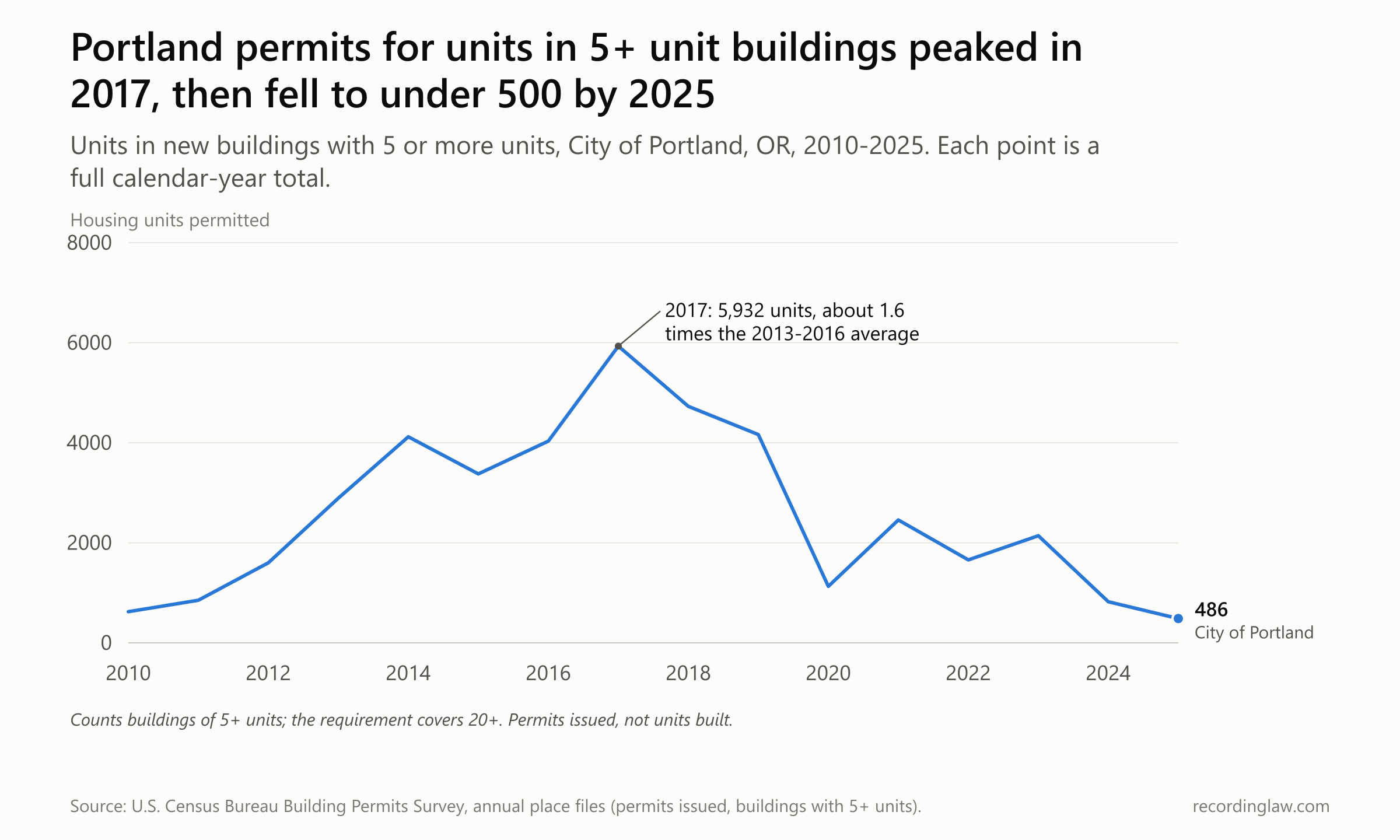
Source: U.S. Census Bureau Building Permits Survey, annual place files, City of Portland. Each point is a full calendar year. The 2020 and 2024 files list fewer than 12 months reported.
Permits for 5,932 units in 2017 were about 1.6 times the 2013-2016 average. The count stayed above 4,000 through 2019. It fell to about 1,100 in 2020, the first pandemic year, and rose to about 2,500 in 2021. It has stayed below that since.
| Year | Units in new 5+ unit buildings | New 5+ unit buildings |
|---|---|---|
| 2012 | 1,601 | 41 |
| 2014 | 4,120 | 69 |
| 2016 | 4,032 | 80 |
| 2017 | 5,932 | 110 |
| 2018 | 4,728 | 81 |
| 2019 | 4,163 | 98 |
| 2020 | 1,128 | 31 |
| 2021 | 2,457 | 36 |
| 2022 | 1,659 | 45 |
| 2023 | 2,142 | 50 |
| 2024 | 820 | 21 |
| 2025 | 486 | 13 |
The Census category starts at five units, so the count also includes buildings below Portland's 20-unit threshold. Before any of those permits were issued, developers rushed to file, and the rush started with a clause in a state law.
A deadline written in Salem
The grandfather window, the time to file under the old rules, was not Portland's invention. It came from the state law, passed by the Legislature in Salem, that made the requirement possible.
Until 2016, Oregon barred cities from requiring affordable units in private buildings, a kind of rule often called inclusionary zoning, under a ban Northwest News Network said was "passed nearly two decades ago." Senate Bill 1533 lifted it.
The Senate passed it 20-8 on February 26, 2016. The House passed it 39-21 on March 3, with House Speaker Tina Kotek carrying it on the floor. "We must improve the supply of affordable housing in the state if we're really going to level the playing field for all Oregonians so they can all have a chance at prosperity," she said, according to Northwest News Network, which reported lifting the ban as a long-time priority of hers.
Gov. Kate Brown signed it March 15, and it took effect June 2. Multnomah County Chair Deborah Kafoury later told the council she and Saltzman had gone to Salem together to ask for it.
The law came with limits. A mandate could apply only to buildings of at least 20 units. It could require no more than 20 percent of units. It had to offer a fee in place of on-site units, and at least one incentive.
And a city "may not apply the regulation, provision or requirement to any multifamily structure for which an application for a permit" had already been submitted. That last clause meant any city that adopted a mandate would announce a deadline, and anyone who filed before it would be exempt. Portland could choose the date. It could not choose whether there would be one.
One critic saw a different risk in the bill. Joe Cortright, an economist who runs the Portland think tank City Observatory, wrote to a Senate committee in February 2016 that "inclusionary zoning would likely make the city's affordability problems worse." His reason was geography: "Because inclusionary zoning is likely to apply only to housing built in Portland, not in the suburbs, it will penalize dense development in the city relative to housing on the periphery." Census county permit data would later show how the city and its neighbors moved, and the picture looked different before and after 2022.
What each side said would happen
Eight days before the vote, the council heard the arguments. The hearing on December 13, 2016, ran about three hours, and 56 people signed up to testify.
Saltzman opened it. "Inclusionary housing will not solve our affordable housing crisis but it is a critical step towards more affordable housing in our city now and in our future," he said, according to the caption record.
Kurt Creager, director of the Housing Bureau, explained how the city had set the rules. The plan started at 15 percent of units affordable at 80 percent of area median income. Area median income is the midpoint household income for the region, and those units were for households earning no more than 80 percent of it.
That share was to rise to 20 percent in 2019. In return, the city offered tax exemptions and other offsets.
"Importantly as we calibrated the offsets we wanted to make sure that we were not impeding the market rate development industry," Creager said. He added that the model's assumptions about profit, land and construction prices had erred toward generosity, because the market was peaking as the city built it.
The supporting panel made predictions the later data could test. George Galster, an urban affairs professor at Wayne State University, said policies like Portland's "will not reduce the rate of new housing construction." Vivian Satterfield of OPAL Environmental Justice Oregon, an advocacy group, called claims that the policy would stop development "demonstrably false" and said: "Buildings are still going up."
Lisa Bates of Portland State University, also supporting, described the rush before it peaked. "There will be an adjustment period for this policy, certainly, in response," she said. "That adjustment is delayed by the rushed to permit we've been talking about. That's one of the ways that firms adjust to those policies, they try to get in under the wire."
The builders and developers who warned against the plan mostly did not oppose a mandate outright. Paul Grove of the Home Builders Association of Metro Portland wrote that the group "is supportive of an inclusionary housing program for the City of Portland," but warned of factors that could "potentially suppress the production of overall units," and asked for lower rates in mixed-use zones: 10 percent of units at 80 percent of median income and 5 percent at 60 percent.
Mike Kingsella, executive director of Oregon LOCUS, a coalition of developers later renamed Oregon Smart Growth, told the council that "the inclusionary rate needs to be set lower to avoid slowing housing production." Kurt Schultz of SERA Architects said his firm had designed more than 500 units a year for six years. "For 2017, past projects, we have a total of zero new units on the boards that will come post-vesting," he said. Post-vesting meant after the February 1 deadline.
Cortright testified too. "When less housing is built in Portland, all of our rent and housing affordability problems will get worse," he said. Jeff Bachrach of the city's Planning and Sustainability Commission raised a different gap: "there is no benchmarking for what we're trying to achieve. What will demonstrate to the city that we're successful or not successful?"
On the day of the vote, the council stated both risks itself. "If we don't provide enough incentives or expect more than the market will bear in terms of development of inclusionary housing, we run the risk of reducing overall housing production," said Commissioner Steve Novick. If the city asked too little, he added, it risked missing the chance to demand more in a strong market. Mayor Charlie Hales, in his final weeks in office, said the policy "may need to be tuned."
The race to file
Creager had already told the council what was coming. "I think we're approaching 16,000 units of vested projects that will vest prior to the February 1st date," he said at the December 13 hearing.
The filings kept arriving after that. In December and January alone, the city's Bureau of Development Services received 42 land-use review applications for residential projects, which the bureau conservatively estimated could include 5,000 units, the Portland Mercury reported. Each application cost at least $20,000. Another 18 commercial building permit applications carried nearly 900 homes.
In January the Daily Journal of Commerce counted 14,000 proposed multifamily units in the pipeline, "three times as many as usual," according to The Southeast Examiner. The Mercury's headline in February was "Developers Just Proposed Nearly 6,000 Apartments to Evade Portland's New Affordable Housing Mandate." The story began, "Want to ensure Portland developers build more housing? Threaten to make them offer affordable units."
The Housing Bureau's final count came in its 18-month review in September 2018. "In the 11 months before the IH program went into effect, developers vested residential projects totaling approximately 19,000 units, a market anomaly that was equivalent to the previous eight years of multifamily unit permit totals combined," it wrote. IH is the city's short form for its Inclusionary Housing program.
The eight-year comparison measured the 19,000 units against permits issued in earlier years. Measured instead against what the city expected to need, the bureau put them at "4-5 years' worth of the multifamily residential development needed." A Housing Bureau slide in March 2018 called them "the equivalent of 42% of all multi-family housing units built in the last 20 years."
That same March 2018 presentation offered tax breaks to the grandfathered projects themselves: available for two years only, capped at $3 million in all and $500,000 per project. Vesting, though, only locked in the old rules. The buildings still needed permits, money and builders.
When did the rush reach the permit count?
Vested projects did not get their building permits on the day they filed. If the rush was as large as the filings suggested, it should show up in permits issued over the months after February 2017, as the pipeline worked through review. The Census Bureau's monthly permit survey for the City of Portland, counting units in new buildings of five or more units, shows when it arrived.
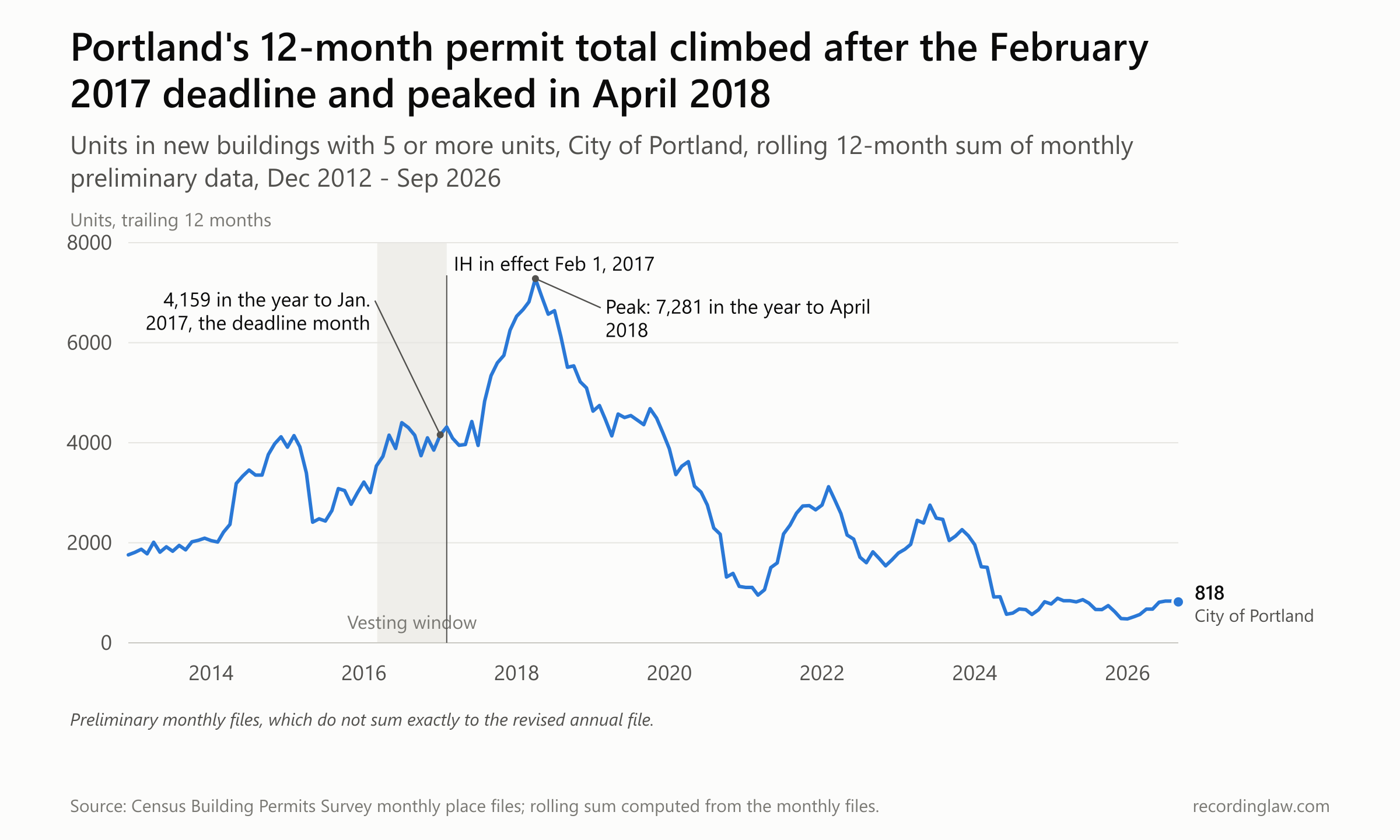
Source: U.S. Census Bureau Building Permits Survey, monthly place files (preliminary), City of Portland; rolling 12-month sums computed from the monthly files.
For each month, the chart adds up the units permitted in the 12 months ending that month. That 12-month total stayed between about 3,500 and 4,400 units while developers were filing. After the deadline it climbed, while the vested projects moved through permitting, to a peak of about 7,300 units in the year to April 2018. The total first passed 5,000 in the year to September 2017.
| 12 months ending | Units in new 5+ unit buildings, City of Portland |
|---|---|
| December 2015 | 2,998 |
| January 2017 (deadline month) | 4,159 |
| December 2017 | 6,250 |
| April 2018 (peak) | 7,281 |
| December 2019 | 4,199 |
| December 2020 | 1,128 |
| December 2022 | 1,659 |
| December 2024 | 820 |
| September 2026 (latest) | 818 |
The Housing Bureau tracked the same wave from its side. Six months after the deadline, it reported, about 14,000 of the 19,000 vested units were still somewhere in permitting and the other 5,000 had building permits. On August 1, 2018, 8,294 units in 65 projects were still vested and waiting in the permitting pipeline. Using its own permit count, which differs from the Census figure, the bureau said 2017 "set a historic high at over 6,000 permits."
Cortright, a leading critic of the requirement, also saw an upside in the rush. In 2019, by his own later account, he called the first two years "a game-theory win-win for housing affordability," because "the threat of tougher future requirements prompted a whole lot of investment to happen much earlier than it otherwise would have." The question was what would come after the grandfathered projects were built.
The first year under the new rules
The answer for the first year was small. Between February 1, 2017, and February 1, 2018, building permits were filed for 17 projects subject to the requirement, with 1,007 units, 117 of them counted as inclusionary units. Twelve of the projects were privately financed: 565 market-rate units and 89 affordable ones. The other five were publicly financed affordable-housing projects.
A draft memo by Tyler Bump, a senior economic planner at the Bureau of Planning and Sustainability, found the rate of new applications "significantly slower compared to other years, both pre- and post-recession." In focus groups that January, the memo reported, there was "significant discussion that construction cost escalations, stabelizing rents, high land values and tighter lending standards along with recent implementation of IH is creating a perfect storm of slowing development activity."
Brendan Finn, Saltzman's chief of staff, had seen that argument coming. He told Next City in April 2018 that "a mad rush of developers and property owners and architects pulled out an enormous amount of permits," and that when a downturn reached Portland, "some people are going to blame inclusionary housing."
The Housing Bureau's 18-month review, the same September 2018 report that gave the final vesting count, pointed to the market. Annual rent increases had fallen below 2 percent, a rate not seen since 2010-2011, and vacancy had risen to 7 to 8 percent, a level not seen in a decade. "There are significant challenges in determining what changes in volume are the result of what market factor(s) when reviewing permitting and pipeline data," it wrote.
The bureau recommended delaying, by two years, the step-up in required affordable units outside the Central City that was scheduled for January 1, 2019. That was the rise Creager had described for 2019. The council did so that December in Ordinance 189302, citing market "factors unrelated to the inclusionary housing program including; increasing construction costs, increasing federal fund rates" as well as tariffs and state economists' warnings of a slowdown. In July 2020, citing the pandemic, it extended the lower rates again, through January 1, 2022.
Did building move to the suburbs?
By 2019 critics had their own count. Up for Growth, a national housing-supply member network, published "The Cautionary Tale of Portland's Inclusionary Housing Policy" in April 2019. Its authors were industry-side: Noel Johnson, a Portland developer, and Kingsella, who had testified for the developer coalition in 2016.
They compared the city's average of 3,915 multifamily permits a year from 2012 to 2017 with permits issued under the inclusionary program from February 2017 to March 2019, and found "a 64% decrease." That comparison left out the grandfathered projects, which were still receiving permits. Census counted 4,728 units in Portland's five-plus-unit buildings in 2018, against the 1,709 the authors counted under the program in the same year.
They predicted "a further underproduction of housing in 2020, 2021 and 2022." Census permits in Portland in those years were well below their 2012-2017 average, in years that also held the pandemic.
Cortright had proposed a cleaner test in September 2017. "In effect, the region's suburbs represent a kind of control group: none of them has a similar inclusionary housing requirement," he wrote. In April 2023 he reported the result as he read it, citing state economist Josh Lehner: "apartment permitting has fallen 60 percent in Portland and the same time it has increased two-and-a-half fold in the surrounding suburbs."
Census county files let that comparison run three more years, through 2025. Because the comparison is between counties, Portland is represented by Multnomah County, which Cortright described as mostly, but not entirely, Portland. The comparison group is six nearby counties in Oregon and Washington, added together.
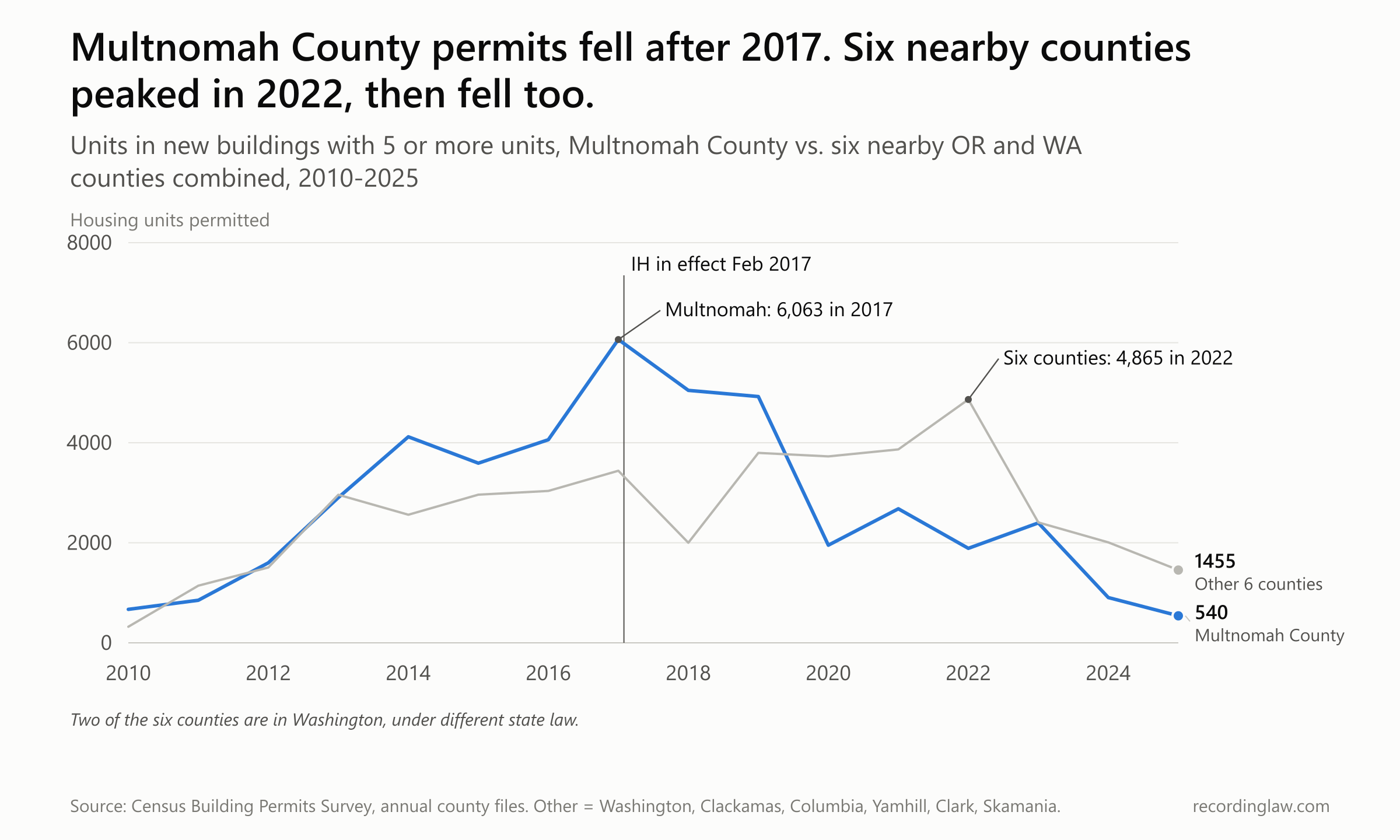
Source: U.S. Census Bureau Building Permits Survey, annual county files. The six counties are Washington, Clackamas, Columbia and Yamhill in Oregon and Clark and Skamania in Washington.
Through 2022 the numbers looked much as Cortright described: Multnomah fell from about 5,000 units in 2018 to about 1,900, while the six counties rose from about 2,000 to about 4,900. After 2022 the surrounding counties fell too, to about 1,500 units in 2025. In the table, Multnomah share is Multnomah's units as a percentage of all seven counties' units.
| Year | Multnomah County | Six nearby counties | Multnomah share |
|---|---|---|---|
| 2016 | 4,061 | 3,037 | 57.2% |
| 2017 | 6,063 | 3,441 | 63.8% |
| 2018 | 5,047 | 2,001 | 71.6% |
| 2019 | 4,923 | 3,796 | 56.5% |
| 2020 | 1,953 | 3,728 | 34.4% |
| 2022 | 1,889 | 4,865 | 28.0% |
| 2023 | 2,397 | 2,407 | 49.9% |
| 2025 | 540 | 1,455 | 27.1% |
The suburbs are not a clean control group. Clark and Skamania counties sit across the Columbia River in Washington, under different state law, and all seven counties shared the same interest rates and costs. Oregon as a whole issued only 4,800 multifamily permits in 2024, "the lowest total in more than a decade," Axios reported, citing an Oregon Journalism Project analysis of federal data; the statewide high in the past decade was 10,500 in 2019.
Fish's canary
The requirement covered buildings of 20 or more units, so one way to avoid it was to build just under that size. On the day of the vote, Fish had named the signal he would watch. "If in six months or a year we start seeing development on the east side is 19 units or fewer in other places other indicators this isn't working then I will join with my colleagues in bringing it back and asking tough questions," he said. At the earlier hearing he had asked staff for "the canaries in the tunnel."
The city looked. In 2017, the Housing Bureau found, 13 percent of permits were for buildings under 20 units, consistent with the years since 2012.
A December 2022 Bureau of Planning and Sustainability memo found that from 2019 to 2021 an average of 9.3 percent of units were in buildings of 12 to 19 units. It concluded that avoiding the requirement by building just under the threshold "is not prevalent within recent years of housing production trends," while noting that units in such buildings had risen from about 200 a year in 2012-2016 to 400 to 500 in 2017 and 2018.
Sightline Institute, a nonprofit funded mostly by individual donors and foundations that supports inclusionary zoning when it is paid for, counted differently. In Sightline's usage, a requirement is funded when the tax break offsets the revenue developers lose to the discounted rents. Michael Andersen of Sightline wrote in November 2025 that while the program was underfunded, "the share of projects coming in just below its threshold of 20 homes doubled to almost half of multifamily projects."
The two counts measure different things. The city counted units, so one large building can outweigh several small ones. Sightline counted projects, so each building counts once, however many homes it holds.
Andersen reached for the same image. Sites like the Northbound 30 Collaborative, where City Observatory reported Johnson, the developer who co-wrote the Up for Growth post, was building eight five-story buildings with a total of 145 units on one infill site, "were canaries keeling over in a coal mine," he wrote.
Paying for the affordable units
By 2023 the city's own consultant reported that most apartment projects it modeled did not pencil out, meaning their expected returns would not cover their costs, with or without the requirement. The Housing Bureau had hired BAE Urban Economics to recalibrate the program after the council set aside money in 2022. BAE's November 2023 study found "the majority of the development prototypes are infeasible under current market conditions." BAE found the program "not a significant financial impediment to overall development feasibility, especially in the Central City," but found the incentives too small in higher- and medium-rent neighborhoods outside downtown.
The city later summarized BAE's list of barriers: development costs up more than 50 percent since 2016, rents rising more slowly, higher interest rates and high investor return requirements. "At a time when development activity has dropped off, these changes will ensure that the City is providing enough financial incentives to adequately cover the costs of complying with the program," Commissioner Carmen Rubio said of the changes she brought to council.
Ordinance 191610 passed in January 2024 and took effect March 1. It extended the full-building, 10-year tax exemption, which covers all the homes in a project rather than only the affordable ones, to higher-rent neighborhoods outside the Central City for projects that set aside units at 60 percent of median income. Sightline described it as quintupling the size of the tax break in those neighborhoods. The ordinance suspended the cap on forgone tax revenue, the property taxes given up through these exemptions, until December 31, 2029.
The City Budget Office warned of the tradeoff. Forgone revenue could rise from about $2 million to $4 million a year to $7 million to $10 million if development recovered, it estimated, and "one primary concern is that the City would subsidize development that would happen regardless and therefore lose expected revenue."
The City Auditor's May 2024 audit counted the affordable homes the program had produced. From the start to April 2023, "566 apartments for rent in 78 buildings had been built, with 1,157 more anticipated."
The program had collected more than $5 million in fees from developers who chose not to build the units on site. As of June 2023, the auditor found, the fees had gone to running the program rather than to building housing. The auditor did not study the program's effect on overall building, and wrote that changes in affordable housing "cannot be attributed to the Program alone."
Other counts of the program's output differ. OPB reported in February 2024 that, according to the Housing Bureau's interim deputy director, Michael Buonocore, the policy had led to 1,300 new affordable apartments since 2017. The auditor also counted two affordable condominiums, homes built for sale rather than rent, by April 2023. Housing Oregon, in 2026 testimony, cited the bureau's director as saying the program had produced "only six affordable condos."
Sightline estimated the 2024 changes amounted to "a subsidy worth something like $220,000 per below-market home," less than the roughly $250,000 a comparable home in an all-affordable building would cost taxpayers. It reported that after the expansion, the share of projects just under 20 units returned to normal. "To be clear, the improvements to this program didn't change the fundamentals of Portland's housing market," Andersen wrote.
Salem changes the terms
In 2026 the Legislature took up the question the 2016 opponents had raised, about who pays for the affordable units. Senate Bill 1521 passed the Senate 21-6 on February 20 and the House 32-21 on March 4. Gov. Tina Kotek, who as House speaker had carried the 2016 law, signed it March 31.
Under the new law, in the legislature's summary, cities and counties in the Portland metropolitan area cannot enforce requirements that developers provide affordable units "unless the city or county first calculates the developers' average expected losses due to providing affordable housing and the city or county offsets those losses." It takes effect January 1, 2027, and applies to rental housing from January 1, 2028, and to all housing from January 1, 2029.
Its backers included Oregon Smart Growth, the renamed LOCUS that had asked the council for lower rates in 2016. A letter from the Commercial Real Estate Public Affairs Collaborative, whose members include Oregon Smart Growth, argued that "affordability requirements that are not economically calibrated and funded suppress housing supply and, ultimately, reduce the number of both market rate and affordable homes that can be delivered."
They also included Sightline and other supporters of inclusionary zoning. Their coalition sheet, filed with the bill, said the City of Portland had "settled on a neutral position" and added: "We are not aware of any remaining institutional opposition." The testimony list we reviewed carried opposition only from private individuals. Councilor Candace Avalos, who chairs the council's housing committee, signed the city's letter, which noted that Portland "operates the only Inclusionary Housing (IZ) program in Oregon."
The next deadlines
The newest permit numbers have moved off the bottom. Portland's 12-month total for units in five-plus-unit buildings was 477 in the year to January 2026 and 818 in the year to September 2026, the latest month posted when we checked on October 31.
That rise came while two other incentives were in force. One was the 2024 tax-exemption expansion. The other was a citywide waiver of system development charges, the one-time fees the city charges new homes for infrastructure, which was adopted under Mayor Keith Wilson and Gov. Kotek and is in place until October 2028.
Those incentives are now mixed into the same permit numbers as everything else. The requirement, the rush it set off, the 2018 market turn, the pandemic, interest rates and construction costs all overlap in Portland's permit count over the same years, and no peer-reviewed study we found has tried to separate them. The count shows when building rose and fell, not which of those changes moved it.
The next fixed dates are on the calendar. SB 1521 takes effect January 1, 2027. Portland's feasibility report on the program, which the 2024 ordinance required, is due to the council and the Multnomah County board by December 31, 2027, the day before the state's offset rule reaches rentals on January 1, 2028. The Census Bureau's 2026 annual permit file, which will show whether this year's rise held, is expected around May 2027.
Ten years after Fish predicted a bull run to beat February 1, 2017, the program faces another effective date. This one decides whether Portland can keep requiring the units without first covering what they cost developers.
How we measured
Permit data. Annual figures for the City of Portland come from the Census Bureau's Building Permits Survey annual place files (State 41, place 59000), using the "5+ units" columns for units and buildings. County figures come from the annual county files.
Monthly figures and the rolling 12-month totals come from the preliminary monthly place files, January 2012 to September 2026, the latest posted when we checked on October 31, 2026; the October 2026 file had not been posted. Monthly files do not sum to the annual file: 2017's months sum to 6,250 units, against 5,932 in the annual file, which includes revisions and imputation. The annual file lists Portland with 10 months reported in 2020 and 11 in 2024.
Five units is not twenty. The Census category is buildings of five or more units. Portland's requirement applies to buildings of 20 or more units, and Census does not publish permits by 20-unit bands, so the series is a stand-in that includes buildings the mandate never covered. It counts permits issued, not applications filed, vested projects or units completed.
Vested units are a different measure. The 19,000 figure is the Housing Bureau's count of units in projects that vested under the old rules from March 5, 2016, to February 1, 2017, across all building sizes. The bureau's memo does not say why the window starts on March 5.
The city later restated its pipeline for buildings of 20 or more units only, about 10,000 units in February 2018. For context, Census permits for units in Portland's five-plus-unit buildings summed to 17,495 for the seven years 2010 through 2016. The city's "over 6,000" for 2017 is its own permit count and differs from the Census annual figure.
Derived figures. "About 1.6 times" is 5,932 units in 2017 divided by the 2013-2016 average of 3,605. "About one-twelfth" is 486 divided by 5,932 (8.2%). Multnomah share is Multnomah County's units divided by Multnomah plus the six-county sum. In the first year, 117 inclusionary units of 1,007 is 11.6%.
The six counties. The comparison group is the sum of Washington, Clackamas, Columbia and Yamhill counties in Oregon and Clark and Skamania counties in Washington. These are counties near Portland; we did not confirm them against the federal metropolitan-area definition, so we do not call them the metro area. Cortright's figures came from state economist Josh Lehner's data, which we did not open. Our county figures come close to his description through 2022 (5,047 in Multnomah in 2018; 4,865 in the six counties in 2022, against his "more than 5,000") but not after.
Council quotes. Quotes from the December 13 and December 21, 2016, council sessions come from the closed-caption record embedded in the city's official minutes, which the city says should not be considered a verbatim transcript. We copy them as the record shows them, including caption errors such as "the rushed to permit". The Portland Mercury quoted Fish's December 13 remark about the deadline as "for the next several years"; the caption record reads "for the next couple of years". We did not review the video.
Who produced the analyses. The Housing Bureau and Bureau of Planning and Sustainability reviews were produced by the city agencies that run or helped design the program. BAE Urban Economics was hired by the Housing Bureau. The City Auditor is independently elected.
Up for Growth is a national housing-supply member network; its homepage carries an endorsement from a National Association of Realtors vice president. Its 2019 post was written by a Portland developer and the former executive director of a developer coalition. City Observatory is Cortright's think tank, which says it is "supported in part by the Quicken Loans Community Investment Fund and was founded with support from Knight Foundation."
Sightline says more than 90 percent of its funding comes from individual donations and foundation grants. We did not open Sightline's underlying project-size data, and we did not open Galster's written citations.
Other changes in the same years. The 2016 state law that allowed the requirement; the delayed rate step-up in 2018 and 2020; the 2018 market turn the city described; the 2020 pandemic; rising interest rates from 2022; the 2024 tax-exemption expansion; and the citywide system development charge waiver all overlap with the series. The current required set-aside rate is not stated here because the sources we opened disagree on whether the step-up took effect.
What the data cannot show. There is no control group for Portland and no causal study in the record. The figures show what permits did before, during and after the requirement and alongside these other changes. They do not show how many buildings the requirement stopped, delayed or moved.
Frequently Asked Questions
What is Portland's inclusionary housing requirement?
Since February 1, 2017, new residential buildings in Portland with 20 or more units must include some units affordable to lower-income households or use an alternative such as a fee, in exchange for incentives including tax exemptions. Oregon's 2016 law, SB 1533, allowed it. That law limited mandates to buildings of at least 20 units and capped the set-aside, the share of units a city can require to be affordable, at 20 percent.
Why did Portland apartment permits spike in 2017?
State law exempted any project whose permit application was submitted before a mandate took effect. The Portland Housing Bureau reported that developers vested about 19,000 units in the 11 months before February 1, 2017, meaning they filed in time to keep the old rules. As those projects received permits, Census counts of units in Portland's five-plus-unit buildings reached 5,932 in 2017, and the rolling 12-month total peaked at 7,281 in April 2018.
Did inclusionary zoning reduce apartment construction in Portland?
The record does not settle it. Permits for units in five-plus-unit buildings fell from 5,932 in 2017 to 486 in 2025, but the grandfathered pipeline, a 2018 market turn, the pandemic, interest rates and costs overlap with the requirement. The city's reviews said the causes were hard to separate. Critics including City Observatory and an industry-written Up for Growth analysis attribute much of the fall to the mandate. No peer-reviewed causal study was found.
How many affordable units has Portland's inclusionary housing program produced?
The City Auditor counted 566 rental apartments built in 78 buildings from the program's start to April 2023, with 1,157 more anticipated. In February 2024 OPB reported a Housing Bureau official's count that the policy had led to 1,300 new affordable apartments since 2017. The two counts use different dates and definitions.
What did Portland change in 2024?
Ordinance 191610 took effect March 1, 2024. It extended the full-building 10-year tax exemption, which covers all the homes in a project rather than only the affordable ones, to higher-rent neighborhoods outside the Central City for projects with units at 60 percent of median income. It also suspended the cap on forgone tax revenue until December 31, 2029, and required a feasibility report by December 31, 2027.
What does Oregon SB 1521 do?
It was signed March 31, 2026. It bars cities and counties in the Portland metropolitan area from enforcing affordable-unit requirements unless they first calculate and offset developers' average expected losses. It takes effect January 1, 2027, and applies to rental housing from January 1, 2028, and to all housing from January 1, 2029.
Updates
Reworded for readability. No figures, quotes, sources or findings changed.
Restructured as a feature: chart titles state the finding, side details moved to How we measured. Every figure and quote was re-checked against its source.
Independently fact-checked against the cited primary sources
Independently fact-checked against the cited primary sources
Sources and References
- U.S. Census Bureau, Building Permits Survey, West Region annual and monthly place files (City of Portland, OR)(www2.census.gov).gov
- U.S. Census Bureau, Building Permits Survey, annual county files(www2.census.gov).gov
- City of Portland, Ordinance 188163 (Inclusionary Housing program), passed December 21, 2016(efiles.portlandoregon.gov).gov
- Portland City Council, December 13, 2016 inclusionary housing hearing (minutes and caption record)(efiles.portlandoregon.gov).gov
- Portland City Council, December 21, 2016 minutes and caption record(efiles.portlandoregon.gov).gov
- Written council record, December 2016: Home Builders Association of Metro Portland and Oregon LOCUS letters(efiles.portlandoregon.gov).gov
- Portland Housing Bureau, 18-Month Inclusionary Housing Program Review (September 26, 2018)(efiles.portlandoregon.gov).gov
- Bureau of Planning and Sustainability, inclusionary housing one-year review memo (draft, February 9, 2018)(efiles.portlandoregon.gov).gov
- Portland Housing Bureau, Pre-IH MULTE presentation (March 2018)(efiles.portlandoregon.gov).gov
- City of Portland, Ordinance 189302 (December 2018)(efiles.portlandoregon.gov).gov
- City of Portland, Ordinance 191610 and impact statement (January 2024)(www.portland.gov).gov
- BAE Urban Economics for the Portland Housing Bureau, Inclusionary Housing Calibration Study, final report (November 2023)(www.portland.gov).gov
- Portland City Auditor, Inclusionary Housing audit (May 15, 2024)(efiles.portlandoregon.gov).gov
- Bureau of Planning and Sustainability, 12-to-19-Unit Building Production Analysis memo (December 2022), hosted by Sightline(www.sightline.org)
- Oregon SB 1533 (2016), enrolled text(olis.oregonlegislature.gov).gov
- Oregon Legislature, SB 1533 (2016) measure history(olis.oregonlegislature.gov).gov
- Joe Cortright, written testimony on SB 1533 (February 2016)(olis.oregonlegislature.gov).gov
- Oregon SB 1521 (2026), measure overview and summary(olis.oregonlegislature.gov).gov
- Oregon Legislature, SB 1521 (2026) measure history(olis.oregonlegislature.gov).gov
- Commercial Real Estate Public Affairs Collaborative, testimony on SB 1521(olis.oregonlegislature.gov).gov
- SB 1521 supporters' coalition sheet(olis.oregonlegislature.gov).gov
- Housing Oregon, testimony in support of SB 1521 (February 5, 2026)(olis.oregonlegislature.gov).gov
- City of Portland letter on SB 1521 (Councilor Candace Avalos)(olis.oregonlegislature.gov).gov
- Northwest News Network, Oregon lawmakers vote to lift ban on inclusionary zoning laws (March 3, 2016)(www.nwnewsnetwork.org)
- Portland Mercury, Developers Just Proposed Nearly 6,000 Apartments to Evade Portland's New Affordable Housing Mandate (February 8, 2017)(www.portlandmercury.com)
- The Southeast Examiner, housing and comprehensive plan updates (January 2017)(www.southeastexaminer.com)
- Next City, Portland developers still getting acclimated to inclusionary housing (April 10, 2018)(nextcity.org)
- Up for Growth (Noel Johnson and Mike Kingsella), The Cautionary Tale of Portland's Inclusionary Housing Policy (April 25, 2019)(upforgrowth.org)
- Up for Growth, Who we are(upforgrowth.org)
- City Observatory (Joe Cortright), Portland's inclusionary zoning law: waiting for the other shoe to drop (September 25, 2017)(cityobservatory.org)
- City Observatory (Joe Cortright), Portland's Wile E. Coyote moment has arrived (March 9, 2021)(cityobservatory.org)
- City Observatory (Joe Cortright), Wile E. Coyote hits bottom: Portland's inclusionary zoning (April 6, 2023)(cityobservatory.org)
- City Observatory, About(cityobservatory.org)
- Sightline Institute (Michael Andersen), Portland's inclusionary housing program after the 2024 changes (November 25, 2025)(www.sightline.org)
- Sightline Institute, About(www.sightline.org)
- Commissioner Carmen Rubio, newsletter on the 2024 inclusionary housing changes(commrubio.substack.com)
- OPB, Multnomah County and the 2024 affordable housing tax exemption changes (February 21, 2024)(www.opb.org)
- OPB, Portland affordable homeownership policy and the citywide SDC waiver (July 7, 2026)(www.opb.org)
- Axios Portland, Oregon multifamily housing permits in 2024 (March 2, 2026)(www.axios.com)