Private Prison Stocks Moved More the Day After the 2016, 2020 and 2024 Elections Than on Biden's Prison Order or Its Revocation

Independently fact-checked against primary sources (last audited November 10, 2026). · 25 primary sources cited on this page. How we verify our legal content
See Recording Law first on Google. Add us as a preferred source to see more of our legal news when you search.
Add on GoogleOn August 17, 2016, shares of the GEO Group closed at $32.29. The next afternoon they closed at $19.51. Corrections Corporation of America (CCA), now CoreCivic, went from $27.22 to $17.57 over the same session.
In between, the Justice Department had released a memo. Deputy Attorney General Sally Yates told the Federal Bureau of Prisons that "as each contract reaches the end of its term," it should "either decline to renew that contract or substantially reduce its scope." The same day the Bureau cut an upcoming contract award from a maximum of 10,800 beds to 3,600.
A public radio reporter noticed a customer the memo did not mention. "ICE is not bound by the Justice Department's memos and it's unclear if it will continue its relationship with private prisons," WLRN reported that day.
By 2025, three more executive actions had followed. Attorney General Jeff Sessions rescinded the memo in 2017. In 2021, President Joe Biden ordered the Justice Department not to renew its private-prison contracts, and in 2025 President Donald Trump revoked that order. None of the four covered Immigration and Customs Enforcement (ICE).
On the first trading session after each of the three later actions, neither stock moved by more than 8%. On the sessions the day after the 2016, 2020 and 2024 elections, the two stocks moved by 11% to 43%. Over the same decade, ICE went from less than a fifth of GEO's revenue to nearly half. The question that runs from that August memo to a $45 billion detention appropriation available through 2029 is which customer the companies came to depend on, and whether any executive action ever reached it.
This article reports historical market data and is not investment advice.
Which customer did the companies come to depend on? Their annual filings with the Securities and Exchange Commission answer the first half of the question.
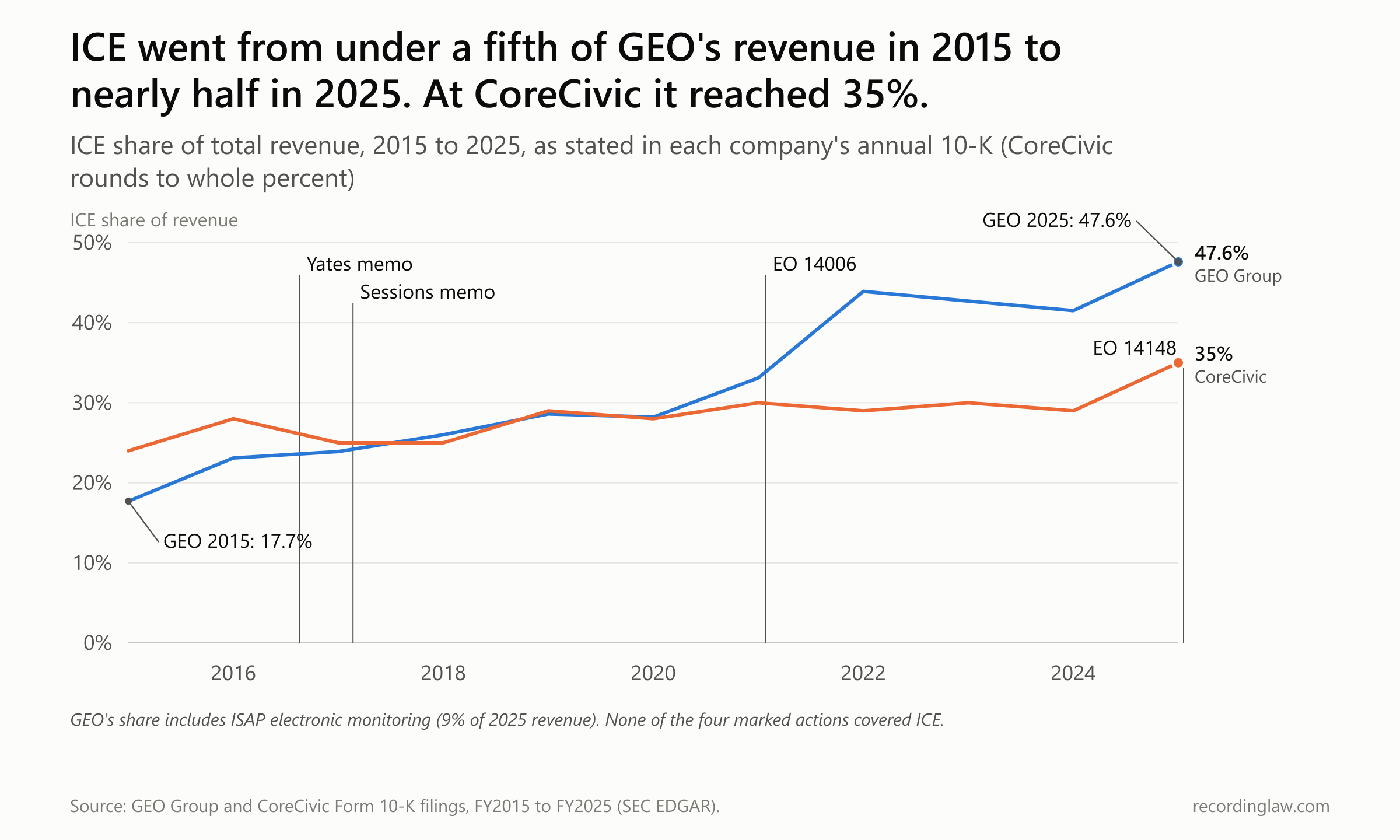
Source: GEO Group and CoreCivic Form 10-K filings, 2015 to 2025, SEC EDGAR. CoreCivic reports whole percentages.
| Year | GEO: ICE share of revenue | GEO: BOP share | CoreCivic: ICE share | CoreCivic: ICE revenue ($M) | CoreCivic: BOP revenue ($M) |
|---|---|---|---|---|---|
| 2015 | 17.7% | 15.6% | 24% | 439.1 | 190.0 |
| 2016 | 23.1% | 14.0% | 28% | 511.8 | 164.9 |
| 2019 | 28.6% | 11.9% | 29% | 579.4 | 95.3 |
| 2020 | 28.2% | 14.0% | 28% | 541.9 | 60.7 |
| 2021 | 33.1% | 8.6% | 30% | 552.2 | 64.7 |
| 2022 | 43.9% | 3.8% | 29% | 527.3 | 63.4 |
| 2023 | 42.7% | 2.9% | 30% | 565.5 | 29.1 |
| 2024 | 41.5% | 3.1% | 29% | 564.8 | 30.7 |
| 2025 | 47.6% | 2.6% | 35% | 770.7 | 32.2 |
The Bureau of Prisons, the customer the 2016 memo was about, moved the other way.
A memo about one customer
The Yates memo was aimed at a business that was already shrinking. The federal prison population had fallen "from nearly 220,000 inmates in 2013 to fewer than 195,000 inmates today," the memo said, and at its 2013 peak the Bureau "was housing approximately 15 percent of its population, or nearly 30,000 inmates, in privately operated prisons."
Yates gave her reasons in one sentence. "Private prisons served an important role during a difficult period, but time has shown that they compare poorly to our own Bureau facilities," she wrote. "They simply do not provide the same level of correctional services, programs, and resources; they do not save substantially on costs."
She leaned on a report the department's Inspector General had published that month. It compared 14 contract prisons with 14 Bureau prisons of similar security level from fiscal 2011 to 2014. "We found that in a majority of the categories we examined, contract prisons incurred more safety and security incidents per capita than comparable BOP institutions," it said. By December 2015, it counted roughly 22,660 federal prisoners in contract prisons, about 12% of the total.
The same report added a limit. "We note that we were unable to evaluate all of the factors that contributed to the underlying data, including the effect of inmate demographics and facility locations," the Inspector General wrote. On cost, the Bureau's own figures put the average annual cost per prisoner at $24,426 in its institutions and $22,488 in contract prisons, a difference of $1,938 per prisoner a year. But the report cautioned "against drawing the conclusion from that data" that contract prisons were necessarily cheaper overall, because the populations and programs differed.
The contractors pressed that point. Scott Marquardt, president of Management & Training Corporation (MTC), a privately held operator in the review, wrote in his response to the draft that "there are notable differences in the population housed at the contract facilities" and that one heading "makes an assertion that relies on a comparison of apples and oranges."
GEO said the damage would come slowly. "While our company was disappointed by today's DOJ announcement, the impact of this decision on GEO is not imminent," its statement said that evening. Damon Hininger, chief executive of Corrections Corporation of America, said 11 days later that "several customers have made public statements supporting their continued use of the private sector" and that "we look forward to validating the value proposition we provide."
The memo's supporters saw a bigger target. On August 19, Carl Takei of the ACLU, an advocacy organization, wrote that Bureau of Prisons contracts were 15% of GEO's revenue and 9% of CCA's. Those shares are the ACLU's own figures, not taken from the companies' 10-K filings.
Then he turned to ICE: "Eighteen percent of GEO's annual revenue comes from ICE detention, and a whopping 28 percent of CCA's revenue is from ICE detention." His conclusion: "And if DHS follows the Justice Department's lead, the impact will be even greater than yesterday's announcement."
Ratings agencies moved too. Prison Legal News, published by the Human Rights Defense Center, an advocacy group, reported that S&P downgraded CCA's corporate credit rating and Moody's cut its debt to junk, while some analysts said "the market had overreacted, as just 7% of CCA's gross revenue comes from its contracts with the Bureau of Prisons."
Whether ICE would follow was now an open question inside the government.
Would ICE follow?
Eleven days after the memo, the Homeland Security secretary opened a review. "On Friday, I directed our Homeland Security Advisory Council, chaired by Judge William Webster, to evaluate whether the immigration detention operations conducted by Immigration and Customs Enforcement should move in the same direction," Jeh Johnson said on August 29, 2016. He asked for a written report by November 30.
Before the council voted, the country did. On November 9, 2016, the first session after the election, CoreCivic (CCA had renamed itself in October) rose 43% and GEO 21%. An S&P 500 index fund rose 1% that session, and a Russell 2000 small-company index fund rose 3%. Analysts at Compass Point called the companies a "clear beneficiary" of a Trump administration, predicting it would be "more supportive given its focus on immigration and crime," BuzzFeed News reported.
The council voted on December 1. Its subcommittee found that 65% of ICE's detained population, as of September 2016, was in facilities run by private, for-profit contractors. It recommended continuing private detention. "Fiscal considerations, combined with the need for realistic capacity to handle sudden increases in detention, indicate that DHS's use of private for-profit detention will continue," it wrote, while granting that much could be said for a government-run model "if one were starting a new detention system from scratch."
The full council split. Five members voted for the report as written. Another 17 voted for the report, but only while also joining a dissent from its recommendation to keep using private detention, and one voted against. The recommendation went to an outgoing administration, and no order on ICE detention followed.
The Justice Department memo lasted six months. On February 21, 2017, Sessions rescinded it, writing that it had "changed long-standing policy and practice, and impaired the Bureau's ability to meet the future needs of the federal correctional system," according to a Bureau of Prisons notice. He directed the Bureau to return "to its previous approach."
On February 24, the first full session after the rescission was reported, GEO rose 3.3% and CoreCivic 3.0%. Six months earlier, both stocks had lost more than a third of their value on the session the memo came out.
The 2021 order and what it reached
By the time a president put the policy back in writing, the federal prison business it covered had shrunk. CoreCivic told investors it had "one prison contract with the BOP, accounting for 2% ($39.2 million) of our total revenue for the year ended December 31, 2020." That 2% ($39.2 million) is its one Bureau of Prisons prison contract. The revenue table's $60.7 million for 2020 is all of its Bureau of Prisons revenue in the 10-K.
Biden signed Executive Order 14006 on January 26, 2021. Its operative section is one sentence: "The Attorney General shall not renew Department of Justice contracts with privately operated criminal detention facilities, as consistent with applicable law." Its stated policy was to "reduce profit-based incentives to incarcerate by phasing out the Federal Government's reliance on privately operated criminal detention facilities."
"This is the first step to stop corporations from profiteering off of incarcerating," Biden said at the signing. The order reached the Bureau of Prisons and the U.S. Marshals Service, both part of the Justice Department. It did not reach ICE, which sits in Homeland Security. CoreCivic's filing that week said ICE facilities were not covered, "although it is possible that the federal government could choose to take similar action on ICE facilities in the future."
The companies pushed back on the premise. "President Biden's Executive Order is a solution in search of a problem," GEO said, calling it "a political statement" that could cost "hundreds of jobs" in communities already hit by the pandemic. The Day 1 Alliance, a trade association founded by CoreCivic, GEO and Management & Training Corporation (MTC) according to PolitiFact, asked: "If this announcement were truly about taking on mass incarceration, shouldn't it address the 91% of federally incarcerated men and women housed in government-run correctional facilities?" CoreCivic said in a prepared statement that its facilities are "safe and secure for those in our care and our staff."
Advocates who supported the order pointed at the same gap from the other side. "Today's executive order validates something we've been saying for years: No one should profit from the human misery that is caused by mass incarceration," said David Fathi of the ACLU National Prison Project, adding that "it does not end the relationship between private prison companies and the Department of Homeland Security." Silky Shah of Detention Watch Network, a coalition that seeks to end immigration detention, said the administration "must now address the private prison industry's toxic relationship with the Department of Homeland Security (DHS)."
Reuters put an upper bound on the stakes the next day: the two companies "could lose as much as a quarter of their revenue, about $1 billion a year between them." An analyst it quoted, Joe Gomes of Noble Capital Markets, said: "It's not a positive for GEO Group or CoreCivic, but it also doesn't blow up the business model."
On the signing day GEO fell 7.8% and CoreCivic 5.9%, leaving both "near their lowest levels in more than a decade," Reuters wrote. On the next session, January 27, both rose about 16% while the S&P 500 fund fell 2%. This comparison does not attribute either the signing-day fall or the next-day rise to any single event.
Contracts that closed, buildings that reopened
The order took effect one contract at a time. On March 5, 2021, the Bureau of Prisons told GEO it would not renew its contract for the 1,940-bed Great Plains Correctional Facility in Oklahoma. Later that month it terminated a contract at the county-owned Reeves I and II, effective May 10.
Some of the beds changed customers rather than closing. The 1,878-bed Moshannon Valley Correctional Facility in Pennsylvania lost its federal prisoners when its contract expired in March 2021, and GEO later announced it would house ICE detainees, The Intercept reported. CoreCivic signed a three-year contract with Mahoning County, Ohio, for 990 beds at its Northeast Ohio Correctional Center, an arrangement through a county rather than directly with the Marshals.
The pushback was not only from the companies. Rep. Scott Peters, a California Democrat, wrote to the White House: "I do not believe applying this order to U.S. Marshals' facilities will serve to remedy the problems we face within our criminal justice system." GEO, local officials, labor groups and the chief judge of the Southern District of California asked for a reprieve for a San Diego jail, according to The Intercept.
Detention Watch Network counted five Bureau of Prisons contracts for "Criminal Alien Requirement" prisons terminated by late 2021, with six more slated to close by November 2022. It also reported that private prisons "detained 79% of people in immigration detention in September 2021," the same figure the ACLU published that October.
States tried to reach ICE contractors on their own. In September 2022, the Ninth Circuit, sitting en banc (as a full court rather than a three-judge panel), held that California could not apply its ban on private detention facilities to ICE's contractors. Applying the ban, the majority wrote, would give California a "virtual power of review". GEO's annual report for 2025 lists seven states with laws barring state and local agencies from contracting to detain immigrants in ICE custody.
Two other 2021 events involved no government action at all. On June 9, 2021, retail traders pushed GEO up as much as 73% during the day. It closed up 38%, which Fortune called a record. Short sales then amounted to about 37% of its float (the shares available for public trading), according to S3 Partners data cited by Fortune.
Separately, CoreCivic agreed that year to pay $56 million, without admitting liability, to settle a shareholder suit filed after the August 2016 drop.
The order ended the companies' Justice Department contracts one expiry at a time. ICE, which it did not cover, was already a larger customer for both.
Which customer grew?
In the companies' annual 10-K filings with the Securities and Exchange Commission, the Bureau of Prisons shrank to a sliver of revenue while ICE grew. GEO's Bureau of Prisons share of revenue went from 15.6% in 2015 to 2.6% in 2025. CoreCivic's Bureau of Prisons revenue went from $190 million to $32 million.
As the chart near the top of this page shows, GEO's ICE share rose most in 2022 and reached 47.6% in 2025. CoreCivic's ranged from 24% to 30% from 2015 to 2024 and reached 35% in 2025.
GEO's figure is not all detention. It includes the Intensive Supervision and Appearance Program (ISAP), an ICE electronic-monitoring contract run by GEO's subsidiary BI. GEO says the contract made up 9% of its 2025 revenue and 14% in 2023. On September 30, 2025, GEO announced a new ICE contract for the program, with an initial year from October 1, 2025, and a one-year option.
How many people was ICE holding over these years?
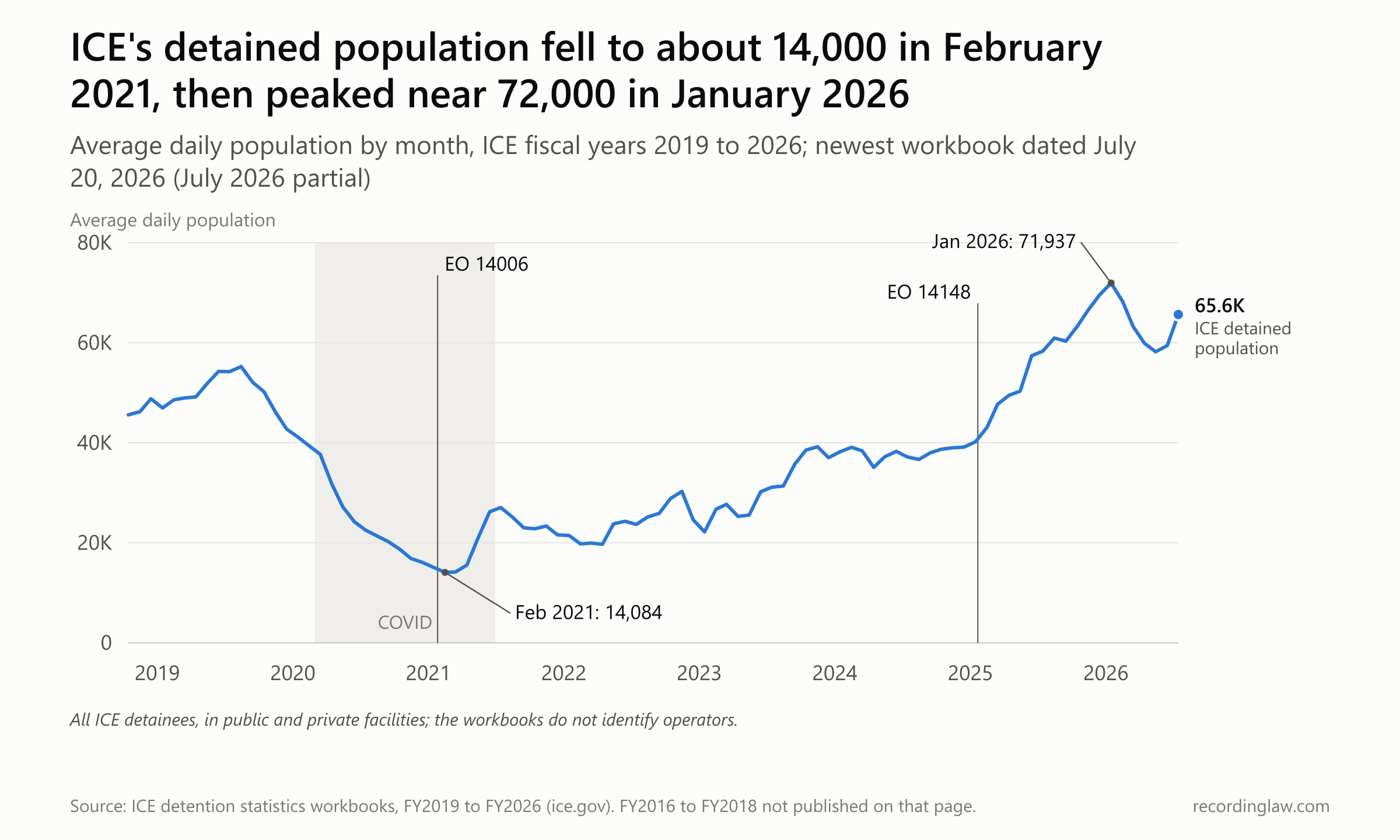
Source: ICE detention statistics workbooks, fiscal 2019 to 2026, the newest dated July 20, 2026. July 2026 is a partial month.
| Month | ICE average daily detained population |
|---|---|
| October 2018 | 45,584 |
| August 2019 | 55,238 |
| February 2021 | 14,084 |
| January 2025 | 40,203 |
| January 2026 | 71,937 |
| June 2026 | 59,425 |
| July 2026 (partial) | 65,634 |
The count fell to about 14,000 in early 2021, during the pandemic, and reached about 72,000 in January 2026, the highest month in the file.
These are all detainees, not only those in private facilities. The last private-share figure in this story is 79%, for September 2021, from the ACLU and Detention Watch Network. ICE's workbooks do not identify operators.
Election days and a revocation
On the session after the 2024 election, GEO moved further than it had on the session after the 2016 one. On November 6, 2024, GEO rose 42% and CoreCivic 29%, while the S&P 500 fund rose 2.5% and the Russell 2000 fund 5.8%. GEO went from $15.13 to $21.50 a share in one session.
GEO's executive chairman described what the company expected on its earnings call the next day. "This is to us an unprecedented opportunity to assist the federal government and the incoming Trump administration towards achieving a much more aggressive immigration policy," George Zoley said. He spoke of "a theoretical potential doubling of all of our services," adding: "Of course, this will depend on Congress providing the required funding."
CBS News reported that ICE had accounted for 30% of each company's revenue in the first nine months of 2024. For GEO, that is lower than the 41.5% ICE share its 10-K gives for full-year 2024, a figure that includes its ISAP monitoring contract. CBS does not say what it counted.
Over 20 sessions from the election, GEO rose 93% and CoreCivic 61%. GEO's shares reached $35.35 on January 17, 2025, the last session before the inauguration.
Three days later, Trump signed Executive Order 14148, which revoked a long list of earlier orders. Biden's private-prison order was item (q), and the order gave no reason specific to it. On the first session, GEO fell 1.4% and CoreCivic 0.5%. Over 20 sessions they fell 22.5% and 16.7%, while the S&P 500 fund rose 2.3%.
GEO's annual report later described the revocation in two sentences: Trump "reversed an executive order" that had directed the Attorney General not to renew Justice Department contracts, and "ICE facilities were not covered by this executive order, as ICE is an agency of the U.S. Department of Homeland Security."
Zoley had said the opportunity would depend on Congress. Congress acted the following July.
The law signed on July 4, 2025, Public Law 119-21, appropriated $45 billion to ICE "for single adult alien detention capacity and family residential center capacity," available until September 30, 2029. It also appropriated a separate $29.85 billion for ICE hiring, transportation and other purposes. Both companies' annual reports summarize the law as $75 billion for ICE.
Set side by side, on which days did the shares move most in the first session?
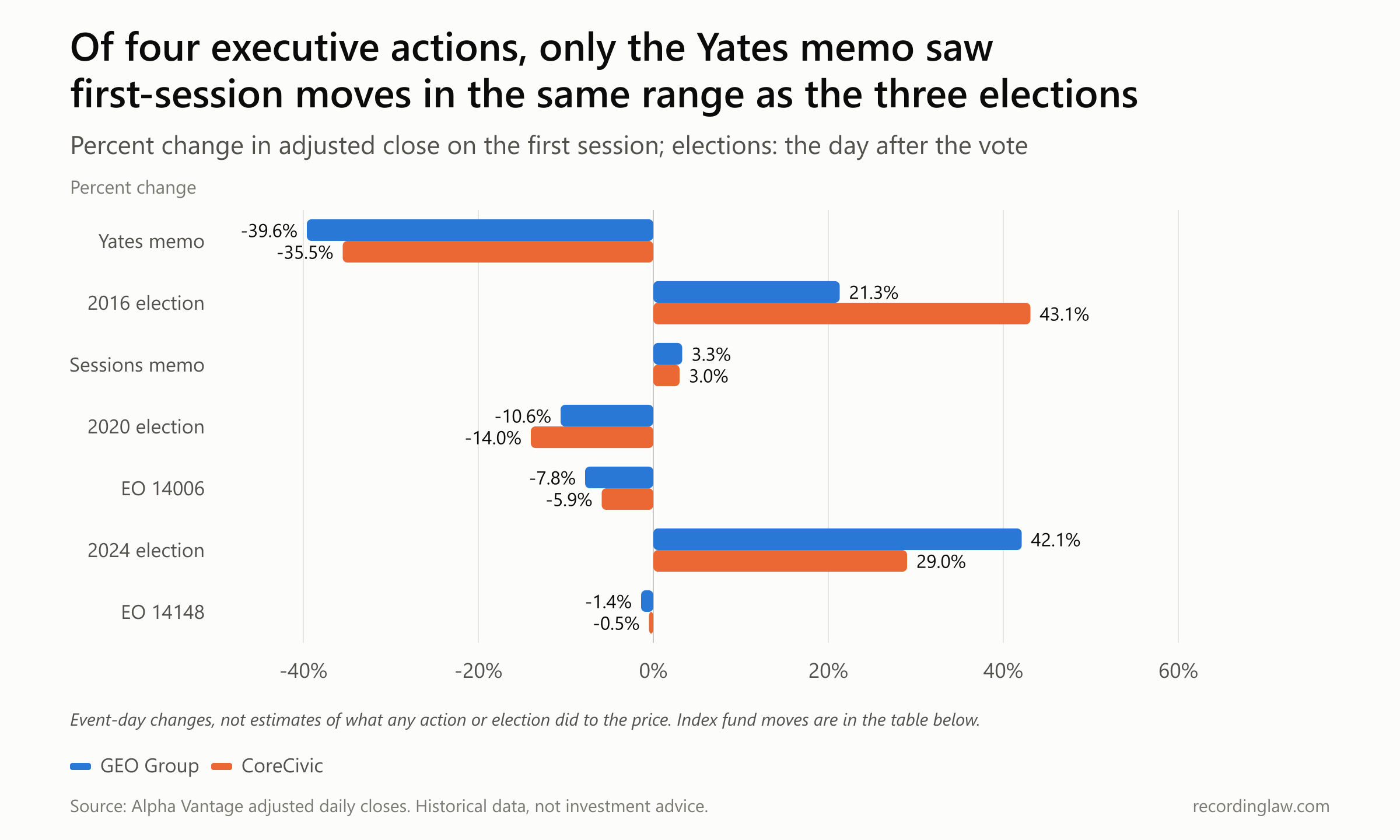
Source: Alpha Vantage adjusted daily closes. Percent change from the prior close to the close of the first session. Historical data, not investment advice.
| Event | First session | GEO | CoreCivic | S&P 500 ETF | Russell 2000 ETF |
|---|---|---|---|---|---|
| Yates memo | Aug 18, 2016 | -39.6% | -35.5% | +0.2% | +0.7% |
| 2016 election | Nov 9, 2016 | +21.3% | +43.1% | +1.1% | +3.1% |
| Sessions rescission reported | Feb 24, 2017 | +3.3% | +3.0% | +0.1% | -0.1% |
| 2020 election | Nov 4, 2020 | -10.6% | -14.0% | +2.2% | +0.1% |
| EO 14006 signed | Jan 26, 2021 | -7.8% | -5.9% | -0.2% | -0.7% |
| 2024 election | Nov 6, 2024 | +42.1% | +29.0% | +2.5% | +5.8% |
| EO 14148 revokes EO 14006 | Jan 21, 2025 | -1.4% | -0.5% | +0.9% | +1.9% |
Of the four executive actions, only the Yates memo saw a first-session move in the same range as the three election sessions. The 2017, 2021 and 2025 actions each came in under 8% that day. On November 4, 2020, the day after that year's vote, GEO fell 10.6% and CoreCivic 14.0%, while the S&P 500 fund rose 2.2%.
Did the picture change over a month?
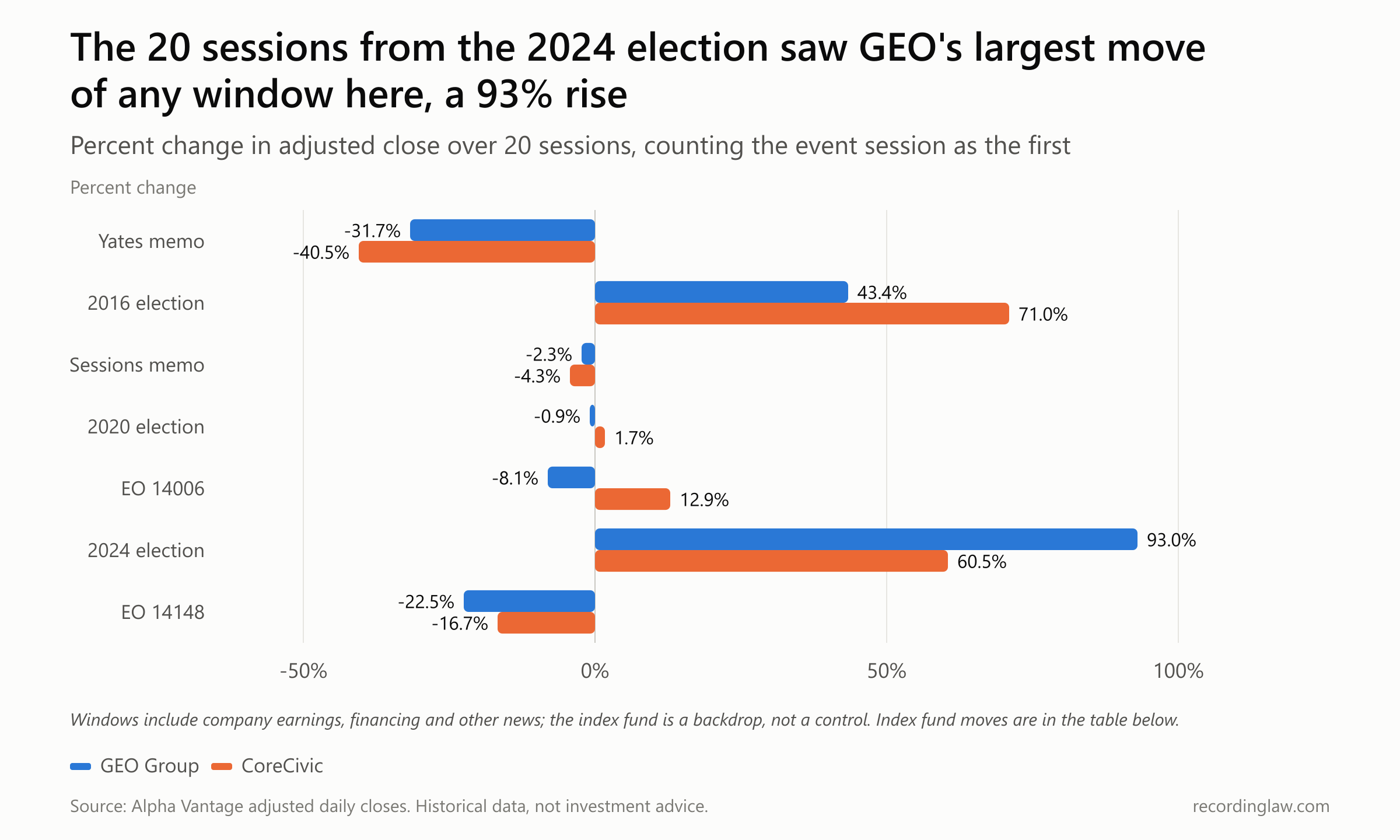
Source: Alpha Vantage adjusted daily closes. Percent change from the prior close to the close of the 20th session, counting the event session as the first. Historical data, not investment advice.
| Event | GEO, 20 sessions | CoreCivic, 20 sessions | S&P 500 ETF | Russell 2000 ETF |
|---|---|---|---|---|
| Yates memo | -31.7% | -40.5% | -1.4% | 0.0% |
| 2016 election | +43.4% | +71.0% | +4.9% | +14.3% |
| Sessions rescission | -2.3% | -4.3% | -0.6% | -2.9% |
| 2020 election | -0.9% | +1.7% | +9.2% | +14.1% |
| EO 14006 | -8.1% | +12.9% | +0.8% | +3.2% |
| 2024 election | +93.0% | +60.5% | +5.4% | +7.4% |
| EO 14148 | -22.5% | -16.7% | +2.3% | +0.8% |
Over 20 sessions after the revocation, GEO fell 22.5% and CoreCivic fell 16.7%. Over 20 sessions after the order itself, GEO fell 8.1% and CoreCivic rose 12.9%. GEO's 93% gain after the 2024 election is the largest move of any date in the table.
These are event-day observations, not estimates of what any action did to the price. Small-company stocks as a group also rose after both the 2016 and 2024 elections. The windows also take in each company's earnings, guidance and other news, which this comparison does not separate out. Each window shows what the shares did after a date, alongside everything else that happened in it.
Ten years after the memo
As of October 30, 2026, both stocks stood above their level the day before the Yates memo, and both trailed the two index funds. The chart below measures each series against that close, which it sets at 100. On that scale, CoreCivic spent most of 2020 and 2021 below half its 2016 level, and GEO bottomed in May 2021 at about 37% of it. How did they get from one point to the other?
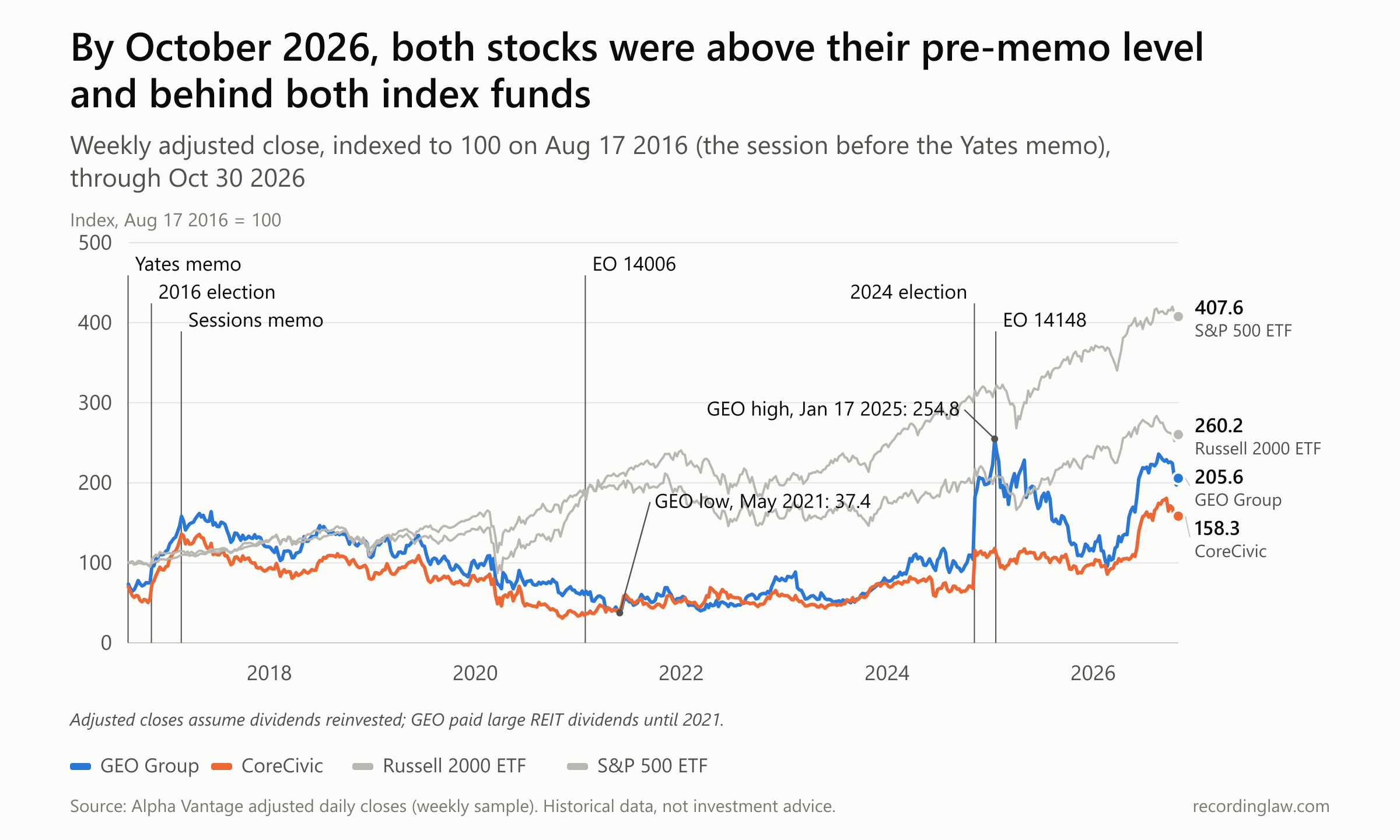
Source: Alpha Vantage adjusted daily closes, weekly sample, through October 30, 2026. GEO's history is adjusted for dividends paid while it was a real estate investment trust. Historical data, not investment advice.
| Series | Index, Aug 17, 2016 | Low (weekly) | High (weekly) | Oct 30, 2026 |
|---|---|---|---|---|
| GEO Group | 100 | 37.4 (May 28, 2021) | 254.8 (Jan 17, 2025) | 205.6 |
| CoreCivic | 100 | 30.8 (Nov 6, 2020) | 180.6 (Sept 18, 2026) | 158.3 |
| Russell 2000 ETF | 100 | not computed | not computed | 260.2 |
| S&P 500 ETF | 100 | not computed | not computed | 407.6 |
As of October 30, 2026, $100 in GEO stock the day before the memo, with dividends reinvested, was worth about $206, and $100 in CoreCivic about $158. The same $100 in the Russell 2000 fund was worth about $260, and in the S&P 500 fund about $408.
Waiting for the 2026 numbers
The companies' own filings now name a different risk from the one in 2016. CoreCivic's annual report for 2025 says "ICE has increased its use of military bases (domestically and at Guantanamo Bay), soft-sided facilities, idled or under-utilized facilities owned and operated by the BOP, facilities owned by state and local government agencies, international options, and has most recently proposed using warehouse-based real estate, and has acquired certain real estate assets for use in ICE detention." Detention options like these, it warns, "could divert potential occupancy from our facilities."
The newest ICE workbook, dated July 20, 2026, counted 65,765 people in detention as of early July, and its average for the partial month of July was about 65,600. ICE had not published a newer edition as of November 10, 2026.
CoreCivic reported third-quarter 2026 results on November 4. Federal customers in its residential segment, mainly ICE and the U.S. Marshals Service, generated 53% of its revenue in the quarter, against 55% a year earlier, and its occupancy rose to 84.0% from 76.7%. GEO reported on November 5: total revenues of $761.1 million, against $682.3 million a year earlier.
Neither release gives an ICE-only share of revenue for the quarter, so the revenue shares in this story come from the companies' 2025 annual reports, and the prices from trading through October 30, 2026. GEO's release listed new ICE contracts, including a 10-year contract at Tacoma that it said was "expected to generate approximately $140 million in annual revenues."
The next full-year answer to how much of ICE's detention money reaches GEO and CoreCivic comes in their 2026 annual reports. CoreCivic filed its 2025 report on February 20, 2026, and GEO on February 25. GEO's third-quarter 2026 release did not say whether ICE exercised the one-year option on its ISAP electronic-monitoring contract, which would run to September 30, 2027.
Ten years after a public radio reporter wrote that it was unclear whether ICE would keep using private prisons, ICE accounted for nearly half of GEO's 2025 revenue and about a third of CoreCivic's. Congress has given the agency $45 billion of its own for detention capacity, available until September 30, 2029.
How we measured
Prices. Daily adjusted closes for GEO, CXW (CoreCivic), SPY (an S&P 500 index fund) and IWM (a Russell 2000 small-company index fund) come from Alpha Vantage's daily adjusted series, July 2016 to October 30, 2026. Adjusted closes account for splits and dividends. So a percent change between two adjusted closes is the total return over the window. Quoted dollar prices (for example $32.29 and $19.51 for GEO on August 17 and 18, 2016) are unadjusted closes from the same files and differ from adjusted levels, especially for GEO, which paid large dividends as a real estate investment trust until 2021.
Event windows. Each window runs from the close of the session before the event to the close of the first, fifth or 20th session, counting the event session as the first. For each election the first session is the day after the vote: November 9, 2016, November 4, 2020, and November 6, 2024. The 2020 race was called on Saturday, November 7. On November 9, the first session after the call, GEO fell 0.6% and CoreCivic rose 3.7%.
The Sessions memo is dated February 21, 2017. News reports of it appeared after the market closed on February 23, so its first session is February 24. EO 14148 was signed on Monday, January 20, 2025, a market holiday, so its first session is January 21.
The "about 16%" rise on January 27, 2021, is adjusted closes of $8.62 against $7.41 for GEO (16.3%) and $7.29 against $6.26 for CoreCivic (16.5%); SPY fell 2.4% that session. This comparison does not attribute either the signing-day fall or the next-day rise to any single event. GEO's June 9, 2021, adjusted change is 38.4%.
Why we do not call these effects. There is no control group and no model of expected returns here. The index funds are a backdrop, not a counterfactual.
The 2016 and 2024 elections coincided with broad small-company rallies. The windows include earnings, guidance, financing and other company news that this comparison does not separate out. And the June 2021 move came on no government action.
The Stanford Securities Class Action Clearinghouse summary of the CCA shareholder suit gives the August 18, 2016 drop as 39.45%. But its own dollar figures ($9.65 on $27.22) work out to 35.5%, the figure in our data, so we do not use the 39.45%.
Index chart. Weekly values are the last session of each week, divided by the August 17, 2016 adjusted close and multiplied by 100. The sentences on what $100 became restate those index values. They assume dividends reinvested, as adjusted prices do, and ignore taxes and fees.
Revenue shares. Each year's ICE and Bureau of Prisons shares are taken from that year's own Form 10-K. Later 10-Ks restate some earlier years: GEO's 2018 ICE share is 26.0% in its 2018 report and 23.9% in its 2019 report. GEO's 2020 report gives its Bureau of Prisons share as 14.0% in one section and "approximately 12%" in another.
CoreCivic rounds to whole percent and states ICE and Bureau of Prisons revenue in dollars. GEO states only percentages.
CoreCivic's 2% ($39.2 million) for 2020 is its one Bureau of Prisons prison contract. The table's $60.7 million is all of its 2020 Bureau of Prisons revenue in the 10-K. Our GEO ICE dollar figures (about $326 million in 2015 and $1.25 billion in 2025) are its stated share times total revenue from its XBRL financial data.
Revenue figures are calendar years and nominal dollars. GEO's ICE share includes its ISAP monitoring contract (9% of 2025 revenue). The 10-K does not give a detention-only ICE share.
ICE detention. Monthly average daily population comes from the Total row of "ICE Average Daily Population by Facility Type and Month" in ICE's fiscal-year workbooks, fiscal 2019 to 2026. The fiscal 2026 workbook is dated July 20, 2026 (data as of July 9), so July 2026 is partial and August and September are not yet published.
ICE revises figures until it locks a fiscal year. ICE's detention-management page posts workbooks from fiscal 2019 onward. ICE fiscal years run October to September, so this series and the companies' calendar-year revenue are on different bases. The 65,765 figure is the workbook's "currently detained" total; TRAC Reports gives the same number as of July 11, 2026.
Private share of ICE detention. 65% (September 2016) is from the Homeland Security Advisory Council report. 81% (January 2020) and 79% (September 2021) are from the ACLU and Detention Watch Network, advocacy organizations that oppose private immigration detention. ICE's workbooks do not identify operators, so they give no private share of their own.
Other sources. The Inspector General comparison is report E&I 16-06 (August 2016); its cost figures are Bureau of Prisons per-capita averages for fiscal 2011 to 2014. The 2016 ACLU revenue shares are the ACLU's own figures, not 10-K extracts. The Day 1 Alliance statement is quoted as published by PolitiFact.
CBS News's 30% for GEO in the first nine months of 2024 is lower than the 41.5% ICE share GEO's 10-K gives for full-year 2024, which includes its ISAP monitoring contract. CBS does not say what it counted, so the table uses the 10-K figure.
Reuters' "as much as a quarter" is its own estimate of the upper bound. The 2025 appropriation figures are from the text of Public Law 119-21.
Frequently Asked Questions
Did Biden's executive order end private prison contracts with ICE?
No. Executive Order 14006, signed January 26, 2021, told the Attorney General not to renew Department of Justice contracts with privately operated criminal detention facilities. ICE is part of the Department of Homeland Security and was not covered, as both GEO Group and CoreCivic stated in their filings.
What was the Yates memo on private prisons?
An August 18, 2016 memo from Deputy Attorney General Sally Yates, Reducing our Use of Private Prisons, directed the Federal Bureau of Prisons to decline to renew or substantially reduce each private-prison contract as it reached the end of its term. Attorney General Jeff Sessions rescinded it on February 21, 2017.
How much did private prison stocks fall after the Yates memo?
On August 18, 2016, GEO Group's adjusted close fell 39.6% and CoreCivic's fell 35.5%. In unadjusted prices, GEO went from $32.29 to $19.51 a share and CoreCivic from $27.22 to $17.57. Over 20 sessions they were down 31.7% and 40.5%.
Is Biden's private prison executive order still in effect?
No. President Trump revoked Executive Order 14006 on January 20, 2025, as item (q) in Executive Order 14148, which revoked a list of earlier orders.
How much of GEO Group and CoreCivic revenue comes from ICE?
In 2025, ICE accounted for 47.6% of GEO Group's total revenue and 35% of CoreCivic's, according to their annual 10-K filings. GEO's figure includes its ISAP electronic-monitoring contract, which was 9% of its 2025 revenue.
How many people does ICE hold in detention?
ICE's detention statistics workbook dated July 20, 2026 showed 65,765 people currently detained and a monthly average daily population that peaked at 71,937 in January 2026. ICE had not published a newer workbook as of November 10, 2026.
How did GEO Group and CoreCivic stocks react to the 2024 election?
On November 6, 2024, the first session after the election, GEO rose 42.1% and CoreCivic 29.0%, while the S&P 500 fund rose 2.5% and the Russell 2000 fund 5.8%. This is historical market data, not investment advice.
Updates
Reworded for readability. No figures, quotes, sources or findings changed.
Restructured as a feature: chart titles state the finding, side details moved to How we measured. Every figure and quote was re-checked against its source.
Independently fact-checked against the cited primary sources
Independently fact-checked against the cited primary sources
Sources and References
- U.S. Department of Justice, Deputy Attorney General Sally Q. Yates, memorandum Reducing our Use of Private Prisons, August 18, 2016(justice.gov).gov
- DOJ Office of the Inspector General, Review of the Federal Bureau of Prisons' Monitoring of Contract Prisons, report E&I 16-06, August 2016(oig.justice.gov).gov
- Federal Bureau of Prisons, notice on Attorney General Sessions's rescission of the August 18, 2016 memorandum, February 2017(bop.gov).gov
- DHS, Statement by Secretary Jeh C. Johnson establishing a review of privatized immigration detention, August 29, 2016(dhs.gov).gov
- Homeland Security Advisory Council, Report of the Subcommittee on Privatized Immigration Detention Facilities, December 1, 2016(dhs.gov).gov
- Executive Order 14006, Reforming Our Incarceration System To Eliminate the Use of Privately Operated Criminal Detention Facilities, January 26, 2021 (Federal Register)(federalregister.gov).gov
- Executive Order 14006, full text (GovInfo)(govinfo.gov).gov
- White House (archived), remarks by President Biden at the signing of executive orders on racial equity, January 26, 2021(bidenwhitehouse.archives.gov).gov
- Executive Order 14148, Initial Rescissions of Harmful Executive Orders and Actions, January 20, 2025 (Federal Register)(federalregister.gov).gov
- Public Law 119-21 (H.R. 1), approved July 4, 2025, sections on ICE detention capacity and appropriations(govinfo.gov).gov
- U.S. Immigration and Customs Enforcement, detention management and statistics workbooks, fiscal 2019 to 2026(ice.gov).gov
- ICE, fiscal 2026 detention statistics workbook dated July 20, 2026(ice.gov).gov
- U.S. Court of Appeals for the Ninth Circuit (en banc), GEO Group v. Newsom, No. 20-56172, September 26, 2022(cdn.ca9.uscourts.gov).gov
- GEO Group Form 10-K filings, fiscal 2015 to 2025 (SEC EDGAR)(sec.gov).gov
- CoreCivic Form 10-K filings, fiscal 2015 to 2025 (SEC EDGAR)(sec.gov).gov
- GEO Group, Form 10-K for 2025(sec.gov).gov
- CoreCivic, Form 10-K for 2025(sec.gov).gov
- CoreCivic, Form 8-K on the private prison executive order, January 2021(sec.gov).gov
- GEO Group, Form 10-Q for the quarter ended March 31, 2021(sec.gov).gov
- GEO Group, third-quarter 2024 earnings call transcript (Exhibit 99.2 to Form 8-K), November 7, 2024(sec.gov).gov
- CoreCivic, announcement of the Grae shareholder litigation settlement (Exhibit 99.1), 2021(sec.gov).gov
- SEC XBRL company facts, GEO Group total revenue(data.sec.gov).gov
- SEC XBRL company facts, CoreCivic total revenue(data.sec.gov).gov
- Alpha Vantage, daily adjusted price data for GEO, CXW, SPY and IWM (retrieved October 31, 2026)(alphavantage.co)
- WLRN via WGCU, August 18, 2016, on the Justice Department memo and GEO Group's statement(news.wgcu.org)
- Corrections Corporation of America press release, August 29, 2016(einpresswire.com)
- ACLU (advocacy organization), Carl Takei, August 19, 2016(aclu.org)
- Prison Legal News (Human Rights Defense Center, advocacy), September 2, 2016(prisonlegalnews.org)
- BuzzFeed News, November 9, 2016, on Compass Point analysts and private prison stocks(buzzfeednews.com)
- GEO Group, statement on President Biden's DOJ executive order, January 2021(geogroup.com)
- PolitiFact, on the private prison executive order and the Day 1 Alliance statement, 2021(politifact.com)
- Cronkite News (Arizona PBS), January 29, 2021(cronkitenews.azpbs.org)
- ACLU (advocacy organization), statement on the executive order, January 26, 2021(aclu.org)
- Detention Watch Network (advocacy coalition), statement, January 26, 2021(detentionwatchnetwork.org)
- Reuters (Kate Duguid), January 27, 2021, republished by Daily Maverick(dailymaverick.co.za)
- The Intercept, October 22, 2021, on how the executive order was carried out(theintercept.com)
- Detention Watch Network (advocacy coalition), Broken Promises: Limits of Biden's Executive Order on Private Prisons, 2021(detentionwatchnetwork.org)
- ACLU (advocacy organization), Eunice Hyunhye Cho, October 5, 2021(aclu.org)
- Fortune, June 10, 2021, on GEO Group's June 9 trading(fortune.com)
- CBS News MoneyWatch, November 7, 2024(cbsnews.com)
- Stanford Securities Class Action Clearinghouse, Grae v. Corrections Corporation of America (percentage not used; see How we measured)(securities.stanford.edu)
- TRAC Reports, immigration quick facts (data as of July 11, 2026)(tracreports.org)
- CoreCivic, third-quarter 2026 results (Exhibit 99.1 to Form 8-K), November 4, 2026(sec.gov).gov
- GEO Group, third-quarter 2026 results (Exhibit 99.1 to Form 8-K), November 5, 2026(sec.gov).gov