DC's 2015-16 Body Camera Trial Found No Detectable Change in Force or Complaints

Independently fact-checked against primary sources (last audited November 9, 2026). · 25 primary sources cited on this page. How we verify our legal content
On October 1, 2014, about 165 Washington, D.C., police officers who had volunteered for a six-month test began wearing body cameras. Each officer would rotate through five camera models from three vendors and send written feedback after each one. The pilot cost $1 million.
Chief Cathy Lanier of the Metropolitan Police Department (MPD) said the cameras would benefit "the community and MPD members by improving police services, increasing accountability and enhancing public safety." On the first day, the Associated Press summed up her case: supervisors would be able to check complaints against the video, and the cameras would make both officers and the public behave better.
Three years later, on October 20, 2017, the city published its test of that last claim, about behavior. Researchers had randomly assigned cameras to 1,189 of 2,224 officers and compared them with the 1,035 who went without. On every outcome they measured, they found no statistically significant difference, meaning none large enough to tell apart from chance. "They kind of blew my mind," said Alexander Coppock, a Yale political scientist and one of the authors.
The cameras did change one thing. Officers wearing them uploaded an average of about 665 videos a year, against 14 for officers without them.
The trial also counted uses of force, which officers document in their own reports, and civilian complaints. The city had hoped cameras would reduce both, and neither moved by an amount the trial could detect.
What did a camera on every officer change, and what did the city decide cameras were for? In Washington, the argument that outlasted the trial was about who gets to see the video, and it began before the trial did, in 2015. The city's latest answer to that question is a temporary law on city police footage of serious or deadly force by federal agents and other agencies, and it expires on January 22, 2027.
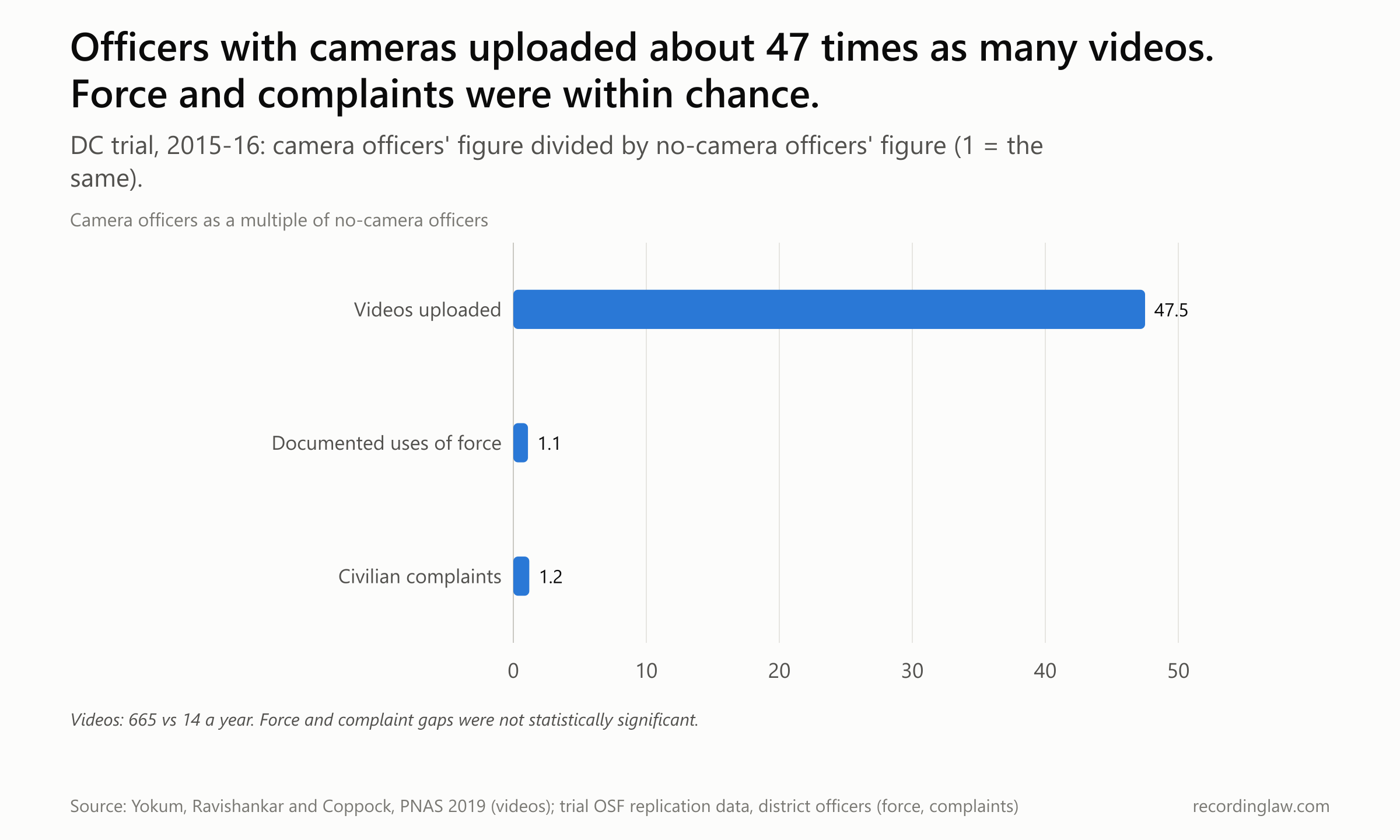
Camera officers' figures as a multiple of no-camera officers', DC trial. Source: Yokum, Ravishankar and Coppock, PNAS 2019 (videos); force and complaint rates computed from the trial's OSF replication data, district officers, matching the paper's estimates.
| DC trial, per year | Camera officers | No-camera officers | Multiple |
|---|---|---|---|
| Videos uploaded per officer | about 665 | about 14 | about 47.5 |
| Documented uses of force per 1,000 officers (district officers: 1,034 with cameras, 888 without) | 880.8 | 807.2 | 1.09 |
| Civilian complaints per 1,000 officers (same officers) | 337.4 | 280.1 | 1.20 |
Across the country, departments kept buying cameras. Between 2013 and 2020, the share of local police departments in the United States using them rose from about a third to about three in five. The DC trial cannot say what cameras do everywhere. Other studies found effects in other places, and its own authors listed its blind spots before they saw a single result.
What the cameras were supposed to do
The case for cameras was made before anyone in Washington had measured them. Mayor Vincent Gray tied the pilot to Ferguson, Missouri: "Especially since the unfortunate incidents in Ferguson, Mo., have brought the issue of body cameras to national attention, I'm proud that MPD will continue to show leadership in this area."
The White House moved two months later. A December 1, 2014, fact sheet proposed a 50 percent federal match for states and localities that bought cameras. It said "the proposed $75 million investment over three years could help purchase 50,000 body worn cameras."
The Police Executive Research Forum, a police research nonprofit, published a camera guide in 2014 that cited studies from Rialto, California, and Mesa, Arizona. In Rialto's 2012 study of 54 officers, as WTOP later summarized it, force was twice as likely when cameras were not worn, and complaints fell from 0.7 to 0.07 per 1,000 contacts, a tenth of the earlier rate. Rialto's chief, William Farrar, said in the guide: "Whether the reduced number of complaints was because of the officers behaving better or the citizens behaving better--well, it was probably a little bit of both."
By 2015 the money was flowing. The Justice Department awarded more than $23.2 million in camera grants to 73 local and tribal agencies in 32 states, including $1 million for about 579 cameras in Washington. Attorney General Loretta Lynch said the impact of cameras "touches on a range of outcomes that build upon efforts to mend the fabric of trust, respect and common purpose that all communities need to thrive." Mayor Muriel Bowser said: "Body Worn Cameras increase accountability, improve police services and strengthen policy-community relations."
The Bureau of Justice Statistics, the Justice Department's statistics agency, later asked departments why they had bought cameras. Each of four reasons was named by about 80% of them: officer safety, better evidence, fewer civilian complaints and lower liability.
The warnings came from several directions. The Police Executive Research Forum, whose 2014 camera guide was produced under a Justice Department cooperative agreement, wrote in its foreword: "If police departments deploy body-worn cameras without well-designed policies, practices, and training of officers to back up the initiative, departments will inevitably find themselves caught in difficult public battles that will undermine public trust in the police rather than increasing community support for the police."
The ACLU, a civil-liberties group, gave conditional support. "Overall, we think they can be a win-win," its 2015 white paper said, if strong privacy policies were in place. "Without such a framework, their accountability benefits would not exceed their privacy risks." On cost, a campus safety expert, S. Daniel Carter, told The GW Hatchet in 2014: "For a smaller agency, it may not be something that could be easily funded."
In Washington, the first of those warnings to come due was the one about policy. The question was who would get to watch.
Who gets to see the video?
On May 7, 2015, the D.C. Council heard testimony on a proposal from Bowser's administration to exempt all camera footage from the District's Freedom of Information Act (FOIA), the law that lets the public request government records. The Sunlight Foundation, an open-government advocacy group, wrote that the mayor "confused many accountability advocates" by proposing it.
Traci Hughes, whom Sunlight identified as head of D.C.'s Board of Ethics and Government Accountability, testified against it: "It is indisputable that the videos taken with [body-worn cameras] are public records." So did the head of the D.C. Police Union, Delroy Burton, who said a blanket exemption would "[defeat] the purpose of having the [body-worn camera] program in the first place."
Lanier was, in Sunlight's account, "the only D.C. government witness to testify yesterday in favor of the sweeping exemption." She argued that the privacy of arrestees, juveniles and victims should come before the public's wish to see the video. She also listed what would need redaction before release: family photos, addresses and school uniforms caught inside homes, and medical information.
Jeramie Scott of the Electronic Privacy Information Center, a privacy group, opposed deploying the cameras at all, Sunlight reported. He asked for strong limits if they were deployed.
Five days later, a council committee cut the purchase. Bowser had asked for $5.1 million to equip all 2,800 patrol officers. The committee approved $1.9 million for 1,200 cameras, and it said the department should work out storage and public access first. Bowser warned, according to The Washington Post, that keeping the footage public could cost the city $1.5 million a year.
The council held its line. In the Budget Support Act passed June 30, 2015, it required that camera video be subject to FOIA.
The administration then proposed narrower exemptions, covering particular kinds of footage rather than all of it, and those drew a second round of testimony in October. Adam Marshall of the Reporters Committee for Freedom of the Press, a press-freedom group, testified that one draft exemption "would appear to allow the MPD to withhold video of assaults committed by law enforcement personnel against civilians."
Deputy Mayor Kevin Donahue said the administration was trying to regulate a very new technology: "We are still determining whether or not there are unexpected, unprotected adversaries." Tuyet Duong of the Asian/Pacific Islander Domestic Violence Resource Project said cameras could deepen victims' fears of police.
A last-minute amendment before the council's December 15 vote let officers watch their own footage before writing reports, except in police shootings. Councilmember Kenyan McDuffie, who chaired the Judiciary Committee, objected: "[Officers are] going to be writing reports that incorporate what's in the body worn cameras, and intentionally or unintentionally filling in gaps where they exist."
Bowser signed the law on December 30, 2015, calling it the "most comprehensive, innovative [police] body-worn camera program in America." McDuffie still called it "a win for every resident and visitor to the District of Columbia." By then, cameras had been on officers in two districts for six months, handed out at random.
A camera for some officers, chosen at random
On June 29, 2015, the department pulled back its pilot cameras and gave 200 new ones each to the Fifth and Seventh Police Districts. Its report to the council said the deployment "was designed by a team of national researchers who will analyze the impact of body-worn cameras on such issues as citizen complaints and use of force."
The researchers worked with The Lab @ DC, a group inside the city government, and the Laura and John Arnold Foundation paid for the study. Within each of the city's seven police districts, officers were randomly assigned to receive a camera or not. After the Fifth and Seventh in June 2015, the other five districts got their cameras between March and May 2016.
This design is called a randomized controlled trial. Because chance alone decided who wore a camera, the camera officers and the officers without one, known as the control group, should on average differ in nothing but the camera. That is what lets such a trial speak to cause. Any gap in their records afterward, beyond what chance alone could produce, could be put down to the camera.
The study tracked 2,224 officers. The main analysis used the 1,922 assigned to the seven districts and left out special units, whose policing and camera use may differ, the authors wrote. For each officer, it compared the 212 days after deployment with the same 212-day window a year earlier. It followed dozens of outcomes in four families: police use of force, civilian complaints, policing activity such as arrests for disorderly conduct, and judicial outcomes such as whether charges were prosecuted.
On October 7, 2016, before any results came in, the team filed its analysis plan, a step researchers call preregistration: it writes down in advance what will be measured and how, so the analysis cannot be bent to fit the results. The plan, which abbreviates body-worn cameras as BWCs, made a prediction: "We expect that BWCs will change many of the outcomes listed above; indeed, these outcomes were selected because changes in these variables are among the most commonly theorized consequences of introducing BWCs."
The same plan wrote down two ways the trial could miss a real effect. The first was the reports. Officers fill in use-of-force reports themselves, so a camera might change "only the occurrence of events, only the reporting of events, or both," and "Our design is not able to distinguish between these two channels." In other words, a camera might change how often officers use force, how often they write it down, or both, and the trial could not tell which.
The second was that every officer might act as if watched, because of "the omnipresence of cell phone cameras and other officers' BWCs." In that case, the plan said, "our design would be unable to distinguish this possibility from the alternative explanation that BWCs have no effect on police behavior."
The department took a risk by agreeing to the test, Coppock said later. "Think of the risks that this study poses to them," he told YaleNews. A large drop in force among camera officers, he said, "implies that the control officers were doing something really wrong and it would be super damning for the department." "Kudos to them for being willing to run that risk."
On December 15, 2016, Bowser announced that more than 2,600 cameras were deployed across the force. The department's camera page still describes the rollout, of about 2,800 cameras, as "the largest deployment of body worn cameras in the country." Ten months later, the results came out.
What the cameras changed, and what they did not
Before asking whether the cameras changed behavior, the researchers checked something simpler. Did officers who were given cameras actually record?
They did, at scale. Camera officers uploaded about 47 videos for every one uploaded by an officer without a camera, and their clips ran longer: over 11 minutes on average, against 0.8 minutes.
The researchers also checked whether officers switched the cameras on when they should. On 98% of days in 2016, the department averaged at least one video for each call for service involving a camera officer. The team put average adherence, meaning use of the cameras according to department policy, at 96%.
Did camera officers use force, or draw complaints, less often than the control group? After the cameras arrived, the two groups' documented records came out close, with the camera officers slightly higher on both.
As the table near the top of this story shows, officers without cameras documented about 807 uses of force per 1,000 officers per year, roughly four for every five officers. Officers with cameras documented about 881. The difference, 74 per 1,000 officers, was the study's best estimate of the camera's effect.
The trial could not pin that 74 down closely. The Lab @ DC put the plausible range at "anywhere from a decrease of 97 uses of force to an increase of 244 uses of force per 1000 officers, per year." A range that runs from fewer uses of force to more cannot say which way the camera pushed. Complaints followed the same pattern: 57 more per 1,000 officers with cameras, a difference the authors also reported as not statistically significant.
How far off could those estimates be? Each comes with a standard error, a measure of how much an estimate could swing by chance alone. The 95% interval, roughly the estimate plus or minus two standard errors (1.96, to be exact), is the range of effects that fit the data.
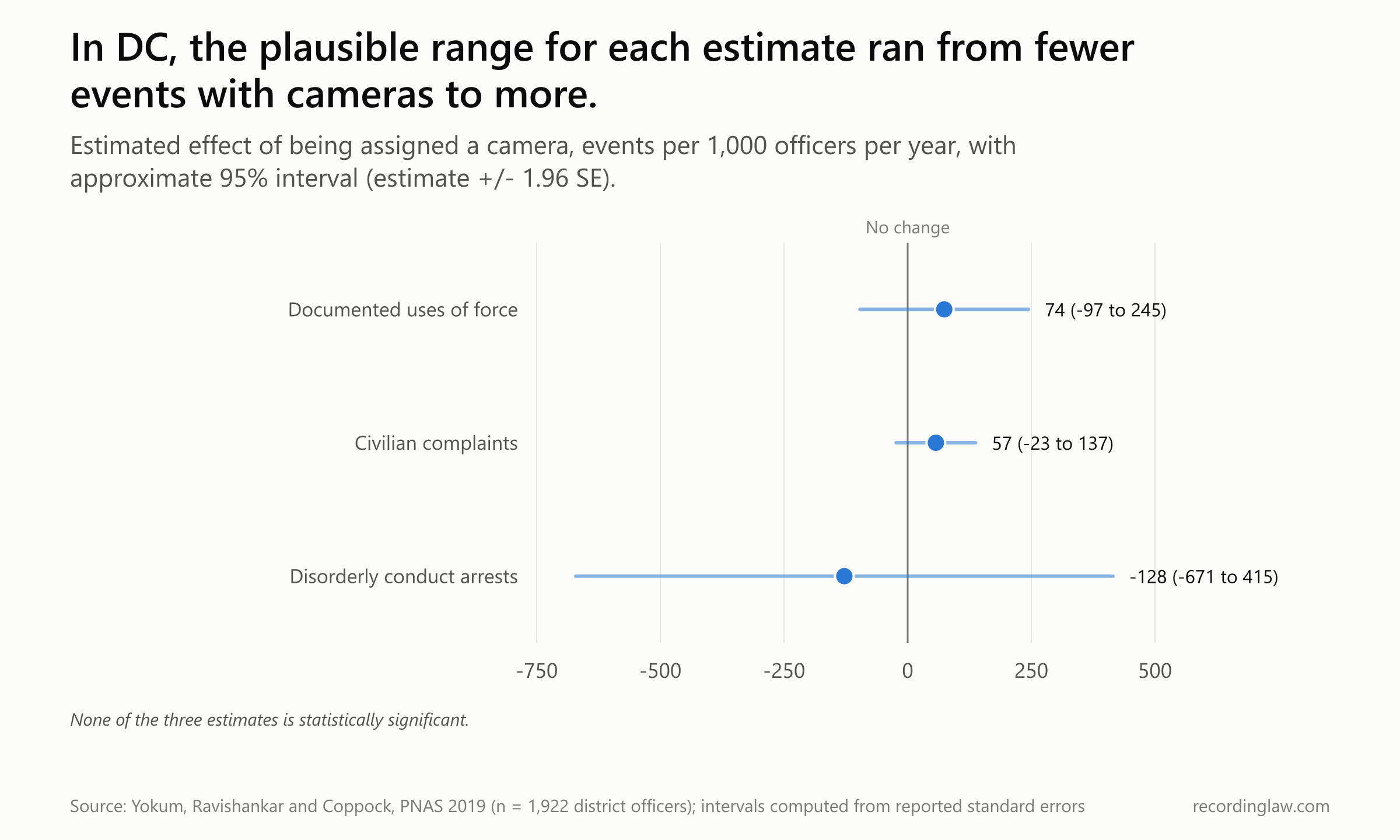
Estimated effect of camera assignment in the DC trial, per 1,000 officers per year. Source: Yokum, Ravishankar and Coppock, PNAS 2019; intervals derived from reported standard errors.
| Outcome | Estimated effect | Standard error | Approximate 95% interval |
|---|---|---|---|
| Use of force | +74 | 87 | -96.5 to +244.5 |
| Civilian complaints | +57 | 41 | -23.4 to +137.4 |
| Disorderly conduct arrests | -128 | 277 | -670.9 to +414.9 |
Every interval crosses zero, which means each one runs from a decrease to an increase. On all three outcomes, the trial cannot tell an increase from a decrease.
Because officers were randomized within each district, the authors could treat each district as its own small experiment, and they found "small, insignificant effects in all seven districts."
WTOP reported that "The number of complaints filed against officers wearing body cameras was actually slightly higher than the number made against officers without the cameras," and added that scientists said "it would be a stretch to conclude the cameras had much of an impact in that regard." The authors' own summary was that the results across all four outcome families, from use of force to court outcomes, "consistently point to a null result." In research terms, a null result means the study found no change it could tell apart from zero. Not detecting an effect is not the same as showing there is none.
"We found essentially that we could not detect any statistically significant effect of the body-worn cameras," Anita Ravishankar, a researcher with the department and The Lab @ DC, told NPR. Coppock had expected otherwise.
"This is a blunt instrument," he told YaleNews. "I didn't know what it was going to change, but we had about 50 dependent variables, and I thought a few of them would move." By dependent variables he meant the outcomes the study measured.
Reactions differed. Bowser's office said the city had invested in one of the most comprehensive deployments "to ensure even greater transparency and accountability." Chief Peter Newsham told NPR: "I am a little concerned that people might misconstrue the information and suggest that the body-worn cameras have no value. I don't think that this study suggests that at all."
Harlan Yu of Upturn, a technology and civil-rights nonprofit, called it "the most important empirical study on the impact of police body-worn cameras to date." He asked: "If cameras don't decrease use of force, don't decrease the number of misconduct complaints and don't change officer behavior, then what are we adopting cameras for?"
In the Proceedings of the National Academy of Sciences (PNAS) in May 2019, the authors called the study "the largest randomized evaluation of BWCs conducted to date." They limited their conclusion to large changes in behavior and to places like Washington. "These results suggest we should recalibrate our expectations of BWCs' ability to induce large-scale behavioral changes in policing, particularly in contexts similar to Washington, DC."
Why the trial might have missed a change
The trial's own authors and other researchers have named specific ways it could have missed a real change. The first is the records.
Uses of force were counted from officers' own reports, and the paper says that "because our data do not capture unreported uses of force, we are unable to detect this kind of change." Its next sentence gives the authors' own view: "As a matter of speculation, however, we find it implausible that we would measure very small effects on reported outcomes but that the true average effect on unreported outcomes is large." In other words, they doubted that cameras could barely move the force officers reported while having a large effect on force nobody reported. The team's 2017 working paper noted that a camera could make officers more likely to report force they used, which would look like an increase when the underlying rate had not changed.
The second is the department itself. After a federal investigation in the late 1990s found "a pattern or practice of excessive use of force," the department operated under a 2001 agreement with the Justice Department, with oversight that ended in 2008. The working paper suggested that scrutiny and reform "may have already helped root out many of these types of issues at MPD, limiting the added effect of BWCs." Michael White, an Arizona State University criminologist who has studied cameras in Tempe and Spokane, made the same argument to NPR: "When you have a department in that kind of state, I don't think you're going to see large reductions in use of force and complaints, because you don't need to."
The footage became the fight
Five years after the pilot, Washington's argument was back where it had started. In October 2019, the ACLU of the District of Columbia told a council roundtable that the program, at "a $5.7 million annual cost," had "fallen far short of achieving its intended purpose of greater transparency and accountability of MPD's police practices."
It cited the Lab @ DC study and a June 2018 report in which officers were found to have violated their duty to turn on their cameras in 297 of 340 investigations. It also pointed to the rule McDuffie had objected to in 2015: officers could still watch their footage "prior to completing and submitting any required reports and being interviewed by the appropriate investigative unit," in every case except a police shooting.
In July 2020, the council passed an emergency law requiring the city, within 5 business days after an officer-involved death or serious use of force, to "publicly release the names and body-worn camera recordings of all officers who committed the officer-involved death or serious use of force." The police union sued.
The union's position had moved since 2015. When the city first used cameras, according to WTOP, union leaders welcomed them and argued they would show that "incidents of police abuse tended to be overblown, if not fabricated." In 2020, union chairman Greggory Pemberton said: "It is disappointing that city leaders have passed a law that intentionally endangers every police officer on this department." Officers had supported the old, limited-release policy, he said, but the new law went too far.
Councilmember Charles Allen, then the Judiciary chair, answered: "Before the Council's emergency bill passed, the public was rarely given even basic information about what happened in these serious cases." A judge declined in August 2020 to block releases. City officials said all footage from fatal incidents since 2014 had now been released: 16 incidents, 10 of them with camera video. D.C. Superior Court dismissed the union's lawsuit on July 16, 2021.
A permanent reform law, D.C. Law 24-345, took effect on April 21, 2023. Among its provisions was the change McDuffie had argued for eight years earlier: "Metropolitan Police Department officers shall not review their body-worn camera recordings or body-worn camera recordings that have been shared with them to assist in initial report writing."
The bar did not last in that form. The Secure DC Omnibus Amendment Act, D.C. Law 25-175, effective June 8, 2024, limited it to officer-involved deaths and serious uses of force. For other incidents, officers must say in their reports whether they watched footage first, and which footage.
A 2026 temporary law, described below, narrows the bar further, to deaths and serious uses of force directly involving a Metropolitan Police officer, until it expires. The District's current release rules are summarized on our D.C. police body camera laws page, and the steps for asking for a recording are in how to request body cam footage.
Other places, other answers
Washington was not the only trial, and the others did not all agree. The researchers who later pooled them, combining their results into one estimate for each outcome, pointed to one difference in design: whether officers without cameras worked beside officers who had them, and so might act as if they were being recorded.
In 2016, criminologists at the University of Cambridge and RAND Europe reported preliminary results from ten trials in eight police forces in the U.K. and U.S. They found assaults on officers 15% higher on camera shifts than on shifts without cameras. Use of force rose when officers turned cameras on and off during a shift, and it fell when they kept them rolling. "At present, there is a worldwide uncontrolled social experiment taking place," they wrote.
Whether officers without cameras worked beside officers with them was also a question in Washington. Spillover is when the treatment reaches the comparison group. An officer without a camera, standing next to one with a camera, might behave as if recorded. In the DC trial, about a third of calls drew camera officers only, a third drew officers without cameras only, and a third drew both.
The authors answered in the PNAS paper that this mix of calls meant "control officers were frequently performing their duties without cameras nearby," and that time trends in documented force and complaints showed "no differences in precamera versus postcamera outcomes for either group." The time trends were their check of whether the cameras had affected officers in both groups. Researchers disagree about how much that matters.
A 2021 University of Chicago Crime Lab and National Bureau of Economic Research paper argued that spillover could bias the DC estimates toward zero, meaning it could make the cameras' effects look smaller than they were. The paper was funded by a grant from Citadel, and it disclosed two $5,000 travel grants from Axon, a body-camera vendor. As evidence, it cited a Boston study in which control officers in camera districts had 38.3% fewer complaints than control officers in districts without cameras.
Coppock told YaleNews: "I have a hunch that this didn't happen, but I don't know for sure." Testing it, he said, "would require an experiment five times larger than this one." That is a question of statistical power, a study's ability to detect an effect of a given size, which grows with the number of people studied.
When the PNAS paper speaks of failures to reject the null, it means finding no change it could tell apart from zero. For the main comparison, it says the trial was large enough "to detect small effect sizes," so "these failures to reject the null are unlikely to be due to insufficient statistical power." Coppock's estimate was about the far larger study needed to test spillover.
In 2020, Cynthia Lum, Christopher Koper and colleagues at George Mason University pooled 30 studies published through September 2019, in a review in Campbell Systematic Reviews. The review was funded by the Laura and John Arnold Foundation through the Campbell Collaboration, and its authors declared no conflicts of interest. Across all those studies, what did cameras change?
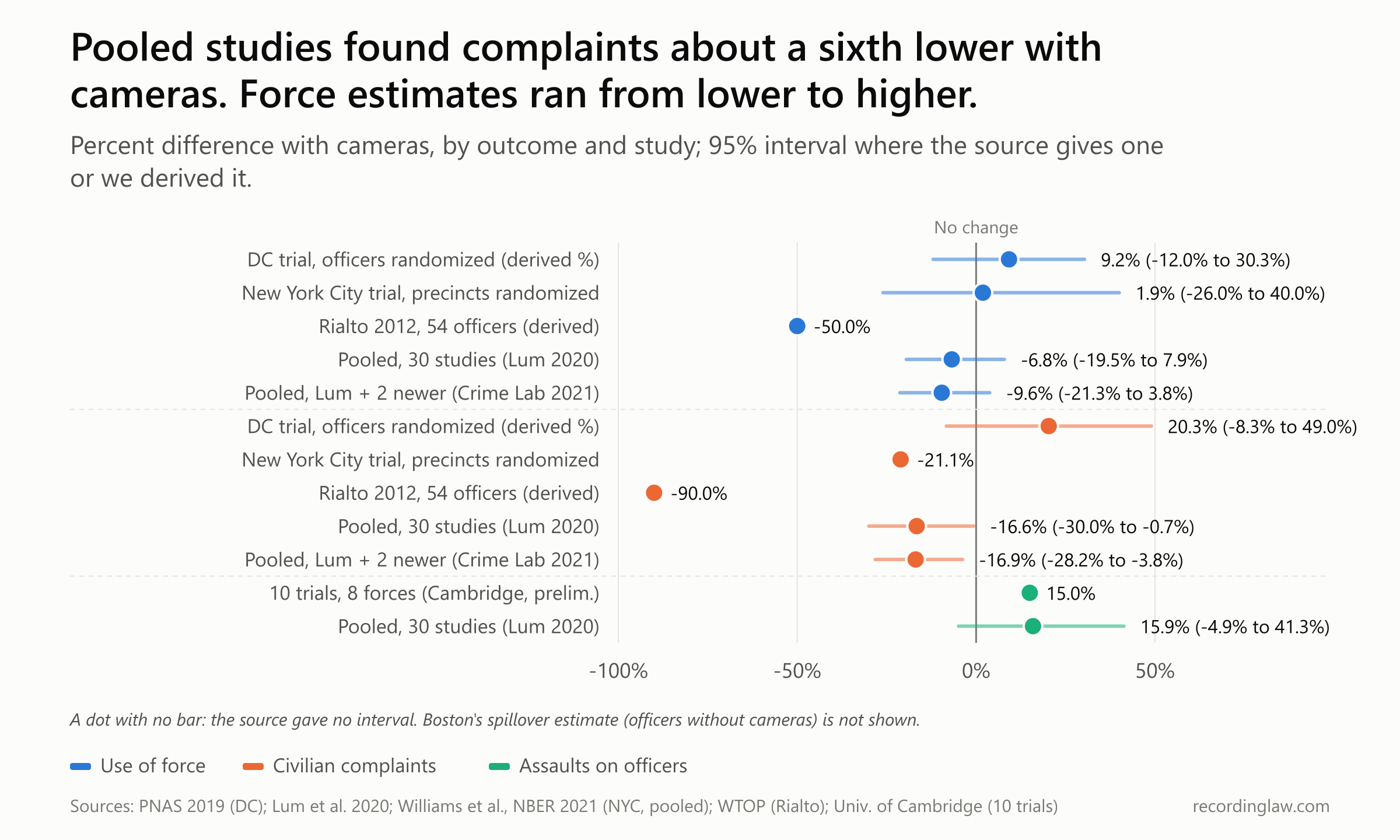
Percent difference with cameras, by outcome and study. Sources: Yokum, Ravishankar and Coppock, PNAS 2019 (DC, converted to percent by us); Lum et al., Campbell Systematic Reviews 2020; Williams et al., NBER 2021 (New York City and the updated pooled estimate); WTOP's summary of Rialto (converted by us); University of Cambridge release (ten trials). See How we measured.
| Study | Use of force | Civilian complaints | Assaults on officers |
|---|---|---|---|
| DC trial, officers randomized within districts (our conversion) | +9.2% (-12.0% to +30.3%) | +20.3% (-8.3% to +49.0%) | not reported here |
| New York City trial, 3,889 officers, precincts randomized | +1.9% (-26% to +40%) | -21.1% | not reported here |
| Rialto 2012, 54 officers (our conversion of WTOP's summary) | about -50% | -90% | not reported here |
| 30-study review (Lum et al. 2020) | -6.8% (-19.5% to 7.9%) | -16.6% (-30.0% to -0.7%) | +15.9% (-4.9% to 41.3%) |
| Review plus two newer studies (Crime Lab 2021) | -9.6% (-21.3% to +3.8%), not statistically significant | -16.9% (-28.2% to -3.8%) | not reported here |
| Ten trials in eight forces (Cambridge and RAND Europe, preliminary) | rose or fell with how cameras were used | not reported here | +15% |
In the 30-study review, only complaints moved clearly, down about a sixth. The authors said it "remains unclear whether this finding signals an improvement in the quality of police–citizen interactions or a change in reporting." Results varied so much from study to study that, the authors wrote, cameras "can have positive, negative, or null impacts on police or citizen behaviors under different circumstances that are not well understood." The review's analysis suggested force was more likely to fall where agencies tightly limit officers' discretion over when to record.
The review also judged that "at least 80% of the BWC studies are more likely than not to have contamination bias," its term for the same spillover problem raised about Washington. The 2021 Crime Lab paper added two newer studies, including a New York City trial of 3,889 officers randomized by precinct, rather than officer by officer within each district as in Washington. In the Crime Lab paper's summary, that trial found complaints down 21.1%. The same summary gives a 1.9% rise in force that was not statistically significant, with an interval from 26% lower to 40% higher.
With those two studies added, the Crime Lab paper estimated complaints down 16.9% and force down 9.6%. The force estimate was not statistically significant.
Six in ten departments by 2020, then the federal agencies
While researchers argued over the evidence, police departments kept adopting cameras. The Bureau of Justice Statistics' periodic survey of departments, the Law Enforcement Management and Administrative Statistics survey (LEMAS), gives three snapshots.
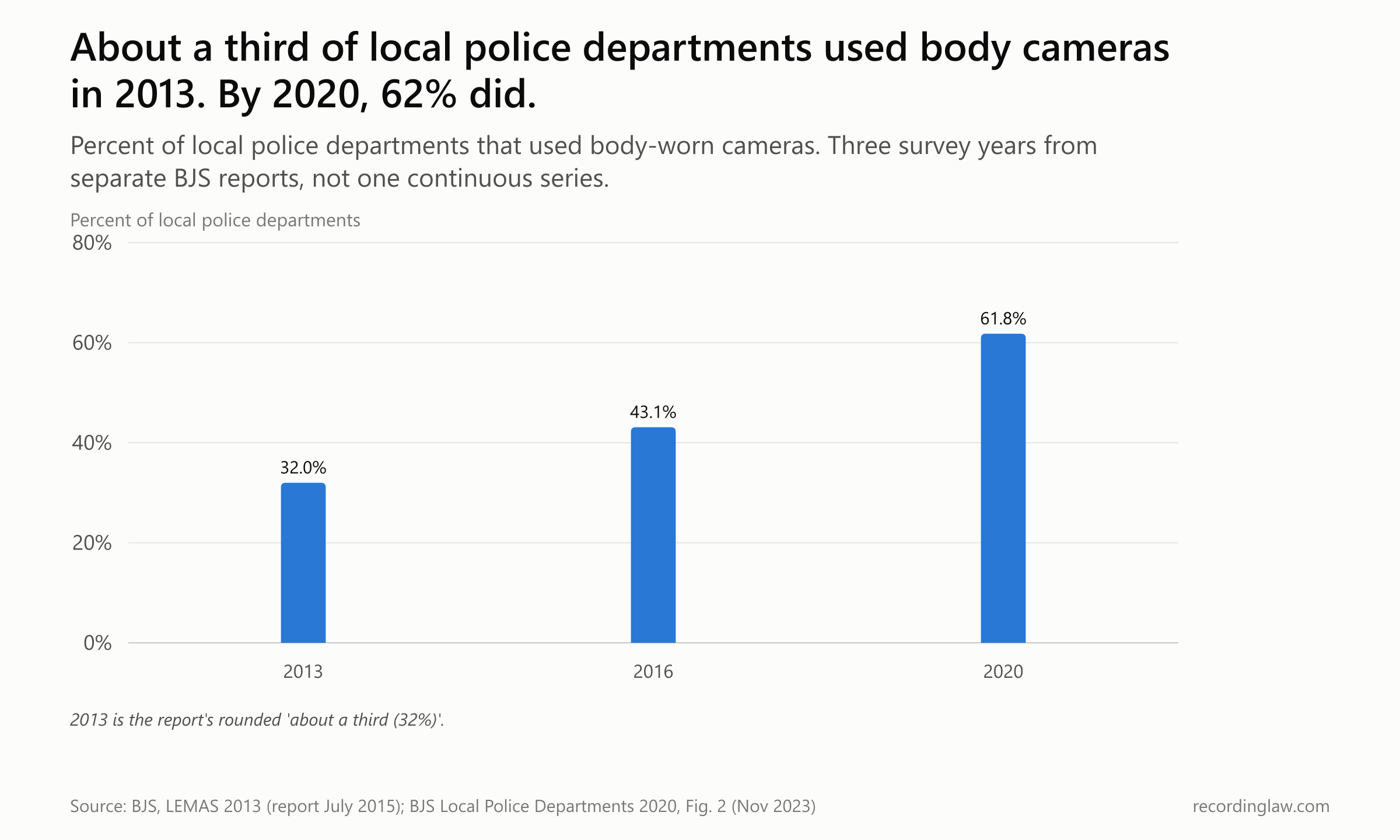
Share of local police departments using body-worn cameras, 2013, 2016 and 2020. Source: BJS LEMAS 2013 report and BJS Local Police Departments 2020 Statistical Tables. Separate reports, not one continuous series.
| Year | Local police departments using body cameras |
|---|---|
| 2013 | about a third (32%) |
| 2016 | 43.1% |
| 2020 | 61.8% |
About a third of local departments used cameras in 2013, and 61.8% did by the end of 2020. Counted by officers rather than departments, the reach was wider. In 2020, 79% of local police officers worked in a department that used cameras, and every department serving a million or more residents used them. The 2020 figures, published in November 2023, are the latest national count.
Federal policy moved the opposite way, away from requiring cameras. Executive Order 14074, of May 2022, was the federal body-camera mandate for federal law enforcement. Executive Order 14148, dated January 20, 2025, rescinded it. ProPublica reported that the Drug Enforcement Administration "quietly ended its body camera program," effective April 1, 2025.
By 2026 the question had reached immigration agents. In July, NPR reported that the Department of Homeland Security (DHS) said half of its immigration field offices had cameras and the rest would "within 60 days." NPR also reported that Congress had provided $31 billion for technology, including cameras, without a mandate to use them.
Lauren Bonds, executive director of the National Police Accountability Project, told NPR that cameras "have been a game changer in proving civil rights claims." NPR reported that Bonds also said cameras do not deter agents from bad behavior.
On September 1, NPR reported that Immigration and Customs Enforcement said it now had enough cameras to equip all its officers and agents, with training still under way. NPR also reported that Homeland Security Secretary Markwayne Mullin predicted every officer in the field would have one by the end of September. That summer, DHS had awarded two contracts to Axon Enterprise totaling more than $30 million for cameras. Independent Sen. Angus King of Maine called the agency's statement about having enough devices a "hollow promise."
When city cameras film federal agents
Washington's newest camera law is about footage of officers who do not work for the city. On March 3, 2026, the council unanimously passed an emergency bill from Councilmember Brooke Pinto, co-introduced by Chairman Phil Mendelson. It passed during what 7News described as a federal law enforcement surge. The bill requires release of the city's police camera footage when its officers are present for serious or deadly force by other agencies, federal agents included.
"We cannot control everything that the federal government does, but we can demand that there be transparency and accountability for what happens in our communities that's captured with our body-worn cameras," Pinto said. Bowser had urged a no vote. "This is a federal issue that should be handled by the Congress," she wrote to Mendelson.
The temporary version, D.C. Law 26-139, took effect on June 11, 2026. In Congress, Sen. Bill Hagerty of Tennessee and Rep. Paul Gosar of Arizona, both Republicans, introduced resolutions on June 2 and 3 disapproving it.
A disapproval resolution is a joint resolution of Congress. It blocks a District act only if both chambers pass it and it is enacted into law. When we checked on November 6, 2026, both had been referred to committee, and no floor action had been recorded.
The temporary law expires on January 22, 2027. Pinto's permanent bill, introduced on February 24, 2026, would make the requirement lasting. We could not confirm its status in council. We have not confirmed whether every immigration officer in the field now wears a camera, as Mullin predicted would happen by the end of September.
In October 2014, about 165 volunteers tried out five camera models, and the city's police chief said cameras would make officers and the public behave better. When Washington tested that by chance assignment, it could not detect the change in documented force or complaints.
The department now describes a rollout of about 2,800 cameras. What they left behind was video, about 665 clips per officer per year in the trial, and the question the city is still voting on is who gets to see it.
How we measured
The DC trial. David Yokum, Anita Ravishankar and Alexander Coppock, PNAS 116(21):10329-10332, May 7, 2019. Officers were block-randomized within district, meaning randomly assigned separately inside each district: 2,224 Metropolitan Police Department members, 1,189 assigned cameras and 1,035 control. The primary analysis covers 1,922 officers in the seven districts and excludes special units. Deployment was staggered: two districts in late June 2015, the rest from March to May 2016, over 11 months.
Each officer's outcomes are measured over 212 days after deployment and compared with the same 212-day window a year earlier, and are reported as yearly rates per 1,000 officers, so they are not calendar-year counts. Follow-up was at least seven months. The study was funded by the Laura and John Arnold Foundation, and the authors declared no conflict of interest.
Estimates and intervals. The headline estimates (use of force +74, standard error 87; complaints +57, SE 41; disorderly conduct arrests -128, SE 277) are differences in means with inverse probability weights, which adjust for each officer's chance of being assigned a camera. The 95% intervals in our table are the estimate plus or minus 1.96 standard errors, which we computed; the paper shows its intervals in a figure. The Lab @ DC's own rounded range for use of force is 97 fewer to 244 more.
The paper reports one more estimate. The headline figures are a simple comparison of averages. A second estimate, also named in the advance plan, is a regression that adjusts for each officer's record before the cameras and for race, gender and length of service. It puts the use-of-force effect at 132.6 more per 1,000 officers per year (SE 83.6), larger than the headline 74.
It is shown with the difference in means in the paper's Figure 1, and in Table C.6 of the supplementary appendix. That is about 1.59 standard errors from zero (132.6 divided by 83.6). Conventional significance needs about 1.96, the same multiplier used for the intervals above, so 1.59 falls short. Both estimates are positive, and neither is statistically distinguishable from zero.
Other checks. A check that was not in the authors' advance plan, of force used at night, when officers are less exposed to nonpolice cameras such as civilians' phones and CCTV, found no detectable change either.
Rates by group. The treatment (camera) and control (no-camera) rates (use of force 880.8 vs 807.2; complaints 337.4 vs 280.1 per 1,000 officers per year) are weighted means we computed from the trial's public replication file (officer_level_anon.csv, OSF project p6vuh) for district officers: 1,034 treatment and 888 control. Their differences (73.6 and 57.3) match the paper. "Roughly four for every five officers" is 807 divided by 1,000. "About 47 videos for every one" is 665 divided by 14.
A pre-period gap. In the same file, the 212-day window before cameras shows treatment officers documenting fewer uses of force than control officers: 557.1 against 726.2 per 1,000 per year. That is a difference of about 169, with an approximate standard error of 69, so the gap is about 2.5 times that standard error. This is our simple calculation, not the paper's method. The paper text and appendix excerpts we read do not discuss this gap.
The working paper reports no statistically significant difference in a separate 90-day window before deployment. The covariate-adjusted estimator, which is the second estimate above, controls for each officer's pre-period value, and its estimate is the +132.6 above.
Other studies. Lum et al., Campbell Systematic Reviews 16(3):e1112 (2020): 30 studies, 116 effect sizes, random-effects meta-analysis, literature through September 2019; funded by the Laura and John Arnold Foundation through the Campbell Collaboration (the same foundation funded the DC trial); the authors declared no conflicts of interest and were not researchers on any study the review examined. Williams et al., NBER Working Paper 28622 (2021): funded by a grant from Citadel to the Council on Criminal Justice and the University of Chicago Crime Lab, with two $5,000 Axon travel grants disclosed. That paper also put the benefit-cost ratio of cameras at 4.95. The New York City (Braga et al. 2020) and Boston figures are as summarized in that paper, and the Rialto figures as summarized by WTOP; we did not open those primary studies. The Cambridge and RAND Europe trials are as described in the University of Cambridge's release.
Derived figures on the charts. The opening chart divides camera officers' figure by no-camera officers': 665 / 14 = 47.5 videos; 880.8 / 807.2 = 1.09 for force; 337.4 / 280.1 = 1.20 for complaints. On the all-studies chart, the DC percentages are our conversion: the paper's estimate divided by the no-camera group's post-deployment rate (74 / 807.2 = 9.2% for force, interval (74 +/- 170.5) / 807.2 = -12.0% to 30.3%; 57 / 280.1 = 20.3% for complaints, interval (57 +/- 80.4) / 280.1 = -8.3% to 49.0%). The paper does not report percentages. Rialto's figures are converted from WTOP's summary: force "twice" as likely without cameras is about 50% lower with them, and complaints falling from 0.7 to 0.07 per 1,000 contacts is a 90% drop; WTOP gives no interval. The New York City complaint figure is shown without an interval because the passage we quote gives none. The Crime Lab paper's updated force estimate has an interval that crosses zero (p = .152). Cambridge's "15% higher" assaults figure is from a preliminary release with no interval. Boston's 38.3% figure is a spillover comparison among officers without cameras, so it is not on the chart.
All six pooled outcomes in the 30-study review (Lum et al. 2020).
| Outcome | Pooled change | 95% interval |
|---|---|---|
| Citizen complaints | -16.6% | -30.0% to -0.7% |
| Officer use of force | -6.8% | -19.5% to 7.9% |
| Arrests | -3.9% | -12.7% to 5.8% |
| Officer self-initiated activities | +3.8% | -5.2% to 13.5% |
| Dispatched calls for service | +2.6% | -3.0% to 8.6% |
| Assaults or resistance against officers | +15.9% | -4.9% to 41.3% |
National adoption. 2013: Bureau of Justice Statistics, Local Police Departments, 2013: Equipment and Technology ("About a third (32%)"). 2016 and 2020: BJS, Local Police Departments, Procedures, Policies, and Technology, 2020 - Statistical Tables (November 2023), which compares 43.1% in 2016 with 61.8% in 2020. These are separate survey years and reports, and the pages we opened do not confirm identical question wording, so they are snapshots rather than one series. Between 2016 and 2020, departments serving 250,000 to 499,999 residents went from 44.0% to 94.3%, while those serving 2,500 to 9,999 went from 43.6% to 56.3%. Across all departments in 2020 there was one camera for every 1.7 officers. The Bureau has not announced a later release on the pages we checked, so no one can yet say how many departments use cameras today. A different measure, from the 2016 body-camera supplement, found 47% of all general-purpose agencies (including sheriffs' offices) had acquired cameras; among local police departments that had, 60% had fully deployed them.
What the data cannot show. The DC trial measures recorded events in one department in 2015 and 2016. It cannot see unreported force, separate a change in behavior from a change in reporting, or rule out spillover to officers without cameras. It does not measure trust in police or the value of video as evidence. We found no count of footage releases under Washington's five-day rule since 2020, and no national adoption figure after 2020.
Frequently Asked Questions
Do police body cameras reduce use of force?
In Washington, D.C.'s randomized trial of 2,224 officers, the best estimate was 74 more documented uses of force per 1,000 officers per year with cameras, with a range from 97 fewer to 244 more, which is not statistically significant. A 2020 review of 30 studies found a pooled 6.8% decrease that was also not statistically significant, and results that varied widely between places.
Do body cameras reduce complaints against police?
The DC trial found 57 more complaints per 1,000 officers per year with cameras, not statistically significant. The 2020 Campbell review of 30 studies found a pooled 16.6% drop in complaints, the one outcome whose interval excluded zero, and said it was unclear whether that reflected better interactions or a change in reporting.
What was the DC police body camera study?
The Lab @ DC and the Metropolitan Police Department randomly assigned cameras to 1,189 of 2,224 officers within each of the city's seven police districts in 2015 and 2016. Researchers compared documented force, complaints, arrests and prosecutions over 212 days after deployment. Results were released on October 20, 2017, and published in PNAS in May 2019, by David Yokum, Anita Ravishankar and Alexander Coppock.
Why might the DC study have found no detectable change?
The authors and other researchers named several possibilities. Use of force is self-reported. About a third of calls had camera and no-camera officers together. Phone cameras were everywhere. And the department had operated under a Justice Department use-of-force agreement from 2001 to 2008. The design cannot separate these explanations from the possibility that cameras had no effect on behavior. The authors also wrote that the trial was large enough to detect small effects, that control officers often worked with no camera nearby, and that, as a matter of speculation, they found it implausible that reported force would barely move while unreported force fell sharply.
How many police departments use body cameras?
The Bureau of Justice Statistics found that 61.8% of local police departments used body-worn cameras in 2020, up from 43.1% in 2016. About a third used them in 2013. In 2020, 79% of local police officers worked in departments that used cameras. No later national figure has been published.
Is DC police body camera footage public?
D.C. law requires the city to release the names and camera recordings of officers involved in an officer-involved death or serious use of force within 5 business days. A temporary law effective June 11, 2026, extends release to incidents in which other agencies, including federal agents, use serious force while Metropolitan Police officers are present. It expires on January 22, 2027. The city may not release a recording under this rule if the decedent's next of kin (for a death) or the person force was used against (for a serious use of force) says they do not consent. If the people whose consent is needed disagree, the Mayor asks D.C. Superior Court, which orders release if it finds that release is in the interest of justice. Other footage can be requested under the District's Freedom of Information Act, which allows the city to withhold some recordings, including those made inside a home or involving domestic violence, stalking or sexual assault.
Can DC police officers watch their body camera footage before writing reports?
Only in part. Since the Secure DC law (D.C. Law 25-175, effective June 8, 2024), officers may not review footage to help write initial reports on an officer-involved death or serious use of force. For other incidents they may, but they must say in the report whether they viewed footage and which footage. D.C. Law 24-345 had barred review before all initial reports from April 21, 2023. A temporary law that expires on January 22, 2027, limits the bar to deaths and serious uses of force directly involving a Metropolitan Police officer. After it expires, the 2024 rule applies unless the Council makes the change permanent. In 2019, the ACLU of DC noted that department orders then allowed review before reports in every case except police shootings.
Updates
Corrected: we said the DC trial could not tell "a small increase from a small decrease." Its intervals reach about 30% more use of force and 49% more complaints, so the page now says it cannot tell an increase from a decrease.
Restructured as a feature: chart titles state the finding, side details moved to How we measured. Every figure and quote was re-checked against its source.
Independently fact-checked against the cited primary sources
Independently fact-checked against the cited primary sources
Sources and References
- Yokum, Ravishankar and Coppock, randomized trial of police body-worn cameras in Washington, DC, PNAS 116(21):10329-10332 (2019), PubMed Central full text(pmc.ncbi.nlm.nih.gov).gov
- PNAS Supplementary Information Appendix to the DC body-worn camera trial (covariate-adjusted estimates, Table C.6)(pmc.ncbi.nlm.nih.gov).gov
- The Lab @ DC, body-worn camera trial project on OSF (pre-analysis plan, working paper and replication data)(osf.io)
- The Lab @ DC, pre-analysis plan for the body-worn camera trial (October 2016)(osf.io)
- The Lab @ DC, working paper: Evaluating the Effects of Police Body-Worn Cameras: A Randomized Controlled Trial (October 2017)(osf.io)
- The Lab @ DC, body-worn camera study website: results(bwc.thelab.dc.gov).gov
- The Lab @ DC, body-worn camera study website: About (funding acknowledgment)(bwc.thelab.dc.gov).gov
- Metropolitan Police Department, A Report on MPD's Use of Body-Worn Cameras (October 2015)(mpdc.dc.gov).gov
- Metropolitan Police Department, body-worn camera program page(mpdc.dc.gov).gov
- Office of the Mayor, District of Columbia awarded $1 million grant to implement body-worn cameras (September 2015)(mayor.dc.gov).gov
- Office of the Mayor, Mayor Bowser releases body-worn camera study findings (October 2017)(mayor.dc.gov).gov
- The White House, Fact Sheet: Strengthening Community Policing (December 1, 2014)(obamawhitehouse.archives.gov).gov
- Bureau of Justice Statistics, Local Police Departments, 2013: Equipment and Technology(bjs.ojp.gov).gov
- Bureau of Justice Statistics, Body-Worn Cameras in Law Enforcement Agencies, 2016(bjs.ojp.gov).gov
- Bureau of Justice Statistics, Local Police Departments, Procedures, Policies, and Technology, 2020: Statistical Tables(bjs.ojp.gov).gov
- Bureau of Justice Statistics, Law Enforcement Management and Administrative Statistics (LEMAS) collection page(bjs.ojp.gov).gov
- Lum, Koper, Wilson et al., Body-worn cameras' effects on police officers and citizen behavior: a systematic review, Campbell Systematic Reviews 16(3):e1112 (2020)(pmc.ncbi.nlm.nih.gov).gov
- NBER Working Paper 28622 (Williams, Weil, Rasich, Ludwig, Chang, Egrari), paper page and funding disclosure(nber.org)
- NBER Working Paper 28622, full text (benefit-cost analysis of body-worn cameras)(nber.org)
- University of Cambridge, news release on ten body-worn camera trials with RAND Europe (May 2016)(cam.ac.uk)
- Police Executive Research Forum and DOJ COPS Office, Implementing a Body-Worn Camera Program (2014)(portal.cops.usdoj.gov).gov
- ACLU, Police Body-Mounted Cameras: With Right Policies in Place, a Win for All (Jay Stanley, 2015)(aclu.org)
- StateScoop, Washington, D.C., police to test body cameras (2014)(statescoop.com)
- Associated Press via WTOP, D.C. police to start wearing body cameras (September 2014)(wtop.com)
- Associated Press via WTOP, D.C. officers begin wearing body cameras (October 2014)(wtop.com)
- The GW Hatchet, D.C. police officers to wear body cameras (September 29, 2014)(gwhatchet.com)
- Sunlight Foundation, D.C. debates body-worn cameras for police (May 11, 2015)(sunlightfoundation.com)
- Associated Press via FOX 5 DC, D.C. Council wants to scale back police body cameras (May 2015)(fox5dc.com)
- FOIA Advisor, excerpt of The Washington Post on the mayor's cost warning (June 2015)(foiaadvisor.com)
- National Freedom of Information Coalition, Washington DC police body cam video to be available under FOIA (2015)(nfoic.org)
- Reporters Committee for Freedom of the Press, New D.C. bodycam policies too restrictive, critics testify (October 2015)(rcfp.org)
- The Eagle, Mayor signs off on regulations for District's police body-worn camera program (December 2015)(theeagleonline.com)
- DCist, All MPD officers are now equipped with body-worn cameras (December 15, 2016)(dcist.com)
- NPR (republished by MPR News), Body cam study shows no effect on police use of force or citizen complaints (October 20, 2017)(mprnews.org)
- YaleNews, Do body cameras affect police officers' behavior? Not so much (October 27, 2017)(news.yale.edu)
- WTOP, body-worn cameras and D.C. police behavior (October 20, 2017)(wtop.com)
- ACLU of DC, statement for the public oversight roundtable on five years of MPD body-worn cameras (October 2019)(acludc.org)
- D.C. Act 23-336, Comprehensive Policing and Justice Reform Second Emergency Amendment Act of 2020(code.dccouncil.gov).gov
- DCist, D.C. police union lawsuit over body camera release (August 10, 2020)(dcist.com)
- FOX 5 DC, D.C. police union suing over law mandating release of body cam video within 5 days (August 2020)(fox5dc.com)
- DCist/WAMU, D.C. judge declines police union request to stop public release of body camera footage (August 14, 2020)(dcist.com)
- Lawyers' Committee for Civil Rights Under Law, judge dismisses D.C. police union's attempts to block body-worn camera footage (July 2021)(lawyerscommittee.org)
- D.C. Law 24-345, Comprehensive Policing and Justice Reform Amendment Act of 2022(code.dccouncil.gov).gov
- Federal Register, Executive Order 14148 (January 20, 2025)(federalregister.gov).gov
- ProPublica, DEA ends body camera program (May 6, 2025)(propublica.org)
- NPR (republished by KUNC), DHS pledged body cams for all immigration agents (July 16, 2026)(kunc.org)
- 7News (WJLA), D.C. Council passes emergency bodycam bill on federal incidents (March 2026)(wjla.com)
- Councilmember Brooke Pinto, press release introducing the Body-Worn Camera Transparency for Use of Force bill (February 24, 2026)(brookepintodc.com)
- D.C. Law 26-139, Body-Worn Camera Transparency for Use of Force Temporary Amendment Act of 2026(code.dccouncil.gov).gov
- D.C. Official Code section 5-116.33 (temporary amendments expire January 22, 2027)(code.dccouncil.gov).gov
- Congress.gov, S.J.Res. 194 (119th Congress), disapproving the D.C. Body-Worn Camera Transparency for Use of Force Temporary Amendment Act of 2026(congress.gov).gov
- Congress.gov, H.J.Res. 193 (119th Congress), disapproving the same D.C. act(congress.gov).gov
- D.C. Law 25-175, Secure DC Omnibus Amendment Act of 2024 (section 11 amends D.C. Code 5-116.33(e), effective June 8, 2024)(code.dccouncil.gov).gov
- D.C. Official Code section 2-534, exemptions from disclosure under the District FOIA (body-worn camera recordings, (a)(2A))(code.dccouncil.gov).gov
- D.C. Official Code section 1-206.02, congressional review and joint resolutions disapproving Council acts(code.dccouncil.gov).gov
- NPR (Ximena Bustillo, republished by WAMC), ICE says it has enough body cameras now (September 1, 2026)(wamc.org)