Auckland Has Permitted More Homes Per Resident Than New Zealand Since 2017. How Many Its Upzoning Added Is Disputed.

Independently fact-checked against primary sources (last audited November 10, 2026). · 10 primary sources cited on this page. How we verify our legal content
In early February 2016, more than 600 Auckland ratepayers filled a protest meeting in Kohimarama. They had come to fight new zoning maps that would allow three-storey apartment blocks in established suburbs, among them parts of the eastern and central suburbs and South Auckland. The organiser was Desley Simpson, whom interest.co.nz described as "a senior figure in National Party circles in Auckland." On Feb. 24, after what Landlords.co.nz called "a marathon extra-ordinary meeting," Auckland councillors voted 13-8 to withdraw the zoning changes.
On July 21, 2026, Simpson was Auckland's deputy mayor. She voted with the 17-5 majority for the more intensive of two options in Plan Change 120, the council's next round of housing intensification around major public transport lines and town centres.
A consent is the building permit a council issues before construction starts. Between those two votes, Auckland went from consenting about 6 new homes a year for every 1,000 residents to more than 12, then back down to under 9. Most of the new homes were apartments, townhouses and units rather than detached houses.
Upzoning means rezoning land so that more homes can be built on it. Supporters of looser rules cite Auckland, and Houston before it, as evidence that upzoning produces housing.
Both cities got a wave of townhouses and apartments. Supporters and opponents still argue over how much of that building the new rules added, and how much a construction boom would have brought anyway. The economists who have studied Auckland disagree about the answer. The Houston studies count and map what was built, rather than estimate what would have been built without the change.
Auckland was not the first city to change the rules about how many homes can stand on a piece of land. Houston, the large American city with no zoning code, did it in two steps, starting at the end of the 1990s. In 1999 Annise Parker, then a city councillor, told the Houston Press: "I don't want to lose any more lots in the intact neighborhoods in Montrose to developers who have more money than sense." In 2013, as mayor, she backed taking the smaller lots citywide.
What Auckland built between the two votes
Auckland's Unitary Plan, the citywide zoning rulebook those maps were drafted for, became operative on Nov. 15, 2016. Stats NZ counts building consents per 1,000 residents, which lets cities of different sizes be compared. By that count, Auckland consented more new homes per resident than New Zealand as a whole in every year from 2017 on. From 2005 to 2016, it was below the national rate in every year except 2015.
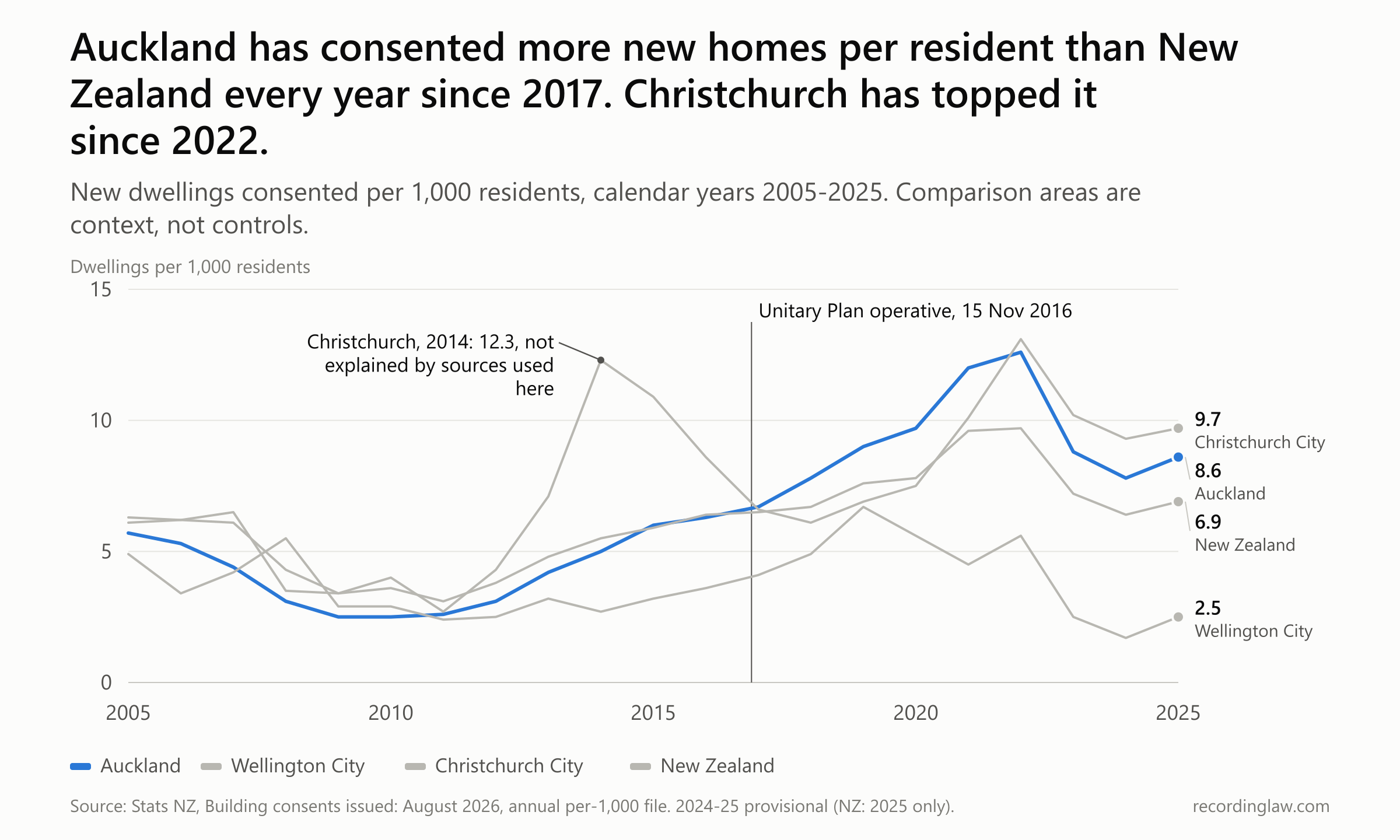
Source: Stats NZ, Building consents issued: August 2026 (released Oct. 1, 2026), annual per-1,000-residents file. 2024 and 2025 are provisional for the three cities; New Zealand's 2025 is provisional.
| Year | Auckland | Wellington City | Christchurch City | New Zealand |
|---|---|---|---|---|
| 2014 | 5.0 | 2.7 | 12.3 | 5.5 |
| 2016 | 6.3 | 3.6 | 8.6 | 6.4 |
| 2019 | 9.0 | 6.7 | 6.9 | 7.6 |
| 2022 | 12.6 | 5.6 | 13.1 | 9.7 |
| 2023 | 8.8 | 2.5 | 10.2 | 7.2 |
| 2025 (provisional) | 8.6 | 2.5 | 9.7 | 6.9 |
Auckland's rate doubled from 6.3 in 2016 to 12.6 in 2022, when the national rate was 9.7. In raw numbers, the city consented about 10,000 new homes in 2016 and about 21,300 in 2022. Then the rate fell to 8.8 in 2023 and has stayed below 9 since, still above the national figure.
Most of the growth came from homes other than detached houses. Stats NZ groups apartments, townhouses and units apart from detached houses. Consents for that group went from 594 in 2010, about one new home in six, to 16,462 in 2022, about three in four.
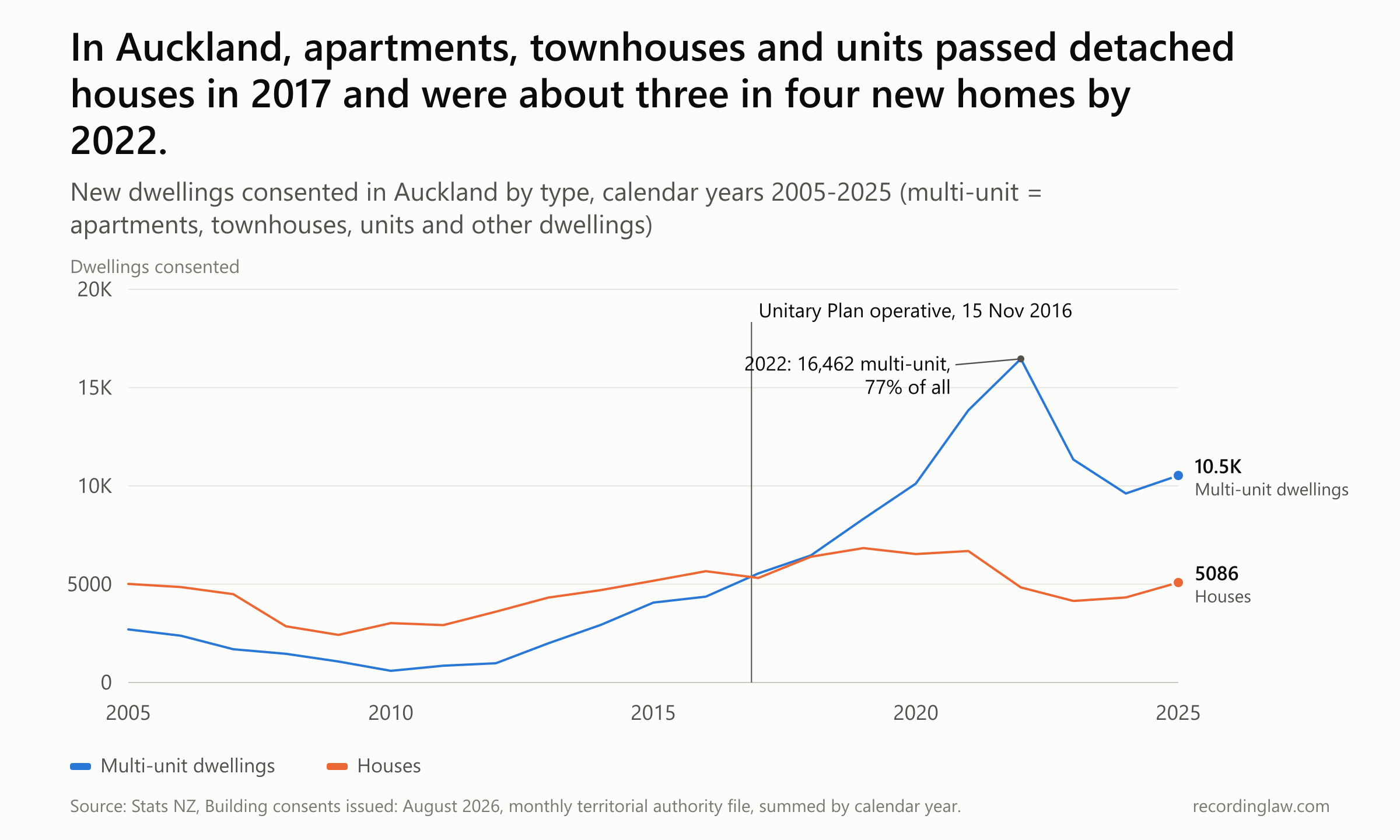
Source: Stats NZ, Building consents issued: August 2026, monthly territorial authority file, summed by calendar year.
| Year | Houses | Apartments, townhouses, units and other | All new dwellings | Multi-unit share |
|---|---|---|---|---|
| 2010 | 3,019 | 594 | 3,613 | 16% |
| 2016 | 5,660 | 4,366 | 10,026 | 44% |
| 2017 | 5,318 | 5,549 | 10,867 | 51% |
| 2022 | 4,839 | 16,462 | 21,301 | 77% |
| 2025 | 5,086 | 10,531 | 15,617 | 67% |
Multi-unit consents, the ones for apartments, townhouses, units and other dwellings, passed detached houses in 2017, the first full year under the plan. Consents for detached houses in 2025, 5,086, were below 2016's. Auckland's leaders read this as the plan at work. In August 2018, Mayor Phil Goff called the plan a success, interest.co.nz reported, and said: "I welcome the 27% increase in new dwellings consented in Auckland."
A report by the council's chief economist, David Norman, found that terraced houses and apartments were 54% of new dwellings consented in the 10 months to May 2018, against 37% in the same months of 2016. Both came from the council that wrote the plan, and both described its first results. Neither was a study of cause.
The other two cities in the chart do not line up with that reading. Christchurch consented more homes per resident than Auckland in 2022 and in every year since.
Christchurch's council later resisted the national density rules passed in 2021, and Christchurch had its own peak of 12.3 in 2014 that this story does not try to explain. Wellington adopted its own plan changes. So neither city is a clean control, the untouched comparison an economist would want.
Whether the plan added those homes, and how many, is still argued over. The estimates come from two kinds of comparison: upzoned areas against other areas inside Auckland, and Auckland against similar New Zealand cities. They run from about 4,500 to 43,500 extra homes. One re-run turned negative, which its authors said did not mean the plan reduced building.
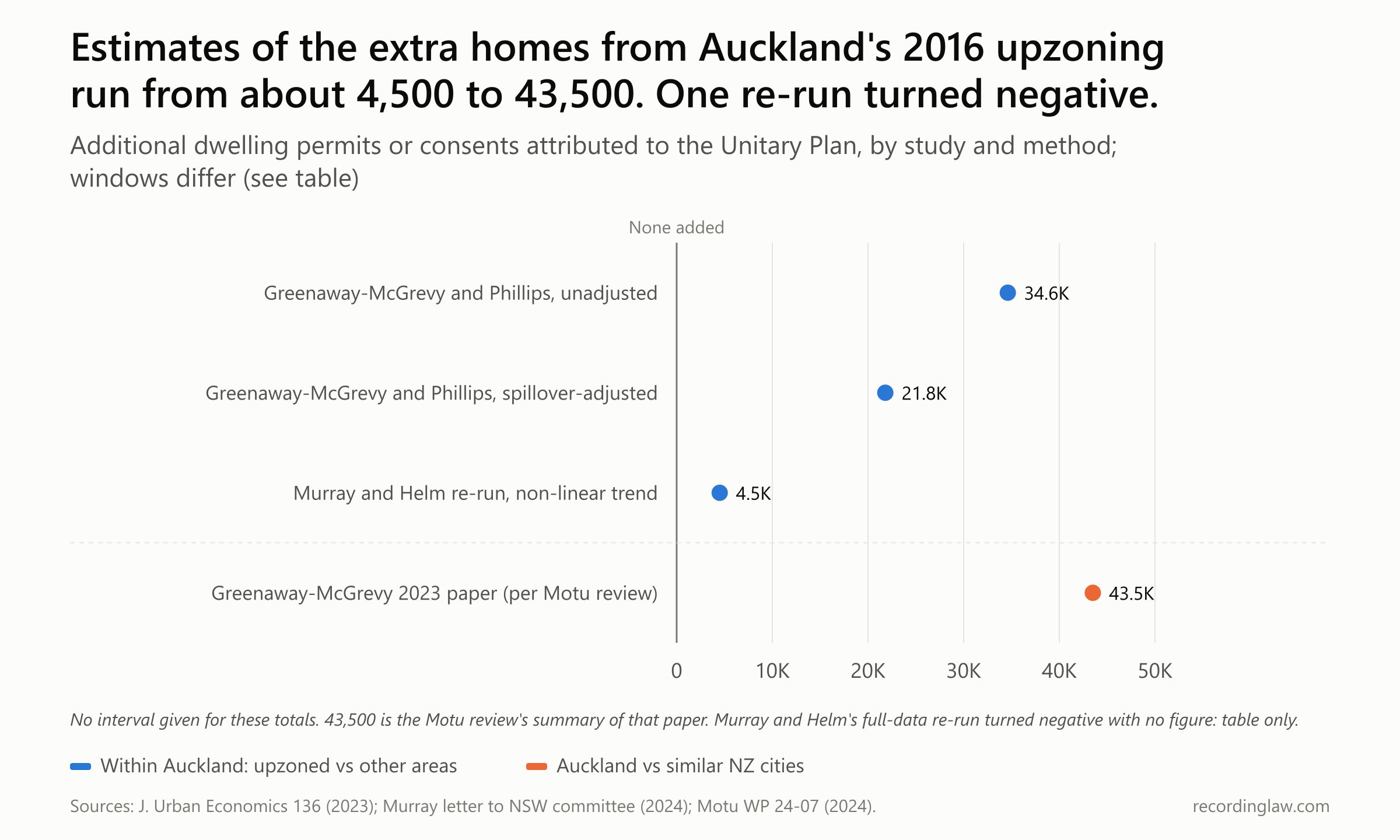
Sources: Greenaway-McGrevy and Phillips, Journal of Urban Economics 136 (2023); Murray and Helm (2023), attached to Murray's June 2024 NSW submission; Donovan and Maltman, Motu Working Paper 24-07 (2024). No source gives an interval for these totals.
| Study | Design | Estimate of additional dwellings |
|---|---|---|
| Greenaway-McGrevy and Phillips (2023), unadjusted | Upzoned vs other areas within Auckland, 2016-2021 | 34,614 permits |
| Greenaway-McGrevy and Phillips (2023), spillover-adjusted | Same | 21,808 permits (4.11% of the housing stock) |
| Murray and Helm (2023), non-linear trend | Re-run of the same comparison | about 4,500 consents |
| Murray and Helm (2023), full data, separate trends | Re-run of the same comparison | turned negative (no figure given) |
| Greenaway-McGrevy (2023 paper), as summarised in the Motu review by Donovan and Maltman | Auckland vs similar New Zealand cities, six years | 43,500 consents |
Houston had the same fight over density two decades earlier.
How a city with no zoning capped its density
Without a zoning code, Houston left the question of what may be built on a lot to other rules. Chapter 42 is the city's development code. "Neighborhoods have to look to Chapter 42 for protection because Houston has no zoning and only about one-third of inner-city neighborhoods have deed restrictions," Mike O'Brien, president of the Houston Homeowners Association, told the Houston Press in 1999. "This ordinance is all we can rely on."
Among other things, Chapter 42 set a minimum lot size for a single-family home, the smallest parcel a house may stand on: 5,000 square feet in the urban core, according to The Pew Charitable Trusts. A minimum like that caps how many homes fit on a block without saying a word about what the land is used for.
By the late 1990s that cap already had a hole in it. A review of the ordinance began in 1996 under Mayor Bob Lanier, a real estate developer, and one of its goals, the Houston Press reported, "was to actually codify a loophole that existed since the mid-1980s." The loophole had let developers "build on lots as small as 1,400 square feet, with no setback from the property line and at whatever density the market would bear."
So the fight in early 1999 was over how far to write that practice into law. "After nearly three years of countless meetings of various committees and task forces representing builders, developers and neighborhood residents, City Council meets February 17 to consider a final draft of the proposed ordinance," the Houston Press wrote on Feb. 4, 1999. The draft limited new housing to 24 units per acre, a figure that, the paper reported, "has enraged many builders and developers." Builders were pressing for 30.
Each side made a prediction. John Spear, executive director of the Community Design Assistance Center and an architect who helped shape the ordinance, said: "What we want in this city, of course, is high-density townhouses." He and Barbara Tennant of Perry Homes, a builder, predicted that "townhome prices will rise, perhaps by as much as $75,000, if density is limited to 24 units per acre."
The neighborhood side, in the Houston Press's summary of O'Brien's warning, saw developers and city staff planning "to overwhelm stable, single-family neighborhoods with high-density townhouse complexes." Annise Parker, then a city councillor and a former president of the Neartown Association, was a vote for the neighborhood side, the paper reported. On loyalty, she told the paper: "I'm very much from the school that believes you dance with whomever brought you," adding: "And the neighborhood people are really the ones who supported me and got me elected."
What came out of it is usually described in round terms. Pew's account reads: "In 1998, policymakers approved an ordinance to allow building on smaller lots, reducing the minimum lot size in the urban core from 5,000 square feet to 3,500 square feet," or to 1,400 square feet for parcels that met open-space standards. In M. Nolan Gray and Adam Millsap's account of the same change, the smallest lots were allowed "within the city's I-610 loop," a reduction of roughly 72 percent.
Even the year of the change is uncertain. Most accounts, Pew's among them, say 1998. But the Houston Press piece shows council had not voted by February 1999.
A 2013 Houston Chronicle story refers to "a change in city development rules in 1999." A later city planning FAQ, written for amendments proposed before 2013, describes an urban-area option of "limiting the density of the development to 27 dwelling units per acre," which falls between the 24 and the 30 units per acre fought over in 1999.
What got built on the smaller lots
What followed was the kind of building the Furman Center's report calls, in its title, "tall skinny houses." Pew, citing a study by University of Texas at Austin researchers that it sponsored with New York University's Furman Center, says: "At least 34,000 town houses were built in the city from 2007 to 2020."
Counts differ by method and window, and the Furman report itself lists three. Gray and Millsap found over 25,000 townhouses from 1999 to 2016. A second team found almost 39,000 from 2005 to 2018.
One of the UT Austin authors found over 34,000 from 1998 to 2020, a longer window than the 2007 to 2020 in Pew's count. That last analysis also found that post-1998 townhouses were "no less than 43 percent of net housing units added citywide since 1990."
Most of them did not replace a detached home. "More than 80% of the houses were constructed on parcels formerly occupied by commercial, industrial, or multifamily properties," Pew reports. The study looked separately at detached homes torn down for townhouses and found 1,392 such lots. That was 0.5% of the single-family parcels not covered in 2007 by a block vote, the block-by-block neighborhood opt-out described in the next section.
When it did happen, the change was large on the lot itself. "A typical conversion involved demolition of one 1,348-square-foot detached home and construction of four 2,483-square-foot town houses," Pew writes. Those townhouses had a median assessed value of $340,000, against $545,000 for other new single-family homes in the city.
Gray and Millsap, writing in the Journal of Planning Education and Research, found that "post-reform development activity was heavily concentrated in middle-income, less dense, underbuilt neighborhoods." Gray was at the Mercatus Center at George Mason University and Millsap at the Charles Koch Institute, both market-oriented organisations. Pew presents the Houston findings as showing that "zoning reform can increase the availability and affordability of housing without these adverse effects."
Does the city's own permit count show the change? Federal permit data can only partly answer that, because the Census Bureau files townhouses with detached houses as "1-unit" homes.
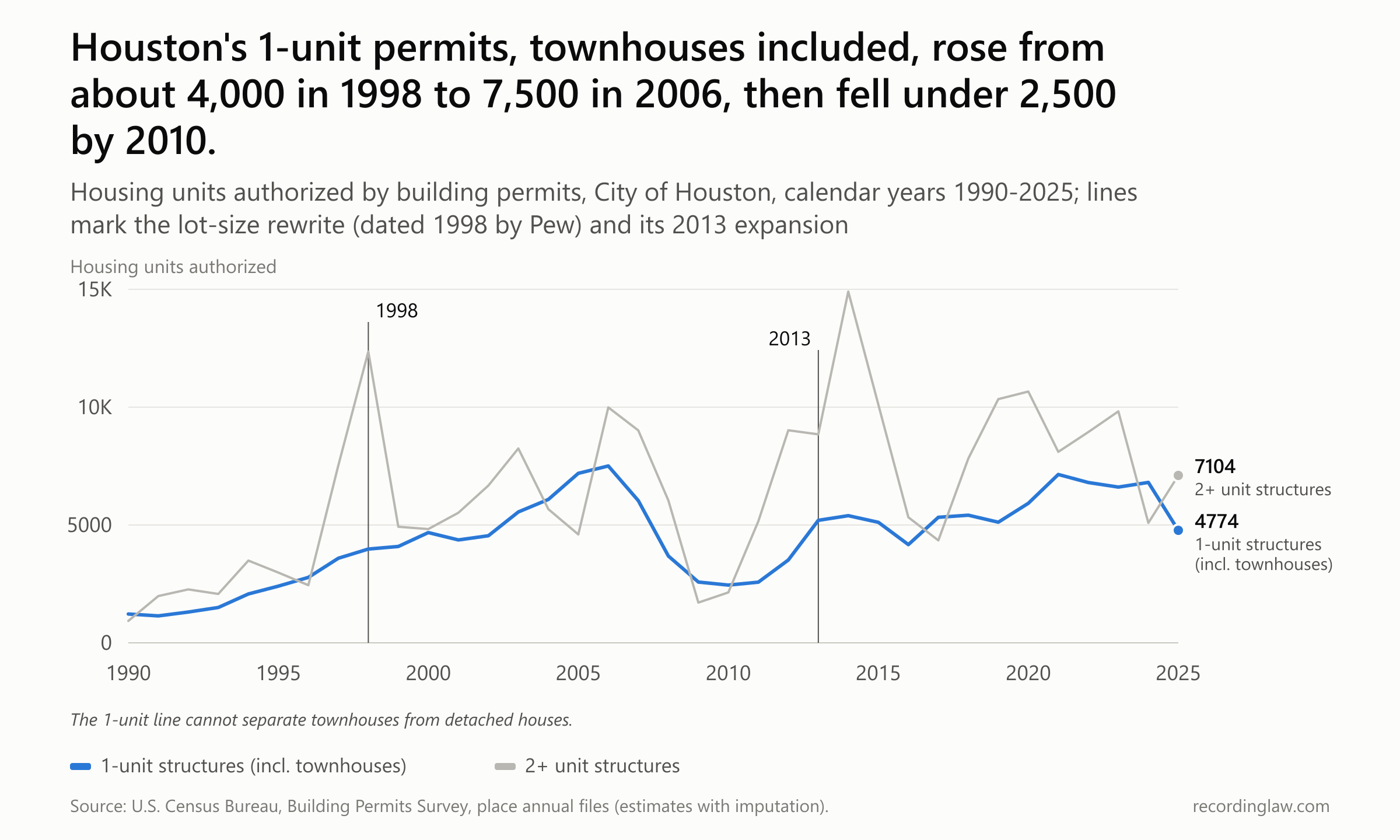
Source: U.S. Census Bureau, Building Permits Survey, place annual files, 1990-2025 (estimates with imputation). The 1998 line follows Pew's date; council was still debating the rewrite in February 1999.
| Year | Units in 1-unit structures (incl. townhouses) | Units in structures with 2+ units |
|---|---|---|
| 1997 | 3,589 | 7,532 |
| 1998 | 3,978 | 12,356 |
| 2000 | 4,680 | 4,826 |
| 2006 | 7,503 | 9,988 |
| 2010 | 2,452 | 2,139 |
| 2013 | 5,198 | 8,845 |
| 2021 | 7,146 | 8,103 |
| 2025 | 4,774 | 7,104 |
Houston's 1-unit permits rose from about 4,000 in 1998 to about 7,500 in 2006. Then they fell to under 2,500 in 2010 and climbed back to about 7,100 in 2021.
The other large Texas cities in the same Census files rose in the early 2000s too. Dallas went from about 1,700 in 1998 to about 3,400 in 2005, and Fort Worth from about 2,700 to about 10,000. The chart shows the housing cycle as clearly as any rule change, and it cannot separate a townhouse from a detached house.
| City | 1-unit units, 1998 | 1-unit units, 2005 |
|---|---|---|
| Houston | 3,978 | 7,194 |
| Dallas | 1,744 | 3,353 |
| Fort Worth | 2,712 | 10,046 |
| San Antonio | 5,752 | 8,266 |
| Austin | 3,521 | 4,569 |
Going citywide, with a way out
In 2013 the question moved outside the I-610 loop. The Houston Chronicle, as excerpted on the Off the Kuff blog, wrote that council was "poised Wednesday to extend that Inner Loop home density citywide in the first rewrite of Houston's development rules, known as Chapter 42, in 14 years."
South Houston civic leaders were wary. "If they say, 'Hey, this is a nice place, I think I'll go out here and buy me a little piece of land and I'll just put this out here,' that's our fear, that it won't be consistent with what we're doing," said Homer Clark, president of the Five Corners Management District.
Neighborhoods already had a block-by-block opt-out, known as a block vote, from the first rewrite. The 2013 package widened it. Owners in an area of up to 500 homes could seek their own minimum lot size, blocking the subdivision of lots for townhouses, if enough of them voted yes in a ballot. "The lot-size proposal is a 'huge achievement,'" said Jane West of the Super Neighborhood Alliance, "though she is concerned areas with many rental properties will struggle with the petition process," the Chronicle reported.
On Wednesday, April 24, 2013, council voted 14-3 for the package. It lowered the share of owners in an area who had to vote yes to impose a minimum lot size, from 60 percent to 55 percent. It phased the rules in, "keeping new development out of residential areas for two years." The Super Neighborhood Alliance also won rules on where townhouse developers put their dumpsters and on building within 3 feet of a property line.
Annise Parker, now mayor, "has said the changes will spur redevelopment of blighted areas and lower housing prices in the city," the Chronicle reported. "It's about time," she said. "The city of Houston has to grow, and we have to have a more flexible development tool."
Pew summarises the opt-out this way: "at least 70% of existing properties meet the new requirements, and those rules remain in effect for 40 years." The tool turned out to be little used. Of the single-family lots not covered by a block vote in 2007, 4.7% had one by 2022. Gray and Millsap argue that "allowing the most extreme opponents to 'opt out' of land-use reform may help clear a path for citywide liberalization."
Houston has kept going. On Sept. 27, 2023, council approved the Livable Places amendments, which Mayor Sylvester Turner said "will expand the variety of homes at a variety of residential price points to meet the needs of all Houstonians into the future, while still protecting the character of neighborhoods."
In Texas, lawmakers looked to Houston. In 2025, the state passed Senate Bill 15 on minimum lot sizes in new subdivisions. "This bill allows the option of building homes at different types and price points to meet the demand and needs of buyers," said its House sponsor, Rep. Gary Gates, a Richmond Republican.
Rep. Ramon Romero, a Fort Worth Democrat, had tried to kill the bill and then added a House amendment requiring cities to create a separate zoning category for it. He said residents "didn't elect their state representatives to decide how their city would develop, not on that level, not with this kind of density."
Gov. Greg Abbott signed it at 3,000 square feet. "That figure represented a compromise," HousingWire reported in April 2026. "Lawmakers originally sought 1,400 square feet, modeling what Houston has permitted since the 1990s."
Auckland, a city with zoning, moved three years after Houston's second vote. Instead of shrinking one lot rule, it redrew its zoning map for the whole city at once.
Auckland redraws the map
The December 2015 maps that brought out the Kohimarama crowd were the council's proposed zones for its Unitary Plan. Councillor Sir John Walker, the Olympic champion, said in February 2016: "I'm on the residents' side. I don't want to see high rise buildings towering over Auckland," adding: "Why ruin the city with three-storey apartments? They might not be very high but I wouldn't want to live next door to one."
The case for more building came from the national government and from industry. Building and Housing Minister Nick Smith said the government would encourage the council "to stay the course and to keep this process on time because it is so critical to the broader housing supply and affordability issues for the city." Phil Eaton, Auckland branch president of the Property Council, an industry group for property owners and developers, said: "We desperately need to open up supply."
Nine days before the vote, Bernard Hickey of interest.co.nz had called the revolt "an action replay" of 2013, "when an initial draft Unitary Plan that allowed more densification was quickly over-turned after some local residents opposed it." After the 13-8 retreat, economist Shamubeel Eaqub said: "Councillors signalled they are against the densification and progress that Auckland desperately needs."
The leading opposition group did not oppose every kind of density. Richard Burton, chair of Auckland 2040, a coalition of more than 100 residents' groups, said: "When you're talking about putting three or more storey apartments within the conventional suburban areas, that is where we have a problem. We believe there is no need for it." What his group wanted instead, he said, was "putting four or six units on the same site, but of a smaller size."
The decision did not rest only with councillors. An independent hearings panel had sat for 249 days and considered about 13,500 submissions. In July 2016 it handed the council a 1,000-page report on a USB stick, made public on July 27.
The panel went further than the council. Newshub reported that it "surprised many by recommending more intensification than the council was looking for, but also calling for the rural-urban boundary to be expanded 30 percent." Its stated aim, in the council's summary, was to "double the feasible enabled residential capacity to exceed 400,000 dwellings."
Opponents of the plan and business groups both raised doubts. Councillor Mark Thomas, a mayoral candidate, called the recommendations "a 'gangbusters' approach to new housing" and said he suspected "many Aucklanders will be alarmed." Mark Champion of the Employers' and Manufacturers' Association questioned whether the new housing areas would be "linked up to where the jobs are going to be."
After four days of decisions, the council's governing body voted on Aug. 15, 2016, to support a majority of the panel's recommendations. It kept the panel's abolition of minimum lot sizes for existing parcels. It voted down some other recommendations, including an end to minimum floor sizes for apartments. The Spinoff, which described its own coverage of the issue as "campaigning journalism," wrote of "an almost complete absence of any coherent opposition."
When the plan took effect that November, about three-quarters (75.2%) of Auckland's residential land was upzoned, by the classification in the main study of its effects. The same study says the plan "trebled the number of dwellings that could be built."
How many of those homes did the rules add?
The studies of Auckland split over one step. That step is the counterfactual: an estimate of what the city would have built without the plan. The main study compares parts of the city that were upzoned with parts that were not, before and after the plan. Economists call this difference-in-differences: if building in the upzoned areas pulled ahead of building elsewhere after the plan, the extra is credited to the upzoning.
Ryan Greenaway-McGrevy of the University of Auckland and Peter C.B. Phillips published it in the Journal of Urban Economics in 2023. The Royal Society of New Zealand's Marsden Fund paid for the research.
They found that "the number of attached dwelling permits per year in upzoned areas increases from under 1000 in 2016 to near 10,000 by 2021." After adjusting for building that may have shifted from one part of the city to another, they estimate "21,808 (= 45.53 x 479) additional permits as a result of the upzoning policy." That figure, they wrote, "corresponds to 4.11% of the city's extant housing stock." Without that adjustment, the figure is 34,614.
The authors added a caution of their own: "permits in upzoned areas are still trending upwards as of 2021, so the full impact of the policy will likely not be known for several more years."
Two Australian economists say those numbers do not hold. Cameron Murray, who writes the Fresh Economic Thinking newsletter, and Tim Helm, director of research and policy at the think tank Prosper Australia, re-ran the analysis in 2023.
Allowing for a non-linear trend alone, they estimated the net effect fell from 22,000 extra consents to about 4,500. With the full consent data and separate trends for upzoned and other areas, it turned negative. They said that did not mean the plan reduced building. Their point was that the method could not pin the number down.
"We don't know how many extra dwellings the AUP is responsible for. We don't think anyone else does either," they wrote. AUP is their short name for the Auckland Unitary Plan.
In their reading, "Auckland's consent trend, like Wellington's, looks a lot like a growth cycle spurred on by an uptick in migration around 2014." They concluded that "housing markets adapt physically due to planning rules, but that the quantity of new homes produced is regulated by market forces."
The critique reached the people who advise ministers. On April 16, 2024, a Housing Technical Working Group of the Treasury, the Reserve Bank and the housing ministry invited Helm and Murray to debate the role of upzoning, according to minutes released under the Official Information Act in July 2026. Helm "argued that upzoning itself doesn't produce more housing," the minutes record, and Chris Parker, who introduced the session, replied that "supply reform can help with housing affordability."
In June 2024, Murray wrote to a New South Wales parliamentary committee: "I am unaware of any reputable expert economist who has argued that our critiques are wrong." Five months later, Stuart Donovan of Motu Research and Matthew Maltman published a review.
"We review these critiques and find them to have little to no merit," they wrote. "In our view, there is remarkably robust evidence that zoning reforms increased housing supply and reduced rents in Auckland." The same Motu review summarises a second Greenaway-McGrevy paper, which compares Auckland with similar New Zealand cities, as finding "an additional 43,500 consents within six years." Their paper thanks Greenaway-McGrevy, among others, for comments; neither side's funding is stated in the documents opened for this story.
The estimates chart in the first section sets these estimates side by side; the gap turns on the method and on how the pre-plan trend is modelled.
Rents are the second disputed number. A 2024 working paper, by Greenaway-McGrevy and James Allan So, was also Marsden-funded. Its March 2024 version was not peer reviewed.
The paper builds a synthetic version of Auckland from a weighted mix of other New Zealand urban areas. That synthetic city stands in for the counterfactual, the Auckland that would have existed without the reform. The paper estimates that six years on, "rents would be approximately 28% higher under the counterfactual."
That estimate leans on one city. Rotorua, an urban area of 74,000 people 194 km from Auckland, "receives a significant weight of almost three-quarters" in the synthetic comparison.
Without Rotorua, the estimated reduction "falls to 21.6%," and ending the sample in 2020, when Auckland's population estimates peak, gives 17.3%. The authors call the results "somewhat sensitive to inclusion of Rotorua."
Greenaway-McGrevy had warned in 2017 that simple price figures could mislead. "Relaxed urban density restrictions will also increase the value of land," he wrote, which "will put upward pressure on the price of dwellings that sit on land that is able to be profitably redeveloped."
In 2021, Auckland's mayor argued that zoning was no longer what held the city back. "Under Auckland's Unitary Plan, zoning changes enable more than 900,000 additional dwellings. We are already consenting up to 20,000 homes a year, four times what we were a decade ago, and around two-thirds of new consents are for intensive housing," Goff said in the council's submission on a national bill. "The constraint on housing in Auckland is not zoning changes, but the cost of the infrastructure needed to support new developments, as well as skills and building materials shortages."
New Zealand goes national, and councils push back
The bill Goff was answering set national density rules. On Oct. 19, 2021, the Labour government and the opposition National Party jointly announced the Medium Density Residential Standards, known as the MDRS. The bill passed that December, with ACT opposed, after a select committee process that, SunLive reported, "lasted six weeks instead of the usual six months."
Ministers David Parker and Megan Woods "estimated 48,200 to 105,500 additional dwellings could be built over the next five to eight years," QV reported. National's Nicola Willis said: "This legislation takes power away from town planners and gives it back to the people they serve."
Councils pushed back. Hamilton City Council called the reforms "fundamentally flawed." On Sept. 13, 2022, Christchurch City Council "voted against changing its planning rules to comply with Government direction to enable more housing and development in the city," the Otago Daily Times reported. "None of us believes a one-size fits all approach to housing intensification is in the best interests of our city," Mayor Lianne Dalziel said.
The political consensus did not last. At a public meeting in the Auckland suburb of Birkenhead in May 2023, National leader Christopher Luxon said: "I think we've got the MDRS wrong." The Spinoff later wrote that the risks of the broad approach "were highlighted by the 2023 Auckland Anniversary floods," when "many Aucklanders thought building thousands of townhouses in areas prone to flooding was a bad idea."
In June 2025, Chris Bishop, housing minister in Luxon's National-led government, said it would step in where councils did not. "If local councillors don't have the courage to make the tough decisions, we will do it for them," he said. "Let me be absolutely clear: the days of letting councils decide that growth shouldn't happen at all are over."
The same government also let councils opt out of the MDRS on conditions. For Christchurch, the city council said, that meant zoning for 30 years of expected high-growth demand plus a 20% buffer. By the council's count, that came to some 65,600 commercially viable homes.
In September 2025 the council voted to ask to opt out. "MDRS across all our residential areas was never the best fit for Christchurch," Mayor Phil Mauger said. In November 2025, Bishop approved the request, saying the city's plan enabled at least 68,200 homes against the 65,640 required.
On Sept. 22, 2026, Parliament passed the Planning Bill and the Natural Environment Bill, the two laws that, as Newswire put it, "together replace the Act that has governed almost every consent to build, farm, dig or discharge since 1991." The government says more than 100 council planning documents will be replaced by 17 regional combined plans with nationally standardised zones and rules.
Auckland's second round
Plan Change 120, the plan Auckland's councillors voted on in July 2026, is the council's answer to the government's directive to zone for more homes. "The option we've gone with is a compromise between those who wanted us to do less and those, like me, who wanted us to do more," Mayor Wayne Brown said. "85% of properties won't be affected, but we are going to get intensification where we've sunk billions of dollars into better public transport and where it makes sense."
Mike Lee, of Waitematā, whose amendment to pause the plan failed, argued that the changes were less about public transport than about opening up valuable land to developers, 1News reported. "What is damaging ... is the wrecking or the destruction of Auckland's historic special character areas," he said.
John Watson, of Albany, who voted against, said the plan created "the appearance of [housing] supply without really the substance." He added: "Upzoning can increase housing supply, but that's generally over the medium-to-long term," and "studies have shown that the effect on prices is often modest." Christine Fletcher, of Albert-Eden, said of homeowners in character areas: "For many, these homes represent a lifetime of hard work and sacrifice."
The evidence will keep arriving. In November 2025, the University of Auckland announced an $853,000 Marsden Fund grant for Greenaway-McGrevy and Phillips to answer "who actually benefits from upzoning?" The project had not reported results as of Oct. 31, 2026, when this story was researched.
The July vote is not the last word. An independent hearings panel will take another round of submissions and hold public hearings, and the council "is expected to make final decisions on Plan Change 120 in mid-2027," 1News reported in July 2026. The Spinoff put the deadline at June 2027. Mid-2027 will be about nine months after Parliament passed the Planning Bill.
More than ten years after she organised the Kohimarama meeting against the first map, Simpson was one of the 17 votes for the more intensive option, much as Annise Parker had backed Houston's citywide change once she was Houston's mayor. The record gathered for this story does not include her reasons.
How we measured
Auckland and New Zealand consents. Stats NZ, Building consents issued: August 2026, released Oct. 1, 2026, the latest edition when the data was collected on Oct. 31, 2026. Per-1,000-resident figures come from the annual territorial-authority file (December-year rows). Dwelling counts are the sum of 12 monthly values for new dwellings in the monthly file. 2024 and 2025 per-1,000 values are provisional for the three cities, and 2025 for New Zealand. The September 2026 edition, released Nov. 3, 2026 and checked on Nov. 7, 2026, left every annual per-1,000 value and dwelling count used here unchanged. Later editions can still revise the provisional years. Consents are permits issued, not homes completed. Auckland has been one territorial authority since the 2010 amalgamation, so its series is continuous.
Shares. Multi-unit share is apartments, townhouses, units and other dwellings divided by all new dwellings consented: 594 of 3,613 in 2010 (16%), 16,462 of 21,301 in 2022 (77%), 10,531 of 15,617 in 2025 (67%). "Doubled" is 12.6 per 1,000 in 2022 against 6.3 in 2016.
Comparison areas. Wellington City, Christchurch City and New Zealand are shown for context, not as controls. Christchurch's 2014 peak is not explained by any source used here, and Wellington made its own plan changes. Moves in migration, interest rates and the wider building cycle affect every line.
Auckland studies. Greenaway-McGrevy and Phillips (Journal of Urban Economics 136, 2023) use Auckland Council permit data for 479 statistical areas, 2010-2021, excluding consents under the earlier Special Housing Area program, and compare upzoned and non-upzoned areas. Their figures are permits, which can differ from Stats NZ's territorial-authority counts. The rents estimate (Greenaway-McGrevy and So, University of Auckland Economic Policy Centre Working Paper 016, March 2024 version) uses a synthetic control built from other urban areas. The Murray and Helm critiques (June and August 2023) were read as attachments to Murray's June 2024 submission to a New South Wales parliamentary committee; the Donovan and Maltman review is Motu Working Paper 24-07 (November 2024).
Study estimates chart. Rows are the totals each source states. Greenaway-McGrevy and Phillips report confidence intervals for yearly effects per statistical area, not for the 21,808 or 34,614 totals, so no interval is drawn. Murray and Helm's "about 4,500" is their estimate with a non-linear trend. Their full-data, separate-trends re-run turned negative with no figure, so it appears in the table only. The 43,500 figure is as summarised in the Motu review by Donovan and Maltman (Working Paper 24-07); the underlying paper was not opened for this story. The estimates use different data (council permits vs Stats NZ consents) and windows, so they are not strictly comparable.
Houston permits. U.S. Census Bureau, Building Permits Survey place annual files for 1990-2025 (final 2025 data released May 14, 2026), City of Houston only. "1-unit" includes detached houses and townhouses separated by a ground-to-roof wall, so the series cannot isolate townhouses or small lots. Values are estimates with imputation. The place's ID code changes across years, so rows were matched by name within Texas. Dallas, Fort Worth, San Antonio and Austin are shown for the shared building cycle, not as a counterfactual.
Houston chart title. 1-unit units authorized: 3,978 in 1998 (about 4,000), 7,503 in 2006 (about 7,500) and 2,452 in 2010 (under 2,500).
Houston dates and counts. Pew and Gray and Millsap date the urban-core change to 1998. The Houston Press (Feb. 4, 1999) shows the council hearing set for Feb. 17, 1999, and the exact adoption date and vote were not found. Pew's "at least 34,000" townhouses covers 2007-2020. The Furman report attributes "over 34,000 from 1998 to 2020" to one of its authors. The block-vote share (4.7%) and conversion share (0.5%) come from the UT Austin study published by the Furman Center and sponsored by Pew.
Texas Senate Bill 15. As enacted, the law covers only unplatted tracts of five acres or more zoned for single-family homes, in cities of more than 150,000 people that lie at least partly in a county of more than 300,000. The April 2026 HousingWire report also described a dispute in suburban Montgomery County, next to Houston, over a move to raise lot widths.
What the data cannot show. Neither city's permit series has a counterfactual, a measured estimate of what would have been built without the rule change. Consent and permit counts do not measure prices, rents or who moved into the new homes, and no source here measures what happened to rents in Houston.
What comes next. Auckland Council's final decisions on Plan Change 120 are expected in mid-2027 (1News, July 2026; The Spinoff: by June 2027). Stats NZ's next building consents release, for October 2026, is due Dec. 2, 2026. The Marsden project on who benefits from upzoning had not reported as of Oct. 31, 2026.
Frequently Asked Questions
What did Auckland's Unitary Plan change?
The Auckland Unitary Plan, operative from Nov. 15, 2016, set Auckland's zoning. A University of Auckland study classifies about three-quarters (75.2%) of residential land as upzoned and says the plan trebled the number of homes that could be built. It also abolished minimum lot sizes for existing parcels.
How many homes did Auckland's upzoning add?
Estimates differ. Greenaway-McGrevy and Phillips (2023) attribute 21,808 additional permits over 2016-2021 to upzoning, about 4.11% of the housing stock. Cameron Murray and Tim Helm re-ran the analysis, got about 4,500 or less, and argue the method cannot settle the number. A Motu review by Donovan and Maltman found their critique to have little to no merit.
Did Auckland's upzoning lower rents?
A 2024 University of Auckland working paper estimates rents would have been about 28% higher six years on without the reform. The estimate falls to 21.6% when Rotorua, which carries almost three-quarters of the comparison weight, is left out, and to 17.3% if the sample ends in 2020.
Does Houston have zoning?
No. Houston has no zoning code. Its development code, Chapter 42, and private deed restrictions set rules such as minimum lot sizes, which limit how many homes fit on a block.
When did Houston reduce its minimum lot size?
Most accounts, including Pew's, date the urban-core change to 1998: from 5,000 square feet to 3,500, or 1,400 for parcels meeting open-space standards, inside Loop 610. A Houston Press article shows council had not voted by February 1999. In April 2013 council voted 14-3 to extend the rules to nearly the whole city.
How many townhouses has Houston built since the lot-size change?
Pew, citing a UT Austin study it sponsored, says at least 34,000 townhouses were built from 2007 to 2020, more than 80% on land formerly used for commercial, industrial or apartment buildings. Other counts range from over 25,000 (1999-2016) to almost 39,000 (2005-2018).
What is Auckland's Plan Change 120 and when will it be decided?
Plan Change 120 is Auckland Council's response to the government's directive to zone for more homes, concentrating intensification around rapid transit and town centres. The council's planning committee voted 17-5 for the more intensive option on July 21, 2026. After hearings by an independent panel, final decisions are expected in mid-2027.
Updates
Reworded for readability. No figures, quotes, sources or findings changed.
Restructured as a feature: chart titles state the finding, side details moved to How we measured. Every figure and quote was re-checked against its source.
Independently fact-checked against the cited primary sources
Independently fact-checked against the cited primary sources
Sources and References
- Stats NZ, Building consents issued: August 2026 (released Oct. 1, 2026), with downloadable territorial authority data(stats.govt.nz).gov
- U.S. Census Bureau, Building Permits Survey, South Region place annual files, 1990-2025(www2.census.gov).gov
- U.S. Census Bureau, Building Permits Survey definitions (single-family includes townhouses)(census.gov).gov
- Greenaway-McGrevy and Phillips, The impact of upzoning on housing construction in Auckland, Journal of Urban Economics 136 (2023), Cowles reprint(cowles.yale.edu)
- Greenaway-McGrevy and So, University of Auckland Economic Policy Centre Working Paper 016 (rents), March 2024(auckland.ac.nz)
- Donovan and Maltman, Dispelling myths: Reviewing the evidence on zoning reforms in Auckland, Motu Working Paper 24-07 (Nov. 2024)(motu-www.motu.org.nz)
- Cameron Murray letter to NSW Legislative Council Portfolio Committee No. 7 (June 17, 2024), attaching Murray and Helm critiques(parliament.nsw.gov.au).gov
- New Zealand Treasury OIA response 20260437 (July 2026), Housing Technical Working Group minutes of April 16, 2024(treasury.govt.nz).gov
- University of Auckland, Who benefits from housing intensification? (Nov. 5, 2025)(auckland.ac.nz)
- OurAuckland (Auckland Council), Unitary plan final recommendations released (July 2016)(ourauckland.aucklandcouncil.govt.nz).gov
- interest.co.nz, Minister calls on Auckland Council to stay the course (Feb. 16, 2016)(interest.co.nz)
- interest.co.nz, Auckland councillors wobble on intensification plan (Feb. 15, 2016)(interest.co.nz)
- Landlords.co.nz, Intensification plans in disarray (Feb. 25, 2016)(landlords.co.nz)
- interest.co.nz, Auckland 2040 sees no long term housing capacity problem (Mar. 28, 2016)(interest.co.nz)
- Newshub, Auckland Council given Unitary Plan recommendations (July 21, 2016)(newshub.co.nz)
- Newshub, Unitary Plan divides Aucklanders, politicians (July 27, 2016)(newshub.co.nz)
- The Spinoff, What the hell just happened there? An illustrated guide to a big day for Auckland (July 27, 2016)(thespinoff.co.nz)
- Good Returns, Auckland Council votes for Unitary Plan (Aug. 15, 2016)(test.goodreturns.co.nz)
- The Spinoff editorial, The war for Auckland is over. Long live the war! (Aug. 15, 2016)(thespinoff.co.nz)
- interest.co.nz, Auckland Council points to surging housing consent numbers (Aug. 8, 2018)(interest.co.nz)
- interest.co.nz opinion, Ryan Greenaway-McGrevy (Oct. 31, 2017)(interest.co.nz)
- NZ Adviser, More calls on government to rethink new joint housing policy (Nov. 2021)(mpamag.com)
- QV, Labour and National propose major building densification law change (Oct. 19, 2021)(qv.co.nz)
- Newstalk ZB, Labour and National join forces for housing crisis fix (Oct. 19, 2021)(newstalkzb.co.nz)
- SunLive, Sweeping townhouse bill passes into law (Dec. 2021)(sunlive.co.nz)
- Otago Daily Times, Christchurch council rejects Govt's housing intensification rules (Sept. 13, 2022)(odt.co.nz)
- Newstalk ZB, Luxon wants to change housing density rules (May 24, 2023)(newstalkzb.co.nz)
- The Spinoff, The housing reform that will reshape Auckland: Plan Change 120, explained (Jan. 15, 2026)(thespinoff.co.nz)
- interest.co.nz, The days of letting councils decide growth shouldn't happen at all are over, says Chris Bishop (June 18, 2025)(interest.co.nz)
- Christchurch City Council Newsline, Council to request opt-out from more housing intensification (Sept. 3, 2025)(newsline.ccc.govt.nz).gov
- Newswire, Resource Management Act replaced after 35 years (Sept. 23, 2026)(newswire.co.nz)
- 1News, More intensification option wins out in Auckland housing vote (July 22, 2026)(1news.co.nz)
- Houston Press, Inner-city Shootout (Feb. 4, 1999)(houstonpress.com)
- City of Houston Planning and Development, Proposed Amendments to Chapter 42: Frequently Asked Questions(houstontx.gov).gov
- Pew Charitable Trusts, Lot-Size Reform Unlocks Affordable Homeownership in Houston (Sept. 2023)(pew.org)
- Wegmann, Baqai and Conrad, Here Come the Tall Skinny Houses, NYU Furman Center (2023)(furmancenter.org)
- Gray and Millsap, How Houston Achieved Lot Size Reform, Planetizen (July 22, 2020)(planetizen.com)
- Information for Practice (NYU), abstract of Gray and Millsap, Subdividing the Unzoned City, Journal of Planning Education and Research (2020)(ifp.nyu.edu)
- Off the Kuff, Today is Chapter 42 day (Apr. 24, 2013), quoting the Houston Chronicle(offthekuff.com)
- Off the Kuff, Revamped Chapter 42 ordinance finally passes (Apr. 26, 2013), quoting the Houston Chronicle(offthekuff.com)
- City of Houston Planning and Development, Livable Places press release (Sept. 27, 2023)(cohips.houstontx.gov).gov
- Texas Tribune, Texas bill allowing smaller homes on smaller lots advances in House (May 27, 2025)(texastribune.org)
- HousingWire, Minimum residential lot size dispute heats up in a Texas county (Apr. 8, 2026)(housingwire.com)
- RNZ, Christchurch council gets green light to withdraw from part of housing plan (Nov. 10, 2025)(rnz.co.nz)
- Texas Legislature, S.B. 15 (89th Legislature), enrolled bill text(capitol.texas.gov).gov