West Virginia Traffic Camera Ticket Laws: A Ban That Survived Another Year
Independently fact-checked against primary sources (last audited August 12, 2026). · 3 primary sources cited on this page. How we verify our legal content
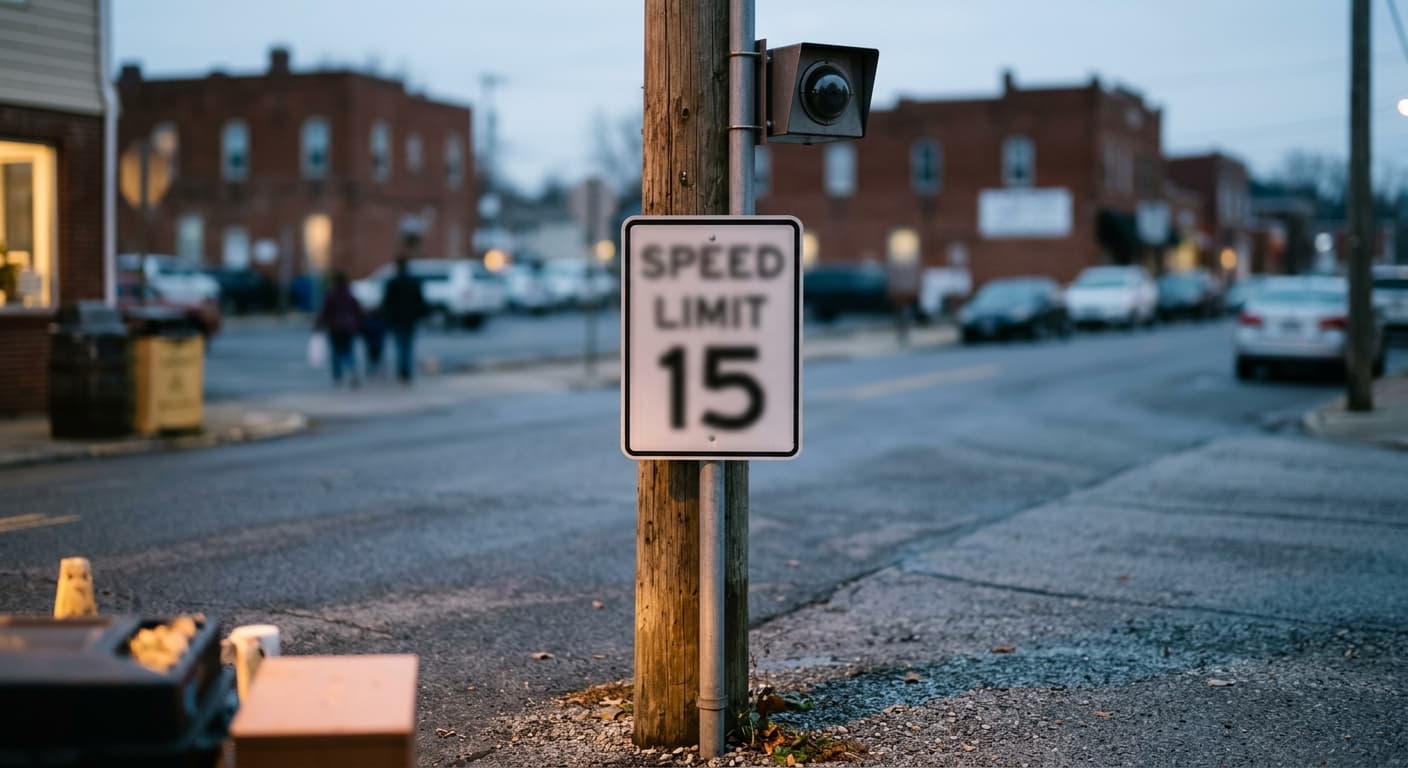
West Virginia does not have traffic camera tickets. State law bars police from using traffic-law photo-monitoring devices to enforce traffic laws, and it blocks images from those devices from being used as evidence that a violation happened. The one camera program the state does mandate is on school buses, and it is aimed at a single offense: passing a stopped bus. A 2026 push to carve out an exception for highway work zones came close, then failed, at least as far as the camera piece goes.
West Virginia's Camera Ban, in Plain Terms
West Virginia Code 17C-6-7a is unambiguous: «No police officer may utilize a traffic law photo-monitoring device to determine compliance with, or to detect a violation of, a municipal or county ordinance or any provision of this code that governs or regulates the operation of motor vehicles.» The statute goes further than a simple ban on issuing tickets. It also bars the evidence itself: «A violation... may not be proved by evidence obtained by the use of a traffic law photo-monitoring device.» That means even if a camera captured a clear violation, that footage cannot be used to prove the case in court. The law defines a covered device broadly, as an electronic system combining a camera with a means of automatically sensing a vehicle's presence and producing photographic, video, or digital images. This section has not been amended since 2007, and the ban applies statewide, to both state and local law enforcement. What it bans is the photo-monitoring device used for general traffic enforcement. It is not a rule that no camera image can ever figure in a West Virginia traffic case, and the school bus program described below sits outside that framing.
What Almost Changed in 2026, and What Actually Did
The 2026 legislative session saw the most serious attempt in years to open a hole in West Virginia's photo-monitoring ban. A bill, HB 4538, would have authorized the Division of Highways to use photographic, video, or digital speed enforcement in highway work zones, paired with real-time officer communication and posting on the state's 511 traveler-information system. Before the bill passed the House, the camera-enforcement language was stripped out entirely. It was not the first attempt, either: earlier bills to authorize some form of camera enforcement, including HB 2957 in 2023 and HB 4266 in 2024, along with a 2025 work-zone camera-assisted enforcement bill (SB 696), had already failed to become law before HB 4538 met the same fate on its camera provisions in 2026.
What remained, and what actually became law as Chapter 198 (approved by the Governor April 1, 2026, effective June 12, 2026), was a straightforward fine increase for officer-issued work-zone speeding tickets under West Virginia Code 17C-3-4b: up to $500 for driving under 15 mph over the limit with workers present, and up to $1,000 plus a possible 30 days in regional jail for 15 mph or more over, up from the prior $200 and 20-day maximums. That is a change to how West Virginia punishes an ordinary, officer-issued speeding ticket in a work zone, not a change to whether cameras are allowed. West Virginia's camera ban was untouched. The head of a contractors' industry group that pushed for the bill said publicly, after the House vote, that he hoped to bring camera legislation back in 2027 built around requiring an officer to initiate the stop, and this was at least the third or fourth such attempt to fail since 2023.
The One Camera Program West Virginia Does Require: School Buses
The photo-monitoring ban is not the whole picture. A separate statute, W. Va. Code 17C-12-7, requires every county board of education to install forward-facing and rear-facing cameras on all school buses purchased on or after July 1, 2019, and the statute itself says they are there «for the purpose of enforcing this section and for any other lawful purpose.» The section being enforced is the school-bus-passing law, which is a provision of the same traffic chapter that 17C-6-7a otherwise shields from camera enforcement.
The same section also addresses the plate-known, driver-unknown problem that camera programs exist to solve. Under 17C-12-7(c), where the driver's identity is unknown but the license plate number is known, it may be inferred that the driver was the registered owner or lessee «for purposes of the probable cause determination.» Where the vehicle's presence at the scene is the only evidence against that owner, the statute limits the outcome to the fine, without confinement.
That is still not the mailed civil camera ticket other states send. Passing a stopped school bus in West Virginia is a criminal misdemeanor, charged by a law enforcement officer, with service of process handled like any other criminal complaint. But a reader who concludes from the camera ban that no camera image can ever start a traffic case here is assuming more than the code says.
A 2026 bill would have made that link explicit. SB 558 would have amended 17C-12-7 to authorize video from school bus cameras that records a passing violation to be sent directly to a law enforcement agency «for purposes of citation and enforcement,» and would have added a new aggravated passing offense at 17C-12-7b. It passed the Senate on February 23, 2026 (Roll No. 197) and the House on March 13, 2026 (Roll No. 536), and both chambers completed action on March 14, 2026. The Governor vetoed it on April 1, 2026, and the Legislature did not override, so none of it became law and 17C-12-7 reads today as it did before the session.
If You Get a Camera Ticket From Another State
West Virginia's ban only controls what West Virginia police and courts can do inside the state. It has no effect on another state's owner-liability camera program mailing a civil notice to a West Virginia address after a vehicle registered here was photographed committing a violation somewhere else. Those out-of-state notices remain the issuing state's civil matter, and unpaid ones can still be sent to collections there, even though West Virginia's own courts cannot use camera evidence and no West Virginia agency can operate a camera program of its own. This article does not address toll collection cameras, which run under separate authority from traffic-law enforcement and are not covered by 17C-6-7a's ban.

Information last verified on 2026-09-22. This article has not yet been reviewed by a licensed lawyer.
Related Resources
- Traffic Camera Ticket Laws by State
- Do You Have to Pay a Camera Ticket?
- How to Fight a Camera Ticket
- Automated License Plate Readers
- DUI Laws by State
Last updated: 2026-09-22.
More West Virginia Laws
Frequently Asked Questions
Are traffic cameras legal in West Virginia?
Not for routine traffic enforcement. West Virginia Code 17C-6-7a bars police from using a traffic-law photo-monitoring device to enforce traffic laws, and it bars images from such a device from being used as evidence of a violation. School bus cameras are a separate matter: W. Va. Code 17C-12-7 requires them and says they exist to enforce the school-bus-passing law.
Did West Virginia just start allowing work-zone cameras?
No. A 2026 bill would have authorized camera enforcement in highway work zones, but that camera language was removed before the bill passed the House. What passed instead was a fine increase for ordinary, officer-issued work-zone speeding tickets.
Can a school bus camera get me ticketed in West Virginia?
It can contribute to a case. W. Va. Code 17C-12-7 requires forward- and rear-facing cameras on school buses purchased on or after July 1, 2019, for the purpose of enforcing the school-bus-passing law, and 17C-12-7(c) lets a court infer that the registered owner was driving when the plate is known but the driver is not. This is a criminal misdemeanor charged by an officer, not a mailed civil camera ticket, and where the vehicle's presence is the only evidence the penalty is limited to the fine without jail. A 2026 bill, SB 558, would have expressly authorized bus video to be sent directly to law enforcement for citation; it passed both chambers and the Governor vetoed it on April 1, 2026.
How much is a West Virginia work-zone speeding ticket now?
Under the 2026 fine increase, driving under 15 mph over the limit with workers present can bring a fine up to $500. Driving 15 mph or more over can bring a fine up to $1,000 and up to 30 days in regional jail.
Can I get a camera ticket in West Virginia from another state's program?
Yes. West Virginia's ban only controls enforcement inside West Virginia. A vehicle registered in West Virginia can still receive a mailed civil camera notice from a program in another state, and unpaid notices can be sent to collections in that state.
Will West Virginia ever allow traffic cameras?
It's possible but not settled. An industry group that backed the 2026 work-zone camera language said it plans to bring the idea back in 2027, built around requiring an officer to initiate the stop, after at least three prior attempts have failed since 2023.
Updates
Added West Virginia's school bus camera requirement under W. Va. Code 17C-12-7, and the vetoed 2026 SB 558, and qualified the statement that camera images can never be used as evidence of a traffic violation in the state.
Independently fact-checked against the cited primary sources
The Law Behind This Article
This article rests on the statutory provisions below, held in our own legal record and retrieved from the official source. Tap a section to read the operative text.
West Virginia Code
§ 17C-6-7AProhibition of the use of traffic law photo-monitoring devices to detect or prove traffic law violations.In force
(a) As used in this section "traffic law photo-monitoring device" means an electronic system consisting of a photographic, video, or electronic camera and a means of sensing the presence of a motor vehicle that automatically produces photographs, videotape, or digital images of the vehicle, its operator, or its license plate. (b) No police officer may utilize a traffic law photo-monitoring device to determine compliance with, or to detect a violation of, a municipal or county ordinance or any provision of this code that governs or regulates the operation of motor vehicles. (c) A violation of a municipal or county ordinance or any provision of this code that governs or regulates the operation of motor vehicles may not be proved by evidence obtained by the use of a traffic law photo-monitoring device. (d) The provisions of this section do not prohibit the use of any device designed to measure and indicate the speed of a moving object by means of microwaves or reflected light to obtain evidence to prove the speed of a motor vehicle pursuant to section seven of this article.
Official text (excerpt) · last checked 2026-09-16 · Read the full text in our law library · Verify at code.wvlegislature.gov
§ 17C-3-4BTraffic violations in construction zones; posting requirement; criminal penalty.In force
(a) Where street or highway construction work is being conducted, signs and other traffic control devices, as adopted in §17C-3-1 of this code, shall be posted giving the location of the work and notifying all motorists as to the speed limit and any other traffic restrictions. (b) Any person who exceeds any posted speed restriction or traffic restriction at a construction site referred to in subsection (a) of this section by less than 15 miles per hour is guilty of a misdemeanor and, upon conviction thereof, shall be fined not more than $200: Provided, That any person who exceeds any posted speed restriction or traffic restriction at a construction site referred to in subsection (a) of this section when any worker is present by less than 15 miles per hour is guilty of a misdemeanor and, upon conviction thereof, shall be fined not more than $500.
Official text (excerpt) · last checked 2026-07-30 · Read the full text in our law library · Verify at code.wvlegislature.gov
Search our full record of US law — 2.1 million sections, every state + federal →
Sources and References
- W. Va. Code 17C-6-7a, Use of traffic law photo-monitoring devices prohibited(code.wvlegislature.gov).gov
- W. Va. Code 17C-3-4b, Exceeding speed limit in highway work zones; penalties(code.wvlegislature.gov).gov
- West Virginia Legislature, HB 4538 (2026) bill history(wvlegislature.gov).gov
- WV MetroNews, "Work zone safety bill increasing speeding fines passes House"(wvmetronews.com)
- W. Va. Code 17C-12-7, Overtaking and passing school bus; penalties; mounting of cameras(code.wvlegislature.gov)
- West Virginia Legislature, SB 558 (2026 Regular Session) bill history, vetoed April 1, 2026(wvlegislature.gov)
- Enrolled Committee Substitute for S.B. 558 (2026), full text(wvlegislature.gov)