Michigan Traffic Camera Ticket Laws: Work Zone Speed Cameras Explained
Independently fact-checked against primary sources (last audited August 12, 2026). · 3 primary sources cited on this page. How we verify our legal content

Michigan's camera-enforcement law is narrow by design. State law authorizes automated camera enforcement in three settings and no others: highway work zones under MDOT jurisdiction, railroad grade crossings with flashing signals and gates, and school bus stop arms. None of the three is a general speed or red light camera program, and there is no red light camera law in Michigan at all.
Work Zone Speed Cameras: A New, Narrow Authorization
Michigan's automated speed enforcement authority lives at MCL 257.627c, with supporting definitions at MCL 257.2c, both added by 2024 Public Act 164 and effective April 2, 2025. The statute itself, however, delays MDOT's actual authority to install and use a system: it does not take effect for that purpose until «1 year after the effective date of the amendatory act that added section 2c,» meaning MDOT's own legal authority to deploy a system began April 2, 2026, not the statute's general effective date. A late-2025 state budget cut of roughly $2.94 million earmarked for camera implementation further delayed the program on top of that built-in one-year lag. The scope is tightly drawn:
- Applies only in MDOT-jurisdiction work zones not separated from traffic by concrete barriers.
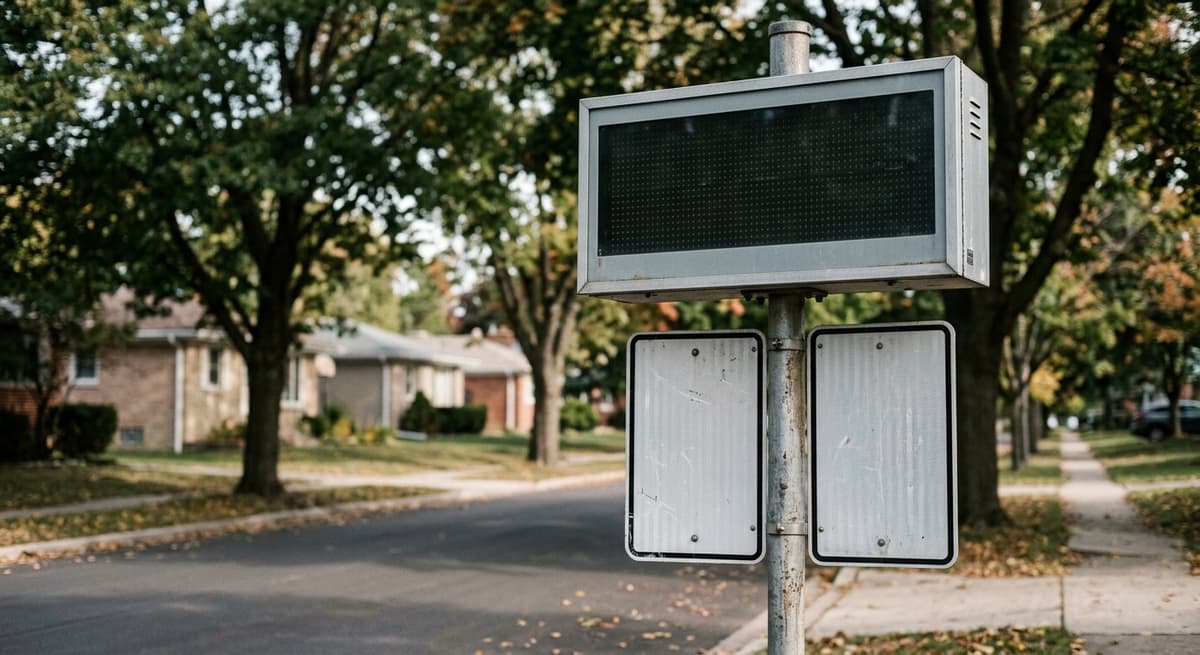
- Requires a warning sign posted one mile before the work zone and a digital speed display at the system location.
- Operates only while workers are present in proximity to a roadway that is not protected by a guardrail or barrier.
- Uses lidar or a comparable technology, which the statute's definitions specifically distinguish from radar.
- MDOT may operate the system «only by contracting with a third-party vendor,» and no more than four systems may run at the same time within a single state transportation department region.
- The threshold for a violation is 10 or more miles per hour over the posted work-zone limit.
The penalty structure is graduated and starts gently: a first violation within a three-year period gets a written warning only, with no fine. A second violation in that window brings a civil fine of up to $150. A third or later violation in the same three-year window brings a civil fine of up to $300. The registered owner is presumed to be the operator, but that presumption can be rebutted with an affidavit or a police report showing someone else was driving.
Nothing is running yet. MDOT has not announced the third-party vendor contract that MCL 257.627c requires before any system can be installed or used, and reporting through 2026 placed the earliest realistic start at the 2027 construction season rather than 2026. MDOT has not published a confirmed activation date, so treat any specific start date you see as a target rather than a schedule.
If you see references to Michigan camera legislation under different act numbers, be cautious. Some secondary sources describe this law as «Public Act 132/133,» which does not match the actual legislative history; the correct citations are Public Act 164 (the work zone speed system) and, for the separate stop-arm law discussed below, Public Act 161.
No Red Light Camera Law Exists, and Michigan's Attorney General Has Called the Idea Unlawful
Michigan has no statute authorizing red light cameras and no statute banning them. On the bare text, that reads like a neutral gap, distinct from states like Montana or Maine that affirmatively prohibit camera enforcement. It is not neutral in practice. In a formal opinion issued January 30, 2007 (Opinion No. 7199), Michigan Attorney General Mike Cox addressed this exact question and concluded that a city ordinance authorizing citations for a red-light violation captured by an unmanned traffic-monitoring device, at any location other than a railroad grade crossing, «conflicts with the Michigan Vehicle Code» and «is invalid.» That opinion is almost certainly why no Michigan city currently runs a red-light-camera program: the state's own chief law-enforcement legal officer told cities the ordinance authorizing one would not survive a legal challenge.
The railroad grade crossing carve-out in that opinion is not an arbitrary exception. It exists because the Legislature had already authorized cameras at those crossings by statute, at MCL 257.667a, which is covered in the next section.
A 2022 bill did try to move Michigan's restriction off an opinion and into the statute books, but it would have written a ban, not an authorization. Senate Bill 875 of 2022 carried the subject line «Traffic control: speed restrictions; use of automated traffic enforcement devices; prohibit» and would have added a new section 612a to the Michigan Vehicle Code prohibiting automated traffic enforcement devices. It passed the Senate 28 to 10 on March 22, 2022 (roll call 97), was referred that same day to the House Committee on Transportation, and went no further before the session ended. Because that bill failed, Michigan's restriction on red light and general speed cameras still rests on an Attorney General opinion rather than on an express statutory prohibition.
If you receive a Michigan red light camera ticket, its legitimacy would depend on statutory authority Michigan law does not provide outside the three settings described on this page, and it runs directly against an AG opinion holding the underlying ordinance mechanism unlawful.
Railroad Grade Crossing Cameras: Michigan's Oldest Camera-Ticket Statute
MCL 257.667a, added by 2000 Public Act 367 and last amended in 2006, lets the Department of State Police, the state transportation department, a county board of commissioners, a board of county road commissioners, a county sheriff, or another local authority with jurisdiction over a highway or street authorize «the installation and use of unmanned traffic monitoring devices at a railroad grade crossing with flashing signals and gates» on roads under their respective jurisdictions.
The mechanics will look familiar if you have read the work zone section above:
- Each device must be marked or identified, or a sign must be posted at the approach to the crossing, indicating that the crossing is monitored.
- For the first 30 days after installation, a driver caught by the device receives a written warning only. After that initial period, a person is responsible for a civil infraction under MCL 257.667 on the basis of evidence obtained from the device.
- Prima facie evidence that the vehicle was operated in violation of section 667, together with proof that the defendant was the registered owner at the time, «shall constitute in evidence a rebuttable presumption that the registered owner of the vehicle was the person who committed the violation.» The owner can rebut it by affidavit or testimony that someone else was driving, or with a police report showing the vehicle was stolen before the violation.
- The citation may be executed by mailing a copy first-class to the owner's address as shown in Secretary of State records, with certified mail as a follow-up.
So a Michigan camera ticket for a grade crossing violation rests on real statutory authority. That is the narrow exception Opinion No. 7199 preserved, not evidence that camera tickets are generally valid anywhere else in Michigan.
A Separate Law: School-Bus Stop-Arm Cameras
2024 Public Act 161 amended MCL 257.682 to authorize camera-based enforcement of school-bus stop-arm violations. Subsection (5) provides that «for a camera-based violation, the operator of a vehicle is responsible for a civil infraction and must be ordered to pay a civil fine of not less than $100.00 and not more than $500.00,» and subsection (7) lets a law enforcement agency start the case by mailing the citation first-class after reviewing the footage.
The liability mechanism is the same one the work zone camera uses, not a different model. Subsection (3) of the same section provides that proof that the vehicle described in the citation was in violation of subsection (1), together with proof that the defendant named in the citation was, at the time of the violation, the registered owner of the vehicle, «constitutes a rebuttable presumption that the registered owner of the vehicle was the driver of the vehicle at the time of the violation.» A camera-based violation is defined as a violation of subsection (1) proved solely by stop-arm camera footage, so that presumption is what connects a photographed license plate to a named defendant, exactly as MCL 257.627c does in a work zone.
What actually separates the two programs is the setting and the money. A camera-based stop-arm violation carries a $100 to $500 civil fine from the first offense, while the work zone system starts with a written warning and caps at $300. If your ticket involves a school bus, you are dealing with this law, not the work zone speed system above.
Points, Insurance, and Your Driving Record
Michigan answered the points question in 2026. MCL 257.320a(2), as amended by 2026 Public Act 66 with immediate effect on July 23, 2026, now provides: «Points must not be entered for a violation of section 310e(14), 311, 602c, 625m, 627c, 658, 682(5), 710d, 717, 719, 719a, or 723.» Section 627c is the work zone automated speed enforcement statute and section 682(5) is the camera-based school-bus stop-arm violation, so neither one puts points on a Michigan driving record.
Insurance is a separate question, and the statutes still do not answer it. Nothing in MCL 257.627c or MCL 257.682 tells an insurer how to treat one of these civil fines. The no-points rule removes the mechanism insurers most often use to reprice a policy, but it is not an express bar on considering the violation. Treat the points question as settled and the insurance question as open.
Nonpayment mechanics were similarly not spelled out in the statute's fetched text, so this page does not state a specific collection or registration consequence for an unpaid Michigan work zone camera fine.
Information last verified on 2026-09-22. This article has not yet been reviewed by a licensed lawyer.
Related Resources
- Traffic Camera Ticket Laws by State
- Do You Have to Pay a Camera Ticket?
- How to Fight a Camera Ticket
- DUI Laws by State
- Automated License Plate Reader Laws
Last updated: 2026-09-22.
More Michigan Laws
Frequently Asked Questions
Are speed cameras legal in Michigan?
Only in one narrow setting: MDOT highway work zones, under a 2024 law (Public Act 164) effective April 2, 2025. Michigan authorizes no general automated speed enforcement. Two other camera regimes exist but neither is speed enforcement: railroad grade crossing cameras under MCL 257.667a and school-bus stop-arm cameras under MCL 257.682.
Are red light cameras legal in Michigan?
There is no Michigan statute authorizing red light cameras, and no statute banning them either. But the state's own Attorney General formally opined in 2007 (Opinion No. 7199) that a city ordinance authorizing red-light-camera citations, at any location other than a railroad grade crossing, conflicts with the Michigan Vehicle Code and is invalid, which is almost certainly why no Michigan city currently runs one. That carve-out exists because MCL 257.667a separately authorizes cameras at grade crossings.
Can Michigan ticket me from a camera at a railroad crossing?
Yes. MCL 257.667a lets state police, the state transportation department, county road authorities, a sheriff, or a local authority install unmanned traffic monitoring devices at a railroad grade crossing that has flashing signals and gates. After a 30-day warning period following installation, camera evidence supports a civil infraction under MCL 257.667, the registered owner is presumed to have been the driver (rebuttable by affidavit, testimony, or a stolen-vehicle police report), and the citation can be mailed to the address on file with the Secretary of State.
How much is a Michigan work zone speed camera fine?
A first violation gets a written warning, not a fine. A second violation within three years brings a civil fine of up to $150, and a third or later violation within three years brings a civil fine of up to $300.
Has Michigan actually deployed any work zone cameras yet?
No. No work zone camera system has been activated. The statute's general effective date was April 2, 2025, but MDOT's own legal authority to install and operate a system did not begin until one year later, April 2, 2026; a late-2025 state budget cut of roughly $2.94 million earmarked for implementation set the program back further; and MDOT has not announced the third-party vendor contract that MCL 257.627c requires before any system can run. Reporting through 2026 put the earliest realistic start at the 2027 construction season rather than 2026, and MDOT has not published a confirmed date.
Does a Michigan work zone camera fine affect my driving record or insurance?
It does not add points. MCL 257.320a(2), as amended by 2026 Public Act 66, provides that points must not be entered for a violation of section 627c, the work zone camera statute, or section 682(5), the camera-based school-bus stop-arm violation. Insurance treatment is a separate question the statutes do not address, so that part remains open.
Is Michigan's school-bus stop-arm camera the same as the work zone camera law?
They are different statutes but the same liability mechanism. The stop-arm camera law (Public Act 161 of 2024, MCL 257.682) makes the operator responsible for a $100 to $500 civil infraction, and MCL 257.682(3) creates a rebuttable presumption that the registered owner was the driver, the same structure the work zone statute uses. The real differences are the setting and the fine: stop-arm violations start at $100, while the work zone system starts with a warning and caps at $300.
Updates
Corrected the school-bus stop-arm camera section (it uses the same registered-owner rebuttable presumption as the work zone camera law, not a different liability model), added Michigan's railroad grade crossing camera statute (MCL 257.667a), fixed the description of the failed 2022 Senate bill (it would have banned automated enforcement, not authorized it), and updated the points and rollout-timing sections for 2026 Public Act 66 and the slipped MDOT deployment target.
Independently fact-checked against the cited primary sources
The Law Behind This Article
This article rests on the statutory provisions below, held in our own legal record and retrieved from the official source. Tap a section to read the operative text.
Michigan Compiled Laws
§ 257.627cInstallation and use of automated speed enforcement systems in work zones; violations; report to legislatureIn force
(1) Beginning 1 year after the effective date of the amendatory act that added section 2c, the state transportation department may install and use or authorize the installation and use of an automated speed enforcement system in a work zone that is not separated from traffic by concrete barriers on a street or highway under the jurisdiction of the state transportation department. The installation and use of automated speed enforcement systems is subject to all of the following: (a) A sign must be placed 1 mile before the start of a work zone where an automated speed enforcement system is installed and used under this section indicating that the work zone is monitored by an automated speed enforcement system. (b) A digital display must be placed on or near the automated speed enforcement system that shows the speed of an approaching vehicle as measured by the automated speed enforcement system. (c) Prioritization must be given to work zones that meet the following factors: (i) The work zone is active and located on a freeway with a speed limit of 45 miles per hour or more.
Official text (excerpt) · last checked 2026-09-16 · Read the full text in our law library · Verify at legislature.mi.gov
§ 257.2c"Automated speed enforcement system" and "automated speed enforcement system operator" definedIn force
(1) "Automated speed enforcement system" means an electronic traffic sensor system that does both of the following: (a) Automatically detects a vehicle exceeding the posted speed limit using a lidar system or another technology that must not be either of the following: (i) A radar system. (ii) Less capable than a lidar system. (b) Produces a recorded image of the vehicle described in subdivision (a) that shows all of the following: (i) A clear and legible identification of the vehicle's registration plate. (ii) The location where the recorded image was taken. (iii) The date and time when the recorded image was taken. (2) "Automated speed enforcement system operator" means an individual trained and certified to operate and monitor an automated speed enforcement system by the automated speed enforcement unit within the state transportation department.
Official text (excerpt) · last checked 2026-07-30 · Read the full text in our law library · Verify at legislature.mi.gov
§ 257.682Stopping for school bus displaying flashing red lights; violation as civil infraction and civil fine; meeting stopped school bus on divided highway; proof; rebuttable presumption; use of stop-arm camera system; camera-based violations; definitionsIn force
(1) The operator of a vehicle overtaking or meeting a school bus that has stopped and is displaying 2 alternately flashing red lights located at the same level shall bring the vehicle to a full stop not less than 20 feet from the school bus and shall not proceed until the school bus resumes motion or the visual signals are no longer actuated. The operator of a vehicle that fails to stop for a school bus as required by this subsection, that passes a school bus in violation of this subsection, or that fails to stop for a school bus in violation of an ordinance that is substantially similar to this subsection, is responsible for a civil infraction and must be ordered to pay a civil fine of not less than $100.00 and not more than $500.00. A citation issued under this subsection is not a citation for a camera-based violation under subsection (4), and a civil fine for a violation of this subsection must be applied as provided in section 909(1).
Official text (excerpt) · last checked 2026-07-30 · Read the full text in our law library · Verify at legislature.mi.gov
Cited in 4 court opinions in our collectionLatest citing opinion in our collection: 1993
Opinions citing this section in our collection:
- Michigan Mutual Insurance v. Farm Bureau Insurance Group (Michigan Court of Appeals 1990, 183 Mich. App. 626)“…341 NW2d 510 (1983), lv den 419 Mich 852 (1984), and MCL 257.682; MSA 9.2382. Citizens relies extensivel…”
- McNees v. Scholley (Michigan Court of Appeals 1973, 46 Mich. App. 702)“…vehicles for a distance of 500 feet as required by statute MCLA 257.682(c); MSA 9.2382(c). Plaintiffs cl…”
- Dedes v. South Lyon Community Schools (Michigan Court of Appeals 1993, 199 Mich. App. 385)“…veling east, ahead of the bus, when it struck the children. MCL 257.682; *392 MSA 9.2382 requires only vehicle…”
Identified automatically from the court opinions citing this section — not a ranking of which case controls.
Search our full record of US law — 2.1 million sections, every state + federal →
Sources and References
- MCL 257.627c, Automated speed enforcement system in a work zone(legislature.mi.gov).gov
- MCL 257.2c, Definitions for automated work zone speed enforcement(legislature.mi.gov).gov
- MCL 257.682, School bus stop-arm violations, including camera-based enforcement(legislature.mi.gov).gov
- Michigan Attorney General Opinion No. 7199 (Jan. 30, 2007), red light camera ordinances conflict with the Vehicle Code(thenewspaper.com)
- MCL 257.667a, Unmanned traffic monitoring devices at railroad grade crossings(legislature.mi.gov)
- MCL 257.320a(2), as amended by 2026 PA 66, points must not be entered for violations of sections 627c and 682(5)(legislature.mi.gov)
- Michigan Senate Bill 875 of 2022, automated traffic enforcement devices; prohibit (passed Senate 28-10, died in House Transportation)(legislature.mi.gov)