
New York
New York Pepper Spray and Stun Gun Laws (2026)
Independently fact-checked against primary sources (last audited September 23, 2026). · 15 primary sources cited on this page. How we verify our legal content

New York regulates pepper spray through a dense, cross-referenced set of Penal Law exemptions and a Department of Health regulation that fixes the exact formula, size, and label a device must carry. Stun guns are a harder case: Penal Law Section 265.01(1) still lists them as a fourth-degree weapon, a 2019 federal district court order enjoined the State Police from enforcing that ban as to those two devices generally, and since the Supreme Court reset the constitutional test in 2022, three courts, most recently the Second Circuit in a non-precedential summary order, have rejected a constitutional challenge to the ban for lack of evidence that the devices are in common use, without disturbing or narrowing the 2019 injunction. New York City separately bans stun gun possession and sale under its own Administrative Code, a ban the Southern District of New York and the Second Circuit left standing in that same litigation, and that city ban is not touched by the 2019 federal order at all.
Jurisdiction scope: This page covers New York law: the state Penal Law (Sections 265.00, 265.01, 265.20, 270.05, and 195.08), the Department of Health's self-defense-spray regulation (10 NYCRR Part 54), and New York City's separate stun-gun ban (N.Y.C. Admin. Code Section 10-135), which applies only inside the five boroughs. It does not cover how an individual district attorney or a court outside the decisions named below is currently charging or deciding a stun-gun case; that can vary by county.
Is pepper spray legal to carry in New York?
Legal for an adult with no disqualifying record, but only a device meeting a specific state formula and sold through a specific channel. New York regulates pepper spray through the interaction of three Penal Law sections and one Department of Health regulation, rather than a single stand-alone statute.
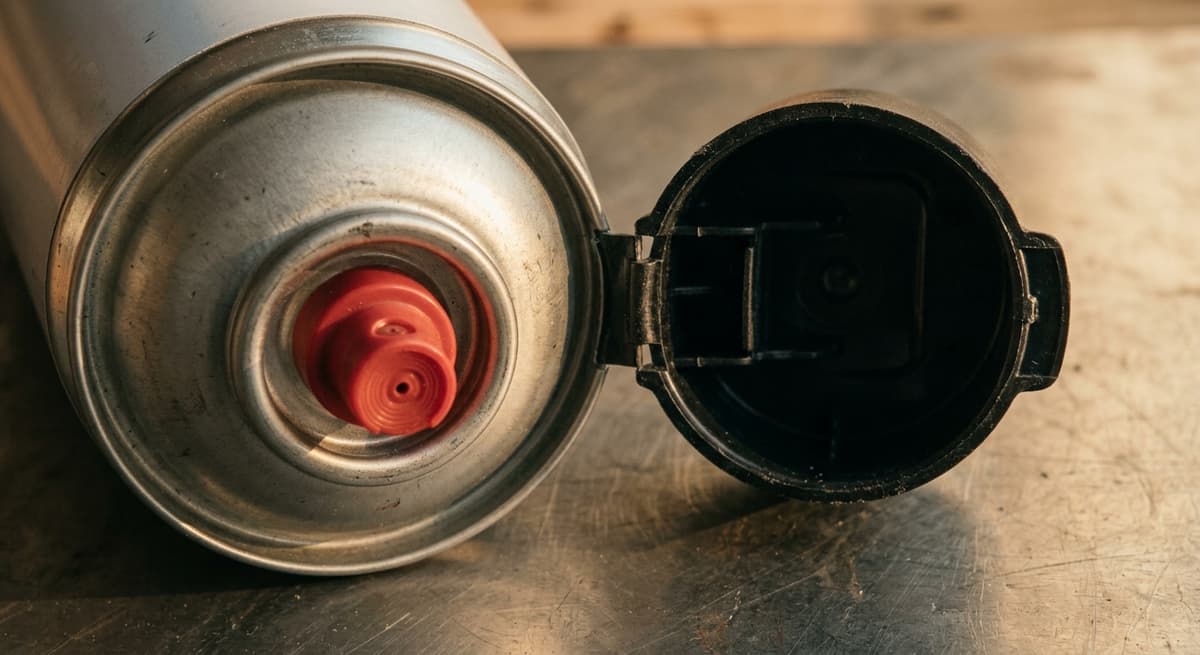
Section 265.20(a)(14) is the core exemption, and it is narrower than a flat legalization. It covers "possession in accordance with the provisions of this paragraph of a self-defense spray device as defined herein for the protection of a person or property and use of such self-defense spray device under circumstances which would justify the use of physical force pursuant to article thirty-five of this chapter." Possession is exempt outright; use is exempt only when New York's justification law, Article 35, would allow physical force in the same circumstances. The device is defined as "a pocket sized spray device which contains and releases a chemical or organic substance which is intended to produce temporary physical discomfort or disability through being vaporized or otherwise dispensed in the air or any like device containing tear gas, pepper or similar disabling agent." The exemption "shall not apply to a person who: (i) is less than eighteen years of age; or (ii) has been previously convicted in this state of a felony or any assault; or (iii) has been convicted of a crime outside the state of New York which if committed in New York would constitute a felony or any assault crime." That statutory bar is what disqualifies a felon or an under-18 buyer. The warning label described below is a regulatory mandate the statute directs the Department of Health to print on the device, not the source of the age-18 or no-felony rule itself.
Section 270.05(5), New York's general noxious-material statute, tracks the same line from the other direction: "Notwithstanding the provisions of subdivisions two and three of this section, it shall not be unlawful for a person eighteen years of age or older to possess a self-defense spray device as defined in paragraph fourteen of subdivision a of section 265.20 of this chapter in accordance with the provisions set forth therein." The carve-out runs only against subdivisions two and three of 270.05, and only for someone who actually satisfies paragraph fourteen; turning 18 does not by itself clear a person who has a disqualifying felony or assault conviction. Outside that carve-out, 270.05 still applies in full. Subdivision 3 makes possession of noxious material "presumptive evidence of intent to use it or cause it to be used in violation of this section," and subdivision 6 separately makes it a crime to sell a self-defense spray device outside the authorized channel described below. Unlawfully possessing or selling noxious material is a class B misdemeanor.
Who may sell the device, and how many, is separately restricted. Section 265.20(a)(15) permits sale only by "a dealer in firearms licensed pursuant to section 400.00 of this chapter, a pharmacist licensed pursuant to article one hundred thirty-seven of the education law or by such other vendor as may be authorized and approved by the superintendent of state police," and requires the seller to obtain "proof of age and a sworn statement... that such person has not been convicted of a felony or any crime involving an assault" before delivering a device, with "no more than two self-defense spray devices... sold at any one time to a single purchaser."
The device itself is separately regulated by the Department of Health under 10 NYCRR Part 54. Section 54.3 states that "every self-defense spray device which is purchased, possessed or used in New York State shall satisfy" a fixed list of requirements: it must contain "oleoresin capsicum, and no other substance, as the active ingredient"; its contents "shall not contain more than 0.7% by weight total capsaicinoids"; its "net weight... shall not exceed 0.75 ounces"; it must have a safety device; it must be sold in sealed, tamper-proof packaging; it must not be camouflaged; it must include a safety and first-aid insert with a toll-free information number; and it must carry a label warning that "possession of this device by a person under the age of eighteen or by anyone who has been convicted of a felony or assault is illegal." The 0.75-ounce figure is a cap on contents, not on the canister: Section 54.2(b) defines "net weight" to mean "the weight of the contents of a self-defense spray device," so an otherwise-compliant unit is not disqualified by the weight of its housing.
Are stun guns legal to carry in New York?
No. Possession is still a class A misdemeanor under Penal Law Section 265.01(1), and the 2019 federal injunction described below does not change that for an ordinary civilian: it binds the State Police, not a county district attorney, a local police department or the NYPD. N.Y. Penal Law Section 265.01(1) makes it a crime to possess "any firearm, electronic dart gun, electronic stun gun, switchblade knife, pilum ballistic knife, metal knuckle knife, cane sword, billy, blackjack, bludgeon, plastic knuckles, metal knuckles, chuka stick, sand bag, sandclub, wrist-brace type slingshot or slungshot, shuriken, or throwing star," and criminal possession of a weapon in the fourth degree is a class A misdemeanor. Section 265.00 defines the two banned devices: an "electronic dart gun" is "any device designed primarily as a weapon, the purpose of which is to momentarily stun, knock out or paralyze a person by passing an electrical shock to such person by means of a dart or projectile," and an "electronic stun gun" is "any device designed primarily as a weapon, the purpose of which is to stun, cause mental disorientation, knock out or paralyze a person by passing a high voltage electrical shock to such person." The difference between them is the dart. Neither definition has been amended, and neither device has been removed from the 265.01(1) list. A separate residual clause, 265.01(2), independently reaches a stun gun or a canister of pepper spray carried "with intent to use the same unlawfully against another," and that clause is untouched by everything discussed below.
In 2019, in Avitabile v. Beach, the U.S. District Court for the Northern District of New York held Section 265.01(1) unconstitutional as applied to electronic dart guns and electronic stun guns, applying the pre-Bruen intermediate-scrutiny framework then used in this circuit and finding the two devices commonly possessed for lawful self-defense. Its order states that "New York Penal Law Section 265.01(1), as applied to 'electronic dart guns' and 'electronic stun guns,' is an unconstitutional restriction on the right to bear arms," and enjoins "defendant, his officers, agents, servants, employees, and all persons in active concert or participation with the New York State Police" from enforcing that subdivision against those two devices. The decretal paragraphs name no plaintiff: the injunction runs against the State Police and those acting in concert with it, as to electronic dart guns and electronic stun guns generally, and it carries no end date, so it stays in force unless a court modifies or dissolves it. It does not bind a county district attorney, a municipal police department, or New York City's separate stun-gun ban.
The legal landscape has moved since 2019, though not by repealing or narrowing Avitabile. The Supreme Court's 2022 decision in New York State Rifle & Pistol Association v. Bruen replaced the framework Avitabile applied with a text-and-history test that puts the burden on a challenger to show a weapon is in common use for lawful purposes before a court reaches the state's justification for regulating it. Under that test, three courts have since rejected a Bruen challenge to the ban rather than struck it down, each on evidentiary grounds. On March 24, 2025, the Southern District of New York granted summary judgment for the City in Calce v. City of New York, rejecting a Second Amendment challenge to both Penal Law 265.01 and New York City's own stun-gun ban. The court found "Plaintiffs have not provided any studies, reports, or data" on common use, and quoted the City's own brief for the conclusion that the plaintiffs offered "no evidence whatsoever to support their claim that stun guns and tasers are in common use in the United States for self-defense, let alone in New York City." On April 13, 2026, the Second Circuit affirmed by summary order, a disposition its own cover page states "do not have precedential effect": "upon due consideration, it is hereby ordered, adjudged, and decreed that the judgment of the District Court is affirmed." The panel framed the appeal as a failure of proof under Federal Rule of Civil Procedure 56 rather than a constitutional ruling on the merits, holding that the plaintiffs "failed to provide evidence that stun guns and tasers are in common use for lawful purposes" and so "failed in this case to carry their burden at step one of the Bruen analysis." On June 12, 2025, a Bronx Criminal Court denied a pretrial constitutional challenge on the same evidentiary ground in People v. Taylor, but described the underlying authority differently than the outcome suggests: "courts whose decisions do not bind this one have split on the question, albeit with the weight of authority appearing to favor invalidity of section 265.01 (1)'s ban on civilian possession of tasers and stun guns," citing Avitabile alongside O'Neil v. Neronha, 594 F. Supp. 3d 463 (D.R.I. 2022), which struck down a comparable Rhode Island statute after Bruen, against Calce on the other side. The court denied Taylor's motion "for substantially the reasons set forth by Judge Ramos in Calce," on a pretrial record it called necessarily circumscribed, and left the door open: "should the trial judge decide to permit Taylor to make a more expansive application on this ground later in the case, Taylor should feel free to do so."
None of this repeals Section 265.01(1) or reverses Avitabile. The State Police remain enjoined from enforcing the statute as to electronic dart guns and electronic stun guns generally, not against a limited set of people. But the Southern District, the Second Circuit, and a Bronx Criminal Court have each rejected a constitutional challenge to the ban itself for lack of evidence that the devices are commonly used for self-defense, without disturbing that injunction. Because the order binds only the State Police and those acting in concert with them, a New York resident who possesses a stun gun or electronic dart gun remains exposed to prosecution under Section 265.01(1) by a county district attorney or a local police department, and to the separate New York City ban.
The Calce litigation is not final. The plaintiffs filed a petition for a writ of certiorari with the U.S. Supreme Court on July 7, 2026, Docket No. 26-46, Calce v. City of New York. The City initially waived its right to respond, but on September 8, 2026 the Court requested a response, due October 8, 2026. That does not change the current state of New York law described above, but it means the Second Circuit's summary order is not the last word in this litigation.
New York City's separate stun-gun ban
New York City bans stun guns independently of the state Penal Law, and that ban applies inside the city regardless of Avitabile. N.Y.C. Administrative Code Section 10-135 defines an "electronic stun gun" as "any device designed primarily as a weapon, the purpose of which is to stun, render unconscious or paralyze a person by passing an electronic shock to such person, but shall not include an 'electronic dart gun' as such term is defined in section 265.00 of the penal law," and makes it "unlawful for any person to sell or offer for sale or to have in his or her possession within the jurisdiction of the city any electronic stun gun." Violation is a class A misdemeanor. The section exempts police officers "operating under regular department procedure or operation guidelines established by their department," and separately exempts manufacturers and bulk shipments passing through the city to a point outside it, so long as the shipment stays in its original, unopened packaging.

This is the same city ban the Southern District of New York upheld, and the Second Circuit affirmed by summary order, in Calce v. City of New York. The summary-judgment record in that case shows the NYPD enforces it: one of the named plaintiffs was charged under Section 10-135 in November 2021 after brandishing a stun gun to deter a woman who had struck her in the face, a charge resolved through an adjournment in contemplation of dismissal in Kings County Criminal Court. The Avitabile injunction runs against the New York State Police; it says nothing about the NYPD or Section 10-135. A New York City resident faces this city-level ban whether or not the state Penal Law claim is enjoined as to anyone else.
Two offenses that reach either device
Section 195.08 makes it a separate, more serious crime to use a self-defense spray device against a police or peace officer to obstruct a lawful duty. The statute reads: "a person is guilty of obstructing governmental administration by means of a self-defense spray device when, with the intent to prevent a police officer or peace officer from performing a lawful duty, he causes temporary physical impairment to a police officer or peace officer by intentionally discharging a self-defense spray device... thereby causing such temporary physical impairment." Obstructing governmental administration by means of a self-defense spray device is a class D felony, the most serious exposure on this page for an otherwise lawful pepper-spray carrier.
Separately, Penal Law Section 265.01(2) reaches either device, along with a long list of other objects, when it is carried "with intent to use the same unlawfully against another." That residual intent-based offense applies statewide regardless of the sale-channel exemption for pepper spray or the Avitabile injunction for stun guns, and neither of those reaches it. New York's place-based weapons offenses do not reach either device: Sections 265.01-a, 265.01-d and 265.01-e each apply only to a firearm, rifle or shotgun.
Federal law: what it does and does not reach
No federal statute regulates a civilian's purchase or possession of pepper spray or a stun gun. Federal law matters in three places.
Federal buildings. Under 18 U.S.C. § 930(a), whoever knowingly possesses or causes to be present "a firearm or other dangerous weapon in a Federal facility (other than a Federal court facility)" faces a fine, imprisonment of up to 1 year, or both. Subsection (e) sets up to 2 years for a federal court facility, and subsection (b) up to 5 years where the weapon is intended to be used in a crime. Section 930(g)(2) defines the term:
The term "dangerous weapon" means a weapon, device, instrument, material, or substance, animate or inanimate, that is used for, or is readily capable of, causing death or serious bodily injury, except that such term does not include a pocket knife with a blade of less than 2½ inches in length.
The definition names neither device. Whether a particular spray or stun gun is "readily capable of" causing serious bodily injury is a question of fact the statute does not answer. Subsection (d)(3) exempts "the lawful carrying of firearms or other dangerous weapons in a Federal facility incident to hunting or other lawful purposes," and subsection (h) requires notice of the ban to be posted at each public entrance. A "Federal facility" is "a building or part thereof owned or leased by the Federal Government, where Federal employees are regularly present for the purpose of performing their official duties."
Air travel. The Transportation Security Administration's screening rules, which are agency policy rather than statute, bar both devices from carry-on bags. One 4 fl. oz. (118 ml) container of mace or pepper spray is permitted in checked baggage if it has a safety mechanism to prevent accidental discharge, and sprays containing more than 2 percent by mass of tear gas (CS or CN) are prohibited in checked baggage. Tasers, stun guns and other electro-shock weapons may travel in checked baggage only if transported so the device cannot discharge accidentally. Airlines may set stricter rules.
National parks. National Park Service regulations prohibit possessing, carrying or using a "weapon" in a park area except as the regulations provide (36 CFR 2.4(b)(1)). 36 CFR 1.4 defines "weapon" to include an "irritant gas device" and any "weapon the possession of which is prohibited under the laws of the State in which the park area or portion thereof is located."
Disclaimer: This article provides general legal information about New York's pepper spray and stun gun laws as of September 2026. It is not legal advice. Consult a lawyer licensed in New York for advice about a specific situation.
For a state-by-state comparison, see pepper spray and stun gun laws by state. New York's self-defense statutes are covered separately on the New York self-defense laws page.
Statutes cited reflect their in-force version as of 2026-09-20. Last updated: 2026-09-22.
Frequently Asked Questions
What size pepper spray can you legally carry in New York?
10 NYCRR Section 54.3 caps a self-defense spray device at 0.75 ounces net weight and 0.7% total capsaicinoids by weight, and requires oleoresin capsicum as the only active ingredient, a safety device, and sealed tamper-proof packaging. Section 54.2(b) defines net weight as the weight of the contents, so the cap applies to the contents, not the canister.
Where can you buy pepper spray in New York?
Only from a firearms dealer licensed under Penal Law Section 400.00, a pharmacist licensed under the Education Law, or another vendor authorized by the Superintendent of State Police, per Section 265.20(a)(15). The seller must verify age and obtain a sworn statement that the buyer has no felony or assault conviction, and may sell no more than two devices to one buyer at a time.
Are stun guns legal in New York?
Not for an ordinary civilian. The Avitabile injunction binds only the New York State Police, so it does not stop a county district attorney or a local police department from charging the offense. Penal Law Section 265.01(1) still lists electronic stun guns and electronic dart guns as prohibited weapons, a class A misdemeanor to possess. A 2019 federal district court order, Avitabile v. Beach, enjoined only the New York State Police from enforcing that ban, generally as to those two devices; it does not bind other police departments or New York City's separate ban. Since 2022, three courts, including the Second Circuit in an April 2026 summary order with no precedential effect, have rejected a constitutional challenge to the ban for lack of evidence the devices are in common use, without disturbing or narrowing the Avitabile injunction. The plaintiffs have since petitioned the U.S. Supreme Court, which requested a response from the City on September 8, 2026.
Did a court legalize stun guns in New York?
No. Avitabile v. Beach (N.D.N.Y. 2019) enjoined the New York State Police from enforcing Penal Law Section 265.01(1) against electronic dart guns and electronic stun guns generally, but that injunction runs only against the State Police and does not repeal the statute. Since the Supreme Court's 2022 Bruen decision reset the constitutional test, the Southern District of New York, the Second Circuit (by a non-precedential summary order), and a Bronx Criminal Court in June 2025 (denying a pretrial omnibus motion on a record it called circumscribed, leaving any broader application to the trial judge) have each rejected a constitutional challenge to New York's stun-gun ban for lack of evidence that stun guns and tasers are in common use for self-defense; the Southern District and the Second Circuit rejected the challenge to New York City's separate ban in the same case, while the Bronx court ruled only on the state statute. Writing in June 2025, before the Second Circuit ruled, the Bronx court described the weight of non-binding authority as favoring invalidity of the ban, and the same litigation is now before the U.S. Supreme Court on a certiorari petition the City has been asked to answer.
Does New York City ban stun guns separately from state law?
Yes. N.Y.C. Administrative Code Section 10-135 makes it a class A misdemeanor to sell, offer for sale, or possess an electronic stun gun within the city, with narrow exceptions for police officers and bulk shipments passing through. This city ban is separate from Penal Law Section 265.01(1), is not touched by the Avitabile injunction, and was upheld alongside the state law in Calce v. City of New York, including by the Second Circuit's April 2026 summary order.
What happens if you use pepper spray against a police officer in New York?
It can be a class D felony. Penal Law Section 195.08 makes it obstructing governmental administration by means of a self-defense spray device to intentionally discharge one at a police or peace officer, with intent to prevent that officer from performing a lawful duty, and causing temporary physical impairment.
Can a felon possess pepper spray in New York?
No. Penal Law Section 265.20(a)(14)'s exemption does not apply to anyone previously convicted of a felony or any assault, in New York or in a comparable out-of-state offense.
Updates
Independently fact-checked against the cited primary sources
Sources and References
- N.Y. Penal Law 265.00 - Definitions (electronic dart gun, electronic stun gun)(legislation.nysenate.gov).gov
- N.Y. Penal Law 265.01 - Criminal possession of a weapon in the fourth degree(legislation.nysenate.gov).gov
- N.Y. Penal Law 265.20(a)(14)-(15) - Exemptions (self-defense spray device, definition and sale channel)(legislation.nysenate.gov).gov
- N.Y. Penal Law 270.05 - Unlawfully possessing or selling noxious material(legislation.nysenate.gov).gov
- N.Y. Penal Law 195.08 - Obstructing governmental administration by means of a self-defense spray device(legislation.nysenate.gov).gov
- 10 NYCRR 54.2 - Definitions (self-defense spray device, net weight)(regs.health.ny.gov).gov
- 10 NYCRR 54.3 - Requirements (self-defense spray device)(regs.health.ny.gov).gov
- N.Y.C. Admin. Code 10-135 - Prohibition on sale and possession of electronic stun guns(codelibrary.amlegal.com)
- Avitabile v. Beach, 368 F. Supp. 3d 404 (N.D.N.Y. 2019) - Order(govinfo.gov).gov
- Calce v. City of New York, No. 21 Civ. 8208 (S.D.N.Y. Mar. 24, 2025) - Opinion and Order granting summary judgment(courtlistener.com)
- Calce v. City of New York, No. 25-861-cv (2d Cir. Apr. 13, 2026) - Summary order affirming (no precedential effect)(courtlistener.com)
- Calce v. City of New York, No. 26-46 - U.S. Supreme Court docket (petition for certiorari)(supremecourt.gov).gov
- People v. Taylor, 2025 NY Slip Op 25138 (Crim. Ct., Bronx County, June 12, 2025)(nycourts.gov).gov
- NYS Unified Court System - Ask a Law Librarian: Is pepper spray legal in New York?(askalawlibrarian.nycourts.gov).gov
- 18 U.S.C. § 930 - Possession of firearms and dangerous weapons in Federal facilities(law.cornell.edu)
- Transportation Security Administration - What Can I Bring? Pepper Spray(tsa.gov).gov
- Transportation Security Administration - What Can I Bring? Stun Guns/Shocking Devices(tsa.gov).gov
- 36 CFR 1.4 - National Park Service definitions (weapon)(ecfr.gov).gov
- 36 CFR 2.4 - Weapons, traps and nets(ecfr.gov).gov