
Vermont
Vermont Nursing Home Camera Laws: No Statute, No Wiretap Law
Independently fact-checked against primary sources (last audited August 14, 2026). · 3 primary sources cited on this page. How we verify our legal content
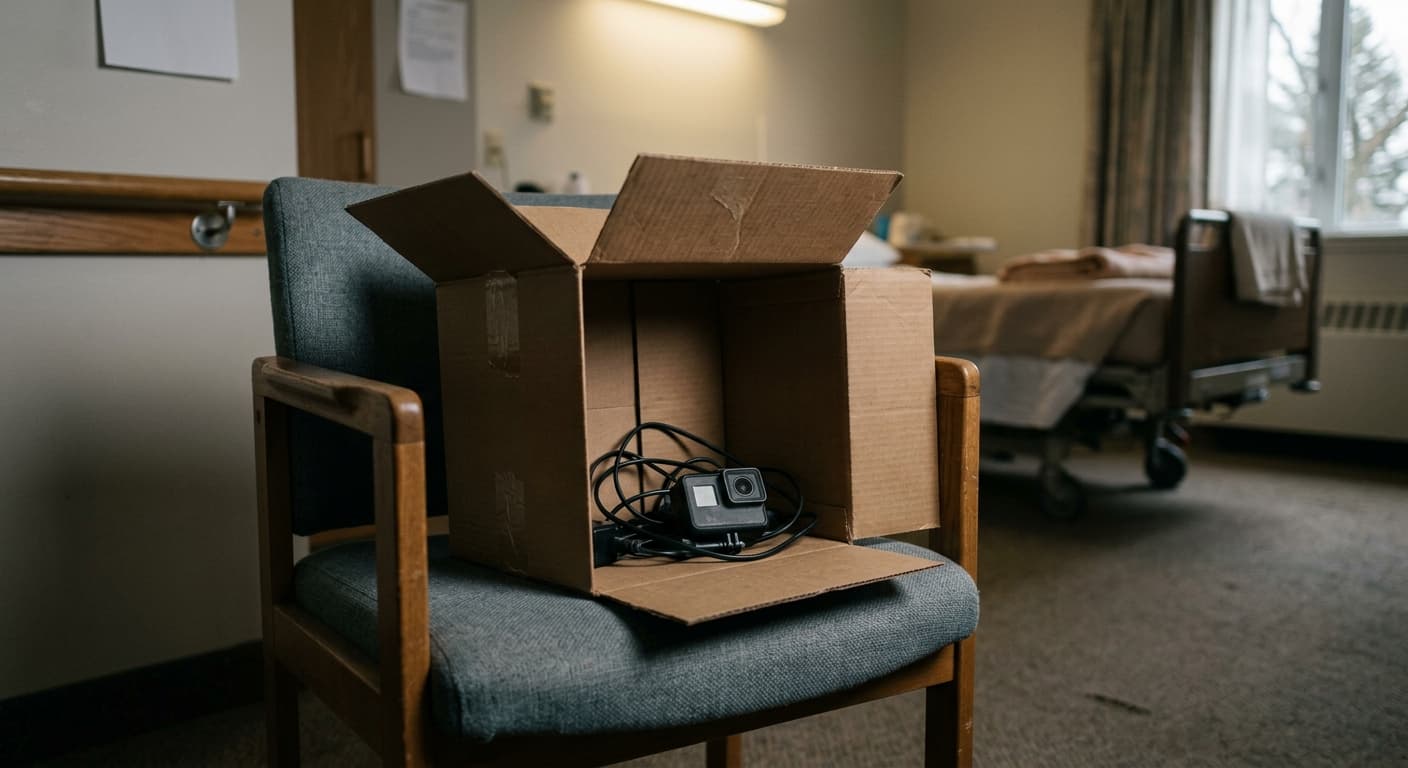
Vermont has no statute giving a nursing home resident or family a right to install a camera in a resident's room, and it is also the only state in this comparison with no general wiretapping or eavesdropping criminal statute at all. This article covers what fills that unusual gap, Vermont's separate voyeurism statute, and where to turn if a facility interferes with a camera.
This page addresses Vermont specifically. For the 18 states with an enacted electronic-monitoring statute, see the nursing home camera laws hub and the state-by-state comparison.
Does Vermont Have a Nursing Home Camera Law?
No. Vermont's Nursing Home Residents' Bill of Rights, 33 V.S.A. Section 7301, was read in full for this article. It guarantees confidential treatment of personal and medical records and the right to send and receive personal mail unopened, among other dignity and autonomy protections, but says nothing about electronic monitoring, cameras, or video or audio recording devices. The rest of the chapter covers grievance procedures, resident notice, penalties, readmission, and representative rights, with no monitoring content either.
A genuine full-text search of the Vermont General Assembly's own bill-search tool, run against both the 2023-2024 and 2025-2026 biennia using the phrase "nursing home camera," returned zero results in each. A broader search for "electronic monitoring" alone traced to interstate licensure compacts, data-privacy bills, and an employer-surveillance bill unrelated to nursing homes. Some generic aggregator lists that rank states by "granny cam" rights include Vermont anyway; nothing found in this review supports that, and this article treats those lists as unreliable for Vermont specifically.
Vermont's Unusual Recording Law: No Wiretap Statute at All
Vermont is the only state in this comparison, and one of the very few in the country, with no general wiretapping or eavesdropping criminal statute on the books. With no Vermont statute setting a consent baseline, federal law fills the gap for an ordinary conversation: under 18 U.S.C. Section 2511(2)(d), the federal Wiretap Act's one-party consent exception, a participant in a conversation may record it without notifying the others, losing that protection only if done for the purpose of committing a crime or a tort.
But Vermont layers two additional, state-specific protections on top of that federal baseline that do not exist in most other states. First, the Vermont Supreme Court held in State v. Geraw that a person has "a reasonable right to expect that he or she is not being secretly monitored or recorded" inside their own home, a constitutional holding developed in the context of government surveillance. Second, Vermont's criminal voyeurism statute, 13 V.S.A. Section 2605(d), makes it a crime, up to two years and a $1,000 fine for a first offense, to intentionally record a person without their knowledge and consent while they are in a place where they would have a reasonable expectation of privacy within a home or residence.
Does a Nursing Home Room Count as a "Residence"?
This is a genuinely open question. Section 2605(d) does not define "home or residence" beyond the phrase itself, and no Vermont case resolving whether an institutional nursing home room qualifies was found in this review. State v. Geraw concerned a private citizen's own kitchen table, not an institutional setting, so its reasoning could extend by analogy but is not a direct holding on nursing facilities. See our Vermont recording laws guide for more on how Vermont's unusual framework works generally.
Facility Policy Still Decides Whether a Camera Is Allowed
Because no Vermont statute grants a resident a right to a camera, the facility's admission agreement is what actually governs day to day. A facility can permit a camera, condition it on notice, or prohibit one outright as a matter of its own contract terms. Federal nursing home rules under 42 CFR 483.10 protect resident privacy and dignity broadly but say nothing about cameras, so no federal rule fills that gap either.
The Practical Risk of a Hidden Camera
A family considering a camera without the facility's knowledge should weigh Vermont's voyeurism statute carefully, since a camera capturing a roommate or staff member without their knowledge and consent risks that criminal charge if a nursing home room is treated as a "residence" under the statute, an outcome the statute's own text does not resolve. Openly disclosing a camera to the facility and any roommate, and getting written acknowledgment where possible, is the more defensible path while this question remains untested.

Using Camera Footage as Evidence of Abuse or Neglect
Footage that appears to show abuse or neglect can support a report to Adult Protective Services or the ombudsman, and it can support a civil claim, though it is typically reviewed alongside medical and staffing records rather than on its own. For a broader look at how a nursing home abuse or neglect claim works, see Nursing Home Abuse & Neglect.
Harmed by a product or exposure? Speak with an attorney about your options
If you or a loved one may have been harmed, you can speak with an attorney about your legal options at no cost. Whether you have a claim depends on the specific facts. This is attorney advertising, not a guarantee that you qualify or of any particular outcome.
Where to Turn: Vermont's Long-Term Care Ombudsman
The Vermont Office of the State Long-Term Care Ombudsman Program, operated under contract by Vermont Legal Aid and overseen by the state's Adult Services Division, investigates complaints affecting the health, safety, welfare, and rights of residents in nursing homes and residential care. A camera dispute, a facility's refusal to discuss monitoring, or a suspected retaliation concern are all within its scope.
Information last verified on 2026-08-14, drawn from 33 V.S.A. Section 7301's complete text, 13 V.S.A. Section 2605, and a Vermont Legislature bill-database search of the 2023-2024 and 2025-2026 biennia. This article has not yet been reviewed by a licensed lawyer and is general legal information, not legal advice for your specific situation.
Related Resources
- Nursing Home Camera Laws by State covers every state's regime, including the 18 states with an enacted statute.
- Nursing Home Camera Laws: State-by-State Comparison breaks down the 18 states with a full statutory right.
- Vermont Recording Laws covers Vermont's unusual no-wiretap-statute framework in full.
- Nursing Home Abuse & Neglect covers how an abuse or neglect claim works once evidence, including camera footage, is in hand.
- US Recording Laws by State covers the general consent framework nationwide.
Last updated: 2026-08-14.
Frequently Asked Questions
Is it legal to put a camera in a nursing home room in Vermont?
Vermont has no statute addressing the question either way. Whether a camera is allowed depends on the facility's own admission agreement and policy, since no state law grants or forbids the right.
Is Vermont really a 'granny cam' state like some lists say?
No. A real search of Vermont's statutes, rules, and recent legislative history found no support for that claim. Some generic aggregator lists are inaccurate on this point.
Does Vermont have a wiretapping law?
No. Vermont is unusual in having no general wiretapping or eavesdropping criminal statute at all. Federal law, including the Wiretap Act's one-party consent exception, sets the baseline consent rule instead.
Could a nursing home camera violate Vermont's voyeurism law?
Possibly. Vermont's voyeurism statute criminalizes recording someone without their knowledge and consent in a home or residence. Whether a nursing home resident's private room counts as a residence under that statute is an open legal question that has not been resolved by any court.
What can I do if a Vermont facility refuses to let me install a camera?
Contact the Vermont Office of the State Long-Term Care Ombudsman Program, which investigates complaints affecting resident rights at nursing homes and residential care facilities and covers monitoring disputes.
Updates
Independently fact-checked against the cited primary sources
The Law Behind This Article
This article rests on the statutory provisions below, held in our own legal record and retrieved from the official source. Tap a section to read the operative text.
Vermont Statutes Annotated, Title 13: Crimes and Criminal Procedure, Chapter 59: Lewdness and Prostitution, Subchapter: LEWD AND INDECENT CONDUCT
§ 2605VoyeurismIn forcecited in 15 of our articles
(a) As used in this section: (1) “Bona fide private investigator or bona fide security guard” means an individual lawfully providing services, whether licensed or unlicensed, pursuant to 26 V.S.A. §§ 3151 and 3151a. (2) “Female breast” means any portion of the female breast below the top of the areola. (3) “Circumstances in which a person has a reasonable expectation of privacy” means circumstances in which a reasonable person would believe that his or her intimate areas would not be visible to the public, regardless of whether that person is in a public or private area. This definition includes circumstances in which a person knowingly disrobes in front of another, but does not expect nor give consent for the other person to photograph, film, or record his or her intimate areas. (4) “Intimate areas” means the naked or undergarment-clad genitals, pubic area, buttocks, or female breast of a person.
Official text (excerpt) · last checked 2026-09-24 · Read the full text in our law library · Verify at legislature.vermont.gov
Cited in 6 court opinions in our collectionLatest citing opinion in our collection: 2022
In the courts (editorial summary, independently checked):In State v. DEVOID (2010) the Vermont Supreme Court reversed an attempted voyeurism conviction under section 2605(b)(1), holding the evidence could not show the defendant, on the ground, was able to see the complainant's intimate areas as the statute defines them, so looking at her window was not an overt act.
Opinions citing this section in our collection:
- State v. DEVOID (Supreme Court of Vermont 2010, 188 Vt. 445)✓A man stared up at a second-floor shower window from the parking lot; a photograph taken inside the bathroom showed the complainant's intimate areas, as the statute defines them, were below the sill, so the court reversed his attempted-voyeurism conviction as unsupported.
- State v. Squiers (Supreme Court of Vermont 2006, 179 Vt. 388)“…r any object into the genital or anal opening of another”); 13 V.S.A. § 2605(a)(4) & (b) (prohibiting the viewing or…”
- State v. Beaudoin (Supreme Court of Vermont 2008, 185 Vt. 164)“…ter 1 includes §§ 2601 and 2602 and a section on voyeurism, 13 V.S.A. § 2605. Section 2601 makes it a felony to enga…”
Identified automatically from the court opinions citing this section — not a ranking of which case controls.
Also relied on in: Vermont Medical Recording Laws, Vermont Laws on Recording in Public, Vermont School Recording Laws
Vermont Statutes Annotated, Title 33: Human Services, Chapter 73: Nursing Home Residents' Bill of Rights
§ 7301Nursing Home Residents’ Bill of RightsIn force
The General Assembly hereby adopts the Nursing Home Residents’ Bill of Rights as follows: (1) The governing body of the facility shall establish written policies regarding the rights and responsibilities of residents and, through the administrator, is responsible for development of, and adherence to, procedures implementing such policies. These policies and procedures shall be made available to residents; to any guardians, next of kin, sponsoring agency, or representative payees selected pursuant to subsection 205(j) of the Social Security Act and 20 C.F.R. Part 404, Subpart U; and to the public. (2) The staff of the facility shall ensure that, at a minimum, each individual admitted to the facility: (A) Is fully informed, as evidenced by the resident’s written acknowledgment, prior to or at the time of admission and during the stay, of these rights and of all rules and regulations governing resident conduct and responsibilities. Reasonable accommodation shall be made to communicate the Residents’ Bill of Rights to residents with communication impairments and residents who speak a language other than English.
Official text (excerpt) · last checked 2026-08-01 · Read the full text in our law library · Verify at legislature.vermont.gov
Cited in 2 court opinions in our collectionLatest citing opinion in our collection: 2026
Opinions citing this section in our collection:
- Whittington v. Office of Professional Regulation (Supreme Court of Vermont 2013, 195 Vt. 181)“…tion of the Vermont Nursing Home Residents’ Bill of Rights, 33 V.S.A. § 7301(13). (4) Respondent created “a hostil…”
- Hoffman v. Gm Operations (Vermont Superior Court 2026)“…n of the Nursing Home Resident's Bill of Rights pursuant to 33 V.S.A. § 7301, et seq. Plaintiff also seeks punitive…”
Identified automatically from the court opinions citing this section — not a ranking of which case controls.
United States Code Title 18
§ 2511Interception and disclosure of wire, oral, or electronic communications prohibitedIn forcecited in 441 of our articles
Except as otherwise specifically provided in this chapter any person who— intentionally intercepts, endeavors to intercept, or procures any other person to intercept or endeavor to intercept, any wire, oral, or electronic communication; intentionally uses, endeavors to use, or procures any other person to use or endeavor to use any electronic, mechanical, or other device to intercept any oral communication when— such device is affixed to, or otherwise transmits a signal through, a wire, cable, or other like connection used in wire communication; or such device transmits communications by radio, or interferes with the transmission of such communication; or such person knows, or has reason to know, that such device or any component thereof has been sent through the mail or transported in interstate or foreign commerce; or such use or endeavor to use (A) takes place on the premises of any business or other commercial establishment the operations of which affect interstate or foreign commerce; or (B) obtains or is for the purpose of obtaining information relating to the operations of any business or other commercial establishment the operations of which affect interstate or foreign…
Official text (excerpt) · last checked 2026-09-17 · Read the full text in our law library · Verify at uscode.house.gov
Cited in 2,045 court opinions in our collectionLatest citing opinion in our collection: 2026
In the courts (editorial summary, independently checked):Griggs-Ryan v. Smith (1990) applied the Section 2511(2)(d) prior-consent exception, treating a tenant repeatedly told that all incoming calls were taped as having impliedly consented. United States v. United States District Court (1972) read the then-current Section 2511(3) as conferring no presidential surveillance power.
Opinions citing this section in our collection:
- Mitchell v. Forsyth (Supreme Court of the United States 1985, 472 U.S. 511)✓The Attorney General authorized a warrantless 1970 national security wiretap that caught the plaintiff's calls; the Court held the since-repealed Section 2511(3) disclaimer left the tap lawful under Title III, and that Mitchell had qualified immunity.
- United States v. United States District Court for the Eastern District of Michigan (Supreme Court of the United States 1972, 407 U.S. 297)✓The Attorney General approved warrantless wiretaps on members of a domestic group accused of bombing a CIA office; the Court read Section 2511(3) as a congressional disclaimer conferring no surveillance power, then held the Fourth Amendment required prior judicial approval.
- Forsyth v. Barr (Court of Appeals for the Fifth Circuit 1994, 19 F.3d 1527)✓Dallas police used, in an internal affairs probe of an officer, calls private parties allegedly intercepted illegally; assuming that was unlawful, the Fifth Circuit held Section 2517(1) and (2) allowed the disclosure and use, defeating the Section 2511(1)(c) and (d) claims.
Identified automatically from the court opinions citing this section — not a ranking of which case controls.
Also relied on in: Connecticut Recording Laws (2026): Hybrid Consent Rules Explained, Oregon Recording Laws (2026): Hybrid One-Party and All-Party Rules, US Recording Laws by State (2026): All 50 States Explained
Code of Federal Regulations Title 42
§ 483.10Resident rights.In forcecited in 19 of our articles
(a) Residents rights. The resident has a right to a dignified existence, self-determination, and communication with and access to persons and services inside and outside the facility, including those specified in this section. (1) A facility must treat each resident with respect and dignity and care for each resident in a manner and in an environment that promotes maintenance or enhancement of his or her quality of life, recognizing each resident's individuality. The facility must protect and promote the rights of the resident. (2) The facility must provide equal access to quality care regardless of diagnosis, severity of condition, or payment source. A facility must establish and maintain identical policies and practices regarding transfer, discharge, and the provision of services under the State plan for all residents regardless of payment source. (b) Exercise of rights. The resident has the right to exercise his or her rights as a resident of the facility and as a citizen or resident of the United States.
Official text (excerpt) · last checked 2026-07-28 · Read the full text in our law library · Verify at ecfr.gov
Cited in 85 court opinions in our collectionLatest citing opinion in our collection: 2026
In the courts (editorial summary, independently checked):Courts reviewing CMS penalties have applied the notice duty then codified at section 483.10(b)(11). Claiborne-Hughes Health Center v. Sebelius (2010) upheld noncompliance where a facility did not promptly consult the physician or notify family after a resident's decline; Senior Rehabilitation (2010) sustained a similar finding.
Opinions citing this section in our collection:
- Roudachevski v. All-American Care Centers, Inc. (Court of Appeals for the Eighth Circuit 2011, 648 F.3d 701)✓A doctor cut off from his nursing home patients sought an injunction, arguing residents' right under Section 483.10(d)(1) to choose a physician made the public interest favor him; the Eighth Circuit affirmed the denial, finding that interest not presently ascertainable.
- CLAIBORNE-HUGHES HEALTH CENTER v. Sebelius (Court of Appeals for the Sixth Circuit 2010, 609 F.3d 839)✓A resident's food intake fell sharply for three weeks and he lost 18.5 pounds before the nursing home called his doctor or family; the Sixth Circuit upheld findings that it violated Section 483.10(b)(11)'s immediate-notification duty and that the lapse was immediate jeopardy.
- Gray Panthers Advocacy Committee v. Louis W. Sullivan, M.D., Secretary, Department of Health and Human Services (Court of Appeals for the D.C. Circuit 1991, 936 F.2d 1284)“…how to apply for and use Medicare and Medicaid benefits.” 42 C.F.R. § 483.10 (b)(9) (1990). On the topic of property…”
Identified automatically from the court opinions citing this section — not a ranking of which case controls.
Search our full record of US law — 2.1 million sections, every state + federal →
Sources and References
- 33 V.S.A. § 7301, Nursing Home Residents' Bill of Rights(legislature.vermont.gov).gov
- 13 V.S.A. § 2605, Voyeurism(legislature.vermont.gov).gov
- 18 U.S.C. § 2511(2)(d), One-Party Consent Exception (Federal Wiretap Act)(law.cornell.edu)
- 42 CFR § 483.10, Resident Rights(law.cornell.edu)
- Vermont Office of the State Long-Term Care Ombudsman Program(asd.vermont.gov).gov