
New Hampshire
New Hampshire Nursing Home Camera Laws: No Statute, All-Party Rule
Independently fact-checked against primary sources (last audited August 14, 2026). · 2 primary sources cited on this page. How we verify our legal content
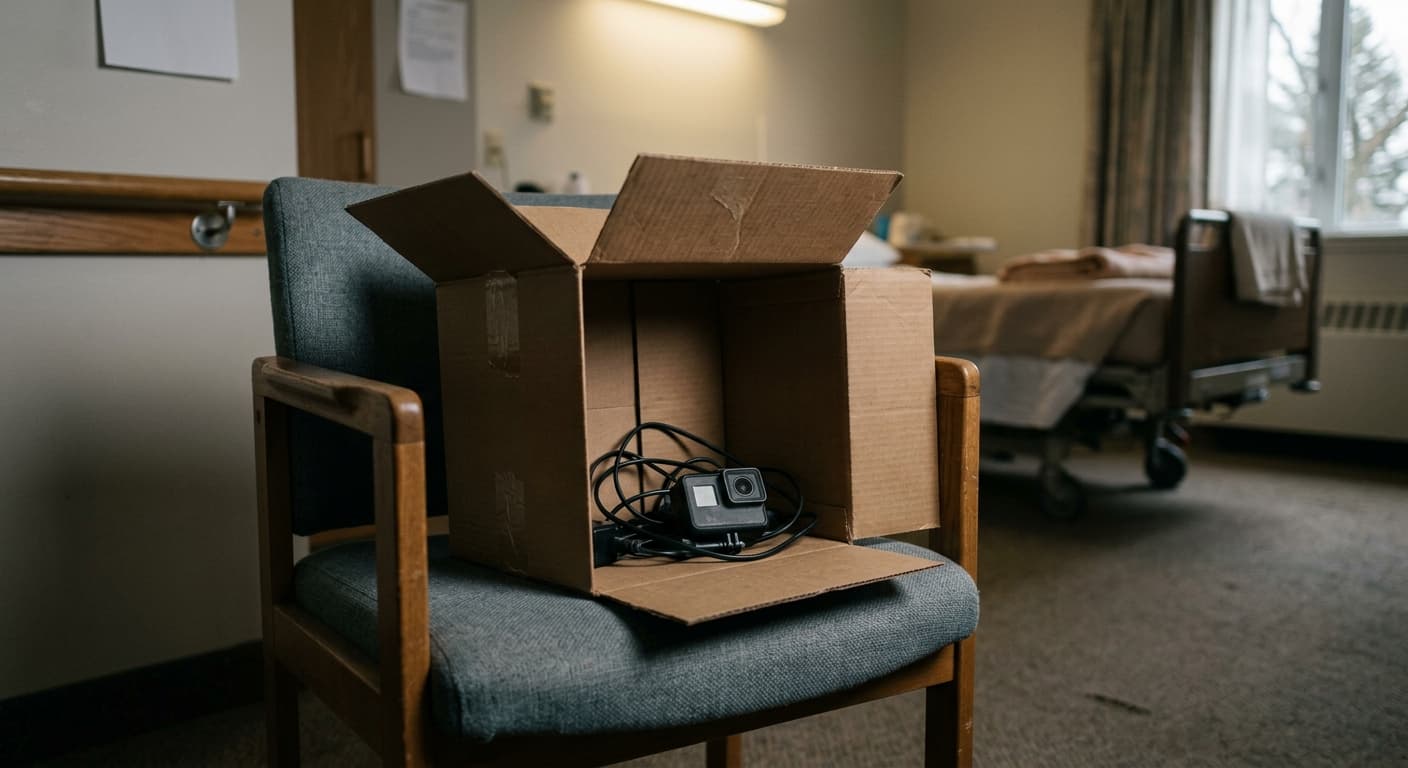
New Hampshire has no statute or rule giving a nursing home resident or family a right to install a camera in a resident's room. This article covers the full nursing home rule set that says nothing about it, the two general criminal statutes that apply instead, on audio interception and on recording images in a private place, and where to turn if a facility interferes.
This page addresses New Hampshire specifically. For the 18 states with an enacted electronic-monitoring statute, see the nursing home camera laws hub and the state-by-state comparison.
Does New Hampshire Have a Nursing Home Camera Law?
No. He-P 803, New Hampshire's complete nursing home rule set, covers everything from licensing and inspections to resident records, restraints, food service, and physical-environment standards across 28 sections. None of them, including the sections closest in subject matter, address electronic monitoring, cameras, or a resident's or family's own recording device. New Hampshire's underlying licensing statute, RSA Chapter 151, is implemented day to day through He-P 803, which is the rule that was reviewed in full for this article.
No pending bill on this subject was found in a search of the current legislative session. That search drew on general legislative sources rather than a direct query of New Hampshire's own bill-status tool, so the finding should be treated as well-supported but not airtight.
New Hampshire's Recording Law: An All-Party Consent State
With no nursing-home-specific statute, the general recording-consent law governs a camera installed without the facility's agreement, and New Hampshire's version is among the strictest in this group. RSA 570-A:2, I makes it a Class B felony to intercept a telecommunication or an oral communication "without the consent of all parties to the communication." Every participant, not just one, has to agree before a conversation can be recorded.
The grading is not uniform, though, and the difference matters for the exact setup most families are considering. RSA 570-A:2, I-a makes the offense a misdemeanor rather than a felony where a person "knowingly intercepts a telecommunication or oral communication when the person is a party to the communication or with the prior consent of one of the parties to the communication," but without the approval RSA 570-A:2, II(d) requires. That II(d) approval is a law enforcement mechanism, available to an investigative or law enforcement officer who has a reasonable-suspicion determination from the attorney general's office, so a resident or family member can never obtain it and the misdemeanor grading is what applies to them. In practical terms: a camera the resident agreed to, capturing conversations the resident takes part in, sits under the misdemeanor grading of I-a. The Class B felony of paragraph I reaches the interception that no party to it agreed to.
That distinction is exactly where a shared room gets dangerous. A device that picks up a conversation no party to it consented to, two staff members talking to each other in the room, or a roommate's visit with family, falls back under the felony grading, a materially higher-stakes exposure than a one-party consent state carries. See our New Hampshire recording laws guide for the full framework, including how this all-party rule applies outside a nursing home too.
Facility Policy Decides Whether a Camera Is Allowed
Because no New Hampshire statute grants a resident a right to a camera, the facility's admission agreement is what actually governs day to day. A facility can permit a camera, condition it on written notice, or prohibit one outright as a matter of its own contract terms. Federal nursing home rules under 42 CFR 483.10 protect resident privacy and dignity broadly but say nothing about cameras, so no federal law fills the gap either.
The Practical Risk of a Hidden or Audio-Capable Camera
New Hampshire's all-party consent rule makes audio a central risk here, more than in most other no-statute states covered on this site. A device that records a conversation no party to it agreed to, installed without the knowledge of the people speaking, risks the Class B felony grading of RSA 570-A:2, I regardless of the family's intent. Where the resident consented and is part of the conversation, the exposure drops to the misdemeanor grading of RSA 570-A:2, I-a, which is lower but is still a criminal offense.
Turning the audio off does not leave the camera unregulated. RSA 644:9, I(b) makes it a class A misdemeanor to install or use, "in any private place, any device for the purpose of observing, photographing, recording, amplifying or broadcasting, or in any way transmitting images or sounds in such place," and the offense turns on acting "without the consent of the persons entitled to privacy therein." Paragraph II defines a private place to include the interior of a dwelling place and any place where a person's private body parts may be exposed. A resident's room is both: it is the resident's home, and personal care happens in it. In a shared room the roommate is a person entitled to privacy there, so a silent camera covering shared space without that roommate's consent is a criminal offense on its own, separate from anything the wiretap statute reaches. A second or subsequent conviction under RSA 644:9 is a class B felony.

Getting written acknowledgment from the facility and, where a roommate is present, from that roommate as well, is therefore more than good practice. Consent from everyone entitled to privacy in the room is what keeps a disclosed camera on the right side of both statutes at once.
Using Camera Footage as Evidence of Abuse or Neglect
Footage that appears to show abuse or neglect can support a report to Adult Protective Services or the ombudsman, and it can support a civil claim, though it is typically reviewed alongside medical and staffing records rather than on its own. For a broader look at how a nursing home abuse or neglect claim works, see Nursing Home Abuse & Neglect.
Harmed by a product or exposure? Speak with an attorney about your options
If you or a loved one may have been harmed, you can speak with an attorney about your legal options at no cost. Whether you have a claim depends on the specific facts. This is attorney advertising, not a guarantee that you qualify or of any particular outcome.
Where to Turn: New Hampshire's Long-Term Care Ombudsman
The New Hampshire Office of the Long-Term Care Ombudsman investigates complaints affecting the health, safety, welfare, and rights of residents in nursing homes and residential care, under authority tracing to the federal Older Americans Act, 42 U.S.C. Section 3058g. A camera dispute, a facility's refusal to discuss monitoring, or a suspected retaliation concern are all within its scope.
Information last verified on 2026-08-14, drawn from He-P 803's complete rule set and RSA 570-A:2. This article has not yet been reviewed by a licensed lawyer and is general legal information, not legal advice for your specific situation.
Related Resources
- Nursing Home Camera Laws by State covers every state's regime, including the 18 states with an enacted statute.
- Nursing Home Camera Laws: State-by-State Comparison breaks down the 18 states with a full statutory right.
- New Hampshire Recording Laws covers New Hampshire's all-party consent framework in full.
- Nursing Home Abuse & Neglect covers how an abuse or neglect claim works once evidence, including camera footage, is in hand.
- US Recording Laws by State covers the general consent framework nationwide.
Last updated: 2026-08-14.
Frequently Asked Questions
Is it legal to put a camera in a nursing home room in New Hampshire?
New Hampshire has no statute addressing the question either way. Whether a camera is allowed depends on the facility's own admission agreement and policy, since no state law grants or forbids the right. Two general criminal statutes still apply: RSA 570-A:2 on recording conversations and RSA 644:9 on recording images in a private place.
Do I need everyone's consent to record audio in a New Hampshire nursing home?
Yes. New Hampshire is an all-party consent state under RSA 570-A:2, so every person party to a recorded conversation, not just one, has to consent. The grading depends on the situation: intercepting a conversation that no party agreed to is a Class B felony under paragraph I, while recording a conversation you are a party to, or that one party gave prior consent for, is a misdemeanor under paragraph I-a.
Does He-P 803 say anything about cameras in New Hampshire nursing homes?
No. He-P 803's complete 28-section nursing home rule set does not address electronic monitoring, cameras, or a resident's own recording device anywhere.
Is video-only recording different from audio recording under New Hampshire law?
Yes, but silent video is not unregulated. New Hampshire's all-party consent rule under RSA 570-A:2 applies to intercepted oral and telecommunication content, so turning the audio off avoids that statute. RSA 644:9, I(b) separately makes it a class A misdemeanor to install a device to record images in a private place, a definition that covers the interior of a dwelling, without the consent of the persons entitled to privacy there. In a shared room, a silent camera installed without the roommate's consent violates that statute no matter what the audio setting is.
What can I do if a New Hampshire facility refuses to let me install a camera?
Contact the New Hampshire Office of the Long-Term Care Ombudsman, which investigates complaints affecting resident rights at nursing homes and residential care facilities and covers monitoring disputes.
Updates
Corrected the New Hampshire wiretap penalty, which the page stated as a Class B felony throughout: RSA 570-A:2, I-a grades the offense a misdemeanor where the recording party has a party's prior consent, and added RSA 644:9, which makes a silent camera in a resident's room a class A misdemeanor without the consent of everyone entitled to privacy there.
Independently fact-checked against the cited primary sources
The Law Behind This Article
This article rests on the statutory provisions below, held in our own legal record and retrieved from the official source. Tap a section to read the operative text.
New Hampshire Revised Statutes Annotated, TITLE LVIII PUBLIC JUSTICE, CHAPTER 570-A WIRETAPPING AND EAVESDROPPING
§ 570-A:2Interception and Disclosure of Telecommunication or Oral Communications Prohibited.In forcecited in 34 of our articles
I. A person is guilty of a class B felony if, except as otherwise specifically provided in this chapter or without the consent of all parties to the communication, the person: (a) Wilfully intercepts, endeavors to intercept, or procures any other person to intercept or endeavor to intercept, any telecommunication or oral communication; (b) Wilfully uses, endeavors to use, or procures any other person to use or endeavor to use any electronic, mechanical, or other device to intercept any oral communication when: (1) Such device is affixed to, or otherwise transmits a signal through, a wire, cable, or other like connection used in telecommunication, or (2) Such device transmits communications by radio, or interferes with the transmission of such communication, or (3) Such use or endeavor to use (A) takes place on premises of any business or other commercial establishment, or (B) obtains or is for the purpose of obtaining information relating to the operations of any business or other commercial establishment; or (c) Wilfully discloses, or endeavors to disclose, to any other person the contents of any telecommunication or oral communication, knowing or having reason to know that…
Official text (excerpt) · last checked 2026-09-24 · Read the full text in our law library · Verify at gc.nh.gov
Cited in 35 court opinions in our collectionLatest citing opinion in our collection: 2025
In the courts (editorial summary, independently checked):New Hampshire courts read the felony offense in RSA 570-A:2, I as requiring more than intent to record. Fischer v. Hooper (1999) held wilfully means intentional or reckless disregard for the lawfulness of the conduct, so a good faith belief is a defense. State of New Hampshire v. Adam Mueller (2014) reversed on that mens rea.
Opinions citing this section in our collection:
- State v. Kilgus (Supreme Court of New Hampshire 1986, 128 N.H. 577)✓A murder-for-hire middleman agreed to wear a hidden recorder and got the defendant to confirm paying $1,000 to have a man killed; the court held the taping was lawful under RSA 570-A:2, II(d) because one party consented and homicide is an enumerated offense.
- Fischer v. Hooper (Supreme Court of New Hampshire 1999, 143 N.H. 585)✓A father secretly taped his ex-wife's calls with their daughter though a guardian ad litem had said both parents must agree; the court held wilfully in RSA 570-A:2, I requires intentional or reckless disregard for the lawfulness of the conduct, and reversed for a new trial.
- State of New Hampshire v. Adam Mueller (Supreme Court of New Hampshire 2014, 166 N.H. 65)✓A police-accountability activist recorded three phone calls with a police captain and two school officials without telling them; the court held that instructing the jury on purposely rather than the statute's wilfully was plain error and reversed his wiretapping convictions.
Identified automatically from the court opinions citing this section — not a ranking of which case controls.
Also relied on in: New Hampshire Security Camera Laws, New Hampshire Video Recording Laws, New Hampshire Voyeurism Laws
Code of Federal Regulations Title 42
§ 483.10Resident rights.In forcecited in 19 of our articles
(a) Residents rights. The resident has a right to a dignified existence, self-determination, and communication with and access to persons and services inside and outside the facility, including those specified in this section. (1) A facility must treat each resident with respect and dignity and care for each resident in a manner and in an environment that promotes maintenance or enhancement of his or her quality of life, recognizing each resident's individuality. The facility must protect and promote the rights of the resident. (2) The facility must provide equal access to quality care regardless of diagnosis, severity of condition, or payment source. A facility must establish and maintain identical policies and practices regarding transfer, discharge, and the provision of services under the State plan for all residents regardless of payment source. (b) Exercise of rights. The resident has the right to exercise his or her rights as a resident of the facility and as a citizen or resident of the United States.
Official text (excerpt) · last checked 2026-07-28 · Read the full text in our law library · Verify at ecfr.gov
Cited in 85 court opinions in our collectionLatest citing opinion in our collection: 2026
In the courts (editorial summary, independently checked):Courts reviewing CMS penalties have applied the notice duty then codified at section 483.10(b)(11). Claiborne-Hughes Health Center v. Sebelius (2010) upheld noncompliance where a facility did not promptly consult the physician or notify family after a resident's decline; Senior Rehabilitation (2010) sustained a similar finding.
Opinions citing this section in our collection:
- Roudachevski v. All-American Care Centers, Inc. (Court of Appeals for the Eighth Circuit 2011, 648 F.3d 701)✓A doctor cut off from his nursing home patients sought an injunction, arguing residents' right under Section 483.10(d)(1) to choose a physician made the public interest favor him; the Eighth Circuit affirmed the denial, finding that interest not presently ascertainable.
- CLAIBORNE-HUGHES HEALTH CENTER v. Sebelius (Court of Appeals for the Sixth Circuit 2010, 609 F.3d 839)✓A resident's food intake fell sharply for three weeks and he lost 18.5 pounds before the nursing home called his doctor or family; the Sixth Circuit upheld findings that it violated Section 483.10(b)(11)'s immediate-notification duty and that the lapse was immediate jeopardy.
- Gray Panthers Advocacy Committee v. Louis W. Sullivan, M.D., Secretary, Department of Health and Human Services (Court of Appeals for the D.C. Circuit 1991, 936 F.2d 1284)“…how to apply for and use Medicare and Medicaid benefits.” 42 C.F.R. § 483.10 (b)(9) (1990). On the topic of property…”
Identified automatically from the court opinions citing this section — not a ranking of which case controls.
Also relied on in: Alabama Nursing Home Camera Laws: No Statute, What Applies, Colorado Nursing Home Camera Laws: No Statute, What Applies, Massachusetts Nursing Home Camera Laws: All-Party Consent Risks
United States Code Title 42
§ 3058gState Long-Term Care Ombudsman programIn forcecited in 12 of our articles
In order to be eligible to receive an allotment under section 3058b of this title from funds appropriated under section 3058a of this title and made available to carry out this subpart, a State agency shall, in accordance with this section— establish and operate an Office of the State Long-Term Care Ombudsman; and carry out through the Office a State Long-Term Care Ombudsman program. The Office shall be headed by an individual, to be known as the State Long-Term Care Ombudsman, who shall be selected from among individuals with expertise and experience in the fields of long-term care and advocacy. The Ombudsman shall be responsible for the management, including the fiscal management, of the Office.
Official text (excerpt) · last checked 2026-07-28 · Read the full text in our law library · Verify at uscode.house.gov
Cited in 18 court opinions in our collectionLatest citing opinion in our collection: 2022
In the courts (editorial summary, independently checked):Rackley v. Fairview Care Centers, Inc. (2001) held 42 U.S.C. 3058g(a)(3) and (5) govern the ombudsman office's duties and do not state a public policy clear enough to support a wrongful discharge claim. Northwestern Illinois Area Agency on Aging v. Basta (2022) applied 3058g(f) to uphold a state conflict of interest form.
Opinions citing this section in our collection:
- Puerto Rico Office of the Ombudsman for the Elderly Ex Rel. Leon v. Puerto Rico (District Court, D. Puerto Rico 2009, 665 F. Supp. 2d 74)“…an enforceable right under § 1983). PROOE also cites 42 U.S.C. § 3058g(j), in support of its proposition that…”
- Newman v. Kelly (District Court, District of Columbia 1994, 848 F. Supp. 228)“…uant to the federal Older Americans Act Amendments of 1992, 42 U.S.C. § 3058g, Pub.L. No. 102-375, § 712 , 106 Stat…”
- Northwestern Illinois Area Agency on Aging v. Basta (Appellate Court of Illinois 2022, 468 Ill. Dec. 773)✓An area agency on aging argued a state ombudsman conflict-of-interest form was a rule needing rulemaking. Reading 42 U.S.C. 3058g(f) as putting the duty to identify conflicts on the state agency, the court held the form merely exercised that duty, so no rulemaking was required.
Identified automatically from the court opinions citing this section — not a ranking of which case controls.
Also relied on in: Nursing Home Camera Laws by State, Arkansas Nursing Home Camera Laws: SB616 and What Applies Today, Hawaii Nursing Home Camera Laws: No Statute, Private-Place Risk
New Hampshire Revised Statutes Annotated, TITLE LXII CRIMINAL CODE, CHAPTER 644 BREACHES OF THE PEACE AND RELATED OFFENSES
§ 644:9Violation of Privacy.In forcecited in 17 of our articles
I. A person is guilty of a class A misdemeanor if such person unlawfully and without the consent of the persons entitled to privacy therein, installs or uses: (a) Any device for the purpose of observing, photographing, recording, amplifying, broadcasting, or in any way transmitting images or sounds of the private body parts of a person including the genitalia, buttocks, or female breasts, or a person's body underneath that person's clothing; or (b) In any private place, any device for the purpose of observing, photographing, recording, amplifying or broadcasting, or in any way transmitting images or sounds in such place; or (c) Outside a private place, any device for the purpose of hearing, recording, amplifying, broadcasting, observing, or in any way transmitting images, location, movement, or sounds originating in such place which would not ordinarily be audible, visible, or comprehensible outside such place. II.
Official text (excerpt) · last checked 2026-08-31 · Read the full text in our law library · Verify at gc.nh.gov
Cited in 4 court opinions in our collectionLatest citing opinion in our collection: 2023
Opinions citing this section in our collection:
- State v. McLellan (Supreme Court of New Hampshire 1999, 144 N.H. 602)“…pposite. Finally, we reject the defendant’s argument that RSA 644:9 (1996) supports his claim that he had a…”
- State of New Hampshire v. Justin M. Lamontagne (Supreme Court of New Hampshire 2023)“…assault and a case involving dissemination of an image. See RSA 644:9- a, II(c). We fail to see such a distin…”
- State v. Richard Lucas (Supreme Court of New Hampshire 2018)“…(1) an intent to commit a violation of privacy pursuant to RSA 644:9, III-a or IV (2016) does not satisfy th…”
Identified automatically from the court opinions citing this section — not a ranking of which case controls.
Also relied on in: New Hampshire Landlord-Tenant Recording Laws, New Hampshire Medical Recording Laws, New Hampshire Laws on Recording in Public
Search our full record of US law — 2.1 million sections, every state + federal →
Sources and References
- N.H. Rev. Stat. Ann. § 570-A:2, Interception and Disclosure of Telecommunication or Oral Communications(gc.nh.gov).gov
- He-P 803, New Hampshire Nursing Home Rules(law.cornell.edu)
- New Hampshire Judicial Branch Law Library, NH Law About Recording Conversations(courts-state-nh-us.libguides.com)
- 42 CFR § 483.10, Resident Rights(law.cornell.edu)
- 42 U.S.C. § 3058g, State Long-Term Care Ombudsman Program(law.cornell.edu)
- New Hampshire Office of the Long-Term Care Ombudsman(dhhs.nh.gov).gov
- N.H. Rev. Stat. Ann. § 644:9, Violation of Privacy(gc.nh.gov)