
Indiana
Indiana Marriage License Requirements 2026: $25 Fee, No Waiting
Independently fact-checked against primary sources (last audited October 7, 2026). · 7 primary sources cited on this page. How we verify our legal content

In Indiana, the clerk of the circuit court issues marriage licenses under Article 11 of Title 31 of the Indiana Code. You apply in the county where either of you lives, the license costs $25 when at least one of you is an Indiana resident ($65 when neither is), there is no waiting period, and the license is good for 60 days.
For the rules in other states, see our guide to marriage license requirements by state.
Information last verified on October 7, 2026. This article has not been reviewed by a licensed lawyer.
Jurisdiction scope: This article covers getting a marriage license and marrying in Indiana under Indiana Code Article 31-11 and the clerk fee in IC 33-32-5-1, using the published procedures of the Allen, Lake and Hamilton county clerks and the Indiana courts' marriage license page. It does not cover divorce, ordering older marriage records, common-law marriage, or the rules of other states.
Where to Get a Marriage License in Indiana
Indiana licenses come from the clerk of the circuit court, and the county you use depends on where you live. IC 31-11-4-3 states: "Individuals who intend to marry must obtain a marriage license from the clerk of the circuit court of the county of residence of either of the individuals."
If neither of you lives in Indiana, the same section sends you to the clerk of the county where the marriage will be solemnized. Indiana residents cannot shop for a convenient county. The Allen County clerk puts it plainly: "Applicants that reside in a different Indiana county may not apply in Allen County."
Lake County says that once the license is issued, Indiana residents may marry anywhere in Indiana, and Allen County's information sheet says its license is valid only for a marriage performed in Indiana. A couple with no Indiana resident is different: Lake and Hamilton counties say that wedding must take place in the county that issued the license. If you plan to marry in a different county from the one that issues your license, confirm with the issuing clerk first.
Applying online and in person
The Indiana courts run an online marriage license system. Their page says: "Starting your application online will save you time at the Clerk's Office." Starting online does not finish the job: you still complete the application with the county clerk.
Counties handle the appointment differently:
- Hamilton County: appointment only, either virtual (Microsoft Teams) or in person in Noblesville. "Both applicants must attend the same meeting."
- Lake County: in person. "Both applicants must be present at the time of application."
- Allen County: in person at the Central Services Division, Room 201, 715 S. Calhoun St. The clerk asks you to allow 30 minutes.
The application is written and verified, which means you swear to it (IC 31-11-4-4).
Same-sex couples
The Fourteenth Amendment requires every state to license marriages between two people of the same sex (Obergefell v. Hodges, 576 U.S. 644 (2015)). The Indiana Code published on the state's site still contains IC 31-11-1-1, which says only a female may marry a male and that a same-sex marriage is void in Indiana. That section cannot be enforced after Obergefell, even though the code text has not been changed.
What an Indiana Marriage License Costs
Indiana sets the license fee by statute, though the Indiana courts' page notes that some clerk offices also charge an additional $4.00 document fee. Under IC 33-32-5-1, the clerk collects a $15 license fee plus a marriage certificate fee of $10 if at least one of you is an Indiana resident, or $50 if neither of you is. That makes $25 for residents and $65 when neither of you lives in Indiana.
Counties differ on how you pay and what the fee includes:
| County | Fee | Payment and extras | Source checked |
|---|---|---|---|
| Allen | $25 Indiana residents; $65 out-of-state residents | Certified copies $4.00 each, extra | Clerk information sheet dated November 5, 2025 |
| Lake | $25 if at least one applicant is a Lake County resident; $65 if neither is an Indiana resident | Cash only | Clerk page, October 2026 |
| Hamilton | $25 residents; $65 out of state | Cash or credit card; the fee includes 2 certified copies | Clerk page, October 2026 |
| Marion | Not verified for this page | Confirm with the Marion County Clerk | Not opened |
We could not open the Marion County (Indianapolis) clerk's marriage page when we checked, so we do not list its payment rules or appointment options. Because the fee is statutory, it should match the table, but confirm everything else with the clerk.
The Indiana courts' page notes that most counties require the fees to be paid in cash. Fees and payment rules can change, and your county clerk's page is the final word.
Documents You Need
Because Indiana residents must apply in their county of residence, clerks also ask you to prove where you live. Allen County requires residency documentation, and proof of an Allen County address if your ID does not show one; Lake County asks for a driver's license or state ID as proof of residency. The Indiana courts' page adds that documents not in English may need a translation.
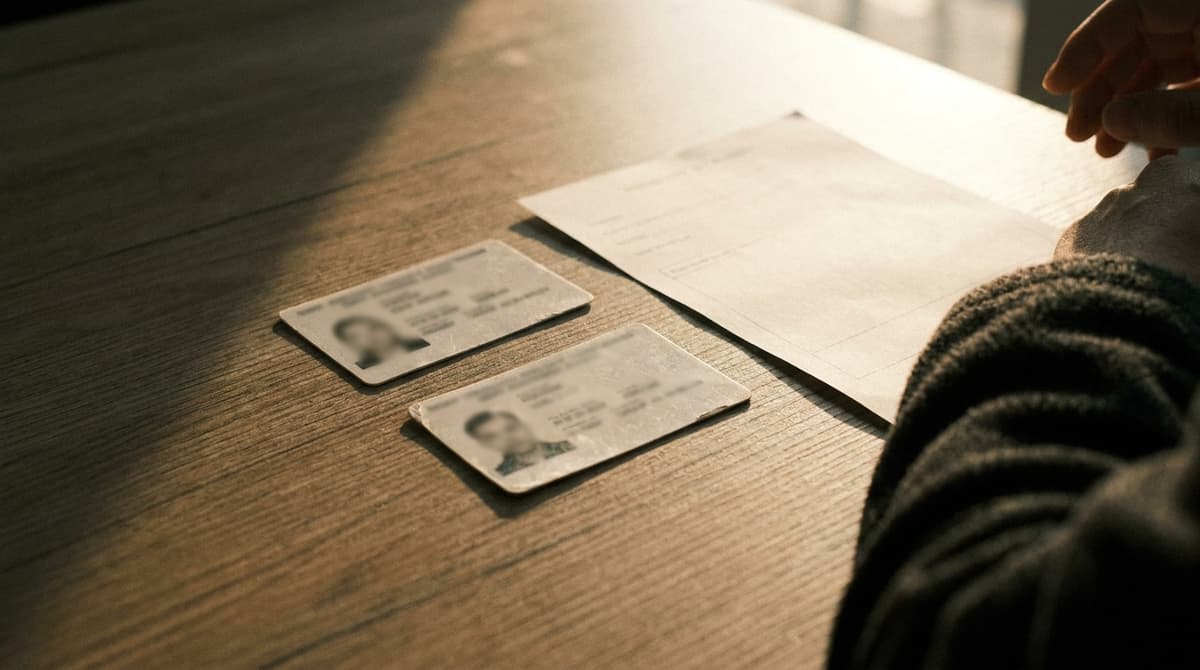
Each of you must also submit documentary proof of age (IC 31-11-4-6). The statute accepts any of these:
- a certified birth certificate, birth record, or certification of birth;
- a court decree establishing your date of birth;
- a passport;
- a valid driver's license or other government ID that shows your date of birth and current address;
- an immigration or naturalization record;
- a selective service or armed forces record;
- another court or government record showing your date of birth.
The application itself (IC 31-11-4-4) asks for each of your full names, birthplaces, residences and ages, the names of any dependent children, your parents' full names (including your mother's maiden name) and their last known residences, whether either of you is a lifetime sex or violent offender, and any facts bearing on a legal impediment to the marriage. Social Security numbers go on the record of marriage form, where they are kept confidential.
If either of you was married before, the Indiana courts' marriage license page says you will need to give the date that marriage ended, and that some counties require a certified copy of the divorce decree. Ask your clerk whether yours does.
Two groups have special rules. A religious objector does not have to swear the application or sign the HIV-information acknowledgment, and an Old Amish Mennonite applicant needs a signed statement from the bishop (IC 31-11-4-4, 31-11-4-5).
Waiting Period and Expiration
Indiana has no waiting period. IC 31-11-4, the marriage license chapter, contains no waiting-period section, the Indiana courts' page says couples may marry as early as the same day, and Lake County states: "There is no waiting period."

The license does not last long. IC 31-11-4-10 states: "A marriage license expires sixty (60) days after the license is issued unless a marriage is solemnized under the license within that time." An application also expires if no license is issued under it within 60 days after it is filed (IC 31-11-4-9).
Age Requirements to Marry in Indiana
The general rule in IC 31-11-1-4 is that "two (2) individuals may not marry each other unless both individuals are at least eighteen (18) years of age." Nobody under 16 may marry in Indiana.
The juvenile court route for 16- and 17-year-olds
Parental consent alone does not let a minor marry in Indiana. Some county and court pages refer loosely to "special consent," but the statute is what controls, and it requires a court order. Under IC 31-11-1-5, two people who are both at least 16 may marry only if all of these are true:
- the older person is not more than 4 years older than the 16- or 17-year-old;
- each person under 18 has a juvenile court order that approves the marriage and completely emancipates the minor;
- not earlier than 15 days after that order, the minor gives the clerk an application with a certified copy of the order and any premarital counseling certificate the order requires;
- no other legal bar to the marriage applies.
The petition (IC 31-11-1-7) is filed in the juvenile court of the county where the minor lives. The court holds an evidentiary hearing, appoints a guardian ad litem, and interviews the minor in camera (privately). It must find, among other things, that the minor is at least 16 and a county resident, the intended spouse is no more than 4 years older, the decision is voluntary, and the minor is mature, self-sufficient, understands the rights involved, and that the marriage is in the minor's best interests.
Pregnancy alone, or the parents' wishes alone, is not enough. If both parents oppose the marriage, a rebuttable presumption arises against it. The court must deny the petition if, for example, the intended spouse held a position of authority or trust over the minor, has certain violent or child-victim convictions, or was subject to a prior protective order, or in certain cases where the pregnancy resulted from an offense.
The Indiana Code's history lines credit these rules to P.L.94-2020, which amended IC 31-11-1-4 and 31-11-1-5, repealed 31-11-1-6, and added 31-11-1-7. For how emancipation works in Indiana, see Indiana emancipation laws.
Who Cannot Marry in Indiana
IC 31-11-1-2 states: "Two (2) individuals may not marry each other if the individuals are more closely related than second cousins." First cousins are the one exception: they may marry if both are at least 65 years old.
Other bars in Article 31-11:
- A living spouse. You cannot marry while either of you has a living spouse (IC 31-11-1-3), and such a marriage is void.
- Mental incompetence. A marriage by a person adjudged mentally incompetent is void. The clerk may not issue a license if either of you has been adjudged mentally incompetent (unless that adjudication is no longer in effect) or is under the influence of alcohol or a narcotic drug (IC 31-11-4-11).
- Voidable marriages. A marriage by a person who lacked capacity because of age or mental incompetence, or one procured by fraud, is voidable (IC 31-11-9-2).
- Lifetime sex or violent offenders. A clerk may not issue a license to a lifetime sex or violent offender unless the offender submits an affidavit that written notice of the intent to marry, and the intended married name, was given to local law enforcement in the county of conviction and the county of residence (IC 31-11-4-11).
- Common-law marriage. Common-law marriages entered into after January 1, 1958 are void (IC 31-11-8-5). See Indiana common-law marriage.
- Marrying elsewhere to evade Indiana law. If Indiana residents marry in another state to get around Indiana's age, application or license-bar rules and then return to live in Indiana, the marriage is void (IC 31-11-8-6).
No Blood Test Required
Indiana does not require a blood test or medical exam for a marriage license. Instead, IC 31-11-4-5 requires the clerk to give you written or video information on sexually transmitted diseases and a list of places that offer voluntary HIV testing.
Each of you then signs "an acknowledgment that both applicants must sign, affirming that the applicants have received the information." Religious objectors are excused from signing.
Who Can Perform a Marriage in Indiana
IC 31-11-6-1 lists who may solemnize a marriage:
- "A member of the clergy of a religious organization (even if the cleric does not perform religious functions for an individual congregation)," such as a minister, priest, bishop, archbishop or rabbi;
- an imam of a mosque;
- a judge;
- a mayor, within the mayor's county;
- a city or town clerk or clerk-treasurer, within the county;
- a clerk of the circuit court;
- the governor, the lieutenant governor, or a member of the general assembly (these three may not accept money for it);
- the Friends Church, German Baptists, the Bahai faith, and the Church of Jesus Christ of Latter-day Saints, under their own rules.
Indiana's officiant chapter (IC 31-11-6) contains no registration requirement for officiants and no witness requirement, and the license chapter we read does not add either. The list also contains no option for a couple to marry themselves. In 2014 the federal appeals court covering Indiana held that the list unlawfully left out secular groups and ordered an injunction allowing certified secular humanist celebrants to solemnize marriages (Center for Inquiry v. Marion Circuit Court Clerk, 758 F.3d 869 (7th Cir. 2014)); the code text has not been changed to reflect it. A person not authorized under IC 31-11-6 who attempts to solemnize a marriage commits a Class B misdemeanor (IC 31-11-11-6).
Online-ordained officiants
The statute does not mention online ordination, and we found no official Indiana source that addresses it. The statute covers clergy "of a religious organization," including clergy without a congregation. If your officiant was ordained online, ask your county clerk before the wedding.
Courthouse weddings
Lake County says judges are available for weddings on weekdays from 11:00 a.m. to 12:45 p.m., for a fee. Allen County lists wedding scheduling with its Superior and Circuit courts. Ask the court or clerk for current times and fees.
Proxy Marriage
Indiana's marriage code is silent on proxy marriage. IC 31-11-4-13 says the couple "must present a marriage license that is issued under this chapter to an individual who is authorized by IC 31-11-6 to solemnize marriages," and the code contains no provision for a stand-in. Ask the clerk or a lawyer if a proxy wedding is part of your plan. Indiana also has no covenant marriage option in Article 31-11.
After the Ceremony
Your officiant completes the original and duplicate certificates and gives the original to you. IC 31-11-4-16 then requires the officiant to "Not later than thirty (30) days after the date of the marriage, file the duplicate certificate and the license to marry with the clerk of the circuit court who issued the marriage license."
The clerk records the marriage and sends records to the Indiana Department of Health at least monthly. An officiant who has not filed the license and duplicate certificate within 90 days after the marriage commits a Class C infraction (IC 31-11-11-8). If the officiant fails to complete or file the certificate on time, either spouse may ask the circuit court in the county where the marriage took place for a declaratory judgment that the marriage was solemnized before the license expired (IC 31-11-4-17, 31-11-4-18).
Certified copies cost $4 each according to Allen County and the Indiana courts' page, and Hamilton County includes 2 copies in the license fee. For ordering copies later, see Indiana marriage and divorce records. If one of you is changing your last name, see name change after marriage.
Common Myths About Indiana Marriage Licenses
"Parents can sign for a 16- or 17-year-old." They cannot. Only a juvenile court order approving the marriage and emancipating the minor works, and the age gap must be 4 years or less (IC 31-11-1-5, 31-11-1-7).
"The fee depends on the county." The amount is set by IC 33-32-5-1: $25 or $65. Counties differ on payment method and whether copies are included, and the Indiana courts' page says some offices add a $4.00 document fee.
"You can apply in any Indiana county." Indiana residents apply in the county where either of them lives. Only couples with no Indiana resident apply in the county of the ceremony (IC 31-11-4-3).
"First cousins can always marry in Indiana." Only if both are at least 65 (IC 31-11-1-2).
Disclaimer: This article provides general legal information about getting a marriage license in Indiana under Indiana Code Article 31-11 and IC 33-32-5-1. It is not legal advice. The information was verified on October 7, 2026. For your specific situation, contact the clerk of the circuit court in your county or consult a lawyer licensed in Indiana.
Related
- Marriage license requirements by state
- Indiana marriage and divorce records
- Indiana name change laws
- Illinois marriage license requirements
- Ohio marriage license requirements
Last updated: October 7, 2026.
Frequently Asked Questions
Where do I get a marriage license in Indiana?
From the clerk of the circuit court in the county where either of you lives. If neither of you is an Indiana resident, apply in the county where you will marry (IC 31-11-4-3).
How much is a marriage license in Indiana?
$25 when at least one of you is an Indiana resident ($15 license fee plus $10 certificate fee) and $65 when neither of you is, under IC 33-32-5-1. Many counties take cash only, so check your clerk's payment rules.
Is there a waiting period to get married in Indiana?
No. Indiana's marriage license chapter (IC 31-11-4) sets no waiting period, and the Indiana courts' page says you can marry as early as the same day.
How long is an Indiana marriage license good for?
60 days from the date it is issued. If no marriage is solemnized under it in that time, it expires (IC 31-11-4-10).
Can a 16 or 17-year-old get married in Indiana with parental consent?
No. Under IC 31-11-1-5 and 31-11-1-7, a 16- or 17-year-old needs a juvenile court order approving the marriage and completely emancipating the minor, and the other person can be no more than 4 years older. Nobody under 16 may marry.
Can first cousins marry in Indiana?
Only if both are at least 65 years old. Otherwise, Indiana bars marriage between people more closely related than second cousins (IC 31-11-1-2).
Do you need witnesses to get married in Indiana?
The marriage chapters of the Indiana Code that we read (IC 31-11-4 and 31-11-6) contain no witness requirement. Ask your county clerk if you are unsure about your ceremony.
Can I apply for an Indiana marriage license online?
You can start the application online through the Indiana courts' system, but you still complete it with the county clerk. Hamilton County offers virtual appointments by Microsoft Teams; Allen and Lake counties require you to appear in person.
Updates
Independently fact-checked against the cited primary sources
The Law Behind This Article
This article rests on the statutory provisions below, held in our own legal record and retrieved from the official source. Tap a section to read the operative text.
Indiana Code, TITLE 31. FAMILY LAW AND JUVENILE LAW
§ 31-11-4-3County of residence or solemnization; place to obtain licenseIn force
Sec. 3. Individuals who intend to marry must obtain a marriage license from the clerk of the circuit court of the county of residence of either of the individuals. If neither of the individuals who intends to marry is a resident of Indiana, the individuals must obtain the marriage license from the clerk of the circuit court of the county in which the marriage is to be solemnized. [Pre-1997 Recodification Citation: 31-7-3-2.]
Official text (excerpt) · last checked 2026-07-29 · Read the full text in our law library · Verify at iga.in.gov
§ 31-11-1-4Minimum age for marriageIn force
Sec. 4. Except as provided in sections 5 and 7 of this chapter, two (2) individuals may not marry each other unless both individuals are at least eighteen (18) years of age. [Pre-1997 Recodification Citation: 31-7-1-5.]
Official text (excerpt) · last checked 2026-07-29 · Read the full text in our law library · Verify at iga.in.gov
§ 31-11-1-5Marriage of individual 16 or 17 years of ageIn force
Sec. 5. Two (2) individuals may marry each other if: (1) both individuals are at least sixteen (16) years of age; (2) one (1) of the individuals is not more than four (4) years older than the other individual if the other individual is sixteen (16) or seventeen (17) years of age; (3) each individual who is less than eighteen (18) years of age: (A) has been granted an order by a juvenile court under section 7 of this chapter granting the individual approval to marry and completely emancipating the individual; and (B) not earlier than fifteen (15) days after the issuance of the order described in clause (A), presents to the clerk of the circuit court an application for a marriage license accompanied by: (i) a certified copy of the order; and (ii) a certificate of completion of any premarital counseling required under the order; and (4) the individuals are not prohibited from marrying each other for a reason set forth in this article. [Pre-1997 Recodification Citation: 31-7-1-6.]
Official text (excerpt) · last checked 2026-07-29 · Read the full text in our law library · Verify at iga.in.gov
§ 31-11-4-10Expiration of licenseIn force
Sec. 10. A marriage license expires sixty (60) days after the license is issued unless a marriage is solemnized under the license within that time. [Pre-1997 Recodification Citation: 31-7-3-8.]
Official text (excerpt) · last checked 2026-07-29 · Read the full text in our law library · Verify at iga.in.gov
§ 31-11-4-4Application; sexually transmitted diseases acknowledgment; lifetime sex or violent offender; religious objectionsIn force
Sec. 4. (a) An application for a marriage license must be written and verified. The application must contain the following information concerning each of the applicants: (1) Full name. (2) Birthplace. (3) Residence. (4) Age. (5) Names of dependent children. (6) Full name, including the maiden name of a mother, last known residence, and, if known, the place of birth of: (A) the birth parents of the applicant if the applicant is not adopted; or (B) the adoptive parents of the applicant if the applicant is adopted. (7) Whether either of the applicants is a lifetime sex or violent offender, and, if an applicant is a lifetime sex or violent offender, the county and state in which the conviction was entered giving rise to the applicant's status as a lifetime sex or violent offender. (8) A statement of facts necessary to determine whether any legal impediment to the proposed marriage exists. (9) Except as provided in subsection (e), an acknowledgment that both applicants must sign, affirming that the applicants have received the information described in section 5 of this chapter, including a list of test sites for the human immunodeficiency virus (HIV).
Official text (excerpt) · last checked 2026-07-29 · Read the full text in our law library · Verify at iga.in.gov
§ 31-11-4-6Proof of birth dateIn force
Sec. 6. Each individual who applies for a marriage license must submit to the clerk of the circuit court documentary proof of the individual's age, in the form of: (1) a: (A) certified copy of the individual's birth certificate; (B) copy of a birth record; or (C) certification of birth issued by the Indiana department of health, a local registrar of vital statistics, or another public office charged with similar duties under the law of another state, territory, or country; (2) a certified copy of a judicial decree issued under IC 34-28-1 (or IC 34-4-3 before its repeal) that establishes the date of the individual's birth; (3) a passport; (4) a valid driver's license or other identification that is issued by a state or another governmental entity and that contains the individual's date of birth and current address; (5) an immigration or naturalization record showing the individual's date of birth; (6) a United States selective service card or armed forces record showing the individual's date of birth; or (7) a: (A) court record; or (B) document or record issued by a governmental entity; showing the individual's date of birth.
Official text (excerpt) · last checked 2026-07-29 · Read the full text in our law library · Verify at iga.in.gov
§ 31-11-6-1Persons authorized to solemnize marriagesIn force
Sec. 1. (a) Marriages may be solemnized by any of the following: (1) A member of the clergy of a religious organization (even if the cleric does not perform religious functions for an individual congregation), such as a minister of the gospel, a priest, a bishop, an archbishop, or a rabbi. (2) A judge. (3) A mayor, within the mayor's county. (4) A clerk or a clerk-treasurer of a city or town, within a county in which the city or town is located. (5) A clerk of the circuit court. (6) The governor. (7) The lieutenant governor. (8) A member of the general assembly. (9) The Friends Church, in accordance with the rules of the Friends Church. (10) The German Baptists, in accordance with the rules of their society. (11) The Bahai faith, in accordance with the rules of the Bahai faith. (12) The Church of Jesus Christ of Latter Day Saints, in accordance with the rules of the Church of Jesus Christ of Latter Day Saints. (13) An imam of a masjid (mosque), in accordance with the rules of the religion of Islam. (b) The governor, the lieutenant governor, or a member of the general assembly may not accept any money for solemnizing a marriage.
Official text (excerpt) · last checked 2026-07-29 · Read the full text in our law library · Verify at iga.in.gov
§ 31-11-4-16Completion, disposition, filing, and recording of marriage certificates and marriage licensesIn force
Sec. 16. (a) The individual who solemnizes a marriage shall do the following: (1) Complete the original and duplicate certificates described in section 15 of this chapter. (2) Give the original certificate to the individuals who married each other. (3) Not later than thirty (30) days after the date of the marriage, file the duplicate certificate and the license to marry with the clerk of the circuit court who issued the marriage license. (b) The clerk of the circuit court shall record the duplicate certificate and license to marry as prescribed by the Indiana department of health under section 15 of this chapter. (c) If a duplicate certificate and marriage license are filed with a clerk of the circuit court who did not issue the marriage license, the clerk shall return the certificate and license to the clerk of the circuit court who issued the license. [Pre-1997 Recodification Citation: 31-7-3-15.]
Official text (excerpt) · last checked 2026-07-29 · Read the full text in our law library · Verify at iga.in.gov
§ 31-11-1-2Marriage to close relative prohibited; marriages between cousins; exceptionsIn force
Sec. 2. Two (2) individuals may not marry each other if the individuals are more closely related than second cousins. However, two (2) individuals may marry each other if the individuals are: (1) first cousins; and (2) both at least sixty-five (65) years of age. [Pre-1997 Recodification Citation: 31-7-1-3.]
Official text (excerpt) · last checked 2026-07-29 · Read the full text in our law library · Verify at iga.in.gov
§ 31-11-4-11Conditions precluding issuance of marriage licenseIn force
Sec. 11. A clerk of a circuit court may not issue a marriage license if either of the individuals who applies for the license: (1) has been adjudged to be mentally incompetent unless the clerk finds that the adjudication is no longer in effect; (2) is under the influence of an alcoholic beverage or a narcotic drug; or (3) is a lifetime sex or violent offender, unless the individual submits an affidavit stating under the penalties of perjury that the individual has provided written notice of the person's: (A) intent to marry; and (B) intended married name; to the local law enforcement authority in the county of conviction and in the person's county of residence. [Pre-1997 Recodification Citation: 31-7-3-10.]
Official text (excerpt) · last checked 2026-07-29 · Read the full text in our law library · Verify at iga.in.gov
§ 31-11-1-7Petition for marriage of individual 16 or 17 years of age; evidentiary hearing; emancipationIn forcecited in 2 of our articles
Sec. 7. (a) A minor who is sixteen (16) or seventeen (17) years of age may petition the juvenile court in the county in which the minor resides for an order granting the minor approval to marry and completely emancipating the minor. The petition must contain the following information: (1) The minor's name, gender, and age. (2) Documentary proof of the minor's date of birth. (3) The minor's address, and how long the minor has resided at that address. (4) The following information with regard to the intended spouse: (A) The intended spouse's name, gender, and age. (B) Documentary proof of the intended spouse's date of birth. (C) The intended spouse's address, and how long the intended spouse has resided at that address. (5) A statement of: (A) the reasons the minor desires to marry; (B) how the minor and the intended spouse came to know each other; and (C) how long the minor and the intended spouse have known each other.
Official text (excerpt) · last checked 2026-07-29 · Read the full text in our law library · Verify at iga.in.gov
Also relied on in: Indiana Emancipation Laws: How Minors Become Emancipated in Indiana (2026)
Indiana Code, TITLE 33. COURTS AND COURT OFFICERS
§ 33-32-5-1Marriage license and certificate feesIn force
Sec. 1. (a) For issuing a marriage license under IC 31-11-4, the clerk shall collect a fee of fifteen dollars ($15). The clerk shall pay these fees to the treasurer of state, who shall deposit the money in the state user fee fund established by IC 33-37-9-2. (b) For issuing a marriage certificate under IC 31-11-4, the clerk shall collect the following fee: (1) Ten dollars ($10), if at least one (1) of the individuals is a resident of Indiana. (2) Fifty dollars ($50), if neither of the individuals is a resident of Indiana. When collected, two dollars ($2) of these fees shall be placed in the clerk's record perpetuation fund established under IC 33-37-5-2 and the remainder shall be deposited in the general fund of the county. [Pre-2004 Recodification Citation: 33-17-14-2.]
Official text (excerpt) · last checked 2026-07-29 · Read the full text in our law library · Verify at iga.in.gov
Search our full record of US law — 2.1 million sections, every state + federal →
Sources and References
- Indiana Code Title 31 (2026 edition), Article 11, Marriage (IC 31-11-1, 31-11-4, 31-11-6, 31-11-8 and 31-11-9)(iga.in.gov).gov
- Allen County Clerk, Marriage License Information (November 5, 2025)(allencountyclerk.in.gov).gov
- Indiana Judicial Branch, Marriage License(in.gov).gov
- Hamilton County, Indiana, Marriage Licenses(hamiltoncounty.in.gov).gov
- Lake County, Indiana, Clerk: Marriage(lakecountyin.gov).gov
- Obergefell v. Hodges, 576 U.S. 644 (2015), U.S. Reports via govinfo.gov(govinfo.gov).gov
- Indiana Code Title 33 (2026 edition), IC 33-32-5-1, marriage license and certificate fees(iga.in.gov).gov
- Center for Inquiry, Inc. v. Marion Circuit Court Clerk, 758 F.3d 869 (7th Cir. 2014), opinion PDF via CourtListener(courtlistener.com)