Roommate Rights: Co-Tenants, Subtenants and Occupants
Independently fact-checked against primary sources (last audited September 28, 2026). · 8 primary sources cited on this page. How we verify our legal content
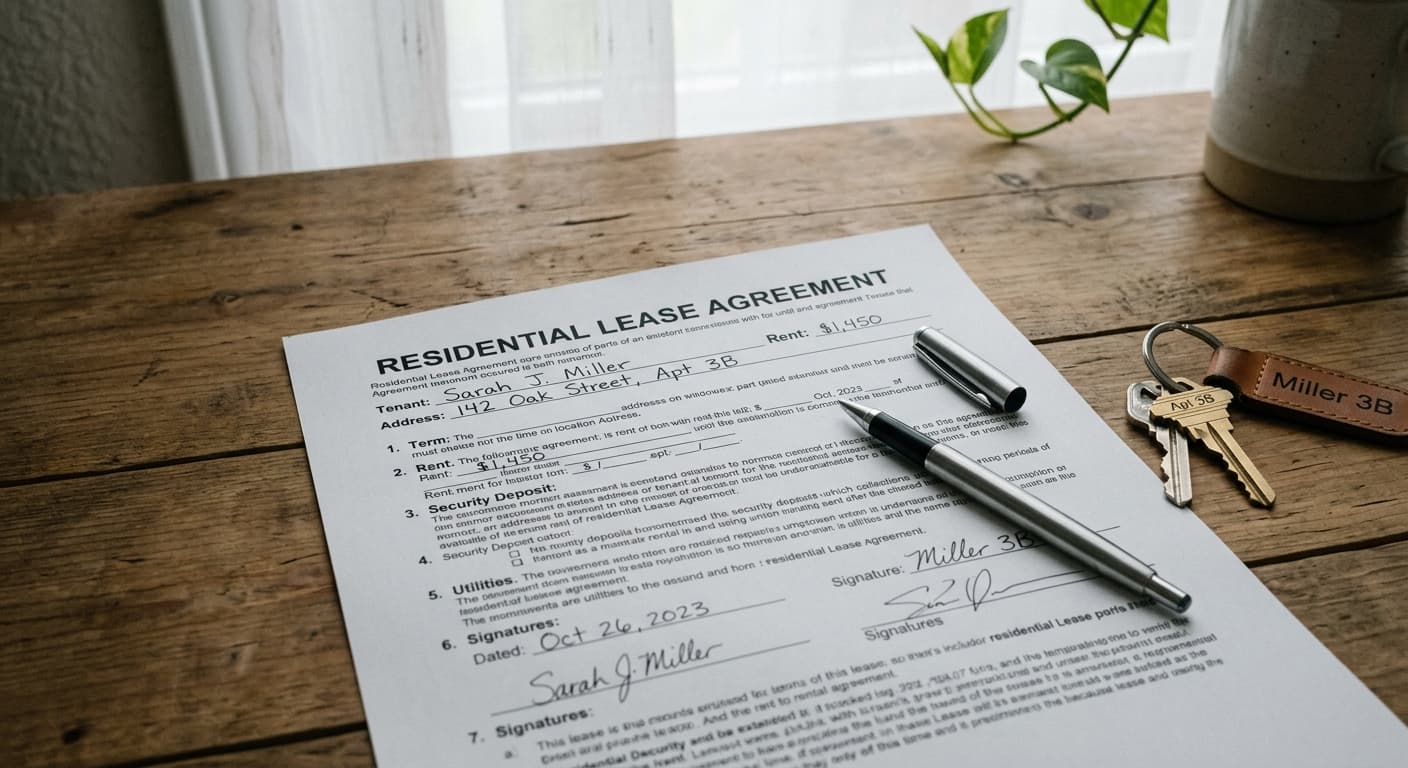
A roommate's rights depend first on one question: is the roommate on the lease? A person who signed the lease with you is a co-tenant with a direct relationship to the landlord. A person who lives with you with your consent but is not on the lease, whether or not they pay you rent, is usually an occupant.
A subtenant is different: in New York's usage, a sublet is when the tenant temporarily leaves and hands the apartment to someone else for a period. Each position carries different rights against the landlord and different obligations to the other people in the home.
This page explains the three positions, who owes the rent, and New York's roommate law (Real Property Law § 235-f), the most detailed state statute on the subject.
Scope: This page explains roommate arrangements in US residential rentals in general terms, using New York's Real Property Law, California's Civil Code and the federal Fair Housing Act as the statutory examples. Security deposit limits and return deadlines, notice periods and eviction procedures are set by each state; see your state's page in our landlord-tenant laws by state guide. Our roommate agreement generator drafts a written agreement between roommates covering rent shares, utilities, the deposit, chores, guests and moving out.
Co-tenant, subtenant or occupant: which one are you?
The label "roommate" has no fixed legal meaning. What matters is the paper, and who signed it with whom.
| Position | Relationship to the landlord | Relationship to the other roommates | Typical source of rights |
|---|---|---|---|
| Co-tenant | Signed the lease; a party to it | Fellow tenants on the same lease | The lease, and state landlord-tenant law |
| Occupant | Not on the lease; lives there with a tenant's consent (may pay the tenant) | Lives with the tenant, who stays in the home | Whatever state law gives occupants (in New York, RPL § 235-f), plus any private agreement |
| Subtenant | No lease with the landlord; takes over the unit from a tenant who is temporarily away | Rents from the prime tenant under a sublease | The sublease with the tenant; the tenant stays bound by the main lease |
New York's statute defines the two main terms. A "tenant" is "a person occupying or entitled to occupy a residential rental premises who is either a party to the lease or rental agreement for such premises or is a statutory tenant" under the rent-control laws the statute lists. An "occupant" is "a person, other than a tenant or a member of a tenant's immediate family, occupying a premises with the consent of the tenant or tenants" (RPL § 235-f(1)).
The New York Attorney General's tenants' rights guide describes a sublet from the tenant's side: "To sublet means that the tenant is temporarily leaving the apartment and therefore is transferring less than the entire interest in the apartment. A tenant who subleases an apartment is called the prime tenant and the person temporarily renting the premises is the subtenant."
Who owes the rent if a roommate stops paying
If every roommate signed the lease, the landlord's rights come from the lease itself. Look for the phrase "jointly and severally." Joint and several liability means each person bound is answerable for the whole obligation, not only a share; Cornell's Legal Information Institute describes it (in the injury-case setting) as each party being "independently liable for the full extent" of the loss. A lease with that phrase lets the landlord look to any one co-tenant for the full rent.
Where the lease is silent, state contract law supplies the answer, and the default differs by state.
California's Civil Code shows how the presumptions work. These are general contract presumptions that a court applies to the facts, not a landlord-tenant statute, and we did not open a case applying them to a residential co-tenancy. The general rule is that an obligation "imposed upon several persons ... is presumed to be joint, and not several," except in special cases (Civ. Code § 1431). Two of those special cases fit a shared lease closely:
"Where all the parties who unite in a promise receive some benefit from the consideration, whether past or present, their promise is presumed to be joint and several." (Cal. Civ. Code § 1659)
"A promise, made in the singular number, but executed by several persons, is presumed to be joint and several." (Cal. Civ. Code § 1660)
Co-tenants who each get the use of the home in exchange for the rent they promise are all receiving "some benefit from the consideration." A lease that says "Tenant agrees to pay" and is signed by three people is a promise "made in the singular number, but executed by several persons." Both presumptions point toward each co-tenant being answerable for the whole rent in California unless the lease says otherwise.
A co-tenant who pays more than their share is not left without recourse: subject to an exception for certain settlements, California law says a party to a joint, or joint and several obligation, "who satisfies more than his share of the claim against all, may require a proportionate contribution from all the parties joined with him" (Civ. Code § 1432). Other states set their own rules, so check yours.
A subtenant's position is different. A subtenant usually has no contract with the landlord, so the tenant who sublet remains responsible to the landlord. New York says so expressly: if the landlord consents to a sublet, "the tenant thereunder, shall nevertheless remain liable for the performance of tenant's obligations under said lease" (RPL § 226-b(2)(c)).
Whatever the landlord can collect, roommates can sort out their shares among themselves. That is what a written roommate agreement does. It does not bind the landlord, but it gives a roommate who covered someone else's share a written promise to point to.
New York's roommate law: RPL § 235-f
New York is the clearest example of a state that protects the right to have a roommate at all. Section 235-f(2) makes it "unlawful for a landlord to restrict occupancy of residential premises, by express lease terms or otherwise, to a tenant or tenants or to such tenants and immediate family," and makes any such lease clause "unenforceable as against public policy."
The statute then sets two rules depending on how many tenants signed the lease.
One tenant on the lease. The lease "shall be construed to permit occupancy by the tenant, immediate family of the tenant, one additional occupant, and dependent children of the occupant provided that the tenant or the tenant's spouse occupies the premises as his primary residence" (RPL § 235-f(3)).
Two or more tenants on the lease. The lease "shall be construed to permit occupancy by tenants, immediate family of tenants, occupants and dependent children of occupants; provided that the total number of tenants and occupants, excluding occupants' dependent children, does not exceed the number of tenants specified in the current lease or rental agreement, and that at least one tenant or a tenants' spouse occupies the premises as his primary residence" (RPL § 235-f(4)). The Attorney General's guide puts it practically: "if one of the tenants named in the lease moves out, that tenant may be replaced with another occupant."
Three further rules matter in practice:
- Tell the landlord. "The tenant shall inform the landlord of the name of any occupant within thirty days following the commencement of occupancy by such person or within thirty days following a request by the landlord" (RPL § 235-f(5)).
- An occupant does not inherit the apartment. "No occupant nor occupant's dependent child shall, without express written permission of the landlord, acquire any right to continued occupancy in the event that the tenant vacates the premises or acquire any other rights of tenancy" (RPL § 235-f(6)). The Attorney General's guide says the same thing in plain terms: "If the tenant named in the lease moves out, the remaining occupant has no right to continue in occupancy without the landlord's express consent."
- No waiver, but occupancy codes still apply. A lease clause waiving § 235-f "is null and void" (§ 235-f(7)), but a landlord may still restrict occupancy "in order to comply with federal, state or local laws, regulations, ordinances or codes" (§ 235-f(8)).
A person harmed by a violation may sue for an injunction, "actual damages sustained as a result of such unlawful practice," and court costs (§ 235-f(9)). Our New York landlord-tenant laws page covers the state's deposit, notice and eviction rules.
Subletting while you are away
Subletting means the tenant temporarily leaves and someone else takes over the apartment for that period. A tenant who keeps living there and takes in a roommate is in the occupant situation above, not a sublet. Whether you can sublet, and whether the landlord can refuse, starts with the lease and then state law. New York's § 226-b gives the most detailed statutory procedure:
- Buildings with four or more units. A tenant under an existing lease "shall have the right to sublease his premises subject to the written consent of the landlord in advance of the subletting. Such consent shall not be unreasonably withheld" (RPL § 226-b(2)(a)).
- The request. The tenant sends the landlord a notice by certified mail, return receipt requested, with the sublease term, the subtenant's name and addresses, the reason for subletting, the tenant's address during the sublease, "the written consent of any cotenant or guarantor of the lease," and a copy of the proposed sublease (§ 226-b(2)(b)).
- The landlord's answer. The landlord may ask for more information within ten days, and must answer within thirty days; "Landlord's failure to send such a notice shall be deemed to be a consent to the proposed subletting" (§ 226-b(2)(c)).
- Buildings with three or fewer units. The Attorney General's guide explains that tenants in these buildings "do not have a right to sublet. They can ask the landlord to sublet but the landlord does not have to agree."
A sublet or assignment that does not comply with § 226-b "shall constitute a substantial breach of lease or tenancy" (§ 226-b(5)). The section also carves out public housing and cooperative proprietary leases, and rent-stabilized and rent-controlled units are subject to their own rules (§ 226-b(3)-(4)).
Outside New York, check your lease's subletting clause and your state's landlord-tenant statute before bringing in a subtenant.
Choosing a roommate and fair housing law
The federal Fair Housing Act makes it unlawful to publish a housing advertisement "that indicates any preference, limitation, or discrimination based on race, color, religion, sex, handicap, familial status, or national origin" (42 U.S.C. § 3604(c)). The Act's exemptions, including the one for "rooms or units in dwellings containing living quarters occupied or intended to be occupied by no more than four families living independently of each other, if the owner actually maintains and occupies one of such living quarters as his residence," expressly leave subsection (c) in force (42 U.S.C. § 3603(b)).
Choosing someone to share your own living unit is treated differently, at least in the Ninth Circuit. In Fair Housing Council of San Fernando Valley v. Roommate.com, LLC, No. 09-55272 (9th Cir. Feb. 2, 2012), the court held that "precluding individuals from selecting roommates based on their sex, sexual orientation and familial status raises substantial constitutional concerns," interpreted "the FHA and FEHA as not applying to the sharing of living units," and concluded that "it's not unlawful to discriminate in selecting a roommate."
That holding binds federal courts in the Ninth Circuit's states; state and local fair housing laws elsewhere can be broader, so check before writing a roommate listing.
Security deposits between roommates
State security deposit laws govern what the landlord must do with the deposit, such as caps, return deadlines and itemized deductions. Those rules are on your state's page in our landlord-tenant guide.
How the roommates divide the deposit among themselves is best settled in a written roommate agreement. Useful points to put in writing:
- how much of the deposit each roommate paid;
- how damage caused by one roommate is charged against that roommate's share;
- what happens to a departing roommate's share when a replacement moves in (for example, the replacement pays the departing roommate directly);
- who receives the landlord's refund and how quickly it is divided.
Adding or removing a roommate
Adding a roommate. In New York, the one-tenant and multi-tenant rules above decide whether the landlord can object, and the tenant must give the landlord the occupant's name within 30 days. Elsewhere, start with the lease's occupancy clause and your state's landlord-tenant law. Making a new roommate a co-tenant means changing the parties to the lease, which takes the landlord's signature.
When a roommate leaves. Whether a co-tenant who moves out stays liable for rent depends on the lease and state law; a written release from the landlord removes the doubt. A New York occupant who stays after the tenant leaves gains no tenancy rights without the landlord's written permission (RPL § 235-f(6)).
When a roommate will not leave. How a roommate who is not on the lease can be required to leave depends on state eviction and occupancy law, and on whether the person is a subtenant with a sublease or an occupant without one. Check your state's rules, or speak with a local tenant organization or lawyer, before acting.
Disclaimer: This page provides general legal information about roommate arrangements in US residential rentals as of September 2026, using New York, California and federal law as examples. It is not legal advice. Landlord-tenant law differs by state and often by city, and rent-regulated units follow additional rules. Consult a lawyer licensed in your state, or a local tenant organization, about your specific situation.
Frequently Asked Questions
Can my landlord stop me from having a roommate?
It depends on your state and your lease. New York bars landlords from limiting occupancy to the named tenant and immediate family, and reads a one-tenant lease to allow one additional occupant and the occupant's dependent children (RPL § 235-f(2)-(3)). In states without a similar statute, the lease's occupancy clause usually controls.
Am I responsible for my roommate's share of the rent?
If you both signed the lease, possibly yes. Check whether the lease makes the tenants "jointly and severally" liable. In California the Civil Code presumes joint and several liability where several people who benefit from a promise make it together, or where a promise written in the singular is signed by several people (Civ. Code §§ 1659, 1660). Read your lease and your state's law.
What is the difference between a co-tenant and a subtenant?
A co-tenant signed the lease with the landlord. A subtenant takes over the unit under a sublease from a tenant who is temporarily away, and usually has no contract with the landlord, so the original tenant stays liable to the landlord; New York states this expressly (RPL § 226-b(2)(c)).
Can I stay if the roommate on the lease moves out?
In New York, an occupant does not acquire a right to stay when the tenant leaves unless the landlord gives express written permission (RPL § 235-f(6)). Elsewhere, check your lease and your state's landlord-tenant law, and ask the landlord for a written agreement if you want to take over the lease.
Do I need the landlord's permission to take in a roommate or sublet in New York?
If you keep living in the apartment and take in a roommate, RPL § 235-f lets a one-tenant lease include one additional occupant (and the occupant's dependent children) without the landlord's consent, as long as you or your spouse live there as a primary residence (leases signed by two or more tenants follow § 235-f(4)); you must give the landlord the occupant's name within 30 days. If you are temporarily leaving and someone else takes over, that is a sublet: in a building with four or more units you need the landlord's advance written consent, which cannot be unreasonably withheld, under the certified-mail procedure in RPL § 226-b(2), and in a building with three or fewer units there is no right to sublet, according to the New York Attorney General.
Does a roommate agreement bind the landlord?
No. The landlord is not a party to an agreement among roommates, so it does not change the lease or what any tenant owes the landlord. It governs only how the roommates divide rent, bills, the deposit and responsibilities among themselves.
Updates
Independently fact-checked against the cited primary sources
The Law Behind This Article
This article rests on the statutory provisions below, held in our own legal record and retrieved from the official source. Tap a section to read the operative text.
California Civil Code
§ 1431In force
Joint Liability An obligation imposed upon several persons, or a right created in favor of several persons, is presumed to be joint, and not several, except as provided in Section 1431.2, and except in the special cases mentioned in the title on the interpretation of contracts. This presumption, in the case of a right, can be overcome only by express words to the contrary.
Official text (excerpt) · last checked 2026-07-28 · Read the full text in our law library · Verify at leginfo.legislature.ca.gov
Cited in 76 court opinions in our collectionLatest citing opinion in our collection: 2026
Opinions citing this section in our collection:
- Howell v. State Farm Fire & Casualty Co. (California Court of Appeal 1990, 218 Cal. App. 3d 1446)“…ting origin of then-proposed Cal. Civ. Code, § 2626 as N.Y. Civ. Code, § 1431]; Civ. Code of the State of N.Y. (1865…”
- Bostick v. Flex Equip. Co., Inc. (California Court of Appeal 2007, 54 Cal. Rptr. 3d 28)“…182 , 578 P.2d 899 . As noted, the initiative amended Civil Code section 1431 *36 and added sections 1431.1 through…”
- Bigler-Engler v. Breg, Inc. (California Court of Appeal 2016)“…of 1975 (MICRA) (Civ. Code, § 3333.2) and Proposition 51 (Civ. Code, § 1431 et seq.) apply to the jury's verdict. I…”
Identified automatically from the court opinions citing this section — not a ranking of which case controls.
§ 1432In force
Except as provided in Section 877 of the Code of Civil Procedure, a party to a joint, or joint and several obligation, who satisfies more than his share of the claim against all, may require a proportionate contribution from all the parties joined with him.
Official text (excerpt) · last checked 2026-07-28 · Read the full text in our law library · Verify at leginfo.legislature.ca.gov
Cited in 54 court opinions in our collectionLatest citing opinion in our collection: 2025
Opinions citing this section in our collection:
- Fireman's Fund Insurance v. Maryland Casualty Co. (California Court of Appeal 1998, 65 Cal. App. 4th 1279)“…event one insurer from profiting at the expense of others. (Civ. Code, § 1432; Signal Companies, Inc. v. Harbor In…”
- Jessup Farms v. Baldwin (California Supreme Court 1983, 33 Cal. 3d 639)“…urchase agreement of 1971, for a total of $127,838.82. (See Civ. Code, § 1432.) The court also ruled that Jessup Farm…”
- Morgan Creek Residential v. Kemp (California Court of Appeal 2007, 63 Cal. Rptr. 3d 232)“…d Haws. A. General Legal Principles Civil Code section 1432 provides: “Except as provided in Sectio…”
Identified automatically from the court opinions citing this section — not a ranking of which case controls.
§ 1659In force
Where all the parties who unite in a promise receive some benefit from the consideration, whether past or present, their promise is presumed to be joint and several.
Official text (excerpt) · last checked 2026-07-28 · Read the full text in our law library · Verify at leginfo.legislature.ca.gov
Cited in 23 court opinions in our collectionLatest citing opinion in our collection: 2025
Opinions citing this section in our collection:
- Douglas v. Bergere (California Court of Appeal 1949, 94 Cal. App. 2d 267)“…s, may be: 1. Joint; 2. Several; or, 3. Joint and several.” Civil Code, section 1659, reads: “Where all the parties who unit…”
- Tukes v. Richard (California Court of Appeal 2022)“…no contrary intention is shown. In support, Tukes relies on Civil Code section 1659, which provides that “[w]here all the p…”
- DKN Holdings LLC v. Faerber (California Supreme Court 2015, 61 Cal. 4th 813)“…opromisors. (9 Corbin, supra, § 52.1, p. 281.) To this end, Civil Code section 1659 provides, “Where all the parties who un…”
Identified automatically from the court opinions citing this section — not a ranking of which case controls.
§ 1660In force
A promise, made in the singular number, but executed by several persons, is presumed to be joint and several.
Official text (excerpt) · last checked 2026-07-28 · Read the full text in our law library · Verify at leginfo.legislature.ca.gov
Cited in 16 court opinions in our collectionLatest citing opinion in our collection: 2025
Opinions citing this section in our collection:
- DKN Holdings LLC v. Faerber (California Supreme Court 2015, 61 Cal. 4th 813)“…ir promise is presumed to be joint and several.” Similarly, Civil Code section 1660 states, “A promise, made in the singula…”
- Williams v. Reed (California Supreme Court 1957, 48 Cal. 2d 57)“…ere is a presumption that the promise is joint and several (Civ. Code, §§ 1660, 3098, subd. (7)). “Reed's comak…”
- Bagley v. Cohen (California Supreme Court 1898, 121 Cal. 604)“…tion that J. B. Cohen was only a witness to its execution. (Civ. Code, sec. 1660.) Prior to the entry of judgment an a…”
Identified automatically from the court opinions citing this section — not a ranking of which case controls.
United States Code Title 42
§ 3603Effective dates of certain prohibitionsIn force
Subject to the provisions of subsection (b) and section 3607 of this title, the prohibitions against discrimination in the sale or rental of housing set forth in section 3604 of this title shall apply: Upon enactment of this subchapter, to— dwellings owned or operated by the Federal Government; dwellings provided in whole or in part with the aid of loans, advances, grants, or contributions made by the Federal Government, under agreements entered into after November 20, 1962, unless payment due thereon has been made in full prior to April 11, 1968; dwellings provided in whole or in part by loans insured, guaranteed, or otherwise secured by the credit of the Federal Government, under agreements entered into after November 20, 1962, unless payment thereon has been made in full prior to April 11, 1968: Provided, That nothing contained in subparagraphs (B) and (C) of this subsection shall be applicable to dwellings solely by virtue of the fact that they are subject to mortgages held by an FDIC or FSLIC institution; and dwellings provided by the development or the redevelopment of real property purchased, rented, or otherwise obtained from a State or local public agency receiving…
Official text (excerpt) · last checked 2026-07-28 · Read the full text in our law library · Verify at uscode.house.gov
Cited in 144 court opinions in our collectionLatest citing opinion in our collection: 2026
Opinions citing this section in our collection:
- Sullivan v. Little Hunting Park, Inc. (Supreme Court of the United States 1969, 396 U.S. 229)“…The Act is not fully effective until December 31, 1969. 42 U. S. C. § 3603 (b) (1964 ed., Supp. IV). Even at that…”
- United States of America, Plaintiff-Appellant-Cross-Appellee v. Space Hunters, Inc., John McDermott Defendants-Appellees-Cross-Appellants (Court of Appeals for the Second Circuit 2005, 429 F.3d 416)“…ix based on the exemption in section 803(b)(2) of the FHA, 42 U.S.C. § 3603 (b)(2), which states that most of the p…”
- Lincoln v. Case (Court of Appeals for the Fifth Circuit 2003, 340 F.3d 283)“…es as follows: As made applicable by section 803 [42 U.S.C. § 3603] and except as exempted by sec…”
Identified automatically from the court opinions citing this section — not a ranking of which case controls.
§ 3604Discrimination in the sale or rental of housing and other prohibited practicesIn forcecited in 4 of our articles
As made applicable by section 3603 of this title and except as exempted by sections 3603(b) and 3607 of this title, it shall be unlawful— To refuse to sell or rent after the making of a bona fide offer, or to refuse to negotiate for the sale or rental of, or otherwise make unavailable or deny, a dwelling to any person because of race, color, religion, sex, familial status, or national origin. To discriminate against any person in the terms, conditions, or privileges of sale or rental of a dwelling, or in the provision of services or facilities in connection therewith, because of race, color, religion, sex, familial status, or national origin. To make, print, or publish, or cause to be made, printed, or published any notice, statement, or advertisement, with respect to the sale or rental of a dwelling that indicates any preference, limitation, or discrimination based on race, color, religion, sex, handicap, familial status, or national origin, or an intention to make any such preference, limitation, or discrimination.
Official text (excerpt) · last checked 2026-07-28 · Read the full text in our law library · Verify at uscode.house.gov
Cited in 3,075 court opinions in our collectionLatest citing opinion in our collection: 2026
Opinions citing this section in our collection:
- Warth v. Seldin (Supreme Court of the United States 1975, 422 U.S. 490)“…n of § 804 of the Civil Rights Act of 1968, 82 Stat. 83 , 42 U. S. C. § 3604 . They claimed that, as a result of suc…”
- Havens Realty Corp. v. Coleman (Supreme Court of the United States 1982, 455 U.S. 363)“…le, or rental when such dwelling is in fact so available,” 42 U. S. C. § 3604 (d) (emphasis added), a prohibition mad…”
- Gladstone, Realtors v. Village of Bellwood (Supreme Court of the United States 1979, 441 U.S. 91)“…nois, alleging that they had violated § 804 of Title VIII, 42 U. S. C. § 3604 . 2 Simultaneously, respondents filed…”
Identified automatically from the court opinions citing this section — not a ranking of which case controls.
Also relied on in: HOA Security Camera Rules: Can They Make You Remove It?, Renting Without a Social Security Number in the U.S. (2026), California Ring Doorbell Laws: What You Need to Know in 2026
Search our full record of US law — 2.1 million sections, every state + federal →
Sources and References
- N.Y. Real Property Law § 235-f, Unlawful restrictions on occupancy(nysenate.gov).gov
- N.Y. Real Property Law § 226-b, Right to sublease or assign(nysenate.gov).gov
- New York State Attorney General, Residential Tenants' Rights Guide(ag.ny.gov).gov
- Cal. Civ. Code § 1431, Joint liability presumption(leginfo.legislature.ca.gov).gov
- Cal. Civ. Code § 1432, Contribution among joint obligors(leginfo.legislature.ca.gov).gov
- Cal. Civ. Code § 1659, Joint and several promise where all benefit(leginfo.legislature.ca.gov).gov
- Cal. Civ. Code § 1660, Promise in the singular executed by several(leginfo.legislature.ca.gov).gov
- 42 U.S.C. § 3604, Discrimination in the sale or rental of housing(law.cornell.edu)
- 42 U.S.C. § 3603, Effective dates of certain prohibitions (exemptions)(law.cornell.edu)
- Fair Housing Council of San Fernando Valley v. Roommate.com, LLC, No. 09-55272 (9th Cir. Feb. 2, 2012)(cdn.ca9.uscourts.gov).gov
- Cornell Law School, Legal Information Institute, joint and several liability(law.cornell.edu)