
Oregon
Is Jaywalking Illegal in Oregon? Rules and Fines (2026)
Independently fact-checked against primary sources (last audited October 10, 2026). · 8 primary sources cited on this page. How we verify our legal content

In Oregon, crossing outside a crosswalk is not banned by state law as such; the state offense is failing to yield to vehicles while doing it. Under ORS 814.040, a pedestrian who fails to yield the right of way to a vehicle when crossing at any point other than a marked crosswalk or an unmarked crosswalk at an intersection commits pedestrian failure to yield, a Class D traffic violation with a presumptive fine of $115 (ORS 153.019) and a maximum of $250 (ORS 153.018). Local road authorities can go further: ORS 810.080 lets them prohibit crossing anywhere other than in a marked or unmarked crosswalk, so the answer can change by city. To compare other states, see our guide to jaywalking laws by state.
Information last verified on 2026-10-10. This article has not been reviewed by a licensed lawyer.
Jurisdiction scope: This article covers Oregon Revised Statutes on pedestrians and the drivers around them: the pedestrian offenses in ORS 814.010 to 814.080, the driver duties in ORS 811.005, 811.020, 811.025, 811.028 and 811.035, the freeway provision in ORS 814.100, police stops and court reporting in ORS 810.370 and 810.410, ORS 807.620, the definitions in ORS 801.220 and 801.385, local road authority power in ORS 810.080, and the violation fines and plea rules in ORS 153.018, 153.019, 153.021 and 153.061. It does not cover the text of any city's or county's ordinances, a court's fine schedule or added assessments, injury claims after a crash, or the law of other states.
Is jaywalking illegal in Oregon?
State law treats crossing outside a crosswalk as a yield problem, not a location ban. ORS 814.040 provides:
"(1) A pedestrian commits the offense of pedestrian failure to yield to a vehicle if the pedestrian does any of the following: (a) Suddenly leaves a curb or other place of safety and moves into the path of a vehicle that is so close as to constitute an immediate hazard. (b) Fails to yield the right of way to a vehicle upon a roadway when the pedestrian is crossing the roadway at any point other than within a marked crosswalk or an unmarked crosswalk at an intersection. (c) Except as otherwise provided under the vehicle code, fails to yield the right of way to all vehicles upon the roadway. (2) The offense described in this section, pedestrian failure to yield to a vehicle, is a Class D traffic violation."
Under paragraph (b), a mid-block crossing is lawful under state law if the pedestrian yields. Oregon's pedestrian sections, ORS 814.010 to 814.070, contain no rule barring crossing between adjacent signalized intersections and no diagonal-crossing rule.
Two things narrow that freedom. First, local road authorities may ban crossing outside crosswalks on their roads (see the local rules section below), so a mid-block crossing that state law allows can still be prohibited in a particular city. Second, ORS 814.060 makes it an offense to cross "other than by means of a pedestrian tunnel or overhead pedestrian crossing when a tunnel or overhead crossing serves the place where the pedestrian is crossing the roadway."
| Situation | Rule under Oregon state law | Source |
|---|---|---|
| Crossing outside a marked crosswalk or an unmarked crosswalk at an intersection | Allowed if the pedestrian yields to vehicles; a local road authority may prohibit it | ORS 814.040(1)(b), 810.080(1)(c) |
| Stepping off the curb into the path of a vehicle so close it is an immediate hazard | Class D traffic violation | ORS 814.040(1)(a) |
| Crossing at the surface where a pedestrian tunnel or overhead crossing serves the place | Class D traffic violation | ORS 814.060 |
| Entering the roadway on a steady yellow or steady red light | Barred unless a pedestrian control signal directs otherwise | ORS 814.010(3), (4) |
| Starting to cross on Wait or Don't Walk | Barred; a pedestrian already crossing proceeds with dispatch to a sidewalk or safety island | ORS 814.010 |
| Crossing where a road authority has closed the crosswalk by posted signs | Barred | ORS 810.080(1)(b) |
| Being on a roadway to solicit a ride | Class D traffic violation (unlawful hitchhiking) | ORS 814.080 |
| Walking on a freeway on which pedestrian traffic is prohibited | Disobeying a traffic control device that applies to the pedestrian is a Class D traffic violation; the driver and passengers of a disabled vehicle may walk to the nearest exit with telephone or repair services | ORS 814.020, 814.100 |
What counts as a crosswalk in Oregon
Whether you were in a crosswalk decides whether 814.040(1)(b) applies, and Oregon's definition has a twist. ORS 801.220 provides:
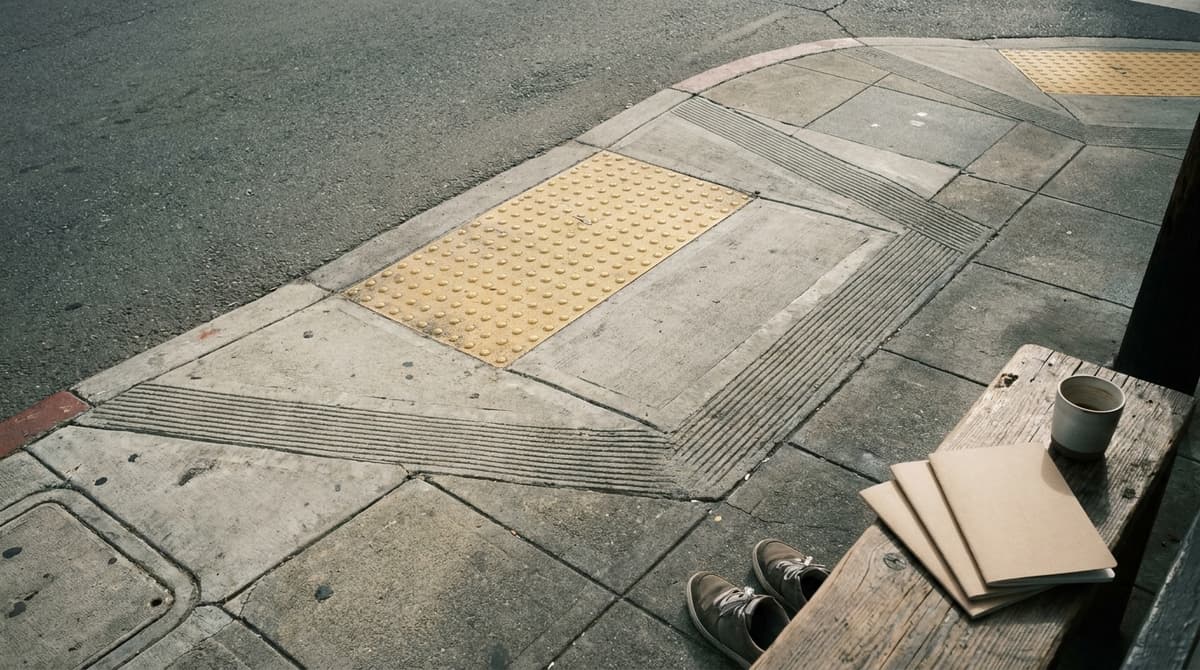
"'Crosswalk' means any portion of a roadway at an intersection or elsewhere that is distinctly indicated for pedestrian crossing by lines or other markings on the surface of the roadway that conform in design to the standards established for crosswalks under ORS 810.200. Whenever marked crosswalks have been indicated, such crosswalks and no other shall be deemed lawful across such roadway at that intersection. Where no marked crosswalk exists, a crosswalk is that portion of the roadway described in the following: (1) Where sidewalks, shoulders or a combination thereof exists, a crosswalk is the portion of a roadway at an intersection, not more than 20 feet in width as measured from the prolongation of the lateral line of the roadway toward the prolongation of the adjacent property line, that is included within: (a) The connections of the lateral lines of the sidewalks, shoulders or a combination thereof on opposite sides of the street or highway measured from the curbs or, in the absence of curbs, from the edges of the traveled roadway; or (b) The prolongation of the lateral lines of a sidewalk, shoulder or both, to the sidewalk or shoulder on the opposite side of the street, if the prolongation would meet such sidewalk or shoulder. (2) If there is neither sidewalk nor shoulder, a crosswalk is the portion of the roadway at an intersection, measuring not less than six feet in width, that would be included within the prolongation of the lateral lines of the sidewalk, shoulder or both on the opposite side of the street or highway if there were a sidewalk."
A marked crosswalk is one painted to state standards, at an intersection or mid-block. Where an intersection has marked crosswalks, those crosswalks and no other are lawful across that roadway at that intersection. Where an intersection has no marked crosswalk, an unmarked crosswalk still exists there: within the lines of the sidewalks or shoulders, up to 20 feet wide, and, even where there is neither sidewalk nor shoulder, a strip at least six feet wide. Under ORS 801.385, "'Pedestrian' means any person afoot or confined in a wheelchair."
Traffic lights and WALK signals
ORS 814.010 sets how pedestrians must respond to signals, and ORS 814.020 makes disobeying them an offense. Note the wording for a steady yellow: the pedestrian shall not enter the roadway at all.
"(3) A pedestrian facing a traffic control device with a steady yellow light shall not enter the roadway unless otherwise directed by a pedestrian control signal. (4) A pedestrian facing a traffic control device with a steady red light shall not enter the roadway unless otherwise directed by a pedestrian control signal."
For pedestrian signals, ORS 814.010 provides that "A pedestrian shall not start to cross the roadway in the direction of a signal showing a 'Wait' or 'Don't Walk' or any other symbol approved under ORS 810.200 and 810.210 indicating that the pedestrian may not proceed. A pedestrian who has started crossing a roadway on a signal showing 'Walk' or any other approved symbol to proceed shall proceed with dispatch to a sidewalk or safety island while a signal is showing 'Wait' or 'Don't Walk' or any other approved symbol indicating not to proceed."
The offense is in ORS 814.020:
"(1) A pedestrian commits the offense of pedestrian failure to obey traffic control devices if the pedestrian does any of the following: (a) Fails to obey any traffic control device specifically applicable to the pedestrian. (b) Fails to obey any specific traffic control device described in ORS 814.010 in the manner required by that section. (2) A pedestrian is not subject to the requirements of this section if the pedestrian complies with directions of a police officer. (3) The offense described in this section, pedestrian failure to obey traffic control devices, is a Class D traffic violation."
Walking along the road and other pedestrian rules
ORS 814.070 makes it a Class D traffic violation for a pedestrian to take an improper position on a highway. It covers a pedestrian who "(a) Takes a position upon or proceeds along and upon the roadway where there is an adjacent usable sidewalk or shoulder," and one who "(e) Fails to take a position upon or proceed along and upon a highway that has neither sidewalk nor shoulder available, as near as practicable to an outside edge of the roadway, and, if the roadway is a two-way roadway, only on the left side of it."
Other pedestrian offenses in chapter 814, each a Class D traffic violation:
- Bridges and railroad gates. A pedestrian may not pass "through, around, over or under any crossing gate or barrier at a bridge or railroad grade crossing while the gate or barrier is closed or being opened or closed" (ORS 814.030).
- Emergency vehicles. A pedestrian must yield the right of way to "(a) An ambulance used in an emergency situation; or (b) An emergency vehicle or an ambulance upon the approach of the vehicle using a visual signal or audible signal or both" as the vehicle code requires (ORS 814.050). Amendments to 814.050 made by section 11, chapter 278, Oregon Laws 2025, become operative January 1, 2027.
- Hitchhiking. "A person commits the offense of unlawful hitchhiking if the person is on a roadway for the purpose of soliciting a ride" (ORS 814.080).
What drivers owe pedestrians in Oregon
Oregon's main driver rule goes beyond yielding. ORS 811.028 provides that a driver commits failure to stop and remain stopped for a pedestrian "if the driver does not stop and remain stopped for a pedestrian when the pedestrian is: (a) Proceeding in accordance with a traffic control device as provided under ORS 814.010 or crossing the roadway in a crosswalk; and (b) In any of the following locations: (A) In the lane in which the driver's vehicle is traveling; (B) In a lane adjacent to the lane in which the driver's vehicle is traveling; (C) In the lane into which the driver's vehicle is turning;" and further locations the section lists. It is a Class B traffic violation (811.028(5)). A Class B violation has a presumptive fine of $265, a maximum of $1,000 and a minimum of $135 (ORS 153.019, 153.018, 153.021). When the officer notes on the citation that the offense occurred in a highway work zone, a posted school zone or a safety corridor under the statutes that govern those zones, the presumptive fine for a Class B violation is $525 (ORS 153.020(1)(b)).
A pedestrian counts as crossing once "any part or extension of the pedestrian, including but not limited to any part of the pedestrian's body, wheelchair, cane, crutch or bicycle, moves onto the roadway in a crosswalk with the intent to proceed" (811.028(4)). The duty does not apply to a driver on the half of a roadway on the far side of a safety island from the pedestrian, or where a pedestrian tunnel or overhead crossing has been provided at or near a crosswalk (811.028(3)).
Other driver offenses:
- Passing a stopped car at a crosswalk. A driver commits passing a stopped vehicle at a crosswalk if the driver "(a) Approaches from the rear another vehicle that is stopped at a marked or an unmarked crosswalk at an intersection to permit a pedestrian to cross the roadway; and (b) Overtakes and passes the stopped vehicle" (ORS 811.020).
- Sidewalks. A driver commits an offense if the driver "does not yield the right of way to any pedestrian on a sidewalk" (ORS 811.025).
- Blind and low-vision pedestrians. A driver approaching a pedestrian who is blind, deaf-blind or has limited vision, who carries a white cane or is accompanied by a dog guide, and who is crossing or about to cross a roadway must stop and remain stopped until the pedestrian has crossed. Where traffic control devices regulate traffic, the driver must stop and remain stopped until such a pedestrian who has entered the roadway has vacated it, notwithstanding the signals. It is a Class B traffic violation (ORS 811.035).
- Due care. "None of the provisions of the vehicle code relieve a pedestrian from the duty to exercise due care or relieve a driver from the duty to exercise due care concerning pedestrians" (ORS 811.005).
Jaywalking fine and penalty in Oregon
Each pedestrian offense in ORS 814.020 to 814.080 described above is a Class D traffic violation. The fine amounts are in ORS chapter 153:
| Amount | Class D (pedestrian offenses) | Class B (driver failure to stop for a pedestrian) | Source |
|---|---|---|---|
| Presumptive fine | $115 | $265 | ORS 153.019(1) |
| Maximum fine for an individual | $250 | $1,000 | ORS 153.018(2) |
| Minimum fine | $65 | $135 | ORS 153.021(1) |
Courts must forward traffic conviction records to the Oregon DMV, but ORS 810.370(3) provides that a court "is not required by this section to forward to the department a record of conviction" under ORS 814.020 to 814.080, which includes the pedestrian offenses on this page.
The presumptive fine is not always the whole amount: "Any surcharge imposed under ORS 1.188 shall be added to and made a part of the presumptive fine" (ORS 153.019(3)). ORS 1.188 lets the presiding judge order a surcharge "in the amount of $5 on each fine assessed for an offense in the county" when the county meets conditions tied to courthouse bond funding. The court may go below the minimum: under ORS 153.021(2), "a court may waive payment of the minimum fine described in this section, in whole or in part, if the court determines that requiring payment of the minimum fine would be inconsistent with justice in the case."
Paying is a plea. Under ORS 153.061(3), a defendant may enter a plea of no contest by delivering to the court or a violations bureau the summons and a check or money order in the amount of the presumptive fine, or by appearing by electronic or telephonic means and entering the plea with a violations bureau. The plea "constitutes a waiver of trial and consent to the entry of a judgment forfeiting the presumptive fine" (153.061(3)(b)). The statute adds: "A no contest plea under this subsection is not subject to the requirements of ORS chapter 135 relating to the entry of pleas and, upon receipt of the plea, the court may enter judgment against the defendant without taking further evidence." A person who wants to contest the ticket should not send in the payment. Ignoring the citation is not an option either: if a defendant fails to make a first appearance on a citation for a traffic violation, "the driving privileges of the defendant are subject to suspension under ORS 809.220" (ORS 153.061(7)).
Can police stop you for jaywalking in Oregon?
Pedestrian offenses are traffic violations, and under ORS 810.410(3) a police officer "May not arrest a person for a traffic violation" but "May stop and detain a person for a traffic violation for the purposes of investigation reasonably related to the traffic violation, identification and issuance of citation." Giving a false or fictitious name, address or date of birth to a police officer who is enforcing motor vehicle laws is a Class A misdemeanor (ORS 807.620). ORS 814.020(2) does protect a pedestrian who follows a police officer's directions: such a pedestrian "is not subject to the requirements of this section."

Local rules: cities can require crosswalks
ORS 810.080 is the state grant that lets local road authorities set stricter crossing rules:
"(1) Road authorities may regulate the movement of pedestrians upon highways within their jurisdictions by doing any of the following: (a) Establishing marked crosswalks and designating them by appropriate marking. (b) Closing a marked or unmarked crosswalk and prohibiting pedestrians from crossing a roadway where a crosswalk has been closed by placing and maintaining signs giving notice of closure. (c) Prohibiting pedestrians from crossing a highway at any place other than within a marked or unmarked crosswalk. (2) This section neither grants authority to nor limits the authority of the Department of Transportation."
Under paragraph (c), a road authority can make crossing outside a crosswalk off-limits on roads it controls, and under paragraph (b) it can close a crosswalk with posted signs. Because ORS 814.020 makes it a violation to disobey a traffic control device that applies to the pedestrian, posted closure signs carry weight. To find out whether your city or county has used this power, look up its traffic code or ask the court named on a citation.
If a pedestrian is hit by a car
Whether a pedestrian crossed lawfully can matter after a collision, alongside the driver's duty to stop and remain stopped under ORS 811.028. For how fault and insurance claims work after a crash, see Oregon car accident laws. Riders of e-scooters follow their own rules, covered in Oregon e-scooter laws.
Related pages
- Jaywalking laws by state
- Oregon car accident laws
- Oregon e-scooter laws
- Washington jaywalking laws
- California jaywalking laws
This article provides general legal information about Oregon law, not legal advice. For advice about a specific situation, contact a lawyer licensed in Oregon.
Last updated: 2026-10-10.
Frequently Asked Questions
Is jaywalking illegal in Oregon?
State law lets you cross outside a crosswalk if you yield the right of way to vehicles; failing to yield is a Class D traffic violation (ORS 814.040). Local road authorities may prohibit crossing anywhere other than a marked or unmarked crosswalk (ORS 810.080), so check your city's rules.
What is the fine for jaywalking in Oregon?
Pedestrian failure to yield is a Class D traffic violation with a presumptive fine of $115, a maximum of $250 and a minimum of $65 that a court may waive (ORS 153.019, 153.018, 153.021). In counties where a courthouse surcharge has been ordered, a $5 surcharge under ORS 1.188 is added to the presumptive fine.
Can I cross mid-block between two traffic lights in Oregon?
Oregon's pedestrian sections, ORS 814.010 to 814.070, contain no rule against crossing between signalized intersections, so state law requires only that you yield to vehicles (ORS 814.040(1)(b)). A local road authority may still prohibit crossing outside crosswalks (ORS 810.080(1)(c)).
Can I start crossing on a yellow light in Oregon?
No. A pedestrian facing a steady yellow light shall not enter the roadway unless a pedestrian control signal directs otherwise (ORS 814.010(3)); disobeying is a Class D traffic violation (ORS 814.020).
Is paying a jaywalking ticket a guilty plea in Oregon?
Sending the summons with a check or money order for the presumptive fine is a plea of no contest, and the court may enter judgment without taking further evidence (ORS 153.061(3)).
Do drivers have to stop for pedestrians in Oregon?
Yes. A driver must stop and remain stopped for a pedestrian crossing in a crosswalk or proceeding as a signal allows when the pedestrian is in the driver's lane, an adjacent lane, or the lane being turned into, among other locations; failing to is a Class B traffic violation (ORS 811.028).
Which side of the road should I walk on in Oregon?
Do not walk on the roadway where there is an adjacent usable sidewalk or shoulder. Where there is neither, walk as near as practicable to an outside edge and, on a two-way roadway, only on the left side (ORS 814.070).
Updates
Independently fact-checked against the cited primary sources
The Law Behind This Article
This article rests on the statutory provisions below, held in our own legal record and retrieved from the official source. Tap a section to read the operative text.
Oregon Revised Statutes, Chapter 814: Pedestrians; Passengers; Livestock; Motorized Wheelchairs; Vehicles With Fewer Than Four Wheels
§ 814.040Failure to yield to vehicle; penaltyIn force
(1) A pedestrian commits the offense of pedestrian failure to yield to a vehicle if the pedestrian does any of the following: (a) Suddenly leaves a curb or other place of safety and moves into the path of a vehicle that is so close as to constitute an immediate hazard. (b) Fails to yield the right of way to a vehicle upon a roadway when the pedestrian is crossing the roadway at any point other than within a marked crosswalk or an unmarked crosswalk at an intersection. (c) Except as otherwise provided under the vehicle code, fails to yield the right of way to all vehicles upon the roadway. (2) The offense described in this section, pedestrian failure to yield to a vehicle, is a Class D traffic violation.
Official text (excerpt) · last checked 2026-07-29 · Read the full text in our law library · Verify at oregonlegislature.gov
§ 814.050Failure to yield to ambulance or emergency vehicle; penaltyIn force
(1) A pedestrian commits the offense of pedestrian failure to yield to an ambulance or emergency vehicle if the pedestrian does not yield the right of way to: (a) An ambulance used in an emergency situation; or (b) An emergency vehicle or an ambulance upon the approach of the vehicle using a visual signal or audible signal or both according to requirements under ORS 820.300 or 820.320. (2) This section does not relieve the driver of an ambulance or emergency vehicle from the duty to: (a) Drive with due regard for the safety of all persons using the highway; and (b) Exercise due care to avoid colliding with any pedestrian. (3) The offense described in this section, pedestrian failure to yield to an ambulance or emergency vehicle, is a Class D traffic violation. [1983 c.338 §556; 1995 c.209 §4; 1995 c.383 §85] Note: The amendments to 814.050 by section 11, chapter 278, Oregon Laws 2025, become operative January 1, 2027. See section 24, chapter 278, Oregon Laws 2025. The text that is operative on and after January 1, 2027, is set forth for the user’s convenience. 814.050.
Official text (excerpt) · last checked 2026-07-29 · Read the full text in our law library · Verify at oregonlegislature.gov
Oregon Revised Statutes, Chapter 811: Rules of the Road for Drivers
§ 811.025Failure to yield to pedestrian on sidewalk; penaltyIn force
(1) The driver of a vehicle commits the offense of failure to yield to a pedestrian on a sidewalk if the driver does not yield the right of way to any pedestrian on a sidewalk. (2) The offense described in this section, failure to yield to a pedestrian on a sidewalk, is a Class B traffic violation.
Official text (excerpt) · last checked 2026-07-29 · Read the full text in our law library · Verify at oregonlegislature.gov
Search our full record of US law — 2.1 million sections, every state + federal →
Sources and References
- ORS chapter 814, Pedestrians (814.010 to 814.080, 814.100)(oregonlegislature.gov).gov
- ORS chapter 153, Violations and fines (153.018, 153.019, 153.020, 153.021, 153.061)(oregonlegislature.gov).gov
- ORS chapter 810, Road authority, court records and police (810.080, 810.370, 810.410)(oregonlegislature.gov).gov
- ORS chapter 801, Definitions (801.220 crosswalk, 801.385 pedestrian)(oregonlegislature.gov).gov
- ORS chapter 811, Rules of the road for drivers (811.005, 811.020, 811.025, 811.028, 811.035)(oregonlegislature.gov).gov
- ORS chapter 807, Driving privileges (807.620, giving false information to police officer)(oregonlegislature.gov).gov
- ORS chapter 1, Courts (1.188, surcharge on fines for courthouse)(oregonlegislature.gov).gov
- Oregon Laws 2026, chapter 65 (HB 4137), amending ORS 153.061(oregonlegislature.gov).gov