
Maryland
Is Jaywalking Illegal in Maryland? Crossing Rules and $50 Fine (2026)
Independently fact-checked against primary sources (last audited October 10, 2026). · 21 primary sources cited on this page. How we verify our legal content
In Maryland, what most people call jaywalking is governed by Md. Code, Transportation 21-503. A pedestrian crossing anywhere other than a marked crosswalk or an unmarked crosswalk at an intersection must yield the right-of-way to any approaching vehicle, and between two adjacent intersections with a working traffic control signal a pedestrian may cross only in a marked crosswalk. By statute a violation is a misdemeanor with a fine of up to $500 (Transp. 27-101), but the District Court's preset fine schedule effective October 1, 2026 lists $50 and 0 points for the common pedestrian violations. To compare other states, see our guide to jaywalking laws by state.
Information last verified on 2026-10-10. This article has not been reviewed by a licensed lawyer.
Jurisdiction scope: This article covers Maryland state law: the pedestrian rules in Md. Code, Transportation 21-501 through 21-511 (including the county sections added after 21-507 in 2026), the driver rules for alleys and driveways in 21-705, the signal rules in 21-202 and 21-203, the crosswalk definition in 21-101, the conviction definition in 11-110, local authority powers in 25-102, the general penalty in 27-101, and the District Court of Maryland preset fine schedule (DC-CR-090) effective October 1, 2026. It does not cover the text of any county or municipal ordinance, injury claims after a crash, or the law of other states.
Is jaywalking illegal in Maryland?
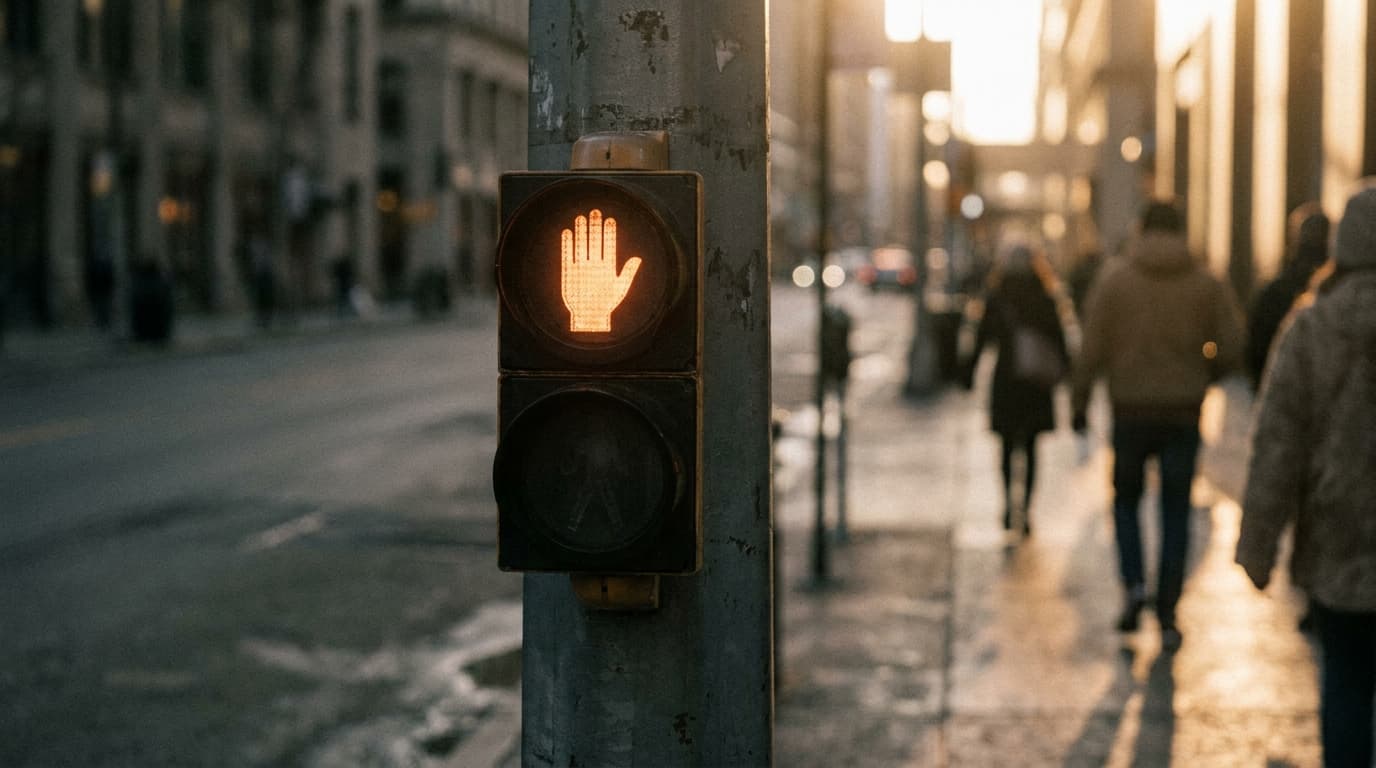
It depends on where and how you cross. Maryland's pedestrian rules mix a duty to yield with a short list of flat prohibitions. Crossing outside a crosswalk is allowed if the pedestrian lets approaching traffic go first. Crossing mid-block between two signalized intersections, cutting diagonally through an intersection without a device allowing it, or stepping off on a "dont walk" signal is barred whether or not traffic is coming.
| Situation | Maryland rule |
|---|---|
| Crossing outside a marked crosswalk or an unmarked crosswalk at an intersection | Allowed, but the pedestrian must yield the right-of-way to any approaching vehicle (21-503(a)) |
| Crossing where a pedestrian tunnel or overhead crossing is provided | Allowed, but the pedestrian must yield the right-of-way to any approaching vehicle (21-503(b)) |
| Crossing between adjacent intersections at which a traffic control signal is in operation | Only in a marked crosswalk (21-503(c)) |
| Crossing an intersection diagonally | Barred unless authorized by a traffic control device, and then only in accordance with it (21-503(d)) |
| Suddenly leaving a curb into the path of a vehicle too close to yield | Barred (21-502(b)) |
| Starting to cross on a "dont walk," "upraised hand," or "wait" signal | Barred (21-203(c), (d)) |
| Starting to cross on a steady yellow, or entering the roadway on a steady red alone, with no pedestrian signal directing otherwise | Barred (21-202(g)(2), (l)) |
| Walking along an adjacent roadway where a sidewalk is provided | Barred (21-506(a)) |
| Walking along or on a controlled access highway, or a ramp or access road leading to or from one | Barred, except in the narrow cases in 21-509(j) |
| Crossing in front of an emergency vehicle using audible and visual signals, or a police vehicle lawfully using an audible signal | The pedestrian must yield (21-510) |
Crossing outside a crosswalk
The basic rule is 21-503(a):

"(a) If a pedestrian crosses a roadway at any point other than in a marked crosswalk or in an unmarked crosswalk at an intersection, the pedestrian shall yield the right-of-way to any vehicle approaching on the roadway."
This is a duty to yield, not a ban. A pedestrian who waits for a gap and lets approaching vehicles pass first complies with subsection (a), subject to the rules below. The same yield duty applies under subsection (b) where a pedestrian tunnel or overhead pedestrian crossing is provided.
Subsection (a) treats an unmarked crosswalk at an intersection the same as a painted one, and Maryland's definition of crosswalk is broad. Under Transportation 21-101, a crosswalk is the part of a roadway that is "(1) Within the prolongation or connection of the lateral lines of sidewalks at any place where 2 or more roadways of any type meet or join, measured from the curbs or, in the absence of curbs, from the edges of the roadway; (2) Within the prolongation or connection of the lateral lines of a bicycle way where a bicycle way and a roadway of any type meet or join, measured from the curbs or, in the absence of curbs, from the edges of the roadway; or (3) Distinctly indicated for pedestrian crossing by lines or other markings." A legal crosswalk can therefore exist with no paint where sidewalk lines extend across a place where two or more roadways meet, or where a bicycle way meets a roadway.
Once in a crosswalk, 21-505 adds: "If practicable, a pedestrian shall walk on the right half of a crosswalk."
Crossing between signalized intersections and diagonally
Two more subsections of 21-503 are flat rules:
"(c) Between adjacent intersections at which a traffic control signal is in operation, a pedestrian may cross a roadway only in a marked crosswalk. (d) A pedestrian may not cross a roadway intersection diagonally unless authorized by a traffic control device for crossing movements. If authorized to cross diagonally, a pedestrian may cross only in accordance with the traffic control device."
Subsection (c) is the closest Maryland comes to a mid-block ban. It applies only between adjacent intersections at which a traffic control signal is in operation. On that stretch, yielding is not enough: the crossing must be in a marked crosswalk.
A separate rule applies everywhere, including in crosswalks. Section 21-502(b) provides: "A pedestrian may not suddenly leave a curb or other place of safety and walk or run into the path of a vehicle which is so close that it is impossible for the driver to yield."
Walk signals and traffic lights
Section 21-501 ties pedestrians to the signal rules: "At an intersection, a pedestrian is subject to all traffic control signals, as provided in 21-202 and 21-203 of this title. However, at any other place, a pedestrian has the rights and is subject to the restrictions stated in this title."
Where a pedestrian signal is installed, 21-203 controls:
"(b) A pedestrian facing a "walk" or "walking person" signal may cross the roadway in the direction of the signal and shall be given the right-of-way by the driver of any vehicle. At an intersection where an exclusive all-pedestrian interval is provided, a pedestrian may cross the roadway in any direction within the intersection. (c) A pedestrian may not start to cross the roadway in the direction of a "dont walk" or "upraised hand" signal. (d) A pedestrian may not start to cross the roadway in the direction of a "wait signal". (e) If a pedestrian has partly completed crossing on a "walk" or "walking person" signal, the pedestrian shall proceed without delay to a sidewalk or safety island while the "dont walk", "wait", or "upraised hand" signal is showing."
Where there is no pedestrian signal, the ordinary traffic light governs. Under 21-202, unless a pedestrian control signal directs otherwise:
- A pedestrian facing any green signal, unless the green signal is only a turn arrow, "may cross the roadway, within any marked or unmarked crosswalk, in the direction of the green signal" (21-202(f)).
- A pedestrian facing a steady yellow is warned there is not enough time to cross, "and a pedestrian may not then start to cross the roadway" (21-202(g)(2)).
- "Pedestrians facing a steady red signal alone may not enter the roadway" (21-202(l)).
Walking along the road and on highways
Maryland regulates walking along a road as well as crossing it:
"(a) Where a sidewalk is provided, a pedestrian may not walk along and on an adjacent roadway. (b) Where a sidewalk is not provided, a pedestrian who walks along and on a highway may walk only on the left shoulder, if practicable, or on the left side of the roadway, as near as practicable to the edge of the roadway, facing any traffic that might approach from the opposite direction."
Controlled access highways are off limits on foot. Section 21-509 provides that, except as provided in subsection (j), "a pedestrian may not walk along a controlled access highway" and "may not walk on a controlled access highway." Subsections (c) through (f) apply the same bans to "a ramp leading to or from a controlled access highway" and "an access road leading to or from a controlled access highway." Subsection (j) provides: "This section does not apply to a person if an emergency prevents the movement of a vehicle in which he is riding and the person goes only to the nearest telephone or other source of assistance, nor to a person boarding or leaving a bus within a bus stop approved by the State Highway Administration."
Two more rules in the subtitle apply to people on foot. A pedestrian who crosses a roadway must yield the right-of-way to an approaching emergency vehicle using audible and visual signals that meet the requirements of 22-218, and to an approaching police vehicle lawfully using an audible signal (21-510). And, except for the occupant of a disabled vehicle seeking aid, "a person may not stand in a roadway to solicit a ride, employment, or business from the occupant of any vehicle" (21-507(a)). In Calvert, Carroll, Charles, Harford, and Washington counties, a person also may not stand in a roadway, median divider, or intersection to solicit money or donations of any kind from a vehicle occupant (21-507(c)). Other subsections of 21-507 restrict standing in a roadway or highway to solicit money or donations in Prince George's, Anne Arundel, Allegany, Cecil, Montgomery, Howard, and Frederick counties, each on its own terms.
Two 2026 acts add county rules for spots a county or town has determined to be "inherently dangerous." In Wicomico County since June 1, 2026 (2026 Md. Laws ch. 781) and in St. Mary's County since October 1, 2026 (2026 Md. Laws ch. 587), a person may not stand in a roadway, shoulder, median divider, or intersection the county or a municipal corporation in the county has determined to be inherently dangerous, and a police officer may not issue a citation unless appropriate signs are installed. Both acts added a section numbered 21-507.1; the District Court schedule lists the St. Mary's rule as 21-507.1 and the Wicomico rule as 21-507.2, each at $70 and 0 points.
County and city rules
Section 25-102(a) provides that the Maryland Vehicle Law does not prevent a local authority, "in the reasonable exercise of its police power," from exercising listed powers "as to highways under its jurisdiction," including "(12) Adopting any other traffic regulations as specifically authorized in the Maryland Vehicle Law." Local rules on pedestrians therefore depend on what the Vehicle Law specifically authorizes and on the ordinances a county or city has adopted. Check your county or municipal code and posted signs.
What drivers owe pedestrians
Where no traffic control signal is in operation, the driver's duty is a stop, not just a yield. Section 21-502(a) provides that the subsection does not apply where a pedestrian tunnel or overhead crossing is provided or "A traffic control signal is in operation," and otherwise:

"(2) The driver of a vehicle shall come to a stop when a pedestrian crossing the roadway in a crosswalk is: (i) On the half of the roadway on which the vehicle is traveling; or (ii) Approaching from an adjacent lane on the other half of the roadway."
The other driver duties:
- If a vehicle is stopped at a marked crosswalk or at an unmarked crosswalk at an intersection to let a pedestrian cross, a driver approaching from the rear "may not overtake and pass the stopped vehicle" (21-502(c)).
- A violation of 21-502(a) or (c) that contributes to an accident is a separate offense, and a person convicted is "subject to imprisonment not exceeding 2 months or a fine not exceeding $1,000 or both" (21-502(d), (e)).
- On a circular green, vehicles, "including any vehicle turning right or left, shall yield the right-of-way to any other vehicle and any pedestrian lawfully within the intersection or an adjacent crosswalk" (21-202(c)). Drivers on a green arrow, and drivers turning on red where permitted, must yield to any pedestrian or bicycle lawfully within an adjacent crosswalk (21-202(e), (k)).
- A pedestrian on a "walk" or "walking person" signal "shall be given the right-of-way by the driver of any vehicle" (21-203(b)).
- "Notwithstanding any other provision of this title, the driver of a vehicle shall exercise due care to avoid colliding with any pedestrian" (21-504(a)).
- Drivers must yield the right-of-way to a blind or partially blind pedestrian using a guide dog or carrying a cane predominantly white or metallic in color (with or without a red tip), to a deaf or hearing impaired pedestrian accompanied by a guide dog, and to a mobility impaired individual crossing a roadway using a wheelchair, motorized scooter, crutches, or a cane (21-511(a)).
- "A vehicle may not be driven at any time through or in a safety zone" (21-508).
- "The driver of a vehicle emerging from an alley, driveway, or building shall yield the right-of-way to any pedestrian," and "The driver of a vehicle entering an alley, driveway, or building shall yield the right-of-way to any pedestrian" (21-705(b), (d)). The District Court schedule lists $90 and 1 point for each.
Jaywalking fine and penalty in Maryland
The statutory default comes from Transportation 27-101:
"(a) A person who violates a provision of the Maryland Vehicle Law is guilty of a misdemeanor unless the violation: (1) Is a felony under the Maryland Vehicle Law; or (2) Is punishable by a civil penalty under the applicable provision of the Maryland Vehicle Law. (b) Except as otherwise provided in the Maryland Vehicle Law, a person convicted of a misdemeanor for a violation of a provision of the Maryland Vehicle Law is subject to a fine not exceeding $500."
The amount on a typical ticket comes from the District Court of Maryland's preset fine schedule (form DC-CR-090). The edition effective October 1, 2026, which replaces all earlier schedules, lists, among others, these pedestrian entries:
| Violation | Preset fine | Points | Source |
|---|---|---|---|
| Pedestrian failure when not in crosswalk to yield right-of-way (21-503(a)) | $50 | 0 | DC-CR-090 |
| Pedestrian crossing roadway between adjacent intersections having traffic control signal (21-503(c)) | $50 | 0 | DC-CR-090 |
| Pedestrian fail to obey "don't walk" or "upraised hand" signal (21-203(c)) | $50 | 0 | DC-CR-090 |
| Pedestrian entering roadway against red traffic signal (21-202(l)) | $90 | 0 | DC-CR-090 |
| Pedestrian fail to obey "wait" signal (21-203(d)) | $50 | 0 | DC-CR-090 |
| Pedestrian diagonally crossing roadway intersection without traffic device authorization (21-503(d)) | $50 | 0 | DC-CR-090 |
| Pedestrian unsafely crossing in path of vehicle (21-502(b)) | $50 | 0 | DC-CR-090 |
| Pedestrian walking along and on adjacent roadway where sidewalk provided (21-506(a)) | $50 | 0 | DC-CR-090 |
| Pedestrian failure while crossing roadway to yield to an emergency vehicle using signals, or to a police vehicle using an audible signal (21-510(a), (b)) | $50 | 0 | DC-CR-090 |
| Walking along or on a controlled access highway, ramp, or access road (21-509(a) to (f)) | $70 | 0 | DC-CR-090 |
| Statutory maximum for a Vehicle Law misdemeanor | Up to $500 | Not applicable | Transp. 27-101(b) |
The schedule states that preset fine amounts for all violations in the book include a Special Funds surcharge of $7.50. A citation written under an earlier schedule may show a different amount; the citation itself shows the amount due.
Paying the fine has a consequence. Under Transportation 11-110(a), "Conviction" includes "(4) The payment of a fine." A paid pedestrian ticket is therefore a conviction for Vehicle Law purposes, even though the schedule lists 0 points for these pedestrian entries.
If a pedestrian is hit by a car
Whether a pedestrian was crossing lawfully under 21-503 can come up after a collision, alongside the driver duties in 21-502 and 21-504. For how fault and insurance work after a crash, see Maryland car accident laws. Electric scooter riders follow a separate set of rules, covered in Maryland e-scooter laws.
Related pages
- Jaywalking laws by state
- Maryland car accident laws
- Maryland e-scooter laws
- Virginia jaywalking laws
- District of Columbia jaywalking laws
This article provides general legal information about Maryland law, not legal advice. For advice about a specific situation, contact a lawyer licensed in Maryland.
Last updated: 2026-10-10.
Frequently Asked Questions
Is jaywalking illegal in Maryland?
Crossing outside a crosswalk is allowed if you yield the right-of-way to any vehicle approaching on the roadway (Md. Code, Transp. 21-503(a)). Between adjacent intersections at which a traffic control signal is in operation you may cross only in a marked crosswalk (21-503(c)), and diagonal crossing at an intersection is barred unless a traffic control device authorizes it (21-503(d)).
What is the fine for jaywalking in Maryland?
The District Court's preset fine schedule effective October 1, 2026 lists $50 for a pedestrian failing to yield outside a crosswalk (21-503(a)) or crossing between signalized intersections (21-503(c)), and $90 for entering the roadway against a red signal (21-202(l)), with 0 points; the preset amounts include a $7.50 Special Funds surcharge. The statutory maximum for a Vehicle Law misdemeanor is $500 (27-101(b)).
Is jaywalking a crime in Maryland?
Under Md. Code, Transp. 27-101(a), a person who violates a provision of the Maryland Vehicle Law is guilty of a misdemeanor unless the violation is a felony or is punishable by a civil penalty. The pedestrian rules in 21-503 fall under that default, with a fine of up to $500 (27-101(b)).
Does a jaywalking ticket go on your record in Maryland?
Under Md. Code, Transp. 11-110(a)(4), payment of a fine is a conviction for Vehicle Law purposes. The District Court preset fine schedule lists 0 points for the pedestrian violations it covers.
Can I cross in the middle of the block in Maryland?
Yes if you yield the right-of-way to any approaching vehicle (21-503(a)), unless the block lies between adjacent intersections at which a traffic control signal is in operation; there you may cross only in a marked crosswalk (21-503(c)).
Can I start crossing when the hand signal is showing in Maryland?
No. Under Md. Code, Transp. 21-203(c) and (d), a pedestrian may not start to cross in the direction of a "dont walk," "upraised hand," or "wait" signal. A pedestrian who has partly crossed on a "walk" signal must proceed without delay to a sidewalk or safety island (21-203(e)).
Which side of the road should I walk on in Maryland?
Use the sidewalk where one is provided; walking along an adjacent roadway there is barred (21-506(a)). Where there is no sidewalk, walk only on the left shoulder if practicable, or on the left side of the roadway as near as practicable to the edge, facing oncoming traffic (21-506(b)).
Can you walk on the highway in Maryland?
Not on a controlled access highway. Md. Code, Transp. 21-509 bars walking along or on one, or on a ramp or access road leading to or from one, except for a person whose vehicle cannot move because of an emergency and who goes only to the nearest telephone or other source of assistance, or a person boarding or leaving a bus at a State Highway Administration approved stop (21-509(j)). The District Court preset fine for these violations is $70 with 0 points.
Do drivers have to stop for pedestrians in Maryland?
Where no traffic control signal is in operation, a driver must come to a stop when a pedestrian in a crosswalk is on the driver's half of the roadway or approaching from an adjacent lane on the other half (Md. Code, Transp. 21-502(a)). Drivers may not pass a vehicle stopped for a pedestrian at a crosswalk (21-502(c)), must give the right-of-way to a pedestrian on a "walk" signal (21-203(b)), and must exercise due care to avoid colliding with any pedestrian (21-504(a)).
Updates
Independently fact-checked against the cited primary sources
The Law Behind This Article
This article rests on the statutory provisions below, held in our own legal record and retrieved from the official source. Tap a section to read the operative text.
Maryland Code, Transportation Article
§ 21-503In force
§21–503. (a) If a pedestrian crosses a roadway at any point other than in a marked crosswalk or in an unmarked crosswalk at an intersection, the pedestrian shall yield the right-of-way to any vehicle approaching on the roadway. (b) If a pedestrian crosses a roadway at a point where a pedestrian tunnel or overhead pedestrian crossing is provided, the pedestrian shall yield the right-of-way to any vehicle approaching on the roadway. (c) Between adjacent intersections at which a traffic control signal is in operation, a pedestrian may cross a roadway only in a marked crosswalk. (d) A pedestrian may not cross a roadway intersection diagonally unless authorized by a traffic control device for crossing movements. If authorized to cross diagonally, a pedestrian may cross only in accordance with the traffic control device.
Official text (excerpt) · last checked 2026-07-29 · Read the full text in our law library · Verify at mgaleg.maryland.gov
§ 21-202In force
§21–202. (a) (1) Except for special pedestrian signals that carry a legend, where traffic is controlled by traffic control signals that show different colored lights or colored lighted arrows, whether successively one at a time or in combination, only the colors green, red, and yellow may be used. (2) These lights apply to drivers and pedestrians as provided in this section. (b) Vehicular traffic facing a circular green signal may proceed straight through or, unless a sign at the place prohibits the turn, turn right or left. (c) Vehicular traffic described under subsection (b) of this section, including any vehicle turning right or left, shall yield the right-of-way to any other vehicle and any pedestrian lawfully within the intersection or an adjacent crosswalk when the signal is shown. (d) Vehicular traffic facing a green arrow signal, whether shown alone or with another indication, cautiously may enter the intersection, but only to make the movement indicated by the arrow or to make another movement permitted by other indications shown at the same time.
Official text (excerpt) · last checked 2026-07-29 · Read the full text in our law library · Verify at mgaleg.maryland.gov
§ 27-101In forcecited in 3 of our articles
§27–101. (a) A person who violates a provision of the Maryland Vehicle Law is guilty of a misdemeanor unless the violation: (1) Is a felony under the Maryland Vehicle Law; or (2) Is punishable by a civil penalty under the applicable provision of the Maryland Vehicle Law. (b) Except as otherwise provided in the Maryland Vehicle Law, a person convicted of a misdemeanor for a violation of a provision of the Maryland Vehicle Law is subject to a fine not exceeding $500.
Official text (excerpt) · last checked 2026-07-29 · Read the full text in our law library · Verify at mgaleg.maryland.gov
Cited in 2 court opinions in our collectionLatest citing opinion in our collection: 2021
Opinions citing this section in our collection:
- Stutzman v. Krenik (District Court, D. Maryland 2018, 350 F. Supp. 3d 366)“…s otherwise or a civil penalty is assessed as punishment. Md. Code Ann., Transp. § 27-101 . Since the provision prohibiting flee…”
- Adeyemi v. Office of General Counsel for Booth Police Officers, National Security Agency (District Court, D. Maryland 2021)“…law, driving without valid registration is a misdemeanor. Md. Code, Transp. § 27-101(a) (“It is a misdemeanor for any perso…”
Identified automatically from the court opinions citing this section — not a ranking of which case controls.
Also relied on in: Maryland Window Tint Laws (2026): Legal VLT Limits, Maryland Windshield Mounting Laws (2026 Guide)
§ 11-110In force
§11–110. (a) “Conviction” means: (1) A final conviction, even if the penalty is refunded, suspended, or probated; (2) An unvacated forfeiture of collateral deposited to secure a defendant’s appearance in court; (3) A plea of nolo contendere accepted by the court; or (4) The payment of a fine. (b) “Conviction” does not include a finding of probation on a stay of entering judgment.
Official text (excerpt) · last checked 2026-07-29 · Read the full text in our law library · Verify at mgaleg.maryland.gov
Search our full record of US law — 2.1 million sections, every state + federal →
Sources and References
- Md. Code, Transportation 21-503, pedestrian crossing outside crosswalks(mgaleg.maryland.gov).gov
- Md. Code, Transportation 27-101, penalties for Vehicle Law violations(mgaleg.maryland.gov).gov
- District Court of Maryland, DC-CR-090 preset fine schedule (effective October 1, 2026)(courts.state.md.us).gov
- Md. Code, Transportation 21-101, definitions (crosswalk)(mgaleg.maryland.gov).gov
- Md. Code, Transportation 21-505, right half of crosswalk(mgaleg.maryland.gov).gov
- Md. Code, Transportation 21-502, pedestrians in crosswalks(mgaleg.maryland.gov).gov
- Md. Code, Transportation 21-501, pedestrians subject to traffic control signals(mgaleg.maryland.gov).gov
- Md. Code, Transportation 21-203, pedestrian control signals(mgaleg.maryland.gov).gov
- Md. Code, Transportation 21-202, traffic control signals(mgaleg.maryland.gov).gov
- Md. Code, Transportation 21-506, pedestrians walking along roadways(mgaleg.maryland.gov).gov
- Md. Code, Transportation 21-509, controlled access highways(mgaleg.maryland.gov).gov
- Md. Code, Transportation 21-510, yielding to emergency and police vehicles(mgaleg.maryland.gov).gov
- Md. Code, Transportation 21-507, soliciting in roadways(mgaleg.maryland.gov).gov
- Md. Code, Transportation 25-102, powers of local authorities(mgaleg.maryland.gov).gov
- Md. Code, Transportation 21-504, driver due care(mgaleg.maryland.gov).gov
- Md. Code, Transportation 21-511, blind, deaf and mobility impaired pedestrians(mgaleg.maryland.gov).gov
- Md. Code, Transportation 21-508, safety zones(mgaleg.maryland.gov).gov
- Md. Code, Transportation 11-110, definition of conviction(mgaleg.maryland.gov).gov
- Md. Code, Transportation 21-705, alleys, driveways and buildings(mgaleg.maryland.gov).gov
- 2026 Laws of Maryland, Chapter 781 (House Bill 591), Wicomico County Highway Pedestrian Safety Act(mgaleg.maryland.gov).gov
- 2026 Laws of Maryland, Chapter 587 (House Bill 668), St. Mary's County prohibition on standing in inherently dangerous highway(mgaleg.maryland.gov).gov