
Wisconsin
Wisconsin Fireworks Laws (2026): Permits, Storage, Penalties
Independently fact-checked against primary sources (last audited September 18, 2026). · 3 primary sources cited on this page. How we verify our legal content
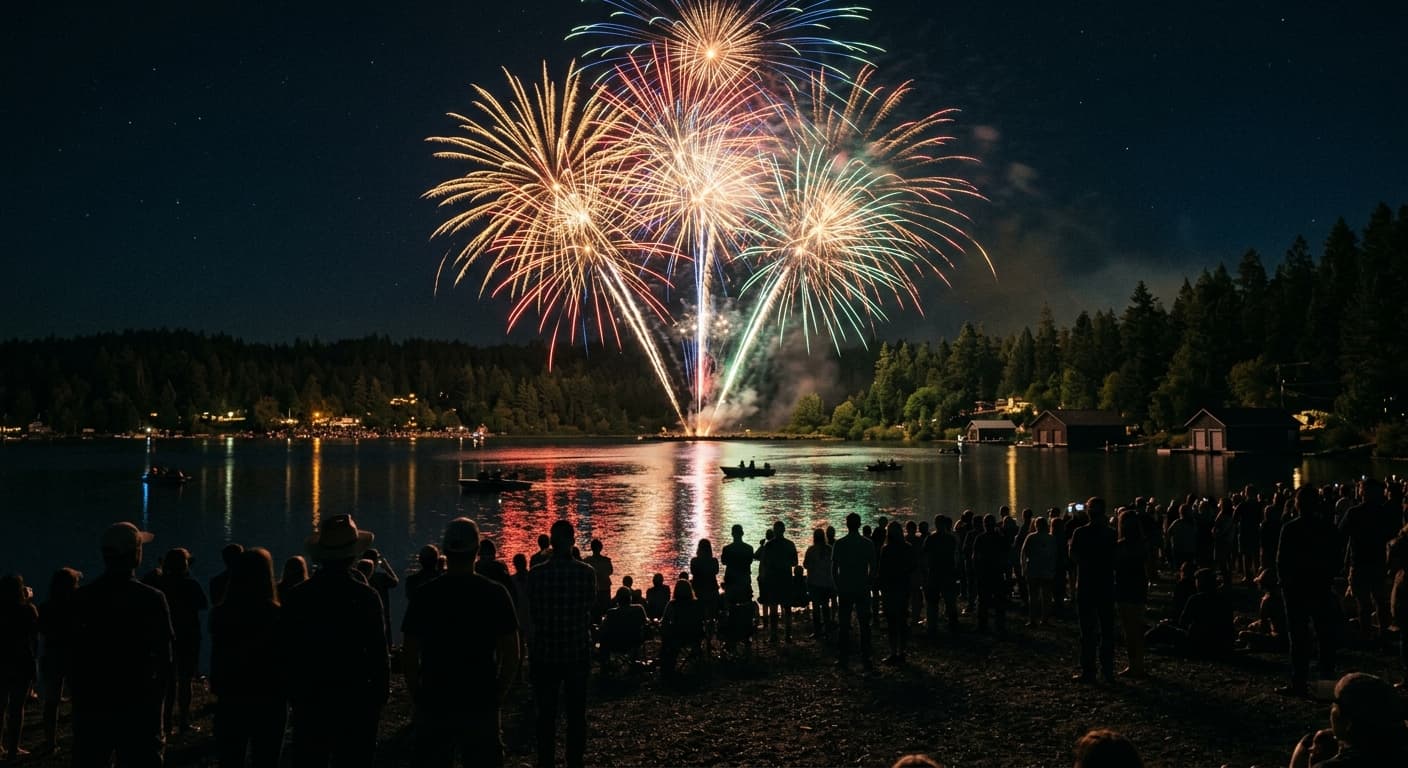
Wisconsin does not create a broad "consumer fireworks" category the way most states do. Wis. Stat. § 167.10 defines "fireworks" very broadly, then excludes a short, specific list of novelty items from that definition entirely. Everything else, firecrackers, aerial shells, Roman candles, bottle rockets, requires a local user's permit rather than being available for ordinary retail purchase. Section 167.10 also carries its own penalties directly: forfeitures up to $1,000 for unpermitted sale, use, or unlawful storage, up to $10,000 or nine months in jail for violating a court injunction, and a Class G felony for manufacturing fireworks without a state license.
Jurisdiction scope: This article addresses Wisconsin's state fireworks law under the full text of Wis. Stat. § 167.10 (Regulation of fireworks), subsections (1) through (9), covering the definitional exemption for enumerated novelty items, the sale and use rules, storage and handling, manufacturer licensing, local option, parental and municipal liability, enforcement, and the penalties in subsection (9). It does not address the cross-referenced manufacturer inspection rules in § 101.19 beyond noting the cross-reference, or individual city, village, or town ordinances beyond the statute's local-option grant.
What Wisconsin Allows: A Narrow, Enumerated Exemption List
Wisconsin's structure is definitional rather than a calendar-gated consumer category. The statute reads:
"In this section, 'fireworks' means anything manufactured, processed or packaged for exploding, emitting sparks or combustion which does not have another common use, but does not include any of the following: ... (e) A cap containing not more than one-quarter grain of explosive mixture, if the cap is used or possessed or sold for use in a device which prevents direct bodily contact with a cap when it is in place for explosion. (f) A toy snake which contains no mercury. (g) A model rocket engine. ... (i) A sparkler on a wire or wood stick not exceeding 36 inches in length... (j) A device designed to spray out paper confetti or streamers and which contains less than one-quarter grain of explosive mixture. (k) A fuseless device... that contains less than one-quarter grain of explosive mixture. (L) A device that is designed primarily to burn pyrotechnic smoke-producing mixtures... (m) A cylindrical fountain... classified by the federal department of transportation as a Division 1.4 explosive, as defined in 49 CFR 173.50. (n) A cone fountain that is classified... as a Division 1.4 explosive... (p) A novelty device that spins or moves on the ground."
Wis. Stat. § 167.10(1)(e)-(p)
Only items matching this specific list fall outside Wisconsin's "fireworks" definition entirely, along with a few unrelated exclusions the same subsection also lists: fuel or a lubricant, a firearm cartridge or shotgun shell, an emergency flare for a railway, aircraft, watercraft, or motor vehicle, a match, cigarette lighter, stove, furnace, candle, lantern, or space heater, and tobacco and a tobacco product, under section 167.10(1)(a)-(d), (h). Everything else that meets the general definition, including firecrackers, aerial shells, Roman candles, and bottle rockets, is regulated "fireworks" and cannot be sold to the general public. Even an item on the exempt list is not unrestricted in every setting: section 167.10(3)(a), covered below, separately bars using it while attending someone else's permitted public fireworks display.
Sale: Permit Holders, Municipalities, Nonresidents, and Agricultural Use Only
Wisconsin does not authorize ordinary retail sale of regulated fireworks to the public:
"No person may sell or possess with intent to sell fireworks, unless any of the following apply: (a) The person sells the fireworks, or possesses the fireworks with intent to sell them, to a person holding a permit under sub. (3) (c). (b) The person sells the fireworks, or possesses the fireworks with intent to sell them, to a city, village or town. (bg) The person sells the fireworks, or possesses the fireworks with intent to sell them, to a person who is not a resident of this state. (c) The person sells the fireworks, or possesses the fireworks with intent to sell them, for a purpose specified under sub. (3) (b) 2. to 6."
Wis. Stat. § 167.10(2)
A vendor may also ship fireworks to a nonresident or to a person or group holding a permit, provided the shipment is packaged in accordance with state and federal law, under section 167.10(4).
Use: A Local Permit Required for Everything Not Exempt
Possessing or using regulated fireworks requires an individual permit:
"No person may possess or use fireworks without a user's permit from the mayor of the city, president of the village or chairperson of the town in which the possession or use is to occur or from a person designated by the mayor, president or chairperson to issue a user's permit. No person may use fireworks or a device listed under sub. (1) (e) to (g) or (i) to (n) while attending a fireworks display for which a permit has been issued to a person listed under par. (c) 1. to 5. or under par. (c) 6. if the display is open to the general public."
Wis. Stat. § 167.10(3)(a)
That second sentence reaches further than the permit requirement alone: it bars using even an exempt novelty item, a sparkler, a cap, a toy snake, a confetti device, a fuseless device, or a fountain, while attending someone else's permitted public fireworks display.
That permit may be issued only to a defined set of persons:
"A permit under this subsection may be issued only to the following persons: 1. A public authority. 2. A fair association. 3. An amusement park. 4. A park board. 5. A civic organization. 6. Any individual or group of individuals. A permit issued to a group of individuals confers the privileges under the permit to each member of the group. 7. An agricultural producer for the protection of crops from predatory birds or animals."
Wis. Stat. § 167.10(3)(c)
The statute carves out several situations the permit requirement does not reach, including a municipality's own use (with 2-day advance notice to fire and law enforcement officials), explosives possession under Department of Safety and Professional Services rules, hazardous-substance disposal under Department of Natural Resources rules, manufacturing-process and educational-class use, a federally licensed explosives possessor or manufacturer acting within that license, and a nonresident who does not use the fireworks in Wisconsin, under section 167.10(3)(b). Simply transporting fireworks through a city, town, or village en route to a jurisdiction that authorizes them is also exempt from the permit requirement, unless the person remains in that municipality for 72 hours or more, under section 167.10(3)(b)7. and (bm).
A permit must specify the holder's name and address, the date on and after which fireworks may be purchased, the general kind and approximate quantity, the date and location of use, and any other ordinance-prescribed conditions, under section 167.10(3)(f). The issuer may require an indemnity bond or liability insurance, and a copy of the permit must go to the local fire or law enforcement official at least two days before use, except for a permit authorizing only the sale or possession of fireworks classified by the federal department of transportation as Division 1.4 explosives, a broader federal transport class than the fountains listed in (1)(m)-(n) alone, under section 167.10(3)(e), (g).
No Statewide Sale Window, Use Window, or Hours Restriction
Section 167.10, in full, sets no statewide calendar sale-date window and no calendar use-date window. The exempt novelty items carry no date restriction of their own. For the regulated category, the statute does not set a public sale or use period at all; instead, the permit itself specifies the purchase date and the use date and location on a case-by-case basis, decided by the local permit-issuing official rather than the legislature. The statute likewise sets no statewide clock-hours restriction; any hour limit comes from the permit's own conditions.
Purchase Age and Parental Liability
Section 167.10 sets no numeric purchase-age floor for the exempt novelty items. It reaches age indirectly, through two separate provisions rather than one. The first restricts who may hold a user's permit:
"A permit under this subsection may not be issued to a minor."
Wis. Stat. § 167.10(3)(h)
That restricts who may hold a user's permit authorizing possession or use of regulated fireworks. It does not, on its face, set a purchase-age floor for the exempt sparklers, caps, fountains, or other novelty items.
The second provision reaches the other direction: it makes a parent or guardian who lets a minor use fireworks financially responsible for what happens:
"A parent, foster parent, legal guardian, or other out-of-home care provider, as defined in s. 48.02 (12r), of a minor who consents to the use of fireworks by the minor is liable for damages caused by the minor's use of the fireworks."
Wis. Stat. § 167.10(7)
That civil liability is backed by its own forfeiture: a consenting parent or guardian also forfeits not more than $1,000, under section 167.10(9)(c), described further in Penalties below.
Local Option
Cities, villages, towns, and counties may regulate further than the state floor, but never less:
"Subject to pars. (b) to (e), a city, village, town or county may enact an ordinance for any of the following: 1. Defining 'fireworks' to include all items included under sub. (1) (intro.) and anything under sub. (1) (e), (f), (i), (j), (k), (L), (m) and (n). 2. Prohibiting the sale, possession or use, as defined by ordinance, of fireworks. 3. Regulating the sale, possession or use, as defined by ordinance, of fireworks."
Wis. Stat. § 167.10(5)(a)
Paragraph (a) opens with "Subject to pars. (b) to (e)," and those three limiting paragraphs matter as much as the grant itself:
"(b) An ordinance under par. (a) may not be less restrictive in its coverage, prohibition or regulation than this section but may be more restrictive than this section. (d) A county ordinance enacted under par. (a) does not apply and may not be enforced within any city, village or town that has enacted or enacts an ordinance under par. (a). (e) Notwithstanding par. (a) or par. (b), no city, village, town or county may enact an ordinance that prohibits the possession of fireworks in that city, town, village or county while transporting the fireworks to a city, town, village or county where the possession of the fireworks is authorized by permit or ordinance."
Wis. Stat. § 167.10(5)(b), (d)-(e)
So a local government can pull some of the exempt novelty items (sparklers, poppers, fountains, and similar) back into a locally regulated or prohibited category, and can regulate more strictly than the state, but three limits bind that power: it cannot loosen the state's own permit requirement for anything else; a city, village, or town ordinance displaces a county ordinance covering the same territory entirely rather than stacking with it; and no locality, including one that bans fireworks outright, may criminalize merely transporting fireworks through its borders to a destination where possessing them is authorized. Check the specific city, village, or town's ordinance before assuming a novelty item that is exempt under state law is also unrestricted locally.
Storage and Handling
Section 167.10 separately regulates how fireworks are stored once they exist, independent of the sale and use rules above:
"(a) No wholesaler, dealer or jobber may store or handle fireworks in premises unless the premises are equipped with fire extinguishers approved by the fire official of the municipality where the premises are located. (b) No person may smoke where fireworks are stored or handled. (c) A person who stores or handles fireworks shall notify the fire official of the municipality in which the fireworks are stored or handled of the location of the fireworks. (d) No wholesaler, dealer or jobber may store fireworks within 50 feet of a dwelling. (e) No person may store fireworks within 50 feet of a public assemblage or place where gasoline or volatile liquid is dispensed in quantities exceeding one gallon."
Wis. Stat. § 167.10(6)
A violation of any of these storage and handling rules carries the same forfeiture as an unpermitted sale or use, described in Penalties below.
Manufacturer Licensing
Manufacturing fireworks in Wisconsin, as opposed to selling, possessing, or using them, requires its own state license, issued separately from any local user's permit:
"No person may manufacture in this state fireworks or a device listed under sub. (1) (e), (f) or (i) to (n) without a fireworks manufacturing license issued by the department of safety and professional services under par. (d)."
Wis. Stat. § 167.10(6m)(a)
The department issues that license for a 4-year term to an applicant who complies with its rules, may revoke it for refusing an inspection or for a continuing rules violation, and may inspect a licensed manufacturer's premises at reasonable times, under section 167.10(6m)(b)-(e). A manufacturer must also provide the department a copy of each federal explosives license issued to it under 18 USC 843, under section 167.10(6m)(c). Manufacturing without this license, or violating a rule the department promulgates under it, is Wisconsin's most severe fireworks penalty, a Class G felony, covered in Penalties below.
Parental and Municipal Liability
Two separate liability rules sit alongside the criminal and forfeiture penalties. A parent, foster parent, legal guardian, or other out-of-home care provider who consents to a minor's use of fireworks is personally liable for the damage that use causes, under section 167.10(7), covered above in Purchase Age and Parental Liability. In the other direction, a city, village, or town that issues a permit is shielded from civil liability for fireworks damage solely because it issued that permit in accordance with the statute:
"No city, village, or town, or committee, official, or employee of a city, village, or town, is civilly liable for damage to any person or property caused by fireworks for the sole reason that the city, village, or town issued a permit in accordance with the requirements of sub. (3) and any applicable requirements authorized under sub. (5), that authorized the purchase, possession, or use of the fireworks."
Wis. Stat. § 167.10(7m)
Enforcement: Court Injunctions and Seizure
Beyond the criminal and forfeiture penalties below, a city, village, or town has a separate civil enforcement tool, and any seized fireworks follow their own disposal rule:
"(a) A city, village or town may petition the circuit court for an order enjoining violations of sub. (2), (3) or (6) or an ordinance adopted under sub. (5). (b) Fireworks stored, handled, sold, possessed or used by a person who violates this section, an ordinance adopted under sub. (5) or a court order under par. (a) may be seized and held as evidence of the violation. Except as provided in s. 968.20 (4), only the fireworks that are the subject of a violation of this section, an ordinance adopted under sub. (5) or a court order under par. (a) may be destroyed after conviction for a violation. Except as provided in s. 968.20 (4), fireworks that are seized as evidence of a violation for which no conviction results shall be returned to the owner in the same condition as they were when seized to the extent practicable."
Wis. Stat. § 167.10(8)
So a municipality is not limited to waiting for a criminal or forfeiture case: it can go to court to enjoin an ongoing violation directly, and fireworks seized as evidence are destroyed only after a conviction or returned to the owner if the case does not result in one. Violating a court order issued under this subsection carries its own, separate penalty, covered next.
Penalties
Section 167.10(9) sets its own penalties directly; there is no gap for Wisconsin's general penalty-default statute to fill. Four separate tiers apply, depending on what was violated:
"(a) A person who violates a court order under sub. (8) (a) shall be fined not more than $10,000 or imprisoned not more than 9 months or both. (b) A person who violates sub. (2), (3) or (6) or an ordinance adopted under sub. (5) shall forfeit not more than $1,000. (c) A parent or legal guardian of a minor who consents to the use of fireworks by the minor shall forfeit not more than $1,000. (g) Whoever violates sub. (6m) (a), (b) or (c) or a rule promulgated under sub. (6m) (e) is guilty of a Class G felony."
Wis. Stat. § 167.10(9)(a)-(c), (g)
In practical terms: unpermitted sale under subsection (2), unpermitted possession or use under subsection (3), or a storage and handling violation under subsection (6), or violating a local ordinance adopted under subsection (5), is a forfeiture of not more than $1,000, a civil rather than criminal penalty. Violating a circuit court injunction issued under subsection (8)(a) is a criminal offense carrying up to $10,000 and up to nine months in jail, or both. A parent or guardian who consents to a minor's fireworks use forfeits not more than $1,000 under subsection (9)(c), on top of the civil damages liability in subsection (7) above. And manufacturing fireworks without the license required by subsection (6m), or violating a rule adopted under it, is Wisconsin's most severe fireworks offense, a Class G felony. No fireworks-specific repeat-offense enhancement appears within subsection (9) itself.
Federal Law on Transporting Fireworks Across State Lines
Federal law sets the floor: 16 CFR 1500.17 and Part 1507 define which consumer devices may be sold at all; 27 CFR 555.141(a)(7) exempts the importation, distribution and storage of consumer fireworks from ATF licensing (manufacture is not exempt); 18 U.S.C. 836 makes it a federal offense, punishable by up to one year, to transport fireworks into any state whose law specifically prohibits or regulates their use, in violation of that law, except in the course of continuous interstate transportation, with exceptions for common or contract carriers, water carriers, and transport for the use of federal agencies; and USPS Publication 52 § 341.22 bars fireworks from the mail entirely. Because Wisconsin's non-exempt category is permit-gated rather than flatly illegal, a resident who buys broader consumer fireworks in a neighboring state and brings them home without a Wisconsin permit can violate both section 167.10 and this federal transport statute at once.
Fireworks Laws in Nearby States
For the broader regional picture, see Minnesota's fireworks laws and Illinois's fireworks laws, two neighboring states worth checking before crossing a state line with fireworks bought elsewhere. For how Wisconsin's rule compares with every other state, see the fireworks laws by state comparison. For Wisconsin's separate open-container rules, see Wisconsin open container laws.
Disclaimer: This article provides general legal information about fireworks laws in Wisconsin as of September 2026. It is not legal advice. Fireworks statutes, local ordinances, and penalties change and are often further restricted by county or municipal ordinance beyond what state law requires. Verify the current rule for your specific city, village, or town before buying, selling, or using fireworks, and consult a lawyer licensed in Wisconsin for advice about a specific situation.
Statutes cited reflect their in-force version as of 2026-09-17. Last updated: 2026-09-17.
Frequently Asked Questions
Are fireworks legal in Wisconsin?
Only a specific enumerated list of novelty items is unrestricted under Wis. Stat. section 167.10(1), including small sparklers, mercury-free toy snakes, low-charge caps, certain fountains, fuseless low-charge devices, novelty spinners, and model rocket engines. Anything else meeting the general "fireworks" definition requires a local permit, and even an exempt item may not be used while attending someone else's permitted public display, under section 167.10(3)(a).
Can you buy firecrackers or aerial fireworks in Wisconsin?
Not through ordinary retail purchase. Section 167.10(2) bars selling regulated fireworks except to a permit holder under sub. (3)(c) (a category that includes an agricultural producer protecting crops from predatory birds or animals), a city, village, or town, a nonresident, or for a purpose specified in sub. (3)(b)2. to 6., such as compliance with state explosives or hazardous-substance-disposal rules, a manufacturing process, educational classes, or a federal explosives license. Possessing or using them also requires a user's permit from the local mayor, village president, or town chairperson.
Is there an age minimum to buy fireworks in Wisconsin?
Section 167.10 sets no numeric purchase-age floor for the exempt novelty items. It reaches age two other ways: a user's permit for regulated fireworks may not be issued to a minor, under section 167.10(3)(h), and a parent or guardian who consents to a minor's fireworks use is liable for the resulting damage and forfeits not more than $1,000, under section 167.10(7) and (9)(c).
Can a Wisconsin city ban fireworks that state law allows?
Yes. A city, village, town, or county may enact an ordinance that is more restrictive than section 167.10, including redefining some exempt novelty items as regulated, but it cannot make the local rule less restrictive than the state's, and a city, village, or town ordinance displaces an overlapping county ordinance, under section 167.10(5).
What is the penalty for illegal fireworks in Wisconsin?
Section 167.10(9) sets the penalty directly. Unpermitted sale, use, or a storage and handling violation, or violating a local ordinance, is a forfeiture of not more than $1,000. Violating a circuit court injunction is a criminal offense carrying up to $10,000, up to nine months in jail, or both. Manufacturing fireworks without the required state license is a Class G felony.
Does Wisconsin have a fireworks sale season?
No. Section 167.10 sets no statewide sale-date or use-date window. The exempt novelty items are unrestricted by date, and the regulated category is gated by an individual permit rather than a calendar period.
Does Wisconsin require a license to manufacture fireworks?
Yes. Section 167.10(6m) requires a 4-year manufacturing license from the Department of Safety and Professional Services, separate from any local user's permit. Manufacturing without that license, or violating a department rule adopted under it, is a Class G felony under section 167.10(9)(g).
Updates
Independently fact-checked against the cited primary sources
Sources and References
- Wis. Stat. Section 167.10 - Regulation of fireworks (subsections (1)-(5); the section-level page truncates at (5)(b), see the chapter PDF citation below for the full text through (9))(docs.legis.wisconsin.gov).gov
- Wis. Stat. Chapter 167 (full PDF) - Source for Section 167.10(6) Storage and handling, (6m) Licensing and inspecting manufacturers, (7) Parental liability, (7m) Municipal liability, (8) Enforcement, and (9) Penalties, none of which render on the truncated section-level HTML page above(docs.legis.wisconsin.gov).gov
- 18 U.S.C. 836 - Transportation of fireworks into a state prohibiting or regulating their use(uscode.house.gov).gov