
New Hampshire
New Hampshire Easement and Eminent Domain Laws (2026)
Independently fact-checked against primary sources (last audited October 21, 2026). · 44 primary sources cited on this page. How we verify our legal content

In New Hampshire, a prescriptive easement takes 20 years of adverse, continuous and uninterrupted use that puts the record owner on notice of an adverse claim, a rule the New Hampshire Supreme Court applies from its own decisions rather than from an easement statute (Greenan v. Lobban, 1998). On the eminent domain side, part 1, article 12-a of the state constitution has barred, since 2006, any taking that transfers property to another person for private development or other private use, and RSA 498-A:2, VII keeps the benefits of private economic development, such as tax revenue and jobs, out of the definition of public use, with exceptions for utilities, common carriers and incidental private use.
This page covers both halves of New Hampshire law: easements between private landowners first, then the power to take private property. For other states, see our guide to easement laws by state.
Information last verified on October 19, 2026. This article has not been reviewed by a licensed lawyer.
Jurisdiction scope: This page covers New Hampshire state law on private easements (prescriptive, express and highway-access routes) and on condemnation of private property under the state constitution, RSA chapter 498-A and the utility condemnation rules in RSA chapter 371. It does not cover adverse possession of title (see New Hampshire squatters' rights and adverse possession), homeowner association covenants, zoning or regulatory takings, condemnation by the federal government, or local ordinances.
How Prescriptive Easements Work in New Hampshire
A prescriptive easement is a right to keep using a path, driveway or other part of someone else's land, earned through long use rather than granted in a deed. New Hampshire sets its elements through case law. In Greenan v. Lobban (1998), the New Hampshire Supreme Court restated the rule, quoting its 1994 Opinion of the Justices:
"To establish a prescriptive easement, the plaintiff must prove by a balance of probabilities twenty years' adverse, continuous, uninterrupted use of the land claimed in such a manner as to give notice to the record owner that an adverse claim was being made to it."
The same opinion, quoting Town of Warren v. Shortt (1994), added that "the absence of permission is an element of a 'claim of right,' which is in turn an essential element of a claim for a prescriptive easement that the claimant must prove by a preponderance of the evidence."
The court has also described the kind of use that counts. In Sandford v. Town of Wolfeboro (1999), quoting an earlier decision, it said that "the nature of the use must [have been] such as to show that the owner knew or ought to have known that the right was being exercised, not in reliance upon [the owner's] toleration or permission, but without regard to [the owner's] consent."
The 20 years and adverse possession
The 20-year length matches RSA 508:2, I, which provides that "no action for the recovery of real estate shall be brought after 20 years from the time the right to recover first accrued to the party claiming it or to some persons under whom the party claims." That statute governs actions to recover land itself. The easement period comes from the court decisions above, not from a separate easement statute. Claims to ownership of land (rather than a right to use it) are covered on our page on New Hampshire squatters' rights and adverse possession.
Uses that never become an easement
RSA 231:174 carves out one kind of use completely: "No enjoyment by a person, copartnership, or corporation for any length of time of the privilege of having or maintaining wires and their supports and appurtenances in, upon, over, or attached to any building or land of other persons, shall create an easement or raise any presumption of a grant thereof."
Nor can anyone acquire by prescription a right to any part of a town house, schoolhouse or church lot, or of any public ground, "by fencing or otherwise inclosing the same or in any way occupying it adversely for any length of time" (RSA 477:34).
Stopping a prescriptive easement
New Hampshire's chapters on conveyances (RSA 477), limitations of actions (RSA 508) and highways (RSA 231) contain no provision that lets an owner block prescription by posting a sign or recording a notice. The rule that matters is the permission element: because a claimant must prove the use was made without the owner's permission (Greenan v. Lobban), use that rests on the owner's permission does not meet that element.
Express Easements: Writing, Deeds and Recording
New Hampshire requires a signed writing for an interest in land. RSA 477:15 provides that "every estate or interest in lands created or conveyed without an instrument in writing signed by the grantor or his attorney shall be deemed an estate at will only, and no estate or interest in lands shall be assigned, granted or surrendered except by writing signed as aforesaid or by operation of law."
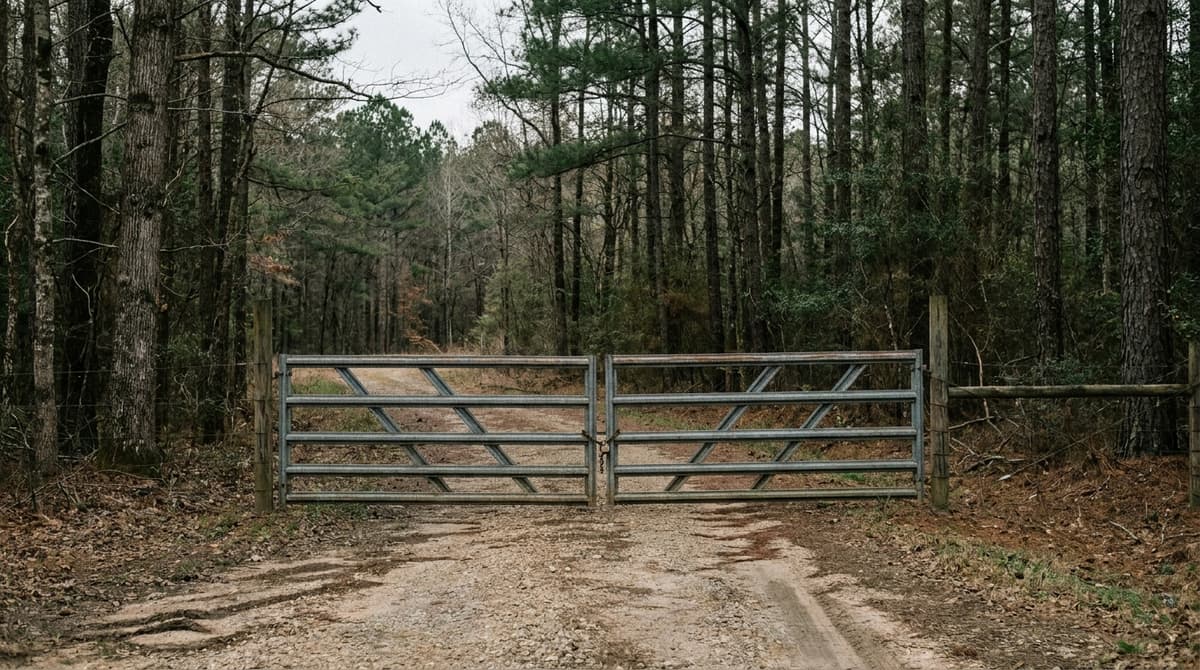
Recording protects the easement against later buyers. Under RSA 477:3-a, an instrument "shall not be effective as against bona fide purchasers for value until so recorded." Our New Hampshire property records guide explains how to look up recorded deeds and easements.
Easements that belong to a parcel pass with it automatically. RSA 477:26 provides that in a conveyance of real estate, "all rights, easements, privileges and appurtenances belonging to the granted estate or interest shall be deemed to be included in the conveyance, unless the contrary shall be stated in the deed," without any need to list them.
Conservation, preservation and agricultural preservation restrictions are a related recorded interest. RSA 477:47 provides that they "are interests in real estate and a document creating such a restriction shall be deemed a conveyance of real estate for purposes of RSA 477:3 and RSA 477:3-a relating to execution and recording."
How Far an Easement Reaches
New Hampshire courts apply a "rule of reason" to easements. They use it to give reasonable meaning to general or unclear terms in the deed granting an easement and, "irrespective of the deed language," to decide "whether a particular use of the easement would be unreasonably burdensome" (Heartz v. City of Concord, 2002). If a proposed use "is a normal development from conditions existing at the time of the grant," it is not considered unreasonably burdensome (Heartz), and the owners on both sides "must still act reasonably under the terms of the grant so as not to interfere with the use and enjoyment of each others' estates" (Lussier v. New England Power Co., 1990).
How an Easement Ends
RSA 477:15 allows an interest in land to be "surrendered" only "by writing signed as aforesaid or by operation of law," so an easement holder's voluntary release of an easement is made by a signed writing. Releasing an interest in land by deed is covered in our New Hampshire quitclaim deed guide, and a release, like other instruments, is not effective against bona fide purchasers for value until recorded (RSA 477:3-a). Nonuse does not end an easement on its own. The New Hampshire Supreme Court has held that "the mere non-user of an easement, however acquired, does not result in its loss or destruction even if continued for a long period of time" (Gagnon v. Carrier, 1951), and that "nonuse by itself does not terminate an easement" (Duchesnaye v. Silva, 1978). In Gagnon, using other water supplies for four years and not using the granted water pipes and pump house during that time were not "such clear, unequivocal and decisive acts as to constitute abandonment."
Landlocked Land: Highway Petitions and Discontinued Roads
RSA chapter 231 does not give a landlocked owner a general procedure to condemn a private way over a neighbor's land. It offers several routes through the town instead, and the courts add common-law rules for land divided without access and for discontinued roads.

Easement by necessity when land is divided. The New Hampshire Supreme Court has held that easements by necessity "arise from the implied intent of the parties" and that necessity "alone is insufficient to create an easement" (Bradley v. Patterson, 1981). A court examines the circumstances when the land was divided and sold: whether reasonable necessity to cross the other parcel existed at that time, and whether the parties to that transaction intended the buyer to have an easement.
Reopening a discontinued highway (RSA 231:22). "Any owner who has no access to his land by public highway may petition the selectmen to layout, subject to gates and bars, a highway located where any previously discontinued highway was located." The statute continues: "Unless written objection to such layout is filed with the selectmen within 60 days after the posting and mailing of such notice, the highway shall be laid out, subject to gates and bars, in the location in which it previously existed if the selectmen find that the petitioner in fact has no other access to his land by public highway." The selectmen assess the damages to each owner whose land is taken, and those "damages shall be paid by the petitioner." The petitioner and all later owners must maintain the gates and bars and the highway at their own expense. If a written objection is filed within the 60 days, the petition is treated as a petition for a new class IV, V or VI highway under RSA 231:8.
Petitioning for a new highway (RSA 231:8). "Selectmen of a town, upon petition, may lay out any new class IV highway not financed in whole or in part with federal aid highway funds, and class V or VI highway or alter any such existing highway within their town for which there shall be occasion."
A right-of-way to remove lumber or wood (RSA 231:40). When it is necessary "for the convenient removal of lumber, wood or other material, to pass through the lands of a person other than the owner," the selectmen "in their discretion, may lay out a right-of-way through the land of any person for the purposes aforesaid." After notice to and a hearing of the landowner, they determine the necessity and assess damages, which "shall be paid by the person applying for such right-of-way before the same shall be open for use."
Access over a discontinued highway. RSA 231:43, III states: "No owner of land shall, without the owner's written consent, be deprived of access over such highway, at such owner's own risk." For a highway discontinued before that statutory right of access existed, the New Hampshire Supreme Court held in Shearer v. Raymond (2021) that "when a highway laid out over private land was discontinued prior to enactment of a statutory right of access, see RSA 231:43, III, a common law easement exists over the discontinued highway if the landowner demonstrates that the easement is reasonably necessary for ingress and egress to the property."
Eminent Domain in New Hampshire
Eminent domain is the government's power to take private property for public use. For a state-by-state comparison and the federal rules, see our guide to eminent domain laws by state.
The constitution
Part 1, article 12 of the New Hampshire Constitution provides: "But no part of a man's property shall be taken from him, or applied to public uses, without his own consent, or that of the representative body of the people." That sentence does not use the phrase "just compensation"; the procedure for setting compensation is in RSA chapter 498-A, described below.
Limits on takings for private development
In Kelo v. City of New London (2005), the U.S. Supreme Court held that a city's economic development plan served a public purpose and satisfied the Fifth Amendment's public use requirement, while noting that nothing in its opinion "precludes any State from placing further restrictions on its exercise of the takings power." New Hampshire voters added part 1, article 12-a to the state constitution on November 7, 2006:
"No part of a person's property shall be taken by eminent domain and transferred, directly or indirectly, to another person if the taking is for the purpose of private development or other private use of the property."
The legislature adopted parallel limits in RSA chapter 498-A, effective January 1, 2007. RSA 498-A:1, II provides that "notwithstanding any other provision of law to the contrary, no person's private real property shall be taken pursuant to this chapter unless that real property is to be put to public use, as defined in RSA 498-A:2, VII." That definition then states: "Except as provided in subparagraphs (a)(2) and (4) of this paragraph, public use shall not include the public benefits resulting from private economic development and private commercial enterprise, including increased tax revenues and increased employment opportunities." Public use means (1) possession, occupation and enjoyment of the property by the general public or governmental entities; (2) acquiring an interest necessary to the function of a public or private utility or common carrier; (3) acquiring property to remove structures beyond repair, public nuisances, structures unfit for habitation or use, and abandoned property that menace health and safety; and (4) private use occupying an incidental area within a public use, though no property may be condemned solely to facilitate that incidental private use (RSA 498-A:2, VII(a)). The economic-development exclusion gives way only to the utility and common-carrier category and the incidental-use category.
Condemnation routes in the statutes
Among the condemnation routes New Hampshire statutes set out:
- State highways. Land for state highways "which cannot be acquired by agreement with the owner or owners thereof may be acquired in accordance with RSA 498-A," with appealed issues of necessity, public use and net public benefit decided under RSA 230:19 (RSA 230:14, I).
- Public utilities. Utility takings are handled by the Public Utilities Commission under RSA chapter 371. RSA 371:1 provides that "no public utility may petition for permission to take private land or property rights for the construction or operation of an electric generating plant or an electric transmission project not eligible for regional cost allocation, for either local or regional transmission tariffs, by ISO-New England or its successor regional system operator." A utility may not refer to eminent domain in negotiations with a landowner unless the commission has first authorized its use for that landowner; a landowner may complain to the commission, and a violation carries a fine of up to $25,000 (RSA 371:1-b).
- Interstate pipelines. A business entity holding a certificate of public convenience and necessity under the federal Natural Gas Act to build and operate a natural gas pipeline, or a petroleum pipeline company doing exclusively an interstate business, that is "unable to acquire necessary lands by purchase, lease or otherwise" may institute condemnation proceedings under RSA 371:15.
Before a taking: appraisal and offer
RSA 498-A:4 sets out the appraisal and offer steps:
- Appraisal reimbursement. An owner may have the property appraised by an independent, qualified appraiser the owner employs, and "the condemnor shall reimburse the usual and customary cost of the appraisal up to $1,000 for each property."
- Copy of the appraisal. The condemnor must give the owner a copy of the appraisal, and if requested any official appraisal review notes the negotiations rest on, "at the time of negotiation or at least 45 days prior to making the notice of offer, whichever comes first."
- Written offer. "The giving of the notice of offer is a jurisdictional prerequisite to instituting condemnation proceedings." If the owner does not accept the offer within 30 days after service of the notice, the condemnor must begin condemnation proceedings within 90 days after that 30-day period ends.
- Valuation date. Compensation is based on the property's value on the date of taking, unless all condemnees elect, by written notice to the board and the condemnor no later than 30 days from the return date of the order of notice, to use its value on the date the condemning body voted to acquire it (RSA 498-A:4, III).
- Offer stays open. The offer may be accepted until either side petitions the superior court to reassess damages (RSA 498-A:4, III(c)).
For utility takings, RSA 371:2-b separately provides that "the public utility shall reimburse the owner the usual and customary cost of the appraisal up to $1,500 for each property."
Before filing, a condemnor may enter the property to make studies, surveys and appraisals after notifying the owner 10 days in advance, and it is liable for any actual damages caused (RSA 498-A:10). A utility entering land to survey under RSA 371:2-a must give the owner at least 30 days' notice by certified mail.
The declaration of taking and the deadlines that matter
Most condemnations under RSA 498-A are filed with the Board of Tax and Land Appeals (the "board"); takings by municipalities acting under RSA 38 and by public utilities are not (RSA 498-A:3). A preliminary objection is the exclusive way to challenge the security, the condemnor's procedure, or the necessity, public use and net public benefit of the taking (RSA 498-A:9-a, I). The board transfers an objection on necessity, public use or net public benefit to the superior court of the county where the property lies, with no filing fee, and the superior court's decision may be appealed to the supreme court (RSA 498-A:9-b). After any bond and security required under RSA 498-A:6, the title the condemnor seeks passes to it "on the date of such filing," and the condemnor is entitled to possession as provided in RSA 498-A:11 (RSA 498-A:5).
Three rules carry real practical risk for an owner:
- 30 days to object, or the objection is waived. "Within 30 days after the return day, any condemnee may file a motion in the office of the board raising preliminary objections to the declaration of taking." The statute adds: "Failure to raise any matters by preliminary objection shall constitute a waiver thereof" (RSA 498-A:9-a). The board may extend the time for filing for cause shown.
- Taking the deposit gives up the objections. "A condemnee who withdraws the sum deposited under either paragraph I or paragraph II shall be deemed to have waived all objections and defenses to the action and to the taking of his property except for any claim to greater compensation" (RSA 498-A:11).
- 20 days to appeal the award. A party "aggrieved by the amount of compensation awarded by the board may, within 20 days after the filing of the report of the board, and not afterwards (unless for good cause shown the superior court extends such time), file in the superior court a petition to have the damages reassessed" (RSA 498-A:27). The superior court tries damages de novo, by jury unless jury trial is waived, and awards costs to the prevailing party. If the deposit the owner withdrew is more than the final judgment, the court enters judgment against the owner for the excess (RSA 498-A:27).
After the superior court, "there shall be a right of review in every condemnation cause from the final judgment of the superior court to the supreme court" (RSA 498-A:28).
Utility awards follow a different timetable. A party aggrieved by the Public Utilities Commission's order awarding damages may, "within 60 days after the entry of the order and not afterwards," petition the superior court of the county where the land lies "to have the damages assessed by a jury" (RSA 371:10). An appellant who does not obtain a change in the award in its favor pays costs (RSA 371:12), and if an owner who took the tendered damages has them reduced on appeal, the utility gets judgment for the reduction and costs (RSA 371:13).
Compensation, fees and costs
The board determines the compensation in a just compensation hearing under RSA 498-A:24, subject to the appeal described above. Before the board, issues of fact are decided on the balance of probabilities with the burden of proof on the condemnor, and the board must view the property if a party asks (RSA 498-A:19). The board's report states the property's value before and after the taking, if different, and any special benefits found (RSA 498-A:26, II). In utility takings, all relevant and probative evidence of value is considered, and the "before and after test" is considered for a partial taking (RSA 371:4-a). Chapter 498-A contains no extra percentage or bonus for a home or principal residence; relocation payments are described below.
RSA 498-A includes these fee and cost provisions:
- Winning on public use. "If the condemnee is the prevailing party solely on the issue of public use, he or she shall be entitled to reasonable attorney's fees" (RSA 498-A:26-b).
- Ending the condemnation. "If preliminary objections are finally sustained, which have the effect of finally terminating the condemnation, the condemnee shall be entitled to damages, including costs and expenses, to be determined by the board in the manner prescribed in RSA 498-A:24" (RSA 498-A:9-a, V; see also RSA 498-A:9-b, IV).
- No appeal. "If neither the condemnor nor the condemnee appeals from the award of the board as provided in RSA 498-A:27, the board shall award costs to the prevailing party" (RSA 498-A:26-a).
Chapter 498-A does not address inverse condemnation (a claim by an owner that the government took property without bringing a condemnation case).
When residential property is proposed to be acquired in part for an above ground substation or transmission line, RSA 371:5-a gives the owners "the option to require the utility to condemn and take in fee the entire tract of land impacted by the proposed partial taking including all buildings and improvements thereon if all owners, excluding lien holders and mortgagees, of the private real property make such an election and provide the commission and the utility with written notice of their election within 30 days after receipt of the notice under RSA 371:4." Where residential property is taken under that section, a resident owner is also awarded reasonable relocation and housing replacement expenses of up to 10 percent of the compensation ordered, and a displaced residential tenant up to 6 months' rent plus relocation and housing expenses of up to another 6 months' rent (RSA 371:5-a, III).
On federally assisted projects, 42 U.S.C. § 4655(a) requires the acquiring agency to give satisfactory assurances that it will be guided, "to the greatest extent practicable under State law," by the federal land acquisition policies.
Relocation payments
New Hampshire's relocation statute, RSA chapter 124-A, applies to people displaced by a program or project of the state or a state agency (defined to include political subdivisions and any person with eminent-domain authority under state law), or of anyone carrying out a project with state or federal financial assistance (RSA 124-A:2). A displaced person is paid actual reasonable moving expenses (RSA 124-A:3, I). A homeowner who owned and occupied the dwelling for at least 180 days before negotiations began may receive an additional replacement-housing payment of up to $22,500, paid only if the owner buys and occupies a decent, safe and sanitary replacement dwelling within the period RSA 124-A:4, II sets (generally one year after final payment for the acquired home), which the agency may extend for good cause (RSA 124-A:4). A tenant or other occupant who lawfully occupied the dwelling for at least 90 days before negotiations began may receive up to $5,250 toward renting a comparable dwelling or a down payment on a replacement home (RSA 124-A:5).
Reestablishment expenses for a displaced farm, nonprofit organization or small business are capped at $100,000 (RSA 124-A:3, I(d)). The agency may exceed the housing caps case by case for good cause when comparable replacement housing cannot otherwise be made available (RSA 124-A:8, I), and no one may be required to move from a dwelling unless the agency is satisfied that comparable replacement housing is available (RSA 124-A:8, II). The acquiring agency also reimburses recording fees, transfer taxes, mortgage prepayment penalties and prorated property taxes (RSA 124-A:6).
Getting the land back
- General condemnations. If a condemnor took a fee and then abandons the purpose, property that has not been substantially improved may not be disposed of within 10 years of condemnation without first being offered to the former owner, or the owner's heirs and assigns, at the price the condemnor paid; the former owner has 90 days after receiving notice of the offer to accept in writing (RSA 498-A:12, I). If a condemnor that acquired a fee abandons the property for any reason within 10 years, or after the purpose is served, it must first offer the property to the former owner at its current appraised value including improvements, except for early or total acquisitions made at the landowner's request (RSA 498-A:12, II).
- Utility takings. "If, after a period of 5 years, the project for which land or property rights were taken has not commenced, the utility shall offer the person from whom such land or rights were taken the first option to buy such land or rights at the current market value" (RSA 371:16-b).
Recent change: remote compensation hearings
A 2025 act (2025, 76:1), effective January 1, 2026, amended RSA 498-A:16 so that "any party may elect to participate in a just compensation hearing under RSA 498-A:24 through electronic or telephonic means consistent with RSA 91-A."
New Hampshire Easement and Eminent Domain Rules at a Glance
| Question | New Hampshire rule | Source |
|---|---|---|
| Prescriptive easement period | 20 years of adverse, continuous, uninterrupted use giving the record owner notice; use must be without permission | Greenan v. Lobban (1998) |
| Utility wires and poles | No easement by any length of use | RSA 231:174 |
| Town house, schoolhouse, church lot or public ground | No prescriptive right by enclosing or adverse occupation for any length of time | RSA 477:34 |
| Notice statute to block prescription | None in RSA 477, 508 or 231 | Permission element: Greenan v. Lobban |
| Landlocked land | Easement by necessity when the parties to a division intended one (necessity alone is insufficient); petition selectmen to re-lay out a discontinued highway (petitioner pays damages and maintains the road) or a new highway; common-law easement over a highway discontinued before the statutory right of access, when reasonably necessary | Bradley v. Patterson (1981); RSA 231:22, 231:8; Shearer v. Raymond (2021) |
| Private development takings | Barred when property is transferred to another person for private development or private use; economic development benefits are not public use, except utility and common-carrier acquisitions and incidental private use within a public use (RSA 498-A:2, VII(a)(2) and (4)) | N.H. Const. pt. 1, art. 12-a (2006); RSA 498-A:2, VII |
| Appraisal reimbursement | Owner's independent appraisal reimbursed up to $1,000 per property; up to $1,500 in utility takings | RSA 498-A:4; RSA 371:2-b |
| Objecting to the taking | Preliminary objections within 30 days after the return day (the board may extend for cause shown); matters not raised are waived; necessity and public-use objections are decided by the superior court | RSA 498-A:9-a; RSA 498-A:9-b |
| Appealing the award | 20 days after the board's report is filed (court may extend for good cause); 60 days after a utility commission order | RSA 498-A:27; RSA 371:10 |
| Extra payments for homes | No percentage bonus in RSA 498-A; replacement-housing payment up to $22,500 for displaced owners who occupied the home at least 180 days before negotiations began and buy a replacement home in time; homes taken under RSA 371:5-a (substation or transmission-line takings where the owners elect a full taking): relocation and housing expenses up to 10% of the compensation ordered | RSA 124-A:4; RSA 371:5-a, III |
| Attorney's fees | Reasonable fees if the owner prevails solely on public use; damages including costs and expenses if objections end the case | RSA 498-A:26-b; RSA 498-A:9-a, V |
| Repurchase | Fee taken, purpose abandoned: offered back within 10 years at the price paid if not substantially improved (90 days to accept); fee abandoned within 10 years for any reason: offered at current appraised value; utility: first option at current market value after 5 years without commencement | RSA 498-A:12; RSA 371:16-b |
Related Pages
- Easement laws by state
- Eminent domain laws by state
- New Hampshire squatters' rights and adverse possession
- New Hampshire property records
- New Hampshire quitclaim deeds
- Maine easement and eminent domain laws
- Vermont easement and eminent domain laws
This article provides general legal information about New Hampshire easement and eminent domain law as of October 19, 2026. It is not legal advice. For advice about a specific property or taking, contact a lawyer licensed in New Hampshire or the agency handling the project.
Last updated: October 19, 2026.
Frequently Asked Questions
How long does it take to get a prescriptive easement in New Hampshire?
Twenty years. The New Hampshire Supreme Court requires twenty years' adverse, continuous, uninterrupted use of the land in a way that gives the record owner notice of an adverse claim, proved by a balance of probabilities, and the claimant must also prove the use was without permission (Greenan v. Lobban, 1998).
Does permission stop a prescriptive easement in New Hampshire?
Absence of permission is an element of the claim of right that a prescriptive easement requires, and the claimant must prove it by a preponderance of the evidence (Greenan v. Lobban, quoting Town of Warren v. Shortt). New Hampshire's conveyancing, limitations and highway chapters (RSA 477, 508 and 231) contain no statute for blocking prescription by posting or recording a notice.
What can I do if my land is landlocked in New Hampshire?
An owner with no access to the land by public highway may petition the selectmen under RSA 231:22 to lay out again, subject to gates and bars, a highway where a discontinued highway used to run; the petitioner pays the damages to affected owners, and the petitioner and later owners must maintain the reopened road at their own expense. Selectmen may also lay out new class IV, V or VI highways on petition (RSA 231:8). The New Hampshire Supreme Court recognizes an easement by necessity where the circumstances when land was divided show that reasonable necessity existed and that the parties intended an easement, since necessity alone is insufficient (Bradley v. Patterson, 1981), and an easement over a highway discontinued before the statutory right of access when it is reasonably necessary for ingress and egress (Shearer v. Raymond, 2021).
Does an easement have to be in writing in New Hampshire?
An interest in land created without a writing signed by the grantor or the grantor's attorney is an estate at will only, and no interest in land may be granted or surrendered except by a signed writing or by operation of law (RSA 477:15). An unrecorded instrument is not effective against bona fide purchasers for value until it is recorded (RSA 477:3-a).
Can New Hampshire take my property for a private developer?
Part 1, article 12-a of the state constitution, adopted in 2006, bars taking property by eminent domain and transferring it, directly or indirectly, to another person for private development or other private use. RSA 498-A:2, VII also excludes the public benefits of private economic development, including increased tax revenue and jobs, from public use, except for acquisitions necessary to a public or private utility or common carrier and private use occupying an incidental area within a public use (RSA 498-A:2, VII(a)(2) and (4)).
Can a utility or pipeline company use eminent domain in New Hampshire?
Utility takings run through the Public Utilities Commission under RSA chapter 371, but RSA 371:1 bars a public utility from petitioning to take private land for an electric generating plant or for a transmission project not eligible for regional cost allocation by ISO-New England. An interstate natural gas pipeline holding a federal certificate of public convenience and necessity, or an exclusively interstate petroleum pipeline, may institute condemnation proceedings under RSA 371:15 when it cannot acquire the land by purchase, lease or otherwise.
How long do I have to challenge an eminent domain taking in New Hampshire?
Preliminary objections to the declaration of taking must be filed with the board within 30 days after the return day, unless the board extends the time for cause shown, and any matter not raised by preliminary objection is waived (RSA 498-A:9-a). Objections on necessity, public use or net public benefit are transferred to the superior court (RSA 498-A:9-b). A party aggrieved by the board's compensation award has 20 days after the board's report is filed to petition the superior court to reassess damages, unless that court extends the time for good cause (RSA 498-A:27).
Does New Hampshire pay attorney fees in eminent domain cases?
RSA 498-A:26-b gives reasonable attorney's fees to a condemnee who is the prevailing party solely on the issue of public use. If preliminary objections are finally sustained and end the condemnation, the condemnee is entitled to damages, including costs and expenses, set by the board (RSA 498-A:9-a, V), and if neither side appeals the board's award, the board awards costs to the prevailing party (RSA 498-A:26-a).
Can I buy my land back if New Hampshire does not use it?
If a condemnor that took a fee abandons the purpose, property that has not been substantially improved may not be disposed of within 10 years of condemnation without first being offered to the former owner, or the owner's heirs and assigns, at the price the condemnor paid, and the former owner has 90 days after receiving notice of the offer to accept in writing (RSA 498-A:12, I). If the condemnor abandons a fee for any reason within 10 years, or after its purpose is served, it must first offer the property at its current appraised value including improvements, except for early or total acquisitions made at the landowner's request (RSA 498-A:12, II). For utility takings, if the project has not commenced after 5 years, the utility must offer the former owner the first option to buy at current market value (RSA 371:16-b).
Updates
Independently fact-checked against the cited primary sources
The Law Behind This Article
This article rests on the statutory provisions below, held in our own legal record and retrieved from the official source. Tap a section to read the operative text.
New Hampshire Revised Statutes Annotated, TITLE XX TRANSPORTATION, CHAPTER 231 CITIES, TOWNS AND VILLAGE DISTRICT HIGHWAYS
§ 231:22Previously Discontinued Highway.In force
Notwithstanding any other provisions of this chapter to the contrary, any owner who has no access to his land by public highway may petition the selectmen to layout, subject to gates and bars, a highway located where any previously discontinued highway was located. Upon receipt of such a petition, the selectmen shall immediately post notice thereof in 2 public places in the town in which the land is situated and shall mail like notices to the owners of the land over which such highway may pass, postage prepaid, at their last known mail addresses. Unless written objection to such layout is filed with the selectmen within 60 days after the posting and mailing of such notice, the highway shall be laid out, subject to gates and bars, in the location in which it previously existed if the selectmen find that the petitioner in fact has no other access to his land by public highway. The selectmen shall assess the damages sustained by each owner of land or other property taken for such highway, which damages shall be paid by the petitioner. They shall take and cause to be recorded by the town clerk a return as required by RSA 231:16.
Official text (excerpt) · last checked 2026-07-29 · Read the full text in our law library · Verify at gc.nh.gov
§ 231:174No Prescriptive Right.In force
No enjoyment by a person, copartnership, or corporation for any length of time of the privilege of having or maintaining wires and their supports and appurtenances in, upon, over, or attached to any building or land of other persons, shall create an easement or raise any presumption of a grant thereof.
Official text (excerpt) · last checked 2026-07-29 · Read the full text in our law library · Verify at gc.nh.gov
§ 231:40Petition.In force
Upon petition, when it becomes necessary for the convenient removal of lumber, wood or other material, to pass through the lands of a person other than the owner of the land from which such lumber, wood or other material is to be removed, the selectmen of the town within which said lands are situated, in their discretion, may lay out a right-of-way through the land of any person for the purposes aforesaid, and, upon notice to and hearing of the owner of the lands, shall determine the necessity for and assess the damages occasioned by the laying out of such right-of-way, and such damages shall be paid by the person applying for such right-of-way before the same shall be open for use. Any person aggrieved by the action hereunder of the selectmen shall have the same right of appeal as provided by this chapter.
Official text (excerpt) · last checked 2026-07-29 · Read the full text in our law library · Verify at gc.nh.gov
New Hampshire Revised Statutes Annotated, TITLE XXXIV PUBLIC UTILITIES, CHAPTER 371 PROCEEDINGS TO ACQUIRE PROPERTY OR RIGHTS
§ 371:1Petition.In force
Whenever it is necessary, in order to meet the reasonable requirements of service to the public, that any public utility should construct a line, branch line, extension, pipeline, conduit, line of poles, towers, or wires across the land of another, or should acquire land, land for an electric substation, or flowage, drainage, or other rights for the necessary construction, extension, or improvement of any water power or other works owned or operated by such public utility, and it cannot agree with the owners of such land or rights as to the necessity or the price to be paid therefor, such public utility may petition the public utilities commission for such rights and easements or for permission to take such lands or rights as may be needed for said purposes. No public utility may petition for permission to take private land or property rights for the construction or operation of an electric generating plant or an electric transmission project not eligible for regional cost allocation, for either local or regional transmission tariffs, by ISO-New England or its successor regional system operator.
Official text (excerpt) · last checked 2026-07-29 · Read the full text in our law library · Verify at gc.nh.gov
§ 371:2-bAppraisal Required.In force
A public utility shall have an impartial, qualified appraiser make at least one appraisal of any property proposed to be acquired by eminent domain. The owner shall have a reasonable opportunity to have the property appraised by an independent, qualified appraiser, selected by the owner. The public utility shall reimburse the owner the usual and customary cost of the appraisal up to $1,500 for each property.
Official text (excerpt) · last checked 2026-07-29 · Read the full text in our law library · Verify at gc.nh.gov
§ 371:5-aResidential Owner Option.In force
I. When private real property which is used for residential purposes is proposed to be acquired in part for the construction of an above ground substation or transmission line, the owners of the residential property shall have the option to require the utility to condemn and take in fee the entire tract of land impacted by the proposed partial taking including all buildings and improvements thereon if all owners, excluding lien holders and mortgagees, of the private real property make such an election and provide the commission and the utility with written notice of their election within 30 days after receipt of the notice under RSA 371:4. If the utility acquires the entire tract of land with buildings and improvements thereon pursuant to this section or by agreement with the owners, the entire acquisition shall be deemed to be an acquisition for a public purpose and for use in the utility's business. II.
Official text (excerpt) · last checked 2026-07-29 · Read the full text in our law library · Verify at gc.nh.gov
§ 371:16-bProject Delay; Option to Purchase.In force
If, after a period of 5 years, the project for which land or property rights were taken has not commenced, the utility shall offer the person from whom such land or rights were taken the first option to buy such land or rights at the current market value.
Official text (excerpt) · last checked 2026-07-29 · Read the full text in our law library · Verify at gc.nh.gov
§ 371:15By Pipeline Companies.In force
Whenever any business entity organized under the laws of this state, another state, or the United States to construct and operate a natural gas pipeline holds a certificate of public convenience and necessity issued under the federal Natural Gas Act, authorizing it to construct and operate a natural gas pipeline or pipelines and appurtenant facilities within this state, or any petroleum pipeline company doing exclusively an interstate business, shall be unable to acquire necessary lands by purchase, lease or otherwise, it may institute condemnation proceedings as follows: I. Said pipeline company shall cause a plan or location of the real estate proposed to be taken to be prepared and a copy thereof filed with the clerk of the superior court for each county in which any of such real estate is located and shall apply by petition to the superior court for the county in which such real estate is located to acquire said real estate for the purposes of such pipeline and to have assessed the damages occasioned by the taking.
Official text (excerpt) · last checked 2026-07-29 · Read the full text in our law library · Verify at gc.nh.gov
New Hampshire Revised Statutes Annotated, TITLE LII ACTIONS, PROCESS, AND SERVICE OF PROCESS, CHAPTER 508 LIMITATION OF ACTIONS
§ 508:2Real Actions.In forcecited in 3 of our articles
I. No action for the recovery of real estate shall be brought after 20 years from the time the right to recover first accrued to the party claiming it or to some persons under whom the party claims. II. No action for the recovery of real estate pursuant to rights based on a possibility of reverter, right of re-entry, or executory interest shall be brought after 5 years from the time the right to recover possession or the right of re-entry first accrued to the party claiming it or to some persons under whom the party claims.
Official text (excerpt) · last checked 2026-09-08 · Read the full text in our law library · Verify at gc.nh.gov
Cited in 31 court opinions in our collectionLatest citing opinion in our collection: 2025
Opinions citing this section in our collection:
- Jenot v. White Mountain Acceptance Corp. (Supreme Court of New Hampshire 1984, 124 N.H. 701)“…collection of the promissory note, under the provisions of RSA 508:2 and RSA 508:6, beyond the three-year co…”
- Del Norte, Inc. v. Provencher (Supreme Court of New Hampshire 1997, 142 N.H. 535)“…provided for actions upon notes secured by mortgages, see RSA 508:2, :6 (1997), because foreclosure of the…”
- O'Hearne v. McCLAMMER (Supreme Court of New Hampshire 2012, 163 N.H. 430)“…rred by the twenty-year statute of limitations set forth in RSA 508:2 (2010), which the court determined had…”
Identified automatically from the court opinions citing this section — not a ranking of which case controls.
Also relied on in: New Hampshire Squatters Rights and Adverse Possession Laws (2026), New Hampshire Statute of Limitations: Filing Deadlines by Case Type
New Hampshire Revised Statutes Annotated, TITLE XLVIII CONVEYANCES AND MORTGAGES OF REALTY, CHAPTER 477 CONVEYANCES OF REALTY AND INTERESTS THEREIN
§ 477:26Easements, Appurtenances, Etc.In force
In a conveyance of real estate or any interest therein, all rights, easements, privileges and appurtenances belonging to the granted estate or interest shall be deemed to be included in the conveyance, unless the contrary shall be stated in the deed, and it shall be unnecessary in order for their inclusion to enumerate or mention them either generally or specifically.
Official text (excerpt) · last checked 2026-07-29 · Read the full text in our law library · Verify at gc.nh.gov
§ 477:15Oral Conveyance.In force
Every estate or interest in lands created or conveyed without an instrument in writing signed by the grantor or his attorney shall be deemed an estate at will only, and no estate or interest in lands shall be assigned, granted or surrendered except by writing signed as aforesaid or by operation of law.
Official text (excerpt) · last checked 2026-07-29 · Read the full text in our law library · Verify at gc.nh.gov
§ 477:3-aRecording.In forcecited in 2 of our articles
Every deed or other conveyance of real estate and every court order or other instrument which affects title to any interest in real estate, except probate records and tax liens which are by law exempt from recording, shall be recorded at length in the registry of deeds for the county or counties in which the real estate lies and such deed, conveyance, court order or instrument shall not be effective as against bona fide purchasers for value until so recorded.
Official text (excerpt) · last checked 2026-07-29 · Read the full text in our law library · Verify at gc.nh.gov
Also relied on in: New Hampshire Quitclaim Deed: Requirements, Recording and Tax
§ 477:47Interests in Real Estate.In force
Conservation, preservation, and agricultural preservation restrictions are interests in real estate and a document creating such a restriction shall be deemed a conveyance of real estate for purposes of RSA 477:3 and RSA 477:3-a relating to execution and recording. Such a restriction may be enforced by an action at law or by injunction or other proceeding in equity. No grantee or contingent grantee interest in such a restriction shall be created or amended by any document unless it bears the notarized signature of the grantee and any and all contingent grantees.
Official text (excerpt) · last checked 2026-07-29 · Read the full text in our law library · Verify at gc.nh.gov
Search our full record of US law — 2.1 million sections, every state + federal →
Sources and References
- Greenan v. Lobban (N.H. 1998)(courtlistener.com)
- N.H. Constitution, Part 1 (Bill of Rights), arts. 12 and 12-a(nh.gov).gov
- RSA 498-A:2, VII (definition of public use)(gc.nh.gov).gov
- Sandford v. Town of Wolfeboro (N.H. 1999)(courtlistener.com)
- RSA 508:2, Real Actions(gc.nh.gov).gov
- RSA 231:174, No Prescriptive Right(gc.nh.gov).gov
- RSA 477:15, Oral Conveyance(gc.nh.gov).gov
- RSA 477:3-a, Recording(gc.nh.gov).gov
- RSA 477:26, Easements, Appurtenances, Etc.(gc.nh.gov).gov
- RSA 477:47, Interests in Real Estate (conservation restrictions)(gc.nh.gov).gov
- RSA 231:22, Previously Discontinued Highway(gc.nh.gov).gov
- RSA 231:8 (layout of class IV, V and VI highways by selectmen)(gc.nh.gov).gov
- RSA 231:40 (right-of-way for removal of lumber or wood)(gc.nh.gov).gov
- RSA 231:43, III (owner access over a discontinued highway)(gc.nh.gov).gov
- Shearer v. Raymond (N.H. 2021)(courtlistener.com)
- Kelo v. City of New London, 545 U.S. 469 (2005)(loc.gov).gov
- RSA 498-A:1, II (public use requirement)(gc.nh.gov).gov
- RSA 230:14, I (acquiring land for state highways)(gc.nh.gov).gov
- RSA 371:1, Petition (utility takings)(gc.nh.gov).gov
- RSA 371:15, By Pipeline Companies(gc.nh.gov).gov
- RSA 498-A:4 (appraisal and notice of offer)(gc.nh.gov).gov
- RSA 371:2-b, Appraisal Required(gc.nh.gov).gov
- RSA 498-A:5 (passage of title on filing)(gc.nh.gov).gov
- New Hampshire Board of Tax and Land Appeals(nh.gov).gov
- RSA 498-A:9-a (preliminary objections; damages when sustained)(gc.nh.gov).gov
- RSA 498-A:11 (deposit, possession and waiver on withdrawal)(gc.nh.gov).gov
- RSA 498-A:27 (petition to reassess damages in superior court)(gc.nh.gov).gov
- RSA 498-A:28 (review by the supreme court)(gc.nh.gov).gov
- RSA 371:10 (jury assessment of utility damage awards)(gc.nh.gov).gov
- RSA 498-A:26-b (attorney fees on public use)(gc.nh.gov).gov
- RSA 498-A:9-b (public-use objections decided by the superior court)(gc.nh.gov).gov
- RSA 498-A:26-a (costs)(gc.nh.gov).gov
- RSA 371:5-a, Residential Owner Option(gc.nh.gov).gov
- 42 U.S.C. § 4655, Requirements for relocation payments and assistance of federally assisted programs(law.cornell.edu)
- RSA 498-A:12 (offer back of unimproved condemned property)(gc.nh.gov).gov
- RSA 371:16-b, Project Delay; Option to Purchase(gc.nh.gov).gov
- RSA 498-A:16 (electronic participation in hearings)(gc.nh.gov).gov
- Gagnon v. Carrier, 96 N.H. 409 (1951)(static.case.law)
- Duchesnaye v. Silva, 118 N.H. 728 (1978)(static.case.law)
- Bradley v. Patterson, 121 N.H. 802 (1981)(static.case.law)
- Heartz v. City of Concord, 148 N.H. 325 (2002)(static.case.law)
- Lussier v. New England Power Co., 133 N.H. 753 (1990)(static.case.law)
- RSA 477:34 (no prescription against public ground)(gc.nh.gov).gov
- RSA 498-A:3 (jurisdiction of the board)(gc.nh.gov).gov
- RSA 498-A:10 (entry before condemnation)(gc.nh.gov).gov
- RSA 498-A:19 (view and burden of proof)(gc.nh.gov).gov
- RSA 498-A:26 (report of the board)(gc.nh.gov).gov
- RSA 371:1-b (reference to eminent domain in negotiations)(gc.nh.gov).gov
- RSA 371:2-a, Right to Enter(gc.nh.gov).gov
- RSA 371:4-a (evidence of compensation)(gc.nh.gov).gov
- RSA 371:12, Costs(gc.nh.gov).gov
- RSA 371:13, Reduction of Damages(gc.nh.gov).gov
- RSA chapter 124-A, Relocation Assistance and Real Property Acquisition(gc.nh.gov).gov